Operations Management Analysis: Unilever's Leadership and Strategies
VerifiedAdded on 2020/12/09
|9
|2666
|179
Report
AI Summary
This report provides a comprehensive analysis of operations management within Unilever, a transnational consumer goods company. It explores the roles and characteristics of leaders and managers, examining how different situations within the organization affect their functions. The report delves into various leadership theories, including situational, system, and contingency leadership. It also investigates the role of operation managers in enhancing efficiency and decision-making, covering key elements of different operations management systems such as lean management, total quality management, and six sigma. Furthermore, the report examines the impact of factors like corporate social responsibility, culture, values, ethics, and sustainability on Unilever's business operations, providing insights into their influence on managerial decisions and overall business performance. The conclusion summarizes the key findings and implications of the analysis.
Management and
Operation
Operation

Paraphrase This Document
Need a fresh take? Get an instant paraphrase of this document with our AI Paraphraser
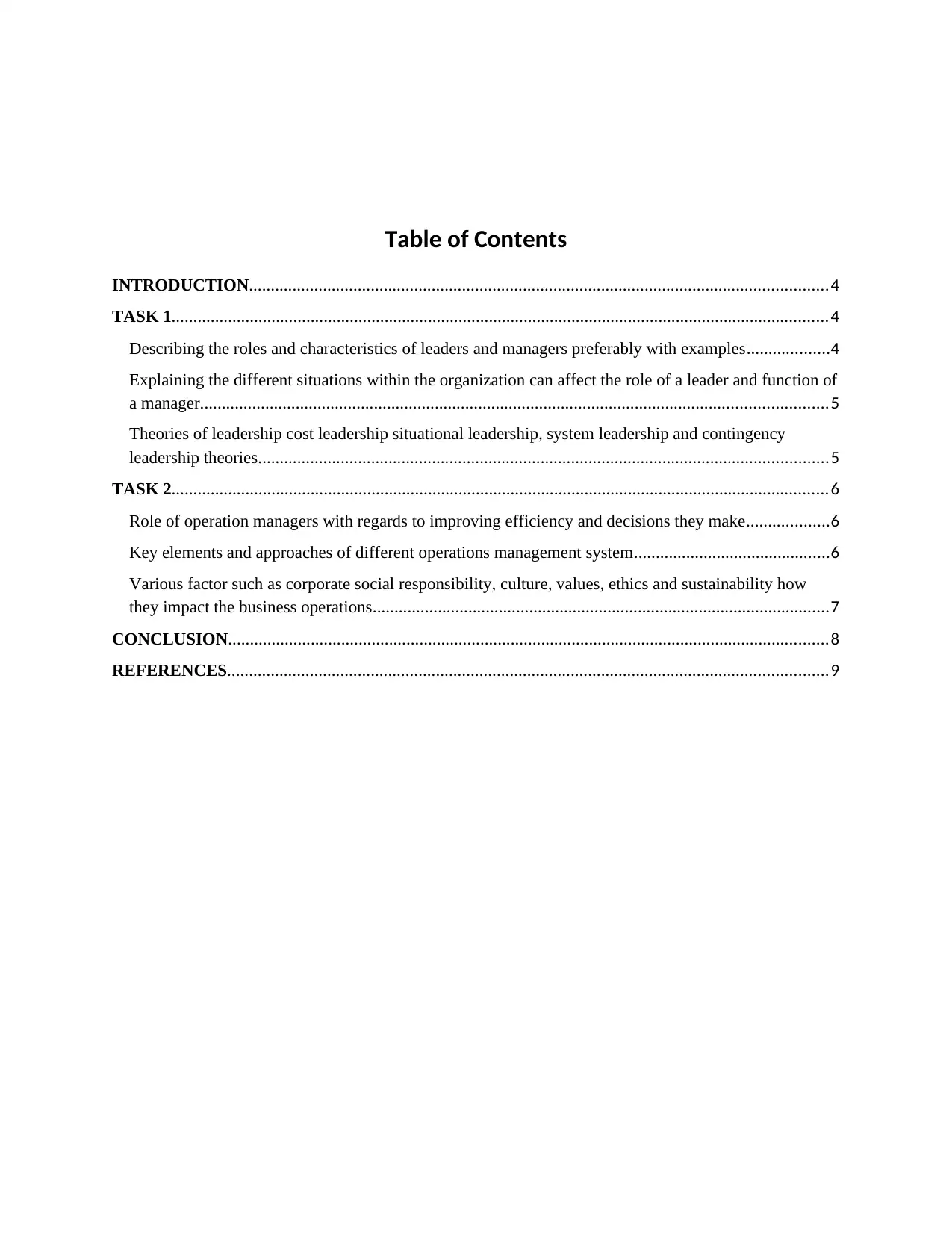
Table of Contents
INTRODUCTION.....................................................................................................................................4
TASK 1.......................................................................................................................................................4
Describing the roles and characteristics of leaders and managers preferably with examples...................4
Explaining the different situations within the organization can affect the role of a leader and function of
a manager................................................................................................................................................5
Theories of leadership cost leadership situational leadership, system leadership and contingency
leadership theories...................................................................................................................................5
TASK 2.......................................................................................................................................................6
Role of operation managers with regards to improving efficiency and decisions they make...................6
Key elements and approaches of different operations management system.............................................6
Various factor such as corporate social responsibility, culture, values, ethics and sustainability how
they impact the business operations.........................................................................................................7
CONCLUSION..........................................................................................................................................8
REFERENCES..........................................................................................................................................9
INTRODUCTION.....................................................................................................................................4
TASK 1.......................................................................................................................................................4
Describing the roles and characteristics of leaders and managers preferably with examples...................4
Explaining the different situations within the organization can affect the role of a leader and function of
a manager................................................................................................................................................5
Theories of leadership cost leadership situational leadership, system leadership and contingency
leadership theories...................................................................................................................................5
TASK 2.......................................................................................................................................................6
Role of operation managers with regards to improving efficiency and decisions they make...................6
Key elements and approaches of different operations management system.............................................6
Various factor such as corporate social responsibility, culture, values, ethics and sustainability how
they impact the business operations.........................................................................................................7
CONCLUSION..........................................................................................................................................8
REFERENCES..........................................................................................................................................9
INTRODUCTION
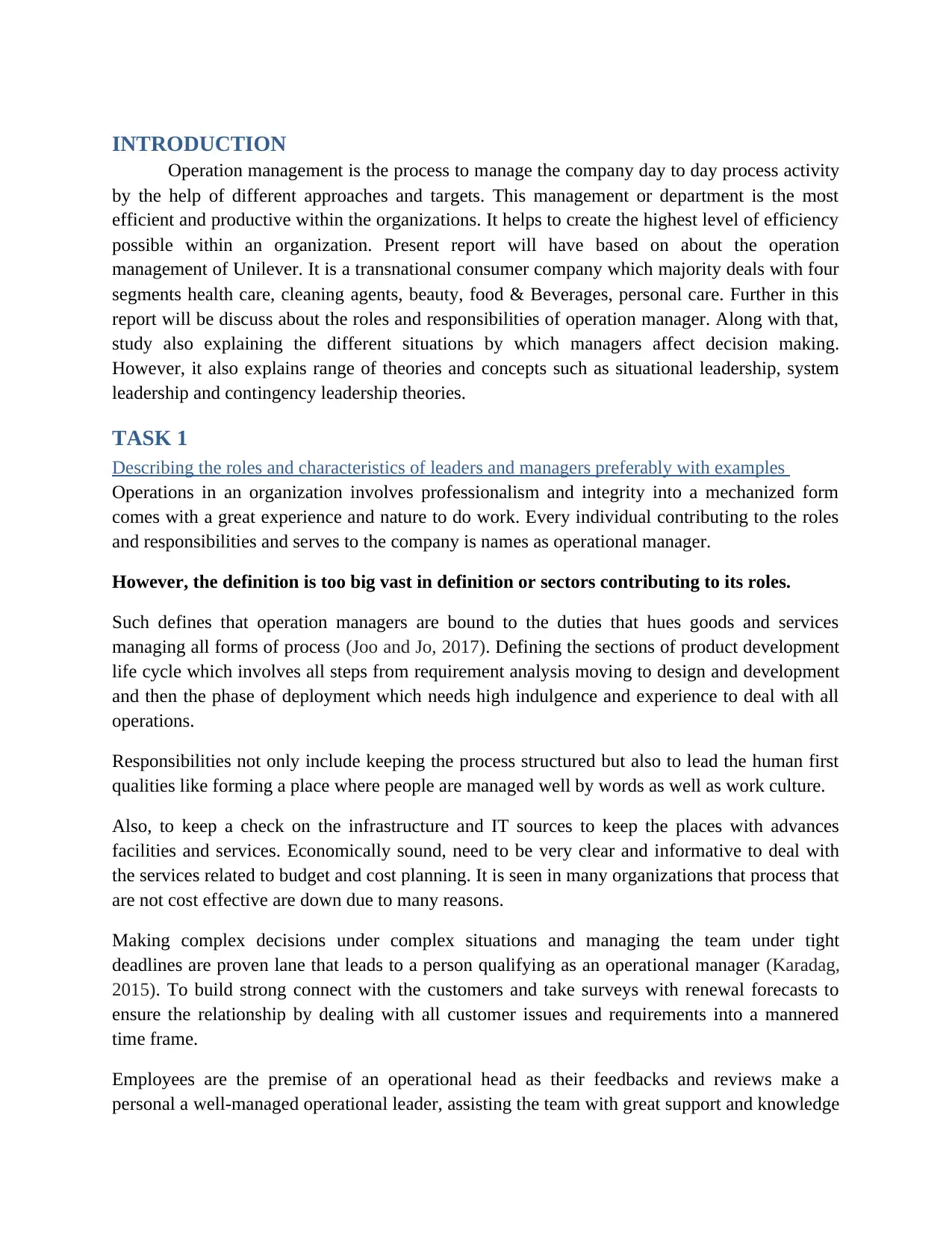
Operation management is the process to manage the company day to day process activity
by the help of different approaches and targets. This management or department is the most
efficient and productive within the organizations. It helps to create the highest level of efficiency
possible within an organization. Present report will have based on about the operation
management of Unilever. It is a transnational consumer company which majority deals with four
segments health care, cleaning agents, beauty, food & Beverages, personal care. Further in this
report will be discuss about the roles and responsibilities of operation manager. Along with that,
study also explaining the different situations by which managers affect decision making.
However, it also explains range of theories and concepts such as situational leadership, system
leadership and contingency leadership theories.
TASK 1
Describing the roles and characteristics of leaders and managers preferably with examples
Operations in an organization involves professionalism and integrity into a mechanized form
comes with a great experience and nature to do work. Every individual contributing to the roles
and responsibilities and serves to the company is names as operational manager.
However, the definition is too big vast in definition or sectors contributing to its roles.
Such defines that operation managers are bound to the duties that hues goods and services
managing all forms of process (Joo and Jo, 2017). Defining the sections of product development
life cycle which involves all steps from requirement analysis moving to design and development
and then the phase of deployment which needs high indulgence and experience to deal with all
operations.
Responsibilities not only include keeping the process structured but also to lead the human first
qualities like forming a place where people are managed well by words as well as work culture.
Also, to keep a check on the infrastructure and IT sources to keep the places with advances
facilities and services. Economically sound, need to be very clear and informative to deal with
the services related to budget and cost planning. It is seen in many organizations that process that
are not cost effective are down due to many reasons.
Making complex decisions under complex situations and managing the team under tight
deadlines are proven lane that leads to a person qualifying as an operational manager (Karadag,
2015). To build strong connect with the customers and take surveys with renewal forecasts to
ensure the relationship by dealing with all customer issues and requirements into a mannered
time frame.
Employees are the premise of an operational head as their feedbacks and reviews make a
personal a well-managed operational leader, assisting the team with great support and knowledge
Operation management is the process to manage the company day to day process activity
by the help of different approaches and targets. This management or department is the most
efficient and productive within the organizations. It helps to create the highest level of efficiency
possible within an organization. Present report will have based on about the operation
management of Unilever. It is a transnational consumer company which majority deals with four
segments health care, cleaning agents, beauty, food & Beverages, personal care. Further in this
report will be discuss about the roles and responsibilities of operation manager. Along with that,
study also explaining the different situations by which managers affect decision making.
However, it also explains range of theories and concepts such as situational leadership, system
leadership and contingency leadership theories.
TASK 1
Describing the roles and characteristics of leaders and managers preferably with examples
Operations in an organization involves professionalism and integrity into a mechanized form
comes with a great experience and nature to do work. Every individual contributing to the roles
and responsibilities and serves to the company is names as operational manager.
However, the definition is too big vast in definition or sectors contributing to its roles.
Such defines that operation managers are bound to the duties that hues goods and services
managing all forms of process (Joo and Jo, 2017). Defining the sections of product development
life cycle which involves all steps from requirement analysis moving to design and development
and then the phase of deployment which needs high indulgence and experience to deal with all
operations.
Responsibilities not only include keeping the process structured but also to lead the human first
qualities like forming a place where people are managed well by words as well as work culture.
Also, to keep a check on the infrastructure and IT sources to keep the places with advances
facilities and services. Economically sound, need to be very clear and informative to deal with
the services related to budget and cost planning. It is seen in many organizations that process that
are not cost effective are down due to many reasons.
Making complex decisions under complex situations and managing the team under tight
deadlines are proven lane that leads to a person qualifying as an operational manager (Karadag,
2015). To build strong connect with the customers and take surveys with renewal forecasts to
ensure the relationship by dealing with all customer issues and requirements into a mannered
time frame.
Employees are the premise of an operational head as their feedbacks and reviews make a
personal a well-managed operational leader, assisting the team with great support and knowledge
⊘ This is a preview!⊘
Do you want full access?
Subscribe today to unlock all pages.

Trusted by 1+ million students worldwide
them into a good appraisal with honest work reviews and feedbacks monitor performing as a
great operational manager.
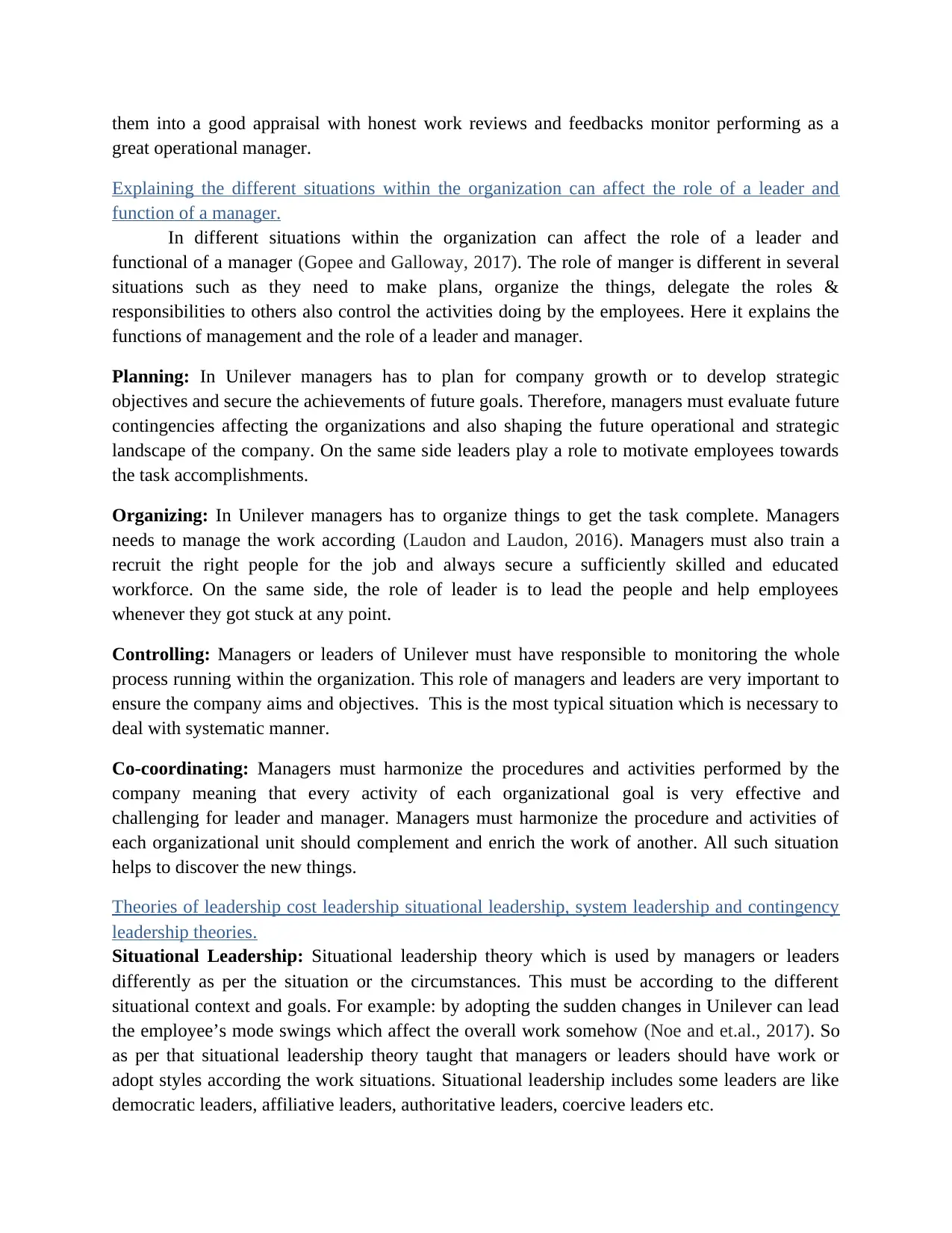
Explaining the different situations within the organization can affect the role of a leader and
function of a manager.
In different situations within the organization can affect the role of a leader and
functional of a manager (Gopee and Galloway, 2017). The role of manger is different in several
situations such as they need to make plans, organize the things, delegate the roles &
responsibilities to others also control the activities doing by the employees. Here it explains the
functions of management and the role of a leader and manager.
Planning: In Unilever managers has to plan for company growth or to develop strategic
objectives and secure the achievements of future goals. Therefore, managers must evaluate future
contingencies affecting the organizations and also shaping the future operational and strategic
landscape of the company. On the same side leaders play a role to motivate employees towards
the task accomplishments.
Organizing: In Unilever managers has to organize things to get the task complete. Managers
needs to manage the work according (Laudon and Laudon, 2016). Managers must also train a
recruit the right people for the job and always secure a sufficiently skilled and educated
workforce. On the same side, the role of leader is to lead the people and help employees
whenever they got stuck at any point.
Controlling: Managers or leaders of Unilever must have responsible to monitoring the whole
process running within the organization. This role of managers and leaders are very important to
ensure the company aims and objectives. This is the most typical situation which is necessary to
deal with systematic manner.
Co-coordinating: Managers must harmonize the procedures and activities performed by the
company meaning that every activity of each organizational goal is very effective and
challenging for leader and manager. Managers must harmonize the procedure and activities of
each organizational unit should complement and enrich the work of another. All such situation
helps to discover the new things.
Theories of leadership cost leadership situational leadership, system leadership and contingency
leadership theories.
Situational Leadership: Situational leadership theory which is used by managers or leaders
differently as per the situation or the circumstances. This must be according to the different
situational context and goals. For example: by adopting the sudden changes in Unilever can lead
the employee’s mode swings which affect the overall work somehow (Noe and et.al., 2017). So
as per that situational leadership theory taught that managers or leaders should have work or
adopt styles according the work situations. Situational leadership includes some leaders are like
democratic leaders, affiliative leaders, authoritative leaders, coercive leaders etc.
great operational manager.
Explaining the different situations within the organization can affect the role of a leader and
function of a manager.
In different situations within the organization can affect the role of a leader and
functional of a manager (Gopee and Galloway, 2017). The role of manger is different in several
situations such as they need to make plans, organize the things, delegate the roles &
responsibilities to others also control the activities doing by the employees. Here it explains the
functions of management and the role of a leader and manager.
Planning: In Unilever managers has to plan for company growth or to develop strategic
objectives and secure the achievements of future goals. Therefore, managers must evaluate future
contingencies affecting the organizations and also shaping the future operational and strategic
landscape of the company. On the same side leaders play a role to motivate employees towards
the task accomplishments.
Organizing: In Unilever managers has to organize things to get the task complete. Managers
needs to manage the work according (Laudon and Laudon, 2016). Managers must also train a
recruit the right people for the job and always secure a sufficiently skilled and educated
workforce. On the same side, the role of leader is to lead the people and help employees
whenever they got stuck at any point.
Controlling: Managers or leaders of Unilever must have responsible to monitoring the whole
process running within the organization. This role of managers and leaders are very important to
ensure the company aims and objectives. This is the most typical situation which is necessary to
deal with systematic manner.
Co-coordinating: Managers must harmonize the procedures and activities performed by the
company meaning that every activity of each organizational goal is very effective and
challenging for leader and manager. Managers must harmonize the procedure and activities of
each organizational unit should complement and enrich the work of another. All such situation
helps to discover the new things.
Theories of leadership cost leadership situational leadership, system leadership and contingency
leadership theories.
Situational Leadership: Situational leadership theory which is used by managers or leaders
differently as per the situation or the circumstances. This must be according to the different
situational context and goals. For example: by adopting the sudden changes in Unilever can lead
the employee’s mode swings which affect the overall work somehow (Noe and et.al., 2017). So
as per that situational leadership theory taught that managers or leaders should have work or
adopt styles according the work situations. Situational leadership includes some leaders are like
democratic leaders, affiliative leaders, authoritative leaders, coercive leaders etc.
Paraphrase This Document
Need a fresh take? Get an instant paraphrase of this document with our AI Paraphraser
System leadership theory: The direction of system theory is a primary function which analyze
the systematic behavior task to perform the task in innovative manner. This kinds of leaders have
always make the work more innovative and learning to gain the market opportunity. Besides that,
manager or leaders of this style easily manage or handle the situation very smoothly by using its
strength. In this context, managers handle the management hurdles and on the other hand leaders
handle the employees and motivate them to enhance the work opportunity and gains.
Contingency Leadership theory: This leadership mainly focus on the context of leadership
before going some other ways. In other organizational way it helps to organize the challenging
and effective learning growth and different context manner. Managers and leaders of this style
reduces the negative effects of the leaders (Northouse, 2017). Besides that, contingency
leadership guides leaders or managers to make the prior plans and manage the work free from
risk and uncertain opportunities and goals.
TASK 2
Role of operation managers with regards to improving efficiency and decisions they make
Leaders are defined for their leaderships and stories which itself is a heavy word to know.
A leader with positive attitude towards his work and focused in achieving higher goals
characterized as a leader in any sector of deliverance. For instance, staying strong and positive in
all situations and to face it will best approach and happy nature.
Positive attitude and positive things have made many leaders as best in their field in
taking prompt decisions and delivering high customer and employee success.
Vision mission and values of a leader defines the implemented approach of a focused
person who takes everything as important as breadth (Priest and Gass, 2017).
Communication towards every individual who is a part of the organization and ability to
listen and react makes a person very well organized and balanced in dealing people to people
contact. Also encouraging people of any company hierarchy and spreading good words highlight
as a great leader.
Being adaptive and passionate to each approach and moment with honesty makes a
person true confident and accountable.
Key elements and approaches of different operations management system
Approaches of operational management systems and the role managers and leaders
Lean Management: Lean management is the most effective and leading operational task in
order to meet out the company aims and objectives. The main purpose of this approach is to
minimizing the value of the product or services to the customer without any minimizing the
quality of product. Manager ensure the all activities as per the aims and objectives and goals in
order to take the higher opportunity and goals (Shah, 2015). In this approach manager and leader
the systematic behavior task to perform the task in innovative manner. This kinds of leaders have
always make the work more innovative and learning to gain the market opportunity. Besides that,
manager or leaders of this style easily manage or handle the situation very smoothly by using its
strength. In this context, managers handle the management hurdles and on the other hand leaders
handle the employees and motivate them to enhance the work opportunity and gains.
Contingency Leadership theory: This leadership mainly focus on the context of leadership
before going some other ways. In other organizational way it helps to organize the challenging
and effective learning growth and different context manner. Managers and leaders of this style
reduces the negative effects of the leaders (Northouse, 2017). Besides that, contingency
leadership guides leaders or managers to make the prior plans and manage the work free from
risk and uncertain opportunities and goals.
TASK 2
Role of operation managers with regards to improving efficiency and decisions they make
Leaders are defined for their leaderships and stories which itself is a heavy word to know.
A leader with positive attitude towards his work and focused in achieving higher goals
characterized as a leader in any sector of deliverance. For instance, staying strong and positive in
all situations and to face it will best approach and happy nature.
Positive attitude and positive things have made many leaders as best in their field in
taking prompt decisions and delivering high customer and employee success.
Vision mission and values of a leader defines the implemented approach of a focused
person who takes everything as important as breadth (Priest and Gass, 2017).
Communication towards every individual who is a part of the organization and ability to
listen and react makes a person very well organized and balanced in dealing people to people
contact. Also encouraging people of any company hierarchy and spreading good words highlight
as a great leader.
Being adaptive and passionate to each approach and moment with honesty makes a
person true confident and accountable.
Key elements and approaches of different operations management system
Approaches of operational management systems and the role managers and leaders
Lean Management: Lean management is the most effective and leading operational task in
order to meet out the company aims and objectives. The main purpose of this approach is to
minimizing the value of the product or services to the customer without any minimizing the
quality of product. Manager ensure the all activities as per the aims and objectives and goals in
order to take the higher opportunity and goals (Shah, 2015). In this approach manager and leader
liable to identify the value, map the value steam, create the flow of work, establish the pull or
pillar towards the work, seek perfection etc. By the help of this approach Unilever can work in
more smother manner.
Total Quality Management: Total Quality management system is the another approach to
maximize the manufacturing process. This approach of operation system helps me to ensure the
high quality standard of product quality and company growth. In which managers or leader
ensure the all process of work and give the high valuable inputs for the best outcomes. This
approach is customer focused, take full involvement of employees, Process centered and
integrated.
Six sigma: One more approach of operation management which strives for quality near
perfection. Six sigma is the approach which is known for its disciplined, data driven qualities. It
brings several opportunities for managers and leaders to take up the long lasting results and
growth.
Various factor such as corporate social responsibility, culture, values, ethics and sustainability
how they impact the business operations
Corporate social responsibility: CSR is the corporate social responsibility which is the
duty for all type of organization towards their society, employees, customers, suppliers etc. for
example: Unilever highly invest on their employee’s development such as give them best
working environment, financial or non-financial benefits (Simsek and et.al., 2015). So all such
efforts help company to attracts talent and enhances reputation of brand. Overall, CSR gives the
positive impact on the business. In the contrast. If organization do no commit the good activities
for the society, so it would have given negative impact due to which they might face loss in
employee turnover, lack of values of employee or customer engagement so on. This factor might
change and affect the decision taken by managers and leaders.
Culture: Culture within the organization is of two types positive and negative culture.
Both culture having their own impact such as positive work culture adds some more vales in the
work. As on the other side, negative culture creates conflicts and dissatisfaction among
employees. This overall thing affects the business operations and somehow on the business
reputations.
Business values: business values are the most core element to sustain the positive
outcomes within the organizations (Wiengarten, Lo and Lam, 2017). Business values stands for
principles, attitudes of employees, business standards, beliefs or behavioral towards the other
staff etc. all such factors affect business operation in different context.
Business Ethics: this is the foremost factor which impact on the business if business not
following their rights and duties as per the laws and regulations. Business ethics define what
need to do or what is not need to do in the business. Otherwise, it directly affects the business
reputation. All such factors affect the decision made by managers and leaders.
pillar towards the work, seek perfection etc. By the help of this approach Unilever can work in
more smother manner.
Total Quality Management: Total Quality management system is the another approach to
maximize the manufacturing process. This approach of operation system helps me to ensure the
high quality standard of product quality and company growth. In which managers or leader
ensure the all process of work and give the high valuable inputs for the best outcomes. This
approach is customer focused, take full involvement of employees, Process centered and
integrated.
Six sigma: One more approach of operation management which strives for quality near
perfection. Six sigma is the approach which is known for its disciplined, data driven qualities. It
brings several opportunities for managers and leaders to take up the long lasting results and
growth.
Various factor such as corporate social responsibility, culture, values, ethics and sustainability
how they impact the business operations
Corporate social responsibility: CSR is the corporate social responsibility which is the
duty for all type of organization towards their society, employees, customers, suppliers etc. for
example: Unilever highly invest on their employee’s development such as give them best
working environment, financial or non-financial benefits (Simsek and et.al., 2015). So all such
efforts help company to attracts talent and enhances reputation of brand. Overall, CSR gives the
positive impact on the business. In the contrast. If organization do no commit the good activities
for the society, so it would have given negative impact due to which they might face loss in
employee turnover, lack of values of employee or customer engagement so on. This factor might
change and affect the decision taken by managers and leaders.
Culture: Culture within the organization is of two types positive and negative culture.
Both culture having their own impact such as positive work culture adds some more vales in the
work. As on the other side, negative culture creates conflicts and dissatisfaction among
employees. This overall thing affects the business operations and somehow on the business
reputations.
Business values: business values are the most core element to sustain the positive
outcomes within the organizations (Wiengarten, Lo and Lam, 2017). Business values stands for
principles, attitudes of employees, business standards, beliefs or behavioral towards the other
staff etc. all such factors affect business operation in different context.
Business Ethics: this is the foremost factor which impact on the business if business not
following their rights and duties as per the laws and regulations. Business ethics define what
need to do or what is not need to do in the business. Otherwise, it directly affects the business
reputation. All such factors affect the decision made by managers and leaders.
⊘ This is a preview!⊘
Do you want full access?
Subscribe today to unlock all pages.
Trusted by 1+ million students worldwide
Sustainability: Sustainability is the another factor which affect most to the business
activities. In present modern era, businesses more focus to produces sustainability products
which are more ecofriendly which is less harmful and good for human health (Windeler and
Riemenschneider, 2016). So in that, this become the difficult task for manager and leader to
fulfill the needs and wants of the customers. So this is how sustainability factor affect the
decision making process of manager and leader.
CONCLUSION
As per the above report it has been concluded that, operation management is the most
essential and required department within the organizations. Management operation is the process
which handles and ensure the planning, organizing, coordinating and controlling function. Present study
and report discussed about the role of managers and leaders in different management context, How the
different situations in the organization can affect the role of a leader and function of a manager.
Moreover, the study also explained the operation management approaches which helps to create the
value into the overall process such as TQM, Six Sigma, Lean Management etc. besides, that the whole
study analyzed the importance of managers and leaders in operation management to accomplish the
company aims and objectives.
activities. In present modern era, businesses more focus to produces sustainability products
which are more ecofriendly which is less harmful and good for human health (Windeler and
Riemenschneider, 2016). So in that, this become the difficult task for manager and leader to
fulfill the needs and wants of the customers. So this is how sustainability factor affect the
decision making process of manager and leader.
CONCLUSION
As per the above report it has been concluded that, operation management is the most
essential and required department within the organizations. Management operation is the process
which handles and ensure the planning, organizing, coordinating and controlling function. Present study
and report discussed about the role of managers and leaders in different management context, How the
different situations in the organization can affect the role of a leader and function of a manager.
Moreover, the study also explained the operation management approaches which helps to create the
value into the overall process such as TQM, Six Sigma, Lean Management etc. besides, that the whole
study analyzed the importance of managers and leaders in operation management to accomplish the
company aims and objectives.
Paraphrase This Document
Need a fresh take? Get an instant paraphrase of this document with our AI Paraphraser
REFERENCES
Books & Journals
Gopee, N. and Galloway, J., 2017. Leadership and management in healthcare. Sage.
Joo, B. K. and Jo, S. J., 2017. The effects of perceived authentic leadership and core self-
evaluations on organizational citizenship behavior: The role of psychological
empowerment as a partial mediator. Leadership & Organization Development
Journal. 38(3). pp.463-481.
Karadag, H., 2015. Financial management challenges in small and medium-sized enterprises: A
strategic management approach. EMAJ: Emerging Markets Journal. 5(1). pp.26-40.
Laudon, K. C. and Laudon, J. P., 2016. Management information system. Pearson Education
India.
Noe, R. A. and et.al., 2017. Human resource management: Gaining a competitive advantage.
New York, NY: McGraw-Hill Education.
Northouse, P. G., 2017. Introduction to leadership: Concepts and practice. Sage Publications.
Priest, S. and Gass, M., 2017. Effective Leadership in Adventure Programming, 3E. Human
Kinetics.
Shah, S., 2015. Education, leadership and Islam: Theories, discourses and practices from an
Islamic perspective. Routledge.
Simsek, Z. and et.al., 2015. Strategic leadership and leaders in entrepreneurial contexts: A nexus
for innovation and impact missed?. Journal of Management Studies. 52(4). pp.463-478.
Wiengarten, F., Lo, C. K. and Lam, J. Y., 2017. How does sustainability leadership affect firm
performance? The choices associated with appointing a chief officer of corporate social
responsibility. Journal of business ethics. 140(3). pp.477-493.
Windeler, J. B. and Riemenschneider, C. K., 2016. The influence of ethnicity on organizational
commitment and merit pay of IT workers: the role of leader support. Information Systems
Journal. 26(2). pp.157-190.
Books & Journals
Gopee, N. and Galloway, J., 2017. Leadership and management in healthcare. Sage.
Joo, B. K. and Jo, S. J., 2017. The effects of perceived authentic leadership and core self-
evaluations on organizational citizenship behavior: The role of psychological
empowerment as a partial mediator. Leadership & Organization Development
Journal. 38(3). pp.463-481.
Karadag, H., 2015. Financial management challenges in small and medium-sized enterprises: A
strategic management approach. EMAJ: Emerging Markets Journal. 5(1). pp.26-40.
Laudon, K. C. and Laudon, J. P., 2016. Management information system. Pearson Education
India.
Noe, R. A. and et.al., 2017. Human resource management: Gaining a competitive advantage.
New York, NY: McGraw-Hill Education.
Northouse, P. G., 2017. Introduction to leadership: Concepts and practice. Sage Publications.
Priest, S. and Gass, M., 2017. Effective Leadership in Adventure Programming, 3E. Human
Kinetics.
Shah, S., 2015. Education, leadership and Islam: Theories, discourses and practices from an
Islamic perspective. Routledge.
Simsek, Z. and et.al., 2015. Strategic leadership and leaders in entrepreneurial contexts: A nexus
for innovation and impact missed?. Journal of Management Studies. 52(4). pp.463-478.
Wiengarten, F., Lo, C. K. and Lam, J. Y., 2017. How does sustainability leadership affect firm
performance? The choices associated with appointing a chief officer of corporate social
responsibility. Journal of business ethics. 140(3). pp.477-493.
Windeler, J. B. and Riemenschneider, C. K., 2016. The influence of ethnicity on organizational
commitment and merit pay of IT workers: the role of leader support. Information Systems
Journal. 26(2). pp.157-190.

⊘ This is a preview!⊘
Do you want full access?
Subscribe today to unlock all pages.
Trusted by 1+ million students worldwide

1 out of 9


Related Documents


Your All-in-One AI-Powered Toolkit for Academic Success.
+13062052269
info@desklib.com
Available 24*7 on WhatsApp / Email
![[object Object]](/_next/static/media/star-bottom.7253800d.svg)
Unlock your academic potential
Copyright © 2020–2026 A2Z Services. All Rights Reserved. Developed and managed by ZUCOL.