Operations & Project Management in Unilever: Implementation Review
VerifiedAdded on 2023/06/18
|17
|4531
|361
Report
AI Summary
This report provides an in-depth analysis of operations and project management within Unilever, a British multinational organization. It differentiates between operations and operations management, reviews the implementation of operations management principles within Unilever, and assesses how well these practices meet the organization's needs. The report also explores continuous improvement and lean principles, proposing a continuous improvement plan for Unilever. The second part of the report focuses on project management, providing an overview of a case study, analyzing project methodologies and tools, and critiquing the effectiveness of the project lifecycle. The analysis highlights Unilever's commitment to quality, efficiency, and continuous improvement in both its operational and project-based activities.
Unit 16 – Operations
and Project
Management
and Project
Management

Paraphrase This Document
Need a fresh take? Get an instant paraphrase of this document with our AI Paraphraser
Contents
INTRODUCTION...........................................................................................................................4
MAIN BODY...................................................................................................................................4
Part 1................................................................................................................................................4
About the organisation...........................................................................................................4
Operations v/s Operations Management................................................................................4
Review and critique implementation of operations management principles..........................5
Operations management of the organisation in the case study meets the requirements of the
organization............................................................................................................................6
Continuous improvement and lean principles........................................................................6
Prepare a Continuous improvement plan...............................................................................8
Recommendations..................................................................................................................9
Part 2................................................................................................................................................9
An overview of the case study................................................................................................9
Analysis of the project methodologies and tools used.........................................................14
Review and critique the effectiveness of the PLC................................................................14
CONCLUSION..............................................................................................................................15
REFERENCES..............................................................................................................................16
Books and Journals...............................................................................................................16
INTRODUCTION...........................................................................................................................4
MAIN BODY...................................................................................................................................4
Part 1................................................................................................................................................4
About the organisation...........................................................................................................4
Operations v/s Operations Management................................................................................4
Review and critique implementation of operations management principles..........................5
Operations management of the organisation in the case study meets the requirements of the
organization............................................................................................................................6
Continuous improvement and lean principles........................................................................6
Prepare a Continuous improvement plan...............................................................................8
Recommendations..................................................................................................................9
Part 2................................................................................................................................................9
An overview of the case study................................................................................................9
Analysis of the project methodologies and tools used.........................................................14
Review and critique the effectiveness of the PLC................................................................14
CONCLUSION..............................................................................................................................15
REFERENCES..............................................................................................................................16
Books and Journals...............................................................................................................16

⊘ This is a preview!⊘
Do you want full access?
Subscribe today to unlock all pages.

Trusted by 1+ million students worldwide
INTRODUCTION
Operations management is one of the integral function carried on in an organisation process
of converting the raw material into finished goods in order to earn revenue for the organisation
(Gunasekaran and et.al., 2018). Operations management in Unilever is discussed in this report.
Discussion related to operations as well as its difference with operations management is
discussed. Various principles of Operation Management are also mentioned in the report. It is
important to work continuously in order to achieve the goals and objectives of continuous
improvement plan of the organisation are also formulated in this report. In the next part of this
report there is dispersion related to project life cycle. In and theories related to the project and the
method used for also reviewed.
MAIN BODY
Part 1
About the organisation
Unilever is a British Multinational organisation that was established in 1929. The
organisation has its headquarters in London, UK. These products are served worldwide and they
are known for largest producer of soap in the world. There are various products served by the
company such as food, ice cream, wellbeing vitamins, condiments, minerals and supplements,
coffee, tea, breakfast cereal, water and air purifiers, beauty products, cleaning agents, pet food,
toothpaste, and personal care. There are around 155,000 employees that work effectively in the
organisation. The organisation works effectively and formulates plans to achieve goals and
objectives and manufacture quality goods for the customer’s.
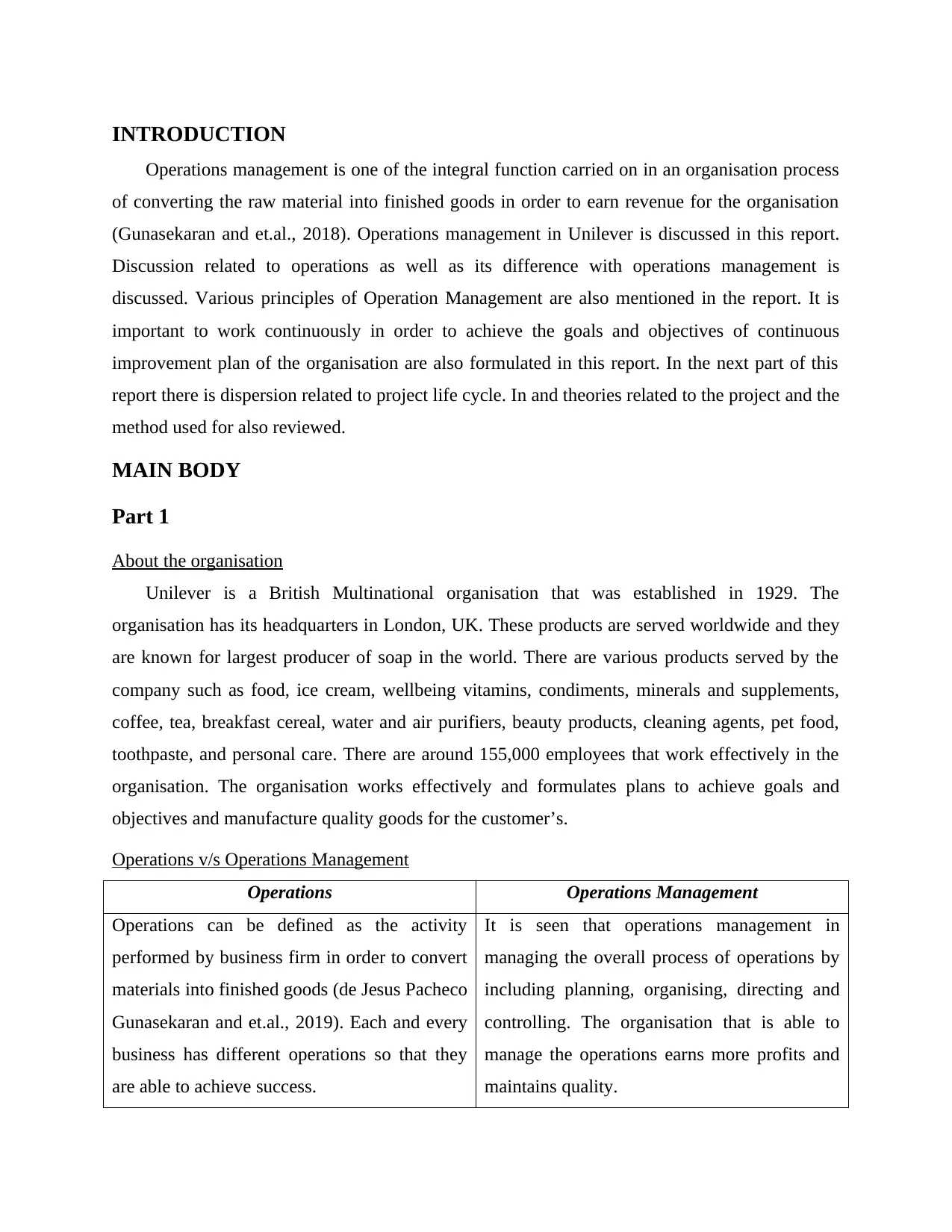
Operations v/s Operations Management
Operations Operations Management
Operations can be defined as the activity
performed by business firm in order to convert
materials into finished goods (de Jesus Pacheco
Gunasekaran and et.al., 2019). Each and every
business has different operations so that they
are able to achieve success.
It is seen that operations management in
managing the overall process of operations by
including planning, organising, directing and
controlling. The organisation that is able to
manage the operations earns more profits and
maintains quality.
Operations management is one of the integral function carried on in an organisation process
of converting the raw material into finished goods in order to earn revenue for the organisation
(Gunasekaran and et.al., 2018). Operations management in Unilever is discussed in this report.
Discussion related to operations as well as its difference with operations management is
discussed. Various principles of Operation Management are also mentioned in the report. It is
important to work continuously in order to achieve the goals and objectives of continuous
improvement plan of the organisation are also formulated in this report. In the next part of this
report there is dispersion related to project life cycle. In and theories related to the project and the
method used for also reviewed.
MAIN BODY
Part 1
About the organisation
Unilever is a British Multinational organisation that was established in 1929. The
organisation has its headquarters in London, UK. These products are served worldwide and they
are known for largest producer of soap in the world. There are various products served by the
company such as food, ice cream, wellbeing vitamins, condiments, minerals and supplements,
coffee, tea, breakfast cereal, water and air purifiers, beauty products, cleaning agents, pet food,
toothpaste, and personal care. There are around 155,000 employees that work effectively in the
organisation. The organisation works effectively and formulates plans to achieve goals and
objectives and manufacture quality goods for the customer’s.
Operations v/s Operations Management
Operations Operations Management
Operations can be defined as the activity
performed by business firm in order to convert
materials into finished goods (de Jesus Pacheco
Gunasekaran and et.al., 2019). Each and every
business has different operations so that they
are able to achieve success.
It is seen that operations management in
managing the overall process of operations by
including planning, organising, directing and
controlling. The organisation that is able to
manage the operations earns more profits and
maintains quality.
Paraphrase This Document
Need a fresh take? Get an instant paraphrase of this document with our AI Paraphraser
Review and critique implementation of operations management principles
It is important for an organisation to follow the principles of operations management. It
helps the company to achieve goals and objectives effectively. It helps the company to achieve
their targets of quality. It is seen that the principles that are followed by Unilever are discussed
below:
Reality: It is necessary for an organisation to focus on reality and then work. In relation to
Unilever the company analysed the real problem and then makes efforts to solve the same in
order to achieve success.
Organisation: There is requirement to organise each and every process of an organisation.
It helps the company to achieve success (Leseure, 2017). It regard to Unilever the company
organises all the operations and that helps them to achieve success.
Humanity: All the work is done by the humans in an organisation. In relation to Unilever
they take proper care of human beings of the organisation and provide those best training so that
they are able to provide best quality products to the customers.
Success: The success of an organisation depends upon satisfying needs and wants of
customers. So Unilever works and check the quality of products so that they are able to provide
best to the customers.
Accountability: It is responsibility of a business organisation to share all the details to
their customers and must be accountable for the work done (Erjavec and Trkman, 2020). In
regard to Unilever they share all the details to the stakeholders so that they are able to achieve
goals and objectives effectively.
Causality: It is necessary for an organisation to remove casualty from the business. In
relation to Unilever they are able to work on reducing mistakes so that they are able to provide
quality to the customers.
Change: It is necessary for a company to bring changes according to business
environment. In regard to Unilever they use latest technology so that they are able to achieve
success. It helps to provide best to the customers.
Collaborating with customers: It is important to take proper care of the customers and to
build relation with them. It helps Unilever to develop relations with customers and provide them
It is important for an organisation to follow the principles of operations management. It
helps the company to achieve goals and objectives effectively. It helps the company to achieve
their targets of quality. It is seen that the principles that are followed by Unilever are discussed
below:
Reality: It is necessary for an organisation to focus on reality and then work. In relation to
Unilever the company analysed the real problem and then makes efforts to solve the same in
order to achieve success.
Organisation: There is requirement to organise each and every process of an organisation.
It helps the company to achieve success (Leseure, 2017). It regard to Unilever the company
organises all the operations and that helps them to achieve success.
Humanity: All the work is done by the humans in an organisation. In relation to Unilever
they take proper care of human beings of the organisation and provide those best training so that
they are able to provide best quality products to the customers.
Success: The success of an organisation depends upon satisfying needs and wants of
customers. So Unilever works and check the quality of products so that they are able to provide
best to the customers.
Accountability: It is responsibility of a business organisation to share all the details to
their customers and must be accountable for the work done (Erjavec and Trkman, 2020). In
regard to Unilever they share all the details to the stakeholders so that they are able to achieve
goals and objectives effectively.
Causality: It is necessary for an organisation to remove casualty from the business. In
relation to Unilever they are able to work on reducing mistakes so that they are able to provide
quality to the customers.
Change: It is necessary for a company to bring changes according to business
environment. In regard to Unilever they use latest technology so that they are able to achieve
success. It helps to provide best to the customers.
Collaborating with customers: It is important to take proper care of the customers and to
build relation with them. It helps Unilever to develop relations with customers and provide them
best products. It is necessary to take feedback from the customers and provide best to the
customers.
Quality control: It is necessary for an organisation to keep check on the quality of goods
(Alfaro-Tanco Gunasekaran and et.al., 2021). In Unilever there are various principles that are
followed by them to provide best quality to the customers.
Operations management of the organisation in the case study meets the requirements of the
organization
It is important for a company to understand the importance of operations management. In
regard to Unilever the organisation has huge operations and that is why they use all the basic
principles of operations management. It helps them to provide best quality products to their
customers and to achieve goals and objectives successful. That is connected to same is done
below:
Unilever maintains quality of the goods by setting standards. All the employees of the
company work according to the standards that help them to achieve economies of scale
and satisfy the needs and wants of customers effectively (Pacheco, and Heidrich, 2021).
They use quality raw materials and designing the production process in such a manner
that they are able to reduce errors. It helps the company to retain the customers in an
effective manner.
Supply chain management of Unilever is also strong. It helps them to provide the goods
and services to the customers on time and this benefits their sales.
Continuous improvement and lean principles
Continuous improvement is a regular process that works on development of products offered
by a company. It helps in organisation to maintain quality of products and enhance the
performance of the organisation. Effective production processes of a company assist them in
achieving success (Lohmer and Lasch, 2020). It is necessary for an organisation to work on
regular basis in order to gain competitive advantage. It is used by Unilever in order to work
according to the standard set. It helps a company to achieve success. This helps them to provide
best to the customers and maintain brand image.
Lean Principles are followed by an organization in order to reduce the wastage of resources
and to reduce the cost of production. It helps the company to achieve and maintain quality. The
principles followed by Unilever are discussed below:
customers.
Quality control: It is necessary for an organisation to keep check on the quality of goods
(Alfaro-Tanco Gunasekaran and et.al., 2021). In Unilever there are various principles that are
followed by them to provide best quality to the customers.
Operations management of the organisation in the case study meets the requirements of the
organization
It is important for a company to understand the importance of operations management. In
regard to Unilever the organisation has huge operations and that is why they use all the basic
principles of operations management. It helps them to provide best quality products to their
customers and to achieve goals and objectives successful. That is connected to same is done
below:
Unilever maintains quality of the goods by setting standards. All the employees of the
company work according to the standards that help them to achieve economies of scale
and satisfy the needs and wants of customers effectively (Pacheco, and Heidrich, 2021).
They use quality raw materials and designing the production process in such a manner
that they are able to reduce errors. It helps the company to retain the customers in an
effective manner.
Supply chain management of Unilever is also strong. It helps them to provide the goods
and services to the customers on time and this benefits their sales.
Continuous improvement and lean principles
Continuous improvement is a regular process that works on development of products offered
by a company. It helps in organisation to maintain quality of products and enhance the
performance of the organisation. Effective production processes of a company assist them in
achieving success (Lohmer and Lasch, 2020). It is necessary for an organisation to work on
regular basis in order to gain competitive advantage. It is used by Unilever in order to work
according to the standard set. It helps a company to achieve success. This helps them to provide
best to the customers and maintain brand image.
Lean Principles are followed by an organization in order to reduce the wastage of resources
and to reduce the cost of production. It helps the company to achieve and maintain quality. The
principles followed by Unilever are discussed below:
⊘ This is a preview!⊘
Do you want full access?
Subscribe today to unlock all pages.
Trusted by 1+ million students worldwide
Value Defining: Unilever is a multinational organization that works to provide best value
to the customers. The company works to enhance the value to products in return of
money they have paid.
Mapping of Value Stream: It is important to design a map that includes all the factors
increase the value for the customers (Samson and Kalchschmidt, 2019). It helps them to
learn about the needs and want of the customers and note them.
Creating flow: it is important for a company to align resources, material and labor in
such a manner that they are able to achieve the standard objectives. For this purpose
Unilever provide best training to the employees and use quality raw materials are used to
achieve the goals of the company
Pull establishment: this principle works on inventory management by a company it
helps Unilever to have raw materials and convert them in finished quotes so that they are
delivered to the customers at perfect time.
It is important for Unilever to follow all these lean principles so that they are able to provide
best to the customers. It helps the company to achieve satisfaction level of customers and
enhance their experience.
Six Sigma
Six Sigma is a technique of operations management that is used by an organisation in order
to enhance the quality of the product (Oladimeji, Singh and Afolabi, 2021). In relation to
Unilever the organisation follow the principles of Six Sigma so as to reduce the cost of
production and reduce wastage of resources. A company that wants to you regularly in hands its
production quality should include Six Sigma. It helps to attend competitive advantage. Unilever
assures that they are able to achieve success by following all these:
Define: In this step Unilever defines the goals and objectives in a clear manner.
Measure: In the next step the company works on measuring the quality of products
offered by them.
Analyse: In this step company analyses the results so that they are able to achieve best
results.
Design: Best design is selected by the company so that they are able to remove defects.
Verify: The planned goals and compared with the actual. It helps to verify the desired
outcomes.
to the customers. The company works to enhance the value to products in return of
money they have paid.
Mapping of Value Stream: It is important to design a map that includes all the factors
increase the value for the customers (Samson and Kalchschmidt, 2019). It helps them to
learn about the needs and want of the customers and note them.
Creating flow: it is important for a company to align resources, material and labor in
such a manner that they are able to achieve the standard objectives. For this purpose
Unilever provide best training to the employees and use quality raw materials are used to
achieve the goals of the company
Pull establishment: this principle works on inventory management by a company it
helps Unilever to have raw materials and convert them in finished quotes so that they are
delivered to the customers at perfect time.
It is important for Unilever to follow all these lean principles so that they are able to provide
best to the customers. It helps the company to achieve satisfaction level of customers and
enhance their experience.
Six Sigma
Six Sigma is a technique of operations management that is used by an organisation in order
to enhance the quality of the product (Oladimeji, Singh and Afolabi, 2021). In relation to
Unilever the organisation follow the principles of Six Sigma so as to reduce the cost of
production and reduce wastage of resources. A company that wants to you regularly in hands its
production quality should include Six Sigma. It helps to attend competitive advantage. Unilever
assures that they are able to achieve success by following all these:
Define: In this step Unilever defines the goals and objectives in a clear manner.
Measure: In the next step the company works on measuring the quality of products
offered by them.
Analyse: In this step company analyses the results so that they are able to achieve best
results.
Design: Best design is selected by the company so that they are able to remove defects.
Verify: The planned goals and compared with the actual. It helps to verify the desired
outcomes.
Paraphrase This Document
Need a fresh take? Get an instant paraphrase of this document with our AI Paraphraser
The principles that are followed under Six Sigma are as follows:
Customer Focus: In this case, Unilever focuses on needs and wants of customers in order
to provide best to the customers.
Identify Root Causes: It is necessary to identify the root cause so that company is able to
analyses the problem. It helps Unilever to provide best to the customers by solving the issue.
Reduce variation: It is important to provide the products as per the standards that are
being set by the company. In this step Unilever reduces variations in the process of operations so
as to provide best to the customers.
Teamwork: There is need of team working skills in order to achieve goals and objectives.
The employees of Unilever work in team and with cooperation to achieve success.
Be Flexible and Thorough: A company must follow all the strategies and must be flexible
in order to achieve best results.
Prepare a Continuous improvement plan
Continuous improvement plan is formulated by an organisation in order to achieve success
at each and every time. Unilever works on long term goals by establishing short term and
medium term goals that help them to achieve success at every stage. There are some quality
standard that established by an organisation and that maintain quality. It is necessary to note that
the company that helps to follow continuous improvement achieve goals and objectives
effectively (Lee, 2018). The steps that are followed by Unilever in order to achieve success are
as follows:
Plan: It is necessary for an organization to formulate effective plans. It is seen that Unilever
to form effective goals so that they are able to work accordingly.
Do: It is the next stage in which Unilever works and implement the strategies. It is necessary
to prepare all the employees so that they are able to implement the strategies so that they are able
to goals and objectives.
Check: It is necessary step in continuous development and it helps the company to check the
progress made by the company on regular basis. It is necessary to check the working of Unilever
on continuous basis so that they are able to achieve success.
Act: It is necessary for a company to act and bring changes so that they are able to achieve
success.
Customer Focus: In this case, Unilever focuses on needs and wants of customers in order
to provide best to the customers.
Identify Root Causes: It is necessary to identify the root cause so that company is able to
analyses the problem. It helps Unilever to provide best to the customers by solving the issue.
Reduce variation: It is important to provide the products as per the standards that are
being set by the company. In this step Unilever reduces variations in the process of operations so
as to provide best to the customers.
Teamwork: There is need of team working skills in order to achieve goals and objectives.
The employees of Unilever work in team and with cooperation to achieve success.
Be Flexible and Thorough: A company must follow all the strategies and must be flexible
in order to achieve best results.
Prepare a Continuous improvement plan
Continuous improvement plan is formulated by an organisation in order to achieve success
at each and every time. Unilever works on long term goals by establishing short term and
medium term goals that help them to achieve success at every stage. There are some quality
standard that established by an organisation and that maintain quality. It is necessary to note that
the company that helps to follow continuous improvement achieve goals and objectives
effectively (Lee, 2018). The steps that are followed by Unilever in order to achieve success are
as follows:
Plan: It is necessary for an organization to formulate effective plans. It is seen that Unilever
to form effective goals so that they are able to work accordingly.
Do: It is the next stage in which Unilever works and implement the strategies. It is necessary
to prepare all the employees so that they are able to implement the strategies so that they are able
to goals and objectives.
Check: It is necessary step in continuous development and it helps the company to check the
progress made by the company on regular basis. It is necessary to check the working of Unilever
on continuous basis so that they are able to achieve success.
Act: It is necessary for a company to act and bring changes so that they are able to achieve
success.
There are some theories that are followed by Unilever in order to support operations
management and they are as follows:
Kaizen: It is one of the approaches that are used by Unilever in order to achieve success. It helps
the company to continuously work on the continuous improvement of the organization. It is seen
that a company must take proper care of the employees in order to achieve goals and objectives
in a successful manner (Demirkesen and Ozorhon, 2017). The company works to maintain
quality of goods in order provide best to the customers. They must use all the strategies in order
to bring changes and adopt best strategies for bringing improvement.
Total Quality management: It is a process that is used by the company is order to provide best
quality products to the customers. It is necessary for an organization to understand the situation if
the company and then take suitable actions that are beneficial for an organization. In Unilever all
the employees are involved in the process and each of them focus on providing best quality
goods to the customers.
Recommendations
To gain advantage over the competitor’s principles of six sigma, total quality
management as well as lean principles must be followed by an organization.
There must be proper training provided to the employees so that they are able to achieve
goals and objectives successfully. It helps to enhance their effectiveness and efficiency.
The company must be ready to bring changes and use updated methods is order to
achieve goals and objectives.
Part 2
Project title: Healthy lifestyle
An overview of the case study
This case study is based on MK motor LTD. It is an organization that has 1250 employees
and was established in 2006. The company was established in Birmingham, England. It is an
automobile manufacturing organization company that provides the services around the company.
There was no canteen facility provided by the company. This causes issues in the organization as
they do not get healthy lifestyle. This enhances absentees in the organization and has direct
impact on the operations of the company. In this regard the company is formulating a project in
order to achieve success.
management and they are as follows:
Kaizen: It is one of the approaches that are used by Unilever in order to achieve success. It helps
the company to continuously work on the continuous improvement of the organization. It is seen
that a company must take proper care of the employees in order to achieve goals and objectives
in a successful manner (Demirkesen and Ozorhon, 2017). The company works to maintain
quality of goods in order provide best to the customers. They must use all the strategies in order
to bring changes and adopt best strategies for bringing improvement.
Total Quality management: It is a process that is used by the company is order to provide best
quality products to the customers. It is necessary for an organization to understand the situation if
the company and then take suitable actions that are beneficial for an organization. In Unilever all
the employees are involved in the process and each of them focus on providing best quality
goods to the customers.
Recommendations
To gain advantage over the competitor’s principles of six sigma, total quality
management as well as lean principles must be followed by an organization.
There must be proper training provided to the employees so that they are able to achieve
goals and objectives successfully. It helps to enhance their effectiveness and efficiency.
The company must be ready to bring changes and use updated methods is order to
achieve goals and objectives.
Part 2
Project title: Healthy lifestyle
An overview of the case study
This case study is based on MK motor LTD. It is an organization that has 1250 employees
and was established in 2006. The company was established in Birmingham, England. It is an
automobile manufacturing organization company that provides the services around the company.
There was no canteen facility provided by the company. This causes issues in the organization as
they do not get healthy lifestyle. This enhances absentees in the organization and has direct
impact on the operations of the company. In this regard the company is formulating a project in
order to achieve success.
⊘ This is a preview!⊘
Do you want full access?
Subscribe today to unlock all pages.
Trusted by 1+ million students worldwide
Project life cycle:
There are different stages that are required to accomplish an order to complete a project.
There are four stages that are necessary for an organisation to follow in order to complete a new
project in an effective manner. Discussion related to their status is done below:
Initiation: it is the first stage of project life cycle. In this organisation works on the problem
they are facing so that they are able to you know down all the required resources and other
points. In relation to MG motors the company start making decisions in this stage. It is important
to first understand the problem in an effective manner and then take for the reaction so that they
are able to work accordingly (Picciotto, 2020). It is important to know about the theories and
concepts that will be required to achieve high quality project. It is necessary to measure the
performance and control the same.
Planning: it is most important stage in the life cycle of project. Once the project is started,
the organisation needs to conduct proper planning so that they are able to achieve goals and
objectives successfully. The company said the object in this stage and decide upon the employee
who will be working (Tereso Gunasekaran and et.al., 2019). Budget formulation is also an
integral part of project planning. All the employees bold in the project so that there is no
confusion in the end and better decisions are taken at this stage.
Execution: It is the next stage in project life cycle in which real work is done. All the
planning is now executed. The company makes efforts in order to practically apply the situation.
All the employees start walking according to the principles of total quality management so that
they are able to work as per standards. In relation to MG motors the employees are hardworking
and focus on the skills that are required in order to achieve the project goals. It is necessary to
work upon the theories. It is necessary to work according to the plans and eliminate all the
barriers that arise in the path.
Closure: It is the last stage in the project development plan. It is necessary to assure that the
project has made progress (Puška, Stojanović, Maksimović and Osmanović, 2020). They
compare the results with the standard that helps them to achieve success. The closure of the
project is based on the effectiveness of execution stage. It is necessary to eliminate the defects in
the process of project planning. It is necessary to take reasonable steps that help in achievement
of success.
Project plan
There are different stages that are required to accomplish an order to complete a project.
There are four stages that are necessary for an organisation to follow in order to complete a new
project in an effective manner. Discussion related to their status is done below:
Initiation: it is the first stage of project life cycle. In this organisation works on the problem
they are facing so that they are able to you know down all the required resources and other
points. In relation to MG motors the company start making decisions in this stage. It is important
to first understand the problem in an effective manner and then take for the reaction so that they
are able to work accordingly (Picciotto, 2020). It is important to know about the theories and
concepts that will be required to achieve high quality project. It is necessary to measure the
performance and control the same.
Planning: it is most important stage in the life cycle of project. Once the project is started,
the organisation needs to conduct proper planning so that they are able to achieve goals and
objectives successfully. The company said the object in this stage and decide upon the employee
who will be working (Tereso Gunasekaran and et.al., 2019). Budget formulation is also an
integral part of project planning. All the employees bold in the project so that there is no
confusion in the end and better decisions are taken at this stage.
Execution: It is the next stage in project life cycle in which real work is done. All the
planning is now executed. The company makes efforts in order to practically apply the situation.
All the employees start walking according to the principles of total quality management so that
they are able to work as per standards. In relation to MG motors the employees are hardworking
and focus on the skills that are required in order to achieve the project goals. It is necessary to
work upon the theories. It is necessary to work according to the plans and eliminate all the
barriers that arise in the path.
Closure: It is the last stage in the project development plan. It is necessary to assure that the
project has made progress (Puška, Stojanović, Maksimović and Osmanović, 2020). They
compare the results with the standard that helps them to achieve success. The closure of the
project is based on the effectiveness of execution stage. It is necessary to eliminate the defects in
the process of project planning. It is necessary to take reasonable steps that help in achievement
of success.
Project plan
Paraphrase This Document
Need a fresh take? Get an instant paraphrase of this document with our AI Paraphraser
Executive Summary MK motor is facing the issue of rise in employee absenteeism and
the project is to engage and retain the employees in the
organisation.
Vision and Mission The vision is to reduce employee absentees in the
organization.
The mission is to provide healthy food within the
organization.
Objectives The various objectives are discussed below:
To reduce the moment of staff outside the organization
To provide good quality food to the employees
To engage the employees
Strategies The best strategy is to make employees understand the importance
of healthy food and lifestyle. It helps to involve them in the
company. So that they do not get outside the organization.
Resources required It is necessary to arrange the resources that will help to carry on
the project. There is requirement of money, staff, and software in
order to work effectively (San Cristóbal and etal., 2018). All the
resources must be available in the organization. It makes the
company to successfully achieve the task with sufficient
resources.
Risk and benefit It is seen that risk is present at every level. It company must be
prepared for the risk that may arise.
There are various benefits that a company will get if the project ill
be successful.
Project plan
Cost It is necessary to analyses the expenditure in the initial phase.
There will be around £24,595 expenditure.
Quality Principles of total quality management must be achieved in order
to get best quality results.
the project is to engage and retain the employees in the
organisation.
Vision and Mission The vision is to reduce employee absentees in the
organization.
The mission is to provide healthy food within the
organization.
Objectives The various objectives are discussed below:
To reduce the moment of staff outside the organization
To provide good quality food to the employees
To engage the employees
Strategies The best strategy is to make employees understand the importance
of healthy food and lifestyle. It helps to involve them in the
company. So that they do not get outside the organization.
Resources required It is necessary to arrange the resources that will help to carry on
the project. There is requirement of money, staff, and software in
order to work effectively (San Cristóbal and etal., 2018). All the
resources must be available in the organization. It makes the
company to successfully achieve the task with sufficient
resources.
Risk and benefit It is seen that risk is present at every level. It company must be
prepared for the risk that may arise.
There are various benefits that a company will get if the project ill
be successful.
Project plan
Cost It is necessary to analyses the expenditure in the initial phase.
There will be around £24,595 expenditure.
Quality Principles of total quality management must be achieved in order
to get best quality results.
Scope The scope is within the organization
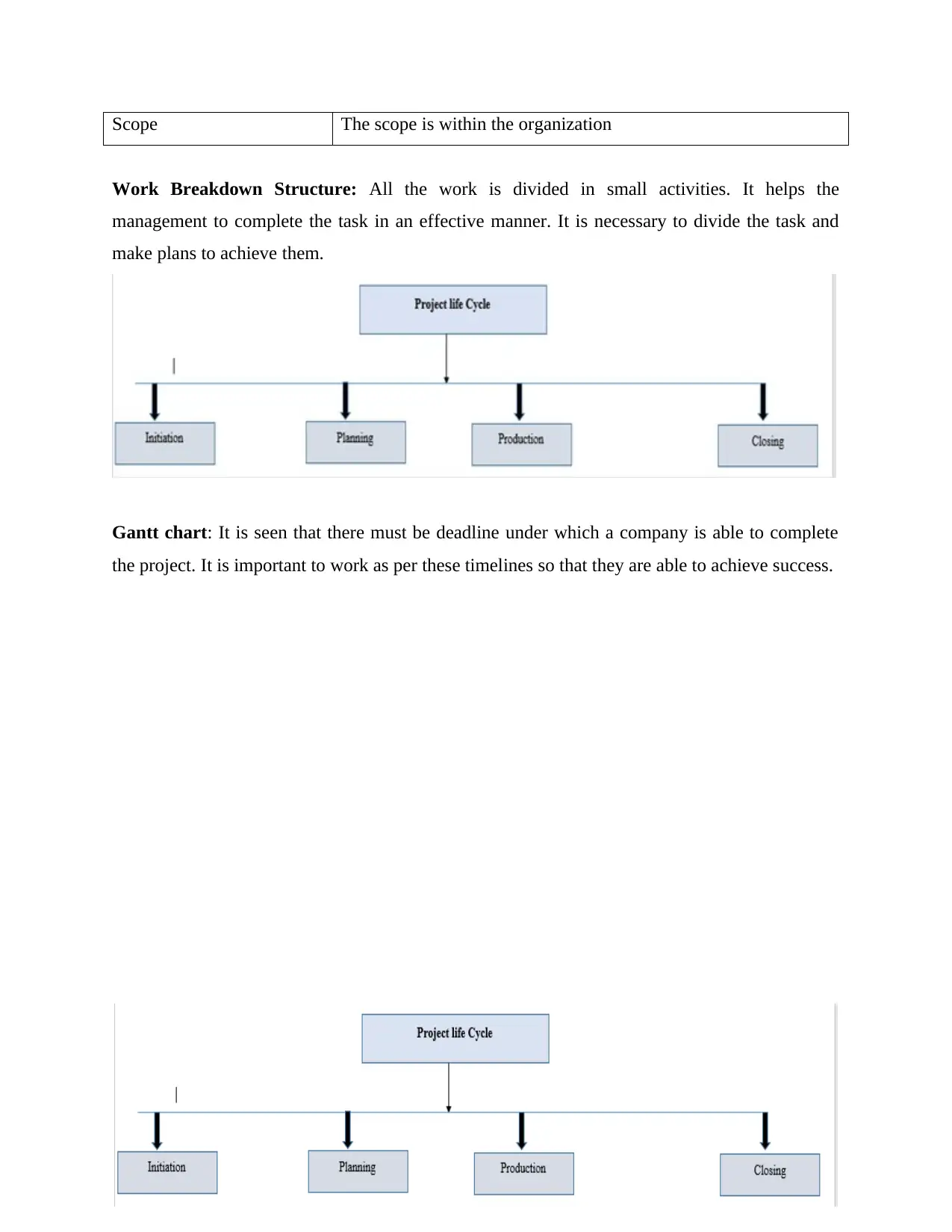
Work Breakdown Structure: All the work is divided in small activities. It helps the
management to complete the task in an effective manner. It is necessary to divide the task and
make plans to achieve them.
Gantt chart: It is seen that there must be deadline under which a company is able to complete
the project. It is important to work as per these timelines so that they are able to achieve success.
Work Breakdown Structure: All the work is divided in small activities. It helps the
management to complete the task in an effective manner. It is necessary to divide the task and
make plans to achieve them.
Gantt chart: It is seen that there must be deadline under which a company is able to complete
the project. It is important to work as per these timelines so that they are able to achieve success.
⊘ This is a preview!⊘
Do you want full access?
Subscribe today to unlock all pages.
Trusted by 1+ million students worldwide

1 out of 17


Related Documents


Your All-in-One AI-Powered Toolkit for Academic Success.
+13062052269
info@desklib.com
Available 24*7 on WhatsApp / Email
![[object Object]](/_next/static/media/star-bottom.7253800d.svg)
Unlock your academic potential
Copyright © 2020–2026 A2Z Services. All Rights Reserved. Developed and managed by ZUCOL.