Organisational Behaviour: Unilever's Motivation and Culture Report
VerifiedAdded on 2023/06/04
|13
|3221
|327
Report
AI Summary
This report explores organisational behaviour within Unilever, focusing on motivation and organisational culture. It discusses the complexities of human behaviour and its impact on organisational performance. The report examines motivational strategies, including Maslow's hierarchy of needs, and their application within Unilever to enhance employee performance. It also analyses Unilever's organisational culture, emphasizing the importance of employee involvement, human relations management, and creating a positive working environment through employee voice, team connections, and personalised experiences. The research findings highlight the significance of monetary and non-monetary benefits, effective communication, and a positive organisational culture in improving employee satisfaction and overall productivity.
CW1 Group Report

Paraphrase This Document
Need a fresh take? Get an instant paraphrase of this document with our AI Paraphraser
Executive summary
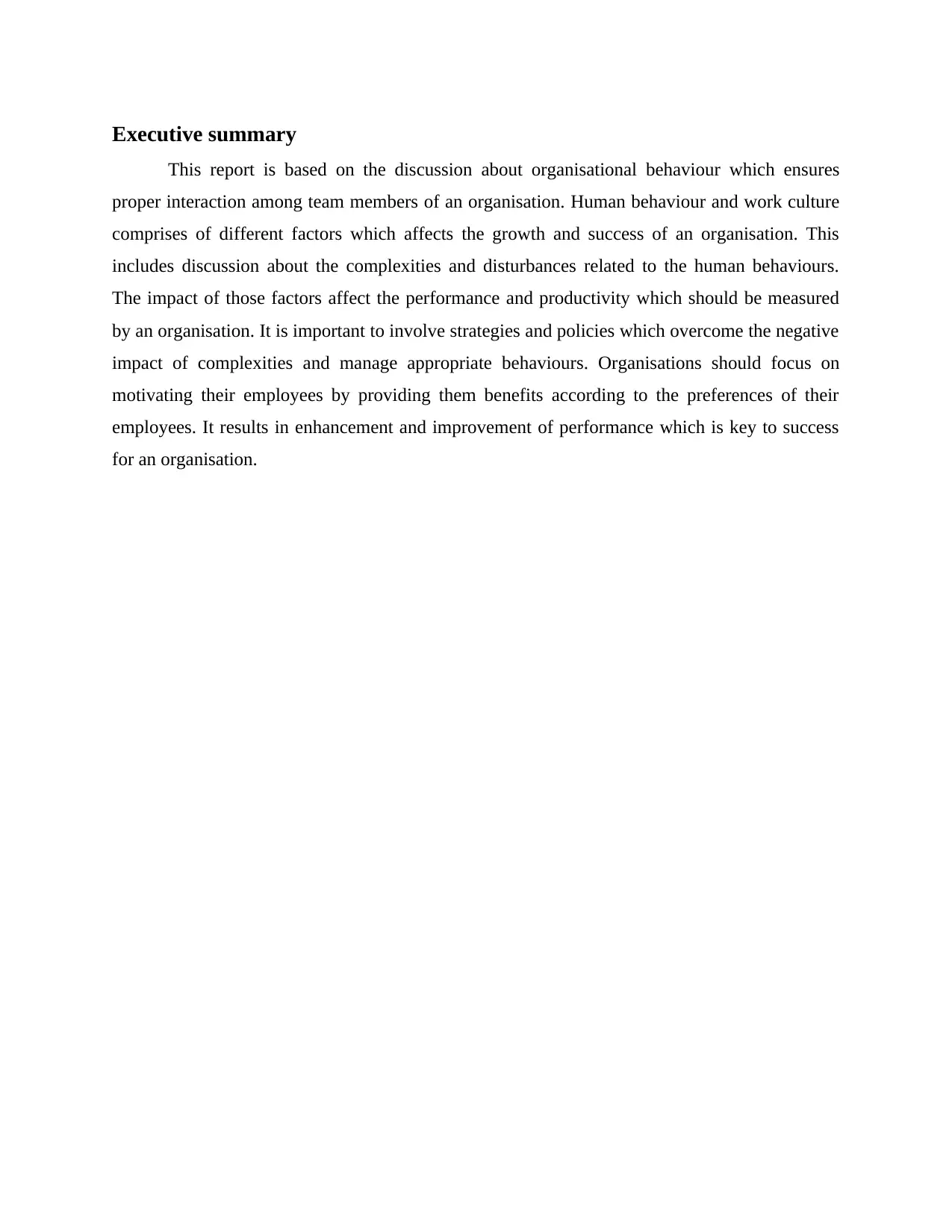
This report is based on the discussion about organisational behaviour which ensures
proper interaction among team members of an organisation. Human behaviour and work culture
comprises of different factors which affects the growth and success of an organisation. This
includes discussion about the complexities and disturbances related to the human behaviours.
The impact of those factors affect the performance and productivity which should be measured
by an organisation. It is important to involve strategies and policies which overcome the negative
impact of complexities and manage appropriate behaviours. Organisations should focus on
motivating their employees by providing them benefits according to the preferences of their
employees. It results in enhancement and improvement of performance which is key to success
for an organisation.
This report is based on the discussion about organisational behaviour which ensures
proper interaction among team members of an organisation. Human behaviour and work culture
comprises of different factors which affects the growth and success of an organisation. This
includes discussion about the complexities and disturbances related to the human behaviours.
The impact of those factors affect the performance and productivity which should be measured
by an organisation. It is important to involve strategies and policies which overcome the negative
impact of complexities and manage appropriate behaviours. Organisations should focus on
motivating their employees by providing them benefits according to the preferences of their
employees. It results in enhancement and improvement of performance which is key to success
for an organisation.
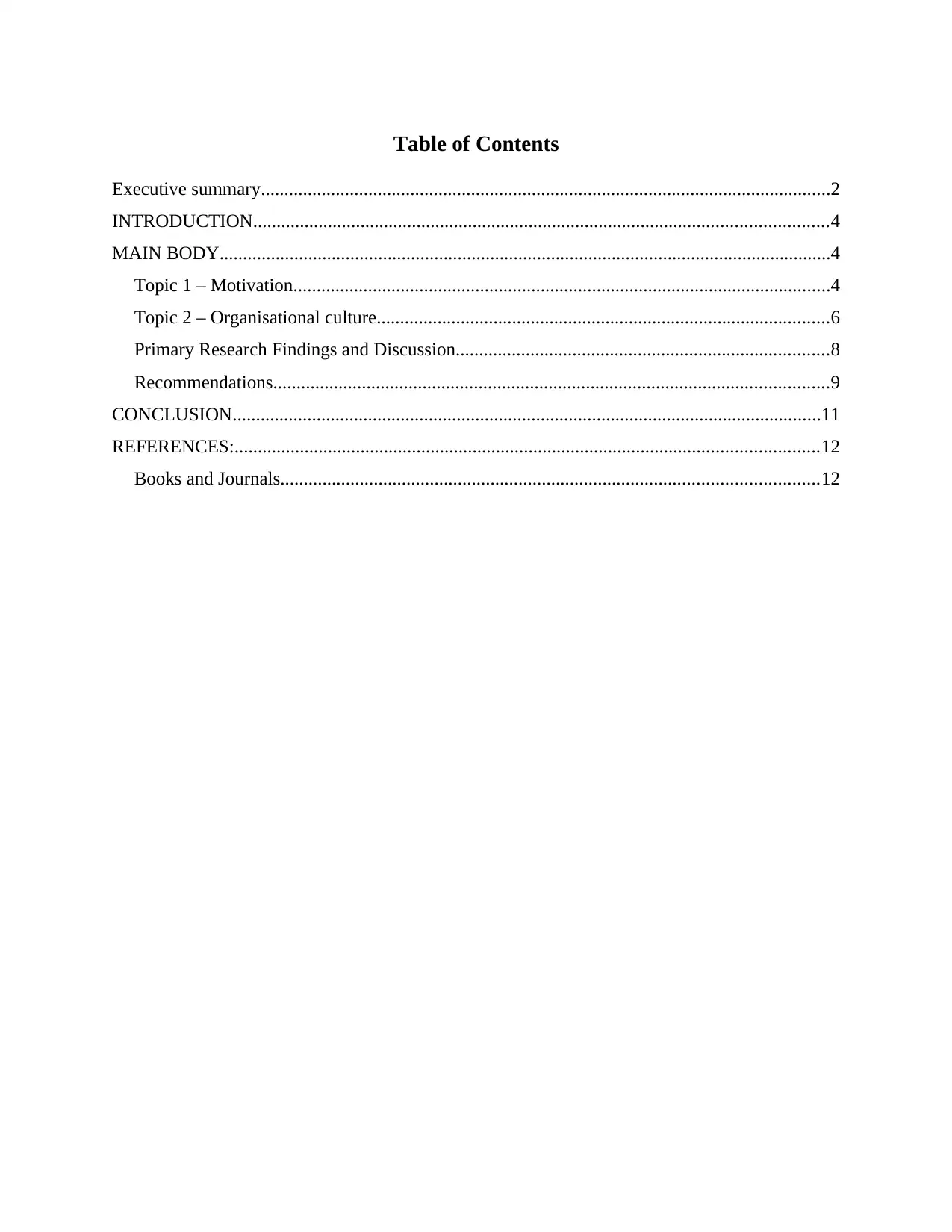
Table of Contents
Executive summary..........................................................................................................................2
INTRODUCTION...........................................................................................................................4
MAIN BODY...................................................................................................................................4
Topic 1 – Motivation...................................................................................................................4
Topic 2 – Organisational culture.................................................................................................6
Primary Research Findings and Discussion................................................................................8
Recommendations.......................................................................................................................9
CONCLUSION..............................................................................................................................11
REFERENCES:.............................................................................................................................12
Books and Journals...................................................................................................................12
Executive summary..........................................................................................................................2
INTRODUCTION...........................................................................................................................4
MAIN BODY...................................................................................................................................4
Topic 1 – Motivation...................................................................................................................4
Topic 2 – Organisational culture.................................................................................................6
Primary Research Findings and Discussion................................................................................8
Recommendations.......................................................................................................................9
CONCLUSION..............................................................................................................................11
REFERENCES:.............................................................................................................................12
Books and Journals...................................................................................................................12
⊘ This is a preview!⊘
Do you want full access?
Subscribe today to unlock all pages.

Trusted by 1+ million students worldwide
INTRODUCTION
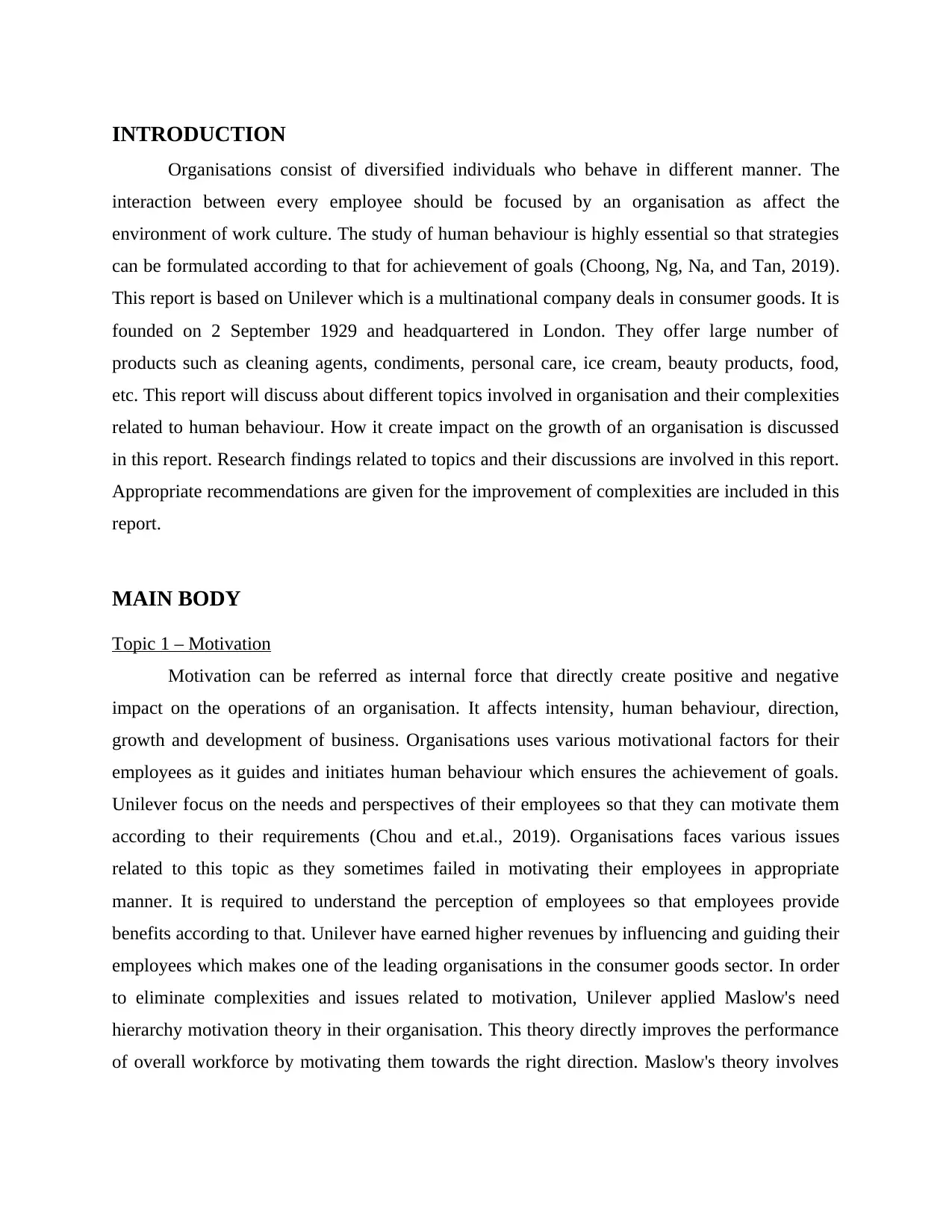
Organisations consist of diversified individuals who behave in different manner. The
interaction between every employee should be focused by an organisation as affect the
environment of work culture. The study of human behaviour is highly essential so that strategies
can be formulated according to that for achievement of goals (Choong, Ng, Na, and Tan, 2019).
This report is based on Unilever which is a multinational company deals in consumer goods. It is
founded on 2 September 1929 and headquartered in London. They offer large number of
products such as cleaning agents, condiments, personal care, ice cream, beauty products, food,
etc. This report will discuss about different topics involved in organisation and their complexities
related to human behaviour. How it create impact on the growth of an organisation is discussed
in this report. Research findings related to topics and their discussions are involved in this report.
Appropriate recommendations are given for the improvement of complexities are included in this
report.
MAIN BODY
Topic 1 – Motivation
Motivation can be referred as internal force that directly create positive and negative
impact on the operations of an organisation. It affects intensity, human behaviour, direction,
growth and development of business. Organisations uses various motivational factors for their
employees as it guides and initiates human behaviour which ensures the achievement of goals.
Unilever focus on the needs and perspectives of their employees so that they can motivate them
according to their requirements (Chou and et.al., 2019). Organisations faces various issues
related to this topic as they sometimes failed in motivating their employees in appropriate
manner. It is required to understand the perception of employees so that employees provide
benefits according to that. Unilever have earned higher revenues by influencing and guiding their
employees which makes one of the leading organisations in the consumer goods sector. In order
to eliminate complexities and issues related to motivation, Unilever applied Maslow's need
hierarchy motivation theory in their organisation. This theory directly improves the performance
of overall workforce by motivating them towards the right direction. Maslow's theory involves
Organisations consist of diversified individuals who behave in different manner. The
interaction between every employee should be focused by an organisation as affect the
environment of work culture. The study of human behaviour is highly essential so that strategies
can be formulated according to that for achievement of goals (Choong, Ng, Na, and Tan, 2019).
This report is based on Unilever which is a multinational company deals in consumer goods. It is
founded on 2 September 1929 and headquartered in London. They offer large number of
products such as cleaning agents, condiments, personal care, ice cream, beauty products, food,
etc. This report will discuss about different topics involved in organisation and their complexities
related to human behaviour. How it create impact on the growth of an organisation is discussed
in this report. Research findings related to topics and their discussions are involved in this report.
Appropriate recommendations are given for the improvement of complexities are included in this
report.
MAIN BODY
Topic 1 – Motivation
Motivation can be referred as internal force that directly create positive and negative
impact on the operations of an organisation. It affects intensity, human behaviour, direction,
growth and development of business. Organisations uses various motivational factors for their
employees as it guides and initiates human behaviour which ensures the achievement of goals.
Unilever focus on the needs and perspectives of their employees so that they can motivate them
according to their requirements (Chou and et.al., 2019). Organisations faces various issues
related to this topic as they sometimes failed in motivating their employees in appropriate
manner. It is required to understand the perception of employees so that employees provide
benefits according to that. Unilever have earned higher revenues by influencing and guiding their
employees which makes one of the leading organisations in the consumer goods sector. In order
to eliminate complexities and issues related to motivation, Unilever applied Maslow's need
hierarchy motivation theory in their organisation. This theory directly improves the performance
of overall workforce by motivating them towards the right direction. Maslow's theory involves
Paraphrase This Document
Need a fresh take? Get an instant paraphrase of this document with our AI Paraphraser
pyramid of different needs according to their respective stages. Unilever applied this theory as
follows:
Physiological needs: This is the first stage of hierarchy which can be referred as basic
needs as they are vital for survival. Basic requirements includes food, water, clothes and shelter
which should be fulfilled on time. Unilever provide basic monthly salaries or wages to all their
employees so that they can survive in effective manner. Other essential facilities are also
provided by them such as providing tea and coffee to their employees. It positively affect their
performance which motivates them for better operations.
Safety and security needs: After the fulfilment of basic needs, next stage comes for
safety and security needs. Individuals want different types of security at workplace such as
financial security, safety related injuries and accidents, health and wellness, personal security
and emotional security (Gnankob, Ansong and Issau, 2022). Secured and safe working
environment motivates employees for achievement of their personal as well organisational goals.
Unilever provides sick pays, formal job contract letter, pension schemes and health insurance to
their employees. It gives them sense of security which results in improved performance
according to the organisation's requirements.
Social needs: Third level of Hierarchy includes social belonging needs which is essential
for the development of social acceptance. Management of employee's social needs encourage
them in achievement of best opportunities for them. Unilever promotes team work so that
individuals interact with each other on regular basis which build strong relationships. They
arrange social and cultural activities for employees which increase their interaction. Satisfied
social and belongingness needs eliminates conflicts from organisation and promotes their
growth.
Self esteem: At this stage, individuals demand for respect, stable esteem and admiration.
It is required that efforts should be recognised which becomes motivating factor for the
employees. Feeling of prestige and accomplishment make employees more confident regarding
their operations which contributes positive efforts towards growth of an organisation
(Holmgreen, 2020). Unilever aims to get 360 degree feedback from their employees which assist
in better understanding their behaviours. They also provide appraisals to their employees
according to their performance and contribution so that their efforts can be effectively
recognised.
follows:
Physiological needs: This is the first stage of hierarchy which can be referred as basic
needs as they are vital for survival. Basic requirements includes food, water, clothes and shelter
which should be fulfilled on time. Unilever provide basic monthly salaries or wages to all their
employees so that they can survive in effective manner. Other essential facilities are also
provided by them such as providing tea and coffee to their employees. It positively affect their
performance which motivates them for better operations.
Safety and security needs: After the fulfilment of basic needs, next stage comes for
safety and security needs. Individuals want different types of security at workplace such as
financial security, safety related injuries and accidents, health and wellness, personal security
and emotional security (Gnankob, Ansong and Issau, 2022). Secured and safe working
environment motivates employees for achievement of their personal as well organisational goals.
Unilever provides sick pays, formal job contract letter, pension schemes and health insurance to
their employees. It gives them sense of security which results in improved performance
according to the organisation's requirements.
Social needs: Third level of Hierarchy includes social belonging needs which is essential
for the development of social acceptance. Management of employee's social needs encourage
them in achievement of best opportunities for them. Unilever promotes team work so that
individuals interact with each other on regular basis which build strong relationships. They
arrange social and cultural activities for employees which increase their interaction. Satisfied
social and belongingness needs eliminates conflicts from organisation and promotes their
growth.
Self esteem: At this stage, individuals demand for respect, stable esteem and admiration.
It is required that efforts should be recognised which becomes motivating factor for the
employees. Feeling of prestige and accomplishment make employees more confident regarding
their operations which contributes positive efforts towards growth of an organisation
(Holmgreen, 2020). Unilever aims to get 360 degree feedback from their employees which assist
in better understanding their behaviours. They also provide appraisals to their employees
according to their performance and contribution so that their efforts can be effectively
recognised.
Self actualisation: This is the last stage of hierarchy which focus on the full realization
of individuals potential. At this point of time, employees wants to accomplish each and
everything which they want in their life. Unilever provides number of opportunities to their
employees such as promotion and mentoring at higher level. Their talents are effectively
recognised at workplace which assist in enhancement of performance. Unilever also arrange
talent planning meetings which involve relevant discussions regarding further growth. The
creativity, growth and advancement is achieved at this stage which is essential for maintaining
motivated workforce.
It is analysed that motivations can effectively deal with the behaviour of human and
manages complexities in better manner (Yan, Wen, Li and Zhang, 2020). This assist Unilever in
maintaining experienced and skilled workforce which results in achievement of success. Benefits
and appreciation is required to enhance the productivity of overall workforce without involving
extra efforts.
Topic 2 – Organisational culture
It can be referred as collection of values, practices that guides, expectations, direction of
actions of overall workforce. Combination of different traits in an organisation is responsible for
the formation of organisational culture. Positive traits assist organisation in achievement of their
goals and objectives which results in improved performance. Unilever follows their all the
mission, visions, aims and objectives by the positive contribution of efforts by each and every
employee. Prioritizing work culture eliminates and minimize difficult times in organisation.
Unilever focus on the regular necessities so that they can transform alter operation which create
complexities. It helps them in achievement of various competitive advantages which make
Unilever priority of large number of customers (Ishak and et.al., 2022). Unilever have to involve
their employees in decision making and planning so that they can maintain harmony in their
organisation. It promotes equality and protect rights of every employee which is positive factor
contributing in developing better organisational culture. Unilever focuses on human relation
management theory which focuses on managing behaviour of employees at workplace. It
resolves conflicts by providing them best alternatives and solutions which is necessary for better
growth. The human relation management theory of organisational behaviour is as follows:
This theory was developed by Elton Mayo in 1920's who was organizational theorist and
Australian-born psychologist. They focus on the study of human behaviour in groups as well as
of individuals potential. At this point of time, employees wants to accomplish each and
everything which they want in their life. Unilever provides number of opportunities to their
employees such as promotion and mentoring at higher level. Their talents are effectively
recognised at workplace which assist in enhancement of performance. Unilever also arrange
talent planning meetings which involve relevant discussions regarding further growth. The
creativity, growth and advancement is achieved at this stage which is essential for maintaining
motivated workforce.
It is analysed that motivations can effectively deal with the behaviour of human and
manages complexities in better manner (Yan, Wen, Li and Zhang, 2020). This assist Unilever in
maintaining experienced and skilled workforce which results in achievement of success. Benefits
and appreciation is required to enhance the productivity of overall workforce without involving
extra efforts.
Topic 2 – Organisational culture
It can be referred as collection of values, practices that guides, expectations, direction of
actions of overall workforce. Combination of different traits in an organisation is responsible for
the formation of organisational culture. Positive traits assist organisation in achievement of their
goals and objectives which results in improved performance. Unilever follows their all the
mission, visions, aims and objectives by the positive contribution of efforts by each and every
employee. Prioritizing work culture eliminates and minimize difficult times in organisation.
Unilever focus on the regular necessities so that they can transform alter operation which create
complexities. It helps them in achievement of various competitive advantages which make
Unilever priority of large number of customers (Ishak and et.al., 2022). Unilever have to involve
their employees in decision making and planning so that they can maintain harmony in their
organisation. It promotes equality and protect rights of every employee which is positive factor
contributing in developing better organisational culture. Unilever focuses on human relation
management theory which focuses on managing behaviour of employees at workplace. It
resolves conflicts by providing them best alternatives and solutions which is necessary for better
growth. The human relation management theory of organisational behaviour is as follows:
This theory was developed by Elton Mayo in 1920's who was organizational theorist and
Australian-born psychologist. They focus on the study of human behaviour in groups as well as
⊘ This is a preview!⊘
Do you want full access?
Subscribe today to unlock all pages.
Trusted by 1+ million students worldwide
individuals at their workplace. It support the career development of employees which results in
better performance. Unilever implement this theory so that they can understand different traits
and behaviours of their employees on regular basis. The changing needs and preferences of
employees should be focused so that they can assist organisation in achievement of their goals
and objectives (Koumproglou and Biginas, 2022). This a relation centric approach which
regulates the behaviour in positive manner and develop better relationship between employees
and their managers. Unilever ensures that they provide training and development sessions to their
employees so that they can inherit relevant skills which are required for smooth operations.
Those skills include communication skills, conflict resolution, multitasking, negotiation,
organisation, etc. Managers of Unilever focus on the individual behaviour as it differentiate from
each other.
Unilever can easily build higher performance organisational culture with the help of
different steps. Necessary actions should be taken into consideration so that they can develop
positive working environment. The steps which are taken by Unilever are mentioned below:
Enable employee voice: It is important to give value to the workforce as they are
responsible for majority of operations. Unilever provides rights to employees for sharing their
thoughts, reviews and feedbacks on various topics. It motivates employees and encourage them
for performing better at workplace. Unilever uses effective listening tools which assist
employees in sharing their view. This can includes workplace chatbots, pulse surveys, etc. which
can effectively analyse the results. It provides opportunity for generating higher benefits by
focusing on the feedbacks of the employees.
Promote team connections: Building appropriate work culture requires strong
connection between team members. Team works promotes connectivity and develop healthy
relationships among team members of an organisation (Mansouri, Singh, and Khan, 2018).
Unilever creates bonds between individuals so that they understand each other which eliminates
conflicts and fights. Team building activities and group projects are involved which is
responsible for achievement of targets in effective manner. It helps overall organisation in
maintaining required performance of employees by developing peace at workplace.
Focus on development and learning: Training initiatives are essential for development
of positive work culture. It requires continuos improvement of skills and abilities which can
improve the quality of operations in required manner. Unilever assign new responsibilities and
better performance. Unilever implement this theory so that they can understand different traits
and behaviours of their employees on regular basis. The changing needs and preferences of
employees should be focused so that they can assist organisation in achievement of their goals
and objectives (Koumproglou and Biginas, 2022). This a relation centric approach which
regulates the behaviour in positive manner and develop better relationship between employees
and their managers. Unilever ensures that they provide training and development sessions to their
employees so that they can inherit relevant skills which are required for smooth operations.
Those skills include communication skills, conflict resolution, multitasking, negotiation,
organisation, etc. Managers of Unilever focus on the individual behaviour as it differentiate from
each other.
Unilever can easily build higher performance organisational culture with the help of
different steps. Necessary actions should be taken into consideration so that they can develop
positive working environment. The steps which are taken by Unilever are mentioned below:
Enable employee voice: It is important to give value to the workforce as they are
responsible for majority of operations. Unilever provides rights to employees for sharing their
thoughts, reviews and feedbacks on various topics. It motivates employees and encourage them
for performing better at workplace. Unilever uses effective listening tools which assist
employees in sharing their view. This can includes workplace chatbots, pulse surveys, etc. which
can effectively analyse the results. It provides opportunity for generating higher benefits by
focusing on the feedbacks of the employees.
Promote team connections: Building appropriate work culture requires strong
connection between team members. Team works promotes connectivity and develop healthy
relationships among team members of an organisation (Mansouri, Singh, and Khan, 2018).
Unilever creates bonds between individuals so that they understand each other which eliminates
conflicts and fights. Team building activities and group projects are involved which is
responsible for achievement of targets in effective manner. It helps overall organisation in
maintaining required performance of employees by developing peace at workplace.
Focus on development and learning: Training initiatives are essential for development
of positive work culture. It requires continuos improvement of skills and abilities which can
improve the quality of operations in required manner. Unilever assign new responsibilities and
Paraphrase This Document
Need a fresh take? Get an instant paraphrase of this document with our AI Paraphraser
authorities to their employees so that they feel confident. Coaching and mentoring are provided
by professionals so that each and individual gain specific knowledge which results in better
growth. Unilever improves their rate of retention and engagement with the help of enhancing
their learnings on regular interval of time.
Personalise the employee experience: Employees expects from organisations that their
experiences get personalised. It provides them sense of satisfaction and motivation at same time.
Unilever identifies their work culture so that they can appreciate the employees who perform
according to the requirements (Varshney, 2018). To identify the value of employees, Unilever
uses employee journey map and pulse surveys so that they can built ideal work culture. It is
required to provide equal rights and benefits to every employee in initial stages so that they can
perform well.
Primary Research Findings and Discussion
It is analysed that organisations consist of large number of individuals who possess
different behaviours and traits. Organisations like Unilever have to focus on the requirements
and needs of their employees so that they can provide motivating factors. Motivation directly
improves the performance of employees. Unilever provides monetary and non monetary benefits
to their employees according to the expectations and performance of employees. It results in
higher retention of employees which save lot of cost of an organisation (Meor Rashydan, 2020).
Unilever includes incentives, promotions, vacations and other perks which influence the
behaviour of individuals in positive manner. It is essential for businesses to focus on the conflicts
and miss understandings of employees so that they can promote better performances. Managers
of Unilever interact with their employees which builds healthy relations with the them. Proper
communication generate create and innovative ideas which is positive factor contributing in the
growth and development of work culture.
It is essential to create positive organisational culture by involving the factors which
support higher growth. Positive and relevant values are considered by each and every employee
in their performance. Unilever provides employee benefits along with support and comfortability
which develop their interest towards the organisation. Almost half of the workforce influenced
by the positive factor which maintains decorum at workplace. Positive organisational culture
becomes the reason for improving job satisfaction to 65% of overall strength which is two third
of total workforce of UK (Thampi, 2022). It positively transform the business environment
by professionals so that each and individual gain specific knowledge which results in better
growth. Unilever improves their rate of retention and engagement with the help of enhancing
their learnings on regular interval of time.
Personalise the employee experience: Employees expects from organisations that their
experiences get personalised. It provides them sense of satisfaction and motivation at same time.
Unilever identifies their work culture so that they can appreciate the employees who perform
according to the requirements (Varshney, 2018). To identify the value of employees, Unilever
uses employee journey map and pulse surveys so that they can built ideal work culture. It is
required to provide equal rights and benefits to every employee in initial stages so that they can
perform well.
Primary Research Findings and Discussion
It is analysed that organisations consist of large number of individuals who possess
different behaviours and traits. Organisations like Unilever have to focus on the requirements
and needs of their employees so that they can provide motivating factors. Motivation directly
improves the performance of employees. Unilever provides monetary and non monetary benefits
to their employees according to the expectations and performance of employees. It results in
higher retention of employees which save lot of cost of an organisation (Meor Rashydan, 2020).
Unilever includes incentives, promotions, vacations and other perks which influence the
behaviour of individuals in positive manner. It is essential for businesses to focus on the conflicts
and miss understandings of employees so that they can promote better performances. Managers
of Unilever interact with their employees which builds healthy relations with the them. Proper
communication generate create and innovative ideas which is positive factor contributing in the
growth and development of work culture.
It is essential to create positive organisational culture by involving the factors which
support higher growth. Positive and relevant values are considered by each and every employee
in their performance. Unilever provides employee benefits along with support and comfortability
which develop their interest towards the organisation. Almost half of the workforce influenced
by the positive factor which maintains decorum at workplace. Positive organisational culture
becomes the reason for improving job satisfaction to 65% of overall strength which is two third
of total workforce of UK (Thampi, 2022). It positively transform the business environment
which is required for better growth and expansion. Enhancing the skills and abilities of
individuals increase their strength to handle critical operations. It provides success to individuals
as well as overall organisation. Workforce satisfaction is important factor which eliminates the
reasons of complexities and ensures smooth operations. Unilever regularly appreciate the efforts
of their workforce which results in self development and improvement of personality. Gathering
of innovative ideas during operations provides further opportunities to organisation for
improving their operations.
Recommendations
Organisations should develop policies regarding equality rights for their employees
which can effectively eliminate discrimination. This improves the quality of working
environment to great extent when everyone enjoys same rights. Unilever can easily lower
down the complexity by developing most suitable policies.
It is important for every organisation that they should promote group projects at their
workplace. This assist them in interacting with each other which provides different ideas
for commencement of operations (Nguyen, Ngo and Gregory, 2021). Understanding
human behaviour is the best way to deal with complexities which can result in positive
outcomes. There should be free flow of ideas among employees which improves the
knowledge and productivity.
Appropriate resources should be provided to all the employees according to the
requirements of operations. Unilever involves technological advancements so that they
can reduce errors and mistakes. It save efforts of labours which maintain their effective
productivity for different human based operations. Utilisation of resources in potential
manner assist work environment in becoming more effective for the achievement of goals
and targets.
Delegation of authorities and responsibilities should be involved at workplace so the it
lower down burden and pressure from employees (Shahid, and Muchiri, 2018). Unilever
should distribute operations according to the expertise and knowledge of employees so
that they can maintain accuracy. It assist overall workforce in meeting their deadlines
without any failure which is positive factors for better growth. Responsibilities make
employees more confident in their field who can carry out operations in better manner.
individuals increase their strength to handle critical operations. It provides success to individuals
as well as overall organisation. Workforce satisfaction is important factor which eliminates the
reasons of complexities and ensures smooth operations. Unilever regularly appreciate the efforts
of their workforce which results in self development and improvement of personality. Gathering
of innovative ideas during operations provides further opportunities to organisation for
improving their operations.
Recommendations
Organisations should develop policies regarding equality rights for their employees
which can effectively eliminate discrimination. This improves the quality of working
environment to great extent when everyone enjoys same rights. Unilever can easily lower
down the complexity by developing most suitable policies.
It is important for every organisation that they should promote group projects at their
workplace. This assist them in interacting with each other which provides different ideas
for commencement of operations (Nguyen, Ngo and Gregory, 2021). Understanding
human behaviour is the best way to deal with complexities which can result in positive
outcomes. There should be free flow of ideas among employees which improves the
knowledge and productivity.
Appropriate resources should be provided to all the employees according to the
requirements of operations. Unilever involves technological advancements so that they
can reduce errors and mistakes. It save efforts of labours which maintain their effective
productivity for different human based operations. Utilisation of resources in potential
manner assist work environment in becoming more effective for the achievement of goals
and targets.
Delegation of authorities and responsibilities should be involved at workplace so the it
lower down burden and pressure from employees (Shahid, and Muchiri, 2018). Unilever
should distribute operations according to the expertise and knowledge of employees so
that they can maintain accuracy. It assist overall workforce in meeting their deadlines
without any failure which is positive factors for better growth. Responsibilities make
employees more confident in their field who can carry out operations in better manner.
⊘ This is a preview!⊘
Do you want full access?
Subscribe today to unlock all pages.
Trusted by 1+ million students worldwide

Paraphrase This Document
Need a fresh take? Get an instant paraphrase of this document with our AI Paraphraser
CONCLUSION
From the above report it can be concluded that organisations involve different positions,
roles and responsibilities which are carried out by workforce. The combination of ethics and
values formulate the organisational culture in positive manner. Organisations develop interaction
with their employees so that they can man age complexities related to their behaviours at
workplace. It is essential to satisfy the demands and needs of employees according to their
productivity and performances. This report involved discussion about complexities which are
faced by organisations on regular basis related to the human behaviour. The impact of these
complexities are undertaken and analysed so that organisation can take necessary actions in order
to overcome them. This report includes some of the findings which shows the impact of
complexities in better manner. Various recommendations are mentioned for organisation so that
they can overcome challenges related to human behaviour.
From the above report it can be concluded that organisations involve different positions,
roles and responsibilities which are carried out by workforce. The combination of ethics and
values formulate the organisational culture in positive manner. Organisations develop interaction
with their employees so that they can man age complexities related to their behaviours at
workplace. It is essential to satisfy the demands and needs of employees according to their
productivity and performances. This report involved discussion about complexities which are
faced by organisations on regular basis related to the human behaviour. The impact of these
complexities are undertaken and analysed so that organisation can take necessary actions in order
to overcome them. This report includes some of the findings which shows the impact of
complexities in better manner. Various recommendations are mentioned for organisation so that
they can overcome challenges related to human behaviour.
REFERENCES:
Books and Journals
Choong, Y.O., Ng, L.P., Na, S.A. and Tan, C.E., 2019. The role of teachers’ self-efficacy
between trust and organisational citizenship behaviour among secondary school
teachers. Personnel Review, 49(3), pp.864-886.
Chou and et.al., 2019. Factors influencing teachers’ innovative teaching behaviour with
information and communication technology (ICT): The mediator role of organisational
innovation climate. Educational Psychology, 39(1), pp.65-85.
Gnankob, R.I., Ansong, A. and Issau, K., 2022. Servant leadership and organisational citizenship
behaviour: the role of public service motivation and length of time spent with the
leader. International Journal of Public Sector Management.
Holmgreen, L.L., 2020. Responding to organisational misbehaviour. The Language of Crisis:
Metaphors, frames and discourses, 87, p.87.
Ishak and et.al., 2022. The role of organisational commitment and leader-member exchange in
knowledge application during the COVID-19 pandemic. VINE Journal of Information
and Knowledge Management Systems, (ahead-of-print).
Koumproglou, A. and Biginas, K., 2022. Exploring the Unique Start-up Organisational Culture.
In Small Business Management and Control of the Uncertain External Environment.
Emerald Publishing Limited.
Mansouri, A.A.A., Singh, S.K. and Khan, M., 2018. Role of organisational culture, leadership
and organisational citizenship behaviour on knowledge management. International
Journal of Knowledge Management Studies, 9(2), pp.129-143.
Meor Rashydan, A., 2020. The mediation of self-efficacy between Antecedents and
organisational citizenship Behaviour in the public sector/Meor Rashydan
Abdullah (Doctoral dissertation, Universiti Malaya).
Nguyen, T.M., Ngo, L.V. and Gregory, G., 2021. Motivation in organisational online knowledge
sharing. Journal of Knowledge Management.
Shahid, S. and Muchiri, M.K., 2018. Positivity at the workplace: Conceptualising the
relationships between authentic leadership, psychological capital, organisational
virtuousness, thriving and job performance. International Journal of Organizational
Analysis.
Thampi, K., 2022. Strategizing the performance of Non-Government Organisations: Exploring
Organisational Practices and Managerial Leadership Behaviour in Indian NGOs. Asia
Pacific Journal of Social Work and Development, pp.1-15.
Varshney, D., 2018. Relationship between social loafing and the self-concept: Mediating role of
perceived organisational politics. Journal of Indian business research.
Yan, D., Wen, F., Li, X. and Zhang, Y., 2020. The relationship between psychological capital
and innovation behaviour in Chinese nurses. Journal of nursing management, 28(3),
pp.471-479.
Books and Journals
Choong, Y.O., Ng, L.P., Na, S.A. and Tan, C.E., 2019. The role of teachers’ self-efficacy
between trust and organisational citizenship behaviour among secondary school
teachers. Personnel Review, 49(3), pp.864-886.
Chou and et.al., 2019. Factors influencing teachers’ innovative teaching behaviour with
information and communication technology (ICT): The mediator role of organisational
innovation climate. Educational Psychology, 39(1), pp.65-85.
Gnankob, R.I., Ansong, A. and Issau, K., 2022. Servant leadership and organisational citizenship
behaviour: the role of public service motivation and length of time spent with the
leader. International Journal of Public Sector Management.
Holmgreen, L.L., 2020. Responding to organisational misbehaviour. The Language of Crisis:
Metaphors, frames and discourses, 87, p.87.
Ishak and et.al., 2022. The role of organisational commitment and leader-member exchange in
knowledge application during the COVID-19 pandemic. VINE Journal of Information
and Knowledge Management Systems, (ahead-of-print).
Koumproglou, A. and Biginas, K., 2022. Exploring the Unique Start-up Organisational Culture.
In Small Business Management and Control of the Uncertain External Environment.
Emerald Publishing Limited.
Mansouri, A.A.A., Singh, S.K. and Khan, M., 2018. Role of organisational culture, leadership
and organisational citizenship behaviour on knowledge management. International
Journal of Knowledge Management Studies, 9(2), pp.129-143.
Meor Rashydan, A., 2020. The mediation of self-efficacy between Antecedents and
organisational citizenship Behaviour in the public sector/Meor Rashydan
Abdullah (Doctoral dissertation, Universiti Malaya).
Nguyen, T.M., Ngo, L.V. and Gregory, G., 2021. Motivation in organisational online knowledge
sharing. Journal of Knowledge Management.
Shahid, S. and Muchiri, M.K., 2018. Positivity at the workplace: Conceptualising the
relationships between authentic leadership, psychological capital, organisational
virtuousness, thriving and job performance. International Journal of Organizational
Analysis.
Thampi, K., 2022. Strategizing the performance of Non-Government Organisations: Exploring
Organisational Practices and Managerial Leadership Behaviour in Indian NGOs. Asia
Pacific Journal of Social Work and Development, pp.1-15.
Varshney, D., 2018. Relationship between social loafing and the self-concept: Mediating role of
perceived organisational politics. Journal of Indian business research.
Yan, D., Wen, F., Li, X. and Zhang, Y., 2020. The relationship between psychological capital
and innovation behaviour in Chinese nurses. Journal of nursing management, 28(3),
pp.471-479.
⊘ This is a preview!⊘
Do you want full access?
Subscribe today to unlock all pages.
Trusted by 1+ million students worldwide

1 out of 13


Related Documents


Your All-in-One AI-Powered Toolkit for Academic Success.
+13062052269
info@desklib.com
Available 24*7 on WhatsApp / Email
![[object Object]](/_next/static/media/star-bottom.7253800d.svg)
Unlock your academic potential
Copyright © 2020–2026 A2Z Services. All Rights Reserved. Developed and managed by ZUCOL.