University of Essex: Unilever Organisational Change Essay
VerifiedAdded on 2022/08/18
|13
|3840
|17
Essay
AI Summary
This essay provides a comprehensive analysis of organisational changes at Unilever, examining the company's strategic shifts from the 1930s to the present day. It explores the evolution from decentralized structures to centralized models, driven by market forces, competition, and the need for enhanced efficiency and sustainability. The essay delves into the various strategies adopted by Unilever, including local market focus, growth initiatives, and sustainability efforts. It also assesses the role of senior management, the impact on human resource management, and the importance of teamwork and leadership in navigating these changes. Through the examination of different organisational change models, the essay highlights Unilever's approach and the factors that influenced its strategic decisions, including market dynamics and internal challenges. It concludes by emphasizing the importance of innovation, training, and value chain management in Unilever's ongoing efforts to adapt and succeed in a dynamic global environment. This assignment showcases the application of theoretical concepts to a real-world business scenario, offering valuable insights into change management and leadership.
Running head: ORGANISATIONAL CHANGES IN UNILEVER
ORGANISATIONAL CHANGE IN UNILEVER
Name of Student
Name of the University
Author notes
Word count
ORGANISATIONAL CHANGE IN UNILEVER
Name of Student
Name of the University
Author notes
Word count

Paraphrase This Document
Need a fresh take? Get an instant paraphrase of this document with our AI Paraphraser
1ORGANISATIONAL CHANGES IN UNILEVER
Introduction
Organisational change is an essential and necessary aspect of every organisation.
Organisational change is the process of changing the procedures, technologies and strategies
of the organization (Waddell et.al 2019). The organisational change can bring success to the
organisation as well as the failure in change can influence the future of the organisation.
Managing a successful organisational change can improve the ability of the workers of the
organisation resulting in a positive team building (Rosenbaum, More and Steane 2018).
Organisational change management is used to mitigate the adverse effects of the changes in
the organisation. The organisational change should focus on both micro and macro levels of
the organisation. Proper change in an organisation can lead to a reduction in the price of the
products, which aids in increasing productivity (Imhonopi, Urim and Excellence-Oluye
2018). Effective organisational change motivates the workers, which increases the production
of the organisation. Moreover, organisational change management strategy requires proper
communication between the workers and management (Elsmore 2017). The organisational
change in Unilever is lead to diminishing their selling units, as well as this change, also
affected their manufacture. Founded in 1929, Unilever is one of the oldest firm, which
operates within food, detergent and personal care industries. In the year 1990, Unilever
decided to centralize their organisation similar to their competitors like Nestle and P&G,
which resulted in the reduction of their selling units. The structure of the firm was not
working as expected, and the increase of its competitor is the primary reason for the change
in the organisation. Unilever found that their organisational structure is working against
them; therefore; they implemented the organisational change in 1996.
Organisational change
Unilever is focused on changing the structure of their organisation, which affected
their firm negatively. From 1996 until today, Unilever is changing the structure of its
organisation in order to focus on its growth. Unilever is focusing on providing more
sustainable environment to their peoples. Organisational change happens when the driving
force is relatively more potent than the restraining force. There are different perspectives of
organisational change, which consists of social, political and economic change. Unilever
suffered from these social, environmental and economic forces, which forced them to change
the structure of their organisation (Rizescu and Tileag 2016). There are certain internal
influences factors, which created the force to change. This includes competitors, products and
Introduction
Organisational change is an essential and necessary aspect of every organisation.
Organisational change is the process of changing the procedures, technologies and strategies
of the organization (Waddell et.al 2019). The organisational change can bring success to the
organisation as well as the failure in change can influence the future of the organisation.
Managing a successful organisational change can improve the ability of the workers of the
organisation resulting in a positive team building (Rosenbaum, More and Steane 2018).
Organisational change management is used to mitigate the adverse effects of the changes in
the organisation. The organisational change should focus on both micro and macro levels of
the organisation. Proper change in an organisation can lead to a reduction in the price of the
products, which aids in increasing productivity (Imhonopi, Urim and Excellence-Oluye
2018). Effective organisational change motivates the workers, which increases the production
of the organisation. Moreover, organisational change management strategy requires proper
communication between the workers and management (Elsmore 2017). The organisational
change in Unilever is lead to diminishing their selling units, as well as this change, also
affected their manufacture. Founded in 1929, Unilever is one of the oldest firm, which
operates within food, detergent and personal care industries. In the year 1990, Unilever
decided to centralize their organisation similar to their competitors like Nestle and P&G,
which resulted in the reduction of their selling units. The structure of the firm was not
working as expected, and the increase of its competitor is the primary reason for the change
in the organisation. Unilever found that their organisational structure is working against
them; therefore; they implemented the organisational change in 1996.
Organisational change
Unilever is focused on changing the structure of their organisation, which affected
their firm negatively. From 1996 until today, Unilever is changing the structure of its
organisation in order to focus on its growth. Unilever is focusing on providing more
sustainable environment to their peoples. Organisational change happens when the driving
force is relatively more potent than the restraining force. There are different perspectives of
organisational change, which consists of social, political and economic change. Unilever
suffered from these social, environmental and economic forces, which forced them to change
the structure of their organisation (Rizescu and Tileag 2016). There are certain internal
influences factors, which created the force to change. This includes competitors, products and
2ORGANISATIONAL CHANGES IN UNILEVER
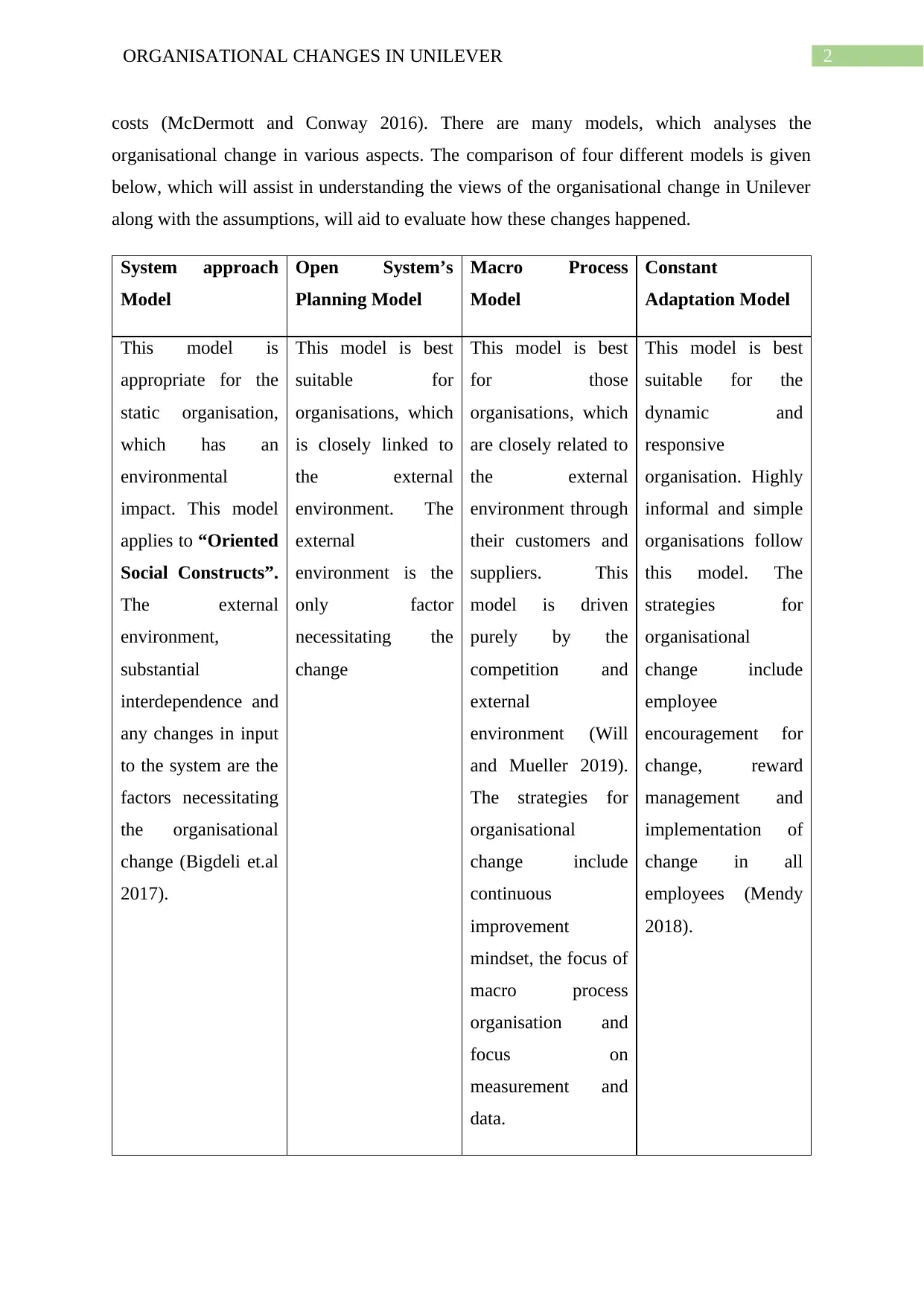
costs (McDermott and Conway 2016). There are many models, which analyses the
organisational change in various aspects. The comparison of four different models is given
below, which will assist in understanding the views of the organisational change in Unilever
along with the assumptions, will aid to evaluate how these changes happened.
System approach
Model
Open System’s
Planning Model
Macro Process
Model
Constant
Adaptation Model
This model is
appropriate for the
static organisation,
which has an
environmental
impact. This model
applies to “Oriented
Social Constructs”.
The external
environment,
substantial
interdependence and
any changes in input
to the system are the
factors necessitating
the organisational
change (Bigdeli et.al
2017).
This model is best
suitable for
organisations, which
is closely linked to
the external
environment. The
external
environment is the
only factor
necessitating the
change
This model is best
for those
organisations, which
are closely related to
the external
environment through
their customers and
suppliers. This
model is driven
purely by the
competition and
external
environment (Will
and Mueller 2019).
The strategies for
organisational
change include
continuous
improvement
mindset, the focus of
macro process
organisation and
focus on
measurement and
data.
This model is best
suitable for the
dynamic and
responsive
organisation. Highly
informal and simple
organisations follow
this model. The
strategies for
organisational
change include
employee
encouragement for
change, reward
management and
implementation of
change in all
employees (Mendy
2018).
costs (McDermott and Conway 2016). There are many models, which analyses the
organisational change in various aspects. The comparison of four different models is given
below, which will assist in understanding the views of the organisational change in Unilever
along with the assumptions, will aid to evaluate how these changes happened.
System approach
Model
Open System’s
Planning Model
Macro Process
Model
Constant
Adaptation Model
This model is
appropriate for the
static organisation,
which has an
environmental
impact. This model
applies to “Oriented
Social Constructs”.
The external
environment,
substantial
interdependence and
any changes in input
to the system are the
factors necessitating
the organisational
change (Bigdeli et.al
2017).
This model is best
suitable for
organisations, which
is closely linked to
the external
environment. The
external
environment is the
only factor
necessitating the
change
This model is best
for those
organisations, which
are closely related to
the external
environment through
their customers and
suppliers. This
model is driven
purely by the
competition and
external
environment (Will
and Mueller 2019).
The strategies for
organisational
change include
continuous
improvement
mindset, the focus of
macro process
organisation and
focus on
measurement and
data.
This model is best
suitable for the
dynamic and
responsive
organisation. Highly
informal and simple
organisations follow
this model. The
strategies for
organisational
change include
employee
encouragement for
change, reward
management and
implementation of
change in all
employees (Mendy
2018).
⊘ This is a preview!⊘
Do you want full access?
Subscribe today to unlock all pages.

Trusted by 1+ million students worldwide
3ORGANISATIONAL CHANGES IN UNILEVER
Unilever is based on a macro process model of organizational change. Unilever was a
decentralized structure before the 1990’s. The change happened as Unilever followed several
strategies which include independent units at various location, growth and sustainability
strategy. This helped Unilever to emerge the market as well as capture the market effectively.
The primary assumption that the management of Unilever had during the implementation of
the change is that they can plan, organize and control the change process (Mendy 2017).
However, they failed to control the perspectives of their employees for which the
organizational change failed in some areas. The organizational change during 1990 happened
as the environment of the market was changing, and in 1932, a single market was created. To
fit into the environment, Unilever had to embrace complicated strategies and organizational
change.
The business strategies and structures are always linked and always evolving; Unilever
was not an exception. The primary purpose of the organizational change in Unilever is to
focus on their strategies more effectively (Blom 2018). The vision of Unilever is to grow its
business by centralizing their structures. Unilever also focused on enhancing the workplace
of their employers, along with environmental sustainability (Narayanan and Adams 2017).
Unilever tried to implement this new organizational change during 1990 as they were focused
on their long-term strategic choices, including emerging markets and cut operating costs. The
organizational change aided them to speed up the development as well as fastened the process
of creation of their new products (Dark et.al 2017). In the year 2000, Unilever switched to a
new structure as their primary strategy was to capture the market while reducing the cost of
their products. This change worked as customers of the market wanted well-known and
reputed brands, which will be able to suit their needs. The centralized structure of Unilever
helped the management in effective decision making, which helped them to follow their
strategies (Brito 2016). Unilever primarily changed their structures through the 1990’s and
2000 to achieve their strategies. The strategies of Unilever for which the restructure in their
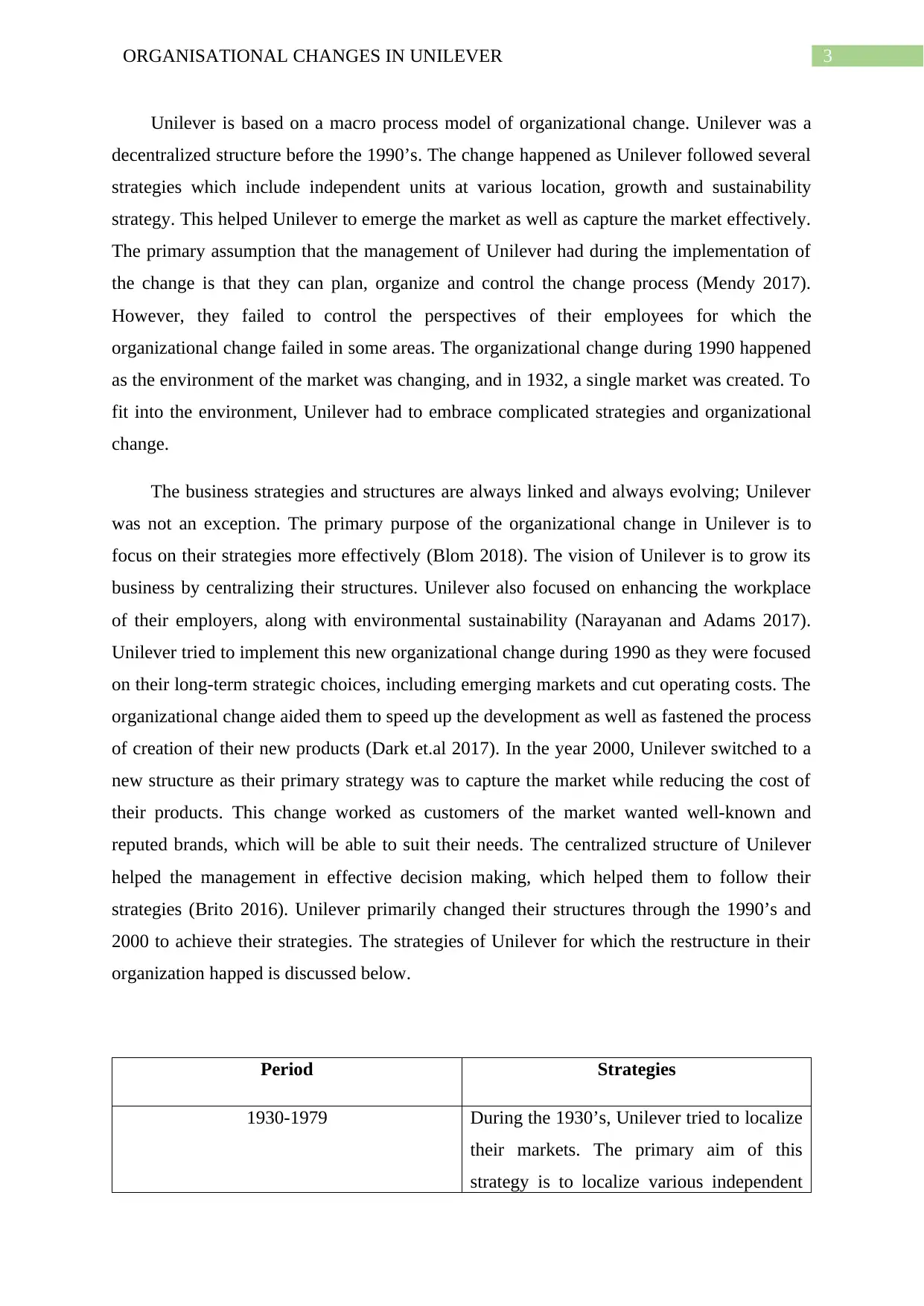
organization happed is discussed below.
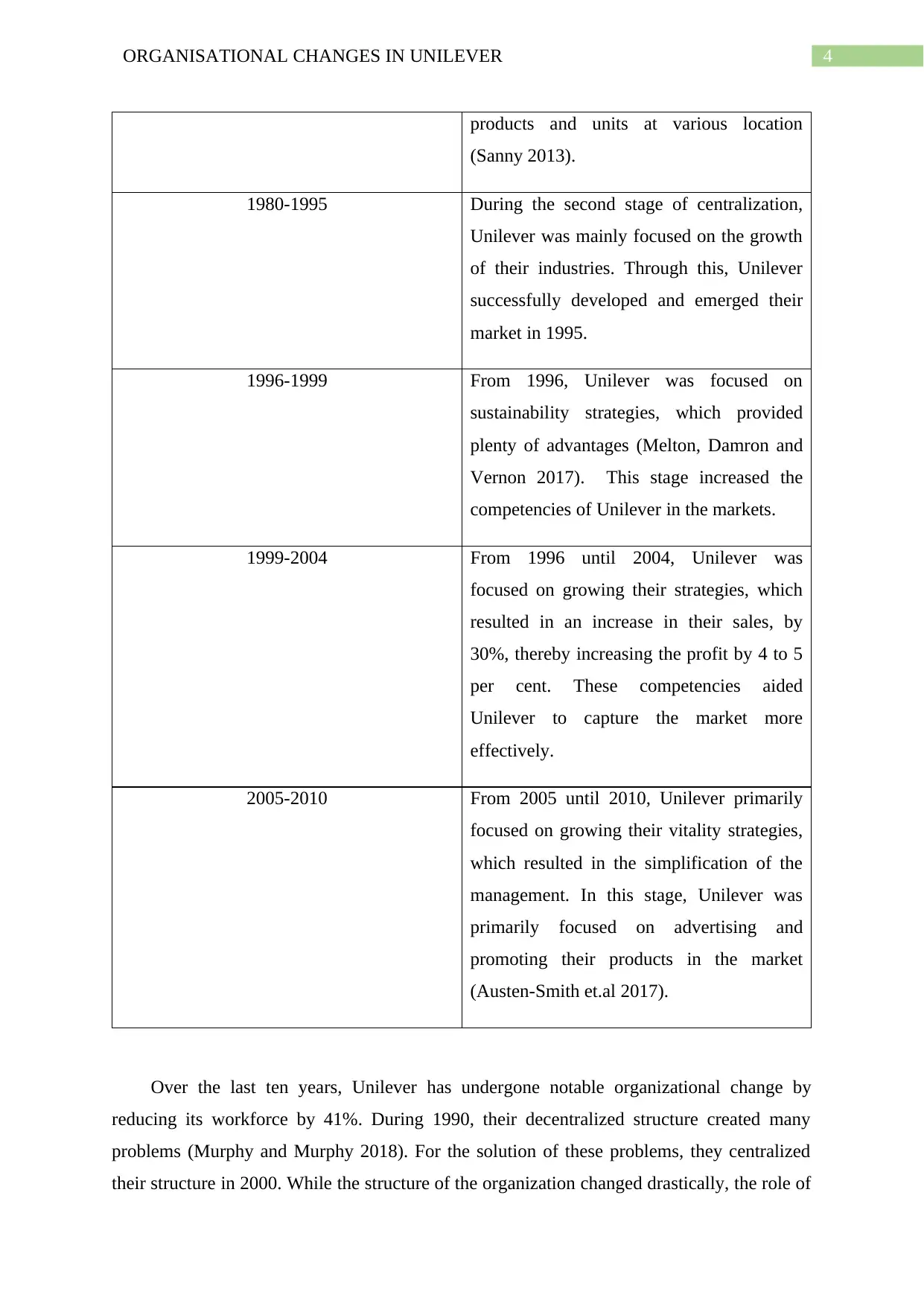
Period Strategies
1930-1979 During the 1930’s, Unilever tried to localize
their markets. The primary aim of this
strategy is to localize various independent
Unilever is based on a macro process model of organizational change. Unilever was a
decentralized structure before the 1990’s. The change happened as Unilever followed several
strategies which include independent units at various location, growth and sustainability
strategy. This helped Unilever to emerge the market as well as capture the market effectively.
The primary assumption that the management of Unilever had during the implementation of
the change is that they can plan, organize and control the change process (Mendy 2017).
However, they failed to control the perspectives of their employees for which the
organizational change failed in some areas. The organizational change during 1990 happened
as the environment of the market was changing, and in 1932, a single market was created. To
fit into the environment, Unilever had to embrace complicated strategies and organizational
change.
The business strategies and structures are always linked and always evolving; Unilever
was not an exception. The primary purpose of the organizational change in Unilever is to
focus on their strategies more effectively (Blom 2018). The vision of Unilever is to grow its
business by centralizing their structures. Unilever also focused on enhancing the workplace
of their employers, along with environmental sustainability (Narayanan and Adams 2017).
Unilever tried to implement this new organizational change during 1990 as they were focused
on their long-term strategic choices, including emerging markets and cut operating costs. The
organizational change aided them to speed up the development as well as fastened the process
of creation of their new products (Dark et.al 2017). In the year 2000, Unilever switched to a
new structure as their primary strategy was to capture the market while reducing the cost of
their products. This change worked as customers of the market wanted well-known and
reputed brands, which will be able to suit their needs. The centralized structure of Unilever
helped the management in effective decision making, which helped them to follow their
strategies (Brito 2016). Unilever primarily changed their structures through the 1990’s and
2000 to achieve their strategies. The strategies of Unilever for which the restructure in their
organization happed is discussed below.
Period Strategies
1930-1979 During the 1930’s, Unilever tried to localize
their markets. The primary aim of this
strategy is to localize various independent
Paraphrase This Document
Need a fresh take? Get an instant paraphrase of this document with our AI Paraphraser
4ORGANISATIONAL CHANGES IN UNILEVER
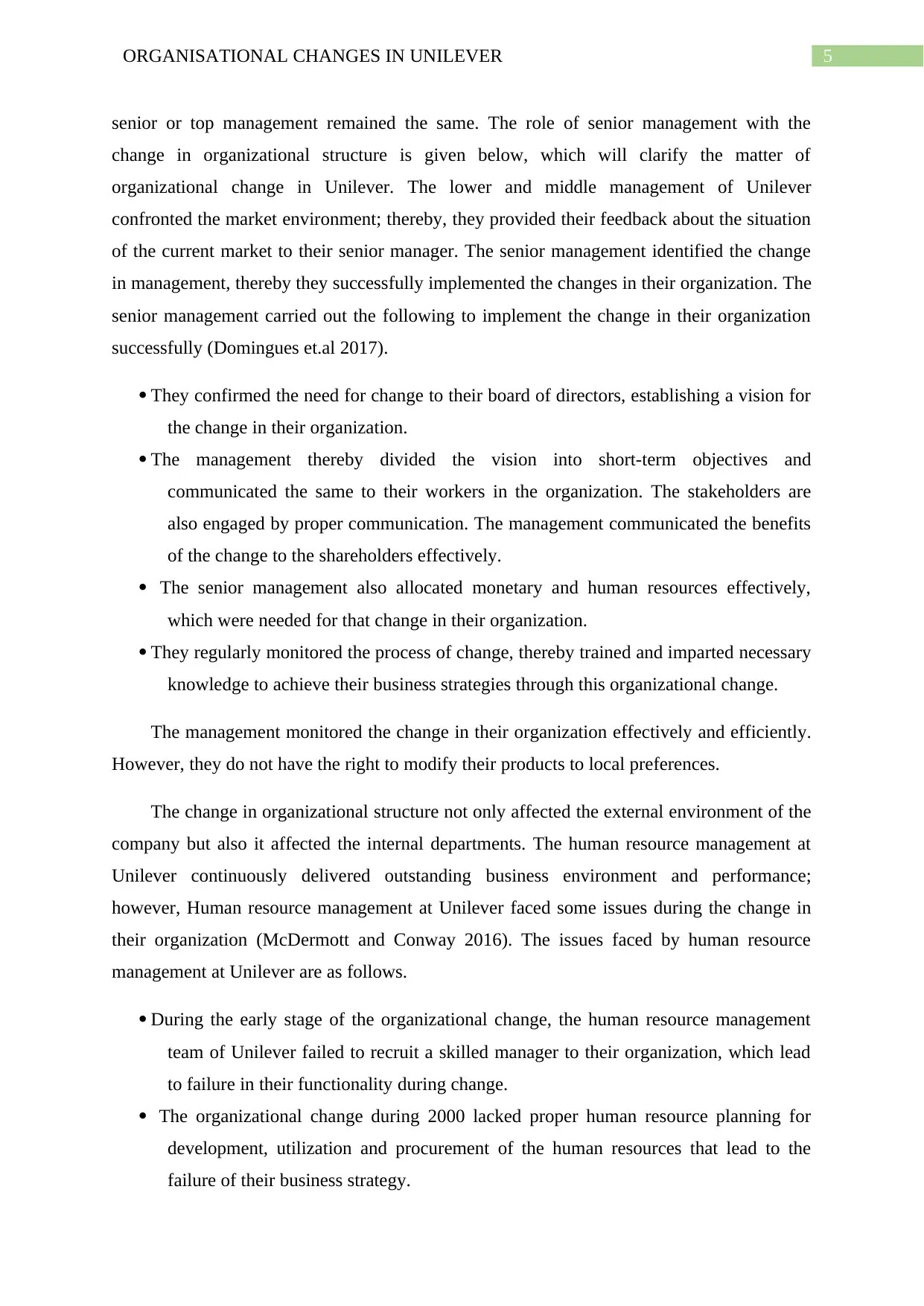
products and units at various location
(Sanny 2013).
1980-1995 During the second stage of centralization,
Unilever was mainly focused on the growth
of their industries. Through this, Unilever
successfully developed and emerged their
market in 1995.
1996-1999 From 1996, Unilever was focused on
sustainability strategies, which provided
plenty of advantages (Melton, Damron and
Vernon 2017). This stage increased the
competencies of Unilever in the markets.
1999-2004 From 1996 until 2004, Unilever was
focused on growing their strategies, which
resulted in an increase in their sales, by
30%, thereby increasing the profit by 4 to 5
per cent. These competencies aided
Unilever to capture the market more
effectively.
2005-2010 From 2005 until 2010, Unilever primarily
focused on growing their vitality strategies,
which resulted in the simplification of the
management. In this stage, Unilever was
primarily focused on advertising and
promoting their products in the market
(Austen-Smith et.al 2017).
Over the last ten years, Unilever has undergone notable organizational change by
reducing its workforce by 41%. During 1990, their decentralized structure created many
problems (Murphy and Murphy 2018). For the solution of these problems, they centralized
their structure in 2000. While the structure of the organization changed drastically, the role of
products and units at various location
(Sanny 2013).
1980-1995 During the second stage of centralization,
Unilever was mainly focused on the growth
of their industries. Through this, Unilever
successfully developed and emerged their
market in 1995.
1996-1999 From 1996, Unilever was focused on
sustainability strategies, which provided
plenty of advantages (Melton, Damron and
Vernon 2017). This stage increased the
competencies of Unilever in the markets.
1999-2004 From 1996 until 2004, Unilever was
focused on growing their strategies, which
resulted in an increase in their sales, by
30%, thereby increasing the profit by 4 to 5
per cent. These competencies aided
Unilever to capture the market more
effectively.
2005-2010 From 2005 until 2010, Unilever primarily
focused on growing their vitality strategies,
which resulted in the simplification of the
management. In this stage, Unilever was
primarily focused on advertising and
promoting their products in the market
(Austen-Smith et.al 2017).
Over the last ten years, Unilever has undergone notable organizational change by
reducing its workforce by 41%. During 1990, their decentralized structure created many
problems (Murphy and Murphy 2018). For the solution of these problems, they centralized
their structure in 2000. While the structure of the organization changed drastically, the role of
5ORGANISATIONAL CHANGES IN UNILEVER
senior or top management remained the same. The role of senior management with the
change in organizational structure is given below, which will clarify the matter of
organizational change in Unilever. The lower and middle management of Unilever
confronted the market environment; thereby, they provided their feedback about the situation
of the current market to their senior manager. The senior management identified the change
in management, thereby they successfully implemented the changes in their organization. The
senior management carried out the following to implement the change in their organization
successfully (Domingues et.al 2017).
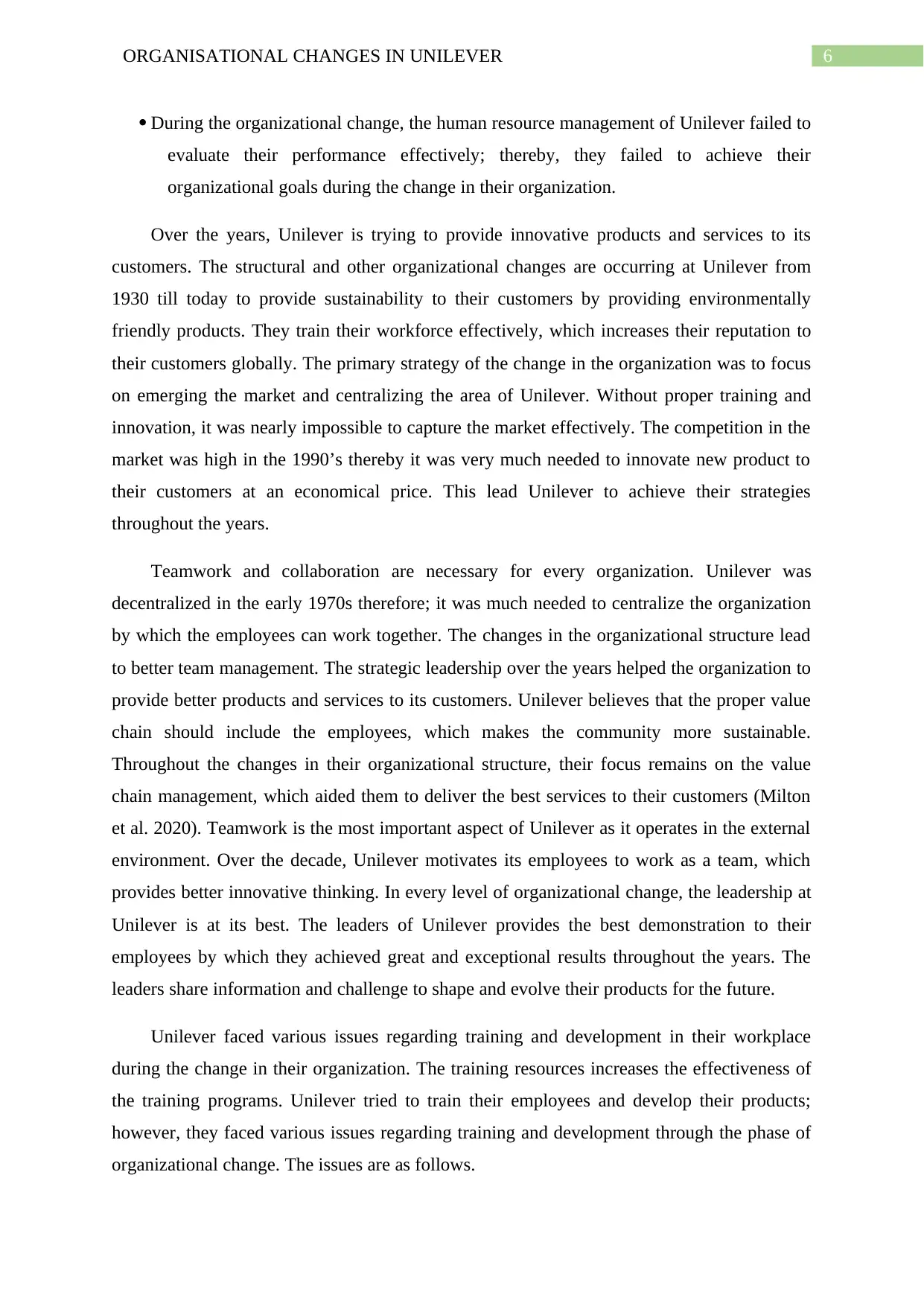
They confirmed the need for change to their board of directors, establishing a vision for
the change in their organization.
The management thereby divided the vision into short-term objectives and
communicated the same to their workers in the organization. The stakeholders are
also engaged by proper communication. The management communicated the benefits
of the change to the shareholders effectively.
The senior management also allocated monetary and human resources effectively,
which were needed for that change in their organization.
They regularly monitored the process of change, thereby trained and imparted necessary
knowledge to achieve their business strategies through this organizational change.
The management monitored the change in their organization effectively and efficiently.
However, they do not have the right to modify their products to local preferences.
The change in organizational structure not only affected the external environment of the
company but also it affected the internal departments. The human resource management at
Unilever continuously delivered outstanding business environment and performance;
however, Human resource management at Unilever faced some issues during the change in
their organization (McDermott and Conway 2016). The issues faced by human resource
management at Unilever are as follows.
During the early stage of the organizational change, the human resource management
team of Unilever failed to recruit a skilled manager to their organization, which lead
to failure in their functionality during change.
The organizational change during 2000 lacked proper human resource planning for
development, utilization and procurement of the human resources that lead to the
failure of their business strategy.
senior or top management remained the same. The role of senior management with the
change in organizational structure is given below, which will clarify the matter of
organizational change in Unilever. The lower and middle management of Unilever
confronted the market environment; thereby, they provided their feedback about the situation
of the current market to their senior manager. The senior management identified the change
in management, thereby they successfully implemented the changes in their organization. The
senior management carried out the following to implement the change in their organization
successfully (Domingues et.al 2017).
They confirmed the need for change to their board of directors, establishing a vision for
the change in their organization.
The management thereby divided the vision into short-term objectives and
communicated the same to their workers in the organization. The stakeholders are
also engaged by proper communication. The management communicated the benefits
of the change to the shareholders effectively.
The senior management also allocated monetary and human resources effectively,
which were needed for that change in their organization.
They regularly monitored the process of change, thereby trained and imparted necessary
knowledge to achieve their business strategies through this organizational change.
The management monitored the change in their organization effectively and efficiently.
However, they do not have the right to modify their products to local preferences.
The change in organizational structure not only affected the external environment of the
company but also it affected the internal departments. The human resource management at
Unilever continuously delivered outstanding business environment and performance;
however, Human resource management at Unilever faced some issues during the change in
their organization (McDermott and Conway 2016). The issues faced by human resource
management at Unilever are as follows.
During the early stage of the organizational change, the human resource management
team of Unilever failed to recruit a skilled manager to their organization, which lead
to failure in their functionality during change.
The organizational change during 2000 lacked proper human resource planning for
development, utilization and procurement of the human resources that lead to the
failure of their business strategy.
⊘ This is a preview!⊘
Do you want full access?
Subscribe today to unlock all pages.
Trusted by 1+ million students worldwide
6ORGANISATIONAL CHANGES IN UNILEVER
During the organizational change, the human resource management of Unilever failed to
evaluate their performance effectively; thereby, they failed to achieve their
organizational goals during the change in their organization.
Over the years, Unilever is trying to provide innovative products and services to its
customers. The structural and other organizational changes are occurring at Unilever from
1930 till today to provide sustainability to their customers by providing environmentally
friendly products. They train their workforce effectively, which increases their reputation to
their customers globally. The primary strategy of the change in the organization was to focus
on emerging the market and centralizing the area of Unilever. Without proper training and
innovation, it was nearly impossible to capture the market effectively. The competition in the
market was high in the 1990’s thereby it was very much needed to innovate new product to
their customers at an economical price. This lead Unilever to achieve their strategies
throughout the years.
Teamwork and collaboration are necessary for every organization. Unilever was
decentralized in the early 1970s therefore; it was much needed to centralize the organization
by which the employees can work together. The changes in the organizational structure lead
to better team management. The strategic leadership over the years helped the organization to
provide better products and services to its customers. Unilever believes that the proper value
chain should include the employees, which makes the community more sustainable.
Throughout the changes in their organizational structure, their focus remains on the value
chain management, which aided them to deliver the best services to their customers (Milton
et al. 2020). Teamwork is the most important aspect of Unilever as it operates in the external
environment. Over the decade, Unilever motivates its employees to work as a team, which
provides better innovative thinking. In every level of organizational change, the leadership at
Unilever is at its best. The leaders of Unilever provides the best demonstration to their
employees by which they achieved great and exceptional results throughout the years. The
leaders share information and challenge to shape and evolve their products for the future.
Unilever faced various issues regarding training and development in their workplace
during the change in their organization. The training resources increases the effectiveness of
the training programs. Unilever tried to train their employees and develop their products;
however, they faced various issues regarding training and development through the phase of
organizational change. The issues are as follows.
During the organizational change, the human resource management of Unilever failed to
evaluate their performance effectively; thereby, they failed to achieve their
organizational goals during the change in their organization.
Over the years, Unilever is trying to provide innovative products and services to its
customers. The structural and other organizational changes are occurring at Unilever from
1930 till today to provide sustainability to their customers by providing environmentally
friendly products. They train their workforce effectively, which increases their reputation to
their customers globally. The primary strategy of the change in the organization was to focus
on emerging the market and centralizing the area of Unilever. Without proper training and
innovation, it was nearly impossible to capture the market effectively. The competition in the
market was high in the 1990’s thereby it was very much needed to innovate new product to
their customers at an economical price. This lead Unilever to achieve their strategies
throughout the years.
Teamwork and collaboration are necessary for every organization. Unilever was
decentralized in the early 1970s therefore; it was much needed to centralize the organization
by which the employees can work together. The changes in the organizational structure lead
to better team management. The strategic leadership over the years helped the organization to
provide better products and services to its customers. Unilever believes that the proper value
chain should include the employees, which makes the community more sustainable.
Throughout the changes in their organizational structure, their focus remains on the value
chain management, which aided them to deliver the best services to their customers (Milton
et al. 2020). Teamwork is the most important aspect of Unilever as it operates in the external
environment. Over the decade, Unilever motivates its employees to work as a team, which
provides better innovative thinking. In every level of organizational change, the leadership at
Unilever is at its best. The leaders of Unilever provides the best demonstration to their
employees by which they achieved great and exceptional results throughout the years. The
leaders share information and challenge to shape and evolve their products for the future.
Unilever faced various issues regarding training and development in their workplace
during the change in their organization. The training resources increases the effectiveness of
the training programs. Unilever tried to train their employees and develop their products;
however, they faced various issues regarding training and development through the phase of
organizational change. The issues are as follows.
Paraphrase This Document
Need a fresh take? Get an instant paraphrase of this document with our AI Paraphraser
7ORGANISATIONAL CHANGES IN UNILEVER
The primary reason for which Unilever failed to solve their challenges is hectic work
schedules of their employees. The confusion in the training sessions is the primary
reason for this failure in the training of Unilever.
The decentralized workforce in 1930 was a real problem for Unilever. With a dispersed
workforce, the training can be hard for the employees. Unilever tried to communicate
with their employees through training after the centralization of their workforce,
which reduced the problem regarding workforce and development.
Lack of engagement is a problem in the training of Unilever. Most of the employees
thought that training is irrelevant and unnecessary. During the organizational change,
this became a serious issue to Unilever.
The leaders of Unilever had certain roles, which helped them to implement the change
in the organization successfully (Burnes, Hughes and By 2018). The roles of leaders of
Unilever is given below, which helped the organization to change successfully.
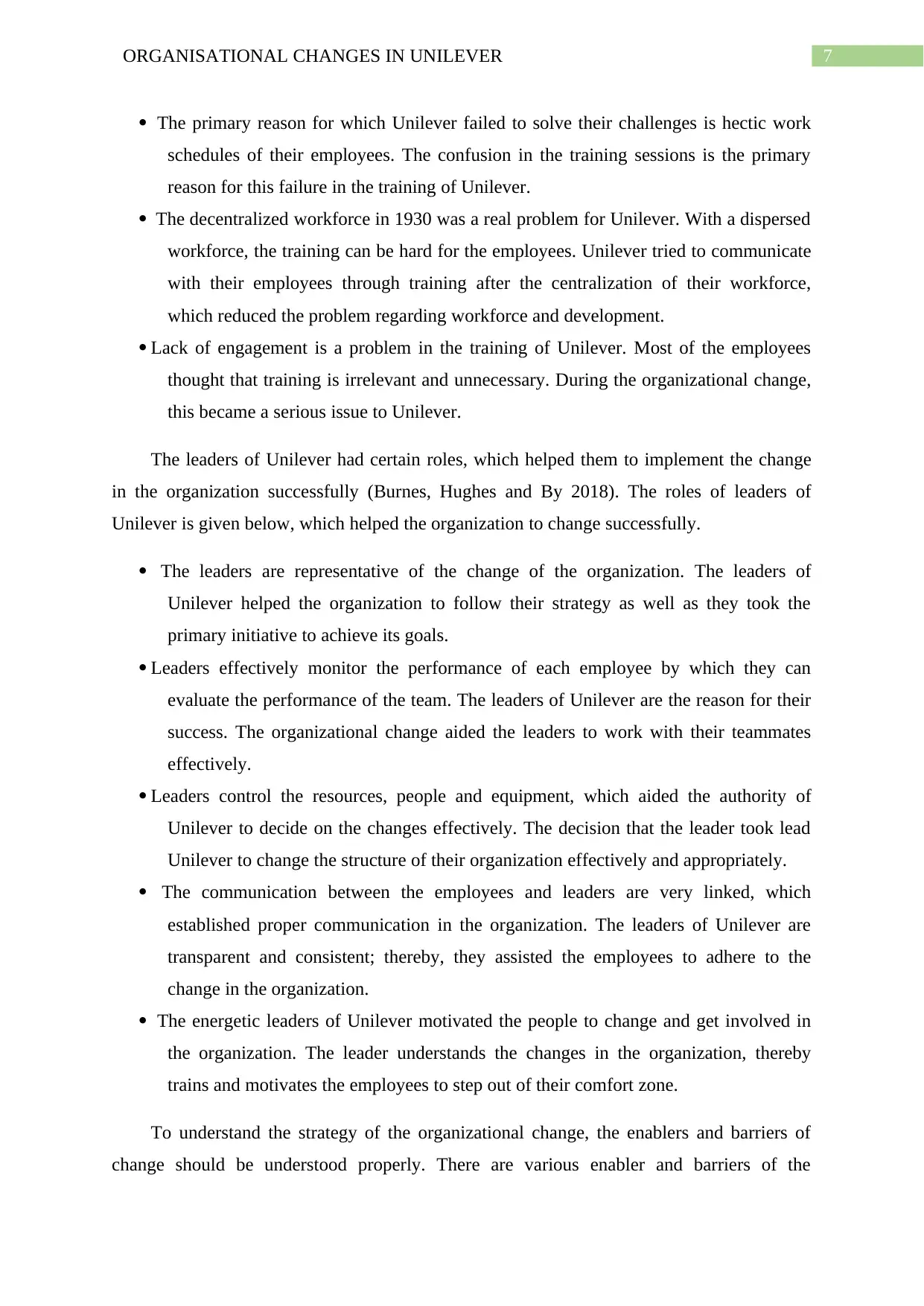
The leaders are representative of the change of the organization. The leaders of
Unilever helped the organization to follow their strategy as well as they took the
primary initiative to achieve its goals.
Leaders effectively monitor the performance of each employee by which they can
evaluate the performance of the team. The leaders of Unilever are the reason for their
success. The organizational change aided the leaders to work with their teammates
effectively.
Leaders control the resources, people and equipment, which aided the authority of
Unilever to decide on the changes effectively. The decision that the leader took lead
Unilever to change the structure of their organization effectively and appropriately.
The communication between the employees and leaders are very linked, which
established proper communication in the organization. The leaders of Unilever are
transparent and consistent; thereby, they assisted the employees to adhere to the
change in the organization.
The energetic leaders of Unilever motivated the people to change and get involved in
the organization. The leader understands the changes in the organization, thereby
trains and motivates the employees to step out of their comfort zone.
To understand the strategy of the organizational change, the enablers and barriers of
change should be understood properly. There are various enabler and barriers of the
The primary reason for which Unilever failed to solve their challenges is hectic work
schedules of their employees. The confusion in the training sessions is the primary
reason for this failure in the training of Unilever.
The decentralized workforce in 1930 was a real problem for Unilever. With a dispersed
workforce, the training can be hard for the employees. Unilever tried to communicate
with their employees through training after the centralization of their workforce,
which reduced the problem regarding workforce and development.
Lack of engagement is a problem in the training of Unilever. Most of the employees
thought that training is irrelevant and unnecessary. During the organizational change,
this became a serious issue to Unilever.
The leaders of Unilever had certain roles, which helped them to implement the change
in the organization successfully (Burnes, Hughes and By 2018). The roles of leaders of
Unilever is given below, which helped the organization to change successfully.
The leaders are representative of the change of the organization. The leaders of
Unilever helped the organization to follow their strategy as well as they took the
primary initiative to achieve its goals.
Leaders effectively monitor the performance of each employee by which they can
evaluate the performance of the team. The leaders of Unilever are the reason for their
success. The organizational change aided the leaders to work with their teammates
effectively.
Leaders control the resources, people and equipment, which aided the authority of
Unilever to decide on the changes effectively. The decision that the leader took lead
Unilever to change the structure of their organization effectively and appropriately.
The communication between the employees and leaders are very linked, which
established proper communication in the organization. The leaders of Unilever are
transparent and consistent; thereby, they assisted the employees to adhere to the
change in the organization.
The energetic leaders of Unilever motivated the people to change and get involved in
the organization. The leader understands the changes in the organization, thereby
trains and motivates the employees to step out of their comfort zone.
To understand the strategy of the organizational change, the enablers and barriers of
change should be understood properly. There are various enabler and barriers of the
8ORGANISATIONAL CHANGES IN UNILEVER
organizational change that Unilever had gone through. The enablers and barriers of
organizational change are evaluated below, which will aid to understand the change in the
organization.
The properly planned change management provides various benefits to the organization.
The benefits of change management are given below
Teamwork is the primary enablers of organizational change. Strong teamwork leads to
a better reputation of the organization. The leaders should interpret the need for the
change to their teammates. Interdependency is the primary factor in the teamwork.
The management of the Unilever should identify the employees, which helped them to
undergo the changes in their organization. Each employee should be linked with other
people, which helps the management to manage the employees effectively, thereby
providing a better change in the organization.
The power is a noteworthy enabler of organisational change if used properly. The
management of Unilever should observe whether the powers to the leaders are
allocated properly or not. This leads to a change in the structure of the organization
effective and accurately.
The leaders should help the employees to understand why the change is necessary. The
leaders of Unilever assisted the employees in understanding why this change is
necessary for them and for the organization. Effective communication helped the
management to understand the organisational change effectively (Totterdill and Exton
2017).
Despite these enablers, there are several barriers to Unilever, which affected their
change. The barriers to organisational change are given below.
The primary barrier for the early decentralization of their structure is because of the high
cost in the structures. For the higher cost of structures compared to their competitor,
Unilever was falling behind in the market. The decentralized structure prevented the
development of their new products to the global market.
The primary barrier of the centralized structure was that the managers of Unilever could
not modify their new products to local preferences. In simple form, the managers are
not allowed to match the product offerings and market strategies to local tastes.
organizational change that Unilever had gone through. The enablers and barriers of
organizational change are evaluated below, which will aid to understand the change in the
organization.
The properly planned change management provides various benefits to the organization.
The benefits of change management are given below
Teamwork is the primary enablers of organizational change. Strong teamwork leads to
a better reputation of the organization. The leaders should interpret the need for the
change to their teammates. Interdependency is the primary factor in the teamwork.
The management of the Unilever should identify the employees, which helped them to
undergo the changes in their organization. Each employee should be linked with other
people, which helps the management to manage the employees effectively, thereby
providing a better change in the organization.
The power is a noteworthy enabler of organisational change if used properly. The
management of Unilever should observe whether the powers to the leaders are
allocated properly or not. This leads to a change in the structure of the organization
effective and accurately.
The leaders should help the employees to understand why the change is necessary. The
leaders of Unilever assisted the employees in understanding why this change is
necessary for them and for the organization. Effective communication helped the
management to understand the organisational change effectively (Totterdill and Exton
2017).
Despite these enablers, there are several barriers to Unilever, which affected their
change. The barriers to organisational change are given below.
The primary barrier for the early decentralization of their structure is because of the high
cost in the structures. For the higher cost of structures compared to their competitor,
Unilever was falling behind in the market. The decentralized structure prevented the
development of their new products to the global market.
The primary barrier of the centralized structure was that the managers of Unilever could
not modify their new products to local preferences. In simple form, the managers are
not allowed to match the product offerings and market strategies to local tastes.
⊘ This is a preview!⊘
Do you want full access?
Subscribe today to unlock all pages.
Trusted by 1+ million students worldwide
9ORGANISATIONAL CHANGES IN UNILEVER
There are other barriers in the organisational change of Unilever, including poor
communication between the management, inadequate resources and budget, impact in
the global market economy and drop in the productivity and performance.
Conclusion
The essay signifies that Unilever had made a notable impact in the global market from
1930. However, it can be observed that the company was decentralised in early 1930, which
made some problems like the high cost of structures and prevention of the development of the
new product. From 2000, the company centralised, which aided them to capture and compete
in the market more effectively. The change in organisational structure aided the firm to
increase its area of operations along with boosting their productivity.
There are other barriers in the organisational change of Unilever, including poor
communication between the management, inadequate resources and budget, impact in
the global market economy and drop in the productivity and performance.
Conclusion
The essay signifies that Unilever had made a notable impact in the global market from
1930. However, it can be observed that the company was decentralised in early 1930, which
made some problems like the high cost of structures and prevention of the development of the
new product. From 2000, the company centralised, which aided them to capture and compete
in the market more effectively. The change in organisational structure aided the firm to
increase its area of operations along with boosting their productivity.
Paraphrase This Document
Need a fresh take? Get an instant paraphrase of this document with our AI Paraphraser
10ORGANISATIONAL CHANGES IN UNILEVER
References
Austen-Smith, D., Galinsky, A., Chung, K.H. and LaVanway, C., 2017. Unilever's Mission
for Vitality. Kellogg School of Management Cases.
Bigdeli, A.Z., Baines, T., Bustinza, O.F. and Shi, V.G., 2017. Organisational change towards
servitization: a theoretical framework. Competitiveness Review: An International Business
Journal.
Blom, T., 2018. Organisational wellness: human reaction to change. South African Journal of
Business Management, 49(1), pp.1-10.
Brito, B.D.R.M.S., 2016. Centralization of supply chain management operations: the case of
Unilever Ultralogistik.
Burnes, B., Hughes, M. and By, R.T., 2018. Reimagining organisational change
leadership. Leadership, 14(2), pp.141-158.
Busse, R. and Doganer, U., 2018. The role of compliance for organisational change. Journal
of Organizational Change Management.
Dark, F., Whiteford, H., Ashkanasy, N.M., Harvey, C., Harris, M., Crompton, D. and
Newman, E., 2017. The impact of organisational change and fiscal restraint on organisational
culture. International journal of mental health systems, 11(1), p.11.
Domingues, A.R., Lozano, R., Ceulemans, K. and Ramos, T.B., 2017. Sustainability
reporting in public sector organisations: Exploring the relation between the reporting process
and organisational change management for sustainability. Journal of environmental
management, 192, pp.292-301.
Elsmore, P., 2017. Organisational Culture: Organisational Change?: Organisational
Change?. Routledge.
Imhonopi, D., Urim, U.M. and Excellence-Oluye, N., 2018. Organisational change
management strategies: Lessons for industry in developing countries.
McDermott, A.M. and Conway, E., 2016. Organisational change and human resource
management.
References
Austen-Smith, D., Galinsky, A., Chung, K.H. and LaVanway, C., 2017. Unilever's Mission
for Vitality. Kellogg School of Management Cases.
Bigdeli, A.Z., Baines, T., Bustinza, O.F. and Shi, V.G., 2017. Organisational change towards
servitization: a theoretical framework. Competitiveness Review: An International Business
Journal.
Blom, T., 2018. Organisational wellness: human reaction to change. South African Journal of
Business Management, 49(1), pp.1-10.
Brito, B.D.R.M.S., 2016. Centralization of supply chain management operations: the case of
Unilever Ultralogistik.
Burnes, B., Hughes, M. and By, R.T., 2018. Reimagining organisational change
leadership. Leadership, 14(2), pp.141-158.
Busse, R. and Doganer, U., 2018. The role of compliance for organisational change. Journal
of Organizational Change Management.
Dark, F., Whiteford, H., Ashkanasy, N.M., Harvey, C., Harris, M., Crompton, D. and
Newman, E., 2017. The impact of organisational change and fiscal restraint on organisational
culture. International journal of mental health systems, 11(1), p.11.
Domingues, A.R., Lozano, R., Ceulemans, K. and Ramos, T.B., 2017. Sustainability
reporting in public sector organisations: Exploring the relation between the reporting process
and organisational change management for sustainability. Journal of environmental
management, 192, pp.292-301.
Elsmore, P., 2017. Organisational Culture: Organisational Change?: Organisational
Change?. Routledge.
Imhonopi, D., Urim, U.M. and Excellence-Oluye, N., 2018. Organisational change
management strategies: Lessons for industry in developing countries.
McDermott, A.M. and Conway, E., 2016. Organisational change and human resource
management.
11ORGANISATIONAL CHANGES IN UNILEVER
McDermott, A.M. and Conway, E., 2016. Organisational change and human resource
management.
Melton, A., Damron, T. and Vernon, J., 2017. A Marketing Strategy from Corporate Social
Responsibility: Lessons from Unilever and Coca-Cola Enterprises.
Mendy, J., 2017. Organisational change research: challenges and assumptions. What about
possibilities?.
Mendy, J., 2018. Reflections on Employees’ Lived Experiences of Organisational Change.
Milton, J., Chaboyer, W., Åberg, N.D., Andersson, A.E. and Oxelmark, L., 2020. Safety
attitudes and working climate after organizational change in a major emergency department
in Sweden. International Emergency Nursing, p.100830.
Murphy, P.E. and Murphy, C.E., 2018. Sustainable living: Unilever. In Progressive Business
Models (pp. 263-286). Palgrave Macmillan, Cham.
Narayanan, V. and Adams, C.A., 2017. Transformative change towards sustainability: the
interaction between organisational discourses and organisational practices. Accounting and
Business Research, 47(3), pp.344-368.
Rizescu, A. and Tileag, C., 2016. Factors influencing continuous organisational
change. Journal of Defense Resources Management, 7(2), p.139.
Rosenbaum, D., More, E. and Steane, P., 2018. Planned organisational change
management. Journal of Organizational Change Management.
Sanny, L., 2013. Unilever in Emerging Markets. In Jurnal Forum Ilmiah (Vol. 10, No. 1, pp.
118-124). Univ. Indonusa Esa Unggul,.
Totterdill, P. and Exton, R., 2017. Creating the bottom-up organisation from the top: Leaders
as enablers of workplace innovation. In Workplace Innovation (pp. 189-207). Springer,
Cham.
Waddell, D., Creed, A., Cummings, T.G. and Worley, C.G., 2019. Organisational change:
Development and transformation. Cengage AU.
McDermott, A.M. and Conway, E., 2016. Organisational change and human resource
management.
Melton, A., Damron, T. and Vernon, J., 2017. A Marketing Strategy from Corporate Social
Responsibility: Lessons from Unilever and Coca-Cola Enterprises.
Mendy, J., 2017. Organisational change research: challenges and assumptions. What about
possibilities?.
Mendy, J., 2018. Reflections on Employees’ Lived Experiences of Organisational Change.
Milton, J., Chaboyer, W., Åberg, N.D., Andersson, A.E. and Oxelmark, L., 2020. Safety
attitudes and working climate after organizational change in a major emergency department
in Sweden. International Emergency Nursing, p.100830.
Murphy, P.E. and Murphy, C.E., 2018. Sustainable living: Unilever. In Progressive Business
Models (pp. 263-286). Palgrave Macmillan, Cham.
Narayanan, V. and Adams, C.A., 2017. Transformative change towards sustainability: the
interaction between organisational discourses and organisational practices. Accounting and
Business Research, 47(3), pp.344-368.
Rizescu, A. and Tileag, C., 2016. Factors influencing continuous organisational
change. Journal of Defense Resources Management, 7(2), p.139.
Rosenbaum, D., More, E. and Steane, P., 2018. Planned organisational change
management. Journal of Organizational Change Management.
Sanny, L., 2013. Unilever in Emerging Markets. In Jurnal Forum Ilmiah (Vol. 10, No. 1, pp.
118-124). Univ. Indonusa Esa Unggul,.
Totterdill, P. and Exton, R., 2017. Creating the bottom-up organisation from the top: Leaders
as enablers of workplace innovation. In Workplace Innovation (pp. 189-207). Springer,
Cham.
Waddell, D., Creed, A., Cummings, T.G. and Worley, C.G., 2019. Organisational change:
Development and transformation. Cengage AU.
⊘ This is a preview!⊘
Do you want full access?
Subscribe today to unlock all pages.
Trusted by 1+ million students worldwide

1 out of 13


Related Documents


Your All-in-One AI-Powered Toolkit for Academic Success.
+13062052269
info@desklib.com
Available 24*7 on WhatsApp / Email
![[object Object]](/_next/static/media/star-bottom.7253800d.svg)
Unlock your academic potential
Copyright © 2020–2025 A2Z Services. All Rights Reserved. Developed and managed by ZUCOL.