Analysis of Unilever's Management Strategies: SMART, TQM, Kaizen
VerifiedAdded on 2022/11/23
|11
|3279
|55
Report
AI Summary
This report examines Unilever's strategic management practices, focusing on the Simple Multi-attribute Rating Technique (SMART) for decision-making, Total Quality Management (TQM), and the Kaizen approach for continuous improvement. The report analyzes Unilever's problems, such as maintaining sustainability in marketing and environmental impact, and applies the SMART method to aid in decision-making, discussing its strengths and limitations. Furthermore, it explores the implementation of TQM and Kaizen, highlighting their interrelation and the challenges faced by the company, including organizational culture and employee resistance. The report emphasizes the importance of continuous improvement in the business environment and provides insights into how Unilever can leverage these approaches to achieve its objectives. It offers a detailed analysis of the strategies and their impact on Unilever's operations and success.
Design Management

Paraphrase This Document
Need a fresh take? Get an instant paraphrase of this document with our AI Paraphraser
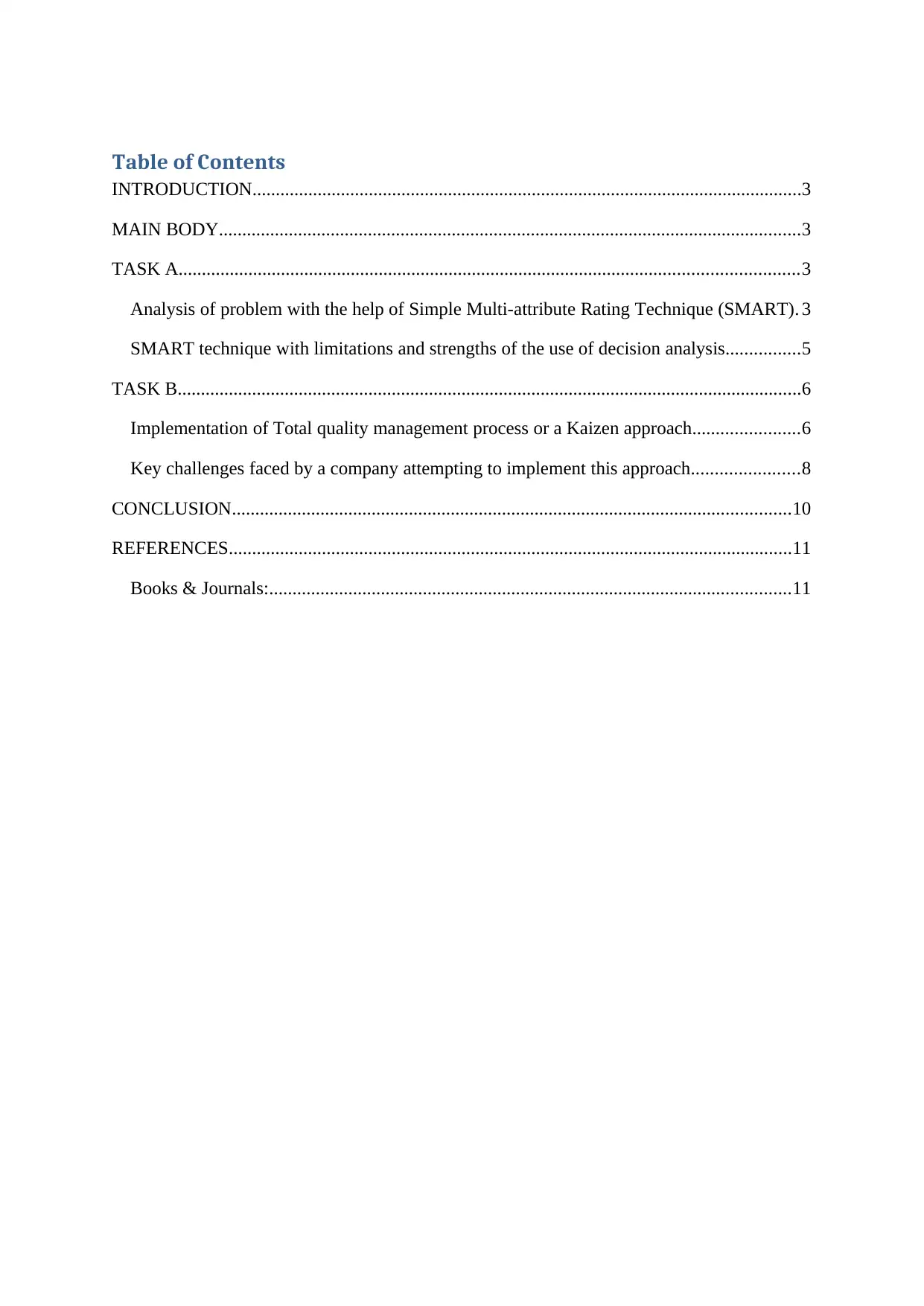
Table of Contents
INTRODUCTION......................................................................................................................3
MAIN BODY.............................................................................................................................3
TASK A.....................................................................................................................................3
Analysis of problem with the help of Simple Multi-attribute Rating Technique (SMART). 3
SMART technique with limitations and strengths of the use of decision analysis................5
TASK B......................................................................................................................................6
Implementation of Total quality management process or a Kaizen approach.......................6
Key challenges faced by a company attempting to implement this approach.......................8
CONCLUSION........................................................................................................................10
REFERENCES.........................................................................................................................11
Books & Journals:................................................................................................................11
INTRODUCTION......................................................................................................................3
MAIN BODY.............................................................................................................................3
TASK A.....................................................................................................................................3
Analysis of problem with the help of Simple Multi-attribute Rating Technique (SMART). 3
SMART technique with limitations and strengths of the use of decision analysis................5
TASK B......................................................................................................................................6
Implementation of Total quality management process or a Kaizen approach.......................6
Key challenges faced by a company attempting to implement this approach.......................8
CONCLUSION........................................................................................................................10
REFERENCES.........................................................................................................................11
Books & Journals:................................................................................................................11
INTRODUCTION
In business environment, organisation takes decisions on a regular basis and it gives a
great impact on the success and growth of a company. That’s why it is necessary for the
organisation that they should take a wise decision which is helpful in order to take a
competitive advantage (Tavakoli, Carriere and Torabi, 2020). Decisions are taken by top
management of organisation and it is a crucial step for company. So it is vital for organisation
that they should important framework or method which makes the decision right. In this
context, Unilever is undertaken in order to solve their problem with the help of technique.
Unilever is the UK based form that operates in consumer goods in international market. This
report will be discussing the analysis of problem with the help of SMART method. It also
discusses the limitations and strengths of tool or technique. In addition to this, report will be
discuss the implementation of total quality management process with description of
challenges that companies facing in order to implement this approach.
MAIN BODY
TASK A
Analysis of problem with the help of Simple Multi-attribute Rating Technique (SMART)
Unilever is the large organisation that currently operates in many countries. Due to
many factors such as competition, dynamic of business environment, etc. company need to
take decisions but it becomes very difficult because the decision is directly impact on
organisation’s success and growth. That's why Unilever need to take a wise decision
(Bolchini, Geronazzo and Quintarelli, 2017). For that purpose, Simple Multi-attribute Rating
Technique (SMART) is the best method for organisation to take right decision from multiple
alternatives. Currently, Unilever is facing problems which are mentioned below:
It is identified in the survey that Unilever is facing of biggest problem is to maintain
sustainability in the marketing practices. Company analysis that it is not so easy for
organisation to ensure sustainability in the marketing.
Unilever is facing a problem of environment impact which is increasing day by day
due to the industrialization. For that purpose, they developed those kinds of products
which are able to reduce the environmental impact. For example, comfort one rinse
In business environment, organisation takes decisions on a regular basis and it gives a
great impact on the success and growth of a company. That’s why it is necessary for the
organisation that they should take a wise decision which is helpful in order to take a
competitive advantage (Tavakoli, Carriere and Torabi, 2020). Decisions are taken by top
management of organisation and it is a crucial step for company. So it is vital for organisation
that they should important framework or method which makes the decision right. In this
context, Unilever is undertaken in order to solve their problem with the help of technique.
Unilever is the UK based form that operates in consumer goods in international market. This
report will be discussing the analysis of problem with the help of SMART method. It also
discusses the limitations and strengths of tool or technique. In addition to this, report will be
discuss the implementation of total quality management process with description of
challenges that companies facing in order to implement this approach.
MAIN BODY
TASK A
Analysis of problem with the help of Simple Multi-attribute Rating Technique (SMART)
Unilever is the large organisation that currently operates in many countries. Due to
many factors such as competition, dynamic of business environment, etc. company need to
take decisions but it becomes very difficult because the decision is directly impact on
organisation’s success and growth. That's why Unilever need to take a wise decision
(Bolchini, Geronazzo and Quintarelli, 2017). For that purpose, Simple Multi-attribute Rating
Technique (SMART) is the best method for organisation to take right decision from multiple
alternatives. Currently, Unilever is facing problems which are mentioned below:
It is identified in the survey that Unilever is facing of biggest problem is to maintain
sustainability in the marketing practices. Company analysis that it is not so easy for
organisation to ensure sustainability in the marketing.
Unilever is facing a problem of environment impact which is increasing day by day
due to the industrialization. For that purpose, they developed those kinds of products
which are able to reduce the environmental impact. For example, comfort one rinse
⊘ This is a preview!⊘
Do you want full access?
Subscribe today to unlock all pages.

Trusted by 1+ million students worldwide
laundry detergent which is very beneficial for people in order to reduce the use of
water. But Unilever is failing to explain the use of this detergent that how it reduces
the use of water. People are not able to use the product in a right way so that they can
minimise the impact on environment.
Resource management is becoming one of the biggest problems in which company
needs to effectively use their available resources so that they can minimise the risk of
unavailability of materials and maximize their profit.
From the discussion of Unilever’s problems, it is identified that organisation can deal with
the situations if they are taking right decisions. This can be done with the use of SMART
method which is the acronym of Simple Multi-attribute Rating Technique (SMART). It is
necessary for companies that they should understand the use and meaning of this technique.
Simple Multi-attribute Rating Technique (SMART)
This technique is widely used by organisation for the purpose of taking this decision
which becomes the reason of their growth and success. It is a very simple method for
decision makers of Unilever in order to resolve their problems by taking right (Chernov and
et. al., 2017). For that purpose, they have to found many alternatives and then give rating to
each alternative according to the critical analysis. After that decision making need to select
one of the best attributes according to the rating basis as it is mathematical tool which is very
easy to implement in the company. For that purpose, it takes a simple process which is well
explained below:
The very first step of is to identify the decision makers in Unilever. It is identified that
the decision maker of Unilever is the marketing manager.
The second step which is very important for a decision maker is needed to find out the
alternatives which are necessary in order to take best decision.
The third step which is very necessary for taking a right decision is to identify he
attributes that are relevant for decision problems. It can be cost, benefits, etc for the
purpose of resolving the problem of sustainability in the marketing.
Now fourth step is to assign values to each attributes in order to measure the
performances of the selected alternatives. In the case of Unilever, they give values to
each of the selected attributes.
The fifth step is determining weight to each attribute which is very necessary in order
to taking the right decision.
water. But Unilever is failing to explain the use of this detergent that how it reduces
the use of water. People are not able to use the product in a right way so that they can
minimise the impact on environment.
Resource management is becoming one of the biggest problems in which company
needs to effectively use their available resources so that they can minimise the risk of
unavailability of materials and maximize their profit.
From the discussion of Unilever’s problems, it is identified that organisation can deal with
the situations if they are taking right decisions. This can be done with the use of SMART
method which is the acronym of Simple Multi-attribute Rating Technique (SMART). It is
necessary for companies that they should understand the use and meaning of this technique.
Simple Multi-attribute Rating Technique (SMART)
This technique is widely used by organisation for the purpose of taking this decision
which becomes the reason of their growth and success. It is a very simple method for
decision makers of Unilever in order to resolve their problems by taking right (Chernov and
et. al., 2017). For that purpose, they have to found many alternatives and then give rating to
each alternative according to the critical analysis. After that decision making need to select
one of the best attributes according to the rating basis as it is mathematical tool which is very
easy to implement in the company. For that purpose, it takes a simple process which is well
explained below:
The very first step of is to identify the decision makers in Unilever. It is identified that
the decision maker of Unilever is the marketing manager.
The second step which is very important for a decision maker is needed to find out the
alternatives which are necessary in order to take best decision.
The third step which is very necessary for taking a right decision is to identify he
attributes that are relevant for decision problems. It can be cost, benefits, etc for the
purpose of resolving the problem of sustainability in the marketing.
Now fourth step is to assign values to each attributes in order to measure the
performances of the selected alternatives. In the case of Unilever, they give values to
each of the selected attributes.
The fifth step is determining weight to each attribute which is very necessary in order
to taking the right decision.
Paraphrase This Document
Need a fresh take? Get an instant paraphrase of this document with our AI Paraphraser
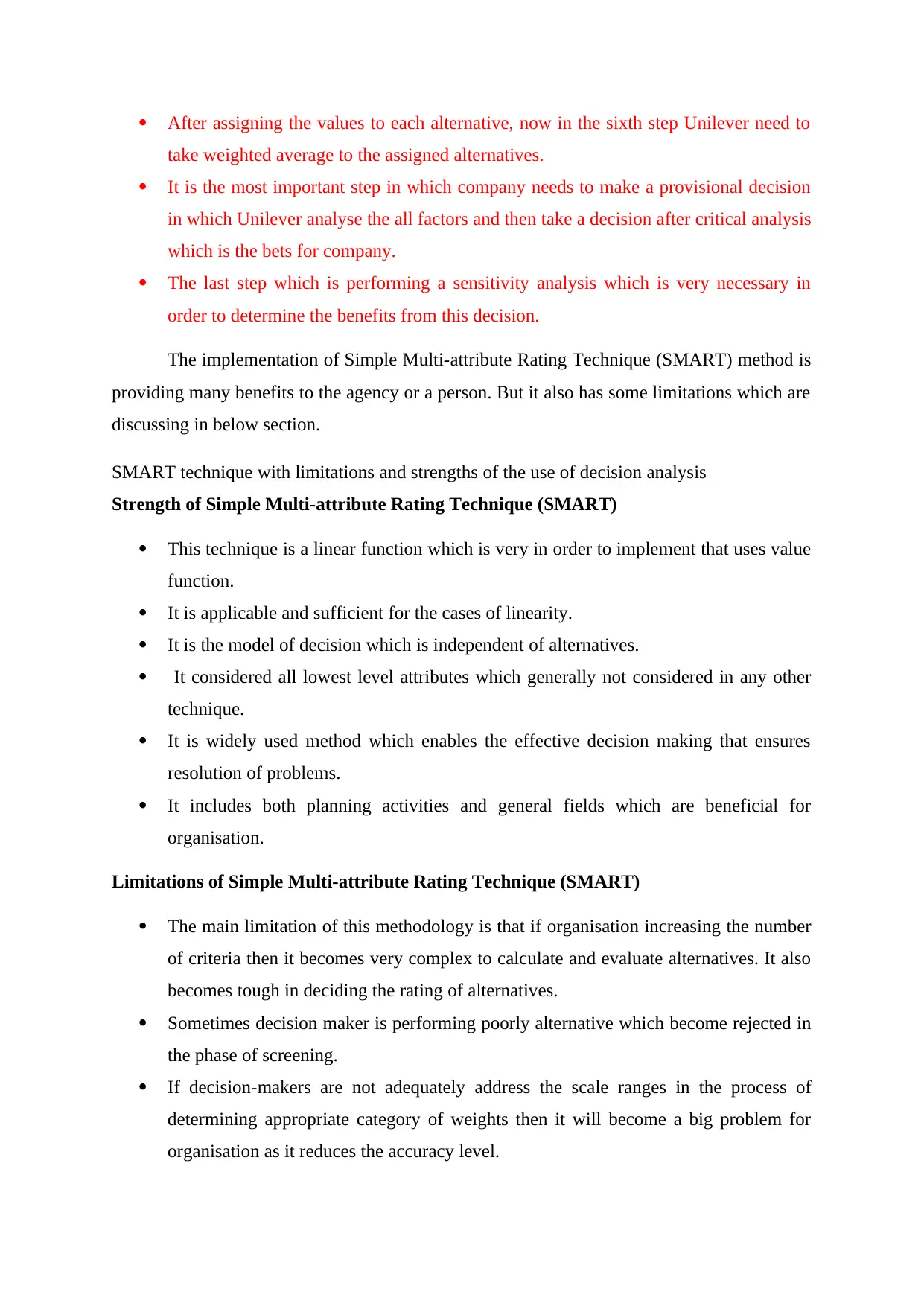
After assigning the values to each alternative, now in the sixth step Unilever need to
take weighted average to the assigned alternatives.
It is the most important step in which company needs to make a provisional decision
in which Unilever analyse the all factors and then take a decision after critical analysis
which is the bets for company.
The last step which is performing a sensitivity analysis which is very necessary in
order to determine the benefits from this decision.
The implementation of Simple Multi-attribute Rating Technique (SMART) method is
providing many benefits to the agency or a person. But it also has some limitations which are
discussing in below section.
SMART technique with limitations and strengths of the use of decision analysis
Strength of Simple Multi-attribute Rating Technique (SMART)
This technique is a linear function which is very in order to implement that uses value
function.
It is applicable and sufficient for the cases of linearity.
It is the model of decision which is independent of alternatives.
It considered all lowest level attributes which generally not considered in any other
technique.
It is widely used method which enables the effective decision making that ensures
resolution of problems.
It includes both planning activities and general fields which are beneficial for
organisation.
Limitations of Simple Multi-attribute Rating Technique (SMART)
The main limitation of this methodology is that if organisation increasing the number
of criteria then it becomes very complex to calculate and evaluate alternatives. It also
becomes tough in deciding the rating of alternatives.
Sometimes decision maker is performing poorly alternative which become rejected in
the phase of screening.
If decision-makers are not adequately address the scale ranges in the process of
determining appropriate category of weights then it will become a big problem for
organisation as it reduces the accuracy level.
take weighted average to the assigned alternatives.
It is the most important step in which company needs to make a provisional decision
in which Unilever analyse the all factors and then take a decision after critical analysis
which is the bets for company.
The last step which is performing a sensitivity analysis which is very necessary in
order to determine the benefits from this decision.
The implementation of Simple Multi-attribute Rating Technique (SMART) method is
providing many benefits to the agency or a person. But it also has some limitations which are
discussing in below section.
SMART technique with limitations and strengths of the use of decision analysis
Strength of Simple Multi-attribute Rating Technique (SMART)
This technique is a linear function which is very in order to implement that uses value
function.
It is applicable and sufficient for the cases of linearity.
It is the model of decision which is independent of alternatives.
It considered all lowest level attributes which generally not considered in any other
technique.
It is widely used method which enables the effective decision making that ensures
resolution of problems.
It includes both planning activities and general fields which are beneficial for
organisation.
Limitations of Simple Multi-attribute Rating Technique (SMART)
The main limitation of this methodology is that if organisation increasing the number
of criteria then it becomes very complex to calculate and evaluate alternatives. It also
becomes tough in deciding the rating of alternatives.
Sometimes decision maker is performing poorly alternative which become rejected in
the phase of screening.
If decision-makers are not adequately address the scale ranges in the process of
determining appropriate category of weights then it will become a big problem for
organisation as it reduces the accuracy level.
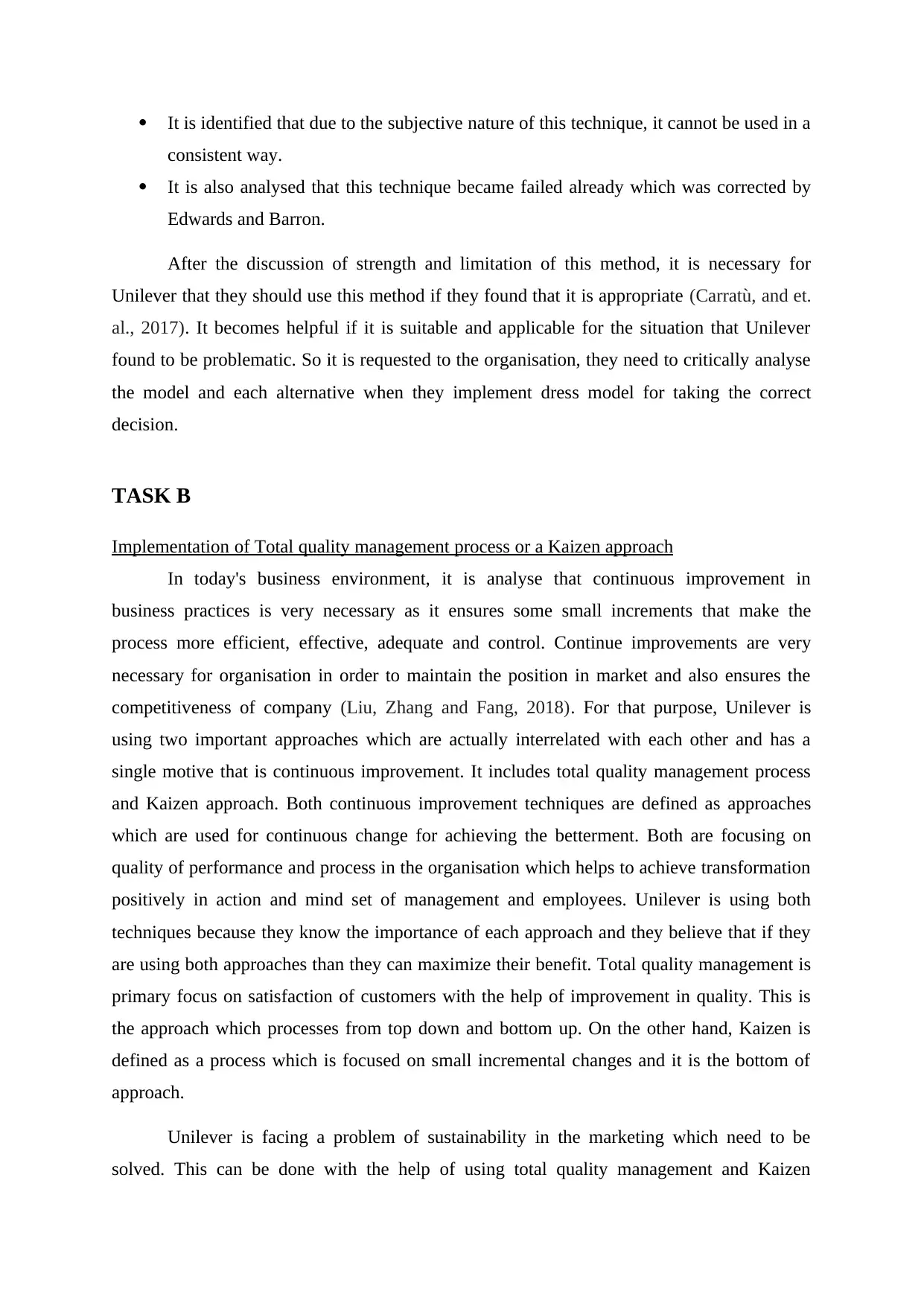
It is identified that due to the subjective nature of this technique, it cannot be used in a
consistent way.
It is also analysed that this technique became failed already which was corrected by
Edwards and Barron.
After the discussion of strength and limitation of this method, it is necessary for
Unilever that they should use this method if they found that it is appropriate (Carratù, and et.
al., 2017). It becomes helpful if it is suitable and applicable for the situation that Unilever
found to be problematic. So it is requested to the organisation, they need to critically analyse
the model and each alternative when they implement dress model for taking the correct
decision.
TASK B
Implementation of Total quality management process or a Kaizen approach
In today's business environment, it is analyse that continuous improvement in
business practices is very necessary as it ensures some small increments that make the
process more efficient, effective, adequate and control. Continue improvements are very
necessary for organisation in order to maintain the position in market and also ensures the
competitiveness of company (Liu, Zhang and Fang, 2018). For that purpose, Unilever is
using two important approaches which are actually interrelated with each other and has a
single motive that is continuous improvement. It includes total quality management process
and Kaizen approach. Both continuous improvement techniques are defined as approaches
which are used for continuous change for achieving the betterment. Both are focusing on
quality of performance and process in the organisation which helps to achieve transformation
positively in action and mind set of management and employees. Unilever is using both
techniques because they know the importance of each approach and they believe that if they
are using both approaches than they can maximize their benefit. Total quality management is
primary focus on satisfaction of customers with the help of improvement in quality. This is
the approach which processes from top down and bottom up. On the other hand, Kaizen is
defined as a process which is focused on small incremental changes and it is the bottom of
approach.
Unilever is facing a problem of sustainability in the marketing which need to be
solved. This can be done with the help of using total quality management and Kaizen
consistent way.
It is also analysed that this technique became failed already which was corrected by
Edwards and Barron.
After the discussion of strength and limitation of this method, it is necessary for
Unilever that they should use this method if they found that it is appropriate (Carratù, and et.
al., 2017). It becomes helpful if it is suitable and applicable for the situation that Unilever
found to be problematic. So it is requested to the organisation, they need to critically analyse
the model and each alternative when they implement dress model for taking the correct
decision.
TASK B
Implementation of Total quality management process or a Kaizen approach
In today's business environment, it is analyse that continuous improvement in
business practices is very necessary as it ensures some small increments that make the
process more efficient, effective, adequate and control. Continue improvements are very
necessary for organisation in order to maintain the position in market and also ensures the
competitiveness of company (Liu, Zhang and Fang, 2018). For that purpose, Unilever is
using two important approaches which are actually interrelated with each other and has a
single motive that is continuous improvement. It includes total quality management process
and Kaizen approach. Both continuous improvement techniques are defined as approaches
which are used for continuous change for achieving the betterment. Both are focusing on
quality of performance and process in the organisation which helps to achieve transformation
positively in action and mind set of management and employees. Unilever is using both
techniques because they know the importance of each approach and they believe that if they
are using both approaches than they can maximize their benefit. Total quality management is
primary focus on satisfaction of customers with the help of improvement in quality. This is
the approach which processes from top down and bottom up. On the other hand, Kaizen is
defined as a process which is focused on small incremental changes and it is the bottom of
approach.
Unilever is facing a problem of sustainability in the marketing which need to be
solved. This can be done with the help of using total quality management and Kaizen
⊘ This is a preview!⊘
Do you want full access?
Subscribe today to unlock all pages.
Trusted by 1+ million students worldwide
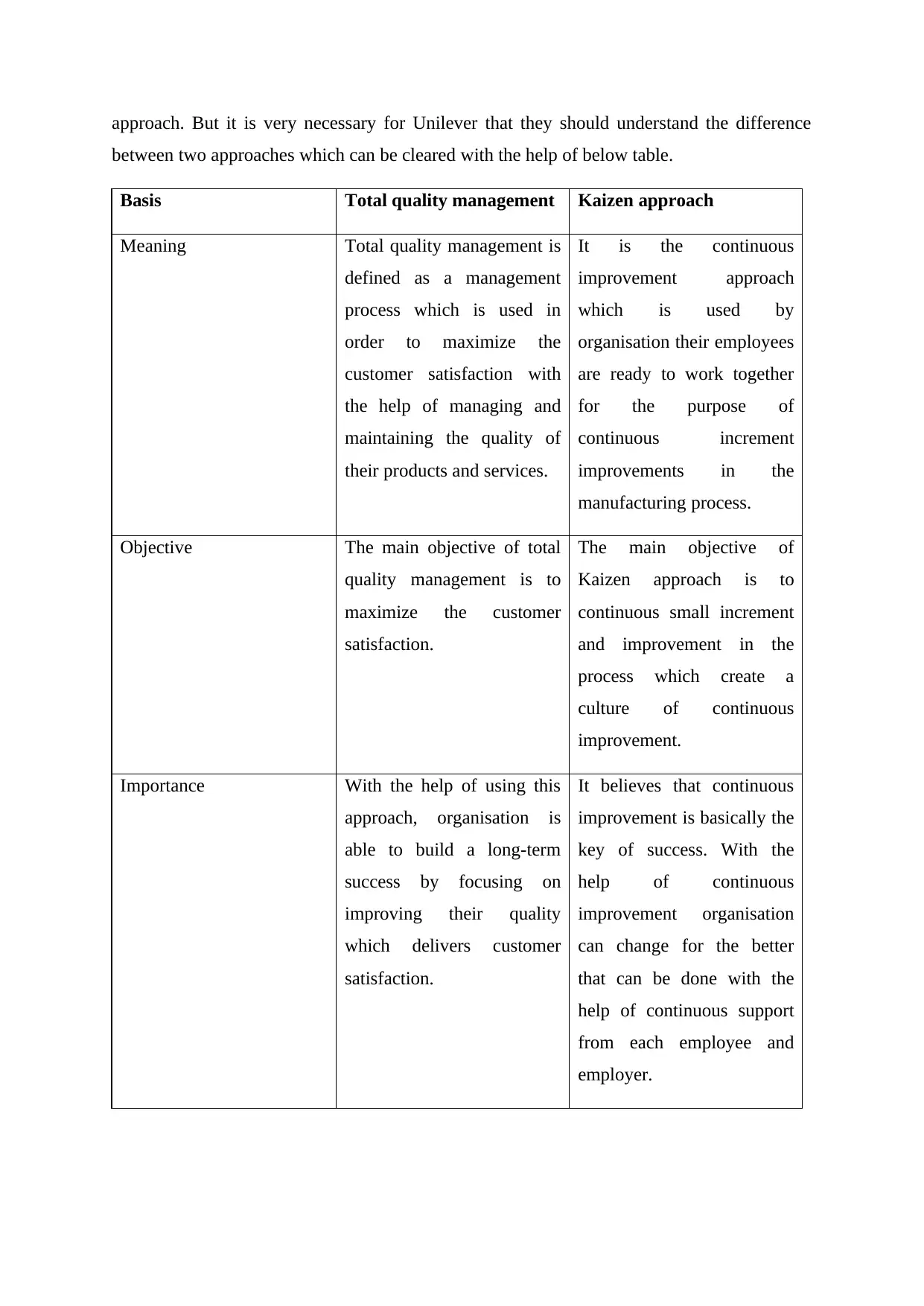
approach. But it is very necessary for Unilever that they should understand the difference
between two approaches which can be cleared with the help of below table.
Basis Total quality management Kaizen approach
Meaning Total quality management is
defined as a management
process which is used in
order to maximize the
customer satisfaction with
the help of managing and
maintaining the quality of
their products and services.
It is the continuous
improvement approach
which is used by
organisation their employees
are ready to work together
for the purpose of
continuous increment
improvements in the
manufacturing process.
Objective The main objective of total
quality management is to
maximize the customer
satisfaction.
The main objective of
Kaizen approach is to
continuous small increment
and improvement in the
process which create a
culture of continuous
improvement.
Importance With the help of using this
approach, organisation is
able to build a long-term
success by focusing on
improving their quality
which delivers customer
satisfaction.
It believes that continuous
improvement is basically the
key of success. With the
help of continuous
improvement organisation
can change for the better
that can be done with the
help of continuous support
from each employee and
employer.
between two approaches which can be cleared with the help of below table.
Basis Total quality management Kaizen approach
Meaning Total quality management is
defined as a management
process which is used in
order to maximize the
customer satisfaction with
the help of managing and
maintaining the quality of
their products and services.
It is the continuous
improvement approach
which is used by
organisation their employees
are ready to work together
for the purpose of
continuous increment
improvements in the
manufacturing process.
Objective The main objective of total
quality management is to
maximize the customer
satisfaction.
The main objective of
Kaizen approach is to
continuous small increment
and improvement in the
process which create a
culture of continuous
improvement.
Importance With the help of using this
approach, organisation is
able to build a long-term
success by focusing on
improving their quality
which delivers customer
satisfaction.
It believes that continuous
improvement is basically the
key of success. With the
help of continuous
improvement organisation
can change for the better
that can be done with the
help of continuous support
from each employee and
employer.
Paraphrase This Document
Need a fresh take? Get an instant paraphrase of this document with our AI Paraphraser
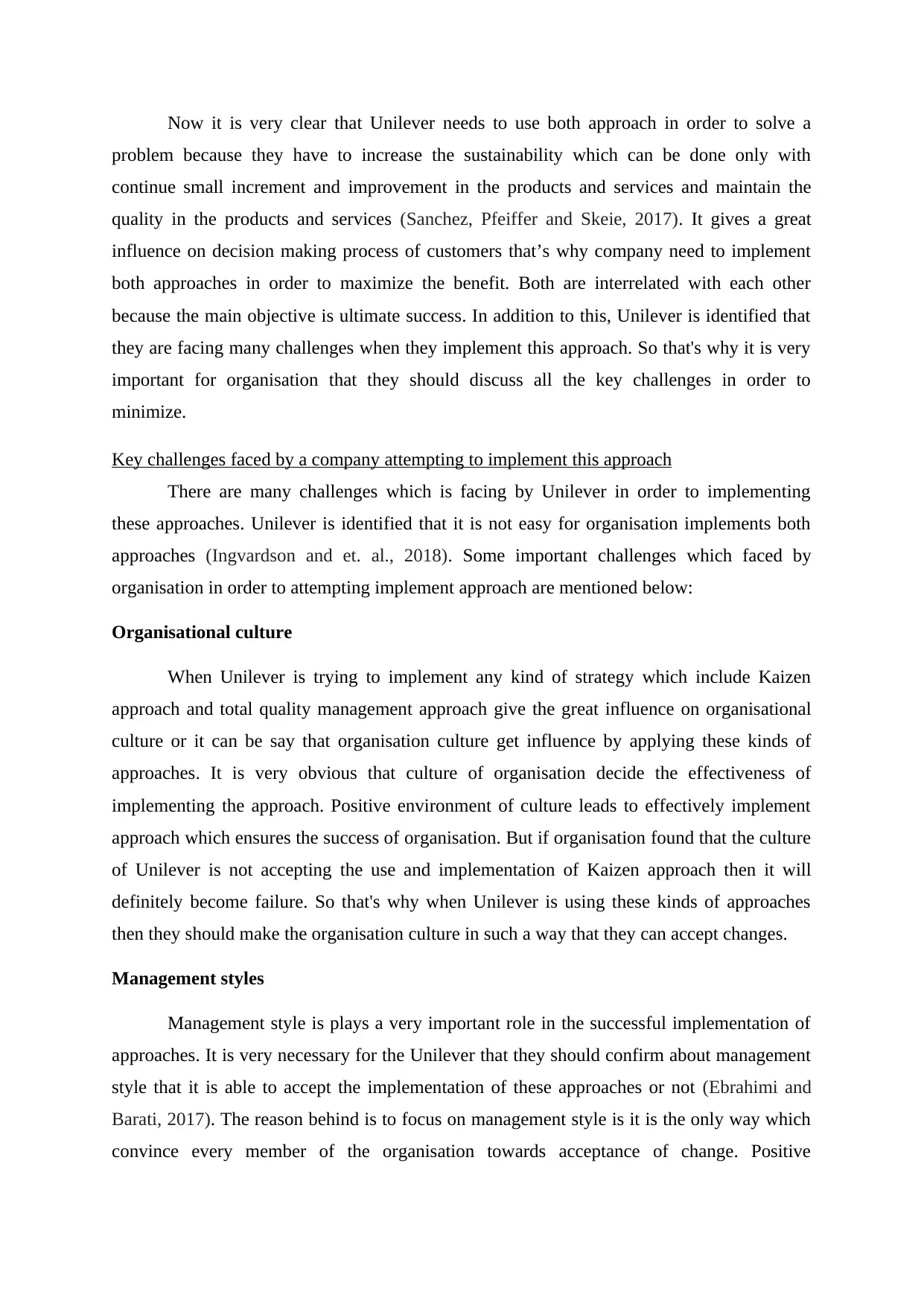
Now it is very clear that Unilever needs to use both approach in order to solve a
problem because they have to increase the sustainability which can be done only with
continue small increment and improvement in the products and services and maintain the
quality in the products and services (Sanchez, Pfeiffer and Skeie, 2017). It gives a great
influence on decision making process of customers that’s why company need to implement
both approaches in order to maximize the benefit. Both are interrelated with each other
because the main objective is ultimate success. In addition to this, Unilever is identified that
they are facing many challenges when they implement this approach. So that's why it is very
important for organisation that they should discuss all the key challenges in order to
minimize.
Key challenges faced by a company attempting to implement this approach
There are many challenges which is facing by Unilever in order to implementing
these approaches. Unilever is identified that it is not easy for organisation implements both
approaches (Ingvardson and et. al., 2018). Some important challenges which faced by
organisation in order to attempting implement approach are mentioned below:
Organisational culture
When Unilever is trying to implement any kind of strategy which include Kaizen
approach and total quality management approach give the great influence on organisational
culture or it can be say that organisation culture get influence by applying these kinds of
approaches. It is very obvious that culture of organisation decide the effectiveness of
implementing the approach. Positive environment of culture leads to effectively implement
approach which ensures the success of organisation. But if organisation found that the culture
of Unilever is not accepting the use and implementation of Kaizen approach then it will
definitely become failure. So that's why when Unilever is using these kinds of approaches
then they should make the organisation culture in such a way that they can accept changes.
Management styles
Management style is plays a very important role in the successful implementation of
approaches. It is very necessary for the Unilever that they should confirm about management
style that it is able to accept the implementation of these approaches or not (Ebrahimi and
Barati, 2017). The reason behind is to focus on management style is it is the only way which
convince every member of the organisation towards acceptance of change. Positive
problem because they have to increase the sustainability which can be done only with
continue small increment and improvement in the products and services and maintain the
quality in the products and services (Sanchez, Pfeiffer and Skeie, 2017). It gives a great
influence on decision making process of customers that’s why company need to implement
both approaches in order to maximize the benefit. Both are interrelated with each other
because the main objective is ultimate success. In addition to this, Unilever is identified that
they are facing many challenges when they implement this approach. So that's why it is very
important for organisation that they should discuss all the key challenges in order to
minimize.
Key challenges faced by a company attempting to implement this approach
There are many challenges which is facing by Unilever in order to implementing
these approaches. Unilever is identified that it is not easy for organisation implements both
approaches (Ingvardson and et. al., 2018). Some important challenges which faced by
organisation in order to attempting implement approach are mentioned below:
Organisational culture
When Unilever is trying to implement any kind of strategy which include Kaizen
approach and total quality management approach give the great influence on organisational
culture or it can be say that organisation culture get influence by applying these kinds of
approaches. It is very obvious that culture of organisation decide the effectiveness of
implementing the approach. Positive environment of culture leads to effectively implement
approach which ensures the success of organisation. But if organisation found that the culture
of Unilever is not accepting the use and implementation of Kaizen approach then it will
definitely become failure. So that's why when Unilever is using these kinds of approaches
then they should make the organisation culture in such a way that they can accept changes.
Management styles
Management style is plays a very important role in the successful implementation of
approaches. It is very necessary for the Unilever that they should confirm about management
style that it is able to accept the implementation of these approaches or not (Ebrahimi and
Barati, 2017). The reason behind is to focus on management style is it is the only way which
convince every member of the organisation towards acceptance of change. Positive
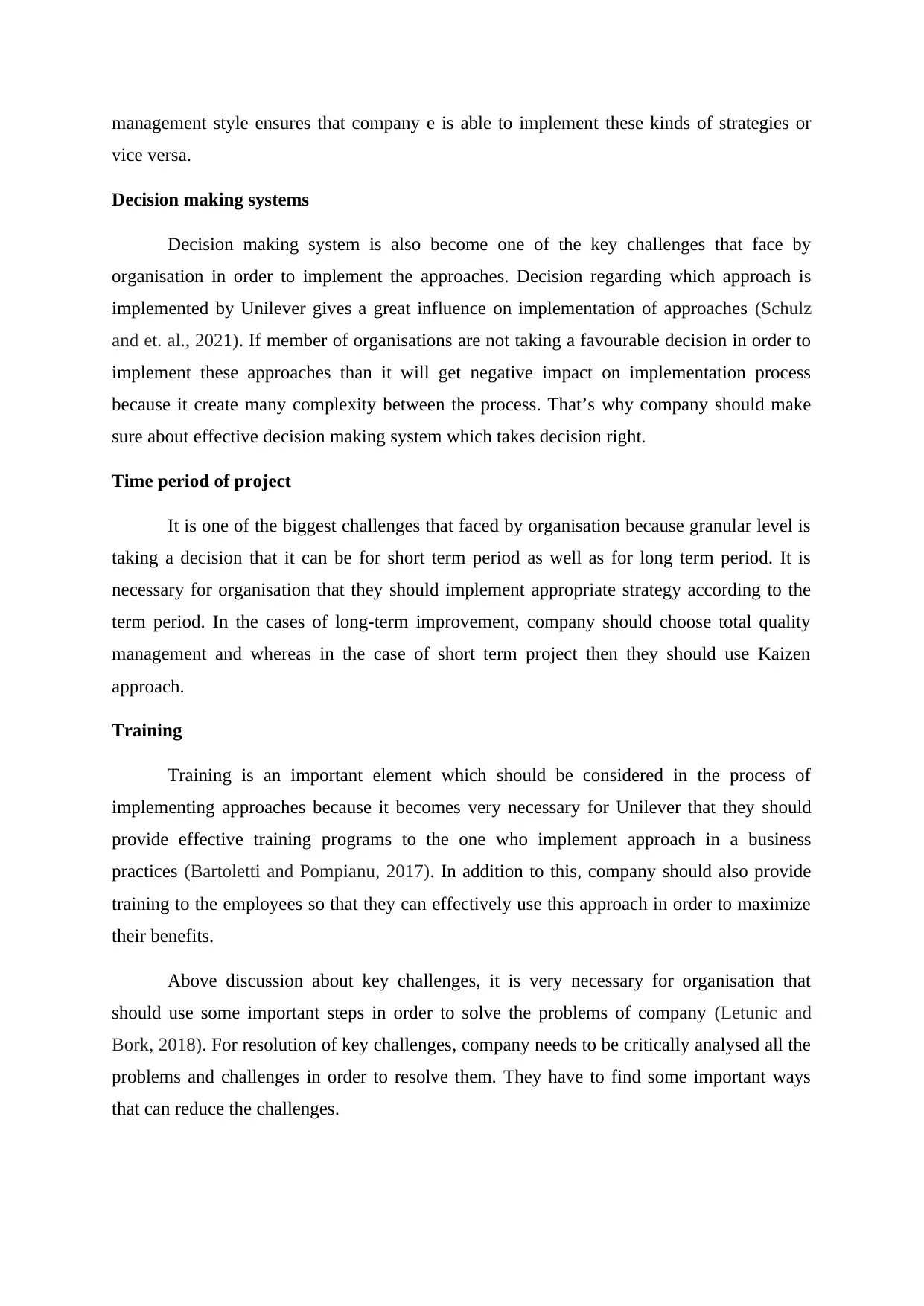
management style ensures that company e is able to implement these kinds of strategies or
vice versa.
Decision making systems
Decision making system is also become one of the key challenges that face by
organisation in order to implement the approaches. Decision regarding which approach is
implemented by Unilever gives a great influence on implementation of approaches (Schulz
and et. al., 2021). If member of organisations are not taking a favourable decision in order to
implement these approaches than it will get negative impact on implementation process
because it create many complexity between the process. That’s why company should make
sure about effective decision making system which takes decision right.
Time period of project
It is one of the biggest challenges that faced by organisation because granular level is
taking a decision that it can be for short term period as well as for long term period. It is
necessary for organisation that they should implement appropriate strategy according to the
term period. In the cases of long-term improvement, company should choose total quality
management and whereas in the case of short term project then they should use Kaizen
approach.
Training
Training is an important element which should be considered in the process of
implementing approaches because it becomes very necessary for Unilever that they should
provide effective training programs to the one who implement approach in a business
practices (Bartoletti and Pompianu, 2017). In addition to this, company should also provide
training to the employees so that they can effectively use this approach in order to maximize
their benefits.
Above discussion about key challenges, it is very necessary for organisation that
should use some important steps in order to solve the problems of company (Letunic and
Bork, 2018). For resolution of key challenges, company needs to be critically analysed all the
problems and challenges in order to resolve them. They have to find some important ways
that can reduce the challenges.
vice versa.
Decision making systems
Decision making system is also become one of the key challenges that face by
organisation in order to implement the approaches. Decision regarding which approach is
implemented by Unilever gives a great influence on implementation of approaches (Schulz
and et. al., 2021). If member of organisations are not taking a favourable decision in order to
implement these approaches than it will get negative impact on implementation process
because it create many complexity between the process. That’s why company should make
sure about effective decision making system which takes decision right.
Time period of project
It is one of the biggest challenges that faced by organisation because granular level is
taking a decision that it can be for short term period as well as for long term period. It is
necessary for organisation that they should implement appropriate strategy according to the
term period. In the cases of long-term improvement, company should choose total quality
management and whereas in the case of short term project then they should use Kaizen
approach.
Training
Training is an important element which should be considered in the process of
implementing approaches because it becomes very necessary for Unilever that they should
provide effective training programs to the one who implement approach in a business
practices (Bartoletti and Pompianu, 2017). In addition to this, company should also provide
training to the employees so that they can effectively use this approach in order to maximize
their benefits.
Above discussion about key challenges, it is very necessary for organisation that
should use some important steps in order to solve the problems of company (Letunic and
Bork, 2018). For resolution of key challenges, company needs to be critically analysed all the
problems and challenges in order to resolve them. They have to find some important ways
that can reduce the challenges.
⊘ This is a preview!⊘
Do you want full access?
Subscribe today to unlock all pages.
Trusted by 1+ million students worldwide
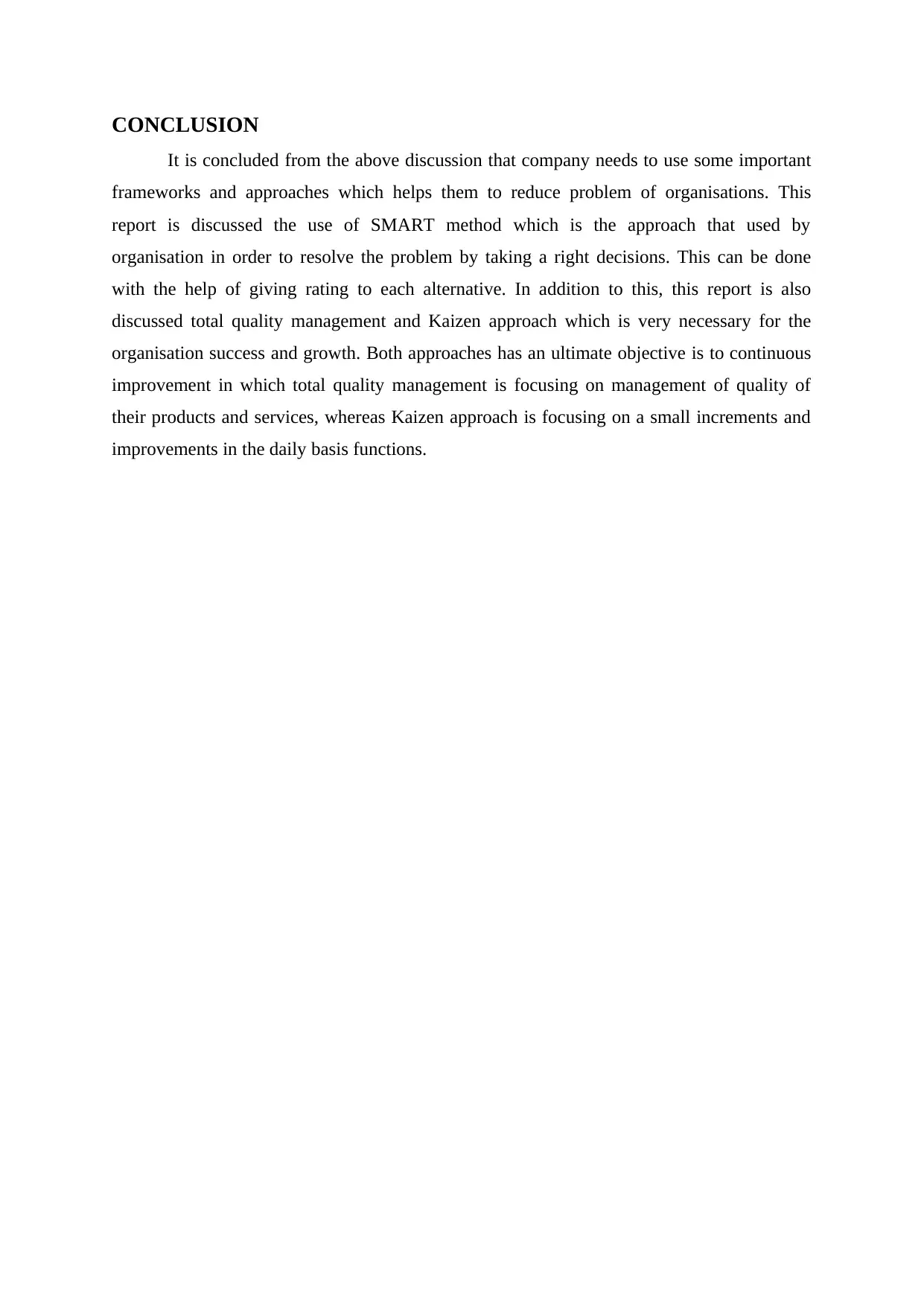
CONCLUSION
It is concluded from the above discussion that company needs to use some important
frameworks and approaches which helps them to reduce problem of organisations. This
report is discussed the use of SMART method which is the approach that used by
organisation in order to resolve the problem by taking a right decisions. This can be done
with the help of giving rating to each alternative. In addition to this, this report is also
discussed total quality management and Kaizen approach which is very necessary for the
organisation success and growth. Both approaches has an ultimate objective is to continuous
improvement in which total quality management is focusing on management of quality of
their products and services, whereas Kaizen approach is focusing on a small increments and
improvements in the daily basis functions.
It is concluded from the above discussion that company needs to use some important
frameworks and approaches which helps them to reduce problem of organisations. This
report is discussed the use of SMART method which is the approach that used by
organisation in order to resolve the problem by taking a right decisions. This can be done
with the help of giving rating to each alternative. In addition to this, this report is also
discussed total quality management and Kaizen approach which is very necessary for the
organisation success and growth. Both approaches has an ultimate objective is to continuous
improvement in which total quality management is focusing on management of quality of
their products and services, whereas Kaizen approach is focusing on a small increments and
improvements in the daily basis functions.
Paraphrase This Document
Need a fresh take? Get an instant paraphrase of this document with our AI Paraphraser
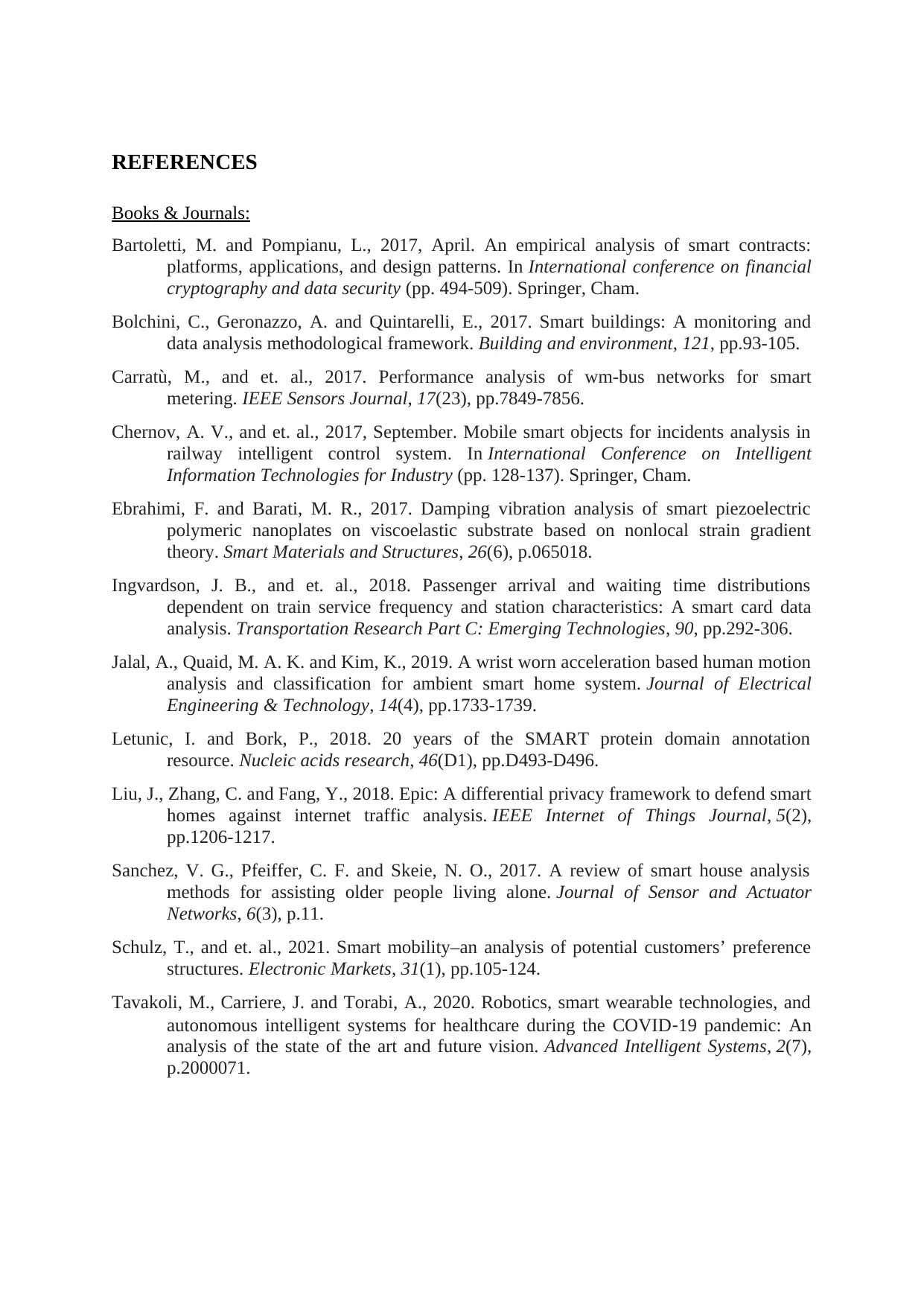
REFERENCES
Books & Journals:
Bartoletti, M. and Pompianu, L., 2017, April. An empirical analysis of smart contracts:
platforms, applications, and design patterns. In International conference on financial
cryptography and data security (pp. 494-509). Springer, Cham.
Bolchini, C., Geronazzo, A. and Quintarelli, E., 2017. Smart buildings: A monitoring and
data analysis methodological framework. Building and environment, 121, pp.93-105.
Carratù, M., and et. al., 2017. Performance analysis of wm-bus networks for smart
metering. IEEE Sensors Journal, 17(23), pp.7849-7856.
Chernov, A. V., and et. al., 2017, September. Mobile smart objects for incidents analysis in
railway intelligent control system. In International Conference on Intelligent
Information Technologies for Industry (pp. 128-137). Springer, Cham.
Ebrahimi, F. and Barati, M. R., 2017. Damping vibration analysis of smart piezoelectric
polymeric nanoplates on viscoelastic substrate based on nonlocal strain gradient
theory. Smart Materials and Structures, 26(6), p.065018.
Ingvardson, J. B., and et. al., 2018. Passenger arrival and waiting time distributions
dependent on train service frequency and station characteristics: A smart card data
analysis. Transportation Research Part C: Emerging Technologies, 90, pp.292-306.
Jalal, A., Quaid, M. A. K. and Kim, K., 2019. A wrist worn acceleration based human motion
analysis and classification for ambient smart home system. Journal of Electrical
Engineering & Technology, 14(4), pp.1733-1739.
Letunic, I. and Bork, P., 2018. 20 years of the SMART protein domain annotation
resource. Nucleic acids research, 46(D1), pp.D493-D496.
Liu, J., Zhang, C. and Fang, Y., 2018. Epic: A differential privacy framework to defend smart
homes against internet traffic analysis. IEEE Internet of Things Journal, 5(2),
pp.1206-1217.
Sanchez, V. G., Pfeiffer, C. F. and Skeie, N. O., 2017. A review of smart house analysis
methods for assisting older people living alone. Journal of Sensor and Actuator
Networks, 6(3), p.11.
Schulz, T., and et. al., 2021. Smart mobility–an analysis of potential customers’ preference
structures. Electronic Markets, 31(1), pp.105-124.
Tavakoli, M., Carriere, J. and Torabi, A., 2020. Robotics, smart wearable technologies, and
autonomous intelligent systems for healthcare during the COVID‐19 pandemic: An
analysis of the state of the art and future vision. Advanced Intelligent Systems, 2(7),
p.2000071.
Books & Journals:
Bartoletti, M. and Pompianu, L., 2017, April. An empirical analysis of smart contracts:
platforms, applications, and design patterns. In International conference on financial
cryptography and data security (pp. 494-509). Springer, Cham.
Bolchini, C., Geronazzo, A. and Quintarelli, E., 2017. Smart buildings: A monitoring and
data analysis methodological framework. Building and environment, 121, pp.93-105.
Carratù, M., and et. al., 2017. Performance analysis of wm-bus networks for smart
metering. IEEE Sensors Journal, 17(23), pp.7849-7856.
Chernov, A. V., and et. al., 2017, September. Mobile smart objects for incidents analysis in
railway intelligent control system. In International Conference on Intelligent
Information Technologies for Industry (pp. 128-137). Springer, Cham.
Ebrahimi, F. and Barati, M. R., 2017. Damping vibration analysis of smart piezoelectric
polymeric nanoplates on viscoelastic substrate based on nonlocal strain gradient
theory. Smart Materials and Structures, 26(6), p.065018.
Ingvardson, J. B., and et. al., 2018. Passenger arrival and waiting time distributions
dependent on train service frequency and station characteristics: A smart card data
analysis. Transportation Research Part C: Emerging Technologies, 90, pp.292-306.
Jalal, A., Quaid, M. A. K. and Kim, K., 2019. A wrist worn acceleration based human motion
analysis and classification for ambient smart home system. Journal of Electrical
Engineering & Technology, 14(4), pp.1733-1739.
Letunic, I. and Bork, P., 2018. 20 years of the SMART protein domain annotation
resource. Nucleic acids research, 46(D1), pp.D493-D496.
Liu, J., Zhang, C. and Fang, Y., 2018. Epic: A differential privacy framework to defend smart
homes against internet traffic analysis. IEEE Internet of Things Journal, 5(2),
pp.1206-1217.
Sanchez, V. G., Pfeiffer, C. F. and Skeie, N. O., 2017. A review of smart house analysis
methods for assisting older people living alone. Journal of Sensor and Actuator
Networks, 6(3), p.11.
Schulz, T., and et. al., 2021. Smart mobility–an analysis of potential customers’ preference
structures. Electronic Markets, 31(1), pp.105-124.
Tavakoli, M., Carriere, J. and Torabi, A., 2020. Robotics, smart wearable technologies, and
autonomous intelligent systems for healthcare during the COVID‐19 pandemic: An
analysis of the state of the art and future vision. Advanced Intelligent Systems, 2(7),
p.2000071.

1 out of 11


Related Documents


Your All-in-One AI-Powered Toolkit for Academic Success.
+13062052269
info@desklib.com
Available 24*7 on WhatsApp / Email
![[object Object]](/_next/static/media/star-bottom.7253800d.svg)
Unlock your academic potential
Copyright © 2020–2026 A2Z Services. All Rights Reserved. Developed and managed by ZUCOL.