Economics Report: Analyzing Uniqlo's Market in the Australian Region
VerifiedAdded on 2021/06/17
|8
|1826
|38
Report
AI Summary
This economics assignment analyzes Uniqlo's market in Australia, examining its position within the oligopoly structure of the apparel industry. The report explores the number of sellers, market knowledge, entry and exit barriers, and the type of products offered by Uniqlo. It further investigates the firm's short-run and long-run profit scenarios, considering its pricing strategies and the use of non-price competition, such as advertising and celebrity endorsements, to maintain its market share. The analysis highlights the brand's collusive pricing approach and its strategies for differentiating itself from competitors in the Australian market. The report concludes by assessing Uniqlo's overall performance and effectiveness in the region.
Running head: ECONOMICS ASSIGNMENT
Economics assignment
Name of the student:
Name of the University:
Author note
Economics assignment
Name of the student:
Name of the University:
Author note
Paraphrase This Document
Need a fresh take? Get an instant paraphrase of this document with our AI Paraphraser

1ECONOMICS ASSIGNMENT
Introduction:
Characterized by a variety of competitive supply chains, niche endeavours and
different business models, fashion industry is one such sector that makes up a major portion
in the global apparel and textile industry (Anwar, 2017). With the rise of the globalisation,
firms are becoming highly mobile and the industry has been spreading all around the world at
the speed of rocket. One such brand is Uniqlo who have capitalized on their capability to
fabricate apparel that reflect the latest trend at a reasonable price to become a major player in
its respective field. Uniqlo, introduced back in 1984 in Japan is now a global brand, which is
known for its outstanding products and services (Uniqlo.com, 2018). The brand not only
operates in the Japan, rather it has expanded its business to the various places like London,
Europe, USA, and other places in Asia too making it a global apparel brand (Caro &
Martínez-de-Albéniz, 2014). With their superiority product the brand has become a famous
high quality fashion brand in the Australia and this essay is aimed to analyse the market of
the same for the Uniqlo. Through this essay, it will portray the market knowledge of the firm
and considering the market structure, it will highlight the short run and long run profits in
order to depict its sustainability.
Number of sellers and market structure:
Uniqlo is one of the fastest growing retailing group in the fashion industry, which is
often acknowledged as the most successful brand in the world at present (Schulz &
Stockmann, 2016). With their vast global expansion since 2001, the brand has marked itself
as one of the market leader that has potential to operate both in the US and the UK market,
considering the differentiated demand structure of both the states. Presently Uniqlo has been
operating in Oceania region too in order to keep up their pace to become global. In Australia
it is accounted as one of the largest apparel brand that has vast amount of potential to become
the market leader (Liu, Liu & Fan, 2017). Considering the market structure of the apparel
Introduction:
Characterized by a variety of competitive supply chains, niche endeavours and
different business models, fashion industry is one such sector that makes up a major portion
in the global apparel and textile industry (Anwar, 2017). With the rise of the globalisation,
firms are becoming highly mobile and the industry has been spreading all around the world at
the speed of rocket. One such brand is Uniqlo who have capitalized on their capability to
fabricate apparel that reflect the latest trend at a reasonable price to become a major player in
its respective field. Uniqlo, introduced back in 1984 in Japan is now a global brand, which is
known for its outstanding products and services (Uniqlo.com, 2018). The brand not only
operates in the Japan, rather it has expanded its business to the various places like London,
Europe, USA, and other places in Asia too making it a global apparel brand (Caro &
Martínez-de-Albéniz, 2014). With their superiority product the brand has become a famous
high quality fashion brand in the Australia and this essay is aimed to analyse the market of
the same for the Uniqlo. Through this essay, it will portray the market knowledge of the firm
and considering the market structure, it will highlight the short run and long run profits in
order to depict its sustainability.
Number of sellers and market structure:
Uniqlo is one of the fastest growing retailing group in the fashion industry, which is
often acknowledged as the most successful brand in the world at present (Schulz &
Stockmann, 2016). With their vast global expansion since 2001, the brand has marked itself
as one of the market leader that has potential to operate both in the US and the UK market,
considering the differentiated demand structure of both the states. Presently Uniqlo has been
operating in Oceania region too in order to keep up their pace to become global. In Australia
it is accounted as one of the largest apparel brand that has vast amount of potential to become
the market leader (Liu, Liu & Fan, 2017). Considering the market structure of the apparel

2ECONOMICS ASSIGNMENT
industry in the Australia, it can be said that the brand operates in oligopoly market, where the
arch rivals of the brand are GAP, American Apparel, Zara, Benetton, H&M, United Colours
and others (Anwar, 2017). In Australian apparel industry, there are almost seven to eight
large market players that makes it an oligopoly market.
Market knowledge:
As it has been observed from the apparel industry of the Australia has moderate
number of market players that makes the marker oligopoly in nature. Under this scenario,
market knowledge is incomplete, where the sellers do have complete information regarding
their market demand, whereas, the buyers do not have the information regarding the best
price in the market (Bischi, Lamantia & Radi, 2015). On the other hand, in oligopoly market,
market competitors do not have proper information regarding their rivals that makes the
decision of one firm related with the other.
Market entry and exit:
Considering the market structure of the Uniqlo in the Australia, it has already been
clear that the firm operates in an oligopoly market, where more than seven to eight players
operate. Under this market structure there exist good amount of barriers in the market that
restricts the new entrants to enter the market. In the case of the apparel industry of Australia
following barriers can be observed (Anufriev & Kopanyi, 2018):
Strong customer loyalty of the present brands
Large amount of investment by the brand to introduce business in Australia
Economies of scale achieved by the existing firm provide cost advantage to the rival
organisations
In case of the apparel industry, there is exit barrier too. Following are the exit barrier in the
market:
industry in the Australia, it can be said that the brand operates in oligopoly market, where the
arch rivals of the brand are GAP, American Apparel, Zara, Benetton, H&M, United Colours
and others (Anwar, 2017). In Australian apparel industry, there are almost seven to eight
large market players that makes it an oligopoly market.
Market knowledge:
As it has been observed from the apparel industry of the Australia has moderate
number of market players that makes the marker oligopoly in nature. Under this scenario,
market knowledge is incomplete, where the sellers do have complete information regarding
their market demand, whereas, the buyers do not have the information regarding the best
price in the market (Bischi, Lamantia & Radi, 2015). On the other hand, in oligopoly market,
market competitors do not have proper information regarding their rivals that makes the
decision of one firm related with the other.
Market entry and exit:
Considering the market structure of the Uniqlo in the Australia, it has already been
clear that the firm operates in an oligopoly market, where more than seven to eight players
operate. Under this market structure there exist good amount of barriers in the market that
restricts the new entrants to enter the market. In the case of the apparel industry of Australia
following barriers can be observed (Anufriev & Kopanyi, 2018):
Strong customer loyalty of the present brands
Large amount of investment by the brand to introduce business in Australia
Economies of scale achieved by the existing firm provide cost advantage to the rival
organisations
In case of the apparel industry, there is exit barrier too. Following are the exit barrier in the
market:
⊘ This is a preview!⊘
Do you want full access?
Subscribe today to unlock all pages.

Trusted by 1+ million students worldwide

3ECONOMICS ASSIGNMENT
Fixed exit cost in the form of contract cancelation cost and indemnities to the
employees
Non-transferable asset cost
Type of the product:
The firm is mainly acknowledged as the producer of the casual wear, however, in
addition to this, it produces various types of apparel in order to satisfy different customer
demand. The brand’s Unique Selling Proposition lies within its affordable price and high
quality garment, which are curated in such a way that it can curtail the demand of wide range
of customers. The targeted customer of the brand is women who are aged between 25 and 45,
due to the fact that most of the demand for the brand, comes from the specific range of
customers (Kotabe & Helsen, 2014).
Short-run and long-run profit:
Utilising the high entry barriers in the market Uniqlo can have supernormal profit
during the long run. With the aid of the entry barriers he firm can restrict the new entrants
from entering into the market and enjoy considerable amount of market share to have better
amount of profit in the long-run (Feng, Li & Li, 2014).
During the short run, the firm will gain only the normal profit due to the fact that that
in short-run it has expand its business and make market dominance, which will allow it to
earn only normal profit (Neary, 2016).
Fixed exit cost in the form of contract cancelation cost and indemnities to the
employees
Non-transferable asset cost
Type of the product:
The firm is mainly acknowledged as the producer of the casual wear, however, in
addition to this, it produces various types of apparel in order to satisfy different customer
demand. The brand’s Unique Selling Proposition lies within its affordable price and high
quality garment, which are curated in such a way that it can curtail the demand of wide range
of customers. The targeted customer of the brand is women who are aged between 25 and 45,
due to the fact that most of the demand for the brand, comes from the specific range of
customers (Kotabe & Helsen, 2014).
Short-run and long-run profit:
Utilising the high entry barriers in the market Uniqlo can have supernormal profit
during the long run. With the aid of the entry barriers he firm can restrict the new entrants
from entering into the market and enjoy considerable amount of market share to have better
amount of profit in the long-run (Feng, Li & Li, 2014).
During the short run, the firm will gain only the normal profit due to the fact that that
in short-run it has expand its business and make market dominance, which will allow it to
earn only normal profit (Neary, 2016).
Paraphrase This Document
Need a fresh take? Get an instant paraphrase of this document with our AI Paraphraser

4ECONOMICS ASSIGNMENT
Price determination:
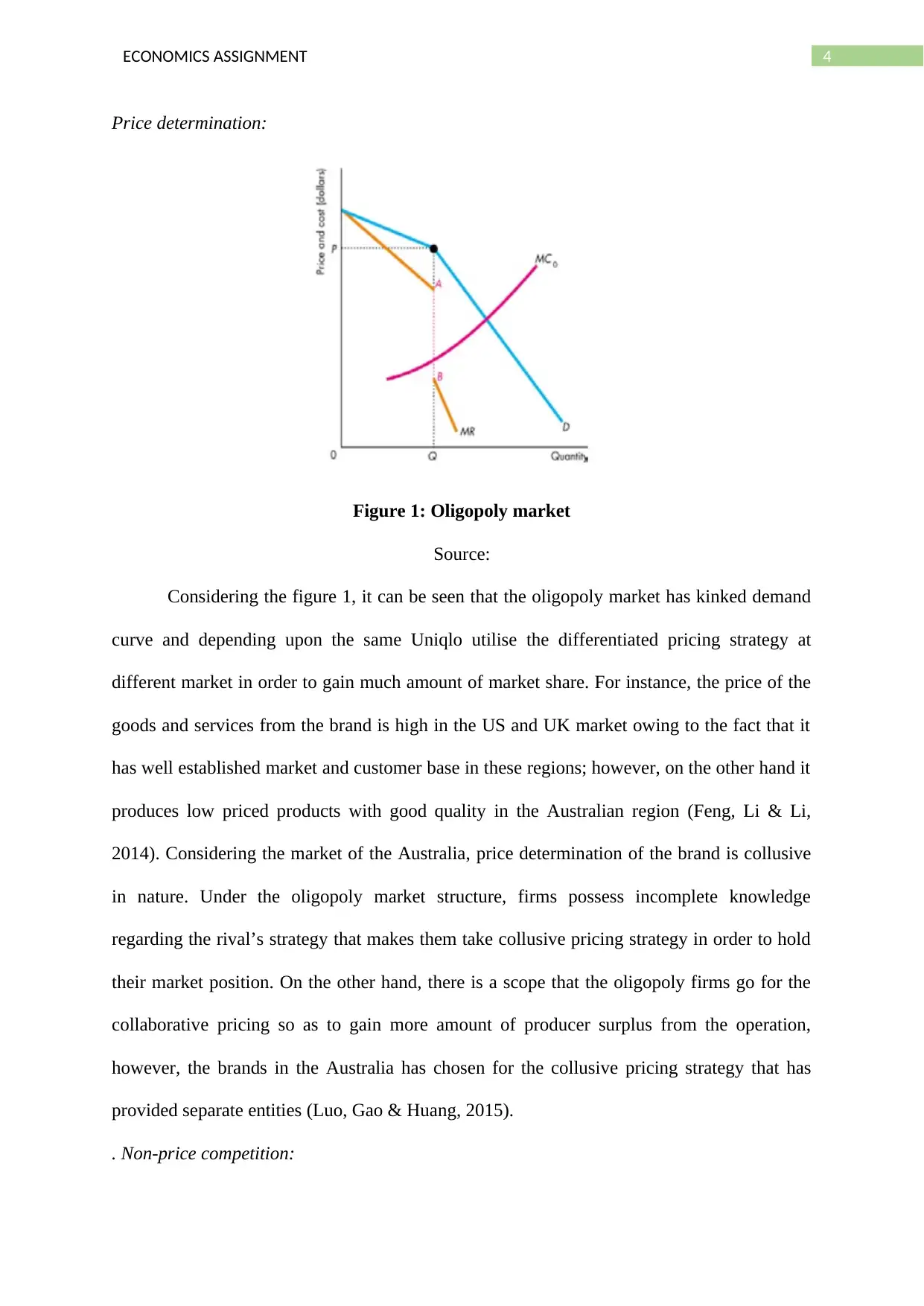
Figure 1: Oligopoly market
Source:
Considering the figure 1, it can be seen that the oligopoly market has kinked demand
curve and depending upon the same Uniqlo utilise the differentiated pricing strategy at
different market in order to gain much amount of market share. For instance, the price of the
goods and services from the brand is high in the US and UK market owing to the fact that it
has well established market and customer base in these regions; however, on the other hand it
produces low priced products with good quality in the Australian region (Feng, Li & Li,
2014). Considering the market of the Australia, price determination of the brand is collusive
in nature. Under the oligopoly market structure, firms possess incomplete knowledge
regarding the rival’s strategy that makes them take collusive pricing strategy in order to hold
their market position. On the other hand, there is a scope that the oligopoly firms go for the
collaborative pricing so as to gain more amount of producer surplus from the operation,
however, the brands in the Australia has chosen for the collusive pricing strategy that has
provided separate entities (Luo, Gao & Huang, 2015).
. Non-price competition:
Price determination:
Figure 1: Oligopoly market
Source:
Considering the figure 1, it can be seen that the oligopoly market has kinked demand
curve and depending upon the same Uniqlo utilise the differentiated pricing strategy at
different market in order to gain much amount of market share. For instance, the price of the
goods and services from the brand is high in the US and UK market owing to the fact that it
has well established market and customer base in these regions; however, on the other hand it
produces low priced products with good quality in the Australian region (Feng, Li & Li,
2014). Considering the market of the Australia, price determination of the brand is collusive
in nature. Under the oligopoly market structure, firms possess incomplete knowledge
regarding the rival’s strategy that makes them take collusive pricing strategy in order to hold
their market position. On the other hand, there is a scope that the oligopoly firms go for the
collaborative pricing so as to gain more amount of producer surplus from the operation,
however, the brands in the Australia has chosen for the collusive pricing strategy that has
provided separate entities (Luo, Gao & Huang, 2015).
. Non-price competition:

5ECONOMICS ASSIGNMENT
In the oligopoly market products produced by the rivals are almost similar to one
another that makes the market scenario for the business houses hard. Under this scenario,
rather than pricing strategies, non-price competition become more useful in order to entice
the market demand (Wang & Li, 2018). As the mechanism of the non-price competition,
Uniqlo uses advertisement as their strategy. In addition to this, the brand has been observed
to utilise celebrities to promote the brand, TV ads and sponsoring events are some of the
strategies utilised by the brand in order to stand out from the crowd (Chan & Luk, 2015).
Considering the market operation and the market structure of the Uniqlo, it can be
said that the firm has been operating really good in the Australian region. With their low and
affordable pricing of the good quality product has been enticing the market demand
effectively and with the strategies to deal with competitors through the non-price competition
has proved to be effective.
In the oligopoly market products produced by the rivals are almost similar to one
another that makes the market scenario for the business houses hard. Under this scenario,
rather than pricing strategies, non-price competition become more useful in order to entice
the market demand (Wang & Li, 2018). As the mechanism of the non-price competition,
Uniqlo uses advertisement as their strategy. In addition to this, the brand has been observed
to utilise celebrities to promote the brand, TV ads and sponsoring events are some of the
strategies utilised by the brand in order to stand out from the crowd (Chan & Luk, 2015).
Considering the market operation and the market structure of the Uniqlo, it can be
said that the firm has been operating really good in the Australian region. With their low and
affordable pricing of the good quality product has been enticing the market demand
effectively and with the strategies to deal with competitors through the non-price competition
has proved to be effective.
⊘ This is a preview!⊘
Do you want full access?
Subscribe today to unlock all pages.

Trusted by 1+ million students worldwide

6ECONOMICS ASSIGNMENT
Reference:
Anufriev, M., & Kopányi, D. (2018). Oligopoly game: price makers meet price takers.
Journal of Economic Dynamics and Control.
Anwar, S. T. (2017). Zara vs. Uniqlo: Leadership strategies in the competitive textile and
apparel industry. Global Business and Organizational Excellence, 36(5), 26-35.
Bischi, G. I., Lamantia, F., & Radi, D. (2015). An evolutionary Cournot model with limited
market knowledge. Journal of Economic Behavior & Organization, 116, 219-238.
Caro, F., & Martínez-de-Albéniz, V. (2014). Who's Fast Fashion and Who's Not. Retrieved
from http://blogs.anderson.ucla.edu/global-supply-chain/2014/02/whos-fast-fashion-
and-whos-not.html
Chan, Y. T., & Luk, K. Y. (2015). UNIQLO: the secret of success.
Feng, Y., Li, B., & Li, B. (2014). Price competition in an oligopoly market with multiple iaas
cloud providers. IEEE Transactions on Computers, 63(1), 59-73.
Kotabe, M., & Helsen, K. (2014). Global marketing management
Liu, Y., Liu, Y., & Fan, C. (2017, May). Brand and channel competition under different
dominant structure. In Control And Decision Conference (CCDC), 2017 29th Chinese
(pp. 3473-3478). IEEE.
Luo, Y., Gao, L., & Huang, J. (2015). Price and inventory competition in oligopoly TV white
space markets. IEEE Journal on Selected Areas in Communications, 33(5), 1002-
1013.
Neary, J. P. (2016). International trade in general oligopolistic equilibrium. Review of
International Economics, 24(4), 669-698.
OUR STORY - UNIQLO. (2018). Uniqlo.com. Retrieved 17 May 2018, from
http://www.uniqlo.com/au/corp/ourstory.html
Reference:
Anufriev, M., & Kopányi, D. (2018). Oligopoly game: price makers meet price takers.
Journal of Economic Dynamics and Control.
Anwar, S. T. (2017). Zara vs. Uniqlo: Leadership strategies in the competitive textile and
apparel industry. Global Business and Organizational Excellence, 36(5), 26-35.
Bischi, G. I., Lamantia, F., & Radi, D. (2015). An evolutionary Cournot model with limited
market knowledge. Journal of Economic Behavior & Organization, 116, 219-238.
Caro, F., & Martínez-de-Albéniz, V. (2014). Who's Fast Fashion and Who's Not. Retrieved
from http://blogs.anderson.ucla.edu/global-supply-chain/2014/02/whos-fast-fashion-
and-whos-not.html
Chan, Y. T., & Luk, K. Y. (2015). UNIQLO: the secret of success.
Feng, Y., Li, B., & Li, B. (2014). Price competition in an oligopoly market with multiple iaas
cloud providers. IEEE Transactions on Computers, 63(1), 59-73.
Kotabe, M., & Helsen, K. (2014). Global marketing management
Liu, Y., Liu, Y., & Fan, C. (2017, May). Brand and channel competition under different
dominant structure. In Control And Decision Conference (CCDC), 2017 29th Chinese
(pp. 3473-3478). IEEE.
Luo, Y., Gao, L., & Huang, J. (2015). Price and inventory competition in oligopoly TV white
space markets. IEEE Journal on Selected Areas in Communications, 33(5), 1002-
1013.
Neary, J. P. (2016). International trade in general oligopolistic equilibrium. Review of
International Economics, 24(4), 669-698.
OUR STORY - UNIQLO. (2018). Uniqlo.com. Retrieved 17 May 2018, from
http://www.uniqlo.com/au/corp/ourstory.html
Paraphrase This Document
Need a fresh take? Get an instant paraphrase of this document with our AI Paraphraser

7ECONOMICS ASSIGNMENT
Schulz-Müllensiefen, F., & Stöckmann, A. (2016). Uniqlo: A Case Study on Creating Market
Share with Affordable and Timeless Designs. In Multinational Management (pp. 221-
236). Springer, Cham.
Wang, N., & Li, C. (2018). An Analysis of Uniqlo’s Management Philosophy and Its
Enlightenment to China’s Fast Fashion Brands. Open Journal of Social Sciences,
6(03), 301.
Schulz-Müllensiefen, F., & Stöckmann, A. (2016). Uniqlo: A Case Study on Creating Market
Share with Affordable and Timeless Designs. In Multinational Management (pp. 221-
236). Springer, Cham.
Wang, N., & Li, C. (2018). An Analysis of Uniqlo’s Management Philosophy and Its
Enlightenment to China’s Fast Fashion Brands. Open Journal of Social Sciences,
6(03), 301.
1 out of 8
Related Documents
Your All-in-One AI-Powered Toolkit for Academic Success.
+13062052269
info@desklib.com
Available 24*7 on WhatsApp / Email
Unlock your academic potential
Copyright © 2020–2025 A2Z Services. All Rights Reserved. Developed and managed by ZUCOL.