Employability Skills Report: NHS - Self-Appraisal and Development
VerifiedAdded on 2023/04/04
|21
|4332
|488
Report
AI Summary
This report, focusing on Unit 23: Employability Skills, explores the crucial role of communication and personal skills in enhancing professional efficiency within the National Health Service (NHS). It begins with a self-appraisal form, evaluating performance objectives, communication abilities, teamwork, and personal qualifications using SMART goals and 360-degree appraisal methods. The report identifies strengths like interpersonal and communication skills and weaknesses such as time management and risk assessment. It discusses motivational techniques, including Maslow's hierarchy of needs and Herzberg's two-factor theory, to improve job satisfaction and performance. Furthermore, it addresses workplace challenges, such as managing emergency cases and high employee turnover, proposing strategies like improved communication chains and employee engagement to foster a supportive work environment. The report also includes a root cause analysis for problem-solving and emphasizes the importance of continuous learning and development in the healthcare sector.
Unit 23: Employability Skills
1 | P a g e
1 | P a g e

Paraphrase This Document
Need a fresh take? Get an instant paraphrase of this document with our AI Paraphraser
Table of Contents
Introduction......................................................................................................................................2
Task 1: Self-Appraisal Form...........................................................................................................2
1. (AC 1.1)...................................................................................................................................2
2. (AC 1.2)...................................................................................................................................2
3. (AC 1.3)...................................................................................................................................2
4. (AC 1.4)...................................................................................................................................2
5. (AC 2.2)...................................................................................................................................2
Task 2...............................................................................................................................................2
6. (AC 2.1)...................................................................................................................................2
Develop an appropriate strategy to overcome and resolve the problem (A.C 4.2)..................2
7. (AC 4.1)...................................................................................................................................2
8. (AC 2.3)...................................................................................................................................2
9. (AC 4.3)...................................................................................................................................2
Task 3...............................................................................................................................................2
11. (AC 3.2).................................................................................................................................2
12. (AC 3.3).................................................................................................................................2
Conclusion.......................................................................................................................................2
Recommendations............................................................................................................................2
References........................................................................................................................................2
2 | P a g e
Introduction......................................................................................................................................2
Task 1: Self-Appraisal Form...........................................................................................................2
1. (AC 1.1)...................................................................................................................................2
2. (AC 1.2)...................................................................................................................................2
3. (AC 1.3)...................................................................................................................................2
4. (AC 1.4)...................................................................................................................................2
5. (AC 2.2)...................................................................................................................................2
Task 2...............................................................................................................................................2
6. (AC 2.1)...................................................................................................................................2
Develop an appropriate strategy to overcome and resolve the problem (A.C 4.2)..................2
7. (AC 4.1)...................................................................................................................................2
8. (AC 2.3)...................................................................................................................................2
9. (AC 4.3)...................................................................................................................................2
Task 3...............................................................................................................................................2
11. (AC 3.2).................................................................................................................................2
12. (AC 3.3).................................................................................................................................2
Conclusion.......................................................................................................................................2
Recommendations............................................................................................................................2
References........................................................................................................................................2
2 | P a g e
Introduction
The following report has been prepared by understanding the key role of communication
and personal skills in improving professional efficiency. In this regard, the objectives have been
noted and related to the overall aims of the organisations. Various tools like the SMART form
and 360 degree appraisal have been used to attain a comprehensive understanding of the work
related problems and issues.
Task 1: Self-Appraisal Form
1. (AC 1.1)-
Performance objective:
To look after the client to manage the adequate level of safety that assist in reducing the situation
of difficult situations.
Offering quality services to the customers for managing their experience that would help in
ensuring customer satisfaction and sales of the organisation
Allocating the roles and responsibilities to the staff and evaluating their performances with
respect to the safety of the client. This could be done through the feedback procedures.
The main performance objective is to assist the client in solving their problem and this would
also be done through effective communication and feedbacks.
Within any business organisation and the roles that are played by the professionals, it is
important to have fair amount of idea about the job duties and responsibilities that come along
with such jobs. In this regard, it is important to relate the individual personal set of goals with the
overall managerial and organisational duties and objectives. By managing the personal traits and
noting which aspects might help in the considerable performance of duties, professional skills
can be enhanced (Meuter, et al., 2015).
What would also be important in the professional aspect is to note the professional
obligations of the duties that are required to be performed. The following set of guidelines might
be effective in setting objectives for performance management and aligning the same with work
place responsibilities. As such, the following goals have been set by keeping mind Doran’s
concept of S.M.A.R.T goals.
3 | P a g e
The following report has been prepared by understanding the key role of communication
and personal skills in improving professional efficiency. In this regard, the objectives have been
noted and related to the overall aims of the organisations. Various tools like the SMART form
and 360 degree appraisal have been used to attain a comprehensive understanding of the work
related problems and issues.
Task 1: Self-Appraisal Form
1. (AC 1.1)-
Performance objective:
To look after the client to manage the adequate level of safety that assist in reducing the situation
of difficult situations.
Offering quality services to the customers for managing their experience that would help in
ensuring customer satisfaction and sales of the organisation
Allocating the roles and responsibilities to the staff and evaluating their performances with
respect to the safety of the client. This could be done through the feedback procedures.
The main performance objective is to assist the client in solving their problem and this would
also be done through effective communication and feedbacks.
Within any business organisation and the roles that are played by the professionals, it is
important to have fair amount of idea about the job duties and responsibilities that come along
with such jobs. In this regard, it is important to relate the individual personal set of goals with the
overall managerial and organisational duties and objectives. By managing the personal traits and
noting which aspects might help in the considerable performance of duties, professional skills
can be enhanced (Meuter, et al., 2015).
What would also be important in the professional aspect is to note the professional
obligations of the duties that are required to be performed. The following set of guidelines might
be effective in setting objectives for performance management and aligning the same with work
place responsibilities. As such, the following goals have been set by keeping mind Doran’s
concept of S.M.A.R.T goals.
3 | P a g e
⊘ This is a preview!⊘
Do you want full access?
Subscribe today to unlock all pages.

Trusted by 1+ million students worldwide
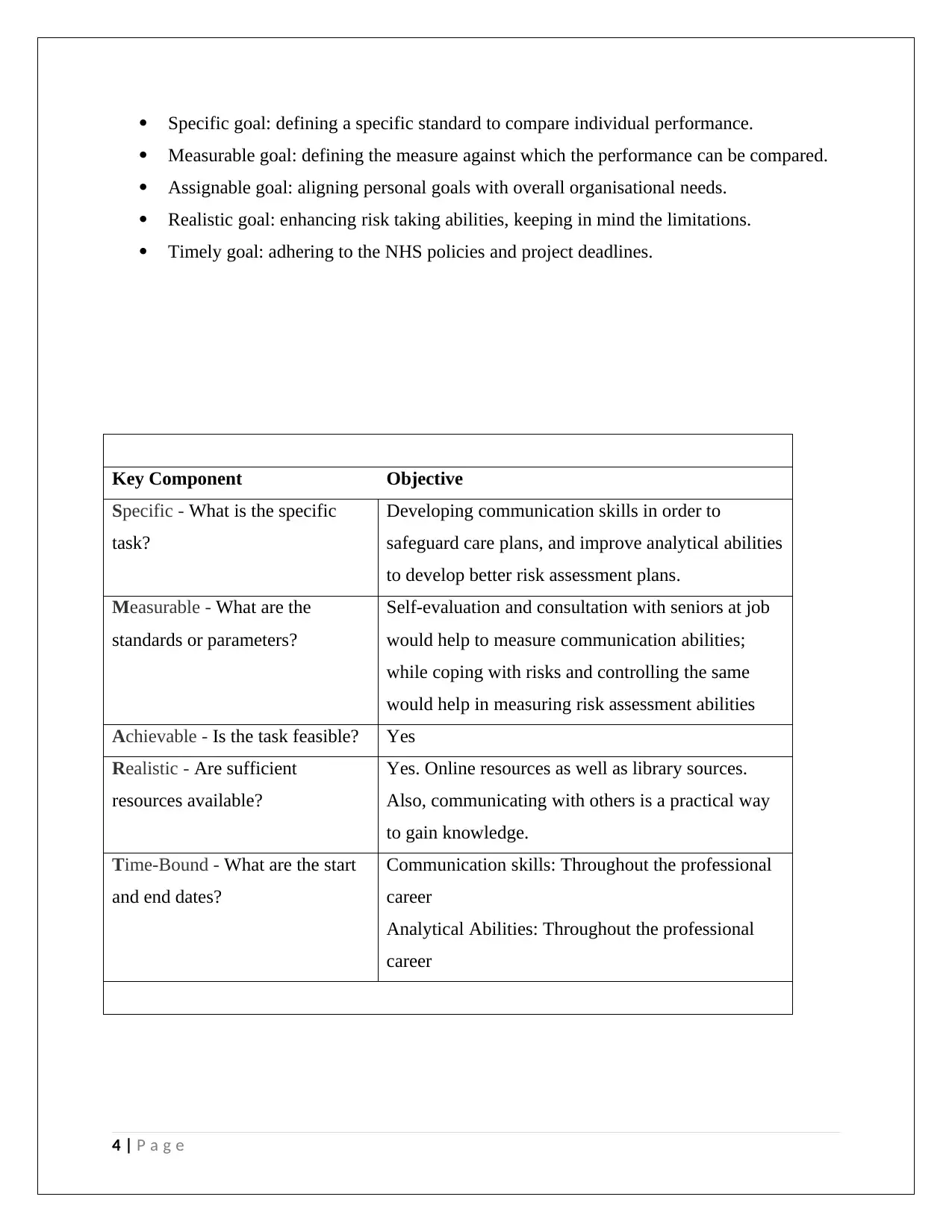
Specific goal: defining a specific standard to compare individual performance.
Measurable goal: defining the measure against which the performance can be compared.
Assignable goal: aligning personal goals with overall organisational needs.
Realistic goal: enhancing risk taking abilities, keeping in mind the limitations.
Timely goal: adhering to the NHS policies and project deadlines.
Key Component Objective
Specific - What is the specific
task?
Developing communication skills in order to
safeguard care plans, and improve analytical abilities
to develop better risk assessment plans.
Measurable - What are the
standards or parameters?
Self-evaluation and consultation with seniors at job
would help to measure communication abilities;
while coping with risks and controlling the same
would help in measuring risk assessment abilities
Achievable - Is the task feasible? Yes
Realistic - Are sufficient
resources available?
Yes. Online resources as well as library sources.
Also, communicating with others is a practical way
to gain knowledge.
Time-Bound - What are the start
and end dates?
Communication skills: Throughout the professional
career
Analytical Abilities: Throughout the professional
career
4 | P a g e
Measurable goal: defining the measure against which the performance can be compared.
Assignable goal: aligning personal goals with overall organisational needs.
Realistic goal: enhancing risk taking abilities, keeping in mind the limitations.
Timely goal: adhering to the NHS policies and project deadlines.
Key Component Objective
Specific - What is the specific
task?
Developing communication skills in order to
safeguard care plans, and improve analytical abilities
to develop better risk assessment plans.
Measurable - What are the
standards or parameters?
Self-evaluation and consultation with seniors at job
would help to measure communication abilities;
while coping with risks and controlling the same
would help in measuring risk assessment abilities
Achievable - Is the task feasible? Yes
Realistic - Are sufficient
resources available?
Yes. Online resources as well as library sources.
Also, communicating with others is a practical way
to gain knowledge.
Time-Bound - What are the start
and end dates?
Communication skills: Throughout the professional
career
Analytical Abilities: Throughout the professional
career
4 | P a g e
Paraphrase This Document
Need a fresh take? Get an instant paraphrase of this document with our AI Paraphraser
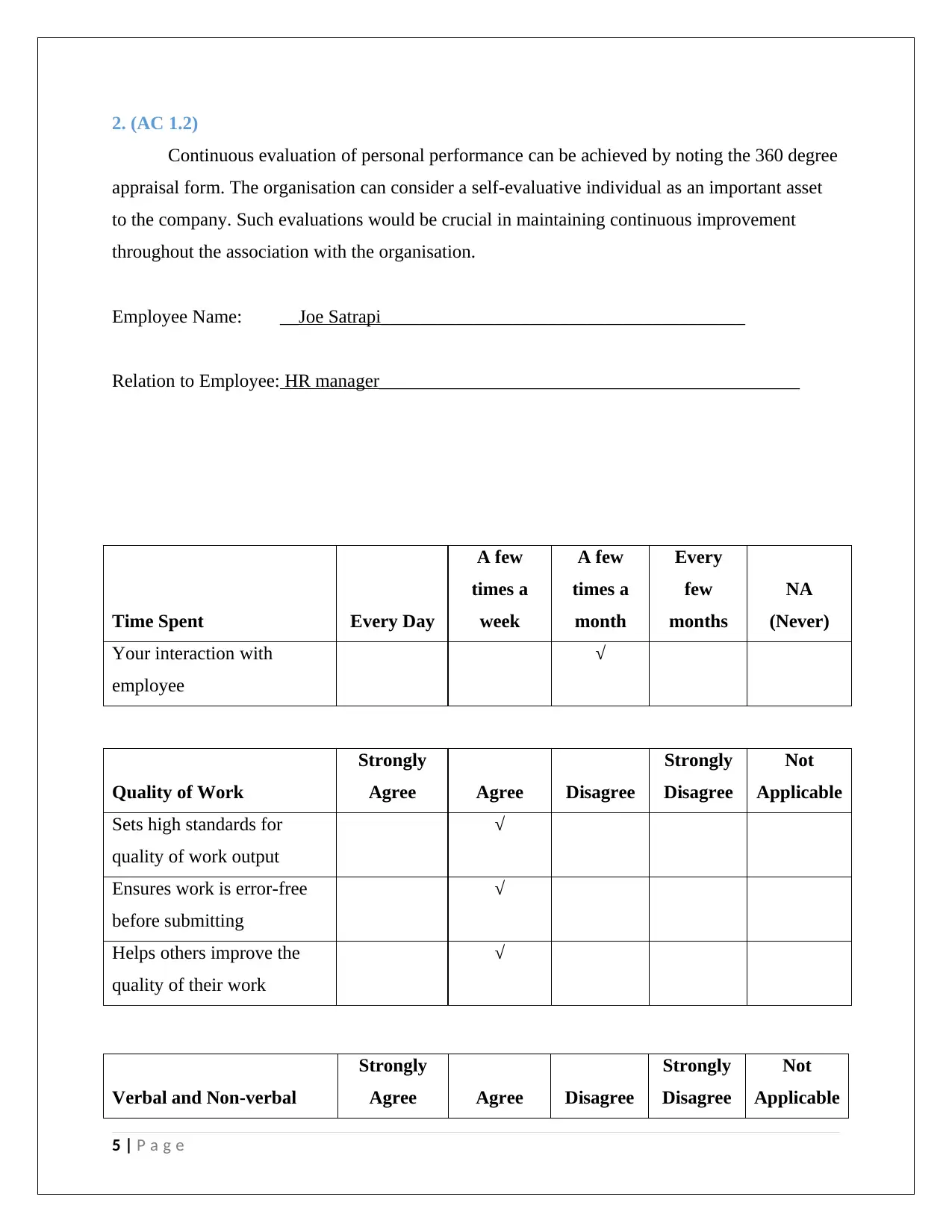
2. (AC 1.2)
Continuous evaluation of personal performance can be achieved by noting the 360 degree
appraisal form. The organisation can consider a self-evaluative individual as an important asset
to the company. Such evaluations would be crucial in maintaining continuous improvement
throughout the association with the organisation.
Employee Name: __Joe Satrapi_______________________________________
Relation to Employee: HR manager_____________________________________________
Time Spent Every Day
A few
times a
week
A few
times a
month
Every
few
months
NA
(Never)
Your interaction with
employee
√
Quality of Work
Strongly
Agree Agree Disagree
Strongly
Disagree
Not
Applicable
Sets high standards for
quality of work output
√
Ensures work is error-free
before submitting
√
Helps others improve the
quality of their work
√
Verbal and Non-verbal
Strongly
Agree Agree Disagree
Strongly
Disagree
Not
Applicable
5 | P a g e
Continuous evaluation of personal performance can be achieved by noting the 360 degree
appraisal form. The organisation can consider a self-evaluative individual as an important asset
to the company. Such evaluations would be crucial in maintaining continuous improvement
throughout the association with the organisation.
Employee Name: __Joe Satrapi_______________________________________
Relation to Employee: HR manager_____________________________________________
Time Spent Every Day
A few
times a
week
A few
times a
month
Every
few
months
NA
(Never)
Your interaction with
employee
√
Quality of Work
Strongly
Agree Agree Disagree
Strongly
Disagree
Not
Applicable
Sets high standards for
quality of work output
√
Ensures work is error-free
before submitting
√
Helps others improve the
quality of their work
√
Verbal and Non-verbal
Strongly
Agree Agree Disagree
Strongly
Disagree
Not
Applicable
5 | P a g e
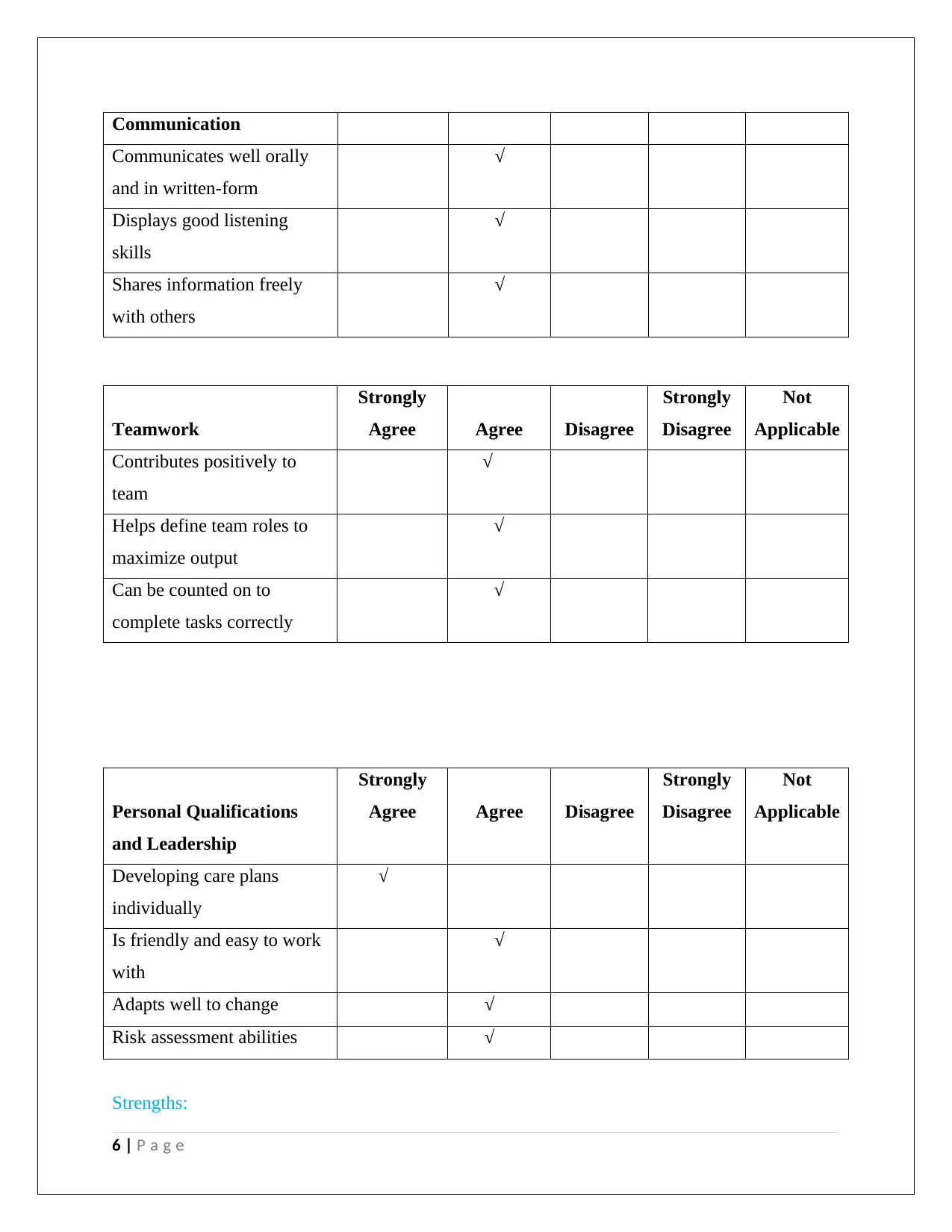
Communication
Communicates well orally
and in written-form
√
Displays good listening
skills
√
Shares information freely
with others
√
Teamwork
Strongly
Agree Agree Disagree
Strongly
Disagree
Not
Applicable
Contributes positively to
team
√
Helps define team roles to
maximize output
√
Can be counted on to
complete tasks correctly
√
Personal Qualifications
and Leadership
Strongly
Agree Agree Disagree
Strongly
Disagree
Not
Applicable
Developing care plans
individually
√
Is friendly and easy to work
with
√
Adapts well to change √
Risk assessment abilities √
Strengths:
6 | P a g e
Communicates well orally
and in written-form
√
Displays good listening
skills
√
Shares information freely
with others
√
Teamwork
Strongly
Agree Agree Disagree
Strongly
Disagree
Not
Applicable
Contributes positively to
team
√
Helps define team roles to
maximize output
√
Can be counted on to
complete tasks correctly
√
Personal Qualifications
and Leadership
Strongly
Agree Agree Disagree
Strongly
Disagree
Not
Applicable
Developing care plans
individually
√
Is friendly and easy to work
with
√
Adapts well to change √
Risk assessment abilities √
Strengths:
6 | P a g e
⊘ This is a preview!⊘
Do you want full access?
Subscribe today to unlock all pages.
Trusted by 1+ million students worldwide
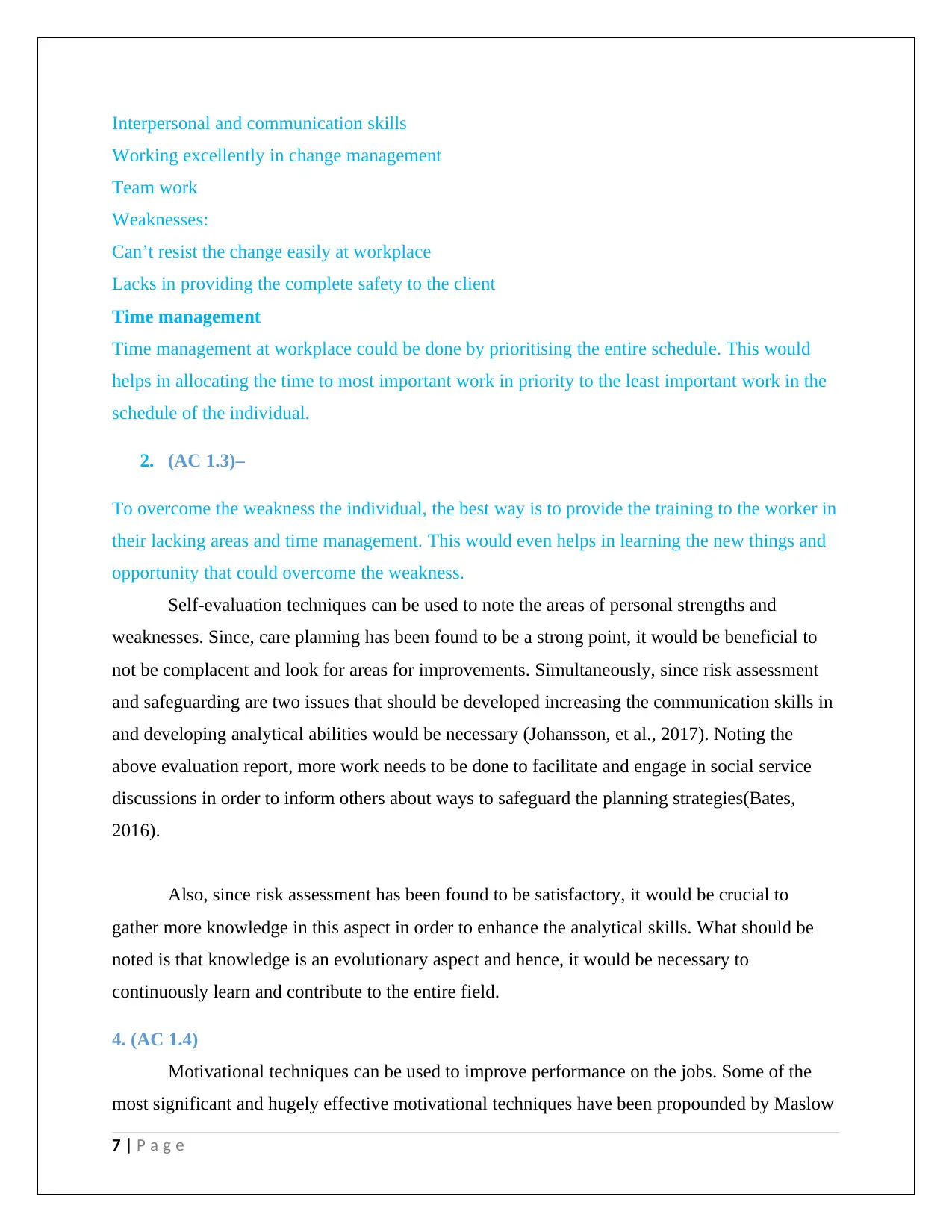
Interpersonal and communication skills
Working excellently in change management
Team work
Weaknesses:
Can’t resist the change easily at workplace
Lacks in providing the complete safety to the client
Time management
Time management at workplace could be done by prioritising the entire schedule. This would
helps in allocating the time to most important work in priority to the least important work in the
schedule of the individual.
2. (AC 1.3)–
To overcome the weakness the individual, the best way is to provide the training to the worker in
their lacking areas and time management. This would even helps in learning the new things and
opportunity that could overcome the weakness.
Self-evaluation techniques can be used to note the areas of personal strengths and
weaknesses. Since, care planning has been found to be a strong point, it would be beneficial to
not be complacent and look for areas for improvements. Simultaneously, since risk assessment
and safeguarding are two issues that should be developed increasing the communication skills in
and developing analytical abilities would be necessary (Johansson, et al., 2017). Noting the
above evaluation report, more work needs to be done to facilitate and engage in social service
discussions in order to inform others about ways to safeguard the planning strategies(Bates,
2016).
Also, since risk assessment has been found to be satisfactory, it would be crucial to
gather more knowledge in this aspect in order to enhance the analytical skills. What should be
noted is that knowledge is an evolutionary aspect and hence, it would be necessary to
continuously learn and contribute to the entire field.
4. (AC 1.4)
Motivational techniques can be used to improve performance on the jobs. Some of the
most significant and hugely effective motivational techniques have been propounded by Maslow
7 | P a g e
Working excellently in change management
Team work
Weaknesses:
Can’t resist the change easily at workplace
Lacks in providing the complete safety to the client
Time management
Time management at workplace could be done by prioritising the entire schedule. This would
helps in allocating the time to most important work in priority to the least important work in the
schedule of the individual.
2. (AC 1.3)–
To overcome the weakness the individual, the best way is to provide the training to the worker in
their lacking areas and time management. This would even helps in learning the new things and
opportunity that could overcome the weakness.
Self-evaluation techniques can be used to note the areas of personal strengths and
weaknesses. Since, care planning has been found to be a strong point, it would be beneficial to
not be complacent and look for areas for improvements. Simultaneously, since risk assessment
and safeguarding are two issues that should be developed increasing the communication skills in
and developing analytical abilities would be necessary (Johansson, et al., 2017). Noting the
above evaluation report, more work needs to be done to facilitate and engage in social service
discussions in order to inform others about ways to safeguard the planning strategies(Bates,
2016).
Also, since risk assessment has been found to be satisfactory, it would be crucial to
gather more knowledge in this aspect in order to enhance the analytical skills. What should be
noted is that knowledge is an evolutionary aspect and hence, it would be necessary to
continuously learn and contribute to the entire field.
4. (AC 1.4)
Motivational techniques can be used to improve performance on the jobs. Some of the
most significant and hugely effective motivational techniques have been propounded by Maslow
7 | P a g e
Paraphrase This Document
Need a fresh take? Get an instant paraphrase of this document with our AI Paraphraser
who had categorised the psychological needs of the employees to improve job
satisfaction(Alhyas, et al., 2013).The most basic are food and shelter, with the mid-level needs
being social security and family safety, with the highest needs being self-actualisation. On a
personal level, job satisfaction can be understood based on Herzberg’s two factor theory that
define certain hygiene factors like salary, job security and others which improve job satisfaction
among employees enhancing job performance, while others like the lack of such salary
incentives or assurance of job security can induce dissatisfaction among employees. Constructive
challenges at workplace have been noted to drive motivation as well (Kim, et al., 2015).
Individual can be kept motivated at workplace by providing attractive incentives. Incentives can
be financial or non financial. Financial incentive includes cash, bonuses and many more and non
financial incentives increasing the morale of the employees, participation in decision making and
leave compensation etc.
5.(AC 2.2)
Communication is one of the most crucial aspects of the organisational success. More so
within the health and social service institutions as gaps in communication chain can be risky for
the patient or can even cost lives(Micu and Garden, 2015). The effective ways of communication
are through proper channels. Maintaining a professional outlook while communicating has been
effective. However, since health and social service frequently works under emergency situations,
professional ways of communication at such times can prove to be costly. At these times,
maintaining an emergency communication outlet might be helpful.
Individual at workplace should adopt the most suitable communication type. In the given
scenario, verbal communication is suitable with the client as my role is of care assistant. The
verbal communication refers to the communication that involves personal feeling and care of the
individual who is performing his job and with this client also recovers quickly.
Table 1: Self-Appraisal Form
Name: Joe Satrapi
Job Title: Care Assistant
8 | P a g e
satisfaction(Alhyas, et al., 2013).The most basic are food and shelter, with the mid-level needs
being social security and family safety, with the highest needs being self-actualisation. On a
personal level, job satisfaction can be understood based on Herzberg’s two factor theory that
define certain hygiene factors like salary, job security and others which improve job satisfaction
among employees enhancing job performance, while others like the lack of such salary
incentives or assurance of job security can induce dissatisfaction among employees. Constructive
challenges at workplace have been noted to drive motivation as well (Kim, et al., 2015).
Individual can be kept motivated at workplace by providing attractive incentives. Incentives can
be financial or non financial. Financial incentive includes cash, bonuses and many more and non
financial incentives increasing the morale of the employees, participation in decision making and
leave compensation etc.
5.(AC 2.2)
Communication is one of the most crucial aspects of the organisational success. More so
within the health and social service institutions as gaps in communication chain can be risky for
the patient or can even cost lives(Micu and Garden, 2015). The effective ways of communication
are through proper channels. Maintaining a professional outlook while communicating has been
effective. However, since health and social service frequently works under emergency situations,
professional ways of communication at such times can prove to be costly. At these times,
maintaining an emergency communication outlet might be helpful.
Individual at workplace should adopt the most suitable communication type. In the given
scenario, verbal communication is suitable with the client as my role is of care assistant. The
verbal communication refers to the communication that involves personal feeling and care of the
individual who is performing his job and with this client also recovers quickly.
Table 1: Self-Appraisal Form
Name: Joe Satrapi
Job Title: Care Assistant
8 | P a g e
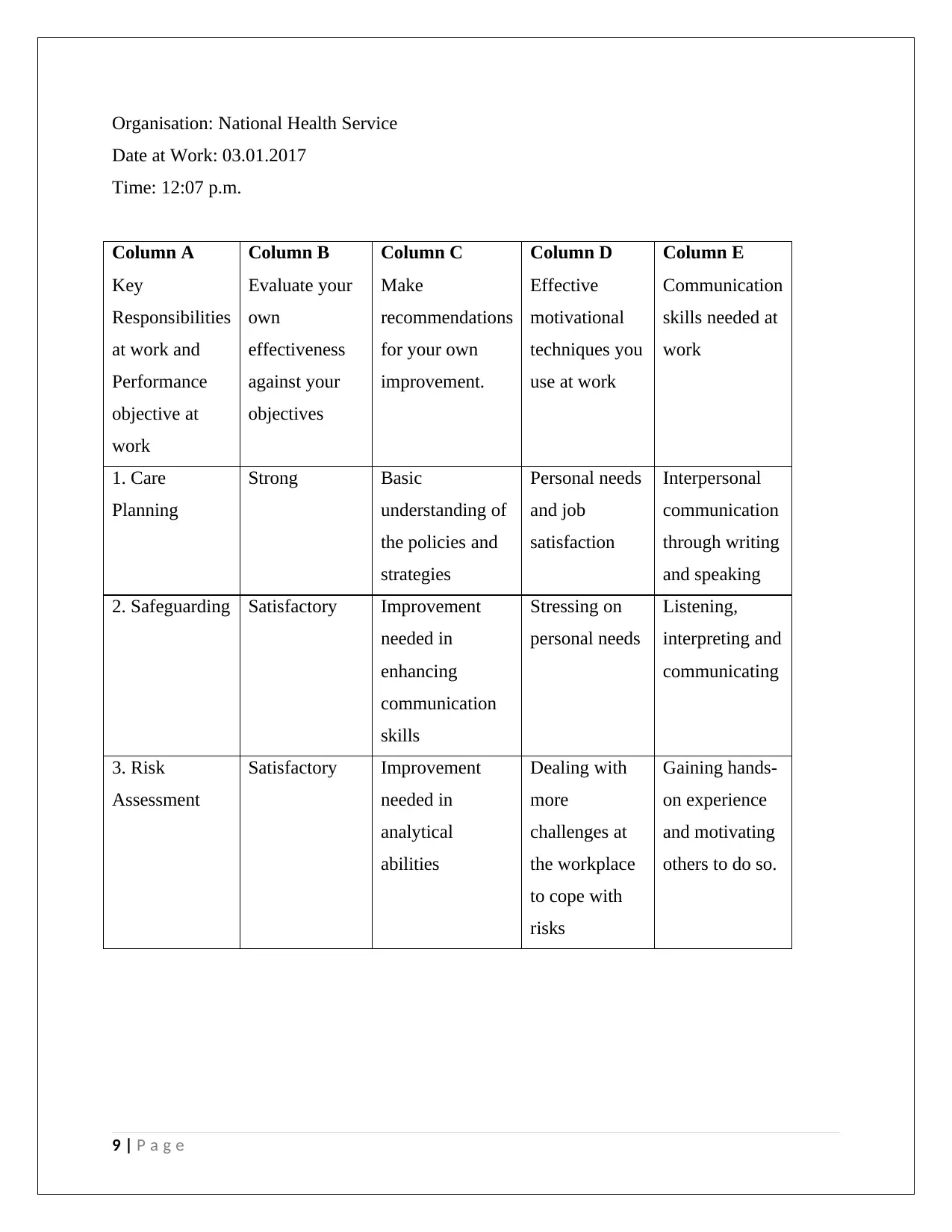
Organisation: National Health Service
Date at Work: 03.01.2017
Time: 12:07 p.m.
Column A
Key
Responsibilities
at work and
Performance
objective at
work
Column B
Evaluate your
own
effectiveness
against your
objectives
Column C
Make
recommendations
for your own
improvement.
Column D
Effective
motivational
techniques you
use at work
Column E
Communication
skills needed at
work
1. Care
Planning
Strong Basic
understanding of
the policies and
strategies
Personal needs
and job
satisfaction
Interpersonal
communication
through writing
and speaking
2. Safeguarding Satisfactory Improvement
needed in
enhancing
communication
skills
Stressing on
personal needs
Listening,
interpreting and
communicating
3. Risk
Assessment
Satisfactory Improvement
needed in
analytical
abilities
Dealing with
more
challenges at
the workplace
to cope with
risks
Gaining hands-
on experience
and motivating
others to do so.
9 | P a g e
Date at Work: 03.01.2017
Time: 12:07 p.m.
Column A
Key
Responsibilities
at work and
Performance
objective at
work
Column B
Evaluate your
own
effectiveness
against your
objectives
Column C
Make
recommendations
for your own
improvement.
Column D
Effective
motivational
techniques you
use at work
Column E
Communication
skills needed at
work
1. Care
Planning
Strong Basic
understanding of
the policies and
strategies
Personal needs
and job
satisfaction
Interpersonal
communication
through writing
and speaking
2. Safeguarding Satisfactory Improvement
needed in
enhancing
communication
skills
Stressing on
personal needs
Listening,
interpreting and
communicating
3. Risk
Assessment
Satisfactory Improvement
needed in
analytical
abilities
Dealing with
more
challenges at
the workplace
to cope with
risks
Gaining hands-
on experience
and motivating
others to do so.
9 | P a g e
⊘ This is a preview!⊘
Do you want full access?
Subscribe today to unlock all pages.
Trusted by 1+ million students worldwide
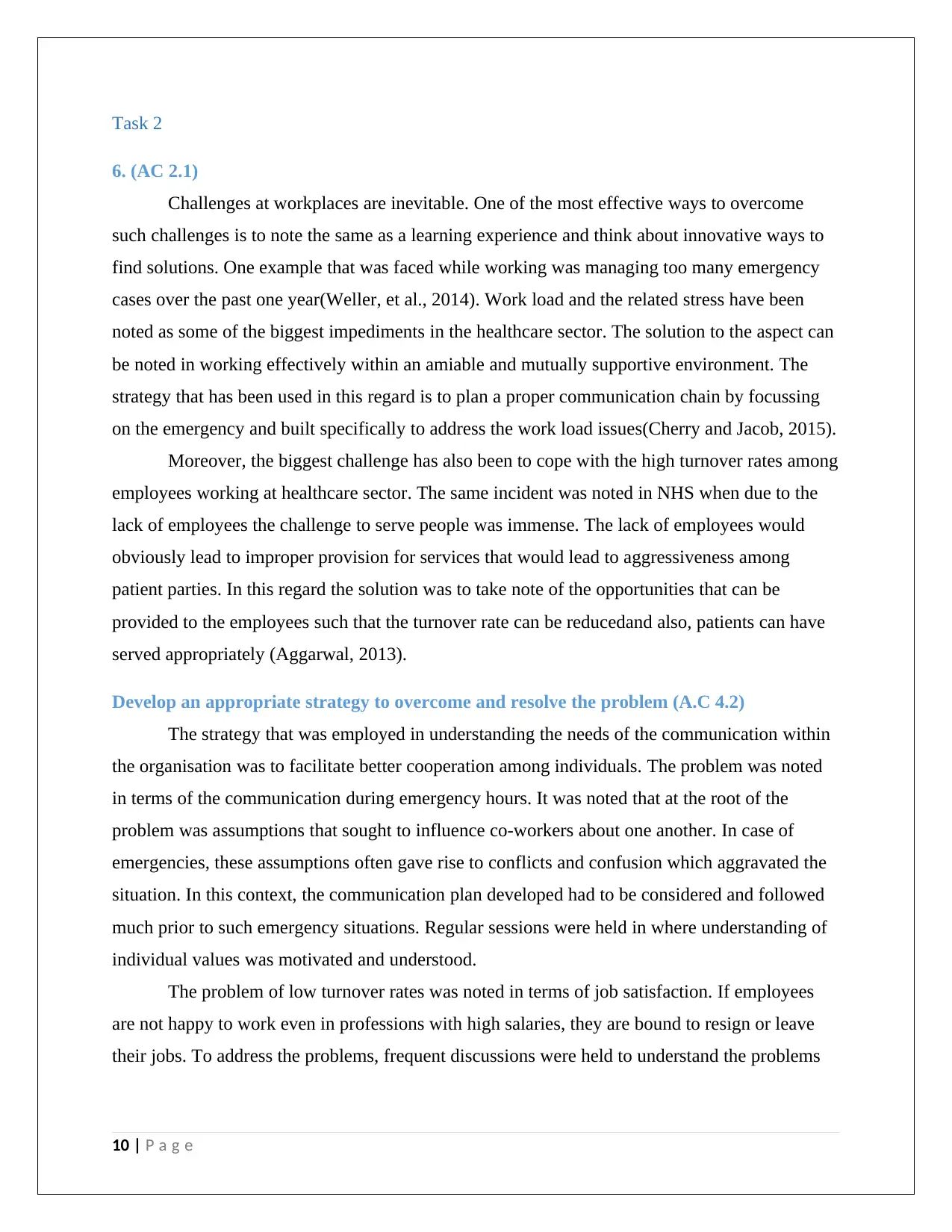
Task 2
6. (AC 2.1)
Challenges at workplaces are inevitable. One of the most effective ways to overcome
such challenges is to note the same as a learning experience and think about innovative ways to
find solutions. One example that was faced while working was managing too many emergency
cases over the past one year(Weller, et al., 2014). Work load and the related stress have been
noted as some of the biggest impediments in the healthcare sector. The solution to the aspect can
be noted in working effectively within an amiable and mutually supportive environment. The
strategy that has been used in this regard is to plan a proper communication chain by focussing
on the emergency and built specifically to address the work load issues(Cherry and Jacob, 2015).
Moreover, the biggest challenge has also been to cope with the high turnover rates among
employees working at healthcare sector. The same incident was noted in NHS when due to the
lack of employees the challenge to serve people was immense. The lack of employees would
obviously lead to improper provision for services that would lead to aggressiveness among
patient parties. In this regard the solution was to take note of the opportunities that can be
provided to the employees such that the turnover rate can be reducedand also, patients can have
served appropriately (Aggarwal, 2013).
Develop an appropriate strategy to overcome and resolve the problem (A.C 4.2)
The strategy that was employed in understanding the needs of the communication within
the organisation was to facilitate better cooperation among individuals. The problem was noted
in terms of the communication during emergency hours. It was noted that at the root of the
problem was assumptions that sought to influence co-workers about one another. In case of
emergencies, these assumptions often gave rise to conflicts and confusion which aggravated the
situation. In this context, the communication plan developed had to be considered and followed
much prior to such emergency situations. Regular sessions were held in where understanding of
individual values was motivated and understood.
The problem of low turnover rates was noted in terms of job satisfaction. If employees
are not happy to work even in professions with high salaries, they are bound to resign or leave
their jobs. To address the problems, frequent discussions were held to understand the problems
10 | P a g e
6. (AC 2.1)
Challenges at workplaces are inevitable. One of the most effective ways to overcome
such challenges is to note the same as a learning experience and think about innovative ways to
find solutions. One example that was faced while working was managing too many emergency
cases over the past one year(Weller, et al., 2014). Work load and the related stress have been
noted as some of the biggest impediments in the healthcare sector. The solution to the aspect can
be noted in working effectively within an amiable and mutually supportive environment. The
strategy that has been used in this regard is to plan a proper communication chain by focussing
on the emergency and built specifically to address the work load issues(Cherry and Jacob, 2015).
Moreover, the biggest challenge has also been to cope with the high turnover rates among
employees working at healthcare sector. The same incident was noted in NHS when due to the
lack of employees the challenge to serve people was immense. The lack of employees would
obviously lead to improper provision for services that would lead to aggressiveness among
patient parties. In this regard the solution was to take note of the opportunities that can be
provided to the employees such that the turnover rate can be reducedand also, patients can have
served appropriately (Aggarwal, 2013).
Develop an appropriate strategy to overcome and resolve the problem (A.C 4.2)
The strategy that was employed in understanding the needs of the communication within
the organisation was to facilitate better cooperation among individuals. The problem was noted
in terms of the communication during emergency hours. It was noted that at the root of the
problem was assumptions that sought to influence co-workers about one another. In case of
emergencies, these assumptions often gave rise to conflicts and confusion which aggravated the
situation. In this context, the communication plan developed had to be considered and followed
much prior to such emergency situations. Regular sessions were held in where understanding of
individual values was motivated and understood.
The problem of low turnover rates was noted in terms of job satisfaction. If employees
are not happy to work even in professions with high salaries, they are bound to resign or leave
their jobs. To address the problems, frequent discussions were held to understand the problems
10 | P a g e
Paraphrase This Document
Need a fresh take? Get an instant paraphrase of this document with our AI Paraphraser
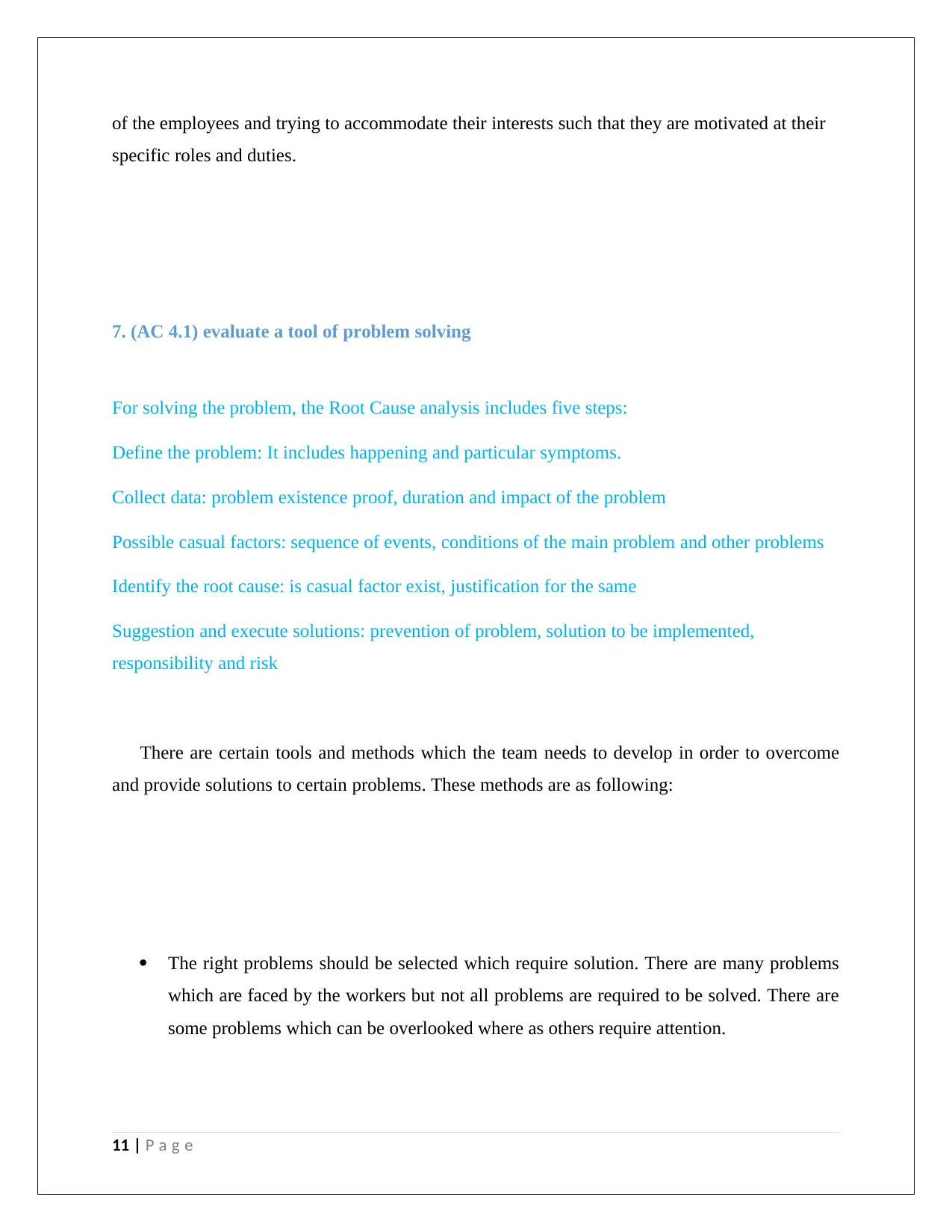
of the employees and trying to accommodate their interests such that they are motivated at their
specific roles and duties.
7. (AC 4.1) evaluate a tool of problem solving
For solving the problem, the Root Cause analysis includes five steps:
Define the problem: It includes happening and particular symptoms.
Collect data: problem existence proof, duration and impact of the problem
Possible casual factors: sequence of events, conditions of the main problem and other problems
Identify the root cause: is casual factor exist, justification for the same
Suggestion and execute solutions: prevention of problem, solution to be implemented,
responsibility and risk
There are certain tools and methods which the team needs to develop in order to overcome
and provide solutions to certain problems. These methods are as following:
The right problems should be selected which require solution. There are many problems
which are faced by the workers but not all problems are required to be solved. There are
some problems which can be overlooked where as others require attention.
11 | P a g e
specific roles and duties.
7. (AC 4.1) evaluate a tool of problem solving
For solving the problem, the Root Cause analysis includes five steps:
Define the problem: It includes happening and particular symptoms.
Collect data: problem existence proof, duration and impact of the problem
Possible casual factors: sequence of events, conditions of the main problem and other problems
Identify the root cause: is casual factor exist, justification for the same
Suggestion and execute solutions: prevention of problem, solution to be implemented,
responsibility and risk
There are certain tools and methods which the team needs to develop in order to overcome
and provide solutions to certain problems. These methods are as following:
The right problems should be selected which require solution. There are many problems
which are faced by the workers but not all problems are required to be solved. There are
some problems which can be overlooked where as others require attention.
11 | P a g e
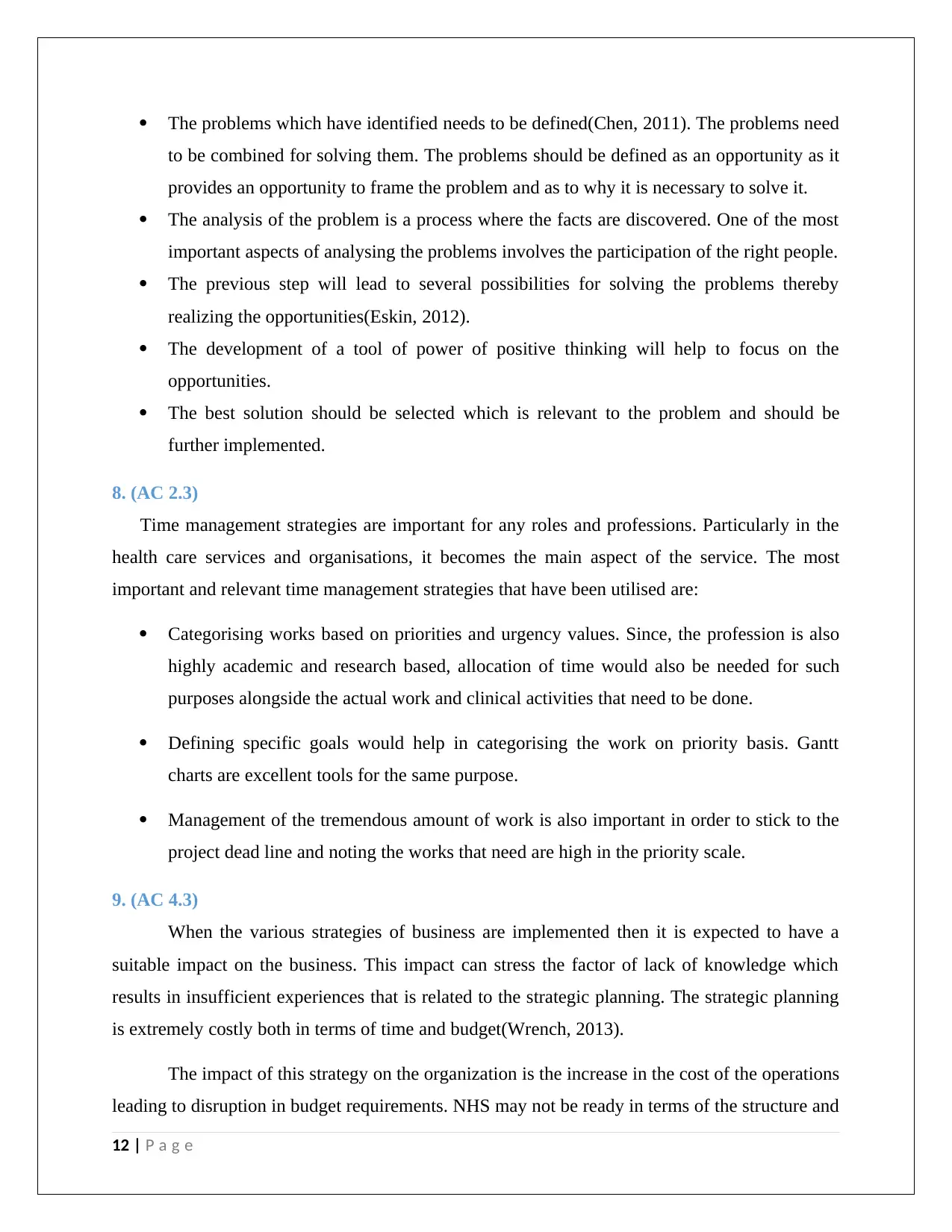
The problems which have identified needs to be defined(Chen, 2011). The problems need
to be combined for solving them. The problems should be defined as an opportunity as it
provides an opportunity to frame the problem and as to why it is necessary to solve it.
The analysis of the problem is a process where the facts are discovered. One of the most
important aspects of analysing the problems involves the participation of the right people.
The previous step will lead to several possibilities for solving the problems thereby
realizing the opportunities(Eskin, 2012).
The development of a tool of power of positive thinking will help to focus on the
opportunities.
The best solution should be selected which is relevant to the problem and should be
further implemented.
8. (AC 2.3)
Time management strategies are important for any roles and professions. Particularly in the
health care services and organisations, it becomes the main aspect of the service. The most
important and relevant time management strategies that have been utilised are:
Categorising works based on priorities and urgency values. Since, the profession is also
highly academic and research based, allocation of time would also be needed for such
purposes alongside the actual work and clinical activities that need to be done.
Defining specific goals would help in categorising the work on priority basis. Gantt
charts are excellent tools for the same purpose.
Management of the tremendous amount of work is also important in order to stick to the
project dead line and noting the works that need are high in the priority scale.
9. (AC 4.3)
When the various strategies of business are implemented then it is expected to have a
suitable impact on the business. This impact can stress the factor of lack of knowledge which
results in insufficient experiences that is related to the strategic planning. The strategic planning
is extremely costly both in terms of time and budget(Wrench, 2013).
The impact of this strategy on the organization is the increase in the cost of the operations
leading to disruption in budget requirements. NHS may not be ready in terms of the structure and
12 | P a g e
to be combined for solving them. The problems should be defined as an opportunity as it
provides an opportunity to frame the problem and as to why it is necessary to solve it.
The analysis of the problem is a process where the facts are discovered. One of the most
important aspects of analysing the problems involves the participation of the right people.
The previous step will lead to several possibilities for solving the problems thereby
realizing the opportunities(Eskin, 2012).
The development of a tool of power of positive thinking will help to focus on the
opportunities.
The best solution should be selected which is relevant to the problem and should be
further implemented.
8. (AC 2.3)
Time management strategies are important for any roles and professions. Particularly in the
health care services and organisations, it becomes the main aspect of the service. The most
important and relevant time management strategies that have been utilised are:
Categorising works based on priorities and urgency values. Since, the profession is also
highly academic and research based, allocation of time would also be needed for such
purposes alongside the actual work and clinical activities that need to be done.
Defining specific goals would help in categorising the work on priority basis. Gantt
charts are excellent tools for the same purpose.
Management of the tremendous amount of work is also important in order to stick to the
project dead line and noting the works that need are high in the priority scale.
9. (AC 4.3)
When the various strategies of business are implemented then it is expected to have a
suitable impact on the business. This impact can stress the factor of lack of knowledge which
results in insufficient experiences that is related to the strategic planning. The strategic planning
is extremely costly both in terms of time and budget(Wrench, 2013).
The impact of this strategy on the organization is the increase in the cost of the operations
leading to disruption in budget requirements. NHS may not be ready in terms of the structure and
12 | P a g e
⊘ This is a preview!⊘
Do you want full access?
Subscribe today to unlock all pages.
Trusted by 1+ million students worldwide

1 out of 21


Related Documents


Your All-in-One AI-Powered Toolkit for Academic Success.
+13062052269
info@desklib.com
Available 24*7 on WhatsApp / Email
![[object Object]](/_next/static/media/star-bottom.7253800d.svg)
Unlock your academic potential
Copyright © 2020–2026 A2Z Services. All Rights Reserved. Developed and managed by ZUCOL.