Unit 25: Analyzing Roles and Skills in Social Care: Non-Direct Workers

Verified

Added on  2023/03/22

|5
|490
|25
Report
AI Summary
This report examines the roles of non-direct care workers in the social care environment, focusing on their responsibilities and required skills. It highlights the importance of office staff, maintenance personnel, and security staff. The report emphasizes the significance of interpersonal skills, including verbal and non-verbal communication, as well as the application of care values. It stresses the importance of effective communication, appropriate body language, and maintaining confidentiality to ensure high-quality care. The document includes references to academic sources supporting the information presented.
Document Page
UNIT 25 SUPPORT WORK IN SOCIAL CARE
tabler-icon-diamond-filled.svg

Paraphrase This Document

Need a fresh take? Get an instant paraphrase of this document with our AI Paraphraser
Document Page
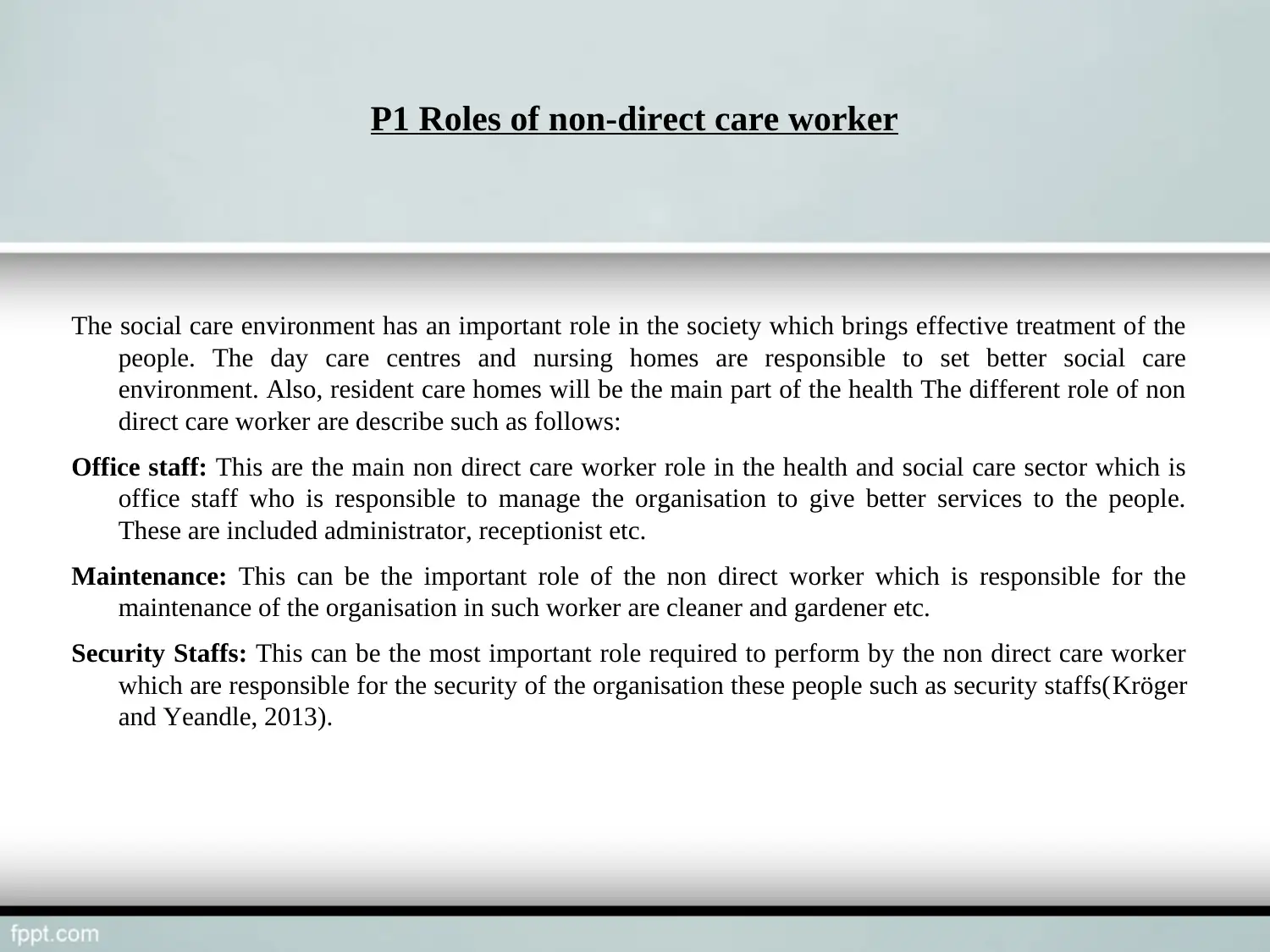
P1 Roles of non-direct care worker
The social care environment has an important role in the society which brings effective treatment of the
people. The day care centres and nursing homes are responsible to set better social care
environment. Also, resident care homes will be the main part of the health The different role of non
direct care worker are describe such as follows:
Office staff: This are the main non direct care worker role in the health and social care sector which is
office staff who is responsible to manage the organisation to give better services to the people.
These are included administrator, receptionist etc.
Maintenance: This can be the important role of the non direct worker which is responsible for the
maintenance of the organisation in such worker are cleaner and gardener etc.
Security Staffs: This can be the most important role required to perform by the non direct care worker
which are responsible for the security of the organisation these people such as security staffs(Kröger
and Yeandle, 2013).
Document Page
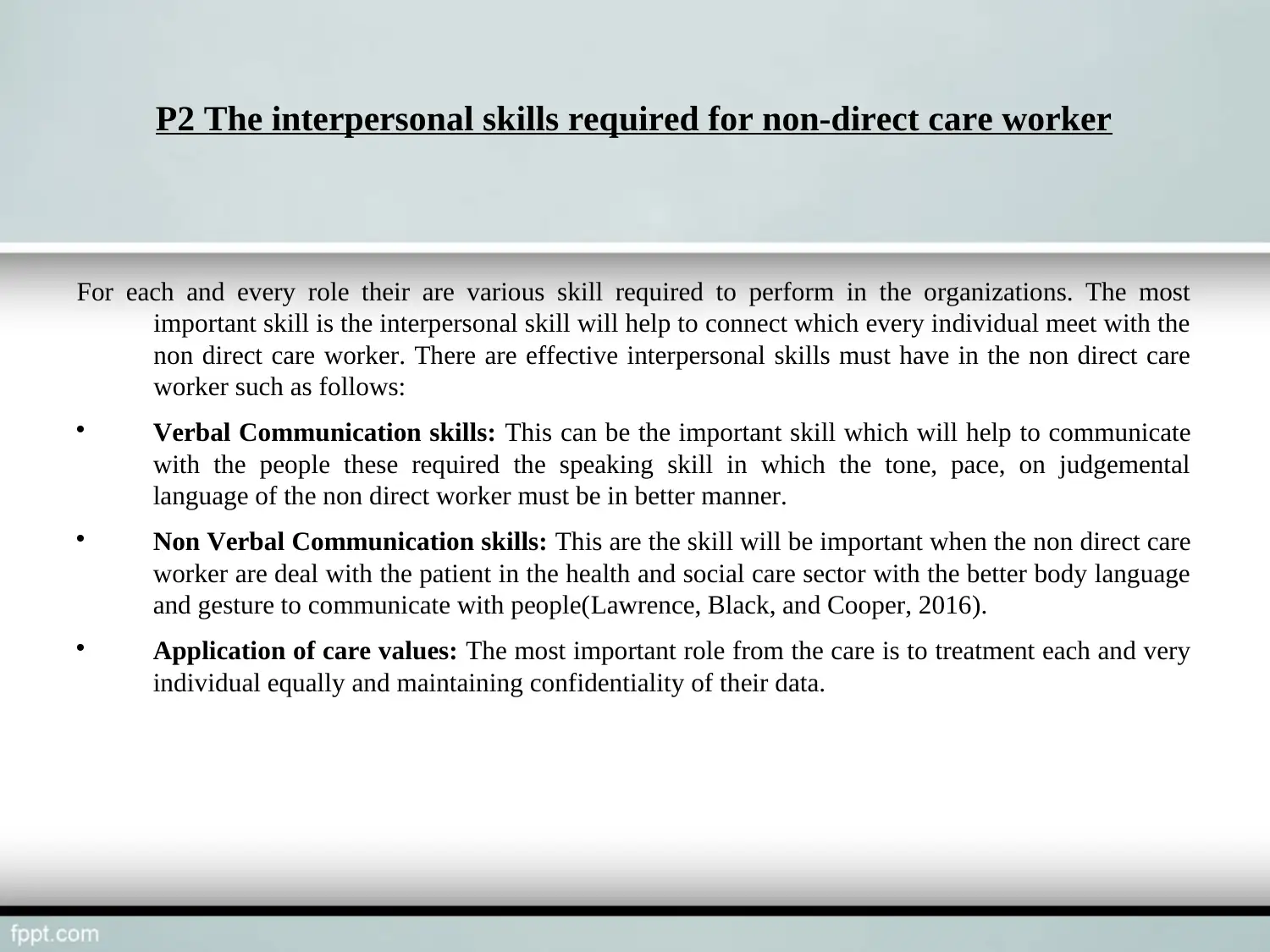
P2 The interpersonal skills required for non-direct care worker
For each and every role their are various skill required to perform in the organizations. The most
important skill is the interpersonal skill will help to connect which every individual meet with the
non direct care worker. There are effective interpersonal skills must have in the non direct care
worker such as follows:
Verbal Communication skills: This can be the important skill which will help to communicate
with the people these required the speaking skill in which the tone, pace, on judgemental
language of the non direct worker must be in better manner.
Non Verbal Communication skills: This are the skill will be important when the non direct care
worker are deal with the patient in the health and social care sector with the better body language
and gesture to communicate with people(Lawrence, Black, and Cooper, 2016).
Application of care values: The most important role from the care is to treatment each and very
individual equally and maintaining confidentiality of their data.
Document Page
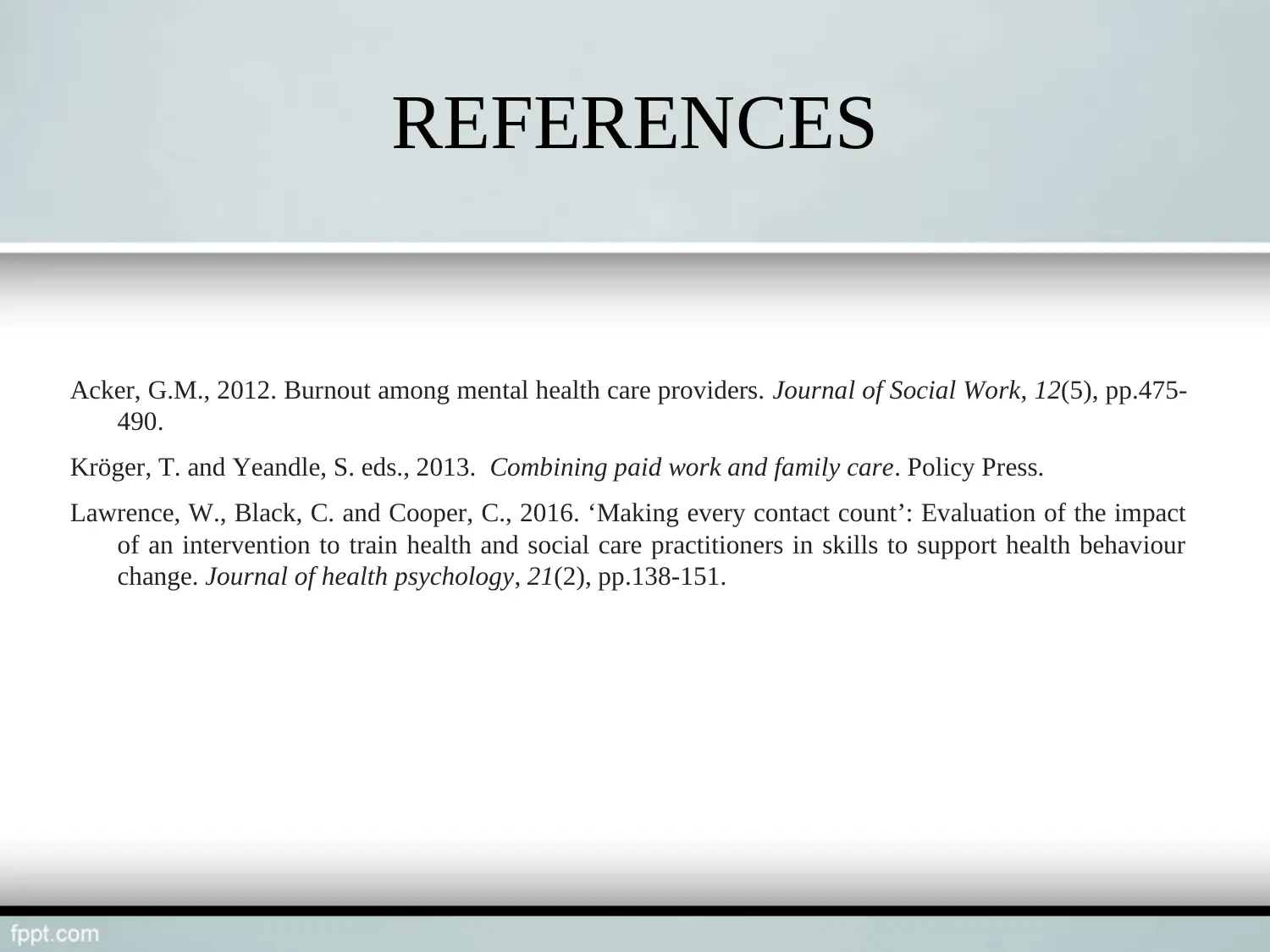
REFERENCES
Acker, G.M., 2012. Burnout among mental health care providers. Journal of Social Work, 12(5), pp.475-
490.
Kröger, T. and Yeandle, S. eds., 2013. Combining paid work and family care. Policy Press.
Lawrence, W., Black, C. and Cooper, C., 2016. ‘Making every contact count’: Evaluation of the impact
of an intervention to train health and social care practitioners in skills to support health behaviour
change. Journal of health psychology, 21(2), pp.138-151.
tabler-icon-diamond-filled.svg

Paraphrase This Document

Need a fresh take? Get an instant paraphrase of this document with our AI Paraphraser
Document Page
THANK YOU
chevron_up_icon
1 out of 5
circle_padding
hide_on_mobile
zoom_out_icon
[object Object]