An Evaluation of the Unitarism Approach to Workplace Change at TWU
VerifiedAdded on 2020/11/12
|9
|2465
|200
Report
AI Summary
This report examines the application of the Unitarism approach to workplace change within the Transport Workers Union (TWU). It explores how this approach, focusing on shared goals and objectives, was implemented and the resulting changes in the organization's processes. The report discusses the advantages of Unitarism, such as improved employee engagement and the ability to address collective disputes, as well as its limitations, including the potential for neglecting individual interests and the importance of balancing individual and collective concerns. The analysis highlights the roles of management, the ASU, and the MSC in facilitating change and maintaining industrial relations, considering the influence of international issues. The report concludes that while the Unitarism approach has benefits, it's crucial to consider its potential drawbacks and the need for a balanced approach to address both individual and collective employee concerns.

Workplace Change

Paraphrase This Document
Need a fresh take? Get an instant paraphrase of this document with our AI Paraphraser
Table of Contents
INTRODUCTION...........................................................................................................................1
MAIN BODY..................................................................................................................................1
CONCLUSION................................................................................................................................4
REFERENCES................................................................................................................................5
INTRODUCTION...........................................................................................................................1
MAIN BODY..................................................................................................................................1
CONCLUSION................................................................................................................................4
REFERENCES................................................................................................................................5
INTRODUCTION
Industrial issues arise due to change in organisational culture. In present times, there
exists certain industrial relational theories which is usually followed in order to implement
change and solve dispute. There are various theories related to bringing change in industrial
relations. The theories are applied according to situation and workplace environment Lantz
Friedrich, Sjöberg and Friedrich, (2016). In present report it is argued that why unitarism
approach is best suited in TWU. Furthermore, what features can and can not be observed in
unitarism approach. This report is based on failure of Union in addressing the issues which has
resulted in the change of an organisation. This report also discusses about how change is
implemented in an organisation and what are the reasons of change.
MAIN BODY
A workplace change can impact on industrial relation in negative way. So, it is essential
to maintain strong relations in order to work for common purpose. There are three universal
approaches through which workplace change can be maintained. They are pluralism, radicalism
and unitarism. It depends on type of workplace change that what approach is best suited for it.
Each approach consists some features and that differs from one another. Additionally, there are
some features which can and can not be observed in each theory. Therefore, it is essential to
evaluate processes and actors in each theory so that organisation change can be done.
As stated by Allan, et.al., 2017 Unitarism is an approach that enables organisation to
works in interest of all people. Here, common goals and objectives are developed within which
all members are treated equally. In similar way, it was identified that in TWU unitarism theory
can be applied. Through this, it will be easy in developing a common process to deal with
disputes. However, the purpose will be shifted from collective to individual dealing of issues.
Moreover, bringing change in process will help in employee engagement. There will be change
in involvement and decision taking. Apart from this, when TWU will work towards shard goals,
employee’s satisfaction will enhance. Through this, it will be easy to retain them and convert
into loyal ones. Mayhew, (2018), referred that unitarism approach best fit to TWU as there is
common goal shared. The union is only focusing on goals and objectives and external industrial
issues. The collective disputes are addressed and solved. Therefore, by applying this approach, a
common goal and objective will be developed. It will help in bringing changes in workplace.
Similarly, changes were bought in TWU. MSC intervention were employed which enabled in
1
Industrial issues arise due to change in organisational culture. In present times, there
exists certain industrial relational theories which is usually followed in order to implement
change and solve dispute. There are various theories related to bringing change in industrial
relations. The theories are applied according to situation and workplace environment Lantz
Friedrich, Sjöberg and Friedrich, (2016). In present report it is argued that why unitarism
approach is best suited in TWU. Furthermore, what features can and can not be observed in
unitarism approach. This report is based on failure of Union in addressing the issues which has
resulted in the change of an organisation. This report also discusses about how change is
implemented in an organisation and what are the reasons of change.
MAIN BODY
A workplace change can impact on industrial relation in negative way. So, it is essential
to maintain strong relations in order to work for common purpose. There are three universal
approaches through which workplace change can be maintained. They are pluralism, radicalism
and unitarism. It depends on type of workplace change that what approach is best suited for it.
Each approach consists some features and that differs from one another. Additionally, there are
some features which can and can not be observed in each theory. Therefore, it is essential to
evaluate processes and actors in each theory so that organisation change can be done.
As stated by Allan, et.al., 2017 Unitarism is an approach that enables organisation to
works in interest of all people. Here, common goals and objectives are developed within which
all members are treated equally. In similar way, it was identified that in TWU unitarism theory
can be applied. Through this, it will be easy in developing a common process to deal with
disputes. However, the purpose will be shifted from collective to individual dealing of issues.
Moreover, bringing change in process will help in employee engagement. There will be change
in involvement and decision taking. Apart from this, when TWU will work towards shard goals,
employee’s satisfaction will enhance. Through this, it will be easy to retain them and convert
into loyal ones. Mayhew, (2018), referred that unitarism approach best fit to TWU as there is
common goal shared. The union is only focusing on goals and objectives and external industrial
issues. The collective disputes are addressed and solved. Therefore, by applying this approach, a
common goal and objective will be developed. It will help in bringing changes in workplace.
Similarly, changes were bought in TWU. MSC intervention were employed which enabled in
1
⊘ This is a preview!⊘
Do you want full access?
Subscribe today to unlock all pages.

Trusted by 1+ million students worldwide
maintaining membership. MSC was converted into an operation centre. The process followed in
this was that decision was taken without consulting industrial organisers. Now, priority was
given to solve individual grievances and collectively overall industrial issues were solved.
Furthermore, SC organiser was assigned responsibility to deal with issue. It was useful in
changing workplace. ASU involved in interrupting change. Moreover, employees reacted to
change in positive manner.
There are several features of unitarism that makes it best fit to apply in TWU. Its main
perspective is it emphasises shared interest of all members within an organisation. Also, another
orientation of theory is it works on basis of common and shared goal. The orientation of
unitarism is that the conflicts are viewed as dysfunctional. This means that disputes are
considered as normal. Moreover, paternalistic approach is followed in which it is expected that
employees remain loyal towards organisation. This enables in applying this theory at TWU.
when TWU will work towards interest of all members so MSC has to share its goals with them.
Alongside it, integrating with all will enable TWU in attaining shared interest.
Dubernet and Axhausen, 2016, stated that in unitarism approach will benefit in solving
dispute of members in TWU. Here, its orientation of shared interest of all members best fits at
workplace. This is because it will allow TWU to set common goals and objectives so that
employees issues are solved. TWU can integrate with ASU to establish shared objectives. This
will enforce them to focus on employees’ issues as a whole and then towards other industrial
issues. It can be observed that in TWU the overall process was changed. There MSC was
appointed and changes in operations was made. The MSC was converted into operation centre.
There all individua issues were solve and now industrial organisers were allowed to solve
collective issues. The individual issues were solved without discussing it with ASU. The
employees reacted in positive way as they now directly approached MSC for any issue. Thus,
they were been consulted while solving issue. This change was successful as it enabled in
maintaining membership of employees within TWU. In addition to it, an agreement was signed
between ASU and TWU.
For solving issues, it is necessary to consult with employees. This is because it helps in
finding out their grievances and problems faced by them. In addition to this, suggestions are also
obtained from employees, their demands are determined, etc. Similarly, in TWU employees were
2
this was that decision was taken without consulting industrial organisers. Now, priority was
given to solve individual grievances and collectively overall industrial issues were solved.
Furthermore, SC organiser was assigned responsibility to deal with issue. It was useful in
changing workplace. ASU involved in interrupting change. Moreover, employees reacted to
change in positive manner.
There are several features of unitarism that makes it best fit to apply in TWU. Its main
perspective is it emphasises shared interest of all members within an organisation. Also, another
orientation of theory is it works on basis of common and shared goal. The orientation of
unitarism is that the conflicts are viewed as dysfunctional. This means that disputes are
considered as normal. Moreover, paternalistic approach is followed in which it is expected that
employees remain loyal towards organisation. This enables in applying this theory at TWU.
when TWU will work towards interest of all members so MSC has to share its goals with them.
Alongside it, integrating with all will enable TWU in attaining shared interest.
Dubernet and Axhausen, 2016, stated that in unitarism approach will benefit in solving
dispute of members in TWU. Here, its orientation of shared interest of all members best fits at
workplace. This is because it will allow TWU to set common goals and objectives so that
employees issues are solved. TWU can integrate with ASU to establish shared objectives. This
will enforce them to focus on employees’ issues as a whole and then towards other industrial
issues. It can be observed that in TWU the overall process was changed. There MSC was
appointed and changes in operations was made. The MSC was converted into operation centre.
There all individua issues were solve and now industrial organisers were allowed to solve
collective issues. The individual issues were solved without discussing it with ASU. The
employees reacted in positive way as they now directly approached MSC for any issue. Thus,
they were been consulted while solving issue. This change was successful as it enabled in
maintaining membership of employees within TWU. In addition to it, an agreement was signed
between ASU and TWU.
For solving issues, it is necessary to consult with employees. This is because it helps in
finding out their grievances and problems faced by them. In addition to this, suggestions are also
obtained from employees, their demands are determined, etc. Similarly, in TWU employees were
2
Paraphrase This Document
Need a fresh take? Get an instant paraphrase of this document with our AI Paraphraser
consulted by MSC. This enabled in considering employees issue as priority. They were allowed
to register their issue with MSC.
Tian, et.al., 2019 referred that there are some features of shared goals orientation in
unitarism approach that can be observed within TWU. here, by developing common goals it will
allow TWU to focus on it rather than on individual one. This will force TWU and MSC to work
for purpose of individual grievances. When any issue is occurred within TWU they will solve it
on basis of priority. Moreover, management of TWU will consider each issue within interest of
employees. The ASU and MSC can categorise different issues and develop framework to solve
it. It will be beneficial in engaging employees and solving their dispute.
Christensen and Schneider, (2015), stated that the feature that can not be observed in
shared goals is individual interest. So, when TWU will work towards common goals, employees’
interest will be ignored. This might result in conflict again. However, in this employee
engagement will not be observed. It will be an implication of workplace change in TWU. Only
MSC will be involved in solving issue. There will be not role of ASU in making things clear.
Here, employees will register their issues wiih MSC. Therefore, only those disputes will be
solved eliminating collective ones. Hence, TWU will not be able to maintain balance between
individual and collective ones.
The feature that can not be observed in unitarism approach conflicts are viewed as
dysfunctional. So, each individual issue will be different. Here, they can not be included in
common goals of TWU. Moreover, issues will be viewed only as in general. It will be not be
focused and employee’s engagement will not be observed. Here, only MSC and TWU will solve
dispute without consulting. Here, all issues might not be viewed as dysfunctional. Therefore, it
may occur a situation that some issues are highly concerned whereas
Another feature of unitarism approach that can not be observed is paternalistic approach.
It might be observed that even disputes are solved employees are not loyal towards TWU. this
situation will occur when individual dispute outside shared goals are not solved. So, this will
lead to creating further dispute. Due to this, employee may not be loyal towards TWU. it may
decline in membership. Consequently, following of protective approach may not focuses on all
members issue. It might be observed that some individual issues are taken as priority but other
are ignored. Hence, it will not evaluate things properly and results are not achieved.
3
to register their issue with MSC.
Tian, et.al., 2019 referred that there are some features of shared goals orientation in
unitarism approach that can be observed within TWU. here, by developing common goals it will
allow TWU to focus on it rather than on individual one. This will force TWU and MSC to work
for purpose of individual grievances. When any issue is occurred within TWU they will solve it
on basis of priority. Moreover, management of TWU will consider each issue within interest of
employees. The ASU and MSC can categorise different issues and develop framework to solve
it. It will be beneficial in engaging employees and solving their dispute.
Christensen and Schneider, (2015), stated that the feature that can not be observed in
shared goals is individual interest. So, when TWU will work towards common goals, employees’
interest will be ignored. This might result in conflict again. However, in this employee
engagement will not be observed. It will be an implication of workplace change in TWU. Only
MSC will be involved in solving issue. There will be not role of ASU in making things clear.
Here, employees will register their issues wiih MSC. Therefore, only those disputes will be
solved eliminating collective ones. Hence, TWU will not be able to maintain balance between
individual and collective ones.
The feature that can not be observed in unitarism approach conflicts are viewed as
dysfunctional. So, each individual issue will be different. Here, they can not be included in
common goals of TWU. Moreover, issues will be viewed only as in general. It will be not be
focused and employee’s engagement will not be observed. Here, only MSC and TWU will solve
dispute without consulting. Here, all issues might not be viewed as dysfunctional. Therefore, it
may occur a situation that some issues are highly concerned whereas
Another feature of unitarism approach that can not be observed is paternalistic approach.
It might be observed that even disputes are solved employees are not loyal towards TWU. this
situation will occur when individual dispute outside shared goals are not solved. So, this will
lead to creating further dispute. Due to this, employee may not be loyal towards TWU. it may
decline in membership. Consequently, following of protective approach may not focuses on all
members issue. It might be observed that some individual issues are taken as priority but other
are ignored. Hence, it will not evaluate things properly and results are not achieved.
3
It is important that in industrial relation change management and other actors plays a vital
role. They are responsible for implementing change and monitoring it. Consequently, in TWU
role of management and trade union could influence on employees. This is because it creates a
high influence on different parties that are involved in TWU (Christensen and Schneider, 2015).
For every relational approach the role of management varies and have an influence on change.
Similarly, in TWU the management will play a significant role in unitarism approach. They will
ensure that common issues are solved by negotiating with ASU. While employee’s behaviour
will be influenced as their grievances will be kept at priority. However, management and ASU
should not discriminate employees. They must maintain unity with each other. Besides this, ASU
role is to ensure that each employee dispute is considered and must be solved. Alongside it,
decision taken should be in favour of TWU and employees. Additionally, ASU at state level
should negotiate with employees. unitarism approach best fit to TWU as there is common goal
shared. The union is only focusing on goals and objectives and external industrial issues. The
collective disputes are addressed and solved.
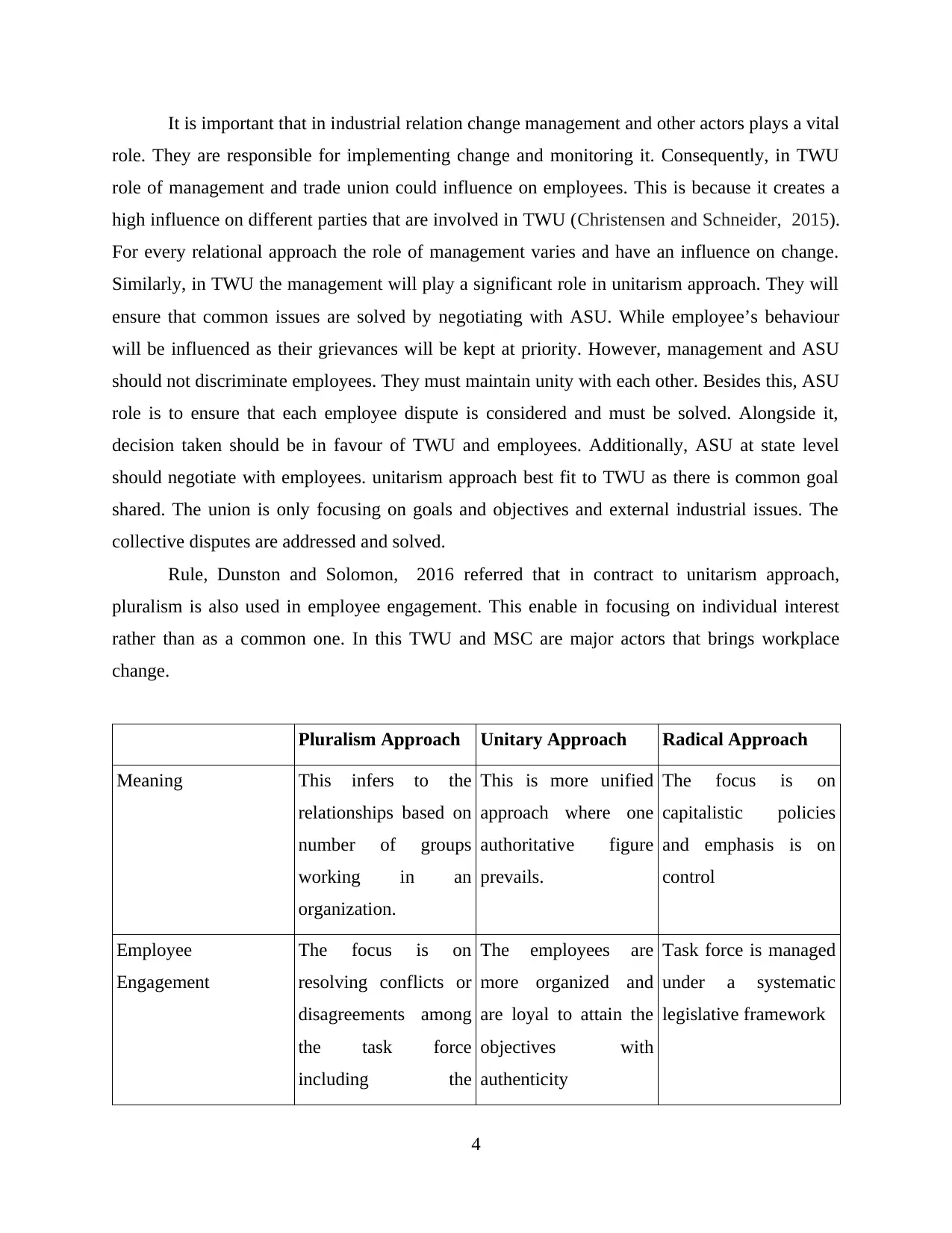
Rule, Dunston and Solomon, 2016 referred that in contract to unitarism approach,
pluralism is also used in employee engagement. This enable in focusing on individual interest
rather than as a common one. In this TWU and MSC are major actors that brings workplace
change.
Pluralism Approach Unitary Approach Radical Approach
Meaning This infers to the
relationships based on
number of groups
working in an
organization.
This is more unified
approach where one
authoritative figure
prevails.
The focus is on
capitalistic policies
and emphasis is on
control
Employee
Engagement
The focus is on
resolving conflicts or
disagreements among
the task force
including the
The employees are
more organized and
are loyal to attain the
objectives with
authenticity
Task force is managed
under a systematic
legislative framework
4
role. They are responsible for implementing change and monitoring it. Consequently, in TWU
role of management and trade union could influence on employees. This is because it creates a
high influence on different parties that are involved in TWU (Christensen and Schneider, 2015).
For every relational approach the role of management varies and have an influence on change.
Similarly, in TWU the management will play a significant role in unitarism approach. They will
ensure that common issues are solved by negotiating with ASU. While employee’s behaviour
will be influenced as their grievances will be kept at priority. However, management and ASU
should not discriminate employees. They must maintain unity with each other. Besides this, ASU
role is to ensure that each employee dispute is considered and must be solved. Alongside it,
decision taken should be in favour of TWU and employees. Additionally, ASU at state level
should negotiate with employees. unitarism approach best fit to TWU as there is common goal
shared. The union is only focusing on goals and objectives and external industrial issues. The
collective disputes are addressed and solved.
Rule, Dunston and Solomon, 2016 referred that in contract to unitarism approach,
pluralism is also used in employee engagement. This enable in focusing on individual interest
rather than as a common one. In this TWU and MSC are major actors that brings workplace
change.
Pluralism Approach Unitary Approach Radical Approach
Meaning This infers to the
relationships based on
number of groups
working in an
organization.
This is more unified
approach where one
authoritative figure
prevails.
The focus is on
capitalistic policies
and emphasis is on
control
Employee
Engagement
The focus is on
resolving conflicts or
disagreements among
the task force
including the
The employees are
more organized and
are loyal to attain the
objectives with
authenticity
Task force is managed
under a systematic
legislative framework
4
⊘ This is a preview!⊘
Do you want full access?
Subscribe today to unlock all pages.
Trusted by 1+ million students worldwide
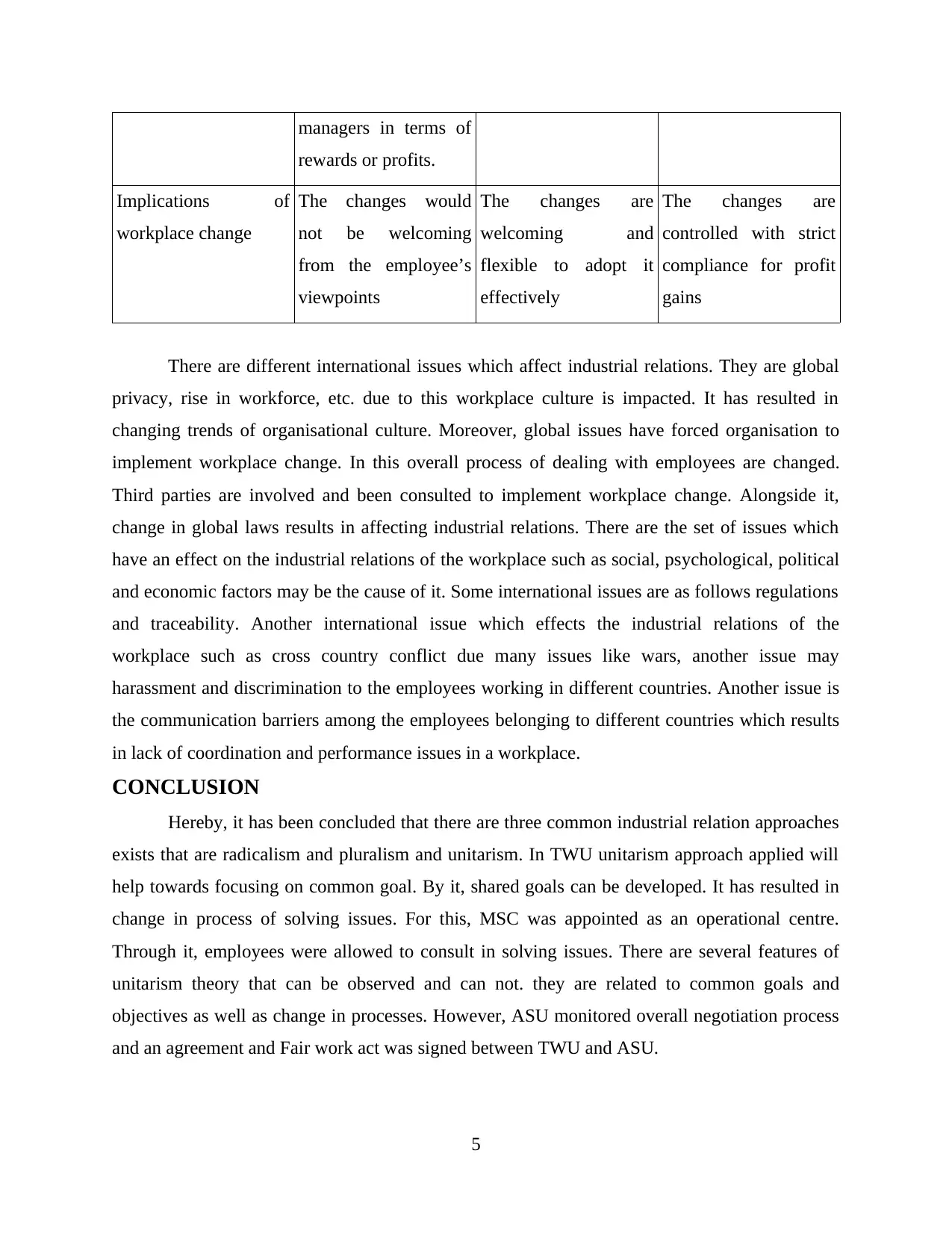
managers in terms of
rewards or profits.
Implications of
workplace change
The changes would
not be welcoming
from the employee’s
viewpoints
The changes are
welcoming and
flexible to adopt it
effectively
The changes are
controlled with strict
compliance for profit
gains
There are different international issues which affect industrial relations. They are global
privacy, rise in workforce, etc. due to this workplace culture is impacted. It has resulted in
changing trends of organisational culture. Moreover, global issues have forced organisation to
implement workplace change. In this overall process of dealing with employees are changed.
Third parties are involved and been consulted to implement workplace change. Alongside it,
change in global laws results in affecting industrial relations. There are the set of issues which
have an effect on the industrial relations of the workplace such as social, psychological, political
and economic factors may be the cause of it. Some international issues are as follows regulations
and traceability. Another international issue which effects the industrial relations of the
workplace such as cross country conflict due many issues like wars, another issue may
harassment and discrimination to the employees working in different countries. Another issue is
the communication barriers among the employees belonging to different countries which results
in lack of coordination and performance issues in a workplace.
CONCLUSION
Hereby, it has been concluded that there are three common industrial relation approaches
exists that are radicalism and pluralism and unitarism. In TWU unitarism approach applied will
help towards focusing on common goal. By it, shared goals can be developed. It has resulted in
change in process of solving issues. For this, MSC was appointed as an operational centre.
Through it, employees were allowed to consult in solving issues. There are several features of
unitarism theory that can be observed and can not. they are related to common goals and
objectives as well as change in processes. However, ASU monitored overall negotiation process
and an agreement and Fair work act was signed between TWU and ASU.
5
rewards or profits.
Implications of
workplace change
The changes would
not be welcoming
from the employee’s
viewpoints
The changes are
welcoming and
flexible to adopt it
effectively
The changes are
controlled with strict
compliance for profit
gains
There are different international issues which affect industrial relations. They are global
privacy, rise in workforce, etc. due to this workplace culture is impacted. It has resulted in
changing trends of organisational culture. Moreover, global issues have forced organisation to
implement workplace change. In this overall process of dealing with employees are changed.
Third parties are involved and been consulted to implement workplace change. Alongside it,
change in global laws results in affecting industrial relations. There are the set of issues which
have an effect on the industrial relations of the workplace such as social, psychological, political
and economic factors may be the cause of it. Some international issues are as follows regulations
and traceability. Another international issue which effects the industrial relations of the
workplace such as cross country conflict due many issues like wars, another issue may
harassment and discrimination to the employees working in different countries. Another issue is
the communication barriers among the employees belonging to different countries which results
in lack of coordination and performance issues in a workplace.
CONCLUSION
Hereby, it has been concluded that there are three common industrial relation approaches
exists that are radicalism and pluralism and unitarism. In TWU unitarism approach applied will
help towards focusing on common goal. By it, shared goals can be developed. It has resulted in
change in process of solving issues. For this, MSC was appointed as an operational centre.
Through it, employees were allowed to consult in solving issues. There are several features of
unitarism theory that can be observed and can not. they are related to common goals and
objectives as well as change in processes. However, ASU monitored overall negotiation process
and an agreement and Fair work act was signed between TWU and ASU.
5
Paraphrase This Document
Need a fresh take? Get an instant paraphrase of this document with our AI Paraphraser
REFERENCES
Books and journals
Allan, J. et.al., 2017. Environmental interventions for altering eating behaviours of employees in
the workplace: a systematic review. Obesity reviews. 18(2). pp.214-226.
Christensen, K. and Schneider, B. eds., 2015. Workplace flexibility: Realigning 20th-century jobs
for a 21st-century workforce. Cornell University Press.
Dubernet, I. and Axhausen, K.W., 2016, April. The choice of workplace and residential location
in Germany. In 16th Swiss transport research conference.
Lantz Friedrich, A., Sjöberg, A. and Friedrich, P., 2016. Leaned teamwork fattens workplace
innovation: The relationship between task complexity, team learning and team
proactivity. European Journal of Work and Organizational Psychology. 25(4). pp.561-
569.
Mayhew, C., 2018. Exploration of the links between workplace stress and precarious
employment. Work Stress: Studies of the Context, Content and Outcomes of Stress: A
Book of Readings.
Rule, J., Dunston, R. and Solomon, N., 2016. Learning and change in the redesign of a primary
health care initiative. Journal of Workplace Learning. 28(7). pp.451-467.
Tian, Q.T. et.al., 2019. Workplace gossip and frontline employees’ proactive service
performance. The Service Industries Journal. 39(1). pp.25-42.
6
Books and journals
Allan, J. et.al., 2017. Environmental interventions for altering eating behaviours of employees in
the workplace: a systematic review. Obesity reviews. 18(2). pp.214-226.
Christensen, K. and Schneider, B. eds., 2015. Workplace flexibility: Realigning 20th-century jobs
for a 21st-century workforce. Cornell University Press.
Dubernet, I. and Axhausen, K.W., 2016, April. The choice of workplace and residential location
in Germany. In 16th Swiss transport research conference.
Lantz Friedrich, A., Sjöberg, A. and Friedrich, P., 2016. Leaned teamwork fattens workplace
innovation: The relationship between task complexity, team learning and team
proactivity. European Journal of Work and Organizational Psychology. 25(4). pp.561-
569.
Mayhew, C., 2018. Exploration of the links between workplace stress and precarious
employment. Work Stress: Studies of the Context, Content and Outcomes of Stress: A
Book of Readings.
Rule, J., Dunston, R. and Solomon, N., 2016. Learning and change in the redesign of a primary
health care initiative. Journal of Workplace Learning. 28(7). pp.451-467.
Tian, Q.T. et.al., 2019. Workplace gossip and frontline employees’ proactive service
performance. The Service Industries Journal. 39(1). pp.25-42.
6

7
⊘ This is a preview!⊘
Do you want full access?
Subscribe today to unlock all pages.
Trusted by 1+ million students worldwide

1 out of 9


Related Documents


Your All-in-One AI-Powered Toolkit for Academic Success.
+13062052269
info@desklib.com
Available 24*7 on WhatsApp / Email
![[object Object]](/_next/static/media/star-bottom.7253800d.svg)
Unlock your academic potential
Copyright © 2020–2026 A2Z Services. All Rights Reserved. Developed and managed by ZUCOL.