Ageism Perception: University Students' Attitudes Research Proposal
VerifiedAdded on 2022/11/15
|16
|3565
|352
Report
AI Summary
This research proposal investigates the perceptions of university students towards ageism and the challenges faced by older people in Australia. The study aims to evaluate students' attitudes, identify challenges, and explore ways to foster positive perspectives on aging. It includes a literature review, research objectives, questions, and hypotheses. The methodology involves a deductive approach using a survey among 80 university students, with both primary and secondary data sources. Data analysis will involve statistical methods, and findings will be presented in tables and graphs, adhering to ethical guidelines. The research is planned for a six-month timeline and covers topics like elder abuse, discrimination, and societal attitudes towards the elderly population, aiming to provide insights into improving the situation for older Australians.
Running head: RESEARCH PROPOSAL
Name of the Student:
Name of the University:
Student ID:
Topic: An evaluation of the perception of University Students’ attitude to ageism and the
challenges being faced in Australian in the support of older people.
Report is dedicated to:
Date of submission:
Name of the Student:
Name of the University:
Student ID:
Topic: An evaluation of the perception of University Students’ attitude to ageism and the
challenges being faced in Australian in the support of older people.
Report is dedicated to:
Date of submission:

Paraphrase This Document
Need a fresh take? Get an instant paraphrase of this document with our AI Paraphraser
RESEARCH PROPOSAL 1
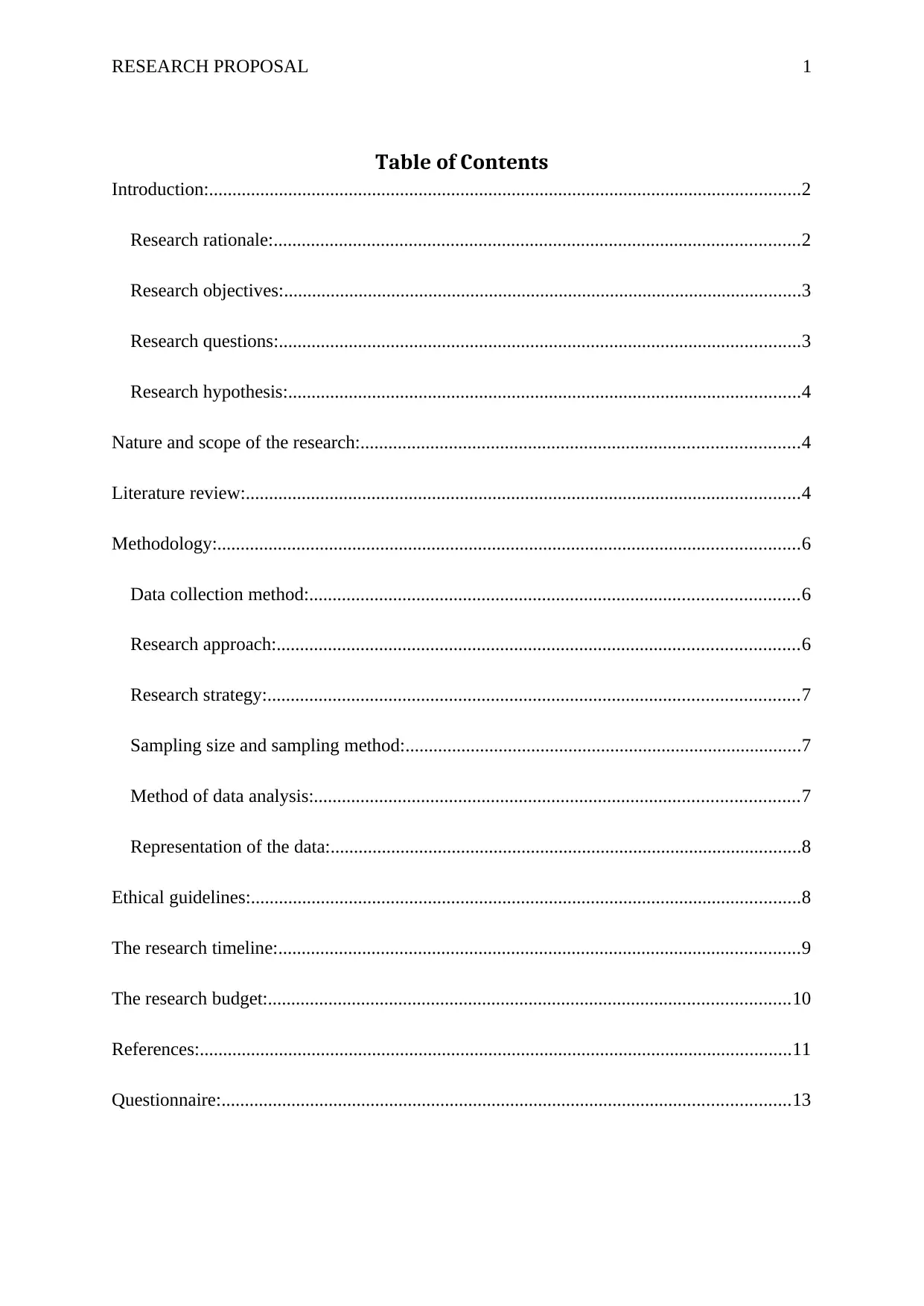
Table of Contents
Introduction:...............................................................................................................................2
Research rationale:.................................................................................................................2
Research objectives:...............................................................................................................3
Research questions:................................................................................................................3
Research hypothesis:..............................................................................................................4
Nature and scope of the research:..............................................................................................4
Literature review:.......................................................................................................................4
Methodology:.............................................................................................................................6
Data collection method:.........................................................................................................6
Research approach:................................................................................................................6
Research strategy:..................................................................................................................7
Sampling size and sampling method:.....................................................................................7
Method of data analysis:........................................................................................................7
Representation of the data:.....................................................................................................8
Ethical guidelines:......................................................................................................................8
The research timeline:................................................................................................................9
The research budget:................................................................................................................10
References:...............................................................................................................................11
Questionnaire:..........................................................................................................................13
Table of Contents
Introduction:...............................................................................................................................2
Research rationale:.................................................................................................................2
Research objectives:...............................................................................................................3
Research questions:................................................................................................................3
Research hypothesis:..............................................................................................................4
Nature and scope of the research:..............................................................................................4
Literature review:.......................................................................................................................4
Methodology:.............................................................................................................................6
Data collection method:.........................................................................................................6
Research approach:................................................................................................................6
Research strategy:..................................................................................................................7
Sampling size and sampling method:.....................................................................................7
Method of data analysis:........................................................................................................7
Representation of the data:.....................................................................................................8
Ethical guidelines:......................................................................................................................8
The research timeline:................................................................................................................9
The research budget:................................................................................................................10
References:...............................................................................................................................11
Questionnaire:..........................................................................................................................13
RESEARCH PROPOSAL 2
Introduction:
As stated by Huang et al. (2018), discrimination of the elderly is referred as ageism
can be defined as a positive or negative attitude displayed by others towards the elderly
person. The concept of discrimination against the elderly has been a subject of concern since
1969 when Robert Butler, the Chairman of US National Institute on Aging Authority and
gerontologists started researching on it (McDonald 2016). Situation in Australia has been
challenging in last two decades as it has been found that a larger percentage of the people are
falling under the demographic of older people. The statistics between 1994 and 2014 shows
that the percentage of older people aged 65 years and above has increased from 11.8% to
14.7% and the percentage of elderly people above 80 years has increased by 100% and
double from 1% to 1.99% of the total population in 2014 (Spies-Butcher and Stebbing 2019).
Consequently, as pointed out by, that the change in this demography has brought a change in
the perception of the people who belongs to the higher strata of age in the demographic chart.
This research aims to evaluate the perception of the University Students towards older
Australians. The study will also review the challenges being faced in Australia in support of
the older people. This research proposal will highlight the recent problems faced as a result of
increasing demography of the older people. A brief literature review will also be conducted
and a detailed methodology will be proposed that will be used to conduct the research.
Research rationale:
The process of physiological changes in a living being from his birth to death is
termed as ageism. Australia, being a developed country has seen several changes from the
traditional living condition. With the advancement in the field of medicine and technology,
there have been several scopes where the older people are getting better benefits in life along
Introduction:
As stated by Huang et al. (2018), discrimination of the elderly is referred as ageism
can be defined as a positive or negative attitude displayed by others towards the elderly
person. The concept of discrimination against the elderly has been a subject of concern since
1969 when Robert Butler, the Chairman of US National Institute on Aging Authority and
gerontologists started researching on it (McDonald 2016). Situation in Australia has been
challenging in last two decades as it has been found that a larger percentage of the people are
falling under the demographic of older people. The statistics between 1994 and 2014 shows
that the percentage of older people aged 65 years and above has increased from 11.8% to
14.7% and the percentage of elderly people above 80 years has increased by 100% and
double from 1% to 1.99% of the total population in 2014 (Spies-Butcher and Stebbing 2019).
Consequently, as pointed out by, that the change in this demography has brought a change in
the perception of the people who belongs to the higher strata of age in the demographic chart.
This research aims to evaluate the perception of the University Students towards older
Australians. The study will also review the challenges being faced in Australia in support of
the older people. This research proposal will highlight the recent problems faced as a result of
increasing demography of the older people. A brief literature review will also be conducted
and a detailed methodology will be proposed that will be used to conduct the research.
Research rationale:
The process of physiological changes in a living being from his birth to death is
termed as ageism. Australia, being a developed country has seen several changes from the
traditional living condition. With the advancement in the field of medicine and technology,
there have been several scopes where the older people are getting better benefits in life along
⊘ This is a preview!⊘
Do you want full access?
Subscribe today to unlock all pages.

Trusted by 1+ million students worldwide
RESEARCH PROPOSAL 3
with better care (Tam et al. 2016). This in turn has increased the life expectancy of people
and there has been a significant increase in the percentage of population of people above 65
years. However, the University students in Australia have some other views on the concept of
ageism. Reading Waern et al. 2015, it has been found that the students consider aging to be a
series of losses in terms of physical, mental as well as emotional strength and is often related
to frailty, helplessness and senility. As a result of this, the elderly people are often victimised
as the younger population group do not treat the aging generation with much the dignity and
respect that they deserve.
This situation has become a matter of concern as such behavioural attitude is violating
the basic human rights of a person and at the same time the elderly people are remaining
without much love and care that is needed in their age (Algoso et al. 2016). Therefore, this
research aims at evaluating the several factors resulting in the negative perception of
University students towards aging population and the challenges being faced in Australia by
the older generation.
Research objectives:
1. To evaluate the perception of University students towards ageism
2. To evaluate the attitude of University students towards the older people
3. To find out the challenges being faced in Australia in support of older people
4. To find out certain ways to build a positive attitude among University people towards
older people and ageism
Research questions:
Primary research question:
with better care (Tam et al. 2016). This in turn has increased the life expectancy of people
and there has been a significant increase in the percentage of population of people above 65
years. However, the University students in Australia have some other views on the concept of
ageism. Reading Waern et al. 2015, it has been found that the students consider aging to be a
series of losses in terms of physical, mental as well as emotional strength and is often related
to frailty, helplessness and senility. As a result of this, the elderly people are often victimised
as the younger population group do not treat the aging generation with much the dignity and
respect that they deserve.
This situation has become a matter of concern as such behavioural attitude is violating
the basic human rights of a person and at the same time the elderly people are remaining
without much love and care that is needed in their age (Algoso et al. 2016). Therefore, this
research aims at evaluating the several factors resulting in the negative perception of
University students towards aging population and the challenges being faced in Australia by
the older generation.
Research objectives:
1. To evaluate the perception of University students towards ageism
2. To evaluate the attitude of University students towards the older people
3. To find out the challenges being faced in Australia in support of older people
4. To find out certain ways to build a positive attitude among University people towards
older people and ageism
Research questions:
Primary research question:
Paraphrase This Document
Need a fresh take? Get an instant paraphrase of this document with our AI Paraphraser
RESEARCH PROPOSAL 4
Q1. What is the perception of University students towards ageism and their attitude towards
older people?
Secondary research question:
Q2. What are the challenges being faced in Australia in support of older people?
Q3. How to build a positive attitude among University people towards older people and
ageism?
Research hypothesis:
H1: The University Students in Australia do not have a positive attitude towards ageism and
older people
H0: The University Students in Australia have a positive attitude towards ageism and older
people
Nature and scope of the research:
The research aims in understanding the perception of the youth and thus, targeting the
University students towards the aging population and how helpful and supportive would this
youth be in respecting the aging population. As the percentage of aging population is
increasing, effort has to be made in taking care of these people. Issues like risk of
homelessness, elder abuse, discrimination among the different age groups and other have
been in news for the time being now (Demir et al. 2016). Therefore, this research would help
to find out the ways to combat the challenges faced by elderly people and would also
recommend the ways to improve the perception of University students towards aging people.
Q1. What is the perception of University students towards ageism and their attitude towards
older people?
Secondary research question:
Q2. What are the challenges being faced in Australia in support of older people?
Q3. How to build a positive attitude among University people towards older people and
ageism?
Research hypothesis:
H1: The University Students in Australia do not have a positive attitude towards ageism and
older people
H0: The University Students in Australia have a positive attitude towards ageism and older
people
Nature and scope of the research:
The research aims in understanding the perception of the youth and thus, targeting the
University students towards the aging population and how helpful and supportive would this
youth be in respecting the aging population. As the percentage of aging population is
increasing, effort has to be made in taking care of these people. Issues like risk of
homelessness, elder abuse, discrimination among the different age groups and other have
been in news for the time being now (Demir et al. 2016). Therefore, this research would help
to find out the ways to combat the challenges faced by elderly people and would also
recommend the ways to improve the perception of University students towards aging people.
RESEARCH PROPOSAL 5
Literature review:
Age discrimination or elder abuse is a single or repeated act towards the older person
which lacks the appropriate action in the relationship and thus, causing harm or distress in the
expectation of the person, mainly the elderly person (Humanrights.gov.au 2019). According
to the Australian Human rights reports, it has been noted that there are various types of elder
abuses taking place which include physical, financial, emotional, and psychological and trust
issues (Humanrights.gov.au 2019). This in turn is resulting in intentional neglect but as an
older person, no one is subjected to any form of abuse but the older persons have to face a lot
of challenges due to this.
In a descriptive study conducted among 416 University students, the perception of the
students towards the ageing group of people was evaluated. As commented by Cinar,
Karadakovan and Sivrikaya (2018), that nowadays, the family structure has changed and
people prefer to stay in nuclear and independent families where no one is dependent on other
for any support be it any kind of household chores or financial support. However, the
situation will not be same if there is an older person in house because at some point of time
the person needs support from others for their regular activities. Following on the same
concept, dash commented that with advancing age, there is a reduction in the independence
occurs and the elderly are often found to have limited approach towards the society.
The perception of the University students as found from various studies has been
different. In the study by, Ozer and Terkes (2014) it has been clearly found that almost 60%
of the respondents had their grandparents living with them in their house. As a consequence,
they were at a positive note only which shows their positive attitude along with love and
respect for their grandparents. Similarly, those respondents who do not have any elder person
residing in their home stated that it would be a burden for them if they have to stay with an
older person (Argentum.org 2019). Moreover, in both the cases, it has been clearly known
Literature review:
Age discrimination or elder abuse is a single or repeated act towards the older person
which lacks the appropriate action in the relationship and thus, causing harm or distress in the
expectation of the person, mainly the elderly person (Humanrights.gov.au 2019). According
to the Australian Human rights reports, it has been noted that there are various types of elder
abuses taking place which include physical, financial, emotional, and psychological and trust
issues (Humanrights.gov.au 2019). This in turn is resulting in intentional neglect but as an
older person, no one is subjected to any form of abuse but the older persons have to face a lot
of challenges due to this.
In a descriptive study conducted among 416 University students, the perception of the
students towards the ageing group of people was evaluated. As commented by Cinar,
Karadakovan and Sivrikaya (2018), that nowadays, the family structure has changed and
people prefer to stay in nuclear and independent families where no one is dependent on other
for any support be it any kind of household chores or financial support. However, the
situation will not be same if there is an older person in house because at some point of time
the person needs support from others for their regular activities. Following on the same
concept, dash commented that with advancing age, there is a reduction in the independence
occurs and the elderly are often found to have limited approach towards the society.
The perception of the University students as found from various studies has been
different. In the study by, Ozer and Terkes (2014) it has been clearly found that almost 60%
of the respondents had their grandparents living with them in their house. As a consequence,
they were at a positive note only which shows their positive attitude along with love and
respect for their grandparents. Similarly, those respondents who do not have any elder person
residing in their home stated that it would be a burden for them if they have to stay with an
older person (Argentum.org 2019). Moreover, in both the cases, it has been clearly known
⊘ This is a preview!⊘
Do you want full access?
Subscribe today to unlock all pages.
Trusted by 1+ million students worldwide
RESEARCH PROPOSAL 6
that the youths have positive attitude towards older person only if the older person is their
own. Thus, the concern of equal treatment of the increasing aging population in Australia still
remains a matter of concern. The government and the social workers or the NGOs also have
been participating in various activities and programs to spread the importance of caring the
elderly people. The care homes are also taking better initiatives and offering better treatment
and support to the people (AASW.asn.au 2019). Yet, the aging population is not entirely
comfortable and is not under the observation of a caring generation of youth. Therefore, a
number of initiatives have to be taken for the purpose of improving the present condition of
the aging population in Australia.
Methodology:
This section of the research proposal discusses the methodology that will be adapted
for the final research.
Data collection method:
In order to work on this research, both primary and secondary data will be used. The
literature review will be done by conducting review of various research papers and peer-
reviewed articles along with recent discussions on the topic (Taylor, Bogdan and DeVault,
2015). The primary research will be quantitative and would involve the University Students
from different fields. As the topic is to understand the perception of the University students
on ageism, no effort will be made to take interview of any other person belong to a different
age group but will depend on survey data only.
Research approach:
There are two types of research approaches, the inductive approach and the deductive
approach. The inductive approach is used when a new set of theories and concepts are used
that the youths have positive attitude towards older person only if the older person is their
own. Thus, the concern of equal treatment of the increasing aging population in Australia still
remains a matter of concern. The government and the social workers or the NGOs also have
been participating in various activities and programs to spread the importance of caring the
elderly people. The care homes are also taking better initiatives and offering better treatment
and support to the people (AASW.asn.au 2019). Yet, the aging population is not entirely
comfortable and is not under the observation of a caring generation of youth. Therefore, a
number of initiatives have to be taken for the purpose of improving the present condition of
the aging population in Australia.
Methodology:
This section of the research proposal discusses the methodology that will be adapted
for the final research.
Data collection method:
In order to work on this research, both primary and secondary data will be used. The
literature review will be done by conducting review of various research papers and peer-
reviewed articles along with recent discussions on the topic (Taylor, Bogdan and DeVault,
2015). The primary research will be quantitative and would involve the University Students
from different fields. As the topic is to understand the perception of the University students
on ageism, no effort will be made to take interview of any other person belong to a different
age group but will depend on survey data only.
Research approach:
There are two types of research approaches, the inductive approach and the deductive
approach. The inductive approach is used when a new set of theories and concepts are used
Paraphrase This Document
Need a fresh take? Get an instant paraphrase of this document with our AI Paraphraser
RESEARCH PROPOSAL 7
while deductive approach is used when we use the existing theories as a reference to our
research (Nix 2016). For this research, a systematic review of the literatures will be done and
thus, deductive approach will be taken.
Research strategy:
The strategies undertaken for any research include case study evaluation, carrying out
a research among the focus groups as well as by survey and interview procedure (Ledford
and Gast 2018). As this research topic is based on the perception of the people, conducting a
survey with the valid questions is the best suitable strategy.
Sampling size and sampling method:
The aim is to conduct the survey among 80 participants or the University Students
from different academic fields. The simple random sampling method will be used to target
the particular respondent. Both probability and non-probability sampling technique will be
used as the number of respondents is high. A survey link will be shared with the respondent
in their personal email ID and they will be asked to fill the survey. The questionnaire will
consists of mainly closed ended questions with the options of true/false or the options on the
likert scale. In case, any respondent would not like to share his personal mail ID, the person
will be provided with a survey paper and the response would be recorded.
Method of data analysis:
The data collected from the respondents will be converted into numbers and figures so
that the quantitative analysis can be done easily. In order to prove the hypothesis set for the
research, the various factors that affect the perception of the University will considered as the
independent variables on the dependent variable, perception of University Students on ageism
(Fletcher 2017). The co-relation will be found out between these two variables and one of the
while deductive approach is used when we use the existing theories as a reference to our
research (Nix 2016). For this research, a systematic review of the literatures will be done and
thus, deductive approach will be taken.
Research strategy:
The strategies undertaken for any research include case study evaluation, carrying out
a research among the focus groups as well as by survey and interview procedure (Ledford
and Gast 2018). As this research topic is based on the perception of the people, conducting a
survey with the valid questions is the best suitable strategy.
Sampling size and sampling method:
The aim is to conduct the survey among 80 participants or the University Students
from different academic fields. The simple random sampling method will be used to target
the particular respondent. Both probability and non-probability sampling technique will be
used as the number of respondents is high. A survey link will be shared with the respondent
in their personal email ID and they will be asked to fill the survey. The questionnaire will
consists of mainly closed ended questions with the options of true/false or the options on the
likert scale. In case, any respondent would not like to share his personal mail ID, the person
will be provided with a survey paper and the response would be recorded.
Method of data analysis:
The data collected from the respondents will be converted into numbers and figures so
that the quantitative analysis can be done easily. In order to prove the hypothesis set for the
research, the various factors that affect the perception of the University will considered as the
independent variables on the dependent variable, perception of University Students on ageism
(Fletcher 2017). The co-relation will be found out between these two variables and one of the
RESEARCH PROPOSAL 8
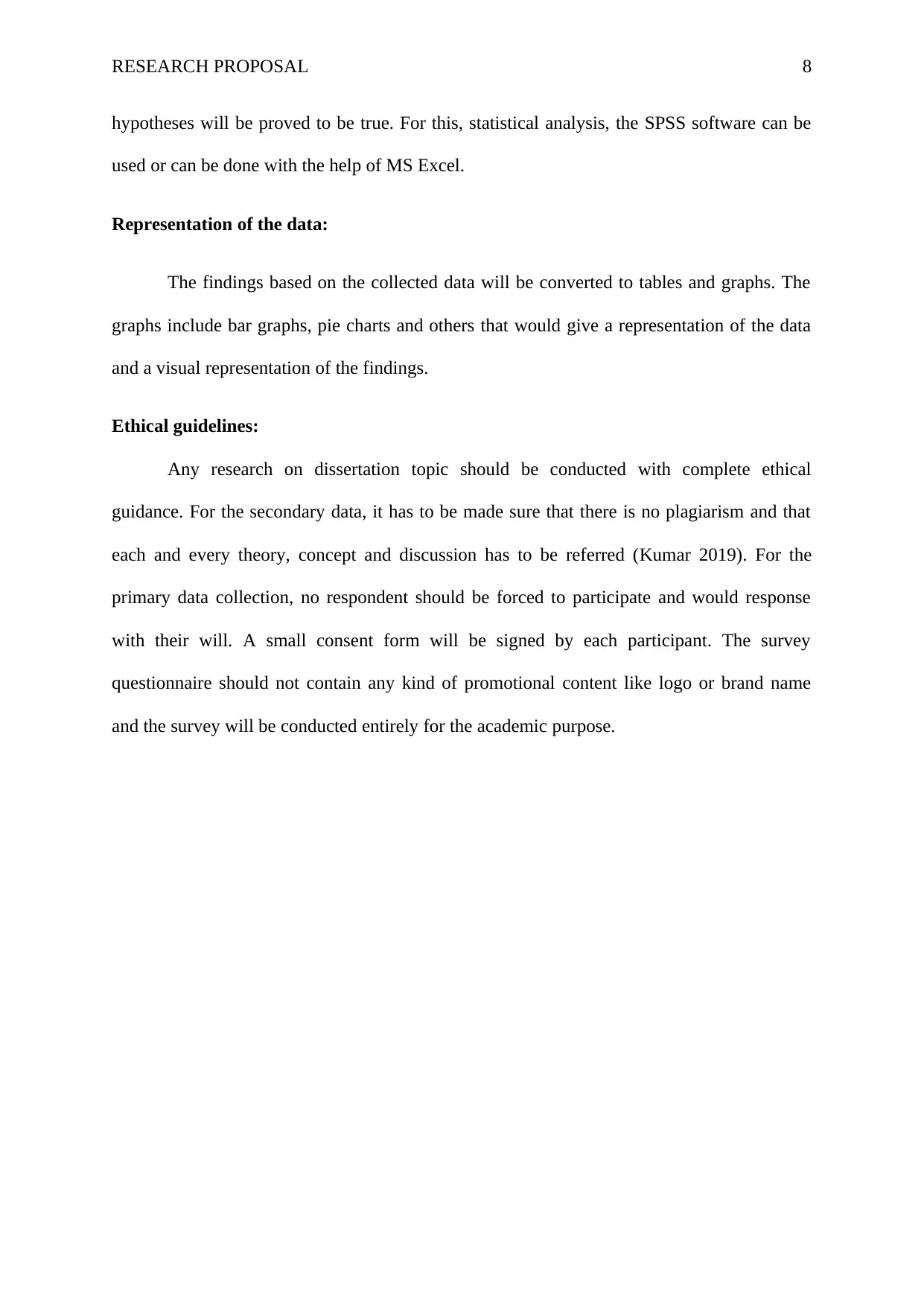
hypotheses will be proved to be true. For this, statistical analysis, the SPSS software can be
used or can be done with the help of MS Excel.
Representation of the data:
The findings based on the collected data will be converted to tables and graphs. The
graphs include bar graphs, pie charts and others that would give a representation of the data
and a visual representation of the findings.
Ethical guidelines:
Any research on dissertation topic should be conducted with complete ethical
guidance. For the secondary data, it has to be made sure that there is no plagiarism and that
each and every theory, concept and discussion has to be referred (Kumar 2019). For the
primary data collection, no respondent should be forced to participate and would response
with their will. A small consent form will be signed by each participant. The survey
questionnaire should not contain any kind of promotional content like logo or brand name
and the survey will be conducted entirely for the academic purpose.
hypotheses will be proved to be true. For this, statistical analysis, the SPSS software can be
used or can be done with the help of MS Excel.
Representation of the data:
The findings based on the collected data will be converted to tables and graphs. The
graphs include bar graphs, pie charts and others that would give a representation of the data
and a visual representation of the findings.
Ethical guidelines:
Any research on dissertation topic should be conducted with complete ethical
guidance. For the secondary data, it has to be made sure that there is no plagiarism and that
each and every theory, concept and discussion has to be referred (Kumar 2019). For the
primary data collection, no respondent should be forced to participate and would response
with their will. A small consent form will be signed by each participant. The survey
questionnaire should not contain any kind of promotional content like logo or brand name
and the survey will be conducted entirely for the academic purpose.
⊘ This is a preview!⊘
Do you want full access?
Subscribe today to unlock all pages.
Trusted by 1+ million students worldwide
RESEARCH PROPOSAL 9
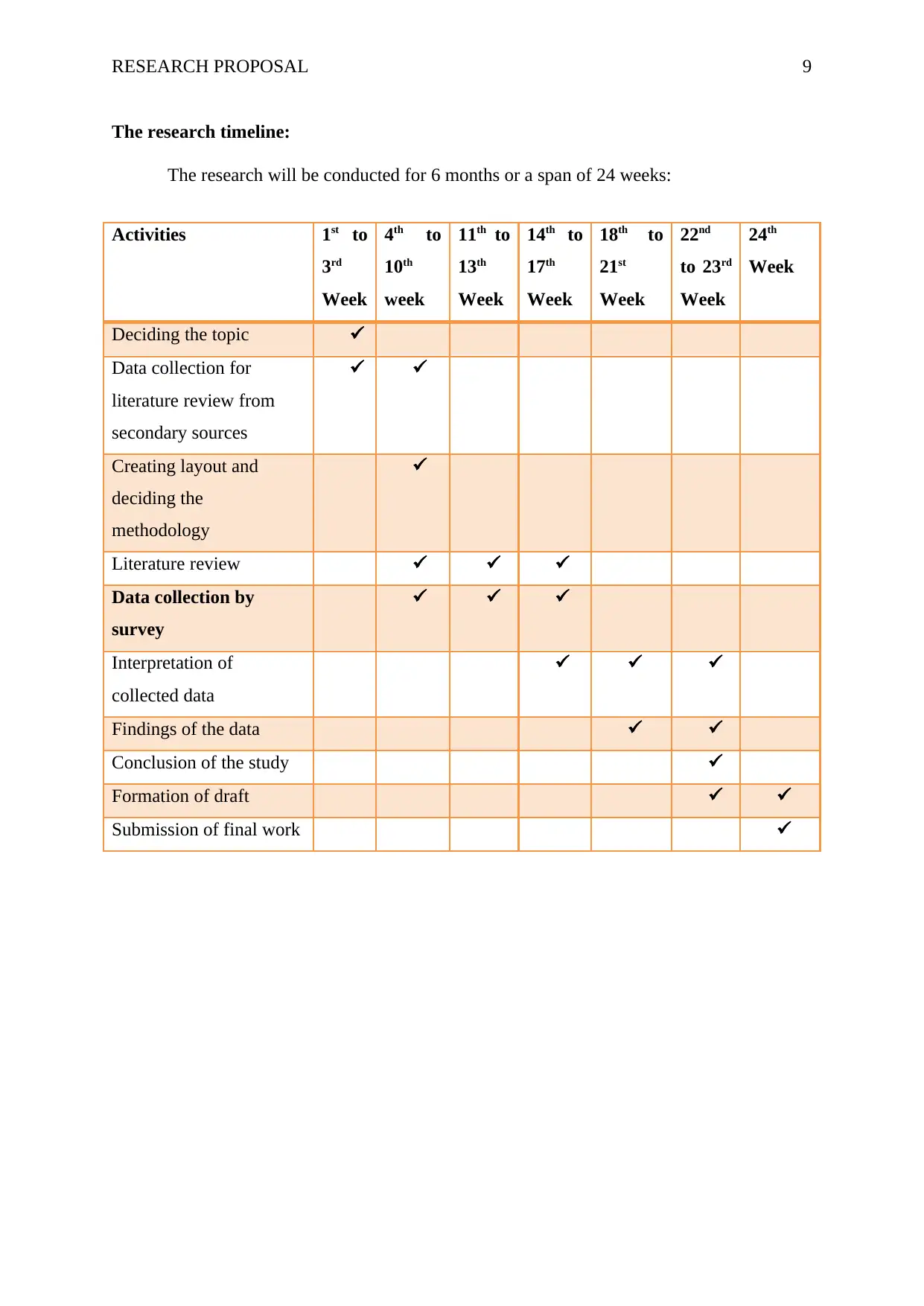
The research timeline:
The research will be conducted for 6 months or a span of 24 weeks:
Activities 1st to
3rd
Week
4th to
10th
week
11th to
13th
Week
14th to
17th
Week
18th to
21st
Week
22nd
to 23rd
Week
24th
Week
Deciding the topic
Data collection for
literature review from
secondary sources
Creating layout and
deciding the
methodology
Literature review
Data collection by
survey
Interpretation of
collected data
Findings of the data
Conclusion of the study
Formation of draft
Submission of final work
The research timeline:
The research will be conducted for 6 months or a span of 24 weeks:
Activities 1st to
3rd
Week
4th to
10th
week
11th to
13th
Week
14th to
17th
Week
18th to
21st
Week
22nd
to 23rd
Week
24th
Week
Deciding the topic
Data collection for
literature review from
secondary sources
Creating layout and
deciding the
methodology
Literature review
Data collection by
survey
Interpretation of
collected data
Findings of the data
Conclusion of the study
Formation of draft
Submission of final work
Paraphrase This Document
Need a fresh take? Get an instant paraphrase of this document with our AI Paraphraser
RESEARCH PROPOSAL 10
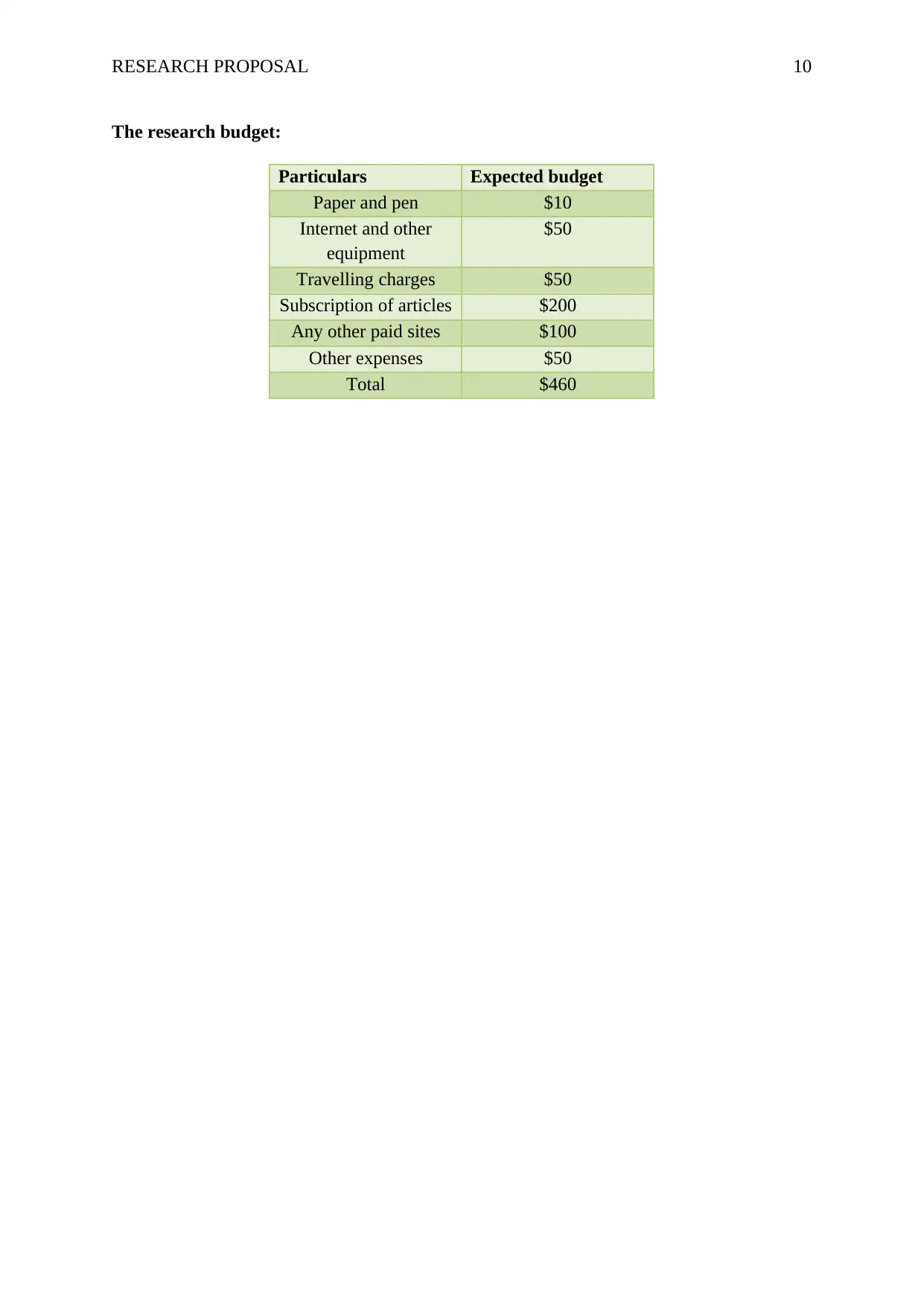
The research budget:
Particulars Expected budget
Paper and pen $10
Internet and other
equipment
$50
Travelling charges $50
Subscription of articles $200
Any other paid sites $100
Other expenses $50
Total $460
The research budget:
Particulars Expected budget
Paper and pen $10
Internet and other
equipment
$50
Travelling charges $50
Subscription of articles $200
Any other paid sites $100
Other expenses $50
Total $460
RESEARCH PROPOSAL 11
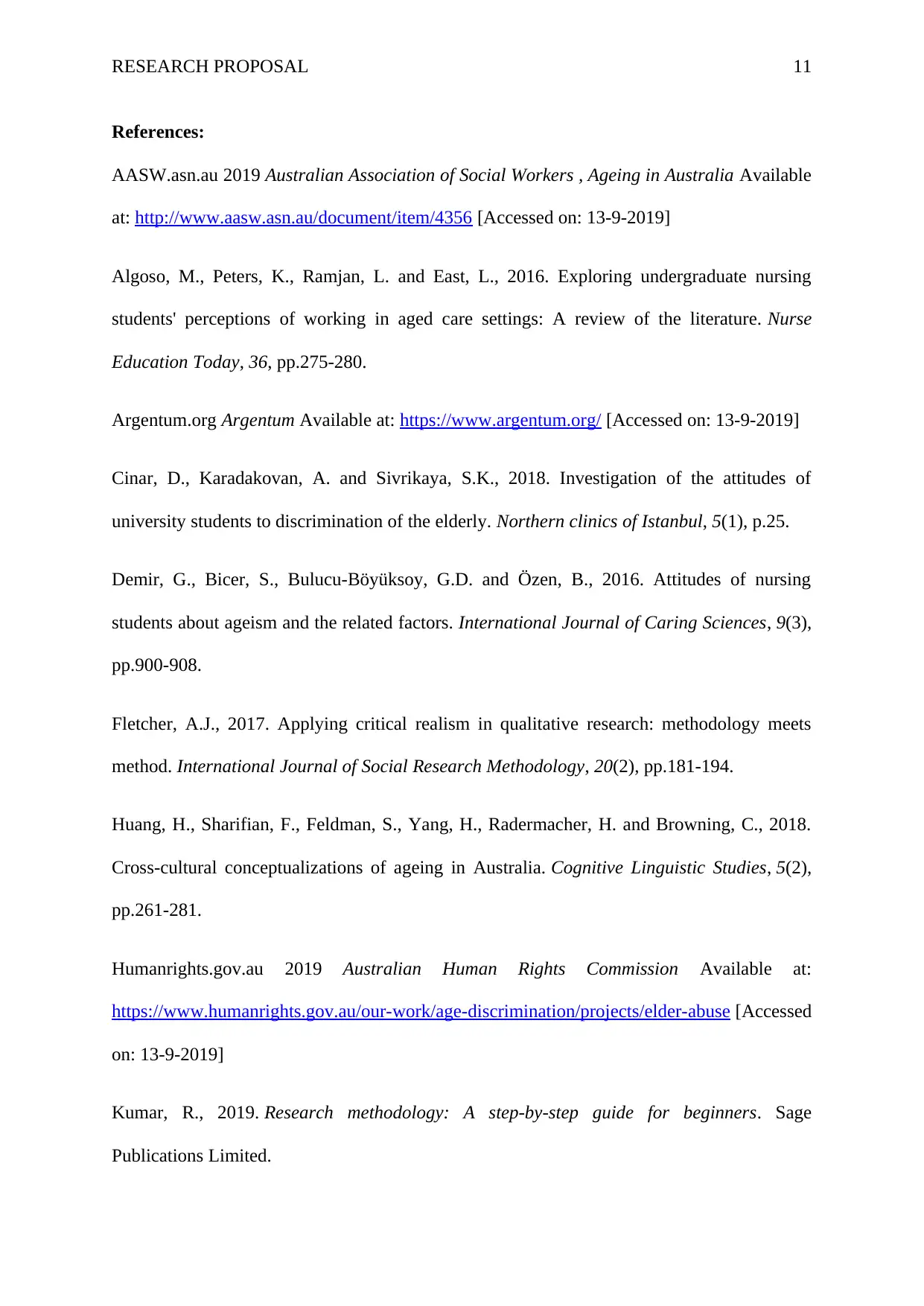
References:
AASW.asn.au 2019 Australian Association of Social Workers , Ageing in Australia Available
at: http://www.aasw.asn.au/document/item/4356 [Accessed on: 13-9-2019]
Algoso, M., Peters, K., Ramjan, L. and East, L., 2016. Exploring undergraduate nursing
students' perceptions of working in aged care settings: A review of the literature. Nurse
Education Today, 36, pp.275-280.
Argentum.org Argentum Available at: https://www.argentum.org/ [Accessed on: 13-9-2019]
Cinar, D., Karadakovan, A. and Sivrikaya, S.K., 2018. Investigation of the attitudes of
university students to discrimination of the elderly. Northern clinics of Istanbul, 5(1), p.25.
Demir, G., Bicer, S., Bulucu-Böyüksoy, G.D. and Özen, B., 2016. Attitudes of nursing
students about ageism and the related factors. International Journal of Caring Sciences, 9(3),
pp.900-908.
Fletcher, A.J., 2017. Applying critical realism in qualitative research: methodology meets
method. International Journal of Social Research Methodology, 20(2), pp.181-194.
Huang, H., Sharifian, F., Feldman, S., Yang, H., Radermacher, H. and Browning, C., 2018.
Cross-cultural conceptualizations of ageing in Australia. Cognitive Linguistic Studies, 5(2),
pp.261-281.
Humanrights.gov.au 2019 Australian Human Rights Commission Available at:
https://www.humanrights.gov.au/our-work/age-discrimination/projects/elder-abuse [Accessed
on: 13-9-2019]
Kumar, R., 2019. Research methodology: A step-by-step guide for beginners. Sage
Publications Limited.
References:
AASW.asn.au 2019 Australian Association of Social Workers , Ageing in Australia Available
at: http://www.aasw.asn.au/document/item/4356 [Accessed on: 13-9-2019]
Algoso, M., Peters, K., Ramjan, L. and East, L., 2016. Exploring undergraduate nursing
students' perceptions of working in aged care settings: A review of the literature. Nurse
Education Today, 36, pp.275-280.
Argentum.org Argentum Available at: https://www.argentum.org/ [Accessed on: 13-9-2019]
Cinar, D., Karadakovan, A. and Sivrikaya, S.K., 2018. Investigation of the attitudes of
university students to discrimination of the elderly. Northern clinics of Istanbul, 5(1), p.25.
Demir, G., Bicer, S., Bulucu-Böyüksoy, G.D. and Özen, B., 2016. Attitudes of nursing
students about ageism and the related factors. International Journal of Caring Sciences, 9(3),
pp.900-908.
Fletcher, A.J., 2017. Applying critical realism in qualitative research: methodology meets
method. International Journal of Social Research Methodology, 20(2), pp.181-194.
Huang, H., Sharifian, F., Feldman, S., Yang, H., Radermacher, H. and Browning, C., 2018.
Cross-cultural conceptualizations of ageing in Australia. Cognitive Linguistic Studies, 5(2),
pp.261-281.
Humanrights.gov.au 2019 Australian Human Rights Commission Available at:
https://www.humanrights.gov.au/our-work/age-discrimination/projects/elder-abuse [Accessed
on: 13-9-2019]
Kumar, R., 2019. Research methodology: A step-by-step guide for beginners. Sage
Publications Limited.
⊘ This is a preview!⊘
Do you want full access?
Subscribe today to unlock all pages.
Trusted by 1+ million students worldwide

1 out of 16


Related Documents


Your All-in-One AI-Powered Toolkit for Academic Success.
+13062052269
info@desklib.com
Available 24*7 on WhatsApp / Email
![[object Object]](/_next/static/media/star-bottom.7253800d.svg)
Unlock your academic potential
Copyright © 2020–2026 A2Z Services. All Rights Reserved. Developed and managed by ZUCOL.