Academic Integrity in Higher Education: A Comparison of Approaches

Verified

Added on  2023/06/03

|13
|888
|177
Presentation
AI Summary
This presentation provides a comparative analysis of how different universities approach academic integrity, focusing on various types of academic misconduct such as plagiarism, misrepresentation, and cheating. It explores the measures universities take to address these issues, ranging from warnings and disciplinary probation to suspension and expulsion. The presentation also emphasizes the importance of fostering a culture of academic integrity by promoting honesty, trust, and responsibility among students and faculty. It discusses how universities aim to develop policies that effectively guide students toward ethical actions and maintain high educational standards. The ultimate goal is to eliminate unethical issues from university operations and uphold the institution's reputation in the global education industry. Desklib offers a platform to explore similar resources for students.
Document Page
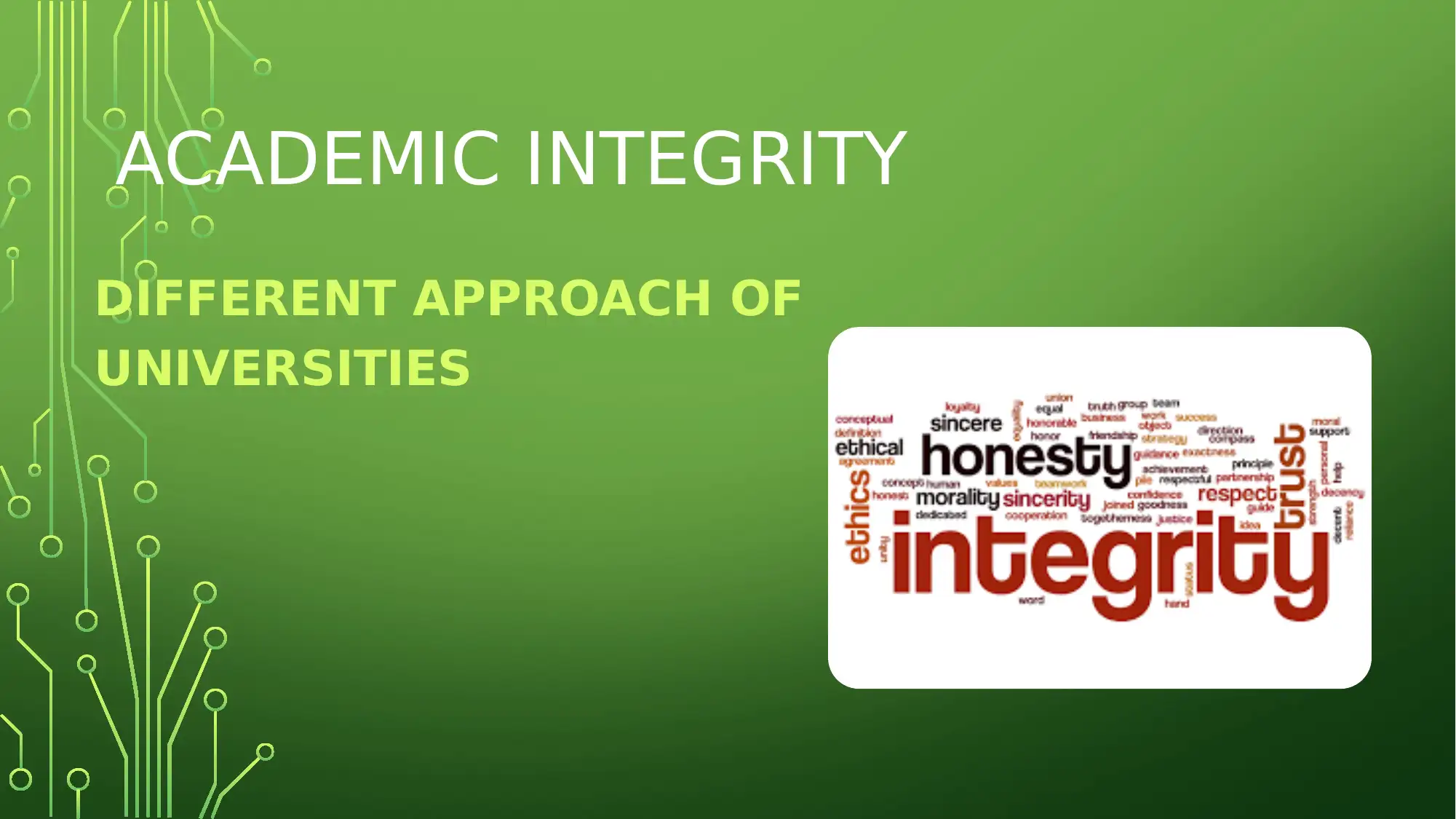
ACADEMIC INTEGRITY
DIFFERENT APPROACH OF
UNIVERSITIES
tabler-icon-diamond-filled.svg

Paraphrase This Document

Need a fresh take? Get an instant paraphrase of this document with our AI Paraphraser
Document Page
INTRODUCTION
Academic integrity the ethical policies or moral code of academia.
This includes the required moral values like plagiarism, cheating
collusion and facilitation, misinterpretation, obstruction and
interference in maintaining the academic standard, rigor and
honesty in the process of searching and academic publishing.
Different universities deal with academic integrity differently in
their curriculum
Document Page
ARGUMENT
Academic misconduct can have various types one affective
than the other.
In this regard the issues of plagiarism, misrepresentation and
fabrication are most important.
AS argued by Bretag et al. (2014) these hamper the
originality of the university by affecting its mission and honor.
Academic integrity handled in different ways.
Document Page
ARGUMENT
Most of the universities are now having websites detailing the
consequences of academic misconduct.
Some universities take strict measure for a small amount of
plagiarism, cheating and misrepresentation and fabrication of the
paper submitted by the students.
Some other universities as argued by Cronan, Mullins and Douglas
(2018) prefer to take less strict measures for small violence of such
misconducts and give warning as initial step.
tabler-icon-diamond-filled.svg

Paraphrase This Document

Need a fresh take? Get an instant paraphrase of this document with our AI Paraphraser
Document Page
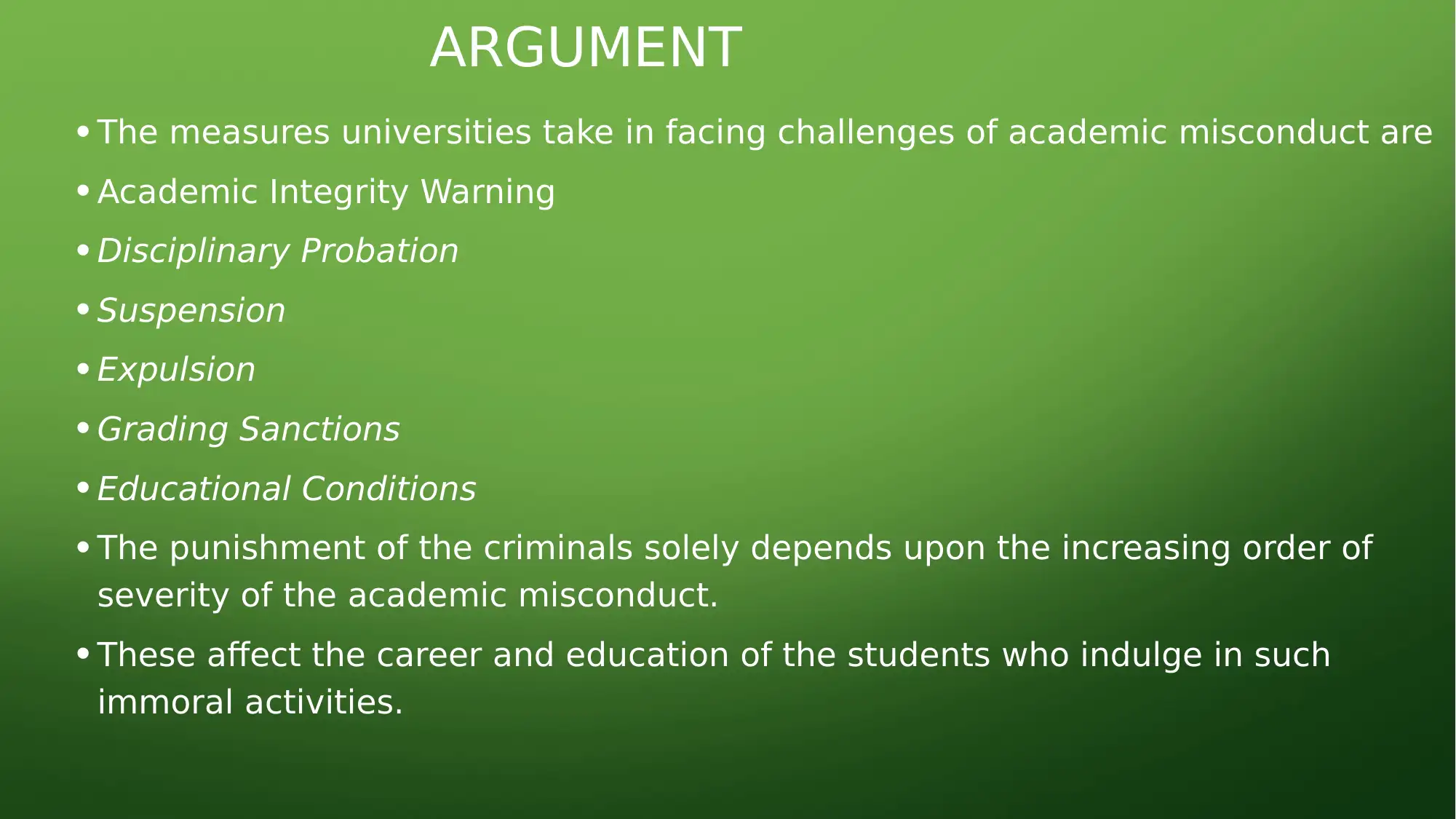
ARGUMENT
The measures universities take in facing challenges of academic misconduct are
Academic Integrity Warning
Disciplinary Probation
Suspension
Expulsion
Grading Sanctions
Educational Conditions
The punishment of the criminals solely depends upon the increasing order of
severity of the academic misconduct.
These affect the career and education of the students who indulge in such
immoral activities.
Document Page
ARGUMENT
Many of the universities take measures to prevent such
unethical practice from the very beginning
In cases of cheating and plagiarism, the universities are
changing the submission method though handwritten
answers to reduce such problems (Macfarlane, Zhang and
Pun 2014).
In case of misrepresentation and fabrication, they make more
serious measures so that this can be example and none tries
such practice anymore.
Document Page
DISCUSSION
For maintaining the culture of academic integrity, the
universities need to make their students understand the
reasons of attaining value of integrity.
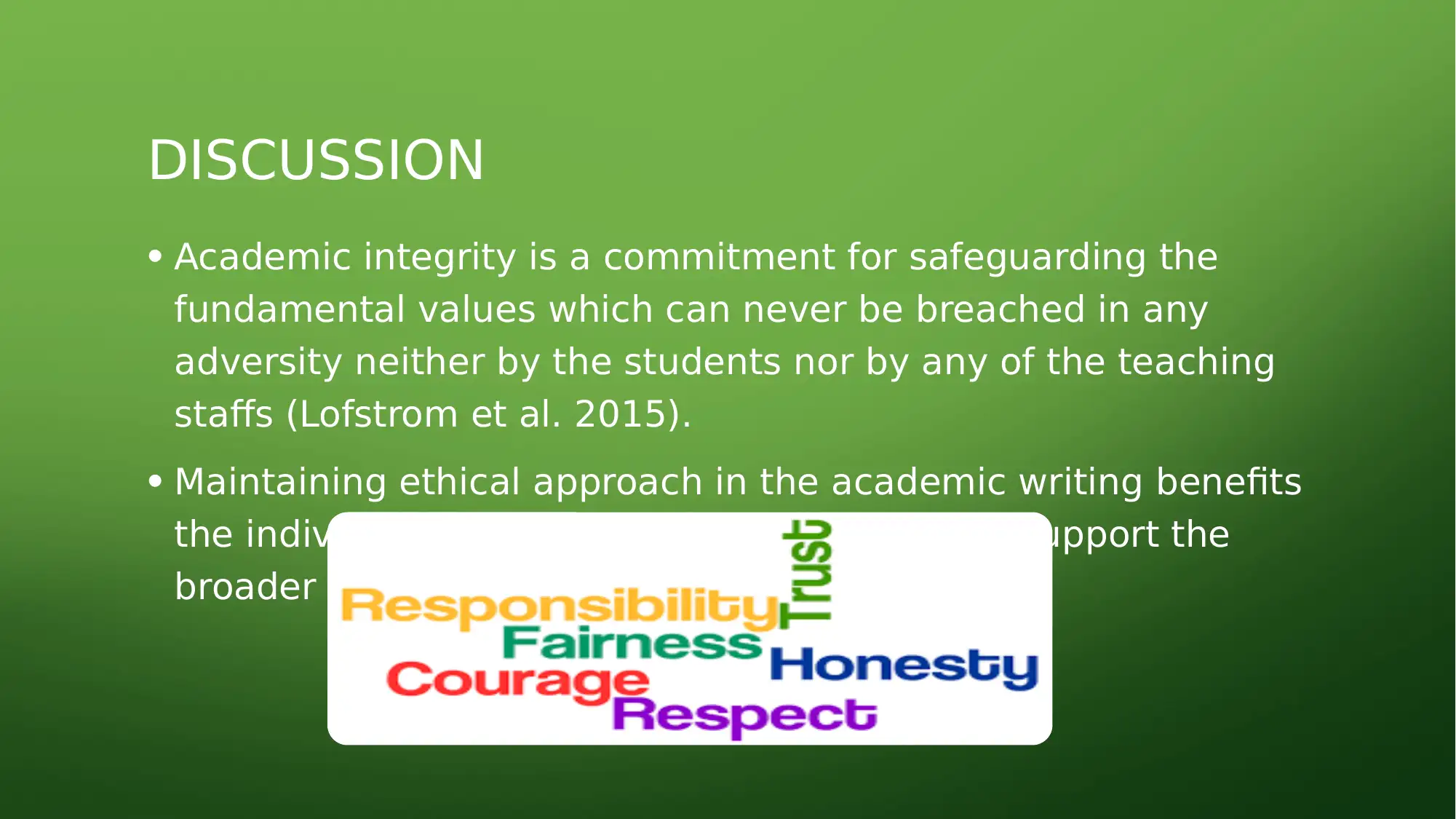
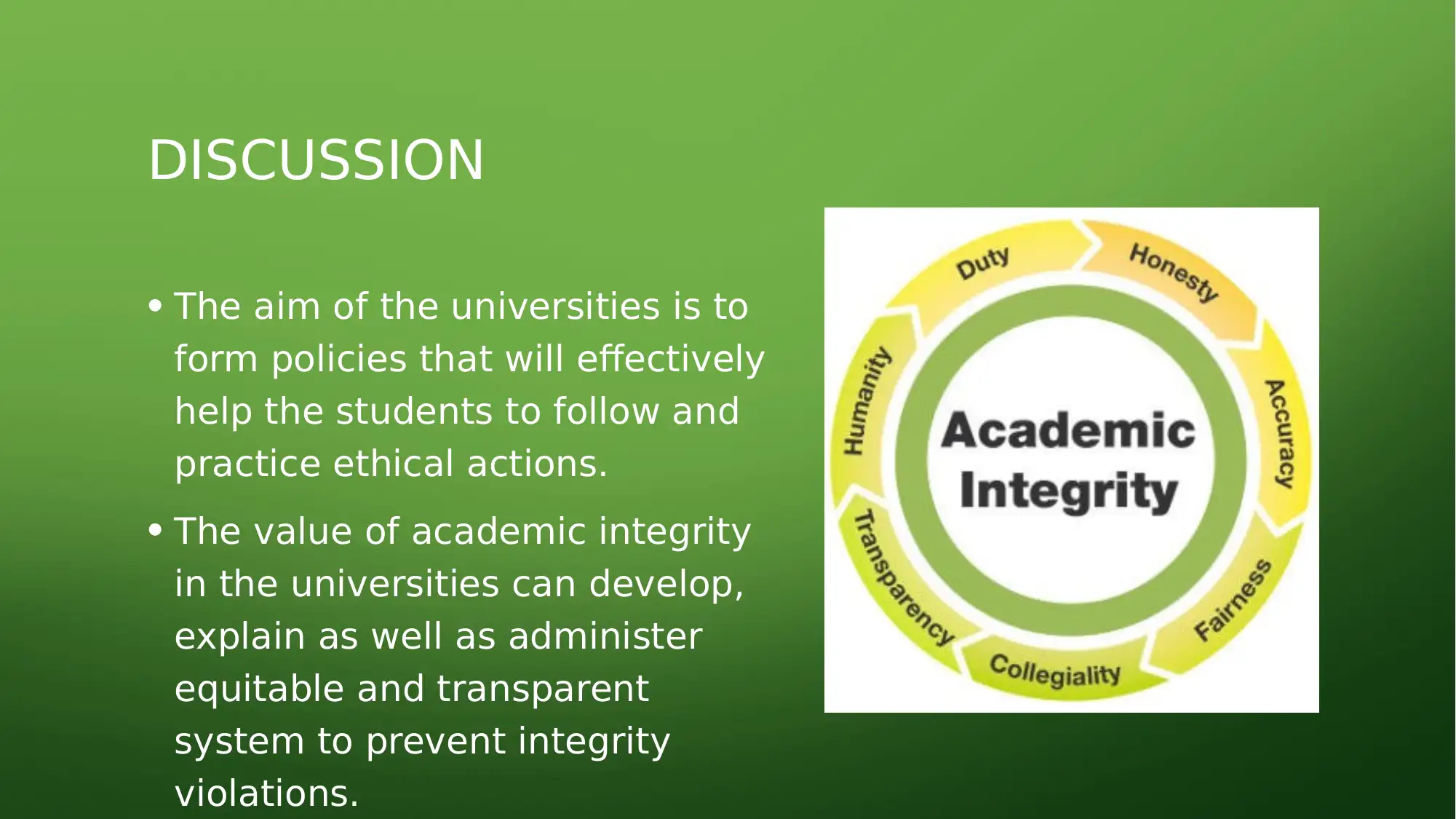
In most of the universities, academic integrity aims to
promote honesty, trust, respect, courage, fairness and
responsibility of the universities as ell as the students.
tabler-icon-diamond-filled.svg

Paraphrase This Document

Need a fresh take? Get an instant paraphrase of this document with our AI Paraphraser
Document Page
DISCUSSION
Academic integrity is a commitment for safeguarding the
fundamental values which can never be breached in any
adversity neither by the students nor by any of the teaching
staffs (Lofstrom et al. 2015).
Maintaining ethical approach in the academic writing benefits
the individual in practicing right behavior and support the
broader university culture.
Document Page
DISCUSSION
The actions based on the fundamental values actually support the
ethical academic processes.
Through a successful academic integrity program, the institutes can
develop and consistently implement high quality education standard.
It helps to promote positive effect amongst all the segments of
campus community.
This also increases, the universities’ ethical decision-making
procedure which improve reputation.
Document Page
DISCUSSION
The aim of the universities is to
form policies that will effectively
help the students to follow and
practice ethical actions.
The value of academic integrity
in the universities can develop,
explain as well as administer
equitable and transparent
system to prevent integrity
violations.
tabler-icon-diamond-filled.svg

Paraphrase This Document

Need a fresh take? Get an instant paraphrase of this document with our AI Paraphraser
Document Page
CONCLUSION
Therefore, it can be concluded that academic integrity is one of the most
important matter that helps the universities to maintain the position in the
global education industry.
Different universities of the world follow different approach to challenge the
academic misconduct
Based on the severity and frequency of such misconduct, the universities
make different decisions.
However, the main motto remains to eliminate such unethical issues from the
complete setting of the university operations.
Document Page
REFERENCE
Bretag, T., Mahmud, S., Wallace, M., Walker, R., McGowan, U., East, J., Green, M.,
Partridge, L. and James, C., 2014. ‘Teach us how to do it properly!’An Australian
academic integrity student survey. Studies in Higher Education, 39(7), pp.1150-1169.
Cronan, T.P., Mullins, J.K. and Douglas, D.E., 2018. Further understanding factors that
explain freshman business students’ academic integrity intention and behavior:
Plagiarism and sharing homework. Journal of Business Ethics, 147(1), pp.197-220.
Löfström, E., Trotman, T., Furnari, M. and Shephard, K., 2015. Who teaches academic
integrity and how do they teach it?. Higher Education, 69(3), pp.435-448.
Macfarlane, B., Zhang, J. and Pun, A., 2014. Academic integrity: A review of the
literature. Studies in Higher Education, 39(2), pp.339-358.
Newton, P., 2016. Academic integrity: a quantitative study of confidence and
understanding in students at the start of their higher education. Assessment &
Evaluation in Higher Education, 41(3), pp.482-497.
chevron_up_icon
1 out of 13
circle_padding
hide_on_mobile
zoom_out_icon
[object Object]