University Global Business Assignment 1: MNG 92210 Analysis
VerifiedAdded on 2022/08/08
|9
|1923
|36
Homework Assignment
AI Summary
This assignment delves into the multifaceted aspects of global business, commencing with an exploration of globalization's definition and its profound effects on domestic businesses. It meticulously examines both the positive and negative impacts of globalization, providing a comprehensive overview of its influence. The assignment then transitions to a comparative analysis of Absolute Advantage and Comparative Advantage theories, determining the more practical approach and elucidating the benefits of trade through a numerical example involving two countries and two products. Finally, the assignment investigates the rationale behind Donald Trump's imposition of tariffs on Chinese imports, based on the first three topics of the unit, and assesses the implications of such interventions on domestic consumers. The student supports their viewpoints using at least five academic sources.
Running Head: ASSIGNMENT 1
Assignment 1 – Global Business
Name of the Student
Name of the University
Author Note
Assignment 1 – Global Business
Name of the Student
Name of the University
Author Note
Paraphrase This Document
Need a fresh take? Get an instant paraphrase of this document with our AI Paraphraser

1
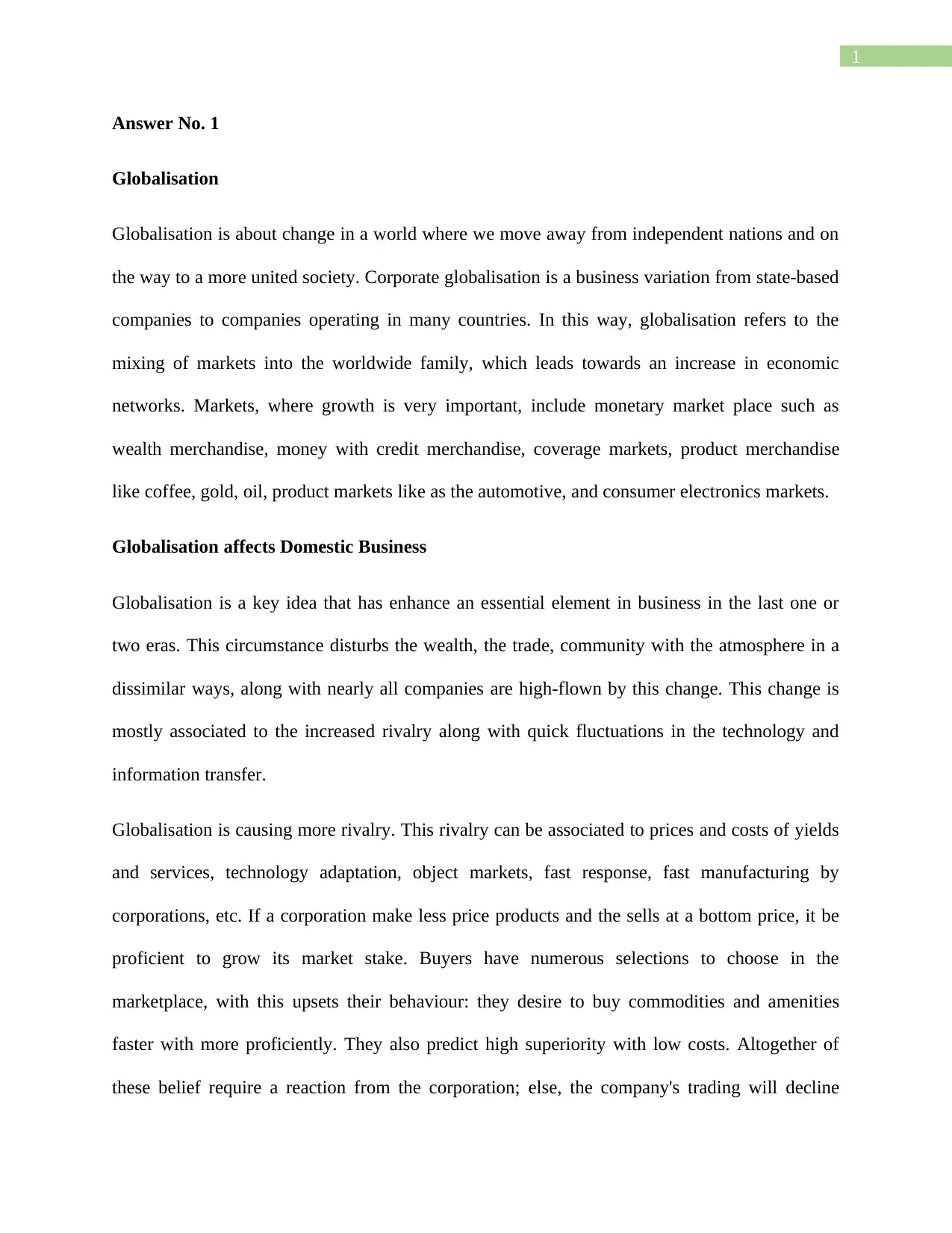
Answer No. 1
Globalisation
Globalisation is about change in a world where we move away from independent nations and on
the way to a more united society. Corporate globalisation is a business variation from state-based
companies to companies operating in many countries. In this way, globalisation refers to the
mixing of markets into the worldwide family, which leads towards an increase in economic
networks. Markets, where growth is very important, include monetary market place such as
wealth merchandise, money with credit merchandise, coverage markets, product merchandise
like coffee, gold, oil, product markets like as the automotive, and consumer electronics markets.
Globalisation affects Domestic Business
Globalisation is a key idea that has enhance an essential element in business in the last one or
two eras. This circumstance disturbs the wealth, the trade, community with the atmosphere in a
dissimilar ways, along with nearly all companies are high-flown by this change. This change is
mostly associated to the increased rivalry along with quick fluctuations in the technology and
information transfer.
Globalisation is causing more rivalry. This rivalry can be associated to prices and costs of yields
and services, technology adaptation, object markets, fast response, fast manufacturing by
corporations, etc. If a corporation make less price products and the sells at a bottom price, it be
proficient to grow its market stake. Buyers have numerous selections to choose in the
marketplace, with this upsets their behaviour: they desire to buy commodities and amenities
faster with more proficiently. They also predict high superiority with low costs. Altogether of
these belief require a reaction from the corporation; else, the company's trading will decline
Answer No. 1
Globalisation
Globalisation is about change in a world where we move away from independent nations and on
the way to a more united society. Corporate globalisation is a business variation from state-based
companies to companies operating in many countries. In this way, globalisation refers to the
mixing of markets into the worldwide family, which leads towards an increase in economic
networks. Markets, where growth is very important, include monetary market place such as
wealth merchandise, money with credit merchandise, coverage markets, product merchandise
like coffee, gold, oil, product markets like as the automotive, and consumer electronics markets.
Globalisation affects Domestic Business
Globalisation is a key idea that has enhance an essential element in business in the last one or
two eras. This circumstance disturbs the wealth, the trade, community with the atmosphere in a
dissimilar ways, along with nearly all companies are high-flown by this change. This change is
mostly associated to the increased rivalry along with quick fluctuations in the technology and
information transfer.
Globalisation is causing more rivalry. This rivalry can be associated to prices and costs of yields
and services, technology adaptation, object markets, fast response, fast manufacturing by
corporations, etc. If a corporation make less price products and the sells at a bottom price, it be
proficient to grow its market stake. Buyers have numerous selections to choose in the
marketplace, with this upsets their behaviour: they desire to buy commodities and amenities
faster with more proficiently. They also predict high superiority with low costs. Altogether of
these belief require a reaction from the corporation; else, the company's trading will decline

2
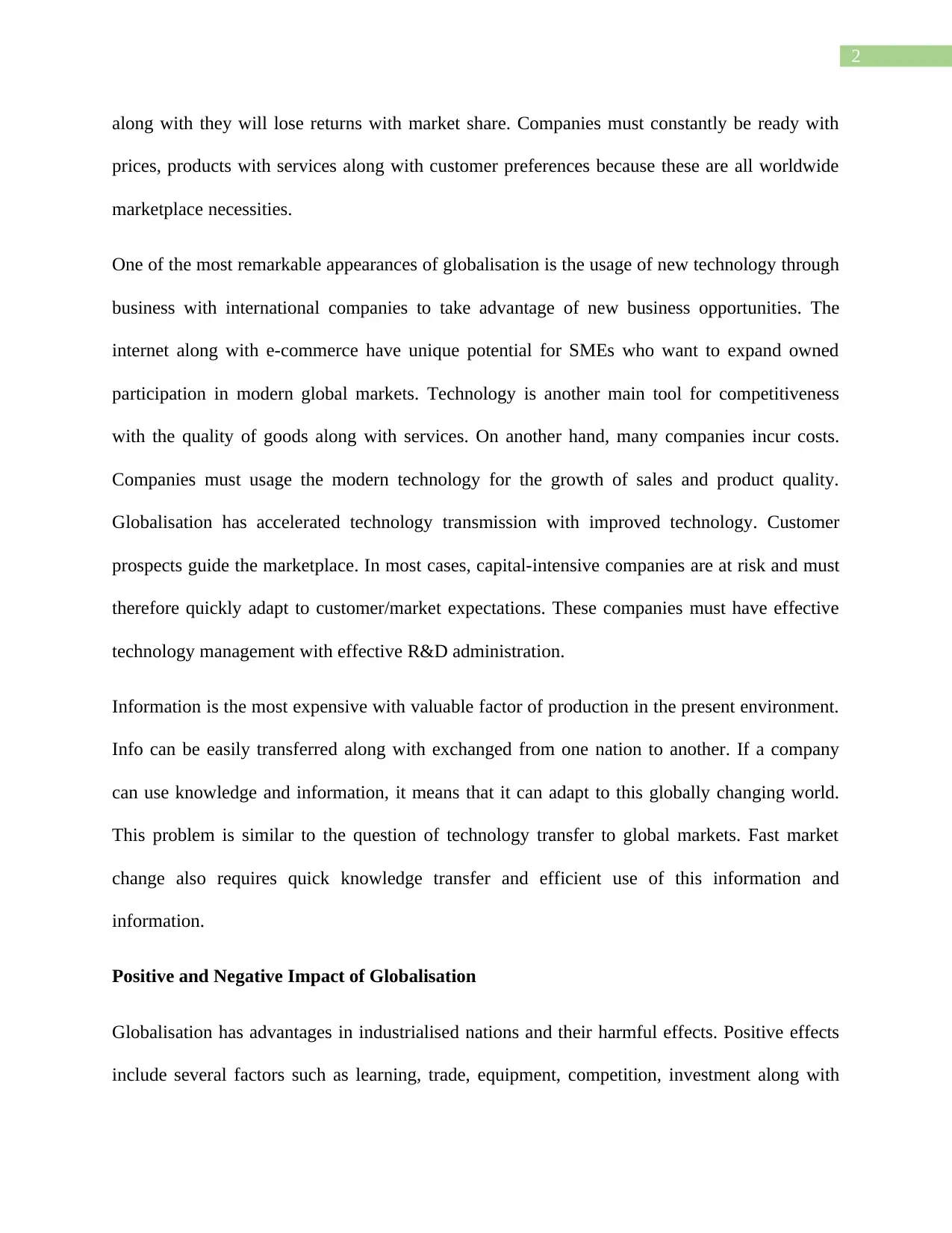
along with they will lose returns with market share. Companies must constantly be ready with
prices, products with services along with customer preferences because these are all worldwide
marketplace necessities.
One of the most remarkable appearances of globalisation is the usage of new technology through
business with international companies to take advantage of new business opportunities. The
internet along with e-commerce have unique potential for SMEs who want to expand owned
participation in modern global markets. Technology is another main tool for competitiveness
with the quality of goods along with services. On another hand, many companies incur costs.
Companies must usage the modern technology for the growth of sales and product quality.
Globalisation has accelerated technology transmission with improved technology. Customer
prospects guide the marketplace. In most cases, capital-intensive companies are at risk and must
therefore quickly adapt to customer/market expectations. These companies must have effective
technology management with effective R&D administration.
Information is the most expensive with valuable factor of production in the present environment.
Info can be easily transferred along with exchanged from one nation to another. If a company
can use knowledge and information, it means that it can adapt to this globally changing world.
This problem is similar to the question of technology transfer to global markets. Fast market
change also requires quick knowledge transfer and efficient use of this information and
information.
Positive and Negative Impact of Globalisation
Globalisation has advantages in industrialised nations and their harmful effects. Positive effects
include several factors such as learning, trade, equipment, competition, investment along with
along with they will lose returns with market share. Companies must constantly be ready with
prices, products with services along with customer preferences because these are all worldwide
marketplace necessities.
One of the most remarkable appearances of globalisation is the usage of new technology through
business with international companies to take advantage of new business opportunities. The
internet along with e-commerce have unique potential for SMEs who want to expand owned
participation in modern global markets. Technology is another main tool for competitiveness
with the quality of goods along with services. On another hand, many companies incur costs.
Companies must usage the modern technology for the growth of sales and product quality.
Globalisation has accelerated technology transmission with improved technology. Customer
prospects guide the marketplace. In most cases, capital-intensive companies are at risk and must
therefore quickly adapt to customer/market expectations. These companies must have effective
technology management with effective R&D administration.
Information is the most expensive with valuable factor of production in the present environment.
Info can be easily transferred along with exchanged from one nation to another. If a company
can use knowledge and information, it means that it can adapt to this globally changing world.
This problem is similar to the question of technology transfer to global markets. Fast market
change also requires quick knowledge transfer and efficient use of this information and
information.
Positive and Negative Impact of Globalisation
Globalisation has advantages in industrialised nations and their harmful effects. Positive effects
include several factors such as learning, trade, equipment, competition, investment along with
⊘ This is a preview!⊘
Do you want full access?
Subscribe today to unlock all pages.

Trusted by 1+ million students worldwide

3
capital flows, occupation, culture with organisational structure. Negative effects include several
factors such as job insecurity, price fluctuations, terrorism, exchange fluctuations, capital flows,
etc.
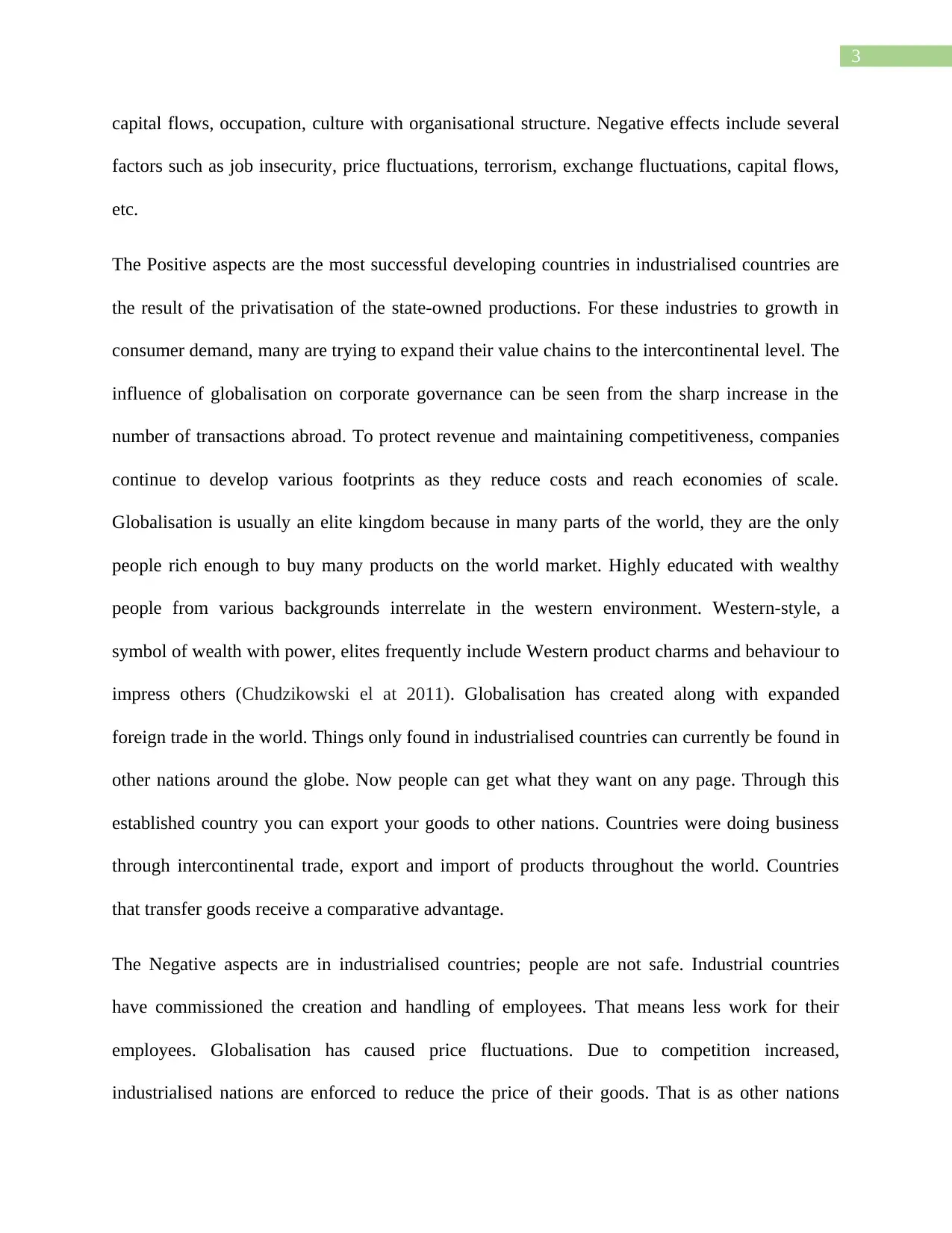
The Positive aspects are the most successful developing countries in industrialised countries are
the result of the privatisation of the state-owned productions. For these industries to growth in
consumer demand, many are trying to expand their value chains to the intercontinental level. The
influence of globalisation on corporate governance can be seen from the sharp increase in the
number of transactions abroad. To protect revenue and maintaining competitiveness, companies
continue to develop various footprints as they reduce costs and reach economies of scale.
Globalisation is usually an elite kingdom because in many parts of the world, they are the only
people rich enough to buy many products on the world market. Highly educated with wealthy
people from various backgrounds interrelate in the western environment. Western-style, a
symbol of wealth with power, elites frequently include Western product charms and behaviour to
impress others (Chudzikowski el at 2011). Globalisation has created along with expanded
foreign trade in the world. Things only found in industrialised countries can currently be found in
other nations around the globe. Now people can get what they want on any page. Through this
established country you can export your goods to other nations. Countries were doing business
through intercontinental trade, export and import of products throughout the world. Countries
that transfer goods receive a comparative advantage.
The Negative aspects are in industrialised countries; people are not safe. Industrial countries
have commissioned the creation and handling of employees. That means less work for their
employees. Globalisation has caused price fluctuations. Due to competition increased,
industrialised nations are enforced to reduce the price of their goods. That is as other nations
capital flows, occupation, culture with organisational structure. Negative effects include several
factors such as job insecurity, price fluctuations, terrorism, exchange fluctuations, capital flows,
etc.
The Positive aspects are the most successful developing countries in industrialised countries are
the result of the privatisation of the state-owned productions. For these industries to growth in
consumer demand, many are trying to expand their value chains to the intercontinental level. The
influence of globalisation on corporate governance can be seen from the sharp increase in the
number of transactions abroad. To protect revenue and maintaining competitiveness, companies
continue to develop various footprints as they reduce costs and reach economies of scale.
Globalisation is usually an elite kingdom because in many parts of the world, they are the only
people rich enough to buy many products on the world market. Highly educated with wealthy
people from various backgrounds interrelate in the western environment. Western-style, a
symbol of wealth with power, elites frequently include Western product charms and behaviour to
impress others (Chudzikowski el at 2011). Globalisation has created along with expanded
foreign trade in the world. Things only found in industrialised countries can currently be found in
other nations around the globe. Now people can get what they want on any page. Through this
established country you can export your goods to other nations. Countries were doing business
through intercontinental trade, export and import of products throughout the world. Countries
that transfer goods receive a comparative advantage.
The Negative aspects are in industrialised countries; people are not safe. Industrial countries
have commissioned the creation and handling of employees. That means less work for their
employees. Globalisation has caused price fluctuations. Due to competition increased,
industrialised nations are enforced to reduce the price of their goods. That is as other nations
Paraphrase This Document
Need a fresh take? Get an instant paraphrase of this document with our AI Paraphraser

4
such as Chinese produce the goods at lesser prices, which make goods inexpensive than those
made in developed nations.
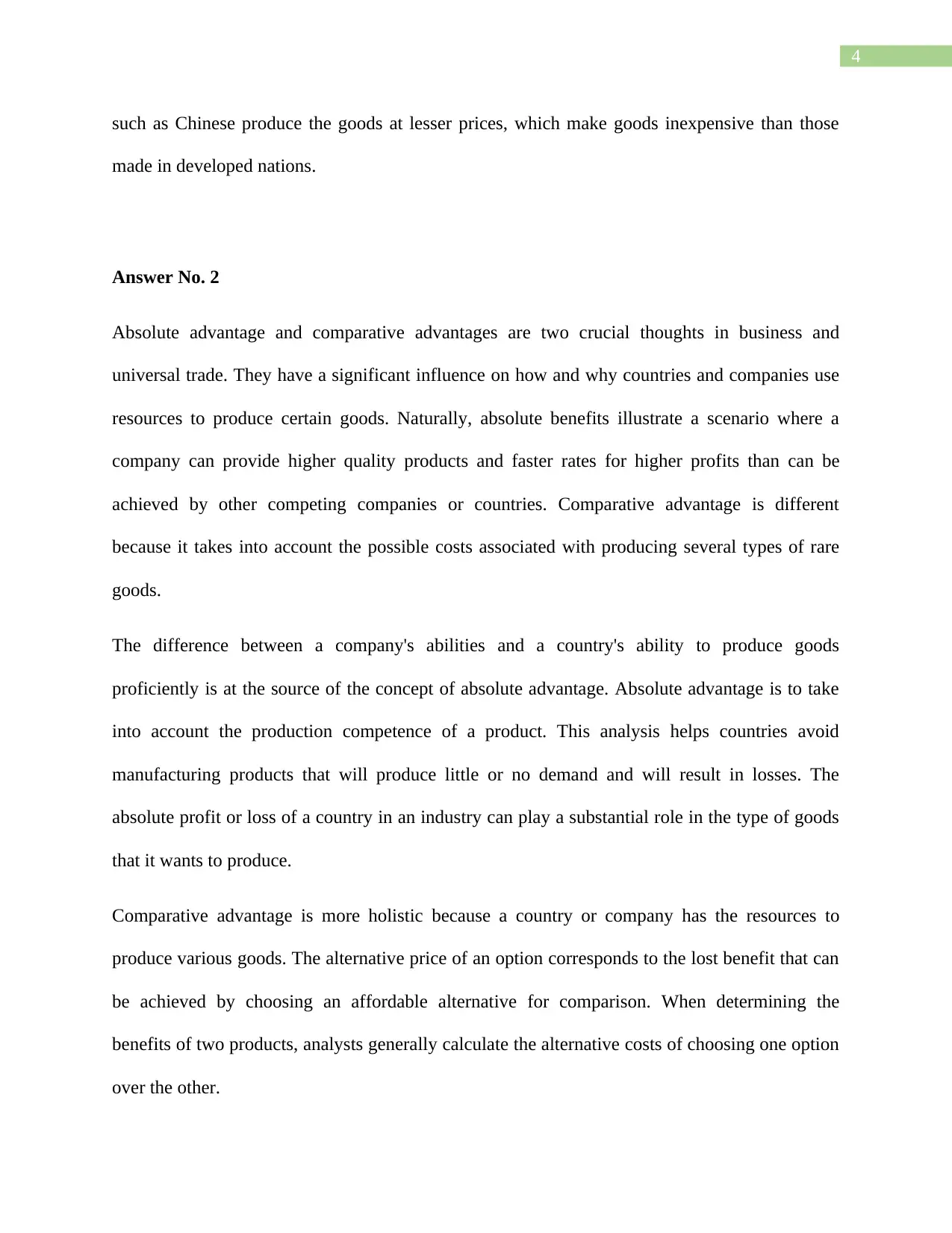
Answer No. 2
Absolute advantage and comparative advantages are two crucial thoughts in business and
universal trade. They have a significant influence on how and why countries and companies use
resources to produce certain goods. Naturally, absolute benefits illustrate a scenario where a
company can provide higher quality products and faster rates for higher profits than can be
achieved by other competing companies or countries. Comparative advantage is different
because it takes into account the possible costs associated with producing several types of rare
goods.
The difference between a company's abilities and a country's ability to produce goods
proficiently is at the source of the concept of absolute advantage. Absolute advantage is to take
into account the production competence of a product. This analysis helps countries avoid
manufacturing products that will produce little or no demand and will result in losses. The
absolute profit or loss of a country in an industry can play a substantial role in the type of goods
that it wants to produce.
Comparative advantage is more holistic because a country or company has the resources to
produce various goods. The alternative price of an option corresponds to the lost benefit that can
be achieved by choosing an affordable alternative for comparison. When determining the
benefits of two products, analysts generally calculate the alternative costs of choosing one option
over the other.
such as Chinese produce the goods at lesser prices, which make goods inexpensive than those
made in developed nations.
Answer No. 2
Absolute advantage and comparative advantages are two crucial thoughts in business and
universal trade. They have a significant influence on how and why countries and companies use
resources to produce certain goods. Naturally, absolute benefits illustrate a scenario where a
company can provide higher quality products and faster rates for higher profits than can be
achieved by other competing companies or countries. Comparative advantage is different
because it takes into account the possible costs associated with producing several types of rare
goods.
The difference between a company's abilities and a country's ability to produce goods
proficiently is at the source of the concept of absolute advantage. Absolute advantage is to take
into account the production competence of a product. This analysis helps countries avoid
manufacturing products that will produce little or no demand and will result in losses. The
absolute profit or loss of a country in an industry can play a substantial role in the type of goods
that it wants to produce.
Comparative advantage is more holistic because a country or company has the resources to
produce various goods. The alternative price of an option corresponds to the lost benefit that can
be achieved by choosing an affordable alternative for comparison. When determining the
benefits of two products, analysts generally calculate the alternative costs of choosing one option
over the other.

5
Comparative Advantage that appears more practical that Absolute Advantage because it
describes a situation where a person, company or a country can manufacture a product or service
at a lesser cost than other manufacturers. For example, because there are many maple trees,
Canada can make maple syrup at a little value compared to avocados, fruits whose climate is less
suitable. Mexico, on the other hand, with its lush sun and warm weather can grow avocados at a
much lower cost compared to Canadian maple syrup.
A numerical example of Absolute and Comparative Advantage
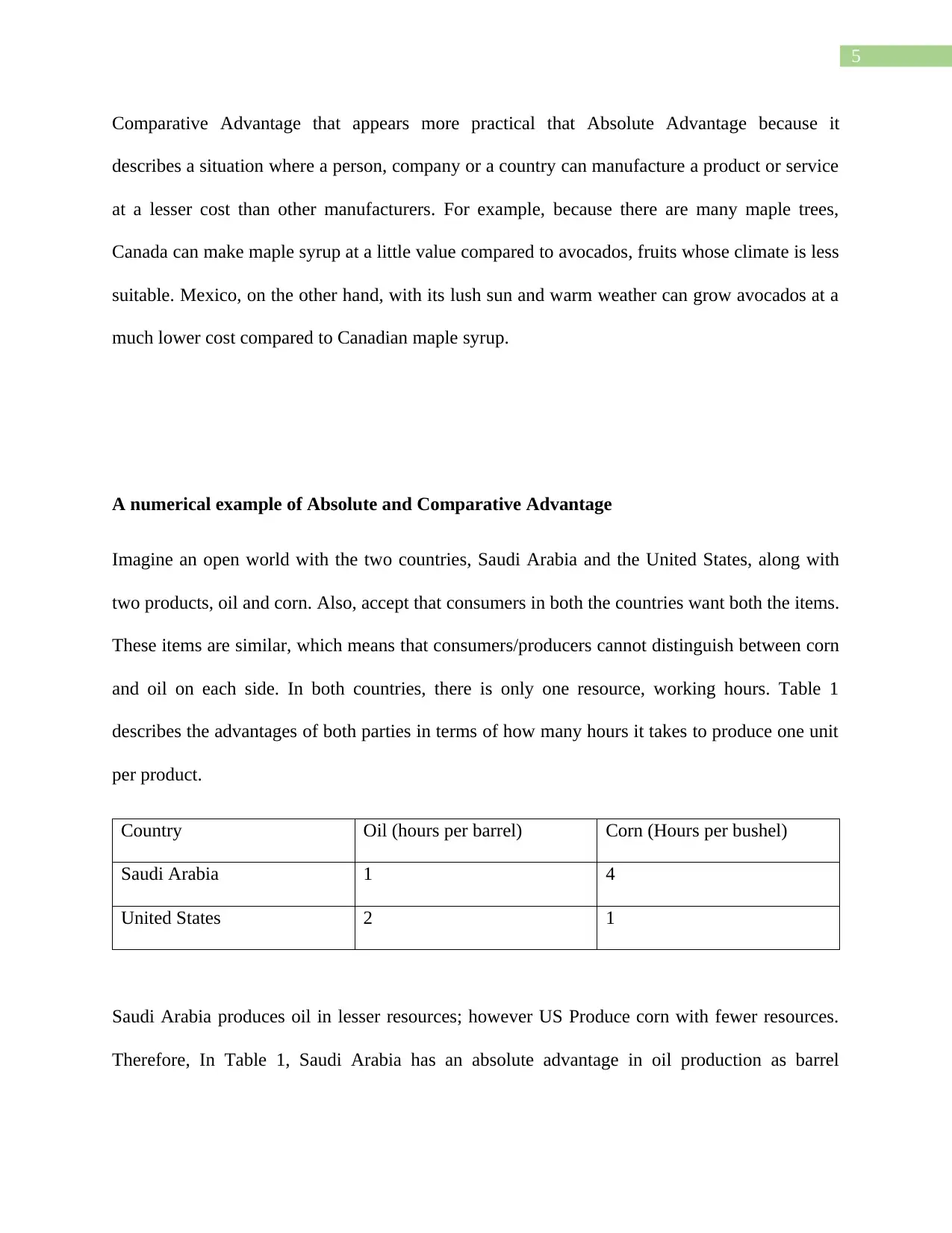
Imagine an open world with the two countries, Saudi Arabia and the United States, along with
two products, oil and corn. Also, accept that consumers in both the countries want both the items.
These items are similar, which means that consumers/producers cannot distinguish between corn
and oil on each side. In both countries, there is only one resource, working hours. Table 1
describes the advantages of both parties in terms of how many hours it takes to produce one unit
per product.
Country Oil (hours per barrel) Corn (Hours per bushel)
Saudi Arabia 1 4
United States 2 1
Saudi Arabia produces oil in lesser resources; however US Produce corn with fewer resources.
Therefore, In Table 1, Saudi Arabia has an absolute advantage in oil production as barrel
Comparative Advantage that appears more practical that Absolute Advantage because it
describes a situation where a person, company or a country can manufacture a product or service
at a lesser cost than other manufacturers. For example, because there are many maple trees,
Canada can make maple syrup at a little value compared to avocados, fruits whose climate is less
suitable. Mexico, on the other hand, with its lush sun and warm weather can grow avocados at a
much lower cost compared to Canadian maple syrup.
A numerical example of Absolute and Comparative Advantage
Imagine an open world with the two countries, Saudi Arabia and the United States, along with
two products, oil and corn. Also, accept that consumers in both the countries want both the items.
These items are similar, which means that consumers/producers cannot distinguish between corn
and oil on each side. In both countries, there is only one resource, working hours. Table 1
describes the advantages of both parties in terms of how many hours it takes to produce one unit
per product.
Country Oil (hours per barrel) Corn (Hours per bushel)
Saudi Arabia 1 4
United States 2 1
Saudi Arabia produces oil in lesser resources; however US Produce corn with fewer resources.
Therefore, In Table 1, Saudi Arabia has an absolute advantage in oil production as barrel
⊘ This is a preview!⊘
Do you want full access?
Subscribe today to unlock all pages.

Trusted by 1+ million students worldwide

6
production requires only one hour related to two hours in the United States. The United States
has an absolute advantage in corn manufacture.
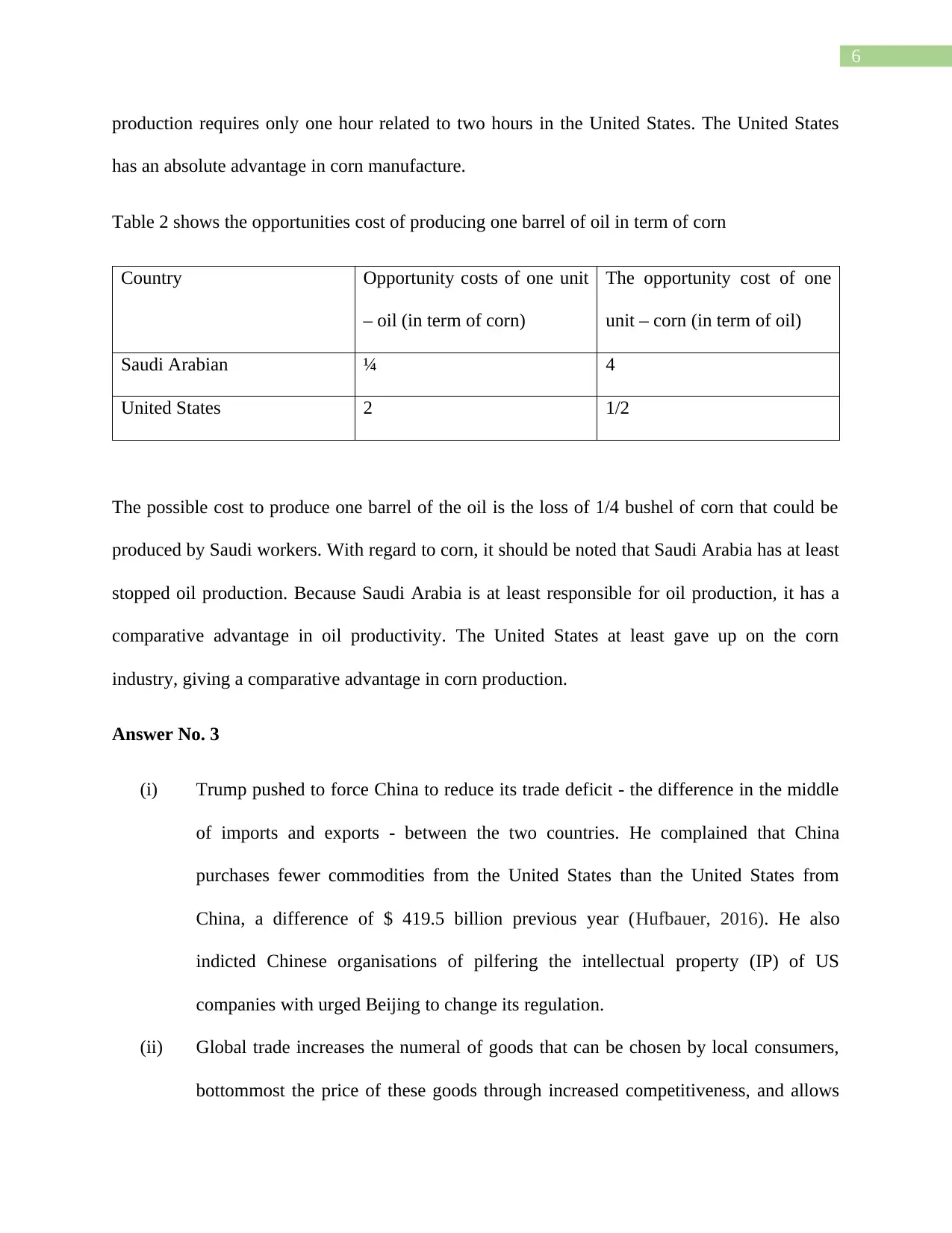
Table 2 shows the opportunities cost of producing one barrel of oil in term of corn
Country Opportunity costs of one unit
– oil (in term of corn)
The opportunity cost of one
unit – corn (in term of oil)
Saudi Arabian ¼ 4
United States 2 1/2
The possible cost to produce one barrel of the oil is the loss of 1/4 bushel of corn that could be
produced by Saudi workers. With regard to corn, it should be noted that Saudi Arabia has at least
stopped oil production. Because Saudi Arabia is at least responsible for oil production, it has a
comparative advantage in oil productivity. The United States at least gave up on the corn
industry, giving a comparative advantage in corn production.
Answer No. 3
(i) Trump pushed to force China to reduce its trade deficit - the difference in the middle
of imports and exports - between the two countries. He complained that China
purchases fewer commodities from the United States than the United States from
China, a difference of $ 419.5 billion previous year (Hufbauer, 2016). He also
indicted Chinese organisations of pilfering the intellectual property (IP) of US
companies with urged Beijing to change its regulation.
(ii) Global trade increases the numeral of goods that can be chosen by local consumers,
bottommost the price of these goods through increased competitiveness, and allows
production requires only one hour related to two hours in the United States. The United States
has an absolute advantage in corn manufacture.
Table 2 shows the opportunities cost of producing one barrel of oil in term of corn
Country Opportunity costs of one unit
– oil (in term of corn)
The opportunity cost of one
unit – corn (in term of oil)
Saudi Arabian ¼ 4
United States 2 1/2
The possible cost to produce one barrel of the oil is the loss of 1/4 bushel of corn that could be
produced by Saudi workers. With regard to corn, it should be noted that Saudi Arabia has at least
stopped oil production. Because Saudi Arabia is at least responsible for oil production, it has a
comparative advantage in oil productivity. The United States at least gave up on the corn
industry, giving a comparative advantage in corn production.
Answer No. 3
(i) Trump pushed to force China to reduce its trade deficit - the difference in the middle
of imports and exports - between the two countries. He complained that China
purchases fewer commodities from the United States than the United States from
China, a difference of $ 419.5 billion previous year (Hufbauer, 2016). He also
indicted Chinese organisations of pilfering the intellectual property (IP) of US
companies with urged Beijing to change its regulation.
(ii) Global trade increases the numeral of goods that can be chosen by local consumers,
bottommost the price of these goods through increased competitiveness, and allows
Paraphrase This Document
Need a fresh take? Get an instant paraphrase of this document with our AI Paraphraser

7
local production to send their products abroad. Although all of these effects appear to
be beneficial, free commerce is generally not considered to be entirely helpful for all
countries.
local production to send their products abroad. Although all of these effects appear to
be beneficial, free commerce is generally not considered to be entirely helpful for all
countries.

8
Reference
Chudzikowski, K., Fink, G., Mayrhofer, W., Minkov, M. and Hofstede, G., 2011. The evolution
of Hofstede's doctrine. Cross cultural management: An international journal.
Henisz, W.J. and Zelner, B.A., 2015. The hidden risks in emerging markets. In International
Business Strategy (pp. 646-654). Routledge.
London, T. and Hart, S.L., 2004. Reinventing strategies for emerging markets: beyond the
transnational model. Journal of international business studies, 35(5), pp.350-370.
Tanev, S., 2012. Global from the start: The characteristics of born-global firms in the technology
sector. Technology Innovation Management Review, 2(3).
Hufbauer, G.C., 2016. Could a President Trump shackle imports?. Assessing Trade Agendas in
the US Presidential Campaign, pp.16-6.
Reference
Chudzikowski, K., Fink, G., Mayrhofer, W., Minkov, M. and Hofstede, G., 2011. The evolution
of Hofstede's doctrine. Cross cultural management: An international journal.
Henisz, W.J. and Zelner, B.A., 2015. The hidden risks in emerging markets. In International
Business Strategy (pp. 646-654). Routledge.
London, T. and Hart, S.L., 2004. Reinventing strategies for emerging markets: beyond the
transnational model. Journal of international business studies, 35(5), pp.350-370.
Tanev, S., 2012. Global from the start: The characteristics of born-global firms in the technology
sector. Technology Innovation Management Review, 2(3).
Hufbauer, G.C., 2016. Could a President Trump shackle imports?. Assessing Trade Agendas in
the US Presidential Campaign, pp.16-6.
⊘ This is a preview!⊘
Do you want full access?
Subscribe today to unlock all pages.

Trusted by 1+ million students worldwide
1 out of 9
Related Documents
Your All-in-One AI-Powered Toolkit for Academic Success.
+13062052269
info@desklib.com
Available 24*7 on WhatsApp / Email
Unlock your academic potential
Copyright © 2020–2026 A2Z Services. All Rights Reserved. Developed and managed by ZUCOL.