Cannabis Use: Examining the Impact on University Students' Lives

Verified

Added on  2019/10/31

|5
|1408
|161
Essay
AI Summary
This essay examines the use of cannabis among university students, exploring its effects on health, academic performance, and social behavior. The introduction highlights the prevalence of cannabis use among young people, particularly university students, and the misconceptions surrounding its addictive nature and impact on cognitive functions. The essay discusses the health effects, including impacts on the brain, appetite, and physical symptoms like bloodshot eyes and increased heart rate. It also delves into the social effects, such as the potential for legal consequences, behavioral changes, and social isolation. The essay emphasizes the importance of avoiding cannabis use to protect academic success, health, and social relationships. The conclusion reiterates the negative consequences of cannabis use and encourages students to make informed decisions about their health and well-being.
Document Page
The Use of Cannabis, for University Students 1
THE USE OF CANNABIS, FOR UNIVERSITY STUDENTS
Student’s Name:
Course
Professor’s Name
Institution
Location of Institution
Date
tabler-icon-diamond-filled.svg

Paraphrase This Document

Need a fresh take? Get an instant paraphrase of this document with our AI Paraphraser
Document Page
The Use of Cannabis, for University Students 2
University Students and the Use of
Cannabis
Introduction
Our society has been faced by the
use of drugs. Many people across gender
and age have been victims of certain
drugs. The young people are however
more affected by some drugs such as
Cannabis. The drug is also known as
Marijuana. University students are using
this drug for variety of their reasons. There
have been many propositions and theories
with the young people about this drug
which has rendered many of them to
addiction calling it a weed (Fong, 46). The
health of these students have gone down
and learning is not taking its cause in the
university students who have been using
marijuana for long. The extent to which
cannabis is used among university students
has raised from the year 2004 to date to an
extent that it has surpassed cigarette
smoking. The effects of this drug are
social, adverse health, academic and
behavioural. The perception that it is just
like any other natural herb makes it hard
for the society to fight. University students
in Australia and United States of America
for example, start taking it at the age of
12-18 years and then the usage declines in
the later years (Shi, Lenzi and An, 2015,
p.93).
Misconceptions of using cannabis
Cannabis is not addictive.
There is a big number of university
students who have been claiming that
cannabis is not addictive but, is that true?
They also praise it among other drugs that
it should not be considered harmful
because one cannot be addicted to
Marijuana. This is not true. The use of
Marijuana can be said not to have
withdrawal symptoms but there is a risky
result against that. It becomes woeful
because cannabis results to a long lasting
effect in a person’s brain. When it is taken
by young people between the age of 12-25
years, it leads to poor development of
human mind. The results are irresponsible
and weird behaviours that are just like
other drugs or worse. The misconception is
a woe.
Cannabis helps you to study and
understand things easily
A big number of university
students have been using cannabis so that
they can be able to study hard. Research
has shown that in the year 2016, the
number of students who have been using
cannabis increased by 12% and many of
them included that it was to help them
carry out heavy tasks in class. There were
also some students who say that cannabis
increases creativity and they were able to
reason out quickly whenever they were
solving their tasks in school like
assignments and exams (Mazanov et.al,
2013, p.110).
The fact is that perception is not
always the reality. Marijuana or cannabis
alters an individual’s perception.
For instance, a research conducted
in 60 people in Netherlands to measure
divergent thinking or creativity revealed
that, after inhaling cannabis with the same
concentration of THC, the participants
exhibited different results according to the
amount inhaled. They were asked to come
up with creative uses of a common thing, a
pen. Those participants who inhaled higher
doses had lower ability to brainstorm
ideas, think flexibly and also developing or
inventing new ideas. The experiment study
reveals that cannabis reduces divergent
thinking abilities but makes a student to
Document Page
The Use of Cannabis, for University Students 3
feel creative but really not creative.
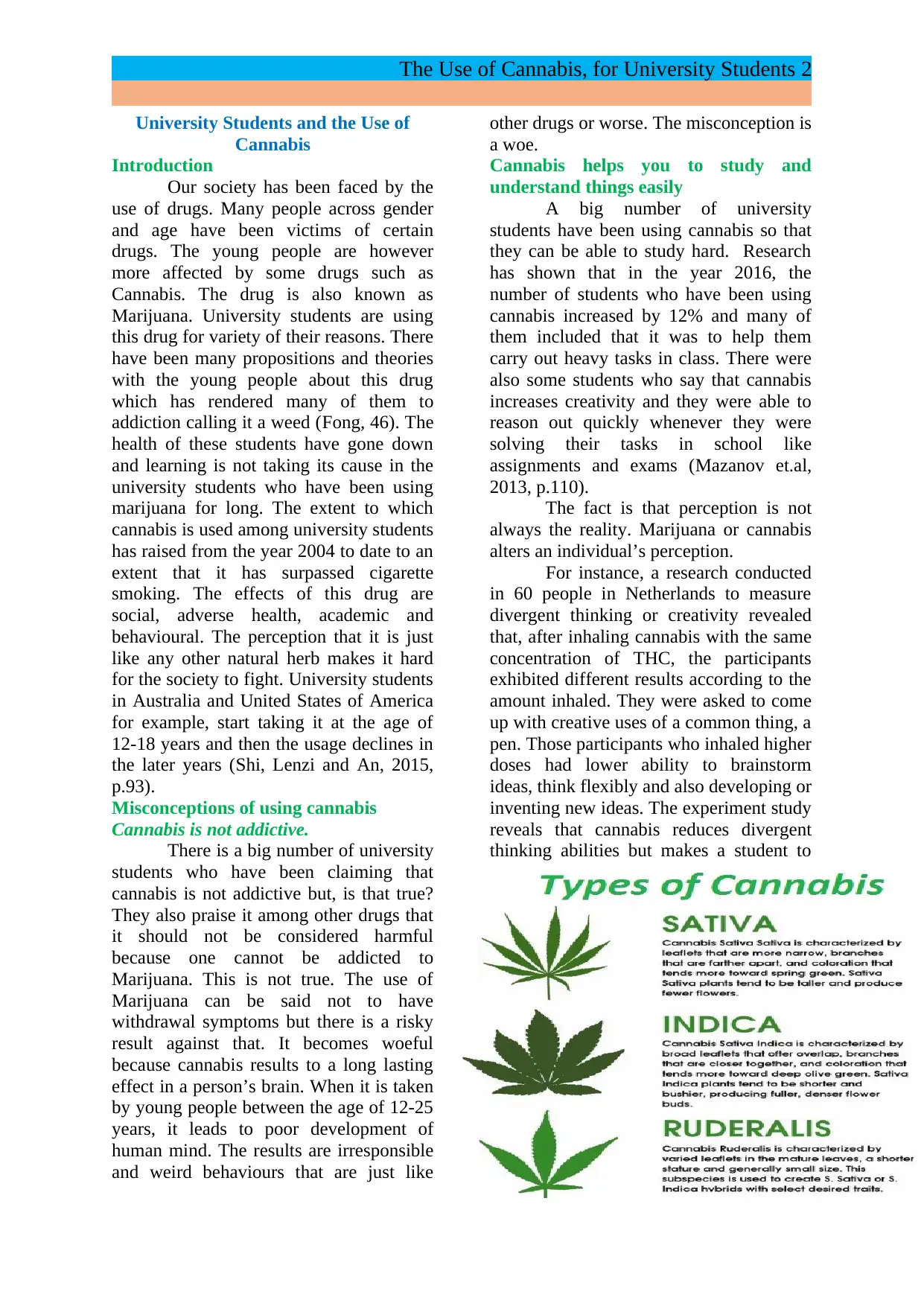
Fig. 1: Different types of cannabis
Effects of cannabis
Health effects
Cannabis has effects on human
brains. Some of them are positive while
the majority are negative. For instance,
the human brain is the one that is mostly
affected by cannabis. Some of the brain
parts that are affected are; cerebral cortex,
hypothalamus, basal ganglia, amygdala,
hippocampus, cerebrum and finally brain
stem. All of these parts of the brain have
fundamental functions in controlling an
individual. For instance, cerebral cortex
has a role in memory, thinking, perceptual
awareness and consciousness. A cannabis
user will be unable to perform these roles
perfectly. Hypothalamus acts to govern the
metabolic processes such as appetite.
Appetite goes to extreme because
endocannabinoids present in the
hypothalamus activates enzymes that
facilitate high quest for food and drinks.
As a university student, it will be
uncomfortable for somebody to always
feel like eating all the time. There is
discomfort caused by affecting
hypothalamus (Volkow, Baler, Compton
and Weiss, 2014, p.2219). None of all
these types is good for you.
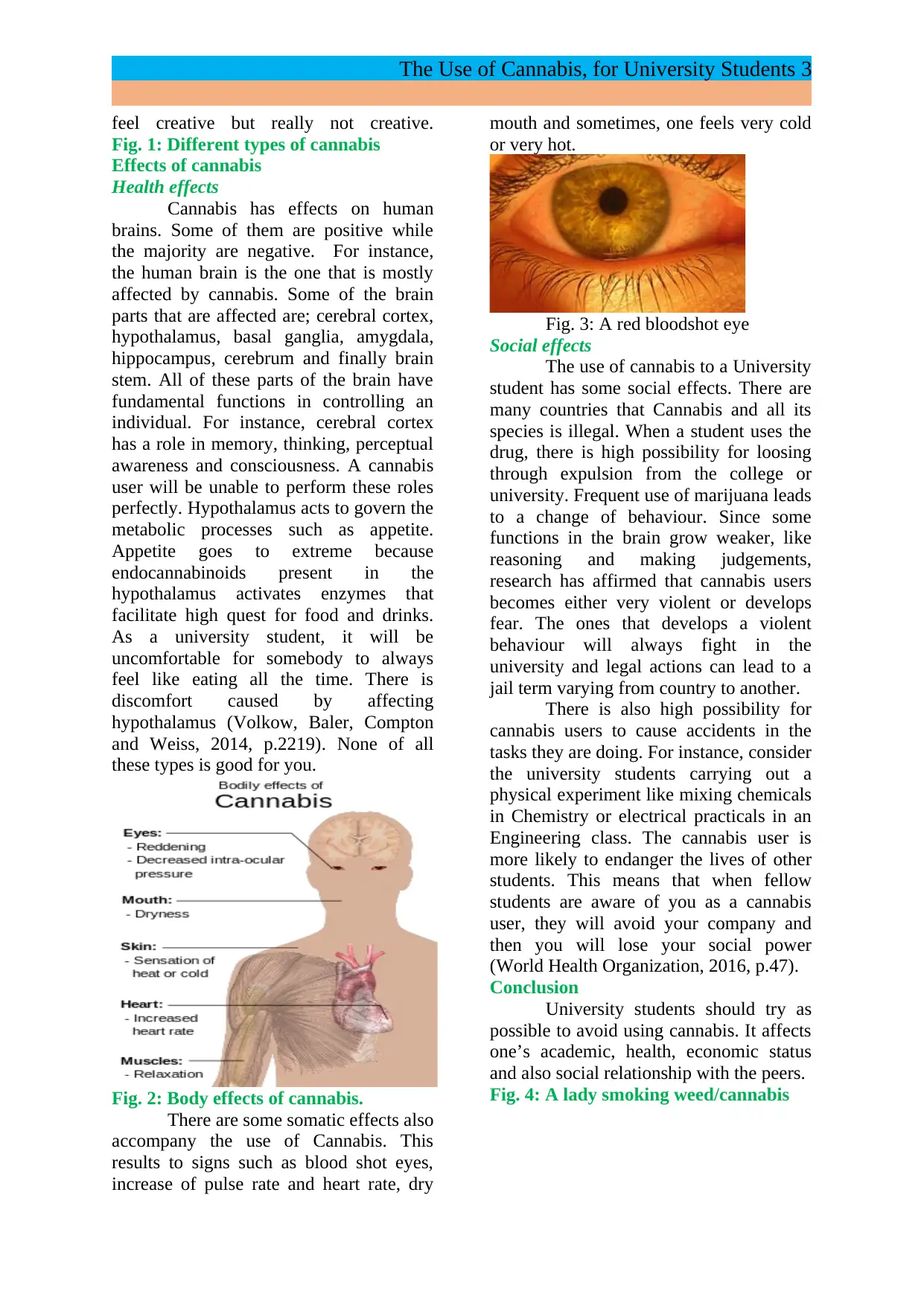
Fig. 2: Body effects of cannabis.
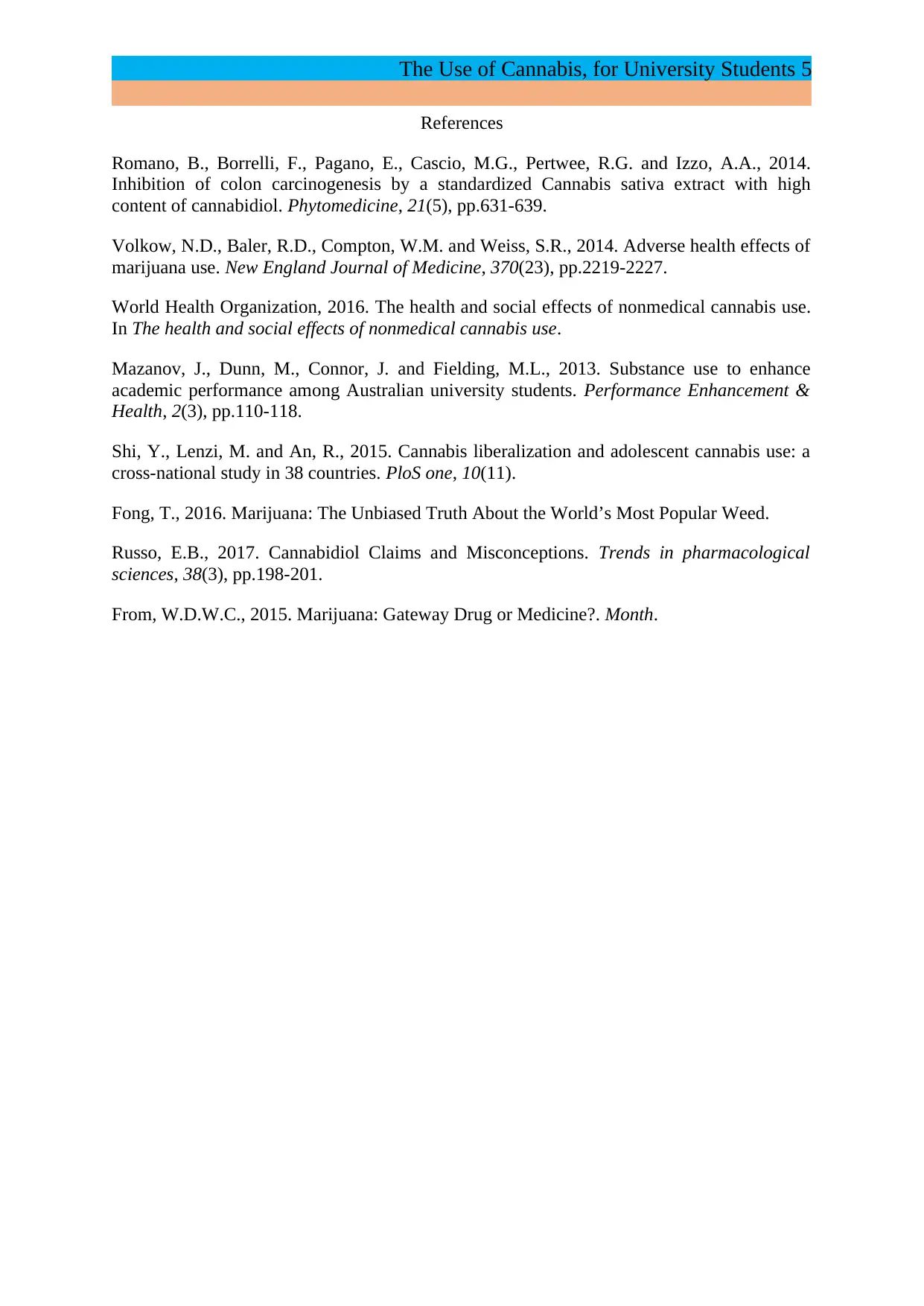
There are some somatic effects also
accompany the use of Cannabis. This
results to signs such as blood shot eyes,
increase of pulse rate and heart rate, dry
mouth and sometimes, one feels very cold
or very hot.
Fig. 3: A red bloodshot eye
Social effects
The use of cannabis to a University
student has some social effects. There are
many countries that Cannabis and all its
species is illegal. When a student uses the
drug, there is high possibility for loosing
through expulsion from the college or
university. Frequent use of marijuana leads
to a change of behaviour. Since some
functions in the brain grow weaker, like
reasoning and making judgements,
research has affirmed that cannabis users
becomes either very violent or develops
fear. The ones that develops a violent
behaviour will always fight in the
university and legal actions can lead to a
jail term varying from country to another.
There is also high possibility for
cannabis users to cause accidents in the
tasks they are doing. For instance, consider
the university students carrying out a
physical experiment like mixing chemicals
in Chemistry or electrical practicals in an
Engineering class. The cannabis user is
more likely to endanger the lives of other
students. This means that when fellow
students are aware of you as a cannabis
user, they will avoid your company and
then you will lose your social power
(World Health Organization, 2016, p.47).
Conclusion
University students should try as
possible to avoid using cannabis. It affects
one’s academic, health, economic status
and also social relationship with the peers.
Fig. 4: A lady smoking weed/cannabis
Document Page
The Use of Cannabis, for University Students 4
tabler-icon-diamond-filled.svg

Paraphrase This Document

Need a fresh take? Get an instant paraphrase of this document with our AI Paraphraser
Document Page
The Use of Cannabis, for University Students 5
References
Romano, B., Borrelli, F., Pagano, E., Cascio, M.G., Pertwee, R.G. and Izzo, A.A., 2014.
Inhibition of colon carcinogenesis by a standardized Cannabis sativa extract with high
content of cannabidiol. Phytomedicine, 21(5), pp.631-639.
Volkow, N.D., Baler, R.D., Compton, W.M. and Weiss, S.R., 2014. Adverse health effects of
marijuana use. New England Journal of Medicine, 370(23), pp.2219-2227.
World Health Organization, 2016. The health and social effects of nonmedical cannabis use.
In The health and social effects of nonmedical cannabis use.
Mazanov, J., Dunn, M., Connor, J. and Fielding, M.L., 2013. Substance use to enhance
academic performance among Australian university students. Performance Enhancement &
Health, 2(3), pp.110-118.
Shi, Y., Lenzi, M. and An, R., 2015. Cannabis liberalization and adolescent cannabis use: a
cross-national study in 38 countries. PloS one, 10(11).
Fong, T., 2016. Marijuana: The Unbiased Truth About the World’s Most Popular Weed.
Russo, E.B., 2017. Cannabidiol Claims and Misconceptions. Trends in pharmacological
sciences, 38(3), pp.198-201.
From, W.D.W.C., 2015. Marijuana: Gateway Drug or Medicine?. Month.
chevron_up_icon
1 out of 5
circle_padding
hide_on_mobile
zoom_out_icon
[object Object]