University Financial Reporting: Analysis of Accounting Principles
VerifiedAdded on 2020/04/21
|14
|2206
|89
Homework Assignment
AI Summary
This assignment, prepared by a student, delves into the core concepts of financial reporting. It commences with an exploration of fundamental accounting principles, including the accounting entity assumption and the significance of a fixed asset register. The assignment proceeds to examine journal entries, the impact of asset sales, and the treatment of unearned income and doubtful debts. It provides detailed examples of balance day adjustments, including accruals and deferrals. Furthermore, the assignment includes practical applications of depreciation methods such as straight-line, double-declining balance, and the sum-of-the-digits method, with comprehensive depreciation schedules and journal entries. The document provides a thorough understanding of key accounting practices, making it a valuable resource for students studying finance and accounting.
Running head: PREPARE FINANCIAL REPORTS
Prepare Financial Reports (Assessment 1)
Name of the Student:
Name of the University:
Author’s Note:
Course ID:
Prepare Financial Reports (Assessment 1)
Name of the Student:
Name of the University:
Author’s Note:
Course ID:

Paraphrase This Document
Need a fresh take? Get an instant paraphrase of this document with our AI Paraphraser
PREPARE FINANCIAL REPORTS
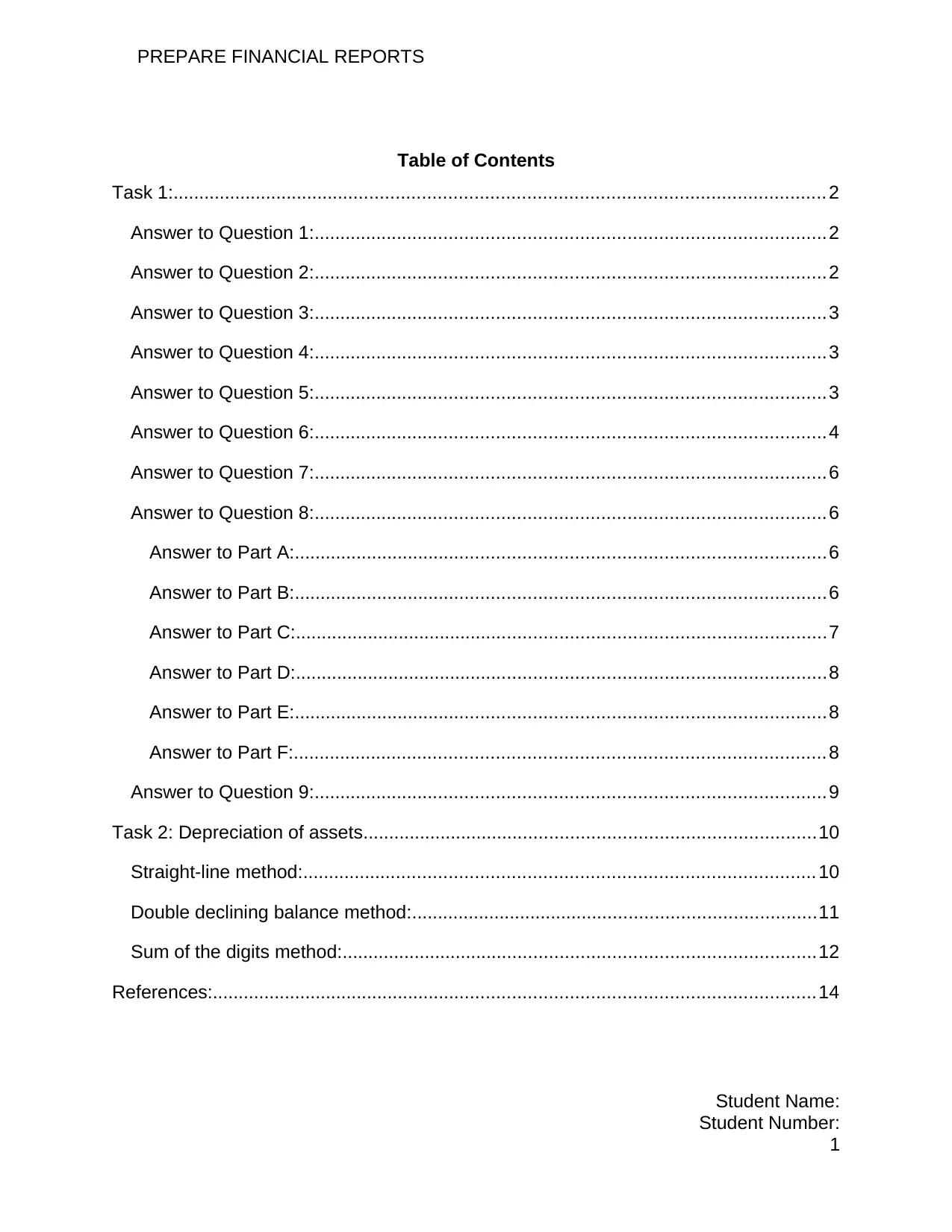
Table of Contents
Task 1:............................................................................................................................. 2
Answer to Question 1:..................................................................................................2
Answer to Question 2:..................................................................................................2
Answer to Question 3:..................................................................................................3
Answer to Question 4:..................................................................................................3
Answer to Question 5:..................................................................................................3
Answer to Question 6:..................................................................................................4
Answer to Question 7:..................................................................................................6
Answer to Question 8:..................................................................................................6
Answer to Part A:......................................................................................................6
Answer to Part B:......................................................................................................6
Answer to Part C:......................................................................................................7
Answer to Part D:......................................................................................................8
Answer to Part E:......................................................................................................8
Answer to Part F:...................................................................................................... 8
Answer to Question 9:..................................................................................................9
Task 2: Depreciation of assets.......................................................................................10
Straight-line method:.................................................................................................. 10
Double declining balance method:..............................................................................11
Sum of the digits method:...........................................................................................12
References:....................................................................................................................14
Student Name:
Student Number:
1
Table of Contents
Task 1:............................................................................................................................. 2
Answer to Question 1:..................................................................................................2
Answer to Question 2:..................................................................................................2
Answer to Question 3:..................................................................................................3
Answer to Question 4:..................................................................................................3
Answer to Question 5:..................................................................................................3
Answer to Question 6:..................................................................................................4
Answer to Question 7:..................................................................................................6
Answer to Question 8:..................................................................................................6
Answer to Part A:......................................................................................................6
Answer to Part B:......................................................................................................6
Answer to Part C:......................................................................................................7
Answer to Part D:......................................................................................................8
Answer to Part E:......................................................................................................8
Answer to Part F:...................................................................................................... 8
Answer to Question 9:..................................................................................................9
Task 2: Depreciation of assets.......................................................................................10
Straight-line method:.................................................................................................. 10
Double declining balance method:..............................................................................11
Sum of the digits method:...........................................................................................12
References:....................................................................................................................14
Student Name:
Student Number:
1

PREPARE FINANCIAL REPORTS
Student Name:
Student Number:
2
Student Name:
Student Number:
2
⊘ This is a preview!⊘
Do you want full access?
Subscribe today to unlock all pages.

Trusted by 1+ million students worldwide
PREPARE FINANCIAL REPORTS
Task 1:
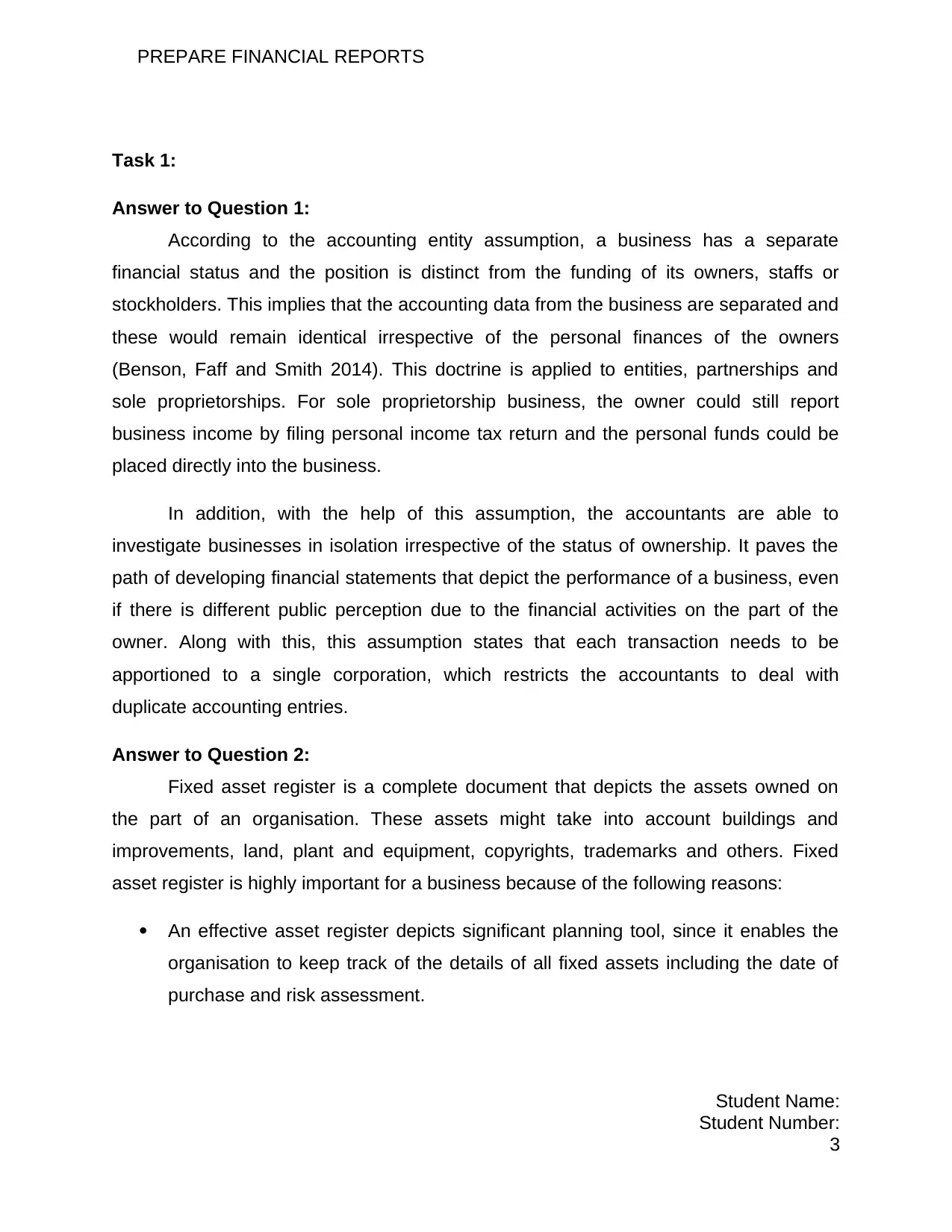
Answer to Question 1:
According to the accounting entity assumption, a business has a separate
financial status and the position is distinct from the funding of its owners, staffs or
stockholders. This implies that the accounting data from the business are separated and
these would remain identical irrespective of the personal finances of the owners
(Benson, Faff and Smith 2014). This doctrine is applied to entities, partnerships and
sole proprietorships. For sole proprietorship business, the owner could still report
business income by filing personal income tax return and the personal funds could be
placed directly into the business.
In addition, with the help of this assumption, the accountants are able to
investigate businesses in isolation irrespective of the status of ownership. It paves the
path of developing financial statements that depict the performance of a business, even
if there is different public perception due to the financial activities on the part of the
owner. Along with this, this assumption states that each transaction needs to be
apportioned to a single corporation, which restricts the accountants to deal with
duplicate accounting entries.
Answer to Question 2:
Fixed asset register is a complete document that depicts the assets owned on
the part of an organisation. These assets might take into account buildings and
improvements, land, plant and equipment, copyrights, trademarks and others. Fixed
asset register is highly important for a business because of the following reasons:
An effective asset register depicts significant planning tool, since it enables the
organisation to keep track of the details of all fixed assets including the date of
purchase and risk assessment.
Student Name:
Student Number:
3
Task 1:
Answer to Question 1:
According to the accounting entity assumption, a business has a separate
financial status and the position is distinct from the funding of its owners, staffs or
stockholders. This implies that the accounting data from the business are separated and
these would remain identical irrespective of the personal finances of the owners
(Benson, Faff and Smith 2014). This doctrine is applied to entities, partnerships and
sole proprietorships. For sole proprietorship business, the owner could still report
business income by filing personal income tax return and the personal funds could be
placed directly into the business.
In addition, with the help of this assumption, the accountants are able to
investigate businesses in isolation irrespective of the status of ownership. It paves the
path of developing financial statements that depict the performance of a business, even
if there is different public perception due to the financial activities on the part of the
owner. Along with this, this assumption states that each transaction needs to be
apportioned to a single corporation, which restricts the accountants to deal with
duplicate accounting entries.
Answer to Question 2:
Fixed asset register is a complete document that depicts the assets owned on
the part of an organisation. These assets might take into account buildings and
improvements, land, plant and equipment, copyrights, trademarks and others. Fixed
asset register is highly important for a business because of the following reasons:
An effective asset register depicts significant planning tool, since it enables the
organisation to keep track of the details of all fixed assets including the date of
purchase and risk assessment.
Student Name:
Student Number:
3
Paraphrase This Document
Need a fresh take? Get an instant paraphrase of this document with our AI Paraphraser
PREPARE FINANCIAL REPORTS
Fraud could be prevented with the help of asset register, when there are
accurate controls in place. This minimises the theft of assets and opportunity to
lose assets at customer sites and service providers (Franks 2014).
By tracking the asset movement, a business could optimise the asset utilisation
including increased billings. With the help of asset register, the assets of an
organisation are protected from any threat that would influence the ability of the
business in maximising revenue.
Answer to Question 3:
Journal is termed as the basic book of accounting. More precisely, it is the book
of prime entry and the procedure of recording transactions into journal is called
journalising. Journal could be explained as a book where the transactions are recorded
in the chronological order. The basic functions of journal in the process of accounting
are depicted briefly as follows:
To evaluate each transaction into credit and debit for enabling their posting into
the ledger
To make chronological arrangement of the transactions in order of date
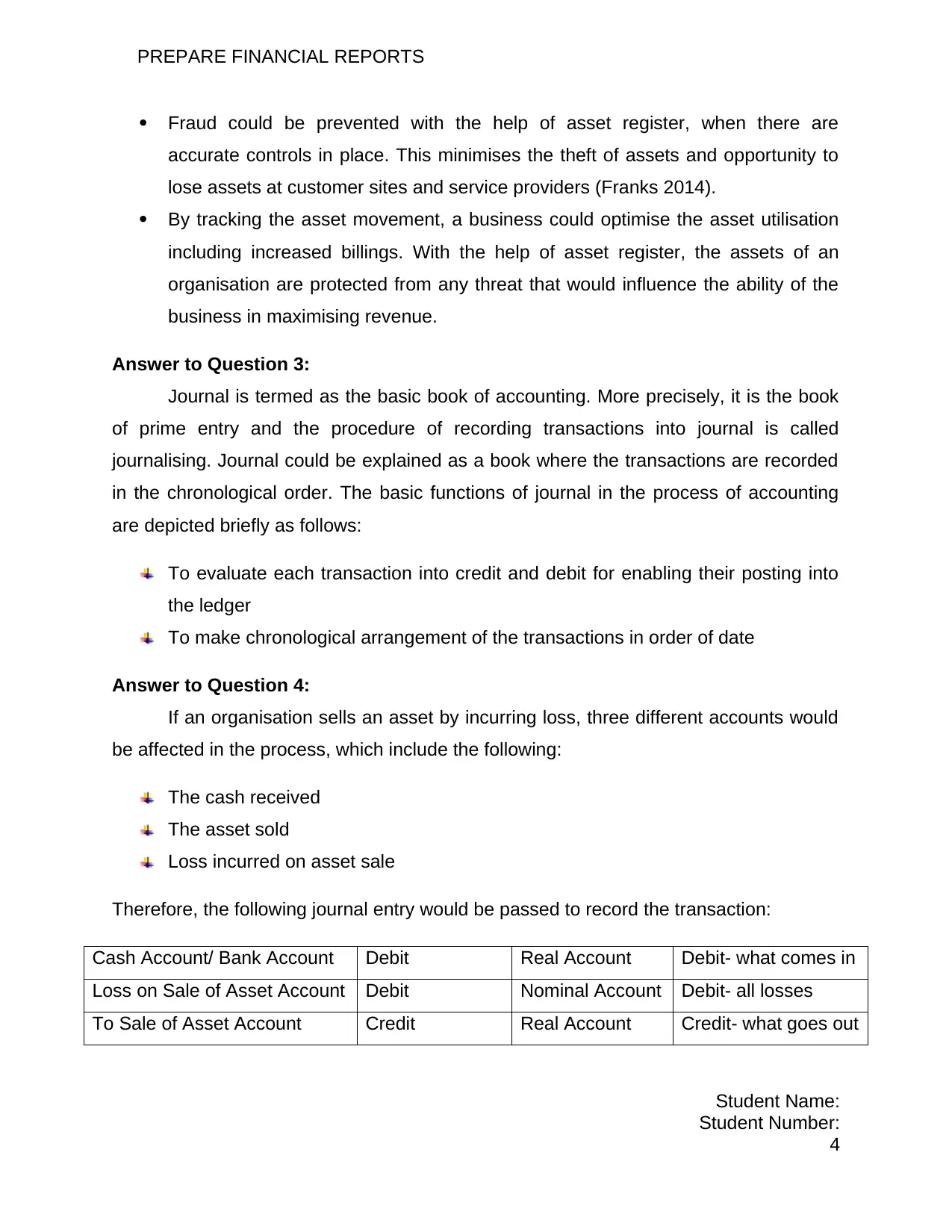
Answer to Question 4:
If an organisation sells an asset by incurring loss, three different accounts would
be affected in the process, which include the following:
The cash received
The asset sold
Loss incurred on asset sale
Therefore, the following journal entry would be passed to record the transaction:
Cash Account/ Bank Account Debit Real Account Debit- what comes in
Loss on Sale of Asset Account Debit Nominal Account Debit- all losses
To Sale of Asset Account Credit Real Account Credit- what goes out
Student Name:
Student Number:
4
Fraud could be prevented with the help of asset register, when there are
accurate controls in place. This minimises the theft of assets and opportunity to
lose assets at customer sites and service providers (Franks 2014).
By tracking the asset movement, a business could optimise the asset utilisation
including increased billings. With the help of asset register, the assets of an
organisation are protected from any threat that would influence the ability of the
business in maximising revenue.
Answer to Question 3:
Journal is termed as the basic book of accounting. More precisely, it is the book
of prime entry and the procedure of recording transactions into journal is called
journalising. Journal could be explained as a book where the transactions are recorded
in the chronological order. The basic functions of journal in the process of accounting
are depicted briefly as follows:
To evaluate each transaction into credit and debit for enabling their posting into
the ledger
To make chronological arrangement of the transactions in order of date
Answer to Question 4:
If an organisation sells an asset by incurring loss, three different accounts would
be affected in the process, which include the following:
The cash received
The asset sold
Loss incurred on asset sale
Therefore, the following journal entry would be passed to record the transaction:
Cash Account/ Bank Account Debit Real Account Debit- what comes in
Loss on Sale of Asset Account Debit Nominal Account Debit- all losses
To Sale of Asset Account Credit Real Account Credit- what goes out
Student Name:
Student Number:
4
PREPARE FINANCIAL REPORTS
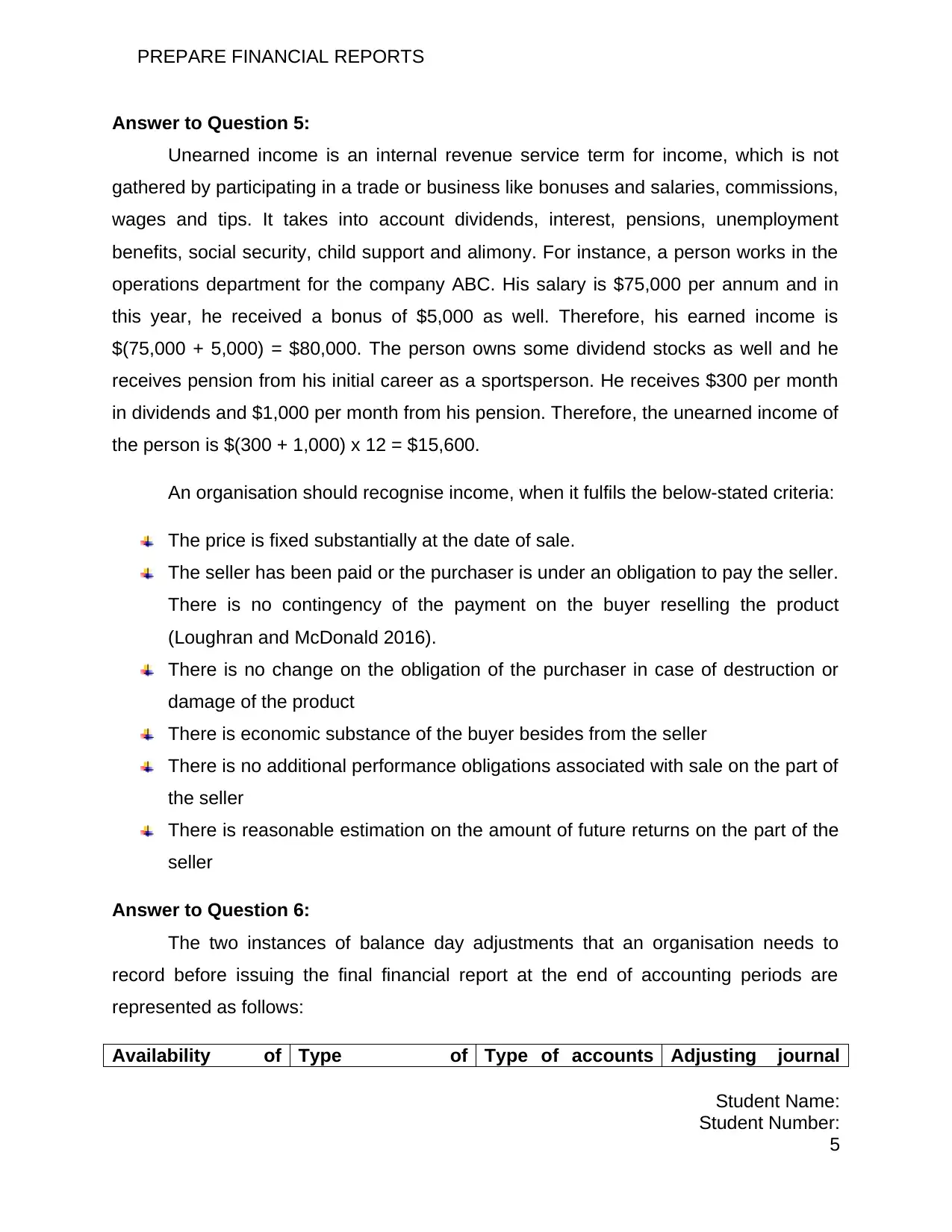
Answer to Question 5:
Unearned income is an internal revenue service term for income, which is not
gathered by participating in a trade or business like bonuses and salaries, commissions,
wages and tips. It takes into account dividends, interest, pensions, unemployment
benefits, social security, child support and alimony. For instance, a person works in the
operations department for the company ABC. His salary is $75,000 per annum and in
this year, he received a bonus of $5,000 as well. Therefore, his earned income is
$(75,000 + 5,000) = $80,000. The person owns some dividend stocks as well and he
receives pension from his initial career as a sportsperson. He receives $300 per month
in dividends and $1,000 per month from his pension. Therefore, the unearned income of
the person is $(300 + 1,000) x 12 = $15,600.
An organisation should recognise income, when it fulfils the below-stated criteria:
The price is fixed substantially at the date of sale.
The seller has been paid or the purchaser is under an obligation to pay the seller.
There is no contingency of the payment on the buyer reselling the product
(Loughran and McDonald 2016).
There is no change on the obligation of the purchaser in case of destruction or
damage of the product
There is economic substance of the buyer besides from the seller
There is no additional performance obligations associated with sale on the part of
the seller
There is reasonable estimation on the amount of future returns on the part of the
seller
Answer to Question 6:
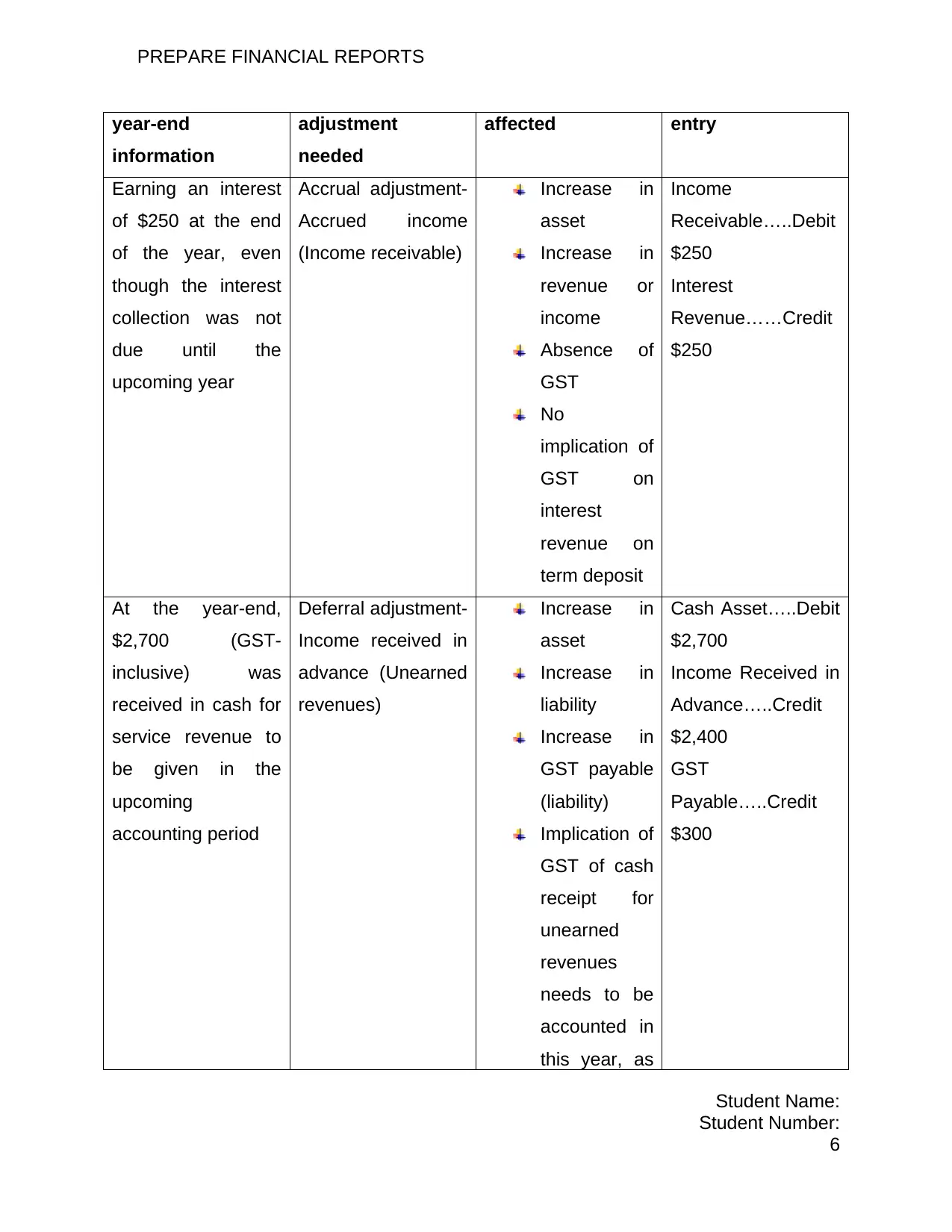
The two instances of balance day adjustments that an organisation needs to
record before issuing the final financial report at the end of accounting periods are
represented as follows:
Availability of Type of Type of accounts Adjusting journal
Student Name:
Student Number:
5
Answer to Question 5:
Unearned income is an internal revenue service term for income, which is not
gathered by participating in a trade or business like bonuses and salaries, commissions,
wages and tips. It takes into account dividends, interest, pensions, unemployment
benefits, social security, child support and alimony. For instance, a person works in the
operations department for the company ABC. His salary is $75,000 per annum and in
this year, he received a bonus of $5,000 as well. Therefore, his earned income is
$(75,000 + 5,000) = $80,000. The person owns some dividend stocks as well and he
receives pension from his initial career as a sportsperson. He receives $300 per month
in dividends and $1,000 per month from his pension. Therefore, the unearned income of
the person is $(300 + 1,000) x 12 = $15,600.
An organisation should recognise income, when it fulfils the below-stated criteria:
The price is fixed substantially at the date of sale.
The seller has been paid or the purchaser is under an obligation to pay the seller.
There is no contingency of the payment on the buyer reselling the product
(Loughran and McDonald 2016).
There is no change on the obligation of the purchaser in case of destruction or
damage of the product
There is economic substance of the buyer besides from the seller
There is no additional performance obligations associated with sale on the part of
the seller
There is reasonable estimation on the amount of future returns on the part of the
seller
Answer to Question 6:
The two instances of balance day adjustments that an organisation needs to
record before issuing the final financial report at the end of accounting periods are
represented as follows:
Availability of Type of Type of accounts Adjusting journal
Student Name:
Student Number:
5
⊘ This is a preview!⊘
Do you want full access?
Subscribe today to unlock all pages.
Trusted by 1+ million students worldwide
PREPARE FINANCIAL REPORTS
year-end
information
adjustment
needed
affected entry
Earning an interest
of $250 at the end
of the year, even
though the interest
collection was not
due until the
upcoming year
Accrual adjustment-
Accrued income
(Income receivable)
Increase in
asset
Increase in
revenue or
income
Absence of
GST
No
implication of
GST on
interest
revenue on
term deposit
Income
Receivable…..Debit
$250
Interest
Revenue……Credit
$250
At the year-end,
$2,700 (GST-
inclusive) was
received in cash for
service revenue to
be given in the
upcoming
accounting period
Deferral adjustment-
Income received in
advance (Unearned
revenues)
Increase in
asset
Increase in
liability
Increase in
GST payable
(liability)
Implication of
GST of cash
receipt for
unearned
revenues
needs to be
accounted in
this year, as
Cash Asset…..Debit
$2,700
Income Received in
Advance…..Credit
$2,400
GST
Payable…..Credit
$300
Student Name:
Student Number:
6
year-end
information
adjustment
needed
affected entry
Earning an interest
of $250 at the end
of the year, even
though the interest
collection was not
due until the
upcoming year
Accrual adjustment-
Accrued income
(Income receivable)
Increase in
asset
Increase in
revenue or
income
Absence of
GST
No
implication of
GST on
interest
revenue on
term deposit
Income
Receivable…..Debit
$250
Interest
Revenue……Credit
$250
At the year-end,
$2,700 (GST-
inclusive) was
received in cash for
service revenue to
be given in the
upcoming
accounting period
Deferral adjustment-
Income received in
advance (Unearned
revenues)
Increase in
asset
Increase in
liability
Increase in
GST payable
(liability)
Implication of
GST of cash
receipt for
unearned
revenues
needs to be
accounted in
this year, as
Cash Asset…..Debit
$2,700
Income Received in
Advance…..Credit
$2,400
GST
Payable…..Credit
$300
Student Name:
Student Number:
6
Paraphrase This Document
Need a fresh take? Get an instant paraphrase of this document with our AI Paraphraser
PREPARE FINANCIAL REPORTS
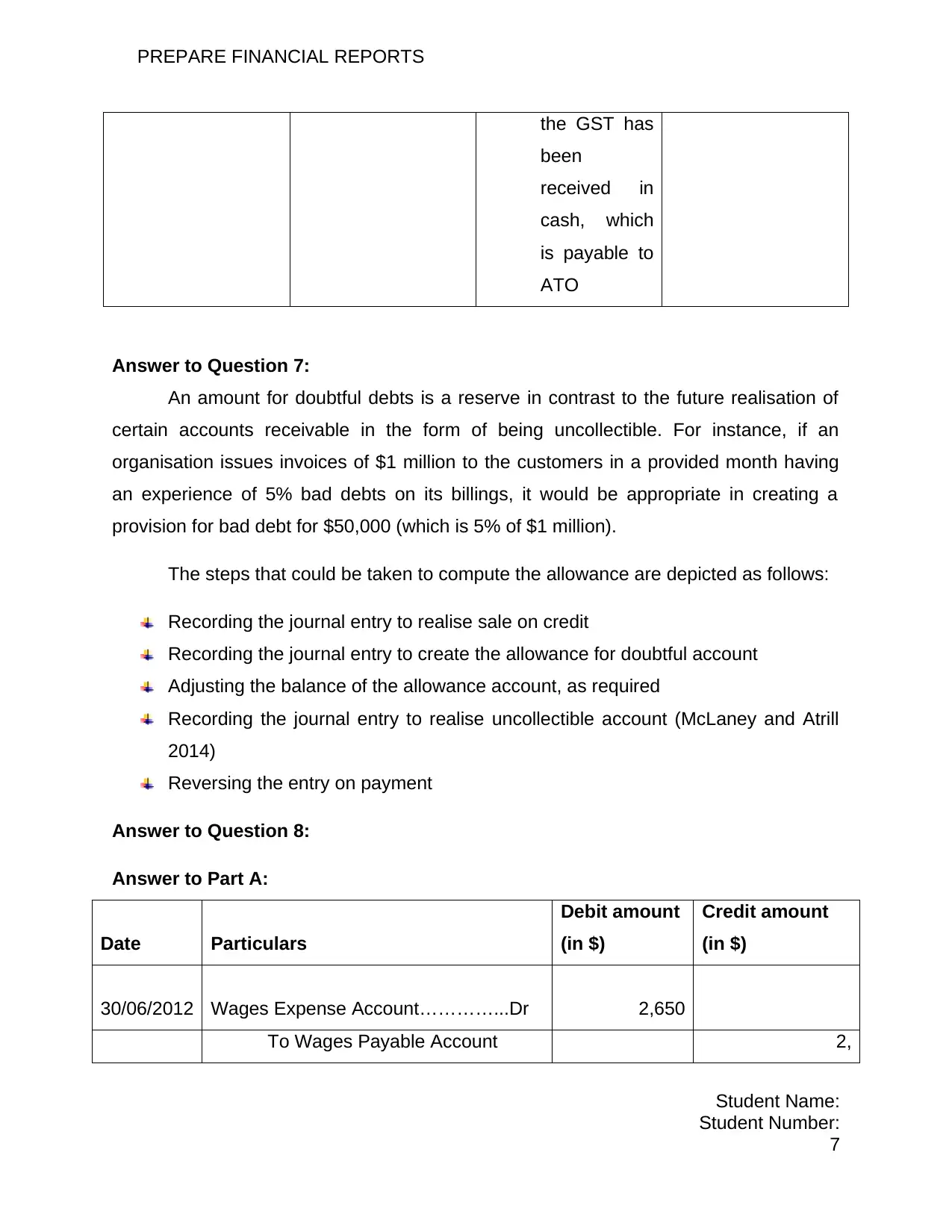
the GST has
been
received in
cash, which
is payable to
ATO
Answer to Question 7:
An amount for doubtful debts is a reserve in contrast to the future realisation of
certain accounts receivable in the form of being uncollectible. For instance, if an
organisation issues invoices of $1 million to the customers in a provided month having
an experience of 5% bad debts on its billings, it would be appropriate in creating a
provision for bad debt for $50,000 (which is 5% of $1 million).
The steps that could be taken to compute the allowance are depicted as follows:
Recording the journal entry to realise sale on credit
Recording the journal entry to create the allowance for doubtful account
Adjusting the balance of the allowance account, as required
Recording the journal entry to realise uncollectible account (McLaney and Atrill
2014)
Reversing the entry on payment
Answer to Question 8:
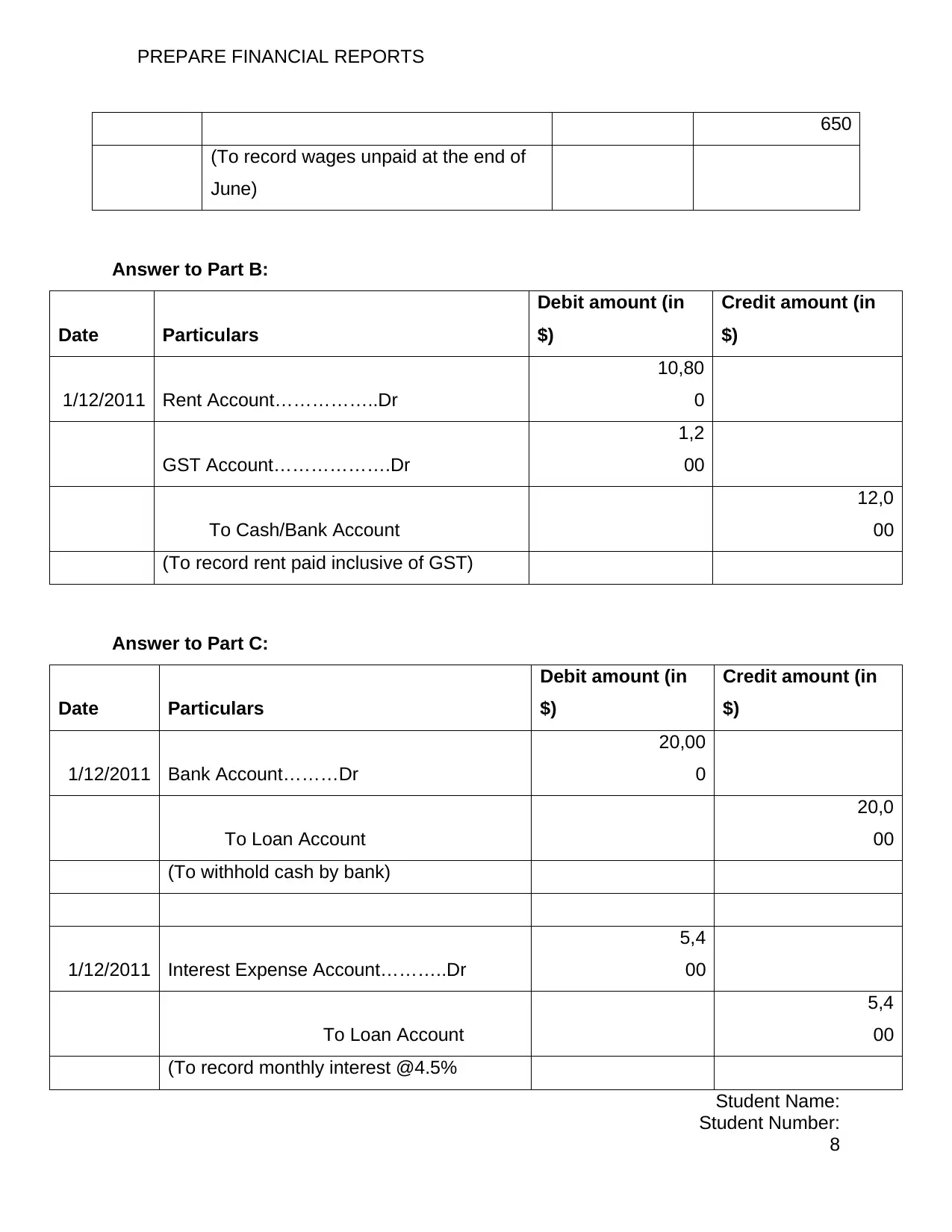
Answer to Part A:
Date Particulars
Debit amount
(in $)
Credit amount
(in $)
30/06/2012 Wages Expense Account…………...Dr 2,650
To Wages Payable Account 2,
Student Name:
Student Number:
7
the GST has
been
received in
cash, which
is payable to
ATO
Answer to Question 7:
An amount for doubtful debts is a reserve in contrast to the future realisation of
certain accounts receivable in the form of being uncollectible. For instance, if an
organisation issues invoices of $1 million to the customers in a provided month having
an experience of 5% bad debts on its billings, it would be appropriate in creating a
provision for bad debt for $50,000 (which is 5% of $1 million).
The steps that could be taken to compute the allowance are depicted as follows:
Recording the journal entry to realise sale on credit
Recording the journal entry to create the allowance for doubtful account
Adjusting the balance of the allowance account, as required
Recording the journal entry to realise uncollectible account (McLaney and Atrill
2014)
Reversing the entry on payment
Answer to Question 8:
Answer to Part A:
Date Particulars
Debit amount
(in $)
Credit amount
(in $)
30/06/2012 Wages Expense Account…………...Dr 2,650
To Wages Payable Account 2,
Student Name:
Student Number:
7
PREPARE FINANCIAL REPORTS
650
(To record wages unpaid at the end of
June)
Answer to Part B:
Date Particulars
Debit amount (in
$)
Credit amount (in
$)
1/12/2011 Rent Account……………..Dr
10,80
0
GST Account……………….Dr
1,2
00
To Cash/Bank Account
12,0
00
(To record rent paid inclusive of GST)
Answer to Part C:
Date Particulars
Debit amount (in
$)
Credit amount (in
$)
1/12/2011 Bank Account………Dr
20,00
0
To Loan Account
20,0
00
(To withhold cash by bank)
1/12/2011 Interest Expense Account………..Dr
5,4
00
To Loan Account
5,4
00
(To record monthly interest @4.5%
Student Name:
Student Number:
8
650
(To record wages unpaid at the end of
June)
Answer to Part B:
Date Particulars
Debit amount (in
$)
Credit amount (in
$)
1/12/2011 Rent Account……………..Dr
10,80
0
GST Account……………….Dr
1,2
00
To Cash/Bank Account
12,0
00
(To record rent paid inclusive of GST)
Answer to Part C:
Date Particulars
Debit amount (in
$)
Credit amount (in
$)
1/12/2011 Bank Account………Dr
20,00
0
To Loan Account
20,0
00
(To withhold cash by bank)
1/12/2011 Interest Expense Account………..Dr
5,4
00
To Loan Account
5,4
00
(To record monthly interest @4.5%
Student Name:
Student Number:
8
⊘ This is a preview!⊘
Do you want full access?
Subscribe today to unlock all pages.
Trusted by 1+ million students worldwide
PREPARE FINANCIAL REPORTS
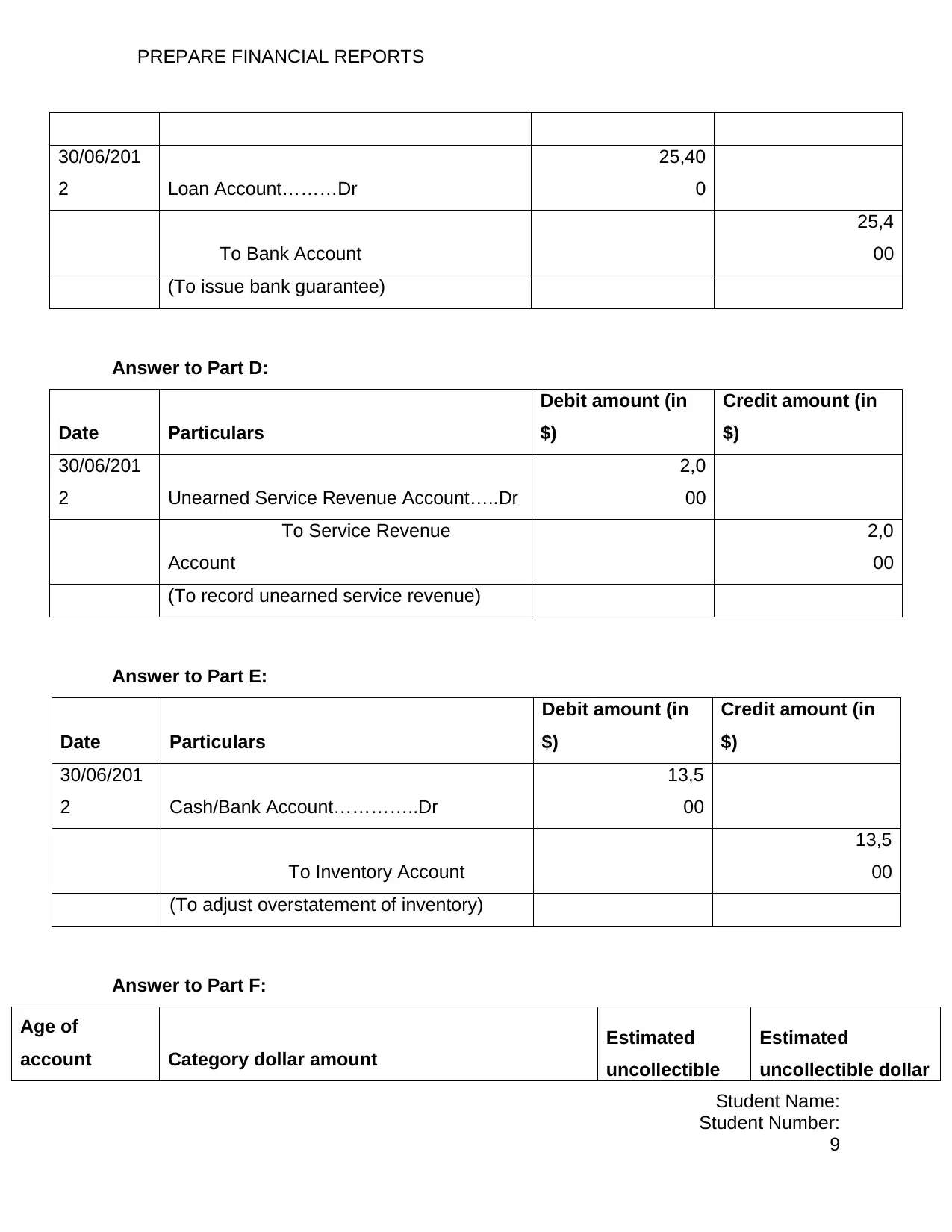
30/06/201
2 Loan Account………Dr
25,40
0
To Bank Account
25,4
00
(To issue bank guarantee)
Answer to Part D:
Date Particulars
Debit amount (in
$)
Credit amount (in
$)
30/06/201
2 Unearned Service Revenue Account…..Dr
2,0
00
To Service Revenue
Account
2,0
00
(To record unearned service revenue)
Answer to Part E:
Date Particulars
Debit amount (in
$)
Credit amount (in
$)
30/06/201
2 Cash/Bank Account…………..Dr
13,5
00
To Inventory Account
13,5
00
(To adjust overstatement of inventory)
Answer to Part F:
Age of
account Category dollar amount
Estimated
uncollectible
Estimated
uncollectible dollar
Student Name:
Student Number:
9
30/06/201
2 Loan Account………Dr
25,40
0
To Bank Account
25,4
00
(To issue bank guarantee)
Answer to Part D:
Date Particulars
Debit amount (in
$)
Credit amount (in
$)
30/06/201
2 Unearned Service Revenue Account…..Dr
2,0
00
To Service Revenue
Account
2,0
00
(To record unearned service revenue)
Answer to Part E:
Date Particulars
Debit amount (in
$)
Credit amount (in
$)
30/06/201
2 Cash/Bank Account…………..Dr
13,5
00
To Inventory Account
13,5
00
(To adjust overstatement of inventory)
Answer to Part F:
Age of
account Category dollar amount
Estimated
uncollectible
Estimated
uncollectible dollar
Student Name:
Student Number:
9
Paraphrase This Document
Need a fresh take? Get an instant paraphrase of this document with our AI Paraphraser
PREPARE FINANCIAL REPORTS
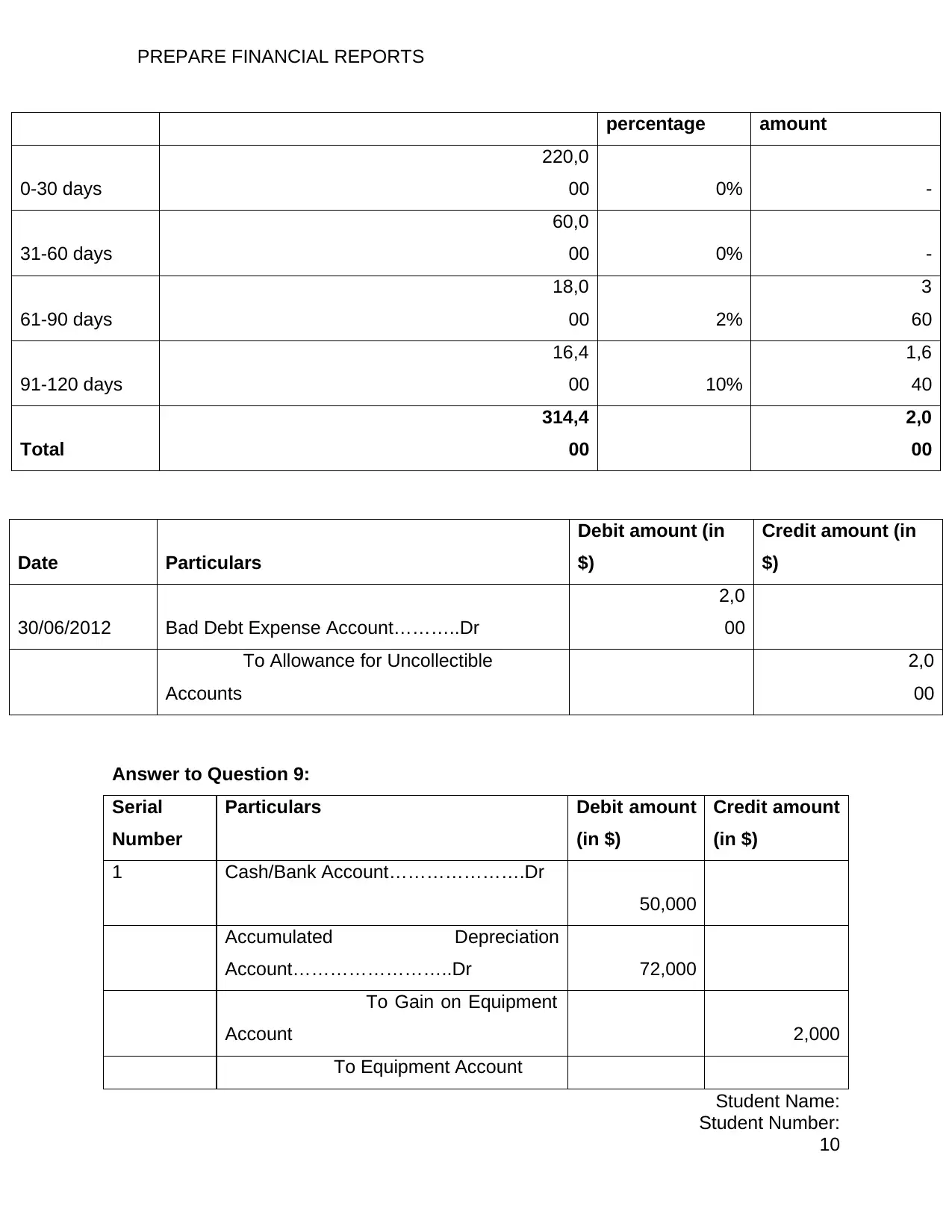
percentage amount
0-30 days
220,0
00 0% -
31-60 days
60,0
00 0% -
61-90 days
18,0
00 2%
3
60
91-120 days
16,4
00 10%
1,6
40
Total
314,4
00
2,0
00
Date Particulars
Debit amount (in
$)
Credit amount (in
$)
30/06/2012 Bad Debt Expense Account………..Dr
2,0
00
To Allowance for Uncollectible
Accounts
2,0
00
Answer to Question 9:
Serial
Number
Particulars Debit amount
(in $)
Credit amount
(in $)
1 Cash/Bank Account………………….Dr
50,000
Accumulated Depreciation
Account……………………..Dr 72,000
To Gain on Equipment
Account 2,000
To Equipment Account
Student Name:
Student Number:
10
percentage amount
0-30 days
220,0
00 0% -
31-60 days
60,0
00 0% -
61-90 days
18,0
00 2%
3
60
91-120 days
16,4
00 10%
1,6
40
Total
314,4
00
2,0
00
Date Particulars
Debit amount (in
$)
Credit amount (in
$)
30/06/2012 Bad Debt Expense Account………..Dr
2,0
00
To Allowance for Uncollectible
Accounts
2,0
00
Answer to Question 9:
Serial
Number
Particulars Debit amount
(in $)
Credit amount
(in $)
1 Cash/Bank Account………………….Dr
50,000
Accumulated Depreciation
Account……………………..Dr 72,000
To Gain on Equipment
Account 2,000
To Equipment Account
Student Name:
Student Number:
10
PREPARE FINANCIAL REPORTS
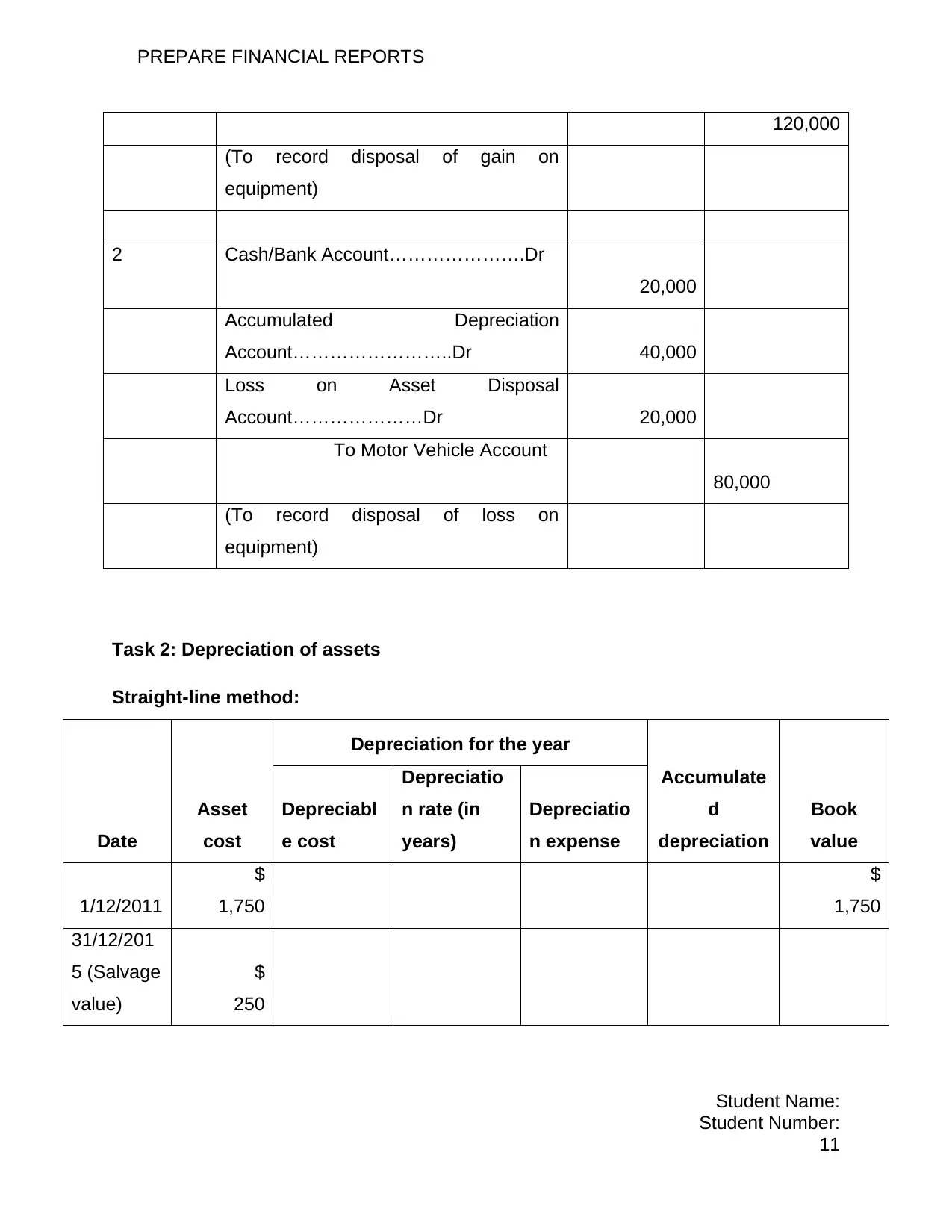
120,000
(To record disposal of gain on
equipment)
2 Cash/Bank Account………………….Dr
20,000
Accumulated Depreciation
Account……………………..Dr 40,000
Loss on Asset Disposal
Account…………………Dr 20,000
To Motor Vehicle Account
80,000
(To record disposal of loss on
equipment)
Task 2: Depreciation of assets
Straight-line method:
Date
Asset
cost
Depreciation for the year
Accumulate
d
depreciation
Book
value
Depreciabl
e cost
Depreciatio
n rate (in
years)
Depreciatio
n expense
1/12/2011
$
1,750
$
1,750
31/12/201
5 (Salvage
value)
$
250
Student Name:
Student Number:
11
120,000
(To record disposal of gain on
equipment)
2 Cash/Bank Account………………….Dr
20,000
Accumulated Depreciation
Account……………………..Dr 40,000
Loss on Asset Disposal
Account…………………Dr 20,000
To Motor Vehicle Account
80,000
(To record disposal of loss on
equipment)
Task 2: Depreciation of assets
Straight-line method:
Date
Asset
cost
Depreciation for the year
Accumulate
d
depreciation
Book
value
Depreciabl
e cost
Depreciatio
n rate (in
years)
Depreciatio
n expense
1/12/2011
$
1,750
$
1,750
31/12/201
5 (Salvage
value)
$
250
Student Name:
Student Number:
11
⊘ This is a preview!⊘
Do you want full access?
Subscribe today to unlock all pages.
Trusted by 1+ million students worldwide

1 out of 14


Related Documents


Your All-in-One AI-Powered Toolkit for Academic Success.
+13062052269
info@desklib.com
Available 24*7 on WhatsApp / Email
![[object Object]](/_next/static/media/star-bottom.7253800d.svg)
Unlock your academic potential
Copyright © 2020–2026 A2Z Services. All Rights Reserved. Developed and managed by ZUCOL.