Green Building: System Science and Engineering Report for University
VerifiedAdded on 2023/06/05
|12
|2640
|239
Report
AI Summary
This report delves into the realm of green building, commencing with an introduction that outlines the significance of sustainable construction and its role in urban development. It analyzes the needs and requirements for green buildings, emphasizing their potential to mitigate environmental challenges. The report progresses to preliminary and detailed design phases, proposing models for energy-efficient buildings and incorporating renewable energy sources like solar panels and wind energy. Detailed designs showcase smart technologies such as energy-efficient windows, rainwater harvesting, and the integration of IoT devices. The report also addresses system testing, evaluation, validation, and optimization processes, referencing international standards and indices like GBI. Evaluation criteria, including energy and water efficiency, material use, indoor environment quality, sustainable site planning, and innovation, are thoroughly examined. The report concludes by summarizing the benefits of green buildings, not only for the environment but also for project owners, highlighting the importance of achieving green status through rigorous evaluation, testing, and validation. This report is designed to give students a detailed understanding of green building practices.
Running head: SYSTEM SCIENCE AND ENGINEERING: GREEN BUILDING
System Science and Engineering: Green Building
Name of the Student
Name of the University
Author Note
System Science and Engineering: Green Building
Name of the Student
Name of the University
Author Note

Paraphrase This Document
Need a fresh take? Get an instant paraphrase of this document with our AI Paraphraser
1
SYSTEM SCIENCE AND ENGINEERING: GREEN BUILDING
Table of Contents
Introduction................................................................................................................................2
Preliminary Design.....................................................................................................................3
Detailed Design..........................................................................................................................4
System test, evaluation, validation and optimisation processes.................................................6
Evaluation..................................................................................................................................8
Conclusion..................................................................................................................................9
References................................................................................................................................11
SYSTEM SCIENCE AND ENGINEERING: GREEN BUILDING
Table of Contents
Introduction................................................................................................................................2
Preliminary Design.....................................................................................................................3
Detailed Design..........................................................................................................................4
System test, evaluation, validation and optimisation processes.................................................6
Evaluation..................................................................................................................................8
Conclusion..................................................................................................................................9
References................................................................................................................................11
2
SYSTEM SCIENCE AND ENGINEERING: GREEN BUILDING
Introduction
Previous assignment focused on the concepts and basics related to the model and
design of the green building through analysing the concepts related to the development of the
green building. The paper introduces the analysis of the needs and requirements of the green
building and how it could possibly contribute in the future growth and development of the
cities. The ecofriendly environment and the buildings could be the solution of the increasing
population and pollution. The needs and requirement definition explain the basic needs of the
green building for the society and how it contributes in the development and growth of the
society. It contributed in the development of the strategies that could comply with the basic
needs and requirements of the society and the individuals living in that world. Previous
assignment introduces the concept for which the green building would be necessary building
for the future development and the needs and requirements of the users and the society. The
system design analysis introduces the barrier to the current development of the green
buildings and how the strategies should be adopted for the development of such buildings
those could contribute in the growth and development of the society.
The second section of the previous paper introduces the system design those needs to
be considered as per the identified needs and required for the successful and efficient
establishment of the green buildings. It contributed in the analysis of the behaviour and
structure of the buildings and how these contribute in the future sustainability. It also
contributes in the development of the strategies those could contribute in the development of
the strategies those are specific towards achieving the goals and objectives for the targeted
users. The proposed conceptual design of the proposed project was helpful in analysing the
concepts those need to be considered for the development of this project. An analysis was
also executed considering the analysis of the effectiveness and reliability of the proposed
SYSTEM SCIENCE AND ENGINEERING: GREEN BUILDING
Introduction
Previous assignment focused on the concepts and basics related to the model and
design of the green building through analysing the concepts related to the development of the
green building. The paper introduces the analysis of the needs and requirements of the green
building and how it could possibly contribute in the future growth and development of the
cities. The ecofriendly environment and the buildings could be the solution of the increasing
population and pollution. The needs and requirement definition explain the basic needs of the
green building for the society and how it contributes in the development and growth of the
society. It contributed in the development of the strategies that could comply with the basic
needs and requirements of the society and the individuals living in that world. Previous
assignment introduces the concept for which the green building would be necessary building
for the future development and the needs and requirements of the users and the society. The
system design analysis introduces the barrier to the current development of the green
buildings and how the strategies should be adopted for the development of such buildings
those could contribute in the growth and development of the society.
The second section of the previous paper introduces the system design those needs to
be considered as per the identified needs and required for the successful and efficient
establishment of the green buildings. It contributed in the analysis of the behaviour and
structure of the buildings and how these contribute in the future sustainability. It also
contributes in the development of the strategies those could contribute in the development of
the strategies those are specific towards achieving the goals and objectives for the targeted
users. The proposed conceptual design of the proposed project was helpful in analysing the
concepts those need to be considered for the development of this project. An analysis was
also executed considering the analysis of the effectiveness and reliability of the proposed
⊘ This is a preview!⊘
Do you want full access?
Subscribe today to unlock all pages.

Trusted by 1+ million students worldwide
3
SYSTEM SCIENCE AND ENGINEERING: GREEN BUILDING
project and how much effective could these be in the growth and development of the user
community.
Preliminary Design
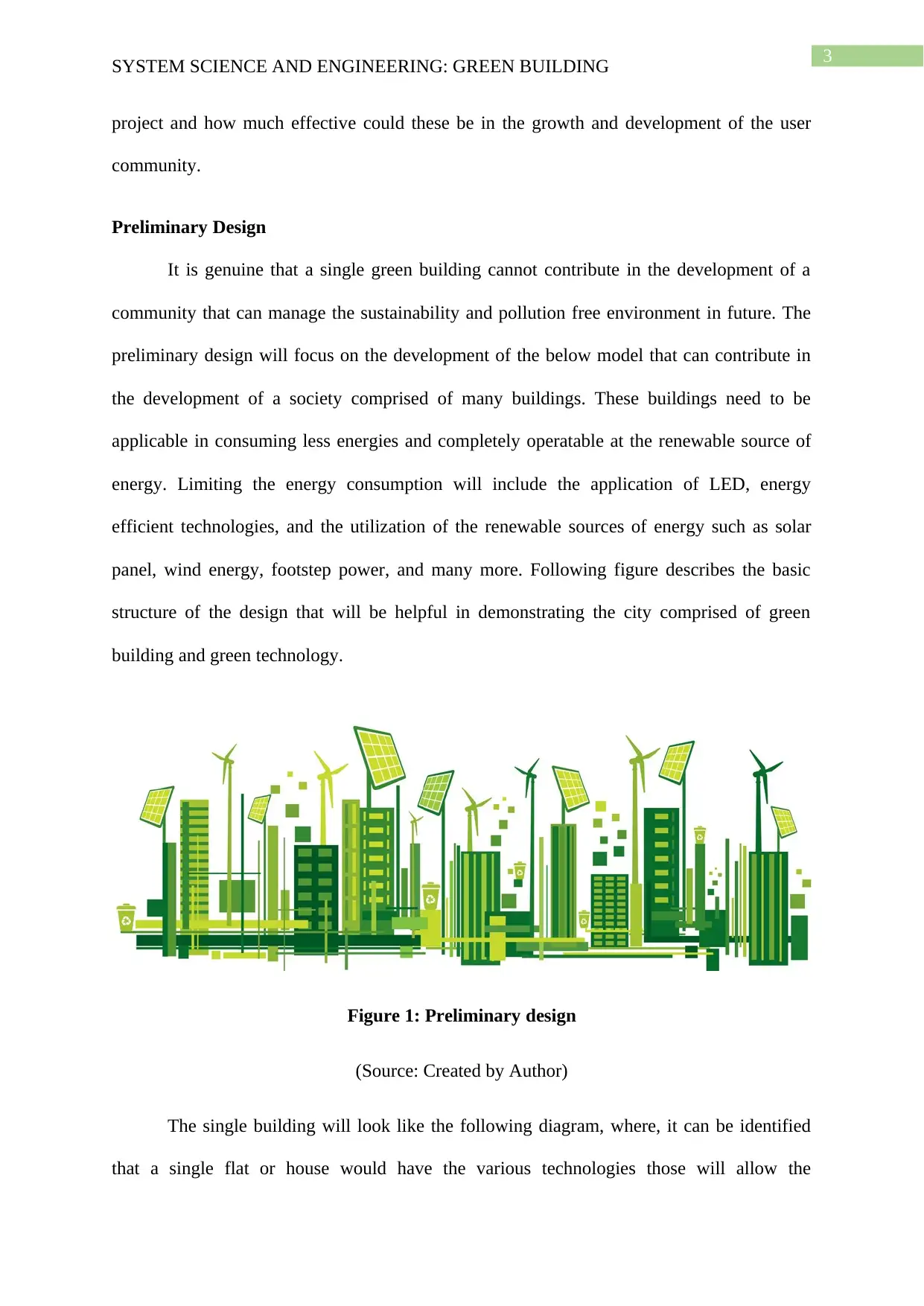
It is genuine that a single green building cannot contribute in the development of a
community that can manage the sustainability and pollution free environment in future. The
preliminary design will focus on the development of the below model that can contribute in
the development of a society comprised of many buildings. These buildings need to be
applicable in consuming less energies and completely operatable at the renewable source of
energy. Limiting the energy consumption will include the application of LED, energy
efficient technologies, and the utilization of the renewable sources of energy such as solar
panel, wind energy, footstep power, and many more. Following figure describes the basic
structure of the design that will be helpful in demonstrating the city comprised of green
building and green technology.
Figure 1: Preliminary design
(Source: Created by Author)
The single building will look like the following diagram, where, it can be identified
that a single flat or house would have the various technologies those will allow the
SYSTEM SCIENCE AND ENGINEERING: GREEN BUILDING
project and how much effective could these be in the growth and development of the user
community.
Preliminary Design
It is genuine that a single green building cannot contribute in the development of a
community that can manage the sustainability and pollution free environment in future. The
preliminary design will focus on the development of the below model that can contribute in
the development of a society comprised of many buildings. These buildings need to be
applicable in consuming less energies and completely operatable at the renewable source of
energy. Limiting the energy consumption will include the application of LED, energy
efficient technologies, and the utilization of the renewable sources of energy such as solar
panel, wind energy, footstep power, and many more. Following figure describes the basic
structure of the design that will be helpful in demonstrating the city comprised of green
building and green technology.
Figure 1: Preliminary design
(Source: Created by Author)
The single building will look like the following diagram, where, it can be identified
that a single flat or house would have the various technologies those will allow the
Paraphrase This Document
Need a fresh take? Get an instant paraphrase of this document with our AI Paraphraser
4
SYSTEM SCIENCE AND ENGINEERING: GREEN BUILDING
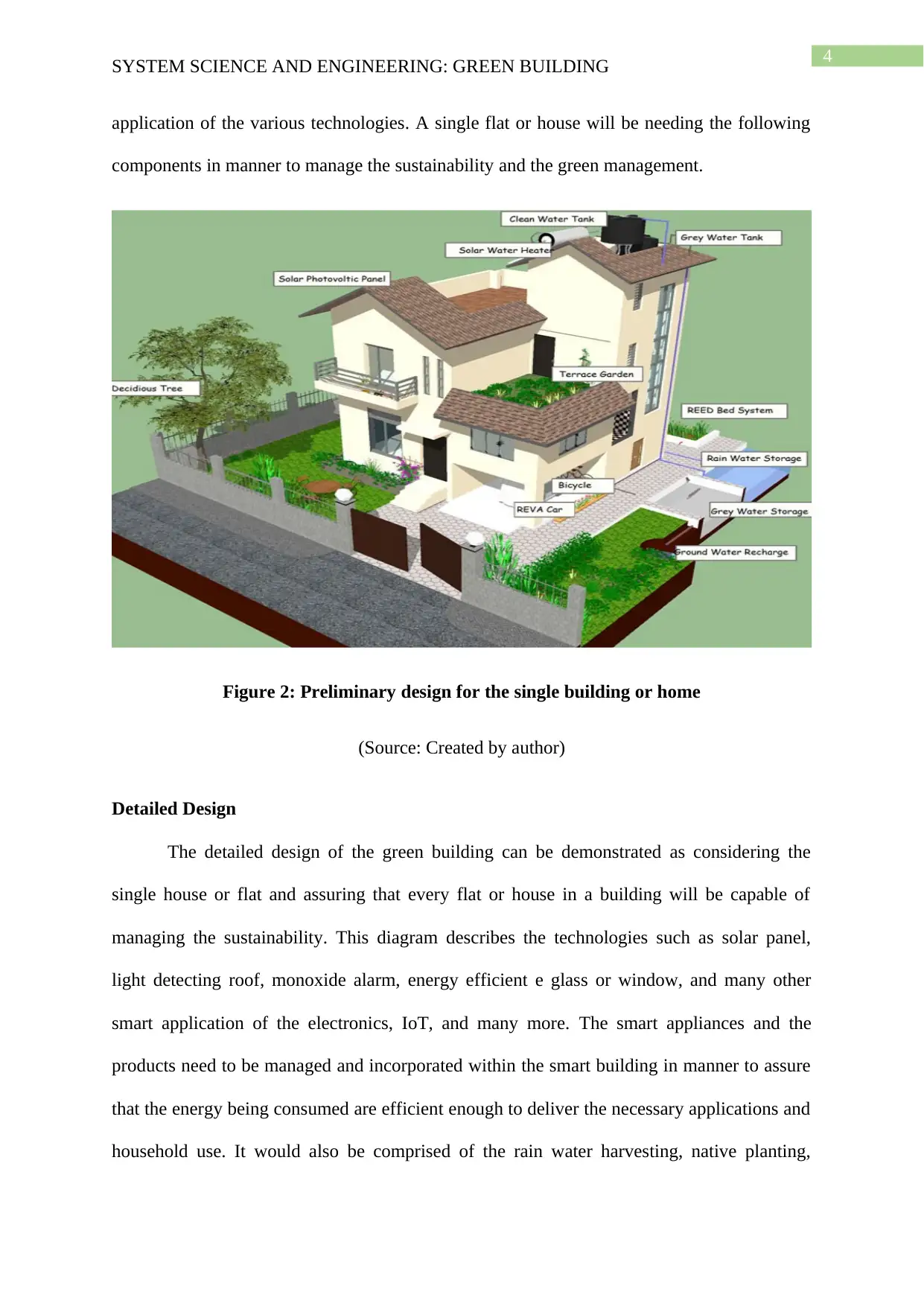
application of the various technologies. A single flat or house will be needing the following
components in manner to manage the sustainability and the green management.
Figure 2: Preliminary design for the single building or home
(Source: Created by author)
Detailed Design
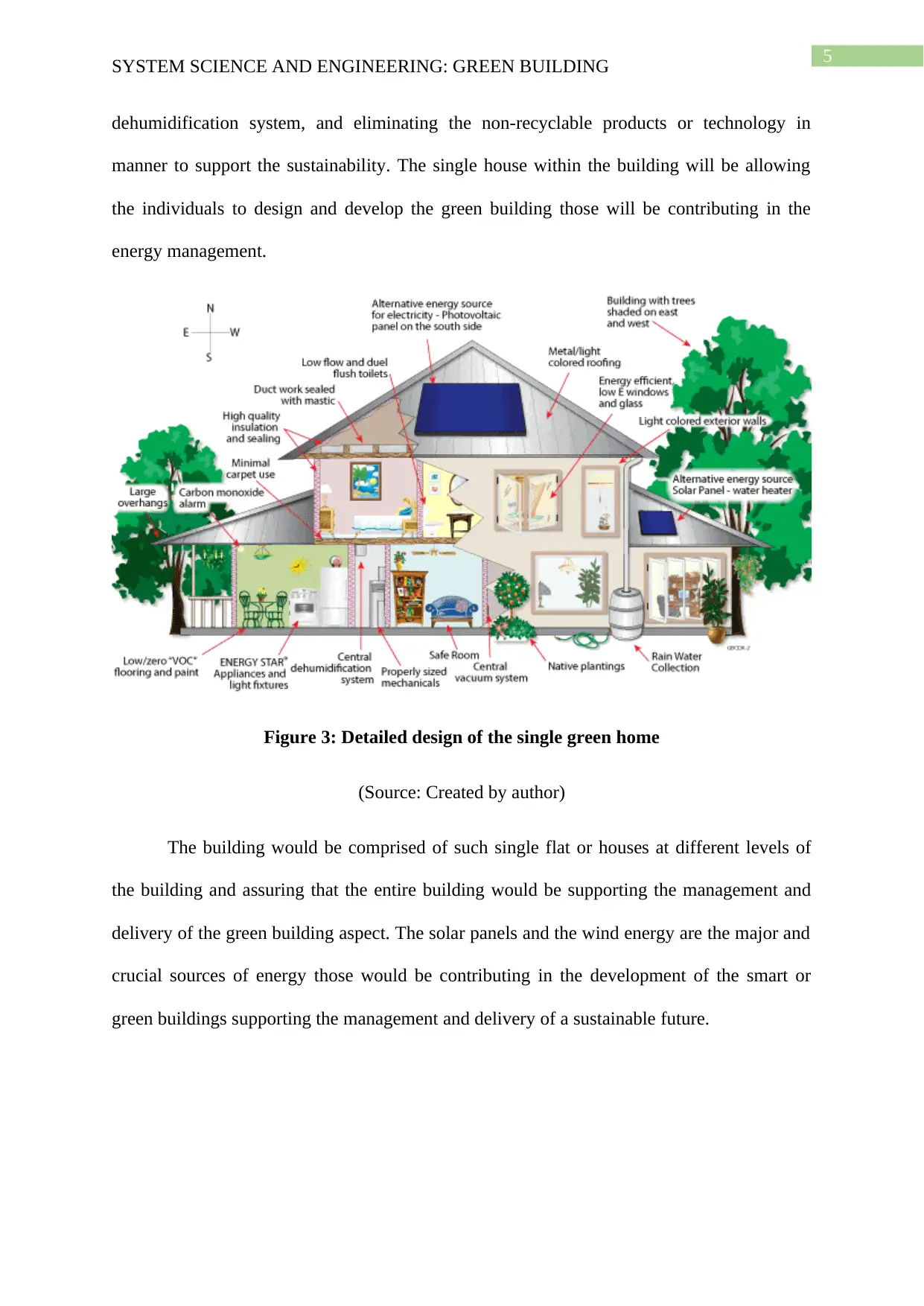
The detailed design of the green building can be demonstrated as considering the
single house or flat and assuring that every flat or house in a building will be capable of
managing the sustainability. This diagram describes the technologies such as solar panel,
light detecting roof, monoxide alarm, energy efficient e glass or window, and many other
smart application of the electronics, IoT, and many more. The smart appliances and the
products need to be managed and incorporated within the smart building in manner to assure
that the energy being consumed are efficient enough to deliver the necessary applications and
household use. It would also be comprised of the rain water harvesting, native planting,
SYSTEM SCIENCE AND ENGINEERING: GREEN BUILDING
application of the various technologies. A single flat or house will be needing the following
components in manner to manage the sustainability and the green management.
Figure 2: Preliminary design for the single building or home
(Source: Created by author)
Detailed Design
The detailed design of the green building can be demonstrated as considering the
single house or flat and assuring that every flat or house in a building will be capable of
managing the sustainability. This diagram describes the technologies such as solar panel,
light detecting roof, monoxide alarm, energy efficient e glass or window, and many other
smart application of the electronics, IoT, and many more. The smart appliances and the
products need to be managed and incorporated within the smart building in manner to assure
that the energy being consumed are efficient enough to deliver the necessary applications and
household use. It would also be comprised of the rain water harvesting, native planting,
5
SYSTEM SCIENCE AND ENGINEERING: GREEN BUILDING
dehumidification system, and eliminating the non-recyclable products or technology in
manner to support the sustainability. The single house within the building will be allowing
the individuals to design and develop the green building those will be contributing in the
energy management.
Figure 3: Detailed design of the single green home
(Source: Created by author)
The building would be comprised of such single flat or houses at different levels of
the building and assuring that the entire building would be supporting the management and
delivery of the green building aspect. The solar panels and the wind energy are the major and
crucial sources of energy those would be contributing in the development of the smart or
green buildings supporting the management and delivery of a sustainable future.
SYSTEM SCIENCE AND ENGINEERING: GREEN BUILDING
dehumidification system, and eliminating the non-recyclable products or technology in
manner to support the sustainability. The single house within the building will be allowing
the individuals to design and develop the green building those will be contributing in the
energy management.
Figure 3: Detailed design of the single green home
(Source: Created by author)
The building would be comprised of such single flat or houses at different levels of
the building and assuring that the entire building would be supporting the management and
delivery of the green building aspect. The solar panels and the wind energy are the major and
crucial sources of energy those would be contributing in the development of the smart or
green buildings supporting the management and delivery of a sustainable future.
⊘ This is a preview!⊘
Do you want full access?
Subscribe today to unlock all pages.
Trusted by 1+ million students worldwide
6
SYSTEM SCIENCE AND ENGINEERING: GREEN BUILDING
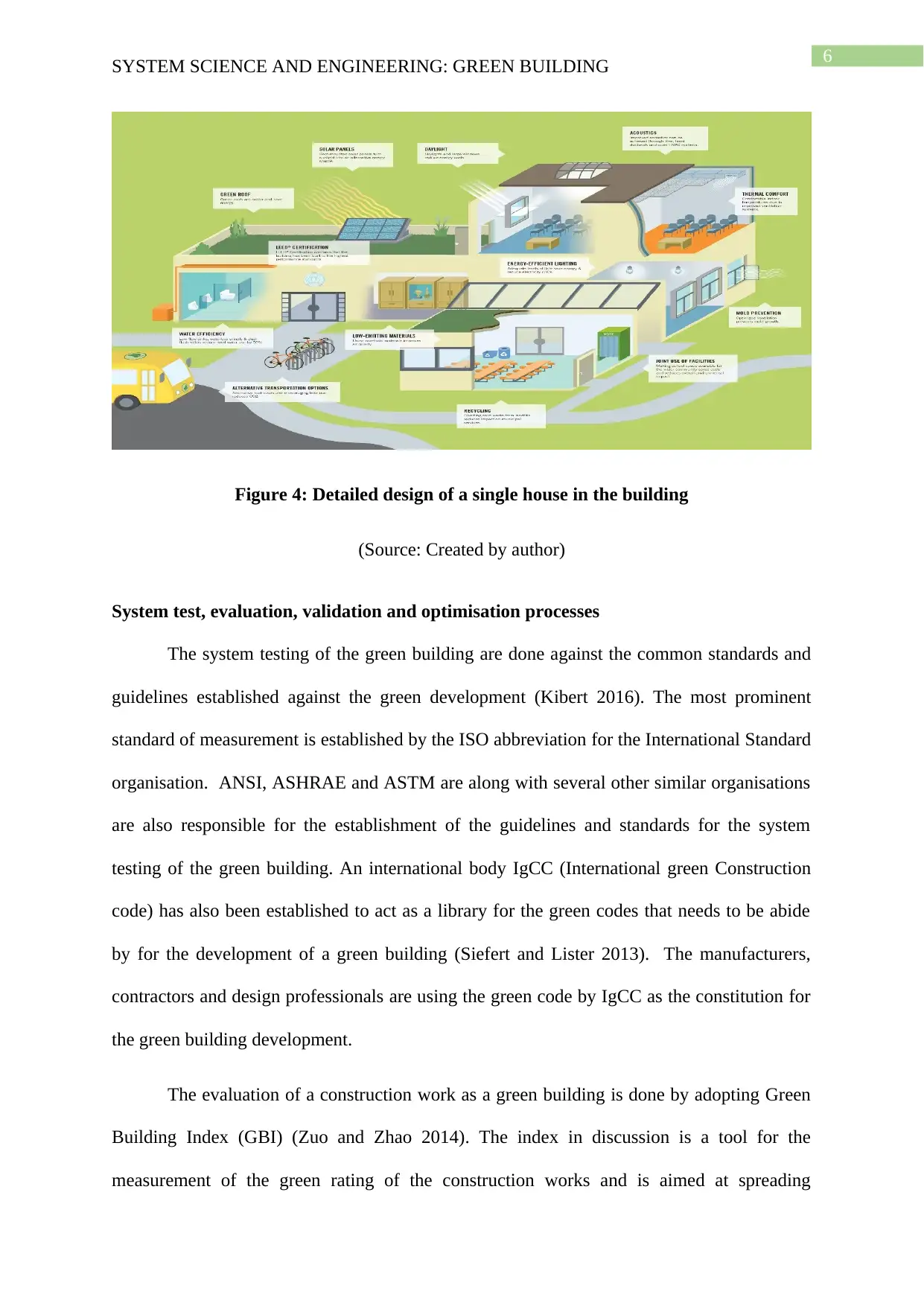
Figure 4: Detailed design of a single house in the building
(Source: Created by author)
System test, evaluation, validation and optimisation processes
The system testing of the green building are done against the common standards and
guidelines established against the green development (Kibert 2016). The most prominent
standard of measurement is established by the ISO abbreviation for the International Standard
organisation. ANSI, ASHRAE and ASTM are along with several other similar organisations
are also responsible for the establishment of the guidelines and standards for the system
testing of the green building. An international body IgCC (International green Construction
code) has also been established to act as a library for the green codes that needs to be abide
by for the development of a green building (Siefert and Lister 2013). The manufacturers,
contractors and design professionals are using the green code by IgCC as the constitution for
the green building development.
The evaluation of a construction work as a green building is done by adopting Green
Building Index (GBI) (Zuo and Zhao 2014). The index in discussion is a tool for the
measurement of the green rating of the construction works and is aimed at spreading
SYSTEM SCIENCE AND ENGINEERING: GREEN BUILDING
Figure 4: Detailed design of a single house in the building
(Source: Created by author)
System test, evaluation, validation and optimisation processes
The system testing of the green building are done against the common standards and
guidelines established against the green development (Kibert 2016). The most prominent
standard of measurement is established by the ISO abbreviation for the International Standard
organisation. ANSI, ASHRAE and ASTM are along with several other similar organisations
are also responsible for the establishment of the guidelines and standards for the system
testing of the green building. An international body IgCC (International green Construction
code) has also been established to act as a library for the green codes that needs to be abide
by for the development of a green building (Siefert and Lister 2013). The manufacturers,
contractors and design professionals are using the green code by IgCC as the constitution for
the green building development.
The evaluation of a construction work as a green building is done by adopting Green
Building Index (GBI) (Zuo and Zhao 2014). The index in discussion is a tool for the
measurement of the green rating of the construction works and is aimed at spreading
Paraphrase This Document
Need a fresh take? Get an instant paraphrase of this document with our AI Paraphraser
7
SYSTEM SCIENCE AND ENGINEERING: GREEN BUILDING
awareness about the sustainable development among the Engineers, Architects, planners and
other crucial contracting entities. The index in discussion believes that it is the responsibility
of the current generation to leave a green future for the next generation. Along with the
guidelines it also offers methods and technologies that can be adopted to attain the discussed
measures. The index in discussion measures a project against six criteria to offer a green
rating. The criteria include, energy efficiency, water efficiency, material & resources, indoor
environment quality, sustainable site planning & management and innovation used. The
discussed criteria are adopted to cite the green rating of the project.
The validation for the green project is offered by different bodies in different regions
around the world. Green star is the body that is responsible for offering the green rating to a
project in Australia. Along with the Green star several other private entities are also available
that offer green rating to a project or product (Xia et al. 2013). Furthermore, the project
certification is given in different categories such as energy star for energy efficiency,
waterSense for water efficiency, forest stewardship council for forest and forest products and
many others.
The aim of the green project is to offer an environment friendly offering as a final
delivery. In case of the green buildings the environment friendly offerings can be offered
only if the building is low carbon emitting in nature. Low carbon emission can be attained by
ensuring that the electricity used by the building and for the building are used with adequacy
and efficiency (Ng, Chen and Wong 2013). It can be attained by adopting energy efficient
measures such as use of eco-friendly materials for construction, having reduced water
consumption so that heat can be reduced. Use of appropriate number of windows and
ventilation for escaping of the heat, dust and other gases also supports in offering energy
efficiency. Water efficiency, sustainable design and similarly many other measures can be
adopted that are capable of optimising the use of resources both pre and post development of
SYSTEM SCIENCE AND ENGINEERING: GREEN BUILDING
awareness about the sustainable development among the Engineers, Architects, planners and
other crucial contracting entities. The index in discussion believes that it is the responsibility
of the current generation to leave a green future for the next generation. Along with the
guidelines it also offers methods and technologies that can be adopted to attain the discussed
measures. The index in discussion measures a project against six criteria to offer a green
rating. The criteria include, energy efficiency, water efficiency, material & resources, indoor
environment quality, sustainable site planning & management and innovation used. The
discussed criteria are adopted to cite the green rating of the project.
The validation for the green project is offered by different bodies in different regions
around the world. Green star is the body that is responsible for offering the green rating to a
project in Australia. Along with the Green star several other private entities are also available
that offer green rating to a project or product (Xia et al. 2013). Furthermore, the project
certification is given in different categories such as energy star for energy efficiency,
waterSense for water efficiency, forest stewardship council for forest and forest products and
many others.
The aim of the green project is to offer an environment friendly offering as a final
delivery. In case of the green buildings the environment friendly offerings can be offered
only if the building is low carbon emitting in nature. Low carbon emission can be attained by
ensuring that the electricity used by the building and for the building are used with adequacy
and efficiency (Ng, Chen and Wong 2013). It can be attained by adopting energy efficient
measures such as use of eco-friendly materials for construction, having reduced water
consumption so that heat can be reduced. Use of appropriate number of windows and
ventilation for escaping of the heat, dust and other gases also supports in offering energy
efficiency. Water efficiency, sustainable design and similarly many other measures can be
adopted that are capable of optimising the use of resources both pre and post development of
8
SYSTEM SCIENCE AND ENGINEERING: GREEN BUILDING
the green buildings. Innovative tools and technologies can also be adopted to support the
cause of optimisation of resource utilisation that are harmful to the environment.
Evaluation
As discussed above the evaluation of a green construction is done based on 6 different
criteria. Each criterion is calculated individually and then they are integrated together to offer
a rating to a system. Hence the evaluation of the sustainability of a green building needs to be
done based on the same criterions.
Energy efficiency: It defines the efficiency of energy that is offered by the building
(Aligaha et al. 2013). The green building will be ensuring the efficient application of the
energy being utilized for the development and growth of a sustainable society.
Water efficiency: It reflects the consumption of water that had been done while the
construction of the building (Eichholtz, Kok and Quigley 2013). The water consumption is
another major component while contributing in a pollution free and sustainable environment.
The rain water harvesting and the application of saline water would be efficient enough for
the management and delivery of the respective project.
Material & resources: It defines the use of the eco-friendly materials and resources for the
development of the building. The mostly contributing resources would be IoT and electronic
components in manner to support the efficient energy usage and maximum efficiency of
output.
Indoor environment quality: Indoor environment quality is crucial because it impacts the
energy, water and other consumable resources efficiency and hence it is assessed. For a
healthy environment monoxide level detection systems, less carpet usage of renewable
sources are another major requirements those need to be incorporated within the building.
SYSTEM SCIENCE AND ENGINEERING: GREEN BUILDING
the green buildings. Innovative tools and technologies can also be adopted to support the
cause of optimisation of resource utilisation that are harmful to the environment.
Evaluation
As discussed above the evaluation of a green construction is done based on 6 different
criteria. Each criterion is calculated individually and then they are integrated together to offer
a rating to a system. Hence the evaluation of the sustainability of a green building needs to be
done based on the same criterions.
Energy efficiency: It defines the efficiency of energy that is offered by the building
(Aligaha et al. 2013). The green building will be ensuring the efficient application of the
energy being utilized for the development and growth of a sustainable society.
Water efficiency: It reflects the consumption of water that had been done while the
construction of the building (Eichholtz, Kok and Quigley 2013). The water consumption is
another major component while contributing in a pollution free and sustainable environment.
The rain water harvesting and the application of saline water would be efficient enough for
the management and delivery of the respective project.
Material & resources: It defines the use of the eco-friendly materials and resources for the
development of the building. The mostly contributing resources would be IoT and electronic
components in manner to support the efficient energy usage and maximum efficiency of
output.
Indoor environment quality: Indoor environment quality is crucial because it impacts the
energy, water and other consumable resources efficiency and hence it is assessed. For a
healthy environment monoxide level detection systems, less carpet usage of renewable
sources are another major requirements those need to be incorporated within the building.
⊘ This is a preview!⊘
Do you want full access?
Subscribe today to unlock all pages.
Trusted by 1+ million students worldwide
9
SYSTEM SCIENCE AND ENGINEERING: GREEN BUILDING
Sustainable site planning & management: The planning and management of the site should
be sustainable in nature (Yusoff and Wen 2014). This will mainly focus on the application of
the renewable products and the energy efficient procedures in manner to support the growth
and development of the sustainable future.
Innovation: The use of innovation should have been done to mitigate the non-eco-friendly
measures. This innovation if implemented, within the entire world the pollution level can be
restricted to zero.
The above aspects will be helpful in identifying that the proposed solution would be
helpful in assuring the management and delivery of a sustainable future. The reliability of
such buildings could be effective enough for the management and delivery of the sustainable
future.
Conclusion
The report can be summarised to state that green buildings are emerging as one of the
most prominent choice for the development of the buildings. The most prominent reason for
massive surge in the number of green building is the benefits that is offered by the subject to
the environment. However, the benefits of the green buildings are not limited to environment
but further extends to the project owners. Hence, the projects owners are of the attempting to
gain green status for their construction project. Attaining of the green status for a construction
project can only be attained when a project is evaluated and tested for the optimisation
measures it have adopted to attain green status after which it is validated as a green
construction. The paper has discussed all the aspects from evaluation to testing, optimisation
and validation in the process. The identification of the discussed factors has enabled in
understanding of the key requirements of a green building. The identified factors are the
energy efficiency, water efficiency, materials and resources used, indoor environment quality,
SYSTEM SCIENCE AND ENGINEERING: GREEN BUILDING
Sustainable site planning & management: The planning and management of the site should
be sustainable in nature (Yusoff and Wen 2014). This will mainly focus on the application of
the renewable products and the energy efficient procedures in manner to support the growth
and development of the sustainable future.
Innovation: The use of innovation should have been done to mitigate the non-eco-friendly
measures. This innovation if implemented, within the entire world the pollution level can be
restricted to zero.
The above aspects will be helpful in identifying that the proposed solution would be
helpful in assuring the management and delivery of a sustainable future. The reliability of
such buildings could be effective enough for the management and delivery of the sustainable
future.
Conclusion
The report can be summarised to state that green buildings are emerging as one of the
most prominent choice for the development of the buildings. The most prominent reason for
massive surge in the number of green building is the benefits that is offered by the subject to
the environment. However, the benefits of the green buildings are not limited to environment
but further extends to the project owners. Hence, the projects owners are of the attempting to
gain green status for their construction project. Attaining of the green status for a construction
project can only be attained when a project is evaluated and tested for the optimisation
measures it have adopted to attain green status after which it is validated as a green
construction. The paper has discussed all the aspects from evaluation to testing, optimisation
and validation in the process. The identification of the discussed factors has enabled in
understanding of the key requirements of a green building. The identified factors are the
energy efficiency, water efficiency, materials and resources used, indoor environment quality,
Paraphrase This Document
Need a fresh take? Get an instant paraphrase of this document with our AI Paraphraser
10
SYSTEM SCIENCE AND ENGINEERING: GREEN BUILDING
sustainable planning and site management and finally innovation used in the building. The
discussed actors need to be considered as the most crucial in the development of a green
building. A proper assessment of the discussed factor will earn the building a green validation
and will offer sustainability to the building associates. A diagram has also been attached with
the paper to cite the conceptual diagram of a green building. It has depicted different aspects
of the project in discussion and will also enable in ensuring that the aim of the paper is clear
and understandable to the readers. Hence, in conclusion the paper can be summarised to state
that green building is emerging as a major trend and it needs to be adopted with adequate
attention so that it can be leveraged by the owners.
SYSTEM SCIENCE AND ENGINEERING: GREEN BUILDING
sustainable planning and site management and finally innovation used in the building. The
discussed actors need to be considered as the most crucial in the development of a green
building. A proper assessment of the discussed factor will earn the building a green validation
and will offer sustainability to the building associates. A diagram has also been attached with
the paper to cite the conceptual diagram of a green building. It has depicted different aspects
of the project in discussion and will also enable in ensuring that the aim of the paper is clear
and understandable to the readers. Hence, in conclusion the paper can be summarised to state
that green building is emerging as a major trend and it needs to be adopted with adequate
attention so that it can be leveraged by the owners.
11
SYSTEM SCIENCE AND ENGINEERING: GREEN BUILDING
References
Aliagha, G.U., Hashim, M., Sanni, A.O. and Ali, K.N., 2013. Review of green building
demand factors for Malaysia. Journal of Energy Technologies and Policy, 3(11), pp.471-478.
Eichholtz, P., Kok, N. and Quigley, J.M., 2013. The economics of green building. Review of
Economics and Statistics, 95(1), pp.50-63.
Kibert, C.J., 2016. Sustainable construction: green building design and delivery. John Wiley
& Sons.
Ng, S.T., Chen, Y. and Wong, J.M., 2013. Variability of building environmental assessment
tools on evaluating carbon emissions. Environmental impact assessment review, 38, pp.131-
141.
Siefert, N.S. and Litster, S., 2013. Exergy and economic analyses of advanced IGCC–CCS
and IGFC–CCS power plants. Applied energy, 107, pp.315-328.
Xia, B., Zuo, J., Skitmore, M., Pullen, S. and Chen, Q., 2013. Green Star points obtained by
Australian building projects. Journal of Architectural Engineering, 19(4), pp.302-308.
Yusoff, W.Z.W. and Wen, W.R., 2014. Analysis of the international sustainable building
rating systems (SBRSS) for sustainable development with special focused on green building
index (GBI) malaysia. Journal of Environmental Conservation Research, 11, pp.11-26.
Zuo, J. and Zhao, Z.Y., 2014. Green building research–current status and future agenda: A
review. Renewable and sustainable energy reviews, 30, pp.271-281.
SYSTEM SCIENCE AND ENGINEERING: GREEN BUILDING
References
Aliagha, G.U., Hashim, M., Sanni, A.O. and Ali, K.N., 2013. Review of green building
demand factors for Malaysia. Journal of Energy Technologies and Policy, 3(11), pp.471-478.
Eichholtz, P., Kok, N. and Quigley, J.M., 2013. The economics of green building. Review of
Economics and Statistics, 95(1), pp.50-63.
Kibert, C.J., 2016. Sustainable construction: green building design and delivery. John Wiley
& Sons.
Ng, S.T., Chen, Y. and Wong, J.M., 2013. Variability of building environmental assessment
tools on evaluating carbon emissions. Environmental impact assessment review, 38, pp.131-
141.
Siefert, N.S. and Litster, S., 2013. Exergy and economic analyses of advanced IGCC–CCS
and IGFC–CCS power plants. Applied energy, 107, pp.315-328.
Xia, B., Zuo, J., Skitmore, M., Pullen, S. and Chen, Q., 2013. Green Star points obtained by
Australian building projects. Journal of Architectural Engineering, 19(4), pp.302-308.
Yusoff, W.Z.W. and Wen, W.R., 2014. Analysis of the international sustainable building
rating systems (SBRSS) for sustainable development with special focused on green building
index (GBI) malaysia. Journal of Environmental Conservation Research, 11, pp.11-26.
Zuo, J. and Zhao, Z.Y., 2014. Green building research–current status and future agenda: A
review. Renewable and sustainable energy reviews, 30, pp.271-281.
⊘ This is a preview!⊘
Do you want full access?
Subscribe today to unlock all pages.
Trusted by 1+ million students worldwide

1 out of 12


Related Documents


Your All-in-One AI-Powered Toolkit for Academic Success.
+13062052269
info@desklib.com
Available 24*7 on WhatsApp / Email
![[object Object]](/_next/static/media/star-bottom.7253800d.svg)
Unlock your academic potential
Copyright © 2020–2026 A2Z Services. All Rights Reserved. Developed and managed by ZUCOL.