Improving Student Retention: A Business Research Project
VerifiedAdded on 2023/01/18
|15
|4063
|69
Project
AI Summary
This business research project investigates student retention within higher education, specifically focusing on the University of London. The project begins with an introduction outlining the aims and objectives, which include understanding the concept of student retention, identifying challenges, and recommending strategies for improvement. A comprehensive literature review explores existing research on student retention, examining the concept itself, challenges such as cultural differences, changing values, and lack of innovation, and strategies for improvement like minute checks, social events, and innovative training sessions. The methodology and timeline for the research are also detailed. The research aims to provide insights and recommendations to improve student retention rates by addressing the various factors that influence students' decisions to stay or leave the university.

BUSINESS RESEARCH
PROJECT
PROJECT

Paraphrase This Document
Need a fresh take? Get an instant paraphrase of this document with our AI Paraphraser

Contents
INTRODUCTION...........................................................................................................................3
Aims and objectives...............................................................................................................3
LITERATURE REVIEW................................................................................................................4
RESEARCH METHODOLOY.......................................................................................................7
TIMELINE.......................................................................................................................................9
REFERENCES..............................................................................................................................12
INTRODUCTION...........................................................................................................................3
Aims and objectives...............................................................................................................3
LITERATURE REVIEW................................................................................................................4
RESEARCH METHODOLOY.......................................................................................................7
TIMELINE.......................................................................................................................................9
REFERENCES..............................................................................................................................12
INTRODUCTION
Background
In the current world the students are leaving the colleges even before completing their
degree or the course. Thus, it is very increasing that the student is leaving their colleges and
universities and this needs to be stopped (Stone, 2017). That is the reason behind the fact that
student retention is very necessary for the colleges and universities. Also, this is a major issue for
the parents of student also as they are also tensed for the career of their children. This is the main
reason underlying this research. The present research is based in University of London. This a
research university which is situated in London, England. This was established in the year 1836
by the Royal Charter as a degree providing examination board. The present research will outline
the different strategies which the University of London can use in order to retain the student
within the society for higher education.
Aims and objectives
Aims
“To investigate the ways of improving student retention within the higher education. A study on
University of London.”
Objective
To understand the concept of student retention.
To outline the challenges occurring at time of student retention
To identify the strategies for improving student retention for higher education. To recommend strategies to University of London for improving student retention.
Research question1. What is the concept of student retention?2. What are the different challenges faced at time of student retention?3. What are the different strategies adopted by university for retaining student?4. What is some recommendation for university to improve student retention?
Significance of study
The present study which is on improving the student retention in university is very
significant. This is because of the major reason that this is very helpful for the other universities
also who are facing the same problem of student retention. This is because of the reason that the
same strategies can also be applied in the other universities as well. Also, this research work is
Background
In the current world the students are leaving the colleges even before completing their
degree or the course. Thus, it is very increasing that the student is leaving their colleges and
universities and this needs to be stopped (Stone, 2017). That is the reason behind the fact that
student retention is very necessary for the colleges and universities. Also, this is a major issue for
the parents of student also as they are also tensed for the career of their children. This is the main
reason underlying this research. The present research is based in University of London. This a
research university which is situated in London, England. This was established in the year 1836
by the Royal Charter as a degree providing examination board. The present research will outline
the different strategies which the University of London can use in order to retain the student
within the society for higher education.
Aims and objectives
Aims
“To investigate the ways of improving student retention within the higher education. A study on
University of London.”
Objective
To understand the concept of student retention.
To outline the challenges occurring at time of student retention
To identify the strategies for improving student retention for higher education. To recommend strategies to University of London for improving student retention.
Research question1. What is the concept of student retention?2. What are the different challenges faced at time of student retention?3. What are the different strategies adopted by university for retaining student?4. What is some recommendation for university to improve student retention?
Significance of study
The present study which is on improving the student retention in university is very
significant. This is because of the major reason that this is very helpful for the other universities
also who are facing the same problem of student retention. This is because of the reason that the
same strategies can also be applied in the other universities as well. Also, this research work is
⊘ This is a preview!⊘
Do you want full access?
Subscribe today to unlock all pages.

Trusted by 1+ million students worldwide
helpful for other researcher also who are doing the research on the same topic or the related
topic.
Rationale
The main reason behind the selection of this topic is that this is the latest topic going on
in the market and is the latest trend among the student of leaving the college or the university.
Thus, this research will help the company in outlining the reason behind the reason which persist
students to leave the university. Also, another reason for undertaking this topic is that this is also
the personal interest of the researcher because they want to know more about the student
retention and various relating strategies.
LITERATURE REVIEW
Theme 1: Concept of student Retention
According to Raju and Schumacker (2015) the student retention refers to retention of
student in college in respect of gaining knowledge and also helping them to improve their skills
through attending class of their professors. Thus, in such manner it is the major priority of the
colleges to make strategies regarding improving the student in college. Thus, in such aspect’s
student retention is necessary in respect of maintaining the reputation of the colleges and this can
be done in respect of improving the colleges administrators. As the dignity of the colleges is
reflected through number of students studying in the colleges. Thus, in these aspects, it is
necessary to retain the student’s interest in colleges so that they can build new institution in the
premises.
Kimbark, Peters and Richardson (2017) criticised that retention of students is necessary
in colleges so that they can utilize the proper facility which is provided by the boards to the
students. In respect of improving the administrator it is necessary to appoint the skilled person to
handle the queries of the students in better way. The issue arises in respect of not using the
appropriate strategies to retain the interest of students in colleges. In respect of not managing the
student’s administrators in better way it reduces the rates of the studies and also increases the
cost of the revenue. Thus, in such aspects it gives rise to the tuition centres to earn more revenue
in respect of attracting customer through their services.
Beer and Lawson (2017) suggested that student retention is undertaken in respect of
improving the academic performance in colleges. So that they can improve the performance of
the student in respect of motivating them to focus more on other curricular activities rather than
topic.
Rationale
The main reason behind the selection of this topic is that this is the latest topic going on
in the market and is the latest trend among the student of leaving the college or the university.
Thus, this research will help the company in outlining the reason behind the reason which persist
students to leave the university. Also, another reason for undertaking this topic is that this is also
the personal interest of the researcher because they want to know more about the student
retention and various relating strategies.
LITERATURE REVIEW
Theme 1: Concept of student Retention
According to Raju and Schumacker (2015) the student retention refers to retention of
student in college in respect of gaining knowledge and also helping them to improve their skills
through attending class of their professors. Thus, in such manner it is the major priority of the
colleges to make strategies regarding improving the student in college. Thus, in such aspect’s
student retention is necessary in respect of maintaining the reputation of the colleges and this can
be done in respect of improving the colleges administrators. As the dignity of the colleges is
reflected through number of students studying in the colleges. Thus, in these aspects, it is
necessary to retain the student’s interest in colleges so that they can build new institution in the
premises.
Kimbark, Peters and Richardson (2017) criticised that retention of students is necessary
in colleges so that they can utilize the proper facility which is provided by the boards to the
students. In respect of improving the administrator it is necessary to appoint the skilled person to
handle the queries of the students in better way. The issue arises in respect of not using the
appropriate strategies to retain the interest of students in colleges. In respect of not managing the
student’s administrators in better way it reduces the rates of the studies and also increases the
cost of the revenue. Thus, in such aspects it gives rise to the tuition centres to earn more revenue
in respect of attracting customer through their services.
Beer and Lawson (2017) suggested that student retention is undertaken in respect of
improving the academic performance in colleges. So that they can improve the performance of
the student in respect of motivating them to focus more on other curricular activities rather than
Paraphrase This Document
Need a fresh take? Get an instant paraphrase of this document with our AI Paraphraser
choosing the academic studies. Thus, in such manner the retention is done in respect of attracting
the students regarding their particular interest field and then only the retention of students is
higher in education field. In such aspects the student’s retention is higher in respect of building
the trust among students in attracting them through their own interest field.
Harackiewicz and Priniski (2018) argued that sometimes it is out of the range of the
students in respect of fulfilling their needs to interact with professors and also share their interest.
Thus, the less of retention also occurs in respect if lack of communication between the students
and professors. Students feel that their views and thoughts are not appreciated in the colleges and
also, they are not properly guided in right way.
Mah (2016) stated that cost is also one of the major reasons in respect of lack of student
retention in higher education as every student are not capable to afford the fees of the colleges
which is higher due to changes in time. Students are attracted of they find any scholarship
programs or also any other monetary benefits in respect of reducing the cost of expenses in
studying in higher education. Thus, in such aspects the student retention is necessary in respect
of managing the overall structure of the higher education.
Theme 2: Challenges occurring at time of student retention
As per Travers (2016) the challenges which is faced by higher education in respect of
retaining students is relating to having different culture background. As every student are
different and carry wide ranges of ideas which they use at the time of carrying the studies in
better way. Thus, challenges which is faced by higher education in respect of building trust
among the students are in respect of guiding or motivating the students to learn or gain
knowledge from other student or commit such activity in group. As students not easily prefer to
mix with other person, thus difficulty arise in respect of keeping all the students on single path
and then undertaking the teaching activity to keep every student on single track.
Brooman, Darwent and Pimor (2015) examined that another challenge is examined in
respect of facing changes in values and polices which is designed for every person. As the main
reason of lack of student retention also arises in respect of not manging the education fees in
better way. Thus, challenges for higher education arises in respect of making such polices which
is specially designed for middle and poor class students so that they can manage the studies in
better way. This can be done in respect of offering the scholarship or any other activity through
which they can manage their studies in better scale. As this procedure is simple for students in
the students regarding their particular interest field and then only the retention of students is
higher in education field. In such aspects the student’s retention is higher in respect of building
the trust among students in attracting them through their own interest field.
Harackiewicz and Priniski (2018) argued that sometimes it is out of the range of the
students in respect of fulfilling their needs to interact with professors and also share their interest.
Thus, the less of retention also occurs in respect if lack of communication between the students
and professors. Students feel that their views and thoughts are not appreciated in the colleges and
also, they are not properly guided in right way.
Mah (2016) stated that cost is also one of the major reasons in respect of lack of student
retention in higher education as every student are not capable to afford the fees of the colleges
which is higher due to changes in time. Students are attracted of they find any scholarship
programs or also any other monetary benefits in respect of reducing the cost of expenses in
studying in higher education. Thus, in such aspects the student retention is necessary in respect
of managing the overall structure of the higher education.
Theme 2: Challenges occurring at time of student retention
As per Travers (2016) the challenges which is faced by higher education in respect of
retaining students is relating to having different culture background. As every student are
different and carry wide ranges of ideas which they use at the time of carrying the studies in
better way. Thus, challenges which is faced by higher education in respect of building trust
among the students are in respect of guiding or motivating the students to learn or gain
knowledge from other student or commit such activity in group. As students not easily prefer to
mix with other person, thus difficulty arise in respect of keeping all the students on single path
and then undertaking the teaching activity to keep every student on single track.
Brooman, Darwent and Pimor (2015) examined that another challenge is examined in
respect of facing changes in values and polices which is designed for every person. As the main
reason of lack of student retention also arises in respect of not manging the education fees in
better way. Thus, challenges for higher education arises in respect of making such polices which
is specially designed for middle and poor class students so that they can manage the studies in
better way. This can be done in respect of offering the scholarship or any other activity through
which they can manage their studies in better scale. As this procedure is simple for students in
respect of bringing changes in policies of higher education but it is difficulty for the higher
education as every student are equal for the colleges and thus the studies are also equal. As no
discrimination is made in respect of charging low fees from the middle class or lower-class
people as the facility are provided to every student is similar way.
Mooring (2016) said that the challenges are also resulting to bring innovation at campus.
As this is also one of the major reasons in respect of not motivating the students to attend the
colleges or retain at such places for longer time period. As they not feel motivated in respect of
attending the classes or visiting to colleges for further studies. Thus, in such manner innovation
is to be undertaken in respect of attracting the student’s needs towards the campus but the
challenges are to be faced by the higher education in resect of adopting such changes. The
challenges are examined in respect of making the financial budgets in context of bringing such
changes in campus or classrooms.
Moriña (2017) highlighted that the major issue which is identify in respect of student’s
retention to higher edition is relating to lack of training sessions which not motivate students to
visits to colleges for further studies. As due to organising the training session in which the
activities are to be organised or such training is to be organised on any different places which is
some type of trip or any other adventure activity. Thus, in such aspects they can retain the
interest of the students for longer way. Thus, it results in lack of training session in colleges
which results in facing challenges which occurs at the time of retention of the students.
Theme 3: Strategies for improving student retention for higher education
Mezick (2015) viewed that student retention is to be improved in respect of organising
the minute check regarding the strategies which is adapted by the higher education in respect of
detaching the student’s strategy in respect of enhancing their needs. As students are sometimes
demotivated or not focused towards their studies. Thus, in such aspects it results in keeping an
eye on the students by keeping an update regarding their overall performance. In this they keep a
check on the behaviours, their attendance in college and also, they involved in any cultural
activities which is organised in campus.
Gaytan (2015) on the other hand said that higher education can use strategies in respect
of organising the social events in campus, where every student’s involvement in necessary and
also, they organise such event at large scale. The students are motivated in respect of performing
or taking part in any such events so that they can promote the higher education at large level.
education as every student are equal for the colleges and thus the studies are also equal. As no
discrimination is made in respect of charging low fees from the middle class or lower-class
people as the facility are provided to every student is similar way.
Mooring (2016) said that the challenges are also resulting to bring innovation at campus.
As this is also one of the major reasons in respect of not motivating the students to attend the
colleges or retain at such places for longer time period. As they not feel motivated in respect of
attending the classes or visiting to colleges for further studies. Thus, in such manner innovation
is to be undertaken in respect of attracting the student’s needs towards the campus but the
challenges are to be faced by the higher education in resect of adopting such changes. The
challenges are examined in respect of making the financial budgets in context of bringing such
changes in campus or classrooms.
Moriña (2017) highlighted that the major issue which is identify in respect of student’s
retention to higher edition is relating to lack of training sessions which not motivate students to
visits to colleges for further studies. As due to organising the training session in which the
activities are to be organised or such training is to be organised on any different places which is
some type of trip or any other adventure activity. Thus, in such aspects they can retain the
interest of the students for longer way. Thus, it results in lack of training session in colleges
which results in facing challenges which occurs at the time of retention of the students.
Theme 3: Strategies for improving student retention for higher education
Mezick (2015) viewed that student retention is to be improved in respect of organising
the minute check regarding the strategies which is adapted by the higher education in respect of
detaching the student’s strategy in respect of enhancing their needs. As students are sometimes
demotivated or not focused towards their studies. Thus, in such aspects it results in keeping an
eye on the students by keeping an update regarding their overall performance. In this they keep a
check on the behaviours, their attendance in college and also, they involved in any cultural
activities which is organised in campus.
Gaytan (2015) on the other hand said that higher education can use strategies in respect
of organising the social events in campus, where every student’s involvement in necessary and
also, they organise such event at large scale. The students are motivated in respect of performing
or taking part in any such events so that they can promote the higher education at large level.
⊘ This is a preview!⊘
Do you want full access?
Subscribe today to unlock all pages.
Trusted by 1+ million students worldwide
Through these aspects, the universities pay attention to students in respect of dealing with their
emotional barriers which they are facing in respect of dealing at social levels. Thus, in such
manner they can improve the performance of the students in respect of giving them chances of
building their own identity in higher education. Another thing which they can also build is
relating to developing their skills and leaning in university and by this procedure they can create
their own identity and make new friends in colleges. This is also one the issue which is identified
in respect of lack of student retention as they nor ready to engaged with any other students which
resulting in lack of commitment in respect of attaining the particular task.
Stone (2017) suggested that innovate training session is to be organised in respect of
interacting with students personally and building trust among them. As students not retain in
respect of not having rights to share the information or any other matter with their superiors.
Thus, through the aspects of organising the training session which is to be held outside the
premises or may be in the form of any outing, this helps them to build the trust among them. As
the students leave with other students, thus it also helps to know each other better and thus
increases the chances of knowing each other in better way. As it is in the hands of the professors
to assign same task with different group so that they can grab the learning capabilities
individually and also helps them to treat them in better way.
Mackey and Gass (2015) responses that various monetary benefits are to be given to the
students in respect of giving excellent performance during exams. Through these aspects, it
results in retaining their interest in universities for longer time period and it also motivates other
students to achieve such task in better way. By these aspects it helps students in two major ways
firstly they can manage their own cost in own ways and secondly, they motivate other students to
improve their performances in exams. So that they can also learn or gain knowledge in respect of
attaining the classes on regular bases.
RESEARCH METHODOLOY
Research type- this refers to as the type of method which is being used by the researcher
for completing the research on the topic improving the student retention in higher education.
There are many different types of research methods which can be used but mainly are the
qualitative research and other is quantitative research (Kumar, 2019). The research for the
present research will use the qualitative research. The main reason for using this type of research
emotional barriers which they are facing in respect of dealing at social levels. Thus, in such
manner they can improve the performance of the students in respect of giving them chances of
building their own identity in higher education. Another thing which they can also build is
relating to developing their skills and leaning in university and by this procedure they can create
their own identity and make new friends in colleges. This is also one the issue which is identified
in respect of lack of student retention as they nor ready to engaged with any other students which
resulting in lack of commitment in respect of attaining the particular task.
Stone (2017) suggested that innovate training session is to be organised in respect of
interacting with students personally and building trust among them. As students not retain in
respect of not having rights to share the information or any other matter with their superiors.
Thus, through the aspects of organising the training session which is to be held outside the
premises or may be in the form of any outing, this helps them to build the trust among them. As
the students leave with other students, thus it also helps to know each other better and thus
increases the chances of knowing each other in better way. As it is in the hands of the professors
to assign same task with different group so that they can grab the learning capabilities
individually and also helps them to treat them in better way.
Mackey and Gass (2015) responses that various monetary benefits are to be given to the
students in respect of giving excellent performance during exams. Through these aspects, it
results in retaining their interest in universities for longer time period and it also motivates other
students to achieve such task in better way. By these aspects it helps students in two major ways
firstly they can manage their own cost in own ways and secondly, they motivate other students to
improve their performances in exams. So that they can also learn or gain knowledge in respect of
attaining the classes on regular bases.
RESEARCH METHODOLOY
Research type- this refers to as the type of method which is being used by the researcher
for completing the research on the topic improving the student retention in higher education.
There are many different types of research methods which can be used but mainly are the
qualitative research and other is quantitative research (Kumar, 2019). The research for the
present research will use the qualitative research. The main reason for using this type of research
Paraphrase This Document
Need a fresh take? Get an instant paraphrase of this document with our AI Paraphraser
is that the qualitative research helps the researcher in deeply understanding the concept of the
research problem. Rather than emphasizing more on the numerical facts and figures.
Research approach- the approach is defined as the different steps and process which are
taken by the researcher in accomplishing the research aim. There are many different approaches
which can be used to complete the research but the two most important are inductive and the
deductive approach. For the present research in student retention the approach which will be
used is the inductive approach. This is pertaining to the fact that inductive approach helps in
generating some meaning from the raw information and to draw some conclusion from that
information to solve the research problem.
Research philosophy- the research philosophy is defined as the assumptions and beliefs
on which the whole research is being based. The research starts with these assumptions only. The
main research philosophies which can be used at time of research are interpretivism and
positivism. For undergoing the current research on improving ways of student retention will be
interpretivism (Mackey and Gass, 2015). This is majorly used by the researcher pertaining to the
reason that this philosophy helps the researcher in understand the main reason behind any of the
concept or anything.
Data collection- this is defined as the act of collecting the data in order to complete the
research. This is very necessary because of the reason that without any data the research cannot
be done (Fletcher, 2017). For collecting the data there are mainly two sources of data that is
primary and secondary data. For carrying on with the current research, the researcher will use the
combination of both the sources that is primary and secondary. The underlying reason behind
this fact is that the primary source of data is the original source where the first- hand data is
collected. On the flip side the secondary source of the data is the one which has already being
used.
Sampling- for doing the research the researcher cannot apply the test on all the
population. Thus, a small sample size is selected from the whole population and then the tests are
being done on the sample size. The sample is defined as the small part of the population which is
being selected for the completion of the research. The sample that will be used for researching
for improving the student retention in university of London will be 25 professors of the
university. The sample is being chosen with the help of random sampling method. This method
research problem. Rather than emphasizing more on the numerical facts and figures.
Research approach- the approach is defined as the different steps and process which are
taken by the researcher in accomplishing the research aim. There are many different approaches
which can be used to complete the research but the two most important are inductive and the
deductive approach. For the present research in student retention the approach which will be
used is the inductive approach. This is pertaining to the fact that inductive approach helps in
generating some meaning from the raw information and to draw some conclusion from that
information to solve the research problem.
Research philosophy- the research philosophy is defined as the assumptions and beliefs
on which the whole research is being based. The research starts with these assumptions only. The
main research philosophies which can be used at time of research are interpretivism and
positivism. For undergoing the current research on improving ways of student retention will be
interpretivism (Mackey and Gass, 2015). This is majorly used by the researcher pertaining to the
reason that this philosophy helps the researcher in understand the main reason behind any of the
concept or anything.
Data collection- this is defined as the act of collecting the data in order to complete the
research. This is very necessary because of the reason that without any data the research cannot
be done (Fletcher, 2017). For collecting the data there are mainly two sources of data that is
primary and secondary data. For carrying on with the current research, the researcher will use the
combination of both the sources that is primary and secondary. The underlying reason behind
this fact is that the primary source of data is the original source where the first- hand data is
collected. On the flip side the secondary source of the data is the one which has already being
used.
Sampling- for doing the research the researcher cannot apply the test on all the
population. Thus, a small sample size is selected from the whole population and then the tests are
being done on the sample size. The sample is defined as the small part of the population which is
being selected for the completion of the research. The sample that will be used for researching
for improving the student retention in university of London will be 25 professors of the
university. The sample is being chosen with the help of random sampling method. This method
will be chosen by the researcher because of the reason that with help of this method the sample is
selected which have all the characteristics of being a sample.
Data analysis- the collection of data is not enough it is very essential for the researcher to
also analyze the data. This is majorly because of the reason that the data collected is of no use if
any meaning is not coming from that data. Thus, it is very necessary for the researcher to
accurately analyze and interpret the data to draw some meaningful conclusion from it. For the
current study of ways of improving the student retention the researcher will use the thematic
analysis of data. This method is being selected because of the reason that this method helps in
analyzing the data in the form of picture and graphs and then interpreting the collected data and
drawing some conclusions from it (Taylor, Bogdan and DeVault, 2015).
Ethical consideration- this is very necessary for the researcher to take into consideration
all the ethical requirements of completing the research. This is very necessary for the researcher
to consider all the requirements of the research completion. These are like the data must be
collected from the ethical sources and also before taking the data from the participant the
researcher must ask the respondent to fill the ethical consent form and the ethical approval form.
Also, the researcher must not use such information which may mislead any participant and the
researcher must ensure the participant that the data collected from them is kept confidential and
safe and will not be misused.
Reliability and validity- it is also necessary for the researcher to have reliability and
validity of the data (Attia and Edge, 2017). This is majorly because of the reason that reliability
is defined as the extent to which the answers of the research are reliable and can be used by the
other researcher as well. On the other hand, the validity of the research is defined as the extent to
which the methods used by the researcher are valid that is how validly the research methods are
being used by the researcher.
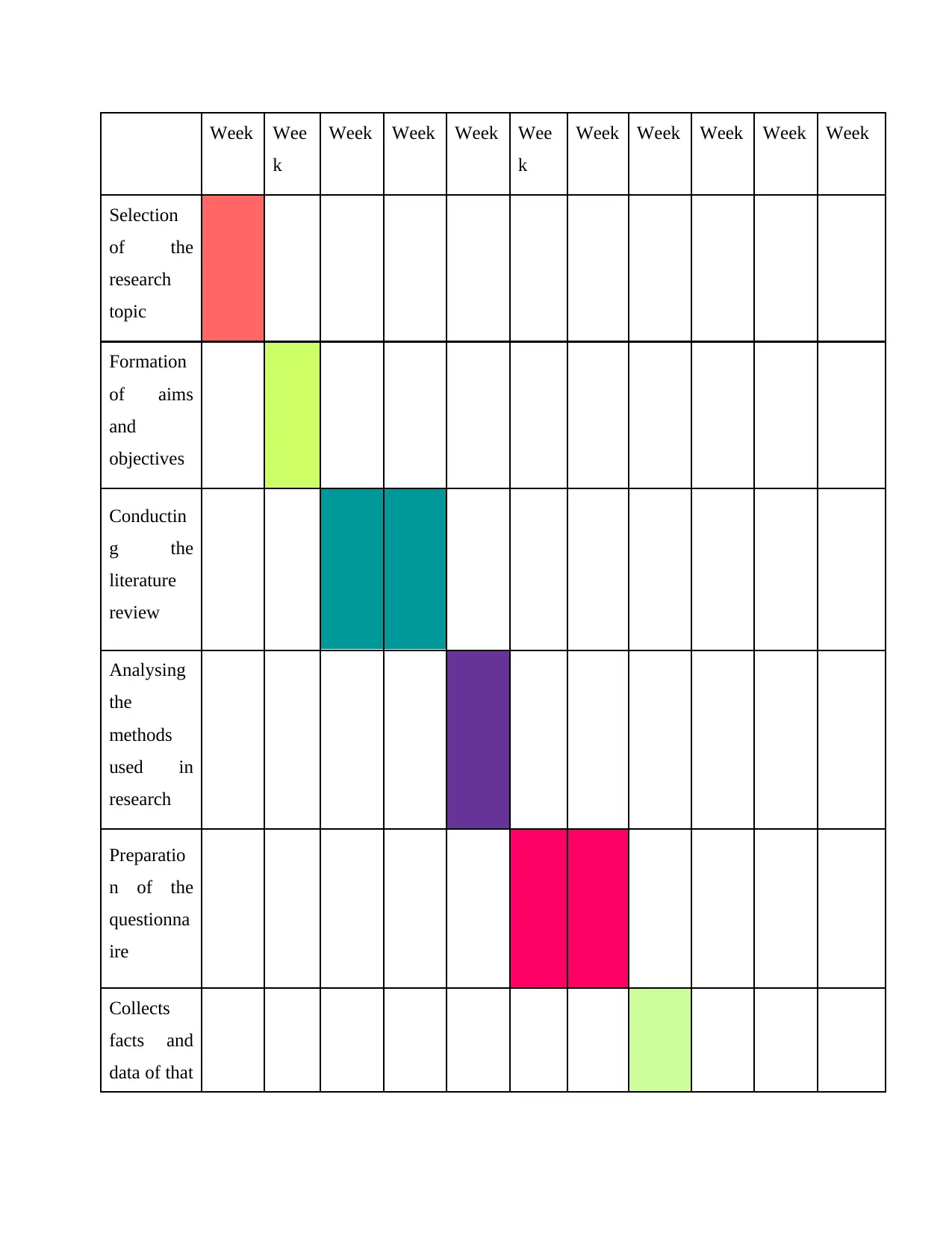
TIMELINE
The timeline is the time plan which is made by the researcher. In this plan the researcher
outlines a schedule which will be followed by the researcher to complete the research project.
This plan outlines the different parts of the whole research and decides the time that in which
time frame what work will be completed.
Activity 1 2 3 4 5 6 7 8 9 10 11
selected which have all the characteristics of being a sample.
Data analysis- the collection of data is not enough it is very essential for the researcher to
also analyze the data. This is majorly because of the reason that the data collected is of no use if
any meaning is not coming from that data. Thus, it is very necessary for the researcher to
accurately analyze and interpret the data to draw some meaningful conclusion from it. For the
current study of ways of improving the student retention the researcher will use the thematic
analysis of data. This method is being selected because of the reason that this method helps in
analyzing the data in the form of picture and graphs and then interpreting the collected data and
drawing some conclusions from it (Taylor, Bogdan and DeVault, 2015).
Ethical consideration- this is very necessary for the researcher to take into consideration
all the ethical requirements of completing the research. This is very necessary for the researcher
to consider all the requirements of the research completion. These are like the data must be
collected from the ethical sources and also before taking the data from the participant the
researcher must ask the respondent to fill the ethical consent form and the ethical approval form.
Also, the researcher must not use such information which may mislead any participant and the
researcher must ensure the participant that the data collected from them is kept confidential and
safe and will not be misused.
Reliability and validity- it is also necessary for the researcher to have reliability and
validity of the data (Attia and Edge, 2017). This is majorly because of the reason that reliability
is defined as the extent to which the answers of the research are reliable and can be used by the
other researcher as well. On the other hand, the validity of the research is defined as the extent to
which the methods used by the researcher are valid that is how validly the research methods are
being used by the researcher.
TIMELINE
The timeline is the time plan which is made by the researcher. In this plan the researcher
outlines a schedule which will be followed by the researcher to complete the research project.
This plan outlines the different parts of the whole research and decides the time that in which
time frame what work will be completed.
Activity 1 2 3 4 5 6 7 8 9 10 11
⊘ This is a preview!⊘
Do you want full access?
Subscribe today to unlock all pages.
Trusted by 1+ million students worldwide
Week Wee
k
Week Week Week Wee
k
Week Week Week Week Week
Selection
of the
research
topic
Formation
of aims
and
objectives
Conductin
g the
literature
review
Analysing
the
methods
used in
research
Preparatio
n of the
questionna
ire
Collects
facts and
data of that
k
Week Week Week Wee
k
Week Week Week Week Week
Selection
of the
research
topic
Formation
of aims
and
objectives
Conductin
g the
literature
review
Analysing
the
methods
used in
research
Preparatio
n of the
questionna
ire
Collects
facts and
data of that
Paraphrase This Document
Need a fresh take? Get an instant paraphrase of this document with our AI Paraphraser

topic.
Analysis
of the data
with help
of
thematic
data
analysis
Recheckin
g the data
and
informatio
n before
final
submission
.
Final
submission
of the
report
Analysis
of the data
with help
of
thematic
data
analysis
Recheckin
g the data
and
informatio
n before
final
submission
.
Final
submission
of the
report
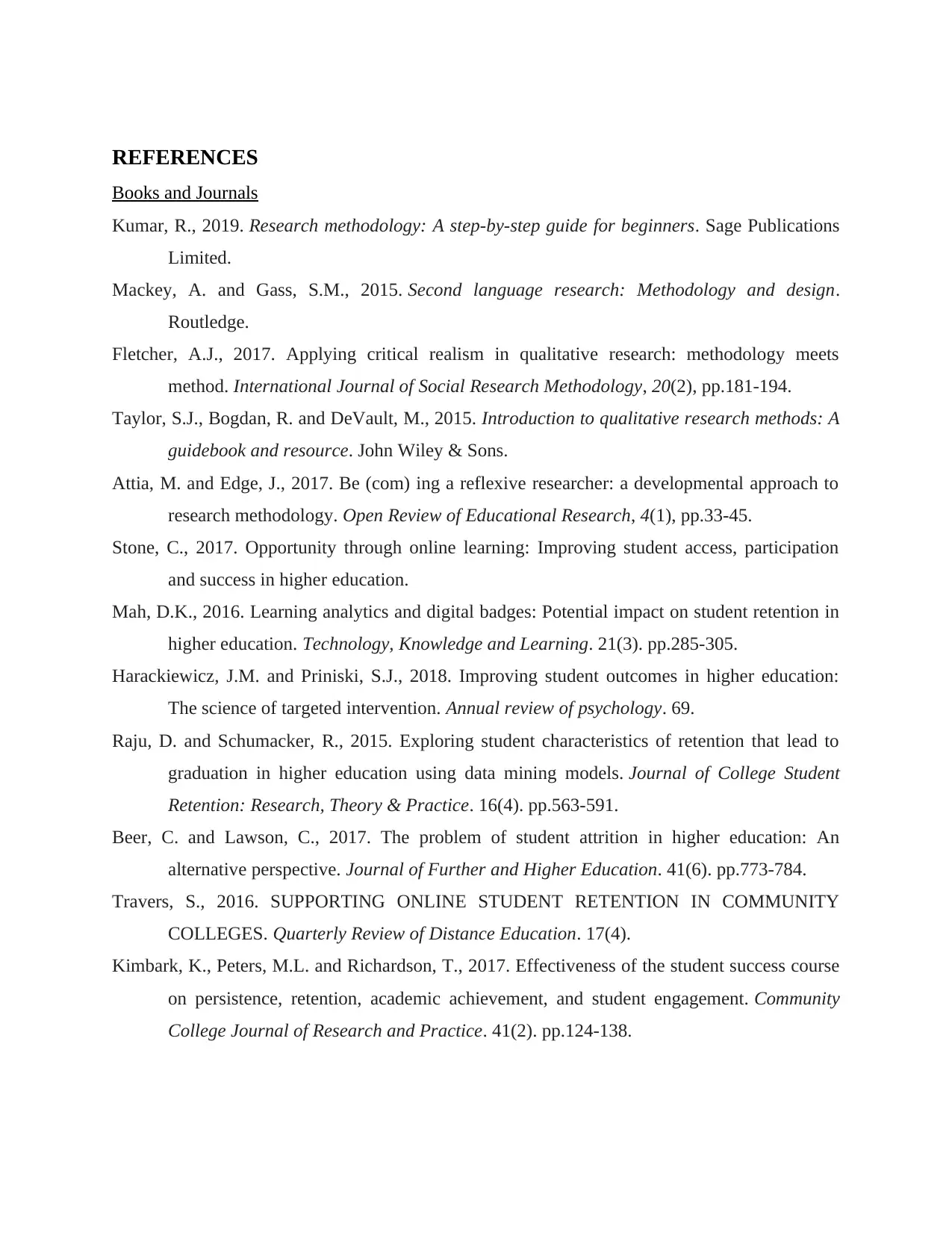
REFERENCES
Books and Journals
Kumar, R., 2019. Research methodology: A step-by-step guide for beginners. Sage Publications
Limited.
Mackey, A. and Gass, S.M., 2015. Second language research: Methodology and design.
Routledge.
Fletcher, A.J., 2017. Applying critical realism in qualitative research: methodology meets
method. International Journal of Social Research Methodology, 20(2), pp.181-194.
Taylor, S.J., Bogdan, R. and DeVault, M., 2015. Introduction to qualitative research methods: A
guidebook and resource. John Wiley & Sons.
Attia, M. and Edge, J., 2017. Be (com) ing a reflexive researcher: a developmental approach to
research methodology. Open Review of Educational Research, 4(1), pp.33-45.
Stone, C., 2017. Opportunity through online learning: Improving student access, participation
and success in higher education.
Mah, D.K., 2016. Learning analytics and digital badges: Potential impact on student retention in
higher education. Technology, Knowledge and Learning. 21(3). pp.285-305.
Harackiewicz, J.M. and Priniski, S.J., 2018. Improving student outcomes in higher education:
The science of targeted intervention. Annual review of psychology. 69.
Raju, D. and Schumacker, R., 2015. Exploring student characteristics of retention that lead to
graduation in higher education using data mining models. Journal of College Student
Retention: Research, Theory & Practice. 16(4). pp.563-591.
Beer, C. and Lawson, C., 2017. The problem of student attrition in higher education: An
alternative perspective. Journal of Further and Higher Education. 41(6). pp.773-784.
Travers, S., 2016. SUPPORTING ONLINE STUDENT RETENTION IN COMMUNITY
COLLEGES. Quarterly Review of Distance Education. 17(4).
Kimbark, K., Peters, M.L. and Richardson, T., 2017. Effectiveness of the student success course
on persistence, retention, academic achievement, and student engagement. Community
College Journal of Research and Practice. 41(2). pp.124-138.
Books and Journals
Kumar, R., 2019. Research methodology: A step-by-step guide for beginners. Sage Publications
Limited.
Mackey, A. and Gass, S.M., 2015. Second language research: Methodology and design.
Routledge.
Fletcher, A.J., 2017. Applying critical realism in qualitative research: methodology meets
method. International Journal of Social Research Methodology, 20(2), pp.181-194.
Taylor, S.J., Bogdan, R. and DeVault, M., 2015. Introduction to qualitative research methods: A
guidebook and resource. John Wiley & Sons.
Attia, M. and Edge, J., 2017. Be (com) ing a reflexive researcher: a developmental approach to
research methodology. Open Review of Educational Research, 4(1), pp.33-45.
Stone, C., 2017. Opportunity through online learning: Improving student access, participation
and success in higher education.
Mah, D.K., 2016. Learning analytics and digital badges: Potential impact on student retention in
higher education. Technology, Knowledge and Learning. 21(3). pp.285-305.
Harackiewicz, J.M. and Priniski, S.J., 2018. Improving student outcomes in higher education:
The science of targeted intervention. Annual review of psychology. 69.
Raju, D. and Schumacker, R., 2015. Exploring student characteristics of retention that lead to
graduation in higher education using data mining models. Journal of College Student
Retention: Research, Theory & Practice. 16(4). pp.563-591.
Beer, C. and Lawson, C., 2017. The problem of student attrition in higher education: An
alternative perspective. Journal of Further and Higher Education. 41(6). pp.773-784.
Travers, S., 2016. SUPPORTING ONLINE STUDENT RETENTION IN COMMUNITY
COLLEGES. Quarterly Review of Distance Education. 17(4).
Kimbark, K., Peters, M.L. and Richardson, T., 2017. Effectiveness of the student success course
on persistence, retention, academic achievement, and student engagement. Community
College Journal of Research and Practice. 41(2). pp.124-138.
⊘ This is a preview!⊘
Do you want full access?
Subscribe today to unlock all pages.
Trusted by 1+ million students worldwide

1 out of 15


Related Documents


Your All-in-One AI-Powered Toolkit for Academic Success.
+13062052269
info@desklib.com
Available 24*7 on WhatsApp / Email
![[object Object]](/_next/static/media/star-bottom.7253800d.svg)
Unlock your academic potential
Copyright © 2020–2026 A2Z Services. All Rights Reserved. Developed and managed by ZUCOL.