Sustainable Operations and Destinations: UNWTO's Impact in India
VerifiedAdded on 2022/11/01
|10
|2060
|169
Report
AI Summary
This report examines the World Tourism Organization (UNWTO)'s initiatives for sustainable tourism in India. It highlights the UNWTO's contributions to promoting responsible, sustainable, and accessible tourism, with a specific focus on their impact on employment and education within the country. The report analyzes the UNWTO's organizational structure, its development initiatives, and the comparison between sustainable and responsible tourism practices. It also explores the application of the triple bottom line framework and the UNWTO's contributions to employment and education, particularly in the context of women's empowerment and gender equality. The report concludes by emphasizing the UNWTO's significant role in fostering educational development and standard employment through sustainable tourism initiatives, providing valuable insights into the organization's impact on India's socio-economic landscape.
Running head: SUSTAINABLE OPERATIONS AND DESTINATIONS
Sustainable operations and destinations
Name of the student
Name of the university
Author note
Sustainable operations and destinations
Name of the student
Name of the university
Author note

Paraphrase This Document
Need a fresh take? Get an instant paraphrase of this document with our AI Paraphraser
1SUSTAINABLE OPERATIONS AND DESTINATIONS
Executive summary
In this study it has been identified that sustainable tourism has practices have become the
important concern for dealing with the environmental as well as social challenges in India. In this
situation following the triple bottom line management approach, the UNWTO has made a
significant contribution for ensuring the development of skills as well as effective economic
opportunities in the country. In that case maintaining the effective collaboration with local
people, UNWTO has brought various opportunity in the country. By focusing on the case of
managing the employment as well as literacy rate in India, UNWTO has introduced different
skills, business and job opportunities.
Executive summary
In this study it has been identified that sustainable tourism has practices have become the
important concern for dealing with the environmental as well as social challenges in India. In this
situation following the triple bottom line management approach, the UNWTO has made a
significant contribution for ensuring the development of skills as well as effective economic
opportunities in the country. In that case maintaining the effective collaboration with local
people, UNWTO has brought various opportunity in the country. By focusing on the case of
managing the employment as well as literacy rate in India, UNWTO has introduced different
skills, business and job opportunities.
2SUSTAINABLE OPERATIONS AND DESTINATIONS
Table of contents
Introduction......................................................................................................................................3
Organization....................................................................................................................................3
Development....................................................................................................................................3
Conclusion.......................................................................................................................................6
Reference list...................................................................................................................................7
Table of contents
Introduction......................................................................................................................................3
Organization....................................................................................................................................3
Development....................................................................................................................................3
Conclusion.......................................................................................................................................6
Reference list...................................................................................................................................7
⊘ This is a preview!⊘
Do you want full access?
Subscribe today to unlock all pages.

Trusted by 1+ million students worldwide
3SUSTAINABLE OPERATIONS AND DESTINATIONS
Introduction
In the current tourism trends, sustainability has become an important component that has
significantly impacted on developing education and employment rate in a country (Mathew &
Sreejesh, 2017). In order to promote the sustainable growth in society, the world tourism
organization has focused on introducing different initiatives which have significantly influenced
the societal structure. The purpose of this study is to shed light on the different development
initiatives adopted by this organization in India. In this study, adding the crucial evidences
regarding the organizational promotional initiatives towards ensuring the responsible, sustainable
and accessible tourism initiative, which have impacted on the education and employment sector.
Organization
The World Tourism Organization (UNWTO) the United nation based agency which has
significantly contributed in case of bringing the standard tourism policies in the global forum.
Analyzing the current growth in tourism sector, the company aims to bring the societal
development through different employment initiative (Muresan et al., 2016). Following the code
of ethics for tourism, the organization focuses on setting the comprehensive principles for
maximizing the community benefits. It is true that UNWTO shares the societal concern with the
stakeholders so that the negative impact on environment can be minimized. It is true that with the
effective development initiative, 10 code of principles have been introduced by the organization
in which social, cultural, economic and environmental components have been covered which are
important for bringing the changes in tourism sector (Unwto.org, 2019).
Development
Comparison between sustainable tourism and responsible tourism
Introduction
In the current tourism trends, sustainability has become an important component that has
significantly impacted on developing education and employment rate in a country (Mathew &
Sreejesh, 2017). In order to promote the sustainable growth in society, the world tourism
organization has focused on introducing different initiatives which have significantly influenced
the societal structure. The purpose of this study is to shed light on the different development
initiatives adopted by this organization in India. In this study, adding the crucial evidences
regarding the organizational promotional initiatives towards ensuring the responsible, sustainable
and accessible tourism initiative, which have impacted on the education and employment sector.
Organization
The World Tourism Organization (UNWTO) the United nation based agency which has
significantly contributed in case of bringing the standard tourism policies in the global forum.
Analyzing the current growth in tourism sector, the company aims to bring the societal
development through different employment initiative (Muresan et al., 2016). Following the code
of ethics for tourism, the organization focuses on setting the comprehensive principles for
maximizing the community benefits. It is true that UNWTO shares the societal concern with the
stakeholders so that the negative impact on environment can be minimized. It is true that with the
effective development initiative, 10 code of principles have been introduced by the organization
in which social, cultural, economic and environmental components have been covered which are
important for bringing the changes in tourism sector (Unwto.org, 2019).
Development
Comparison between sustainable tourism and responsible tourism
Paraphrase This Document
Need a fresh take? Get an instant paraphrase of this document with our AI Paraphraser
4SUSTAINABLE OPERATIONS AND DESTINATIONS
Sustainable and responsible tourism are being considered as the different side of a
single coin. The term sustainable tourism indicates the long term change in the tourism sector
that bring the positive impact on the society (Lee et al., 2017). On the other hand, responsible
tourism mainly focuses on the short term actions, which are being taken by the people for
enhancing the positive impact on the particular destination. Therefore, comparing both the
tourism practices, it can be said that sustainable tourism is about introducing the positive impact
on social, environmental and economic situation on a host destination. On the other hand,
responsible tourism refers different ways that helps to attract small business investors as well as
visitors towards the destination. Analyzing the operational process of UNWTO, it has been
identified that sustainable as well as responsible both the practices are being followed by the
organization based on the situation in the host destination.
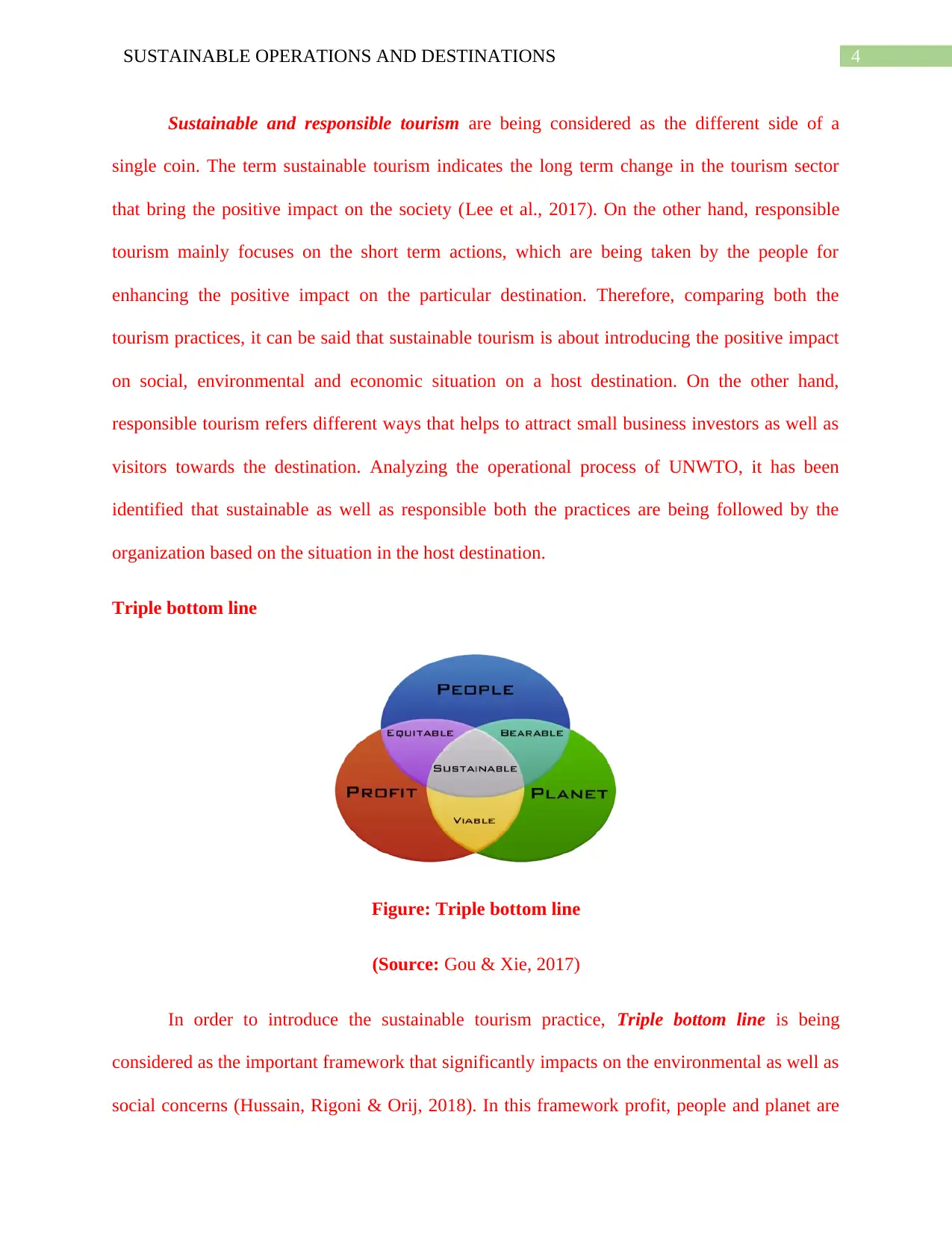
Triple bottom line
Figure: Triple bottom line
(Source: Gou & Xie, 2017)
In order to introduce the sustainable tourism practice, Triple bottom line is being
considered as the important framework that significantly impacts on the environmental as well as
social concerns (Hussain, Rigoni & Orij, 2018). In this framework profit, people and planet are
Sustainable and responsible tourism are being considered as the different side of a
single coin. The term sustainable tourism indicates the long term change in the tourism sector
that bring the positive impact on the society (Lee et al., 2017). On the other hand, responsible
tourism mainly focuses on the short term actions, which are being taken by the people for
enhancing the positive impact on the particular destination. Therefore, comparing both the
tourism practices, it can be said that sustainable tourism is about introducing the positive impact
on social, environmental and economic situation on a host destination. On the other hand,
responsible tourism refers different ways that helps to attract small business investors as well as
visitors towards the destination. Analyzing the operational process of UNWTO, it has been
identified that sustainable as well as responsible both the practices are being followed by the
organization based on the situation in the host destination.
Triple bottom line
Figure: Triple bottom line
(Source: Gou & Xie, 2017)
In order to introduce the sustainable tourism practice, Triple bottom line is being
considered as the important framework that significantly impacts on the environmental as well as
social concerns (Hussain, Rigoni & Orij, 2018). In this framework profit, people and planet are
5SUSTAINABLE OPERATIONS AND DESTINATIONS
the important three components. Applying the triple bottom line management approach,
UNWTO has mainly focused on introducing the social as well as environmental justice in India.
Introducing the sustainable workshop in India, UNWTO has contributed towards
competitiveness as well as sustainability by using the triple bottom line app6roach.
Contribution of UNWTO in Employment and education in India
India has participated in the 88th session of Executive council meeting of The World
Tourism Organization (UNWTO). It can be considered as the lateral international body that
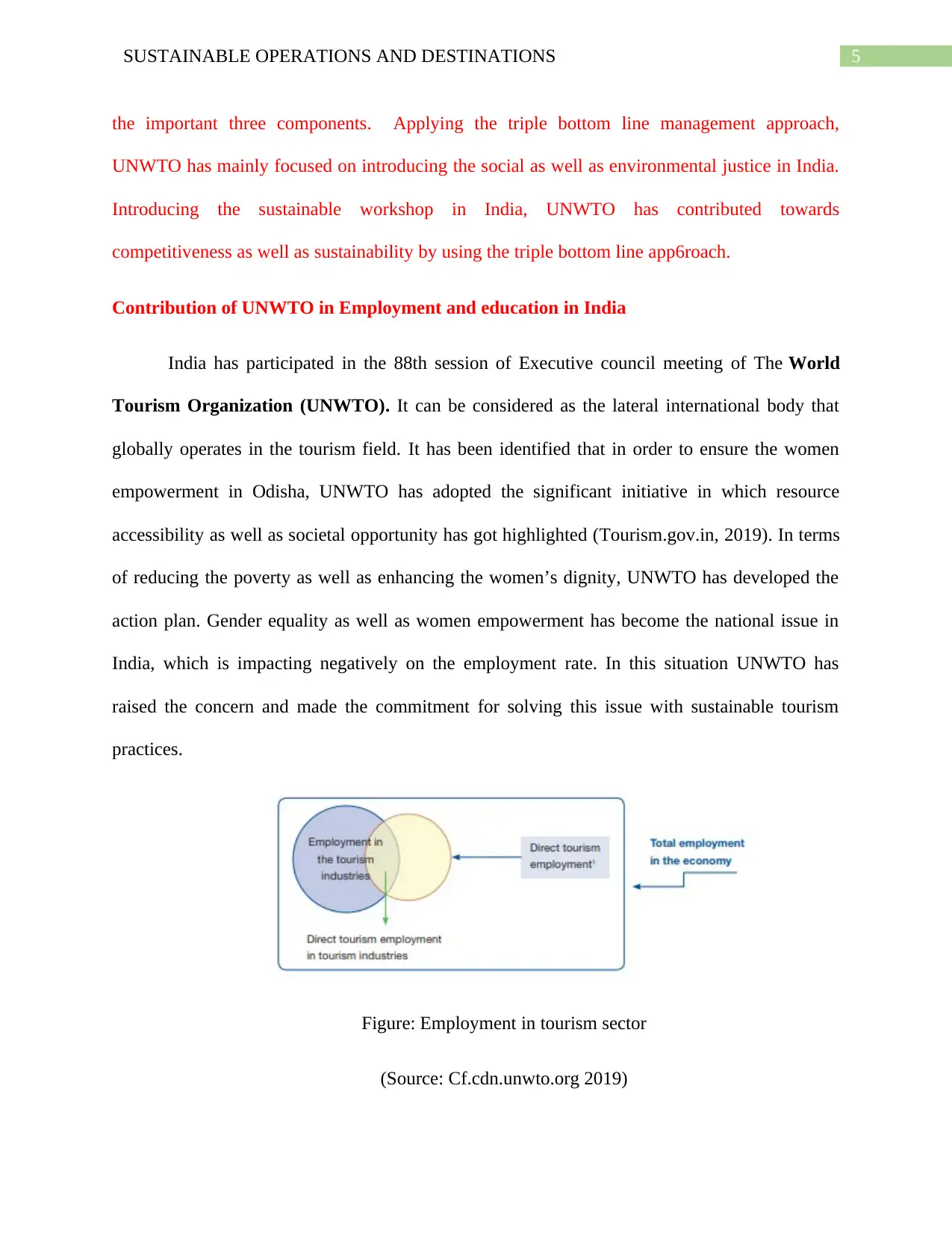
globally operates in the tourism field. It has been identified that in order to ensure the women
empowerment in Odisha, UNWTO has adopted the significant initiative in which resource
accessibility as well as societal opportunity has got highlighted (Tourism.gov.in, 2019). In terms
of reducing the poverty as well as enhancing the women’s dignity, UNWTO has developed the
action plan. Gender equality as well as women empowerment has become the national issue in
India, which is impacting negatively on the employment rate. In this situation UNWTO has
raised the concern and made the commitment for solving this issue with sustainable tourism
practices.
Figure: Employment in tourism sector
(Source: Cf.cdn.unwto.org 2019)
the important three components. Applying the triple bottom line management approach,
UNWTO has mainly focused on introducing the social as well as environmental justice in India.
Introducing the sustainable workshop in India, UNWTO has contributed towards
competitiveness as well as sustainability by using the triple bottom line app6roach.
Contribution of UNWTO in Employment and education in India
India has participated in the 88th session of Executive council meeting of The World
Tourism Organization (UNWTO). It can be considered as the lateral international body that
globally operates in the tourism field. It has been identified that in order to ensure the women
empowerment in Odisha, UNWTO has adopted the significant initiative in which resource
accessibility as well as societal opportunity has got highlighted (Tourism.gov.in, 2019). In terms
of reducing the poverty as well as enhancing the women’s dignity, UNWTO has developed the
action plan. Gender equality as well as women empowerment has become the national issue in
India, which is impacting negatively on the employment rate. In this situation UNWTO has
raised the concern and made the commitment for solving this issue with sustainable tourism
practices.
Figure: Employment in tourism sector
(Source: Cf.cdn.unwto.org 2019)
⊘ This is a preview!⊘
Do you want full access?
Subscribe today to unlock all pages.
Trusted by 1+ million students worldwide
6SUSTAINABLE OPERATIONS AND DESTINATIONS
It is true that realization of fundamental rights of human as well as sustainable
development both the terms are interconnected with each other (Musora & Mbaiwa, 2018). It is
true that tourism can be considered as the broader sector that brings the positive impact on the
socio economic, cultural as well as sustainable perspectives. It is true that with the active
involvement of UNWTO in both the rural as well as urban areas, the empowerment of people in
India has been done in both the national and international perspectives. In case of making the
standard collaboration with the livelihood and growth, UNWTO has introduced various tourism
projects in this country. Increasing the controlling power on the natural resources, the significant
impact on women employment has indirectly influenced the economic sustainability in the
country. Analysing the situation of women in this country, it has been identified that malnutrition
as well as illiteracy are the major concern in this country. In this case UNWTO has defined the
critical concept of employment as well as its significant impact on influencing the gender
equality. By sharing the equal distribution of resources among male and female, the standard
distribution process has been introduced by the organization (Davidson & Sahli, 2015).
It has been identified that in the year 2002, UNWTO has employed 1.85 million people in
India in different sustainable tourism projects. UNWTO has aimed to ensure standard living
hood with the sustainable tourism initiatives for spreading the fundamental rights of human. It
cannot be denied that in order to lead the vital realization of women employment, UNWTO has
promoted the gender equality as well as women empowerment in this country, which is
important for ensuring the standard employment rate. It is true that in the world’s ratio, two third
of the literate adults are adult, however, in the Indian societal context, education has become the
unreachable challenge for both genders. In different regions of this country, education has
become an important challenge, which is creating barrier for bringing any kind of development
It is true that realization of fundamental rights of human as well as sustainable
development both the terms are interconnected with each other (Musora & Mbaiwa, 2018). It is
true that tourism can be considered as the broader sector that brings the positive impact on the
socio economic, cultural as well as sustainable perspectives. It is true that with the active
involvement of UNWTO in both the rural as well as urban areas, the empowerment of people in
India has been done in both the national and international perspectives. In case of making the
standard collaboration with the livelihood and growth, UNWTO has introduced various tourism
projects in this country. Increasing the controlling power on the natural resources, the significant
impact on women employment has indirectly influenced the economic sustainability in the
country. Analysing the situation of women in this country, it has been identified that malnutrition
as well as illiteracy are the major concern in this country. In this case UNWTO has defined the
critical concept of employment as well as its significant impact on influencing the gender
equality. By sharing the equal distribution of resources among male and female, the standard
distribution process has been introduced by the organization (Davidson & Sahli, 2015).
It has been identified that in the year 2002, UNWTO has employed 1.85 million people in
India in different sustainable tourism projects. UNWTO has aimed to ensure standard living
hood with the sustainable tourism initiatives for spreading the fundamental rights of human. It
cannot be denied that in order to lead the vital realization of women employment, UNWTO has
promoted the gender equality as well as women empowerment in this country, which is
important for ensuring the standard employment rate. It is true that in the world’s ratio, two third
of the literate adults are adult, however, in the Indian societal context, education has become the
unreachable challenge for both genders. In different regions of this country, education has
become an important challenge, which is creating barrier for bringing any kind of development
Paraphrase This Document
Need a fresh take? Get an instant paraphrase of this document with our AI Paraphraser
7SUSTAINABLE OPERATIONS AND DESTINATIONS
in the country. By continuing this, it has also been identified that lack of education as well as
increasing unemployment in the country is dragging the young people towards different criminal
activities. In this situation, UNWTO has aimed to bring the significant impact on society by
enhancing the educational opportunities (Edgell Sr, 2016). It is true that UNWTO has played an
important role for providing the training as well as educational opportunities to the people in
case of introducing different forms of women entrepreneurship opportunities. Ensuring the
women engagement in different tourism projects, UNWTO has improved the hospitality skills of
women, which has indirectly impacted on the case of managing the employment rate in the
country. Therefore, it can be said that introducing different employment opportunities such as
seasonal hone, travel and tour business and restaurants as well as educational opportunities,
utilizing the natural resources UNWTO has aimed to introducing the sustainable tourism
initiatives in India. Following the code of conducts followed by UNWTO, it can be said that
introducing the through the sustainable tourism practices the company has contributed towards
improving the multidimensional as well as labour intensive working sector that can significantly
promote the education and employment in the country. UNWTO believes in providing the wider
scope for employment in the country through the sustainable tourism development initiatives
(Ethics.unwto.org, 2019).
Conclusion
In this study, it can be concluded that UNWTO has made the significant contribution in
terms of bringing the educational development as well as standard employment through the
sustainable tourism initiatives. By focusing on the case of managing the employment as well as
literacy rate in India, UNWTO has introduced different skills, business and job opportunities.
in the country. By continuing this, it has also been identified that lack of education as well as
increasing unemployment in the country is dragging the young people towards different criminal
activities. In this situation, UNWTO has aimed to bring the significant impact on society by
enhancing the educational opportunities (Edgell Sr, 2016). It is true that UNWTO has played an
important role for providing the training as well as educational opportunities to the people in
case of introducing different forms of women entrepreneurship opportunities. Ensuring the
women engagement in different tourism projects, UNWTO has improved the hospitality skills of
women, which has indirectly impacted on the case of managing the employment rate in the
country. Therefore, it can be said that introducing different employment opportunities such as
seasonal hone, travel and tour business and restaurants as well as educational opportunities,
utilizing the natural resources UNWTO has aimed to introducing the sustainable tourism
initiatives in India. Following the code of conducts followed by UNWTO, it can be said that
introducing the through the sustainable tourism practices the company has contributed towards
improving the multidimensional as well as labour intensive working sector that can significantly
promote the education and employment in the country. UNWTO believes in providing the wider
scope for employment in the country through the sustainable tourism development initiatives
(Ethics.unwto.org, 2019).
Conclusion
In this study, it can be concluded that UNWTO has made the significant contribution in
terms of bringing the educational development as well as standard employment through the
sustainable tourism initiatives. By focusing on the case of managing the employment as well as
literacy rate in India, UNWTO has introduced different skills, business and job opportunities.
8SUSTAINABLE OPERATIONS AND DESTINATIONS
Reference list
Cf.cdn.unwto.org (2019). retrieved from:
http://cf.cdn.unwto.org/sites/all/files/141015_measuring_employment_4c_stsa_wm.pdf
[Accessed on 21st Sep, 2019]
Cisneros-Martínez, J. D., McCabe, S., & Fernández-Morales, A. (2018). The contribution of
social tourism to sustainable tourism: a case study of seasonally adjusted programmes in
Spain. Journal of Sustainable Tourism, 26(1), 85-107.
Davidson, L., & Sahli, M. (2015). Foreign direct investment in tourism, poverty alleviation, and
sustainable development: a review of the Gambian hotel sector. Journal of sustainable
tourism, 23(2), 167-187.
Edgell Sr, D. L. (2016). Managing sustainable tourism: A legacy for the future. Routledge.
Ethics.unwto.org (2019). Retrieved from: http://ethics.unwto.org/en/content/global-code-ethics-
tourism [Accessed on 21st Sep, 2019]
Gou, Z., & Xie, X. (2017). Evolving green building: triple bottom line or regenerative
design?. Journal of Cleaner Production, 153, 600-607.
Hussain, N., Rigoni, U., & Orij, R. P. (2018). Corporate governance and sustainability
performance: Analysis of triple bottom line performance. Journal of Business
Ethics, 149(2), 411-432.
Lee, H. Y., Bonn, M. A., Reid, E. L., & Kim, W. G. (2017). Differences in tourist ethical
judgment and responsible tourism intention: An ethical scenario approach. Tourism
Management, 60, 298-307.
Reference list
Cf.cdn.unwto.org (2019). retrieved from:
http://cf.cdn.unwto.org/sites/all/files/141015_measuring_employment_4c_stsa_wm.pdf
[Accessed on 21st Sep, 2019]
Cisneros-Martínez, J. D., McCabe, S., & Fernández-Morales, A. (2018). The contribution of
social tourism to sustainable tourism: a case study of seasonally adjusted programmes in
Spain. Journal of Sustainable Tourism, 26(1), 85-107.
Davidson, L., & Sahli, M. (2015). Foreign direct investment in tourism, poverty alleviation, and
sustainable development: a review of the Gambian hotel sector. Journal of sustainable
tourism, 23(2), 167-187.
Edgell Sr, D. L. (2016). Managing sustainable tourism: A legacy for the future. Routledge.
Ethics.unwto.org (2019). Retrieved from: http://ethics.unwto.org/en/content/global-code-ethics-
tourism [Accessed on 21st Sep, 2019]
Gou, Z., & Xie, X. (2017). Evolving green building: triple bottom line or regenerative
design?. Journal of Cleaner Production, 153, 600-607.
Hussain, N., Rigoni, U., & Orij, R. P. (2018). Corporate governance and sustainability
performance: Analysis of triple bottom line performance. Journal of Business
Ethics, 149(2), 411-432.
Lee, H. Y., Bonn, M. A., Reid, E. L., & Kim, W. G. (2017). Differences in tourist ethical
judgment and responsible tourism intention: An ethical scenario approach. Tourism
Management, 60, 298-307.
⊘ This is a preview!⊘
Do you want full access?
Subscribe today to unlock all pages.
Trusted by 1+ million students worldwide
9SUSTAINABLE OPERATIONS AND DESTINATIONS
Lozano-Oyola, M., Blancas, F. J., González, M., & Caballero, R. (2019). Sustainable tourism
tags to reward destination management. Journal of environmental management, 250,
109458.
Mathew, P. V., & Sreejesh, S. (2017). Impact of responsible tourism on destination sustainability
and quality of life of community in tourism destinations. Journal of Hospitality and
Tourism Management, 31, 83-89.
Muresan, I., Oroian, C., Harun, R., Arion, F., Porutiu, A., Chiciudean, G., ... & Lile, R. (2016).
Local residents’ attitude toward sustainable rural tourism
development. Sustainability, 8(1), 100.
Musora, O., & Mbaiwa, J. (2018). Employees' Perceptions of Environmental Impacts of Tourism
Activities in the Okavango Delta, Botswana. International Journal of Hospitality &
Tourism Management, 2(1), 13.
Tourism.gov.in (2019). Retrieved from: http://tourism.gov.in/participation-unwto[Accessed on
21st Sep, 2019]
Unwto.org (2019). Retrieved from: http://www2.unwto.org/about/employment [Accessed on
21st Sep, 2019]
Lozano-Oyola, M., Blancas, F. J., González, M., & Caballero, R. (2019). Sustainable tourism
tags to reward destination management. Journal of environmental management, 250,
109458.
Mathew, P. V., & Sreejesh, S. (2017). Impact of responsible tourism on destination sustainability
and quality of life of community in tourism destinations. Journal of Hospitality and
Tourism Management, 31, 83-89.
Muresan, I., Oroian, C., Harun, R., Arion, F., Porutiu, A., Chiciudean, G., ... & Lile, R. (2016).
Local residents’ attitude toward sustainable rural tourism
development. Sustainability, 8(1), 100.
Musora, O., & Mbaiwa, J. (2018). Employees' Perceptions of Environmental Impacts of Tourism
Activities in the Okavango Delta, Botswana. International Journal of Hospitality &
Tourism Management, 2(1), 13.
Tourism.gov.in (2019). Retrieved from: http://tourism.gov.in/participation-unwto[Accessed on
21st Sep, 2019]
Unwto.org (2019). Retrieved from: http://www2.unwto.org/about/employment [Accessed on
21st Sep, 2019]

1 out of 10


Related Documents


Your All-in-One AI-Powered Toolkit for Academic Success.
+13062052269
info@desklib.com
Available 24*7 on WhatsApp / Email
![[object Object]](/_next/static/media/star-bottom.7253800d.svg)
Unlock your academic potential
Copyright © 2020–2026 A2Z Services. All Rights Reserved. Developed and managed by ZUCOL.