Automation Upgrade: Mechanical Machines to Automated Systems
VerifiedAdded on 2023/04/24
|16
|2933
|85
Report
AI Summary
This report examines the upgrade of mechanical machines to automated systems within industries, highlighting the need for automation to enhance productivity and create a sustainable working environment. It addresses the problems associated with using manual mechanical machines, the scope and benefits of implementing automated systems, and the factors influencing their adoption, such as reliability, repair time, and productivity. The report also discusses future outcomes, including increased accuracy, reduced production time, improved safety, and higher production volumes. A work plan, timeline, and cost-benefit analysis are included, demonstrating the feasibility and financial advantages of upgrading to automated systems, while also addressing concerns about potential unemployment. The report concludes that automation can refine mechanical systems, improve efficiency, and generate revenue, recommending the deployment of augmented reality technology to support the workforce.
Running head: UPGRADING OF MECHANICAL MACHINES INTO AUTOMATED MACHINES
Upgrading of Mechanical Machines into Automated Machines
Name of the Student
Name of the University
Author’s note
Upgrading of Mechanical Machines into Automated Machines
Name of the Student
Name of the University
Author’s note

Paraphrase This Document
Need a fresh take? Get an instant paraphrase of this document with our AI Paraphraser
1UPGRADING OF MECHANICAL MACHINES INTO AUTOMATED MACHINES
Executive Summary
The use of autonomous systems within the industries would be able to put a better form of
impact over the major systems. This report discusses about the various factors that affect the use
of mechanical systems within the industries. With the upgrade of systems, there is a high need
for the implementation of automated systems within the workplace. There are various problems
within the workplace that with the use of mechanical systems. The impact of autonomous
systems would be able to improve the conditions of work and improve productivity. This report
discusses about the factors of future outcomes based on the use of autonomous systems.
Executive Summary
The use of autonomous systems within the industries would be able to put a better form of
impact over the major systems. This report discusses about the various factors that affect the use
of mechanical systems within the industries. With the upgrade of systems, there is a high need
for the implementation of automated systems within the workplace. There are various problems
within the workplace that with the use of mechanical systems. The impact of autonomous
systems would be able to improve the conditions of work and improve productivity. This report
discusses about the factors of future outcomes based on the use of autonomous systems.
2UPGRADING OF MECHANICAL MACHINES INTO AUTOMATED MACHINES
Table of Contents
1. Introduction..................................................................................................................................3
2. Problem Statement.......................................................................................................................3
3. Research Questions......................................................................................................................4
4. Body of the Research...................................................................................................................4
4.1 Current trends within the Industry.........................................................................................4
4.2 Scope of Implementation and Benefits of Automation Systems...........................................4
4.3 Factors for the Implementation of Automated Systems........................................................5
4.4 Future Outcomes with the use of Automated Systems..........................................................6
4.5. Work Plan.............................................................................................................................7
4.6. Timeline................................................................................................................................8
4.8. Cost Benefit Analysis...........................................................................................................8
4.8. Counter arguments on existing labor force...........................................................................9
5. Conclusions and Recommendations..........................................................................................10
References......................................................................................................................................11
Appendices....................................................................................................................................13
Table of Contents
1. Introduction..................................................................................................................................3
2. Problem Statement.......................................................................................................................3
3. Research Questions......................................................................................................................4
4. Body of the Research...................................................................................................................4
4.1 Current trends within the Industry.........................................................................................4
4.2 Scope of Implementation and Benefits of Automation Systems...........................................4
4.3 Factors for the Implementation of Automated Systems........................................................5
4.4 Future Outcomes with the use of Automated Systems..........................................................6
4.5. Work Plan.............................................................................................................................7
4.6. Timeline................................................................................................................................8
4.8. Cost Benefit Analysis...........................................................................................................8
4.8. Counter arguments on existing labor force...........................................................................9
5. Conclusions and Recommendations..........................................................................................10
References......................................................................................................................................11
Appendices....................................................................................................................................13
⊘ This is a preview!⊘
Do you want full access?
Subscribe today to unlock all pages.

Trusted by 1+ million students worldwide
3UPGRADING OF MECHANICAL MACHINES INTO AUTOMATED MACHINES
1. Introduction
With the changing perspectives and processes within the industry in the recent times, it
has been seen that there is a high need for upgrading of the internal systems. Recently, the
industries are entirely dependent on the use of mechanical machines for the completion of tasks
and achieving the set targets. However, with the changing scenario of the industries, different
forms of strategies are applied within the industries for enhancing the processes and activities.
The use of mechanical machines require the use of humans to operate the machines. With
the changing scenario, there has been a high increase of dependency on machines to transform
the industrial sector (Pukhkal, Vatin & Murgul, 2014). Automation is considered as the major
need of the generation and thus the use of mechanical machines could be reduced. This would
further help in enhancing the working scenario and also support a sustainable and flexible
working environment.
2. Problem Statement
According to the mission statement of the organization, the industry seeks to provide
extensive services to different customers.
However, the employees within the industry do not have access to automated machines,
which would be helpful for changing the scenario of work. The use of manual mechanical
machines consumes a lot of time for the work to be completed, which would otherwise be
efficient with the use of automated machines.
In response to the current problem, it could be planned for the implementation of
automated services within the working environment. Different less expensive ways would be
1. Introduction
With the changing perspectives and processes within the industry in the recent times, it
has been seen that there is a high need for upgrading of the internal systems. Recently, the
industries are entirely dependent on the use of mechanical machines for the completion of tasks
and achieving the set targets. However, with the changing scenario of the industries, different
forms of strategies are applied within the industries for enhancing the processes and activities.
The use of mechanical machines require the use of humans to operate the machines. With
the changing scenario, there has been a high increase of dependency on machines to transform
the industrial sector (Pukhkal, Vatin & Murgul, 2014). Automation is considered as the major
need of the generation and thus the use of mechanical machines could be reduced. This would
further help in enhancing the working scenario and also support a sustainable and flexible
working environment.
2. Problem Statement
According to the mission statement of the organization, the industry seeks to provide
extensive services to different customers.
However, the employees within the industry do not have access to automated machines,
which would be helpful for changing the scenario of work. The use of manual mechanical
machines consumes a lot of time for the work to be completed, which would otherwise be
efficient with the use of automated machines.
In response to the current problem, it could be planned for the implementation of
automated services within the working environment. Different less expensive ways would be
Paraphrase This Document
Need a fresh take? Get an instant paraphrase of this document with our AI Paraphraser
4UPGRADING OF MECHANICAL MACHINES INTO AUTOMATED MACHINES
sought for the implementation of automated machines that would enhance the productivity of the
workplace.
3. Research Questions
Some of the questions of research that could be discussed are:
What processes are implemented within the present working environment at the industry?
What is the current scope of implementation and benefits of automation systems within
the industry?
What would be the future outcomes with the implementation of automated systems?
4. Body of the Research
4.1 Current trends within the Industry
The industry focused with the use of mechanical systems consists of a huge number of
production lines and several machines that consist of old custom controllers and logic
controllers. These systems are mostly controlled by humans who are responsible for
understanding the entire scenario of work and thus decide on the appropriate actions that would
help in suiting the needs of work (Herterich, Uebernickel & Brenner, 2015). The current trends
of the industry are based on the use of mechanical systems within the working environment.
Humans are entitled to work with the use of mechanical systems and there are some situations
where these systems might fail.
4.2 Scope of Implementation and Benefits of Automation Systems
Based on the current trends within the market, it has been seen that the use of automated
systems would be helpful in modernizing the existing systems. Automation is considered as the
primary key to improve the industrial operation and efficiency of work processes. It has been
sought for the implementation of automated machines that would enhance the productivity of the
workplace.
3. Research Questions
Some of the questions of research that could be discussed are:
What processes are implemented within the present working environment at the industry?
What is the current scope of implementation and benefits of automation systems within
the industry?
What would be the future outcomes with the implementation of automated systems?
4. Body of the Research
4.1 Current trends within the Industry
The industry focused with the use of mechanical systems consists of a huge number of
production lines and several machines that consist of old custom controllers and logic
controllers. These systems are mostly controlled by humans who are responsible for
understanding the entire scenario of work and thus decide on the appropriate actions that would
help in suiting the needs of work (Herterich, Uebernickel & Brenner, 2015). The current trends
of the industry are based on the use of mechanical systems within the working environment.
Humans are entitled to work with the use of mechanical systems and there are some situations
where these systems might fail.
4.2 Scope of Implementation and Benefits of Automation Systems
Based on the current trends within the market, it has been seen that the use of automated
systems would be helpful in modernizing the existing systems. Automation is considered as the
primary key to improve the industrial operation and efficiency of work processes. It has been
5UPGRADING OF MECHANICAL MACHINES INTO AUTOMATED MACHINES
seen that most of the installed systems are obsolete and old, expensive to maintain and also to
support the latest changing conditions of work (Harjunkoski et al., 2014). It has also been found
that there is a huge problem to recruit people who would have knowledge about the old systems.
This is mainly due to the reason of lack of training to the people who would be able to maintain
and troubleshoot problems based within the old systems.
Thus, the use of automation technology would be helpful in supporting the existing trends
of working. This technology would improve the rate of work rather than mechanical systems.
This is primarily due to the reason of high productivity of life (Tian & Xu, 2015). The
refinements and advancements based on controllers and automation software has been intensely
driven with the wide developments in vendor innovation and computer industry. The
implementation of automated systems would open a huge opportunity to improve the efficiency
and production with latest upgrades.
4.3 Factors for the Implementation of Automated Systems
There are several factors that mainly contribute towards the need for an upgrade of the
mechanical systems. The upgrades based on automation are considered as complex kind of
decisions based on business investment. It would thus be better to plan for the upgrades in an
advanced and planned manner. Some of the other prime factors that contribute towards the
implementation of automated systems are:
Reliability – With the ageing of automation systems, the factor of reliability decreases
and this thus affect the productivity of work (Chen & Barnes, 2014). The factor of
reliability depends on several parameters that includes environmental factors and
electrical stressors.
seen that most of the installed systems are obsolete and old, expensive to maintain and also to
support the latest changing conditions of work (Harjunkoski et al., 2014). It has also been found
that there is a huge problem to recruit people who would have knowledge about the old systems.
This is mainly due to the reason of lack of training to the people who would be able to maintain
and troubleshoot problems based within the old systems.
Thus, the use of automation technology would be helpful in supporting the existing trends
of working. This technology would improve the rate of work rather than mechanical systems.
This is primarily due to the reason of high productivity of life (Tian & Xu, 2015). The
refinements and advancements based on controllers and automation software has been intensely
driven with the wide developments in vendor innovation and computer industry. The
implementation of automated systems would open a huge opportunity to improve the efficiency
and production with latest upgrades.
4.3 Factors for the Implementation of Automated Systems
There are several factors that mainly contribute towards the need for an upgrade of the
mechanical systems. The upgrades based on automation are considered as complex kind of
decisions based on business investment. It would thus be better to plan for the upgrades in an
advanced and planned manner. Some of the other prime factors that contribute towards the
implementation of automated systems are:
Reliability – With the ageing of automation systems, the factor of reliability decreases
and this thus affect the productivity of work (Chen & Barnes, 2014). The factor of
reliability depends on several parameters that includes environmental factors and
electrical stressors.
⊘ This is a preview!⊘
Do you want full access?
Subscribe today to unlock all pages.
Trusted by 1+ million students worldwide
6UPGRADING OF MECHANICAL MACHINES INTO AUTOMATED MACHINES
Repair Time – The mean time taken for repair of the older mechanical systems increase
with the passing of time. The process of repair could be difficult and extremely time-
consuming (May et al., 2015). The downtime of the older systems could lead to failure
of the projects, which might further affect the production of the industry.
Productivity – Most of the upgrades that are done within the industry are entirely
dependent on reliability considerations. This can be considered as a forward investment
and can have great business value (Caldas et al., 2014). The amount of investment made
with the upgrade of automation based controls could be helpful for the productivity of
the existing mechanical systems and also improve the overall efficiency and production
flow.
4.4 Future Outcomes with the use of Automated Systems
With the impact of automation strategies within the working environment, it has been
seen that there would be several forms of future outcomes with the use of automated systems.
Some of the major future based outcomes are:
Increase of Accuracy and Repeatability – The automation systems are programmed in
such a manner to perform a particular repeatedly. The factor of repeatability and accuracy is
greater than work performed by employees (Schaefer et al., 2016). The automated systems would
have an inbuilt program that would be designed in such a manner to reduce the factor of errors
and improve the factor of production of work.
Reduction in Time of Productivity – With the impact of an automated machine, it
would help in speeding up the process of working within the industry. It would also speed up the
time of production since the factor of thinking is not involved with the impact of automated
systems (Sharda et al., 2014). The factor of repeatability would help in reducing the human error.
Repair Time – The mean time taken for repair of the older mechanical systems increase
with the passing of time. The process of repair could be difficult and extremely time-
consuming (May et al., 2015). The downtime of the older systems could lead to failure
of the projects, which might further affect the production of the industry.
Productivity – Most of the upgrades that are done within the industry are entirely
dependent on reliability considerations. This can be considered as a forward investment
and can have great business value (Caldas et al., 2014). The amount of investment made
with the upgrade of automation based controls could be helpful for the productivity of
the existing mechanical systems and also improve the overall efficiency and production
flow.
4.4 Future Outcomes with the use of Automated Systems
With the impact of automation strategies within the working environment, it has been
seen that there would be several forms of future outcomes with the use of automated systems.
Some of the major future based outcomes are:
Increase of Accuracy and Repeatability – The automation systems are programmed in
such a manner to perform a particular repeatedly. The factor of repeatability and accuracy is
greater than work performed by employees (Schaefer et al., 2016). The automated systems would
have an inbuilt program that would be designed in such a manner to reduce the factor of errors
and improve the factor of production of work.
Reduction in Time of Productivity – With the impact of an automated machine, it
would help in speeding up the process of working within the industry. It would also speed up the
time of production since the factor of thinking is not involved with the impact of automated
systems (Sharda et al., 2014). The factor of repeatability would help in reducing the human error.
Paraphrase This Document
Need a fresh take? Get an instant paraphrase of this document with our AI Paraphraser
7UPGRADING OF MECHANICAL MACHINES INTO AUTOMATED MACHINES
Less form of Human Error – Human beings are prone to making errors. This is the
reason that a machine that performs repeatable tasks would be less prone to making to errors
rather than what would be performed by employees.
Increase of Safety Factor – With the impact of automated machines, it would mean that
there would be a need of less employees to perform the mechanical tasks. There are some kind of
mechanical tasks that are extremely dangerous and are highly prone to get injured (Lin et al.,
2014). The use of automated systems could increase the safety within the workplace and cause
less injury within the workplace.
Higher Volume of Production – The making of investment within the use of automated
equipment would create a valuable resource for larger volumes of production. This would in turn
increase the factor of profitability within the workplace scenario (Mosier & Skitka, 2018). With
the implementation of automated systems within the workplace, it would result in the machines
to perform the entire work by the machines in a very efficient and structured manner.
Lesser Employee Cost Factor – With the addition of automated machines within the
various operations of the workplace, it would mean that lesser employees would be needed for
getting the entire job to be done. This factor also indicates that there would less kind of safety
issues and hence lead to financial savings for the organization (Cook et al., 2014). With the
impact of less employees within the workplace, it would mean that the numerous incurable costs
would be reduced or diminished. These costs would include the factors of sick days, benefits and
payroll.
Less form of Human Error – Human beings are prone to making errors. This is the
reason that a machine that performs repeatable tasks would be less prone to making to errors
rather than what would be performed by employees.
Increase of Safety Factor – With the impact of automated machines, it would mean that
there would be a need of less employees to perform the mechanical tasks. There are some kind of
mechanical tasks that are extremely dangerous and are highly prone to get injured (Lin et al.,
2014). The use of automated systems could increase the safety within the workplace and cause
less injury within the workplace.
Higher Volume of Production – The making of investment within the use of automated
equipment would create a valuable resource for larger volumes of production. This would in turn
increase the factor of profitability within the workplace scenario (Mosier & Skitka, 2018). With
the implementation of automated systems within the workplace, it would result in the machines
to perform the entire work by the machines in a very efficient and structured manner.
Lesser Employee Cost Factor – With the addition of automated machines within the
various operations of the workplace, it would mean that lesser employees would be needed for
getting the entire job to be done. This factor also indicates that there would less kind of safety
issues and hence lead to financial savings for the organization (Cook et al., 2014). With the
impact of less employees within the workplace, it would mean that the numerous incurable costs
would be reduced or diminished. These costs would include the factors of sick days, benefits and
payroll.
8UPGRADING OF MECHANICAL MACHINES INTO AUTOMATED MACHINES
4.5. Work Plan
Upgrading the mechanical machines into automated machines within the workplace
requires a planned approach. As per the work plan, the project of upgrading the mechanical
systems into automated system will require a planned approach. A schedule is estimated for this
project and the cost benefit analysis of the project is performed. The work plan includes-
Planning and Scheduling
Ordering the new Machines
Implementation of the Machines
Training the Staffs
4.6. Timeline
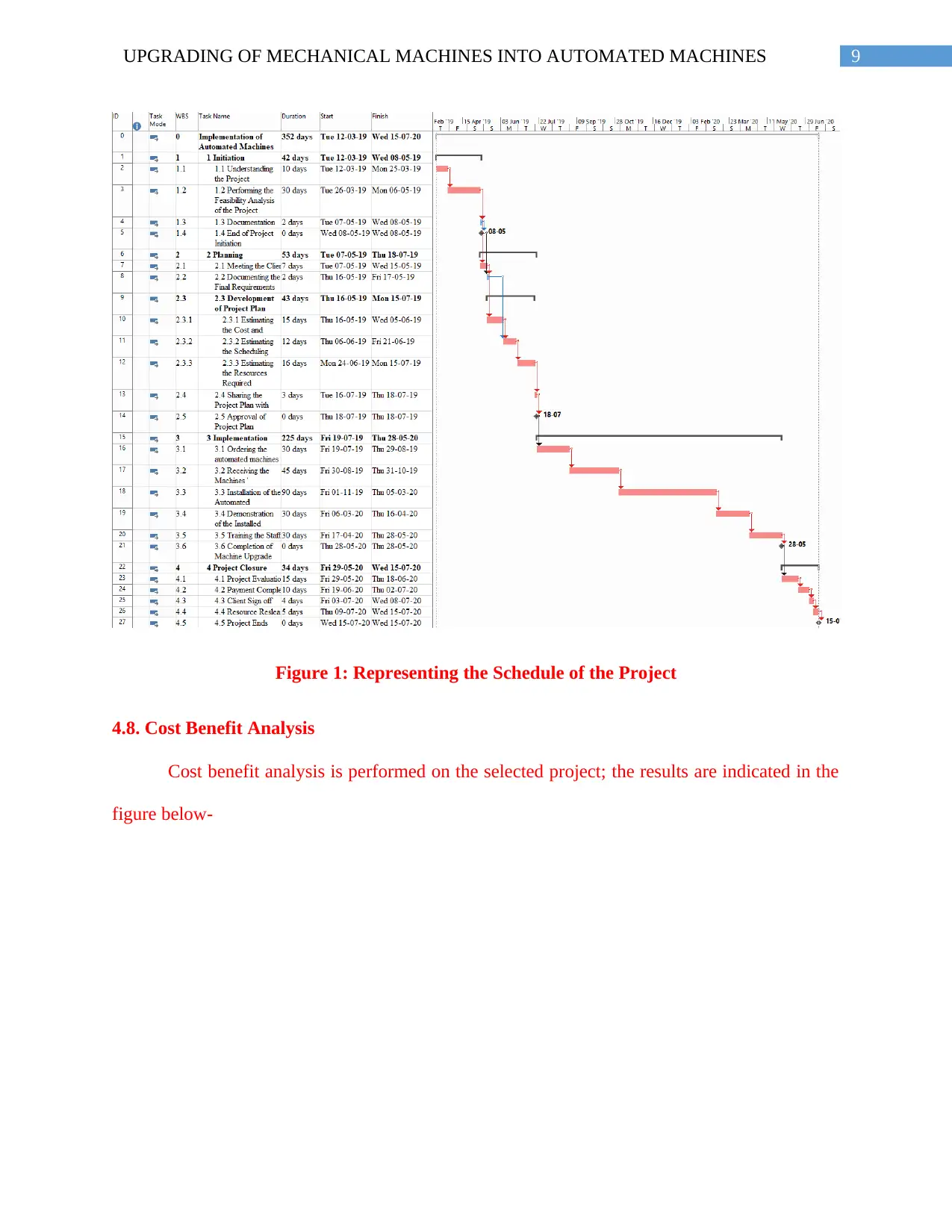
The timeline and the Gantt chart for the project is indicated in the figure below-
4.5. Work Plan
Upgrading the mechanical machines into automated machines within the workplace
requires a planned approach. As per the work plan, the project of upgrading the mechanical
systems into automated system will require a planned approach. A schedule is estimated for this
project and the cost benefit analysis of the project is performed. The work plan includes-
Planning and Scheduling
Ordering the new Machines
Implementation of the Machines
Training the Staffs
4.6. Timeline
The timeline and the Gantt chart for the project is indicated in the figure below-
⊘ This is a preview!⊘
Do you want full access?
Subscribe today to unlock all pages.
Trusted by 1+ million students worldwide
9UPGRADING OF MECHANICAL MACHINES INTO AUTOMATED MACHINES
Figure 1: Representing the Schedule of the Project
4.8. Cost Benefit Analysis
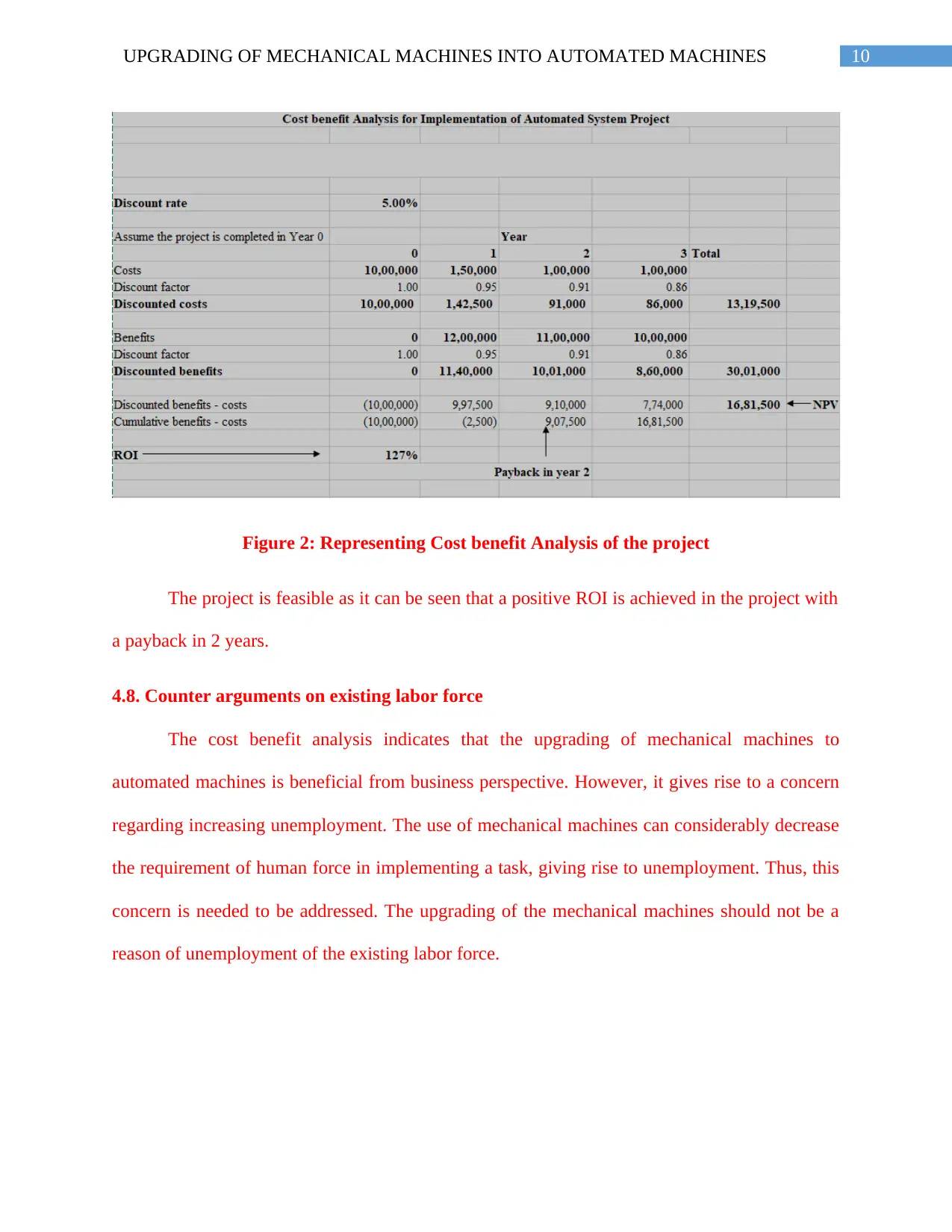
Cost benefit analysis is performed on the selected project; the results are indicated in the
figure below-
Figure 1: Representing the Schedule of the Project
4.8. Cost Benefit Analysis
Cost benefit analysis is performed on the selected project; the results are indicated in the
figure below-
Paraphrase This Document
Need a fresh take? Get an instant paraphrase of this document with our AI Paraphraser
10UPGRADING OF MECHANICAL MACHINES INTO AUTOMATED MACHINES
Figure 2: Representing Cost benefit Analysis of the project
The project is feasible as it can be seen that a positive ROI is achieved in the project with
a payback in 2 years.
4.8. Counter arguments on existing labor force
The cost benefit analysis indicates that the upgrading of mechanical machines to
automated machines is beneficial from business perspective. However, it gives rise to a concern
regarding increasing unemployment. The use of mechanical machines can considerably decrease
the requirement of human force in implementing a task, giving rise to unemployment. Thus, this
concern is needed to be addressed. The upgrading of the mechanical machines should not be a
reason of unemployment of the existing labor force.
Figure 2: Representing Cost benefit Analysis of the project
The project is feasible as it can be seen that a positive ROI is achieved in the project with
a payback in 2 years.
4.8. Counter arguments on existing labor force
The cost benefit analysis indicates that the upgrading of mechanical machines to
automated machines is beneficial from business perspective. However, it gives rise to a concern
regarding increasing unemployment. The use of mechanical machines can considerably decrease
the requirement of human force in implementing a task, giving rise to unemployment. Thus, this
concern is needed to be addressed. The upgrading of the mechanical machines should not be a
reason of unemployment of the existing labor force.
11UPGRADING OF MECHANICAL MACHINES INTO AUTOMATED MACHINES
5. Conclusions and Recommendations
Based on the discussion from the above factors, it could be concluded and understood
that the use of automated systems would be able to refine the use of mechanical systems within
the workplace. With the penetration of technology and computers within industries, the impact of
automation has become the primary factor of advantage within the industry. Automation has
permitted different companies to produce mass number of products at extreme speeds and with
great quality and repeatability.
Some recommendations that could be supported within the discussion is that the use of
automation systems would be able to support the workforce within an organization. Different
companies would be able to generate huge amount of revenue. The companies should deploy
augmented reality technology within the field of for expanding the after-sales service and
develop new services. These companies should also deploy Industry 4.0 technologies and
autonomous robots, which would help in improving the production of work and improve the
quality of produced work. These companies should also enable flexible production lines, 3-D
printing and robotics technology for the purpose of offering products that would have high levels
of customization. Thus the impact of autonomous systems would help the industries to achieve a
proper level of output for the organization.
5. Conclusions and Recommendations
Based on the discussion from the above factors, it could be concluded and understood
that the use of automated systems would be able to refine the use of mechanical systems within
the workplace. With the penetration of technology and computers within industries, the impact of
automation has become the primary factor of advantage within the industry. Automation has
permitted different companies to produce mass number of products at extreme speeds and with
great quality and repeatability.
Some recommendations that could be supported within the discussion is that the use of
automation systems would be able to support the workforce within an organization. Different
companies would be able to generate huge amount of revenue. The companies should deploy
augmented reality technology within the field of for expanding the after-sales service and
develop new services. These companies should also deploy Industry 4.0 technologies and
autonomous robots, which would help in improving the production of work and improve the
quality of produced work. These companies should also enable flexible production lines, 3-D
printing and robotics technology for the purpose of offering products that would have high levels
of customization. Thus the impact of autonomous systems would help the industries to achieve a
proper level of output for the organization.
⊘ This is a preview!⊘
Do you want full access?
Subscribe today to unlock all pages.
Trusted by 1+ million students worldwide

1 out of 16


Related Documents


Your All-in-One AI-Powered Toolkit for Academic Success.
+13062052269
info@desklib.com
Available 24*7 on WhatsApp / Email
![[object Object]](/_next/static/media/star-bottom.7253800d.svg)
Unlock your academic potential
Copyright © 2020–2026 A2Z Services. All Rights Reserved. Developed and managed by ZUCOL.