Energy Saving Potentials and Air Quality Benefits of Urban Heat Island
VerifiedAdded on 2023/04/21
|19
|9085
|398
Report
AI Summary
This report, based on research from the Heat Island Group at Lawrence Berkeley National Laboratory, explores the urban heat island (UHI) effect and its consequences. It highlights how urban areas experience higher temperatures than their rural surroundings due to the replacement of natural vegetation with buildings and roads, increasing air conditioning demand and smog formation. The report details mitigation strategies such as using reflective surfaces (cool roofs and pavements) and planting urban vegetation, demonstrating their potential to reduce urban temperatures, energy consumption, and smog exposure. It presents research findings, including energy savings from cool roofs and the use of computer simulations to assess the impact of these strategies on a large scale, such as in Los Angeles, CA. The report also discusses the direct and indirect effects of these measures on energy and air quality, emphasizing the importance of UHI mitigation as an effective air pollution control strategy and a valuable approach to reduce energy costs. The report further reviews the methodologies used to analyze the impact of heat-island mitigation measures on energy use and urban air pollution, including the use of mesoscale meteorological and photochemical models like CSUMM, MM5 and UAM.
1
Energy Saving Potentials and Air Quality Benefits of
Urban Heat Island Mitigation1
Hashem Akbari
Heat Island Group
Lawrence Berkeley National Laboratory
(510) 486-4287
H_Akbari@lbl.gov
http://HeatIsland.LBL.gov/
ABSTRACT
Urban areas tend to have higher air temperatures than their rural surroundings as a
result of gradual surface modifications that include replacing the natural vegetation with
buildings and roads. The term “Urban Heat Island” describes this phenomenon. The
surfaces of buildings and pavements absorb solar radiation and become extremely hot,
which in turn warm the surrounding air. Cities that have been “paved over” do not
receive the benefit of the natural cooling effect of vegetation. As the air temperature rises,
so does the demand for air-conditioning (a/c). This leads to higher emissions from power
plants, as well as increased smog formation as a result of warmer temperatures. In the
United States, we have found that this increase in air temperature is responsible for 5–
10% of urban peak electric demand for a/c use, and as much as 20% of population-
weighted smog concentrations in urban areas.
Simple ways to cool the cities are the use of reflective surfaces (rooftops and
pavements) and planting of urban vegetation. On a large scale, the evapotranspiration
from vegetation and increased reflection of incoming solar radiation by reflective
surfaces will cool a community a few degrees in the summer. As an example, computer
simulations for Los Angeles, CA show that resurfacing about two-third of the pavements
and rooftops with reflective surfaces and planting three trees per house can cool down LA
by an average of 2–3K. This reduction in air temperature will reduce urban smog
exposure in the LA basin by roughly the same amount as removing the basin entire on-
road vehicle exhaust. Heat island mitigation is an effective air pollution control strategy,
more than paying for itself in cooling energy cost savings. We estimate that the cooling
energy savings in U.S. from cool surfaces and shade trees, when fully implemented, is
about $5 billion per year (about $100 per air-conditioned house).
1. Introduction
Across the world, urban temperatures have increased faster than temperatures in
rural areas. For example, from 1930 to 1990, downtown Los Angeles recorded a growth
1 This paper is an abridged and updated version of an earlier paper published in
Solar Energy (Akbari et al 2001).
Energy Saving Potentials and Air Quality Benefits of
Urban Heat Island Mitigation1
Hashem Akbari
Heat Island Group
Lawrence Berkeley National Laboratory
(510) 486-4287
H_Akbari@lbl.gov
http://HeatIsland.LBL.gov/
ABSTRACT
Urban areas tend to have higher air temperatures than their rural surroundings as a
result of gradual surface modifications that include replacing the natural vegetation with
buildings and roads. The term “Urban Heat Island” describes this phenomenon. The
surfaces of buildings and pavements absorb solar radiation and become extremely hot,
which in turn warm the surrounding air. Cities that have been “paved over” do not
receive the benefit of the natural cooling effect of vegetation. As the air temperature rises,
so does the demand for air-conditioning (a/c). This leads to higher emissions from power
plants, as well as increased smog formation as a result of warmer temperatures. In the
United States, we have found that this increase in air temperature is responsible for 5–
10% of urban peak electric demand for a/c use, and as much as 20% of population-
weighted smog concentrations in urban areas.
Simple ways to cool the cities are the use of reflective surfaces (rooftops and
pavements) and planting of urban vegetation. On a large scale, the evapotranspiration
from vegetation and increased reflection of incoming solar radiation by reflective
surfaces will cool a community a few degrees in the summer. As an example, computer
simulations for Los Angeles, CA show that resurfacing about two-third of the pavements
and rooftops with reflective surfaces and planting three trees per house can cool down LA
by an average of 2–3K. This reduction in air temperature will reduce urban smog
exposure in the LA basin by roughly the same amount as removing the basin entire on-
road vehicle exhaust. Heat island mitigation is an effective air pollution control strategy,
more than paying for itself in cooling energy cost savings. We estimate that the cooling
energy savings in U.S. from cool surfaces and shade trees, when fully implemented, is
about $5 billion per year (about $100 per air-conditioned house).
1. Introduction
Across the world, urban temperatures have increased faster than temperatures in
rural areas. For example, from 1930 to 1990, downtown Los Angeles recorded a growth
1 This paper is an abridged and updated version of an earlier paper published in
Solar Energy (Akbari et al 2001).

Paraphrase This Document
Need a fresh take? Get an instant paraphrase of this document with our AI Paraphraser
2
of 0.5 degrees C per decade (Akbari et al. 2001). Every degree increase adds about 500
megawatts (MW) to the air conditioning load in the Los Angeles Basin (Akbari et al.
2001). Similar increases are taxing the ability of developing countries to meet urban
electricity demand, while increasing global GHG emissions. Local air pollution (e.g.,
particulates, volatile organics, and nitrogen oxides, which are precursors to ozone
formation) are already a problem in most cities in developing countries. Higher
temperatures mean increased ozone formation, with accompanying health impacts. LBNL
has conducted research on both the electricity and air pollution effects of higher
temperatures, and devised methods to reduce both effects. We have tested reflective
coatings on building roofs and pavements, and tree-planting schemes, to demonstrate
potential cost-effective reductions of energy use—between 10 and 40 percent. Among
energy-efficiency solutions, cool roofs and cool pavements are ideally suited to hot
climates that prevail in much of the developing world. Cool (light-colored) pavements
also increase nighttime visibility and pavement durability.
Urban areas have typically darker surfaces and less vegetation than their
surroundings (HIG 2005). These differences affect climate, energy use, and habitability
of cities. At the building scale, dark roofs heat up more and thus raise the summertime
cooling demands of buildings. Collectively, dark surfaces and reduced vegetation warm
the air over urban areas, leading to the creation of urban "heat islands." On a clear
summer afternoon, the air temperature in a typical city is as much as 2.5K higher than in
the surrounding rural areas. Research shows that peak urban electric demand rises by 2–
4% for each 1K rise in daily maximum temperature above a threshold of 15–20°C. Thus,
the additional air-conditioning use caused by this urban air temperature increase is
responsible for 5–10% of urban peak electric demand.
In California, Goodridge (1987, 1989) shows that, before 1940, the average
urban-rural temperature differences for 31 urban and 31 rural stations in California were
always negative, i.e., cities were cooler than their surroundings. After 1940, when built-
up areas began to replace vegetation, the urban centers became as warm or warmer than
the suburbs. From 1965 to 1989, urban temperatures increased by about 1K.
Regardless of whether there is an urban-rural temperature difference, data suggest
that temperatures in cities are increasing. For example, the maximum temperatures in
downtown Los Angeles are now about 2.5K higher than they were in 1930. The
minimum temperatures are about 4K higher than they were in 1880 (Akbari et al. 2001).
In Washington, DC, temperatures increased by about 2K between 1871 and 1987. The
data indicate that this recent warming trend is typical of most U.S. metropolitan areas,
and exacerbates demand for energy. Limited available data also show this increasing
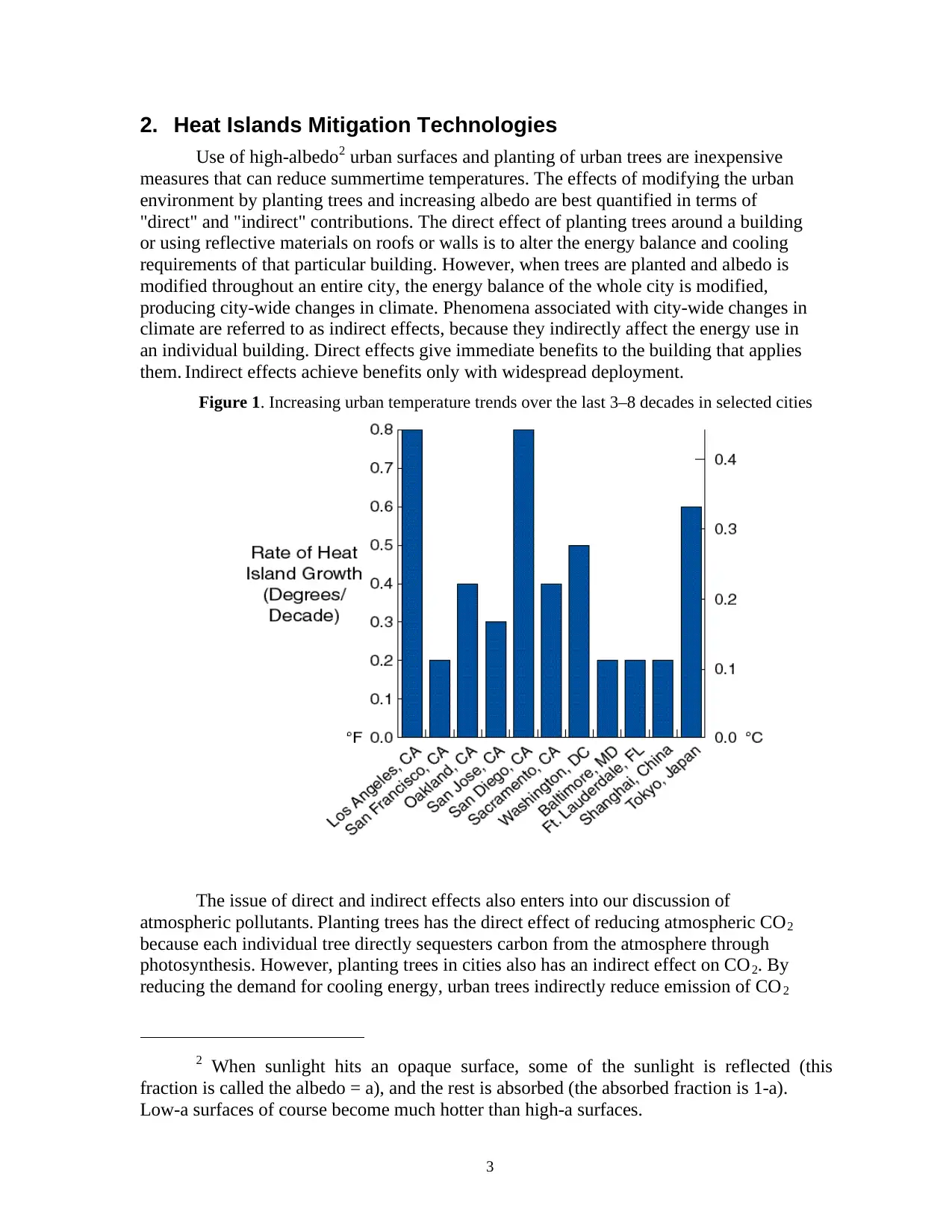
trend in urban temperatures in major cities of other countries (Figure 1.)
Not only do summer heat islands increase system-wide cooling loads, they also
increase smog production because of higher urban air temperatures (Taha et al. 1994).
Smog is created by photochemical reactions of pollutants in the air; and these reactions
are more likely to intensify at higher temperatures. For example, in Los Angeles, for
every 1°C the temperature rise above 22°C, incident of smog increases by 5%.
of 0.5 degrees C per decade (Akbari et al. 2001). Every degree increase adds about 500
megawatts (MW) to the air conditioning load in the Los Angeles Basin (Akbari et al.
2001). Similar increases are taxing the ability of developing countries to meet urban
electricity demand, while increasing global GHG emissions. Local air pollution (e.g.,
particulates, volatile organics, and nitrogen oxides, which are precursors to ozone
formation) are already a problem in most cities in developing countries. Higher
temperatures mean increased ozone formation, with accompanying health impacts. LBNL
has conducted research on both the electricity and air pollution effects of higher
temperatures, and devised methods to reduce both effects. We have tested reflective
coatings on building roofs and pavements, and tree-planting schemes, to demonstrate
potential cost-effective reductions of energy use—between 10 and 40 percent. Among
energy-efficiency solutions, cool roofs and cool pavements are ideally suited to hot
climates that prevail in much of the developing world. Cool (light-colored) pavements
also increase nighttime visibility and pavement durability.
Urban areas have typically darker surfaces and less vegetation than their
surroundings (HIG 2005). These differences affect climate, energy use, and habitability
of cities. At the building scale, dark roofs heat up more and thus raise the summertime
cooling demands of buildings. Collectively, dark surfaces and reduced vegetation warm
the air over urban areas, leading to the creation of urban "heat islands." On a clear
summer afternoon, the air temperature in a typical city is as much as 2.5K higher than in
the surrounding rural areas. Research shows that peak urban electric demand rises by 2–
4% for each 1K rise in daily maximum temperature above a threshold of 15–20°C. Thus,
the additional air-conditioning use caused by this urban air temperature increase is
responsible for 5–10% of urban peak electric demand.
In California, Goodridge (1987, 1989) shows that, before 1940, the average
urban-rural temperature differences for 31 urban and 31 rural stations in California were
always negative, i.e., cities were cooler than their surroundings. After 1940, when built-
up areas began to replace vegetation, the urban centers became as warm or warmer than
the suburbs. From 1965 to 1989, urban temperatures increased by about 1K.
Regardless of whether there is an urban-rural temperature difference, data suggest
that temperatures in cities are increasing. For example, the maximum temperatures in
downtown Los Angeles are now about 2.5K higher than they were in 1930. The
minimum temperatures are about 4K higher than they were in 1880 (Akbari et al. 2001).
In Washington, DC, temperatures increased by about 2K between 1871 and 1987. The
data indicate that this recent warming trend is typical of most U.S. metropolitan areas,
and exacerbates demand for energy. Limited available data also show this increasing
trend in urban temperatures in major cities of other countries (Figure 1.)
Not only do summer heat islands increase system-wide cooling loads, they also
increase smog production because of higher urban air temperatures (Taha et al. 1994).
Smog is created by photochemical reactions of pollutants in the air; and these reactions
are more likely to intensify at higher temperatures. For example, in Los Angeles, for
every 1°C the temperature rise above 22°C, incident of smog increases by 5%.
3
2. Heat Islands Mitigation Technologies
Use of high-albedo2 urban surfaces and planting of urban trees are inexpensive
measures that can reduce summertime temperatures. The effects of modifying the urban
environment by planting trees and increasing albedo are best quantified in terms of
"direct" and "indirect" contributions. The direct effect of planting trees around a building
or using reflective materials on roofs or walls is to alter the energy balance and cooling
requirements of that particular building. However, when trees are planted and albedo is
modified throughout an entire city, the energy balance of the whole city is modified,
producing city-wide changes in climate. Phenomena associated with city-wide changes in
climate are referred to as indirect effects, because they indirectly affect the energy use in
an individual building. Direct effects give immediate benefits to the building that applies
them. Indirect effects achieve benefits only with widespread deployment.
Figure 1. Increasing urban temperature trends over the last 3–8 decades in selected cities
The issue of direct and indirect effects also enters into our discussion of
atmospheric pollutants. Planting trees has the direct effect of reducing atmospheric CO2
because each individual tree directly sequesters carbon from the atmosphere through
photosynthesis. However, planting trees in cities also has an indirect effect on CO2. By
reducing the demand for cooling energy, urban trees indirectly reduce emission of CO2
2 When sunlight hits an opaque surface, some of the sunlight is reflected (this
fraction is called the albedo = a), and the rest is absorbed (the absorbed fraction is 1-a).
Low-a surfaces of course become much hotter than high-a surfaces.
2. Heat Islands Mitigation Technologies
Use of high-albedo2 urban surfaces and planting of urban trees are inexpensive
measures that can reduce summertime temperatures. The effects of modifying the urban
environment by planting trees and increasing albedo are best quantified in terms of
"direct" and "indirect" contributions. The direct effect of planting trees around a building
or using reflective materials on roofs or walls is to alter the energy balance and cooling
requirements of that particular building. However, when trees are planted and albedo is
modified throughout an entire city, the energy balance of the whole city is modified,
producing city-wide changes in climate. Phenomena associated with city-wide changes in
climate are referred to as indirect effects, because they indirectly affect the energy use in
an individual building. Direct effects give immediate benefits to the building that applies
them. Indirect effects achieve benefits only with widespread deployment.
Figure 1. Increasing urban temperature trends over the last 3–8 decades in selected cities
The issue of direct and indirect effects also enters into our discussion of
atmospheric pollutants. Planting trees has the direct effect of reducing atmospheric CO2
because each individual tree directly sequesters carbon from the atmosphere through
photosynthesis. However, planting trees in cities also has an indirect effect on CO2. By
reducing the demand for cooling energy, urban trees indirectly reduce emission of CO2
2 When sunlight hits an opaque surface, some of the sunlight is reflected (this
fraction is called the albedo = a), and the rest is absorbed (the absorbed fraction is 1-a).
Low-a surfaces of course become much hotter than high-a surfaces.
⊘ This is a preview!⊘
Do you want full access?
Subscribe today to unlock all pages.

Trusted by 1+ million students worldwide
4
from power plants. Akbari et al. (1990) showed that the amount of CO2 avoided via the
indirect effect is considerably greater than the amount sequestered directly. Similarly,
trees directly trap ozone precursors (by dry-deposition, a process in which ozone is
directly absorbed by tree leaves), and indirectly reduce the emission of these precursors
from power plants (by reducing combustion of fossil fuels and hence reducing NOx
emissions from power plants) (Taha 1996).
Over the past two decades, LBNL has been studying the energy savings and air-
quality benefits of heat-island mitigation measures. The approaches used for analysis
included direct measurements of the energy savings for cool roofs and shade trees,
simulations of direct and indirect energy savings of the mitigation measures (cool roofs,
cool pavements, and vegetation), and meteorological and air-quality simulations of the
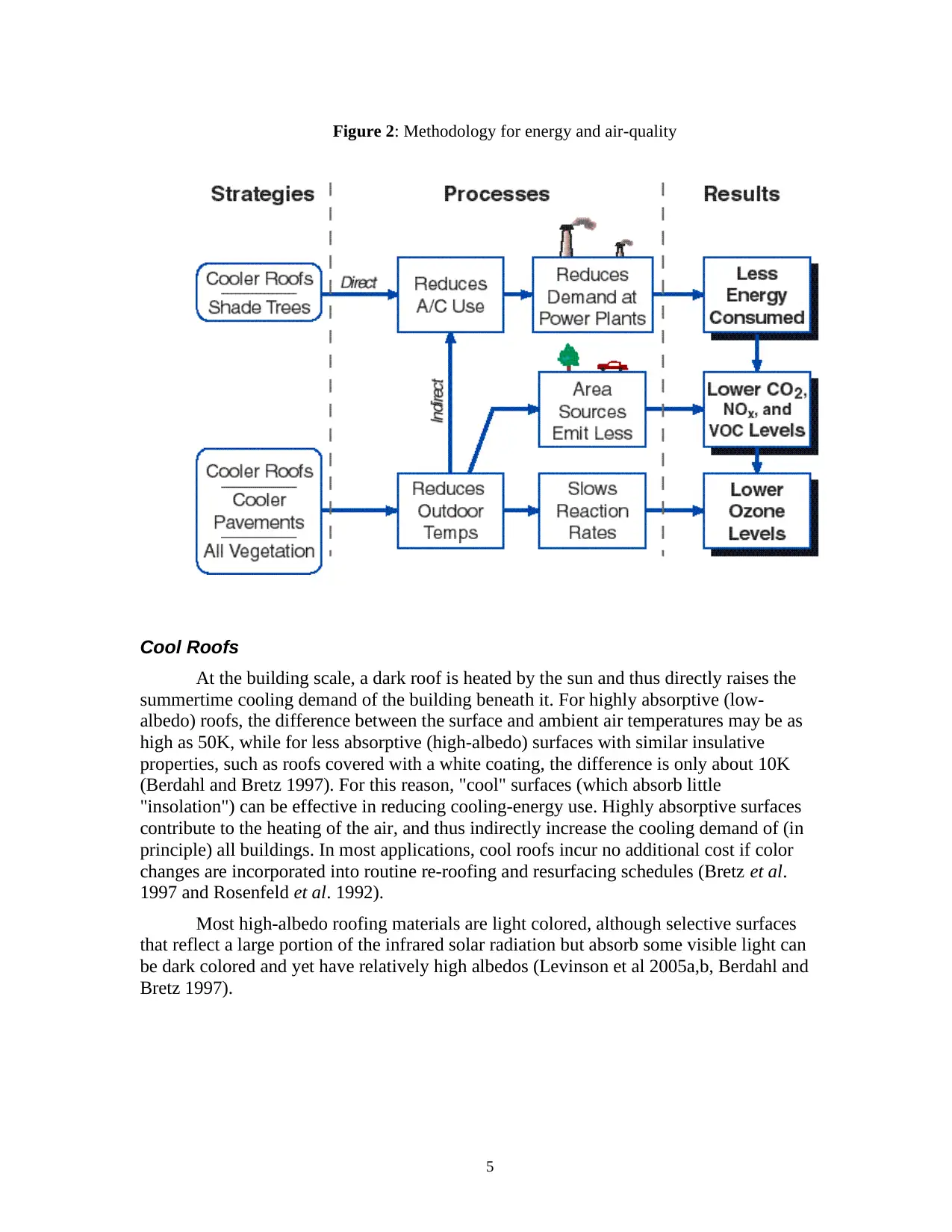
mitigation measures. Figure 2 depicts the overall methodology used in analyzing the
impact of heat-island mitigation measures on energy use and urban air pollution.
To understand the impacts of large-scale increases in albedo and vegetation on
urban climate and ozone air quality, mesoscale meteorological and photochemical models
are used (Taha et al. 1997). For example, Taha et al. (1995) and Taha (1996, 1997) used
the Colorado State University Mesoscale Model (CSUMM) to simulate the Los Angeles
Basin's meteorology and its sensitivity to changes in surface properties. More recently,
we have utilized the PSU/NCAR mesoscale model (known as MM5) to simulate the
meteorology. The Urban Airshed Model (UAM) was used to simulate the impact of the
changes in meteorology and emissions on ozone air quality. The CSUMM, MM5, and the
UAM essentially solve a set of coupled governing conservation equations representing
the conservation of mass (continuity), potential temperature (heat), momentum, water
vapor, and chemical species continuity to obtain prognostic meteorological fields and
pollutant species concentrations.
from power plants. Akbari et al. (1990) showed that the amount of CO2 avoided via the
indirect effect is considerably greater than the amount sequestered directly. Similarly,
trees directly trap ozone precursors (by dry-deposition, a process in which ozone is
directly absorbed by tree leaves), and indirectly reduce the emission of these precursors
from power plants (by reducing combustion of fossil fuels and hence reducing NOx
emissions from power plants) (Taha 1996).
Over the past two decades, LBNL has been studying the energy savings and air-
quality benefits of heat-island mitigation measures. The approaches used for analysis
included direct measurements of the energy savings for cool roofs and shade trees,
simulations of direct and indirect energy savings of the mitigation measures (cool roofs,
cool pavements, and vegetation), and meteorological and air-quality simulations of the
mitigation measures. Figure 2 depicts the overall methodology used in analyzing the
impact of heat-island mitigation measures on energy use and urban air pollution.
To understand the impacts of large-scale increases in albedo and vegetation on
urban climate and ozone air quality, mesoscale meteorological and photochemical models
are used (Taha et al. 1997). For example, Taha et al. (1995) and Taha (1996, 1997) used
the Colorado State University Mesoscale Model (CSUMM) to simulate the Los Angeles
Basin's meteorology and its sensitivity to changes in surface properties. More recently,
we have utilized the PSU/NCAR mesoscale model (known as MM5) to simulate the
meteorology. The Urban Airshed Model (UAM) was used to simulate the impact of the
changes in meteorology and emissions on ozone air quality. The CSUMM, MM5, and the
UAM essentially solve a set of coupled governing conservation equations representing
the conservation of mass (continuity), potential temperature (heat), momentum, water
vapor, and chemical species continuity to obtain prognostic meteorological fields and
pollutant species concentrations.
Paraphrase This Document
Need a fresh take? Get an instant paraphrase of this document with our AI Paraphraser
5
Figure 2: Methodology for energy and air-quality
Cool Roofs
At the building scale, a dark roof is heated by the sun and thus directly raises the
summertime cooling demand of the building beneath it. For highly absorptive (low-
albedo) roofs, the difference between the surface and ambient air temperatures may be as
high as 50K, while for less absorptive (high-albedo) surfaces with similar insulative
properties, such as roofs covered with a white coating, the difference is only about 10K
(Berdahl and Bretz 1997). For this reason, "cool" surfaces (which absorb little
"insolation") can be effective in reducing cooling-energy use. Highly absorptive surfaces
contribute to the heating of the air, and thus indirectly increase the cooling demand of (in
principle) all buildings. In most applications, cool roofs incur no additional cost if color
changes are incorporated into routine re-roofing and resurfacing schedules (Bretz et al.
1997 and Rosenfeld et al. 1992).
Most high-albedo roofing materials are light colored, although selective surfaces
that reflect a large portion of the infrared solar radiation but absorb some visible light can
be dark colored and yet have relatively high albedos (Levinson et al 2005a,b, Berdahl and
Bretz 1997).
Figure 2: Methodology for energy and air-quality
Cool Roofs
At the building scale, a dark roof is heated by the sun and thus directly raises the
summertime cooling demand of the building beneath it. For highly absorptive (low-
albedo) roofs, the difference between the surface and ambient air temperatures may be as
high as 50K, while for less absorptive (high-albedo) surfaces with similar insulative
properties, such as roofs covered with a white coating, the difference is only about 10K
(Berdahl and Bretz 1997). For this reason, "cool" surfaces (which absorb little
"insolation") can be effective in reducing cooling-energy use. Highly absorptive surfaces
contribute to the heating of the air, and thus indirectly increase the cooling demand of (in
principle) all buildings. In most applications, cool roofs incur no additional cost if color
changes are incorporated into routine re-roofing and resurfacing schedules (Bretz et al.
1997 and Rosenfeld et al. 1992).
Most high-albedo roofing materials are light colored, although selective surfaces
that reflect a large portion of the infrared solar radiation but absorb some visible light can
be dark colored and yet have relatively high albedos (Levinson et al 2005a,b, Berdahl and
Bretz 1997).
6
1. Energy and Smog Benefits of Cool Roofs
Direct Energy Savings
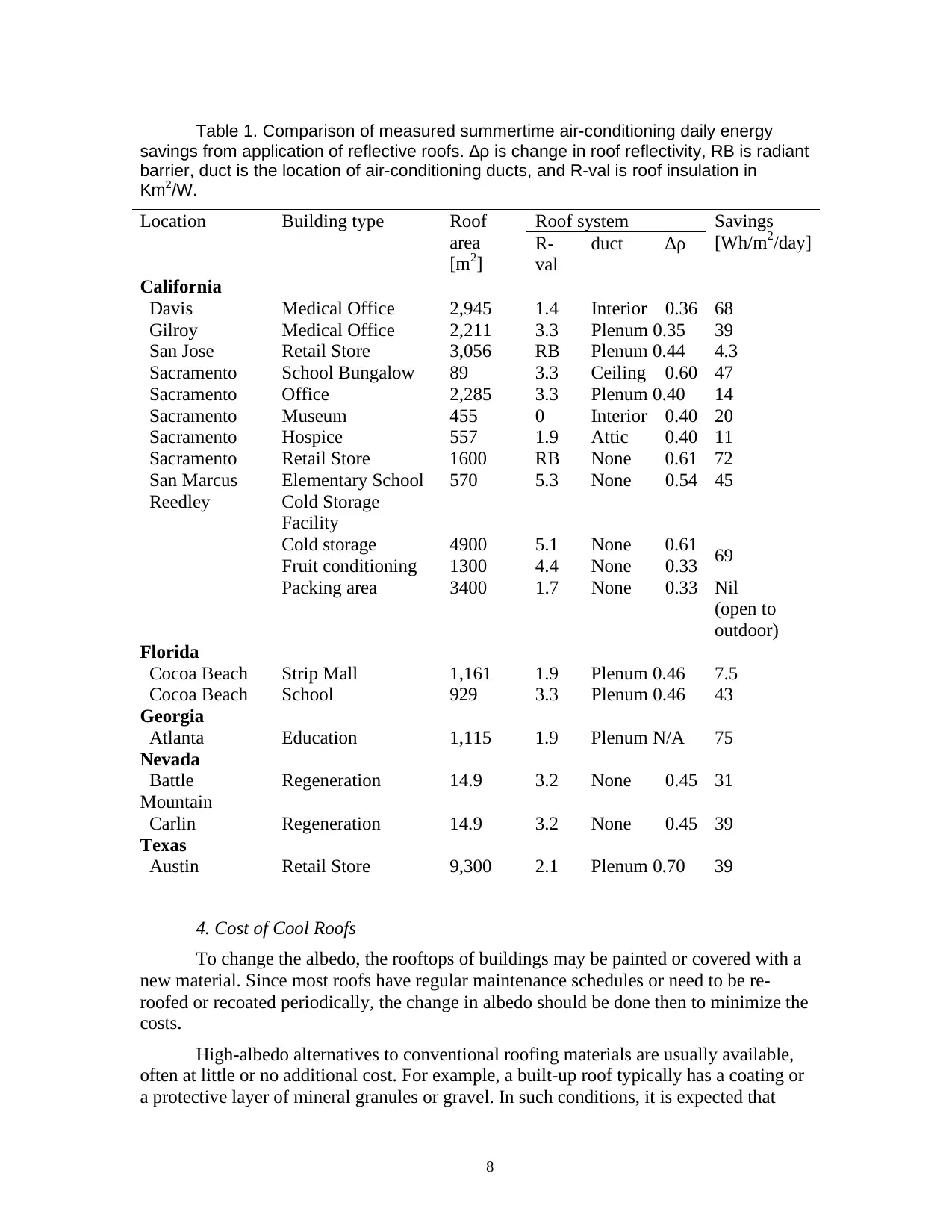
Several field studies have documented measured energy savings that result from
increasing roof solar reflectance (see Table 1). Akbari et al. (1997) reported monitored
cooling-energy savings of 46% and peak power savings of 20% achieved by increasing
the roof reflectance of two identical portable classrooms in Sacramento, California.
Konopacki et al. (1998) documented measured energy savings of 12–18% in two
commercial buildings in California. Konopacki and Akbari (2001) documented measured
energy savings of 12% in a large retail store in Austin, Texas. Akbari (2003) documented
energy savings of 31–39 Wh/m2/day in two small commercial buildings with very high
internal loads, by coating roofs with a white elastomer with a reflectivity of 0.70. Parker
et al. (1998) measured an average of 19% energy savings in eleven Florida residences by
applying reflective coatings on roofs. Parker et al. (1997) also monitored seven retail
stores in a strip mall in Florida before and after applying a high-albedo coating to the roof
and measured a 25% drop in seasonal cooling energy use. Hildebrandt et al. (1998)
observed daily energy savings of 17%, 26%, and 39% in an office, a museum and a
hospice, respectively, retrofitted with high-albedo roofs in Sacramento. Akridge (1998)
reported energy savings of 28% for a school building in Georgia which had an unpainted
galvanized roof that was coated with white acrylic. Boutwell and Salinas (1986) showed
that an office building in southern Mississippi saved 22% after the application of a high-
reflectance coating. Simpson and McPherson (1997) measured energy savings in the
range of 5–28% in several quarter-scale models in Tucson AZ.
In addition to these building monitoring studies, computer simulations of cooling
energy savings from increased roof albedo have been documented in residential and
commercial buildings by many studies, including Konopacki and Akbari (1998), Akbari
et al. (1998a), Parker et al. (1998), and Gartland et al. (1996). Konopacki et al. (1997)
estimated the direct energy savings potential from high-albedo roofs in eleven U.S.
metropolitan areas. The results showed that four major building types account for over
90% of the annual electricity and monetary savings: pre-1980 residences (55%), post-
1980 residences (15%), and office buildings and retail stores together (25%).
Furthermore, these four building types account for 93% of the total air-conditioned roof
area. Regional savings were found to be a function of three factors: energy savings in the
air-conditioned residential and commercial building stock; the percentage of buildings
that were air-conditioned; and the aggregate regional roof area. Metropolitan-wide annual
savings from the application of cool roofs on residential and commercial buildings were
as much as $37M for Phoenix and $35M in Los Angeles and as low as $3M in the
heating-dominated climate of Philadelphia. Analysis of the scale of urban energy savings
potential was further refined for five cities: Baton Rouge, LA; Chicago, IL; Houston, TX;
Sacramento, CA; and Salt Lake City, UT by Konopacki and Akbari (2002, 2000).
The results for the 11 Metropolitan Statistical Areas (MSAs) were extrapolated to
estimate the savings in the entire United States. The study estimates that nationally light-
colored roofing could produce savings of about 10 TWh/yr (about 3.0% of the national
cooling-electricity use in residential and commercial buildings), an increase in natural gas
use by 26 GBtu/yr (1.6%), a decrease in peak electrical demand of 7 GW (2.5%)
1. Energy and Smog Benefits of Cool Roofs
Direct Energy Savings
Several field studies have documented measured energy savings that result from
increasing roof solar reflectance (see Table 1). Akbari et al. (1997) reported monitored
cooling-energy savings of 46% and peak power savings of 20% achieved by increasing
the roof reflectance of two identical portable classrooms in Sacramento, California.
Konopacki et al. (1998) documented measured energy savings of 12–18% in two
commercial buildings in California. Konopacki and Akbari (2001) documented measured
energy savings of 12% in a large retail store in Austin, Texas. Akbari (2003) documented
energy savings of 31–39 Wh/m2/day in two small commercial buildings with very high
internal loads, by coating roofs with a white elastomer with a reflectivity of 0.70. Parker
et al. (1998) measured an average of 19% energy savings in eleven Florida residences by
applying reflective coatings on roofs. Parker et al. (1997) also monitored seven retail
stores in a strip mall in Florida before and after applying a high-albedo coating to the roof
and measured a 25% drop in seasonal cooling energy use. Hildebrandt et al. (1998)
observed daily energy savings of 17%, 26%, and 39% in an office, a museum and a
hospice, respectively, retrofitted with high-albedo roofs in Sacramento. Akridge (1998)
reported energy savings of 28% for a school building in Georgia which had an unpainted
galvanized roof that was coated with white acrylic. Boutwell and Salinas (1986) showed
that an office building in southern Mississippi saved 22% after the application of a high-
reflectance coating. Simpson and McPherson (1997) measured energy savings in the
range of 5–28% in several quarter-scale models in Tucson AZ.
In addition to these building monitoring studies, computer simulations of cooling
energy savings from increased roof albedo have been documented in residential and
commercial buildings by many studies, including Konopacki and Akbari (1998), Akbari
et al. (1998a), Parker et al. (1998), and Gartland et al. (1996). Konopacki et al. (1997)
estimated the direct energy savings potential from high-albedo roofs in eleven U.S.
metropolitan areas. The results showed that four major building types account for over
90% of the annual electricity and monetary savings: pre-1980 residences (55%), post-
1980 residences (15%), and office buildings and retail stores together (25%).
Furthermore, these four building types account for 93% of the total air-conditioned roof
area. Regional savings were found to be a function of three factors: energy savings in the
air-conditioned residential and commercial building stock; the percentage of buildings
that were air-conditioned; and the aggregate regional roof area. Metropolitan-wide annual
savings from the application of cool roofs on residential and commercial buildings were
as much as $37M for Phoenix and $35M in Los Angeles and as low as $3M in the
heating-dominated climate of Philadelphia. Analysis of the scale of urban energy savings
potential was further refined for five cities: Baton Rouge, LA; Chicago, IL; Houston, TX;
Sacramento, CA; and Salt Lake City, UT by Konopacki and Akbari (2002, 2000).
The results for the 11 Metropolitan Statistical Areas (MSAs) were extrapolated to
estimate the savings in the entire United States. The study estimates that nationally light-
colored roofing could produce savings of about 10 TWh/yr (about 3.0% of the national
cooling-electricity use in residential and commercial buildings), an increase in natural gas
use by 26 GBtu/yr (1.6%), a decrease in peak electrical demand of 7 GW (2.5%)
⊘ This is a preview!⊘
Do you want full access?
Subscribe today to unlock all pages.
Trusted by 1+ million students worldwide
7
(equivalent to 14 power plants each with a capacity of 0.5 GW), and a decrease in net
annual energy bills for the rate-payers of $750M.
Indirect Energy and Smog Benefits
Using the Los Angeles Basin as a case study, Taha (1996, 1997) examined the
impacts of using cool surfaces (cool roofs and pavements) on urban air temperature and
thus on cooling-energy use and smog. In these simulations, Taha estimates that about
50% of the urbanized area in the L.A. Basin is covered by roofs and roads, the albedos of
which can realistically be raised by 0.30 when they undergo normal repairs. This results
in a 2K cooling at 3 p.m. during an August episode. This summertime temperature
reduction has a significant effect on further reducing building cooling-energy use. The
annual savings in Los Angeles are estimated at $21M (Rosenfeld et al. 1998).
We have also simulated the impact of urban-wide cooling in Los Angeles on
smog; the results show a significant reduction in ozone concentration. The simulations
predict a reduction of 10–20% in population-weighted smog (ozone). In L.A., where
smog is especially serious, the potential savings were valued at $104M/year (Rosenfeld et
al. 1998).
2. Other Benefits of Cool Roofs
Another benefit of a light-colored roof is a potential increase in its useful life. The
diurnal temperature fluctuation and concomitant expansion and contraction of a light-
colored roof is smaller than that of a dark one. Also, the degradation of materials
resulting from the absorption of ultra-violet light is a temperature-dependent process. For
these reasons, cooler roofs may last longer than hot roofs of the same material
3. Potential Problems with Cool Roofs
Several possible problems may arise from the use of reflective roofing materials
(Bretz and Akbari 1994, 1997). A drastic increase in the overall albedo of the many roofs
in a city has the potential to create glare and visual discomfort if not kept to a reasonable
level. Fortunately, the glare for flat roofs is not a major problem for those who are at
street level. For sloped roofs, the problem of glare should be studied in detail before
proceeding with a full-scale implementation of this measure.
In addition, many types of building materials, such as tar roofing, are not well
adapted to painting. Although such materials could be specially designed to have a higher
albedo, this would entail a greater expense than painting. Additionally, to maintain a high
albedo, roofs may need to be recoated or rewashed on a regular basis. The cost of a
regular maintenance program could be significant.
A possible conflict of great concern is the fact that building owners and architects
like to have the choice as to what color to select for their rooftops. This is particularly a
concern for sloped roofs.
(equivalent to 14 power plants each with a capacity of 0.5 GW), and a decrease in net
annual energy bills for the rate-payers of $750M.
Indirect Energy and Smog Benefits
Using the Los Angeles Basin as a case study, Taha (1996, 1997) examined the
impacts of using cool surfaces (cool roofs and pavements) on urban air temperature and
thus on cooling-energy use and smog. In these simulations, Taha estimates that about
50% of the urbanized area in the L.A. Basin is covered by roofs and roads, the albedos of
which can realistically be raised by 0.30 when they undergo normal repairs. This results
in a 2K cooling at 3 p.m. during an August episode. This summertime temperature
reduction has a significant effect on further reducing building cooling-energy use. The
annual savings in Los Angeles are estimated at $21M (Rosenfeld et al. 1998).
We have also simulated the impact of urban-wide cooling in Los Angeles on
smog; the results show a significant reduction in ozone concentration. The simulations
predict a reduction of 10–20% in population-weighted smog (ozone). In L.A., where
smog is especially serious, the potential savings were valued at $104M/year (Rosenfeld et
al. 1998).
2. Other Benefits of Cool Roofs
Another benefit of a light-colored roof is a potential increase in its useful life. The
diurnal temperature fluctuation and concomitant expansion and contraction of a light-
colored roof is smaller than that of a dark one. Also, the degradation of materials
resulting from the absorption of ultra-violet light is a temperature-dependent process. For
these reasons, cooler roofs may last longer than hot roofs of the same material
3. Potential Problems with Cool Roofs
Several possible problems may arise from the use of reflective roofing materials
(Bretz and Akbari 1994, 1997). A drastic increase in the overall albedo of the many roofs
in a city has the potential to create glare and visual discomfort if not kept to a reasonable
level. Fortunately, the glare for flat roofs is not a major problem for those who are at
street level. For sloped roofs, the problem of glare should be studied in detail before
proceeding with a full-scale implementation of this measure.
In addition, many types of building materials, such as tar roofing, are not well
adapted to painting. Although such materials could be specially designed to have a higher
albedo, this would entail a greater expense than painting. Additionally, to maintain a high
albedo, roofs may need to be recoated or rewashed on a regular basis. The cost of a
regular maintenance program could be significant.
A possible conflict of great concern is the fact that building owners and architects
like to have the choice as to what color to select for their rooftops. This is particularly a
concern for sloped roofs.
Paraphrase This Document
Need a fresh take? Get an instant paraphrase of this document with our AI Paraphraser
8
Table 1. Comparison of measured summertime air-conditioning daily energy
savings from application of reflective roofs. ∆ρ is change in roof reflectivity, RB is radiant
barrier, duct is the location of air-conditioning ducts, and R-val is roof insulation in
Km2/W.
Roof systemLocation Building type Roof
area
[m2]
R-
val
duct ∆ρ
Savings
[Wh/m2/day]
California
Davis Medical Office 2,945 1.4 Interior 0.36 68
Gilroy Medical Office 2,211 3.3 Plenum 0.35 39
San Jose Retail Store 3,056 RB Plenum 0.44 4.3
Sacramento School Bungalow 89 3.3 Ceiling 0.60 47
Sacramento Office 2,285 3.3 Plenum 0.40 14
Sacramento Museum 455 0 Interior 0.40 20
Sacramento Hospice 557 1.9 Attic 0.40 11
Sacramento Retail Store 1600 RB None 0.61 72
San Marcus Elementary School 570 5.3 None 0.54 45
Reedley Cold Storage
Facility
Cold storage 4900 5.1 None 0.61
Fruit conditioning 1300 4.4 None 0.33 69
Packing area 3400 1.7 None 0.33 Nil
(open to
outdoor)
Florida
Cocoa Beach Strip Mall 1,161 1.9 Plenum 0.46 7.5
Cocoa Beach School 929 3.3 Plenum 0.46 43
Georgia
Atlanta Education 1,115 1.9 Plenum N/A 75
Nevada
Battle
Mountain
Regeneration 14.9 3.2 None 0.45 31
Carlin Regeneration 14.9 3.2 None 0.45 39
Texas
Austin Retail Store 9,300 2.1 Plenum 0.70 39
4. Cost of Cool Roofs
To change the albedo, the rooftops of buildings may be painted or covered with a
new material. Since most roofs have regular maintenance schedules or need to be re-
roofed or recoated periodically, the change in albedo should be done then to minimize the
costs.
High-albedo alternatives to conventional roofing materials are usually available,
often at little or no additional cost. For example, a built-up roof typically has a coating or
a protective layer of mineral granules or gravel. In such conditions, it is expected that
Table 1. Comparison of measured summertime air-conditioning daily energy
savings from application of reflective roofs. ∆ρ is change in roof reflectivity, RB is radiant
barrier, duct is the location of air-conditioning ducts, and R-val is roof insulation in
Km2/W.
Roof systemLocation Building type Roof
area
[m2]
R-
val
duct ∆ρ
Savings
[Wh/m2/day]
California
Davis Medical Office 2,945 1.4 Interior 0.36 68
Gilroy Medical Office 2,211 3.3 Plenum 0.35 39
San Jose Retail Store 3,056 RB Plenum 0.44 4.3
Sacramento School Bungalow 89 3.3 Ceiling 0.60 47
Sacramento Office 2,285 3.3 Plenum 0.40 14
Sacramento Museum 455 0 Interior 0.40 20
Sacramento Hospice 557 1.9 Attic 0.40 11
Sacramento Retail Store 1600 RB None 0.61 72
San Marcus Elementary School 570 5.3 None 0.54 45
Reedley Cold Storage
Facility
Cold storage 4900 5.1 None 0.61
Fruit conditioning 1300 4.4 None 0.33 69
Packing area 3400 1.7 None 0.33 Nil
(open to
outdoor)
Florida
Cocoa Beach Strip Mall 1,161 1.9 Plenum 0.46 7.5
Cocoa Beach School 929 3.3 Plenum 0.46 43
Georgia
Atlanta Education 1,115 1.9 Plenum N/A 75
Nevada
Battle
Mountain
Regeneration 14.9 3.2 None 0.45 31
Carlin Regeneration 14.9 3.2 None 0.45 39
Texas
Austin Retail Store 9,300 2.1 Plenum 0.70 39
4. Cost of Cool Roofs
To change the albedo, the rooftops of buildings may be painted or covered with a
new material. Since most roofs have regular maintenance schedules or need to be re-
roofed or recoated periodically, the change in albedo should be done then to minimize the
costs.
High-albedo alternatives to conventional roofing materials are usually available,
often at little or no additional cost. For example, a built-up roof typically has a coating or
a protective layer of mineral granules or gravel. In such conditions, it is expected that
9
choosing a reflective material at the time of installation should not add to the cost of the
roof. Also, roofing shingles are available in a variety of colors, including white, at the
same price. The incremental price premium for choosing a white rather than a black
single-ply membrane roofing material is less than 10%. Cool roofing materials that
require an initial investment may turn out to be more attractive in terms of life-cycle cost
than conventional dark alternatives. Usually, the lower life-cycle cost results from longer
roof life and/or energy savings.
Cool Pavements
The practice of widespread paving of city streets with asphalt began only within
the past century. The advantages of this smooth and all-weather surface for the movement
of bicycles and automobiles are obvious, but some of the associated problems are perhaps
not so well appreciated. One consequence of covering streets with dark asphalt surfaces is
the increased heating of the city by sunlight. The pavements in turn heat the air. LBNL
has conducted studies to measure the effect of albedo on pavement temperature. The data
clearly indicate that significant modification of the pavement surface temperature can be
achieved: a 10K decrease in temperature for a 0.25 increase in albedo. If urban surfaces
were lighter in color, more of the incoming light would be reflected back into space and
the surfaces and the air would be cooler. This tends to reduce the need for air
conditioning. Pomerantz et al. (1997) present an overview of cool paving materials for
urban heat island mitigation.
1. Energy and Smog Benefits of Cool Pavements
Cool pavements provide only indirect effects through lowered ambient
temperatures. Lower temperature has two effects: 1) reduced demand for electricity for
air conditioning and 2) decreased production of smog (ozone). Rosenfeld et al. (1998)
estimated the cost savings of reduced demand for electricity and of the externalities of
lower ozone concentrations in the Los Angeles Basin.
Simulations for Los Angeles (L.A.) basin indicate that a reasonable change in the
albedo of the city could cause a noticeable decrease in temperature. Taha (1997)
predicted a 1.5K decrease in temperature of the downtown area. The lower temperatures
in the city are calculated based on the assumption that all roads and roofs are improved.
From the meteorological simulations of three days in each season, the temperature
changes for every day in a typical year were estimated for Burbank, typical of the hottest
1/3 of L.A. basin. The energy consumptions of typical buildings were then simulated for
the original weather and also for the modified weather. The differences are the annual
energy changes due to the decrease in ambient temperature. The result is a city-wide
annual saving of about $71M, due to combined albedo and vegetation changes. The kWh
savings attributable to the pavement are $15M/yr, or $0.012/m2-yr. Analysis of the hourly
demand indicates that cooler pavements could save an estimated 100 MW of peak power
in L.A.
The simulations of the effects of higher albedo on smog formation indicate that an
albedo change of 0.3 throughout the developed 25% of the city would yield a 12%
choosing a reflective material at the time of installation should not add to the cost of the
roof. Also, roofing shingles are available in a variety of colors, including white, at the
same price. The incremental price premium for choosing a white rather than a black
single-ply membrane roofing material is less than 10%. Cool roofing materials that
require an initial investment may turn out to be more attractive in terms of life-cycle cost
than conventional dark alternatives. Usually, the lower life-cycle cost results from longer
roof life and/or energy savings.
Cool Pavements
The practice of widespread paving of city streets with asphalt began only within
the past century. The advantages of this smooth and all-weather surface for the movement
of bicycles and automobiles are obvious, but some of the associated problems are perhaps
not so well appreciated. One consequence of covering streets with dark asphalt surfaces is
the increased heating of the city by sunlight. The pavements in turn heat the air. LBNL
has conducted studies to measure the effect of albedo on pavement temperature. The data
clearly indicate that significant modification of the pavement surface temperature can be
achieved: a 10K decrease in temperature for a 0.25 increase in albedo. If urban surfaces
were lighter in color, more of the incoming light would be reflected back into space and
the surfaces and the air would be cooler. This tends to reduce the need for air
conditioning. Pomerantz et al. (1997) present an overview of cool paving materials for
urban heat island mitigation.
1. Energy and Smog Benefits of Cool Pavements
Cool pavements provide only indirect effects through lowered ambient
temperatures. Lower temperature has two effects: 1) reduced demand for electricity for
air conditioning and 2) decreased production of smog (ozone). Rosenfeld et al. (1998)
estimated the cost savings of reduced demand for electricity and of the externalities of
lower ozone concentrations in the Los Angeles Basin.
Simulations for Los Angeles (L.A.) basin indicate that a reasonable change in the
albedo of the city could cause a noticeable decrease in temperature. Taha (1997)
predicted a 1.5K decrease in temperature of the downtown area. The lower temperatures
in the city are calculated based on the assumption that all roads and roofs are improved.
From the meteorological simulations of three days in each season, the temperature
changes for every day in a typical year were estimated for Burbank, typical of the hottest
1/3 of L.A. basin. The energy consumptions of typical buildings were then simulated for
the original weather and also for the modified weather. The differences are the annual
energy changes due to the decrease in ambient temperature. The result is a city-wide
annual saving of about $71M, due to combined albedo and vegetation changes. The kWh
savings attributable to the pavement are $15M/yr, or $0.012/m2-yr. Analysis of the hourly
demand indicates that cooler pavements could save an estimated 100 MW of peak power
in L.A.
The simulations of the effects of higher albedo on smog formation indicate that an
albedo change of 0.3 throughout the developed 25% of the city would yield a 12%
⊘ This is a preview!⊘
Do you want full access?
Subscribe today to unlock all pages.
Trusted by 1+ million students worldwide
10
decrease in the population-weighted ozone exceedance of the California air-quality
standard (Taha 1997). It has been estimated (Hall et al. 1992) that residents of L.A.
would be willing to pay about $10 billion per year to avoid the medical costs and lost
work time due to air pollution. The greater part of pollution is particulates, but the ozone
contribution averages about $3 billion/yr. Assuming a proportional relationship of the
cost with the amount of smog exceedance, the cooler-surfaced city would save 12% of $3
billion/yr, or $360M/yr. As above, we attribute about 21% of the saving to pavements.
Rosenfeld et al. (1998) value the benefits from smog improvement by altering the albedo
of all 1250km2 of pavements by 0.25 saves about $76M/year (about $0.06/m2 per year).
2. Other Benefits of Cool Pavements
It has long been known that the temperature of a pavement affects its performance
(Yoder & Witzak 1975). This has been emphasized by the new system of binder
specification advocated by the Strategic Highway Research Program (SHRP). Beginning
in 1987, this program led pavement experts to carry out the task of researching and then
recommending the best methods of making asphalt concrete pavements. A result of this
study was the issuance of specifications for the asphalt binder. The temperature range
which the pavement will endure is a primary consideration (Cominsky et al. 1994). The
performance grade (PG) is specified by two temperatures: (1) the average 7-day
maximum temperature that the pavement will likely encounter, and (2) the minimum
temperature the pavement will likely attain.
Reflectivity of pavements is also a safety factor in visibility at night and in wet
weather, affecting the demand for electric street lighting. Street lighting is more effective
if pavements are more reflective, which can lead to greater safety; or, alternatively, less
lighting could be used to obtain the same visibility. These benefits have not yet been
monetized.
3. Potential Problems with Cool Pavements
A practical drawback of high reflectivity is glare, but this does not appear to be a
problem. We suggest a change in resurfacing using not black asphalt, with an albedo of
about 0.05–0.12, but the application of a product with an albedo of about 0.35, similar to
that of cement concrete. The experiment to test whether this will be a problem has
already been performed: every day millions of people drive on cement concrete roads,
and we rarely hear of accidents caused by glare, or of people even complaining about the
glare on such roads.
There is also a concern that, after some time, light-colored pavement will darken
because of dirt. This tends to be true, but again, experience with cement concrete roads
suggests that the light color of the pavement persists after long usage. Most drivers can
see the difference in reflection between an asphalt and a cement concrete road when they
drive over them, even when the roads are old.
decrease in the population-weighted ozone exceedance of the California air-quality
standard (Taha 1997). It has been estimated (Hall et al. 1992) that residents of L.A.
would be willing to pay about $10 billion per year to avoid the medical costs and lost
work time due to air pollution. The greater part of pollution is particulates, but the ozone
contribution averages about $3 billion/yr. Assuming a proportional relationship of the
cost with the amount of smog exceedance, the cooler-surfaced city would save 12% of $3
billion/yr, or $360M/yr. As above, we attribute about 21% of the saving to pavements.
Rosenfeld et al. (1998) value the benefits from smog improvement by altering the albedo
of all 1250km2 of pavements by 0.25 saves about $76M/year (about $0.06/m2 per year).
2. Other Benefits of Cool Pavements
It has long been known that the temperature of a pavement affects its performance
(Yoder & Witzak 1975). This has been emphasized by the new system of binder
specification advocated by the Strategic Highway Research Program (SHRP). Beginning
in 1987, this program led pavement experts to carry out the task of researching and then
recommending the best methods of making asphalt concrete pavements. A result of this
study was the issuance of specifications for the asphalt binder. The temperature range
which the pavement will endure is a primary consideration (Cominsky et al. 1994). The
performance grade (PG) is specified by two temperatures: (1) the average 7-day
maximum temperature that the pavement will likely encounter, and (2) the minimum
temperature the pavement will likely attain.
Reflectivity of pavements is also a safety factor in visibility at night and in wet
weather, affecting the demand for electric street lighting. Street lighting is more effective
if pavements are more reflective, which can lead to greater safety; or, alternatively, less
lighting could be used to obtain the same visibility. These benefits have not yet been
monetized.
3. Potential Problems with Cool Pavements
A practical drawback of high reflectivity is glare, but this does not appear to be a
problem. We suggest a change in resurfacing using not black asphalt, with an albedo of
about 0.05–0.12, but the application of a product with an albedo of about 0.35, similar to
that of cement concrete. The experiment to test whether this will be a problem has
already been performed: every day millions of people drive on cement concrete roads,
and we rarely hear of accidents caused by glare, or of people even complaining about the
glare on such roads.
There is also a concern that, after some time, light-colored pavement will darken
because of dirt. This tends to be true, but again, experience with cement concrete roads
suggests that the light color of the pavement persists after long usage. Most drivers can
see the difference in reflection between an asphalt and a cement concrete road when they
drive over them, even when the roads are old.
Paraphrase This Document
Need a fresh take? Get an instant paraphrase of this document with our AI Paraphraser
11
4. Cost of Cool Pavements
It is clear that cooler pavements will have energy, environmental, and engineering
benefits. The issue is then whether there are ways to construct pavements that are
feasible, economical, and cooler. The economic question is whether the savings generated
by a cool pavement over its lifetime are greater than its extra cost. Properly, one should
distinguish between initial cost and lifetime costs (including maintenance, repair time,
and length of service of the road). Often the initial cost is decisive.
A typical asphalt concrete contains about 7% of asphalt by weight, or about 17%
by volume; the remainder is rock aggregate, except for a few percent of voids. In one ton
of mixed asphalt concrete the cost of materials only is about $28/ton, of which about $9
is in the binder and $19 is in the aggregate. For a pavement about 10 cm thick (4 inches),
with a density of 2.1 ton/m3, the cost of the binder is about $2 per m2 and aggregate costs
about $4.2 per m2.
Using the assumptions for Los Angeles, a cooler pavement would generate a
stream of savings of $0.07/m2 per year for the lifetime of the road—about 20 years. The
present value of potential savings at a real discount rate of 3% is $1.1/m2. This saving
would allow for purchase of a binder costing $3/m2, instead of $2/m2—or 50% more.
Alternatively, one could buy aggregate; instead of spending $4.2/m2, one can now afford
$5.2/m2 (a 20% more expensive, whiter aggregate). It is doubtful that such modest
increases in costs can buy much whiter pavements.
At some times in its life, a pavement needs to be maintained, i.e., resurfaced. This
offers an opportunity to get cooler pavements economically. Good maintenance practice
calls for resurfacing a new road after about 10 years (Dunn 1996) and the lifetime of
resurfacing is only about 5 years. Hence, within 10 years, all the asphalt concrete surfaces
in a city can be made light colored. As part of this regular maintenance, any additional
cost of the whiter material will be minimized.
For pavements, the energy and smog savings may not pay for whiter roads.
However, if the lighter-colored road leads to substantially longer lifetime, the initial
higher cost may be offset by lifetime savings.
Shade trees and urban vegetation
Akbari 2002 provides an overview of benefits and cost associated with planting
urban trees. Shade trees intercept sunlight before it warms a building. The urban forest
cools the air by evapotranspiration. Trees also decrease the wind speed under their
canopy and shield buildings from cold winter breezes. Urban shade trees offer significant
benefits by both reducing building air conditioning and lowering air temperature, and
thus improving urban air quality by reducing smog. Over the life of a tree, the savings
associated with these benefits vary by climate region and can be up to $200 per tree. The
cost of planting trees and maintaining them can vary from $10 to $500 per tree. Tree
planting programs can be designed to be low cost, so they can offer savings to
communities that plant trees.
4. Cost of Cool Pavements
It is clear that cooler pavements will have energy, environmental, and engineering
benefits. The issue is then whether there are ways to construct pavements that are
feasible, economical, and cooler. The economic question is whether the savings generated
by a cool pavement over its lifetime are greater than its extra cost. Properly, one should
distinguish between initial cost and lifetime costs (including maintenance, repair time,
and length of service of the road). Often the initial cost is decisive.
A typical asphalt concrete contains about 7% of asphalt by weight, or about 17%
by volume; the remainder is rock aggregate, except for a few percent of voids. In one ton
of mixed asphalt concrete the cost of materials only is about $28/ton, of which about $9
is in the binder and $19 is in the aggregate. For a pavement about 10 cm thick (4 inches),
with a density of 2.1 ton/m3, the cost of the binder is about $2 per m2 and aggregate costs
about $4.2 per m2.
Using the assumptions for Los Angeles, a cooler pavement would generate a
stream of savings of $0.07/m2 per year for the lifetime of the road—about 20 years. The
present value of potential savings at a real discount rate of 3% is $1.1/m2. This saving
would allow for purchase of a binder costing $3/m2, instead of $2/m2—or 50% more.
Alternatively, one could buy aggregate; instead of spending $4.2/m2, one can now afford
$5.2/m2 (a 20% more expensive, whiter aggregate). It is doubtful that such modest
increases in costs can buy much whiter pavements.
At some times in its life, a pavement needs to be maintained, i.e., resurfaced. This
offers an opportunity to get cooler pavements economically. Good maintenance practice
calls for resurfacing a new road after about 10 years (Dunn 1996) and the lifetime of
resurfacing is only about 5 years. Hence, within 10 years, all the asphalt concrete surfaces
in a city can be made light colored. As part of this regular maintenance, any additional
cost of the whiter material will be minimized.
For pavements, the energy and smog savings may not pay for whiter roads.
However, if the lighter-colored road leads to substantially longer lifetime, the initial
higher cost may be offset by lifetime savings.
Shade trees and urban vegetation
Akbari 2002 provides an overview of benefits and cost associated with planting
urban trees. Shade trees intercept sunlight before it warms a building. The urban forest
cools the air by evapotranspiration. Trees also decrease the wind speed under their
canopy and shield buildings from cold winter breezes. Urban shade trees offer significant
benefits by both reducing building air conditioning and lowering air temperature, and
thus improving urban air quality by reducing smog. Over the life of a tree, the savings
associated with these benefits vary by climate region and can be up to $200 per tree. The
cost of planting trees and maintaining them can vary from $10 to $500 per tree. Tree
planting programs can be designed to be low cost, so they can offer savings to
communities that plant trees.
12
Energy and Smog Benefits of Shade Trees
Direct Energy Savings
Data on measured energy savings from urban trees are scarce. In one experiment,
Parker (1981) measured the cooling-energy consumption of a temporary building in
Florida before and after adding trees and shrubs and found cooling-electricity savings of
up to 50%. In the summer of 1992, Akbari et al. (1997) monitored peak-power and
cooling-energy savings from shade trees in two houses in Sacramento, California. The
collected data included air-conditioning electricity use, indoor and outdoor dry-bulb
temperatures and humidities, roof and ceiling surface temperatures, inside and outside
wall temperatures, insolation, and wind speed and direction. The shading and
microclimate effects of the trees at the two monitored houses yielded seasonal cooling-
energy savings of 30%, corresponding to average savings of 3.6 and 4.8 kWh/day. Peak-
demand savings for the same houses were 0.6 and 0.8 kW (about 27% savings in one
house and 42% in the other).
DeWalle et al. (1983), Heisler (1989), and Huang et al. (1990) have focused on
measuring and simulating the wind-shielding effects of tree on heating- and cooling-
energy use. Their analysis indicated that a reduction in infiltration because of trees would
save heating-energy use. However, in climates with cooling-energy demand, the impact
of windbreak on cooling is fairly small compared to the shading effects of trees and,
depending on climate, it could decrease or increase cooling-energy use. In cold climates,
the wind-shielding effect of trees can reduce heat-energy use in buildings. However,
using strategically placed deciduous trees can decrease winter heating penalties. Akbari
and Taha (1992) simulated the wind-shielding impact of trees on heating-energy use in
four Canadian cities. For several prototypical residential buildings, they estimated
heating-energy savings in the range of 10–15%.
Taha et al. (1996) simulated the meteorological impact of large-scale tree-
planting programs in 10 U.S. metropolitan areas: Atlanta GA, Chicago IL, Dallas TX,
Houston TX, Los Angeles CA, Miami FL, New York NY, Philadelphia PA, Phoenix AZ,
and Washington, DC. The DOE-2 building simulation program was then used to estimate
the direct and indirect impacts of trees on saving cooling-energy use for two building
prototypes: a single-family residence and an office. The calculations accounted for a
potential increase in winter heating-energy use, and showed that in most hot cities,
shading a building can save annually $5 to $25 per 100m2 of roof area of residential and
commercial buildings.
Indirect Energy and Smog Benefits
Taha et al. (1996) estimated the impact on ambient temperature resulting from a
large-scale tree-planting program in the selected 10 cities. They used a three-dimensional
meteorological model to simulate the potential impact of trees on ambient temperature for
each region. The mesoscale simulations showed that, on average, trees can cool down
cities by about 0.3K to 1K at 2 pm.; in some simulation cells the temperature was
decreased by up to 3K. The corresponding air-conditioning savings resulting from
ambient cooling by trees in hot climates ranges from $5 to $10 per year per 100m2 of roof
Energy and Smog Benefits of Shade Trees
Direct Energy Savings
Data on measured energy savings from urban trees are scarce. In one experiment,
Parker (1981) measured the cooling-energy consumption of a temporary building in
Florida before and after adding trees and shrubs and found cooling-electricity savings of
up to 50%. In the summer of 1992, Akbari et al. (1997) monitored peak-power and
cooling-energy savings from shade trees in two houses in Sacramento, California. The
collected data included air-conditioning electricity use, indoor and outdoor dry-bulb
temperatures and humidities, roof and ceiling surface temperatures, inside and outside
wall temperatures, insolation, and wind speed and direction. The shading and
microclimate effects of the trees at the two monitored houses yielded seasonal cooling-
energy savings of 30%, corresponding to average savings of 3.6 and 4.8 kWh/day. Peak-
demand savings for the same houses were 0.6 and 0.8 kW (about 27% savings in one
house and 42% in the other).
DeWalle et al. (1983), Heisler (1989), and Huang et al. (1990) have focused on
measuring and simulating the wind-shielding effects of tree on heating- and cooling-
energy use. Their analysis indicated that a reduction in infiltration because of trees would
save heating-energy use. However, in climates with cooling-energy demand, the impact
of windbreak on cooling is fairly small compared to the shading effects of trees and,
depending on climate, it could decrease or increase cooling-energy use. In cold climates,
the wind-shielding effect of trees can reduce heat-energy use in buildings. However,
using strategically placed deciduous trees can decrease winter heating penalties. Akbari
and Taha (1992) simulated the wind-shielding impact of trees on heating-energy use in
four Canadian cities. For several prototypical residential buildings, they estimated
heating-energy savings in the range of 10–15%.
Taha et al. (1996) simulated the meteorological impact of large-scale tree-
planting programs in 10 U.S. metropolitan areas: Atlanta GA, Chicago IL, Dallas TX,
Houston TX, Los Angeles CA, Miami FL, New York NY, Philadelphia PA, Phoenix AZ,
and Washington, DC. The DOE-2 building simulation program was then used to estimate
the direct and indirect impacts of trees on saving cooling-energy use for two building
prototypes: a single-family residence and an office. The calculations accounted for a
potential increase in winter heating-energy use, and showed that in most hot cities,
shading a building can save annually $5 to $25 per 100m2 of roof area of residential and
commercial buildings.
Indirect Energy and Smog Benefits
Taha et al. (1996) estimated the impact on ambient temperature resulting from a
large-scale tree-planting program in the selected 10 cities. They used a three-dimensional
meteorological model to simulate the potential impact of trees on ambient temperature for
each region. The mesoscale simulations showed that, on average, trees can cool down
cities by about 0.3K to 1K at 2 pm.; in some simulation cells the temperature was
decreased by up to 3K. The corresponding air-conditioning savings resulting from
ambient cooling by trees in hot climates ranges from $5 to $10 per year per 100m2 of roof
⊘ This is a preview!⊘
Do you want full access?
Subscribe today to unlock all pages.
Trusted by 1+ million students worldwide

1 out of 19


Related Documents


Your All-in-One AI-Powered Toolkit for Academic Success.
+13062052269
info@desklib.com
Available 24*7 on WhatsApp / Email
![[object Object]](/_next/static/media/star-bottom.7253800d.svg)
Unlock your academic potential
Copyright © 2020–2026 A2Z Services. All Rights Reserved. Developed and managed by ZUCOL.