Strategic Analysis of the US Airline Industry: MNG93002 Report
VerifiedAdded on 2023/01/13
|15
|3439
|63
Report
AI Summary
This report offers a comprehensive analysis of the US airline industry, examining its strategic position and strategic choices within a competitive environment. It begins with an introduction to the industry, followed by a discussion of relevant strategic concepts and tools, including PESTEL and Porter's Five Forces analyses. The PESTEL analysis explores political, economic, social, technological, environmental, and legal factors impacting the industry, while the Porter's Five Forces framework assesses the competitive landscape. The report then delves into the business and corporate strategies employed by US airlines, discussing the advantages and disadvantages of various strategic choices. The analysis includes a detailed examination of the industry's strengths, weaknesses, opportunities, and threats, culminating in strategic recommendations for improving profitability and navigating the dynamic airline market. The report aims to provide a nuanced understanding of the US airline industry's challenges and opportunities.
US Airline Industry
By (Name)
Course
Professor
University
Date
By (Name)
Course
Professor
University
Date

Paraphrase This Document
Need a fresh take? Get an instant paraphrase of this document with our AI Paraphraser
i
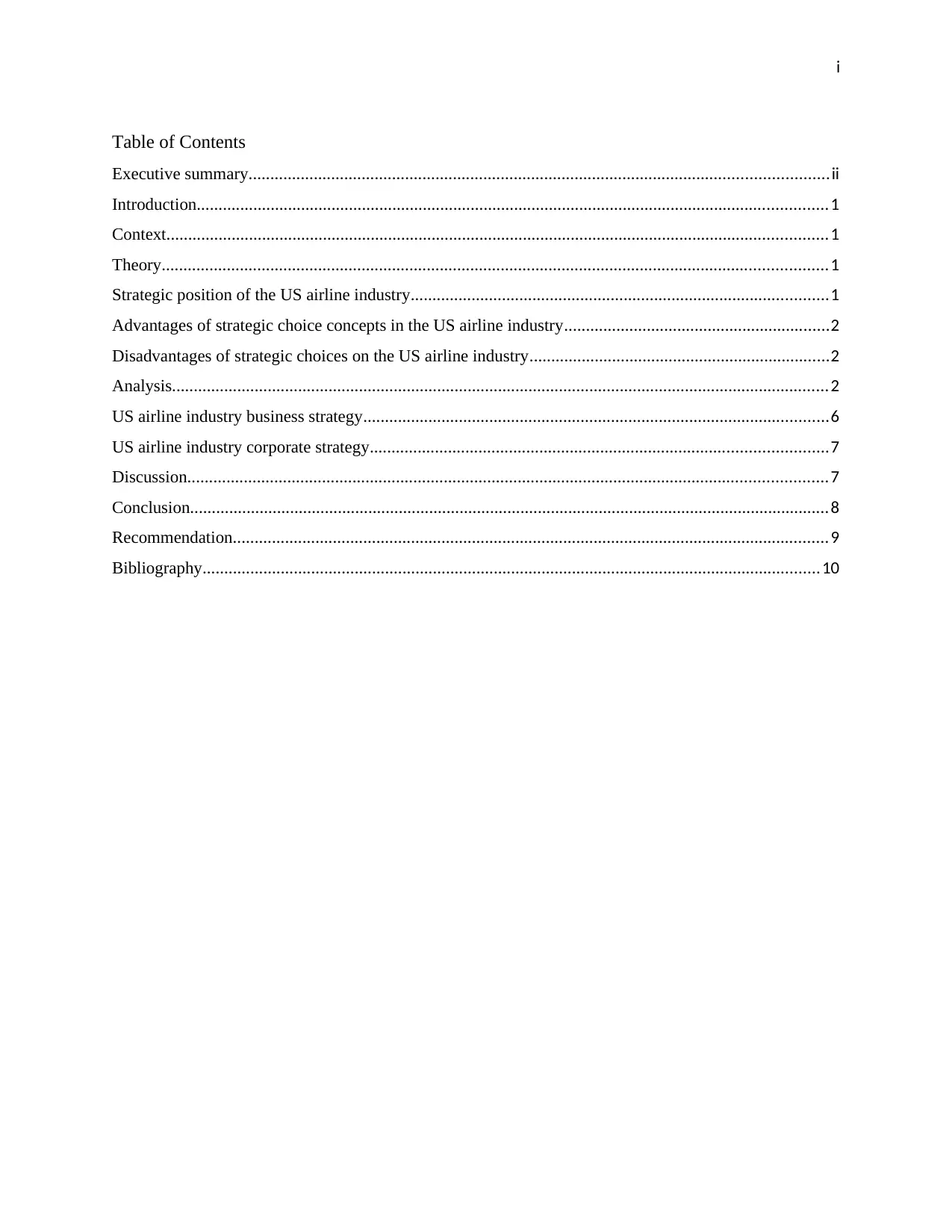
Table of Contents
Executive summary.....................................................................................................................................ii
Introduction.................................................................................................................................................1
Context........................................................................................................................................................1
Theory.........................................................................................................................................................1
Strategic position of the US airline industry................................................................................................1
Advantages of strategic choice concepts in the US airline industry.............................................................2
Disadvantages of strategic choices on the US airline industry.....................................................................2
Analysis.......................................................................................................................................................2
US airline industry business strategy...........................................................................................................6
US airline industry corporate strategy.........................................................................................................7
Discussion...................................................................................................................................................7
Conclusion...................................................................................................................................................8
Recommendation.........................................................................................................................................9
Bibliography..............................................................................................................................................10
Table of Contents
Executive summary.....................................................................................................................................ii
Introduction.................................................................................................................................................1
Context........................................................................................................................................................1
Theory.........................................................................................................................................................1
Strategic position of the US airline industry................................................................................................1
Advantages of strategic choice concepts in the US airline industry.............................................................2
Disadvantages of strategic choices on the US airline industry.....................................................................2
Analysis.......................................................................................................................................................2
US airline industry business strategy...........................................................................................................6
US airline industry corporate strategy.........................................................................................................7
Discussion...................................................................................................................................................7
Conclusion...................................................................................................................................................8
Recommendation.........................................................................................................................................9
Bibliography..............................................................................................................................................10
ii
Executive summary
Just like any other industry in the world the US airline industry has positive and negative
impacts from its operational system. The US airline industry faces political, economic, social,
technological, legal, and environmental factors that affect the industry in general. However, the
industry has strengths and opportunities which helps it to effectively encounter the problems.
Despite the strengths, the industry faces threats in its day to day operation. This is outlined
through the PESTLE analysis and the porter’s five forces. The US airline has placed itself in a
strategic position and has made strategic choices to counter the threats and maintain its
profitability. The US airline industry has benefited from the strategic choices of airline such as
Alaska and Delta. The Alaska airline customer service has been a relevant strategic choice for
the US airline because it has led an increase in demand.
Executive summary
Just like any other industry in the world the US airline industry has positive and negative
impacts from its operational system. The US airline industry faces political, economic, social,
technological, legal, and environmental factors that affect the industry in general. However, the
industry has strengths and opportunities which helps it to effectively encounter the problems.
Despite the strengths, the industry faces threats in its day to day operation. This is outlined
through the PESTLE analysis and the porter’s five forces. The US airline has placed itself in a
strategic position and has made strategic choices to counter the threats and maintain its
profitability. The US airline industry has benefited from the strategic choices of airline such as
Alaska and Delta. The Alaska airline customer service has been a relevant strategic choice for
the US airline because it has led an increase in demand.
⊘ This is a preview!⊘
Do you want full access?
Subscribe today to unlock all pages.

Trusted by 1+ million students worldwide
1
Introduction
The US airline industry is one the best airline industries in the world. The Airline has had
challenges such as flight delays, long TSA lines, cancellation of flights, and law enforcement on
the industry which complicated the journey of the airline in achieving its goals. However, since
its inception, the united airlines has been growing tremendously making US industry the largest
in the world. However, the US airline industry has experienced extreme competition from other
airline industries globally which has reduced its profitability.
Context
Historical overview
The airline has had a history of complicated deregulation and regulation just like any
other airline. The regulation on the United States airline was the airmail act of 1925. This act
covered the federal regulation of air traffic, airmen, aircraft, and navigational facilities. The
introduction of air transport in the United States has been of great importance to the country and
the entire world. The US airline industry comprises of carriers such as delta airlines, JetBlue,
American Airlines, and southwest airlines. The airline has made it easier for family reunions,
business tours, and vacations across the US and around the world. The United States airline
industry started operating in 1914. After the airline started operating, government support
increased worldwide while financial stability of the industry decreased because of the 1930s
depression.
Theory
Strategic position of the US airline industry
Strategic choice of a firm is the process through which decisions are made to choose a
specific option from several alternatives. The strategic choice is important in planning (David,
2013, pp.68). Another importance of strategic choice is that it helps an organization to identify
its strengths and weaknesses. In addition, it helps companies to be able to allocate its resources
well.
Introduction
The US airline industry is one the best airline industries in the world. The Airline has had
challenges such as flight delays, long TSA lines, cancellation of flights, and law enforcement on
the industry which complicated the journey of the airline in achieving its goals. However, since
its inception, the united airlines has been growing tremendously making US industry the largest
in the world. However, the US airline industry has experienced extreme competition from other
airline industries globally which has reduced its profitability.
Context
Historical overview
The airline has had a history of complicated deregulation and regulation just like any
other airline. The regulation on the United States airline was the airmail act of 1925. This act
covered the federal regulation of air traffic, airmen, aircraft, and navigational facilities. The
introduction of air transport in the United States has been of great importance to the country and
the entire world. The US airline industry comprises of carriers such as delta airlines, JetBlue,
American Airlines, and southwest airlines. The airline has made it easier for family reunions,
business tours, and vacations across the US and around the world. The United States airline
industry started operating in 1914. After the airline started operating, government support
increased worldwide while financial stability of the industry decreased because of the 1930s
depression.
Theory
Strategic position of the US airline industry
Strategic choice of a firm is the process through which decisions are made to choose a
specific option from several alternatives. The strategic choice is important in planning (David,
2013, pp.68). Another importance of strategic choice is that it helps an organization to identify
its strengths and weaknesses. In addition, it helps companies to be able to allocate its resources
well.
Paraphrase This Document
Need a fresh take? Get an instant paraphrase of this document with our AI Paraphraser
2
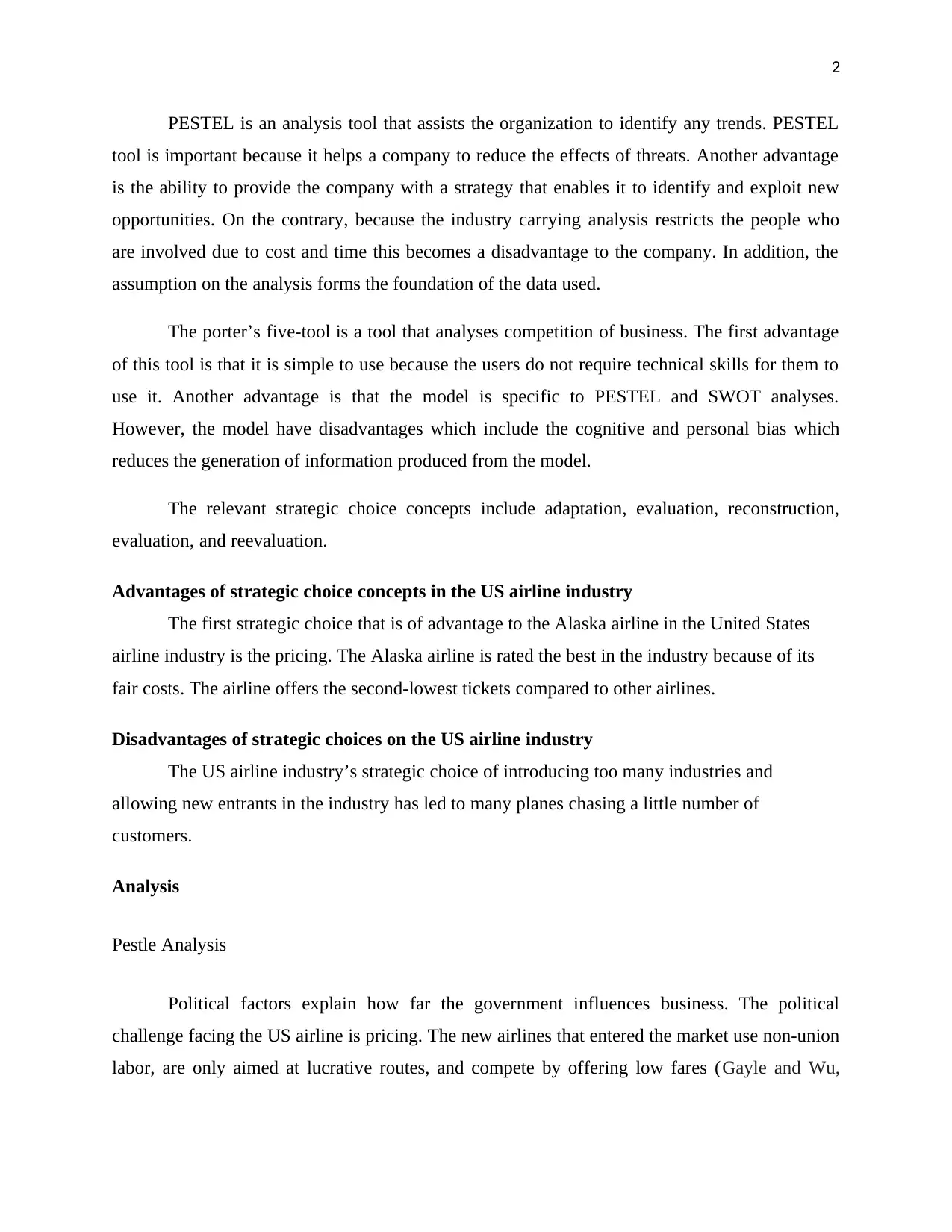
PESTEL is an analysis tool that assists the organization to identify any trends. PESTEL
tool is important because it helps a company to reduce the effects of threats. Another advantage
is the ability to provide the company with a strategy that enables it to identify and exploit new
opportunities. On the contrary, because the industry carrying analysis restricts the people who
are involved due to cost and time this becomes a disadvantage to the company. In addition, the
assumption on the analysis forms the foundation of the data used.
The porter’s five-tool is a tool that analyses competition of business. The first advantage
of this tool is that it is simple to use because the users do not require technical skills for them to
use it. Another advantage is that the model is specific to PESTEL and SWOT analyses.
However, the model have disadvantages which include the cognitive and personal bias which
reduces the generation of information produced from the model.
The relevant strategic choice concepts include adaptation, evaluation, reconstruction,
evaluation, and reevaluation.
Advantages of strategic choice concepts in the US airline industry
The first strategic choice that is of advantage to the Alaska airline in the United States
airline industry is the pricing. The Alaska airline is rated the best in the industry because of its
fair costs. The airline offers the second-lowest tickets compared to other airlines.
Disadvantages of strategic choices on the US airline industry
The US airline industry’s strategic choice of introducing too many industries and
allowing new entrants in the industry has led to many planes chasing a little number of
customers.
Analysis
Pestle Analysis
Political factors explain how far the government influences business. The political
challenge facing the US airline is pricing. The new airlines that entered the market use non-union
labor, are only aimed at lucrative routes, and compete by offering low fares (Gayle and Wu,
PESTEL is an analysis tool that assists the organization to identify any trends. PESTEL
tool is important because it helps a company to reduce the effects of threats. Another advantage
is the ability to provide the company with a strategy that enables it to identify and exploit new
opportunities. On the contrary, because the industry carrying analysis restricts the people who
are involved due to cost and time this becomes a disadvantage to the company. In addition, the
assumption on the analysis forms the foundation of the data used.
The porter’s five-tool is a tool that analyses competition of business. The first advantage
of this tool is that it is simple to use because the users do not require technical skills for them to
use it. Another advantage is that the model is specific to PESTEL and SWOT analyses.
However, the model have disadvantages which include the cognitive and personal bias which
reduces the generation of information produced from the model.
The relevant strategic choice concepts include adaptation, evaluation, reconstruction,
evaluation, and reevaluation.
Advantages of strategic choice concepts in the US airline industry
The first strategic choice that is of advantage to the Alaska airline in the United States
airline industry is the pricing. The Alaska airline is rated the best in the industry because of its
fair costs. The airline offers the second-lowest tickets compared to other airlines.
Disadvantages of strategic choices on the US airline industry
The US airline industry’s strategic choice of introducing too many industries and
allowing new entrants in the industry has led to many planes chasing a little number of
customers.
Analysis
Pestle Analysis
Political factors explain how far the government influences business. The political
challenge facing the US airline is pricing. The new airlines that entered the market use non-union
labor, are only aimed at lucrative routes, and compete by offering low fares (Gayle and Wu,
3
2013, pp.120). This has made the large carriers to reduce their fare charges in order to cope with
the competition of the low-carriers that have entered the market
Economic factors have an effect on the operation of the business. Economic factors
include the growth of the economy, interest rates, inflation, and currency exchange rates. The US
airline has been affected by high fuel cost in 2001.This made many airlines such as delta, united,
northwest, and United States airway to go bankrupt in the 2000s.
Social factors constitute of the growth of the population, cultures, age distribution, and
career attitudes. The US airline face threats from political instability, war, and social unrest. In
2001 there was a terror attack on the world trade Centre which made customers to cancel their
trips and they developed a fear of using aircraft when traveling (Araujo and Kjellberg, 2016,
pp.96). This fear of consumers resulted in reduced revenues for the United States airline and
other sectors of the US economy.
Technological factors: Over the past five years, the United States airline has encountered
drastic changes. The rise of internet travel in the United States has made it easier and faster for
customers to book their flights and compare prices (Ater and Orlov, 2015, pp.189). This has also
reduced the congestions at the airports due to booking queues.
Environmental factors that affect organizations include weather, climate, and changes in
climate. The bad climatic condition in the US and other parts of the world in which the airlines
from the US airline industry operates is a threat to human and sometimes leads to cancellation of
trips until the clouds are clear or the weather is stable.
Legal factors constitute the intellectual property rights of a firm. There are fiscal policies
that govern the United States airline industry which affects it negatively. The excise duties
imposed on airline tickets have led to high consumer prices and in the long run, affects demand
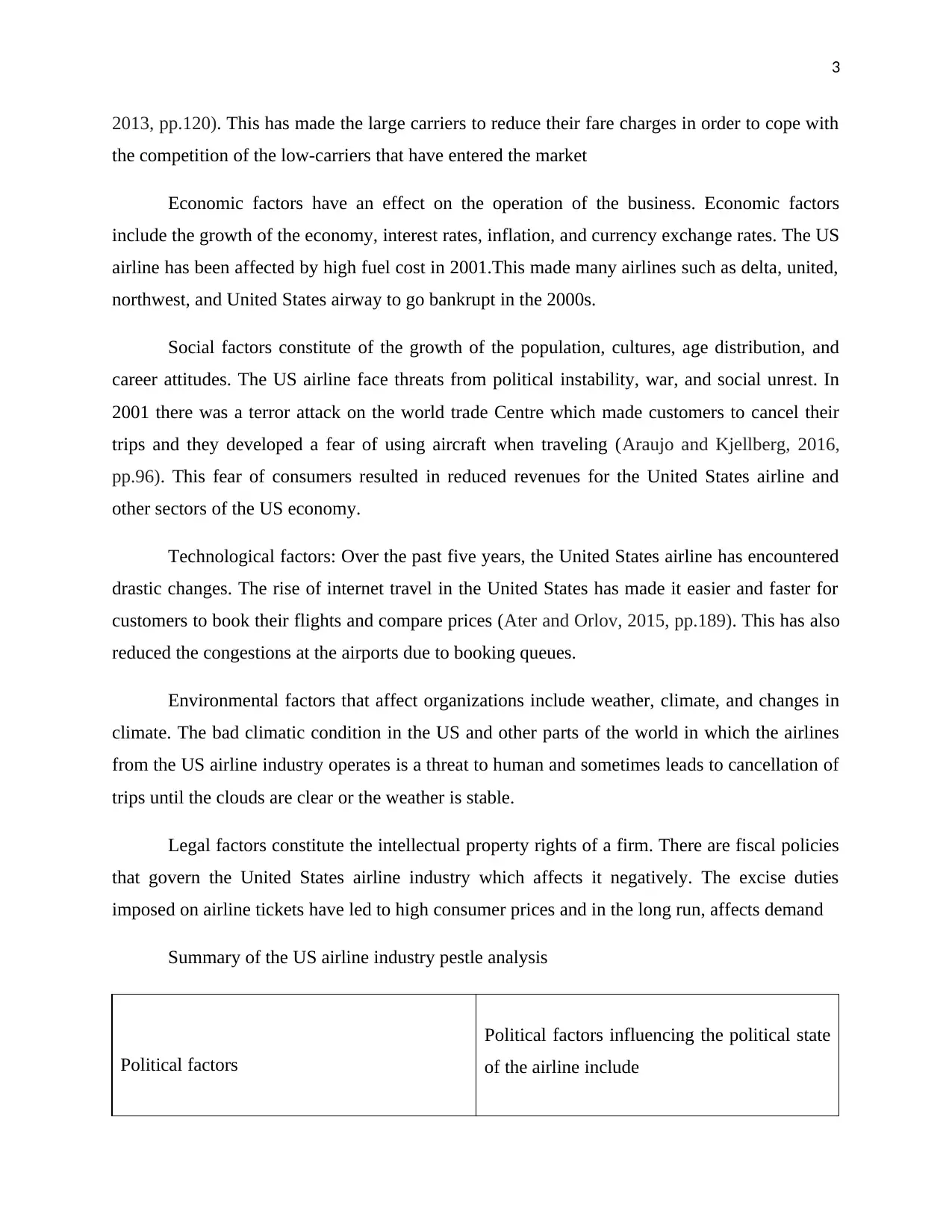
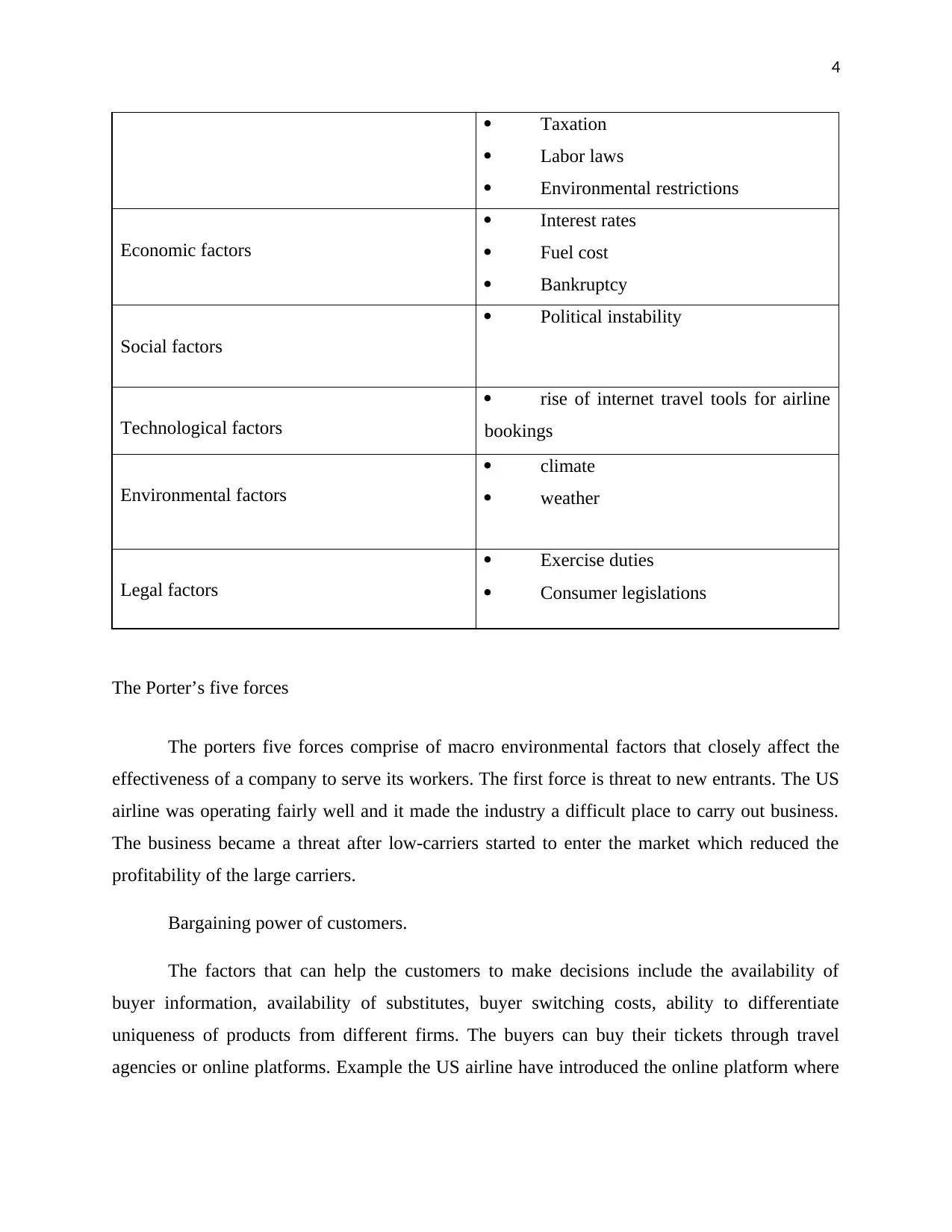
Summary of the US airline industry pestle analysis
Political factors
Political factors influencing the political state
of the airline include
2013, pp.120). This has made the large carriers to reduce their fare charges in order to cope with
the competition of the low-carriers that have entered the market
Economic factors have an effect on the operation of the business. Economic factors
include the growth of the economy, interest rates, inflation, and currency exchange rates. The US
airline has been affected by high fuel cost in 2001.This made many airlines such as delta, united,
northwest, and United States airway to go bankrupt in the 2000s.
Social factors constitute of the growth of the population, cultures, age distribution, and
career attitudes. The US airline face threats from political instability, war, and social unrest. In
2001 there was a terror attack on the world trade Centre which made customers to cancel their
trips and they developed a fear of using aircraft when traveling (Araujo and Kjellberg, 2016,
pp.96). This fear of consumers resulted in reduced revenues for the United States airline and
other sectors of the US economy.
Technological factors: Over the past five years, the United States airline has encountered
drastic changes. The rise of internet travel in the United States has made it easier and faster for
customers to book their flights and compare prices (Ater and Orlov, 2015, pp.189). This has also
reduced the congestions at the airports due to booking queues.
Environmental factors that affect organizations include weather, climate, and changes in
climate. The bad climatic condition in the US and other parts of the world in which the airlines
from the US airline industry operates is a threat to human and sometimes leads to cancellation of
trips until the clouds are clear or the weather is stable.
Legal factors constitute the intellectual property rights of a firm. There are fiscal policies
that govern the United States airline industry which affects it negatively. The excise duties
imposed on airline tickets have led to high consumer prices and in the long run, affects demand
Summary of the US airline industry pestle analysis
Political factors
Political factors influencing the political state
of the airline include
⊘ This is a preview!⊘
Do you want full access?
Subscribe today to unlock all pages.
Trusted by 1+ million students worldwide
4
Taxation
Labor laws
Environmental restrictions
Economic factors
Interest rates
Fuel cost
Bankruptcy
Social factors
Political instability
Technological factors
rise of internet travel tools for airline
bookings
Environmental factors
climate
weather
Legal factors
Exercise duties
Consumer legislations
The Porter’s five forces
The porters five forces comprise of macro environmental factors that closely affect the
effectiveness of a company to serve its workers. The first force is threat to new entrants. The US
airline was operating fairly well and it made the industry a difficult place to carry out business.
The business became a threat after low-carriers started to enter the market which reduced the
profitability of the large carriers.
Bargaining power of customers.
The factors that can help the customers to make decisions include the availability of
buyer information, availability of substitutes, buyer switching costs, ability to differentiate
uniqueness of products from different firms. The buyers can buy their tickets through travel
agencies or online platforms. Example the US airline have introduced the online platform where
Taxation
Labor laws
Environmental restrictions
Economic factors
Interest rates
Fuel cost
Bankruptcy
Social factors
Political instability
Technological factors
rise of internet travel tools for airline
bookings
Environmental factors
climate
weather
Legal factors
Exercise duties
Consumer legislations
The Porter’s five forces
The porters five forces comprise of macro environmental factors that closely affect the
effectiveness of a company to serve its workers. The first force is threat to new entrants. The US
airline was operating fairly well and it made the industry a difficult place to carry out business.
The business became a threat after low-carriers started to enter the market which reduced the
profitability of the large carriers.
Bargaining power of customers.
The factors that can help the customers to make decisions include the availability of
buyer information, availability of substitutes, buyer switching costs, ability to differentiate
uniqueness of products from different firms. The buyers can buy their tickets through travel
agencies or online platforms. Example the US airline have introduced the online platform where
Paraphrase This Document
Need a fresh take? Get an instant paraphrase of this document with our AI Paraphraser
5
customers can purchase their tickets (Baker, 2014, pp.9). However, there are customers who look
for low cost depending on their destination.
Bargaining power of suppliers
The main suppliers are airplane manufactures. The manufacturers are supposed to make
their airplanes eco-friendly. Other airlines have employee solidarity example the labor unions
(Hüschelrath and Müller, 2013, pp.84). The US airline such as Delta, America, and United States
uses the labor union employee solidarity while the new entrants which disrupted the profitability
of the large carriers’ use non-union labor and this made their operative costs to be low compared
to the other airlines.
Threat to new substitutes
This refers to ability of a different product to satisfy the needs of the previous product.
New substitutes in the US airline was a threat to existing airline in the industry. However, the
industry is facing competition globally due to immense growth of the Airline industry. This has
reduced the profitability of the industry (Dresner, Eroglu, Hofer, Mendez). In addition, the
electric trains has made transportation easier and first. This affected the airlines in US since
people have opted to use train transport.
Competitive rivalry
Understanding industry rivals is important to the success of the organization. To cope up
with rivalry, a firm should use sustainable competitive advantage through innovation. The US
airline rivals had to acquire shares in the industry, therefore, they assisted in creating the excess
capacity in the industry.
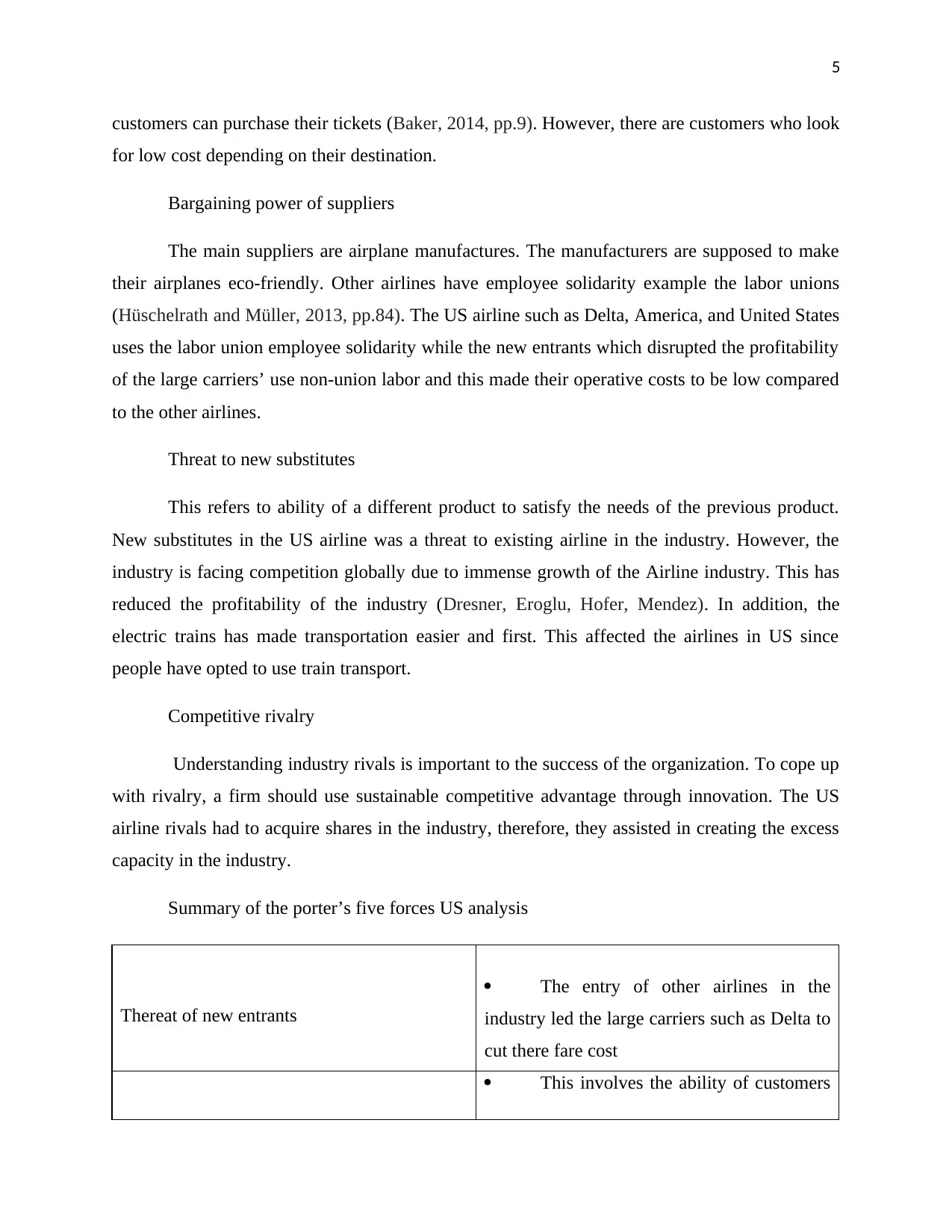
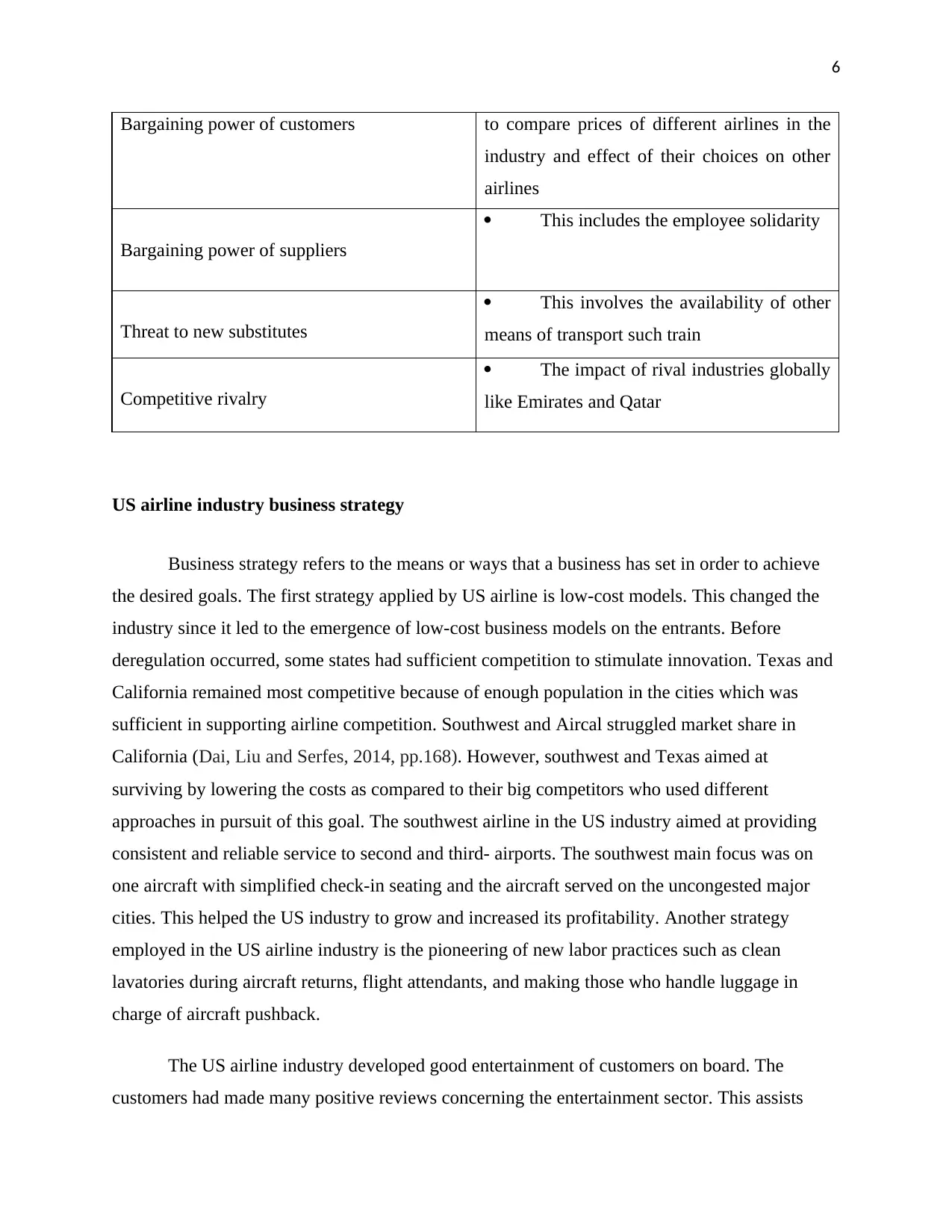
Summary of the porter’s five forces US analysis
Thereat of new entrants
The entry of other airlines in the
industry led the large carriers such as Delta to
cut there fare cost
This involves the ability of customers
customers can purchase their tickets (Baker, 2014, pp.9). However, there are customers who look
for low cost depending on their destination.
Bargaining power of suppliers
The main suppliers are airplane manufactures. The manufacturers are supposed to make
their airplanes eco-friendly. Other airlines have employee solidarity example the labor unions
(Hüschelrath and Müller, 2013, pp.84). The US airline such as Delta, America, and United States
uses the labor union employee solidarity while the new entrants which disrupted the profitability
of the large carriers’ use non-union labor and this made their operative costs to be low compared
to the other airlines.
Threat to new substitutes
This refers to ability of a different product to satisfy the needs of the previous product.
New substitutes in the US airline was a threat to existing airline in the industry. However, the
industry is facing competition globally due to immense growth of the Airline industry. This has
reduced the profitability of the industry (Dresner, Eroglu, Hofer, Mendez). In addition, the
electric trains has made transportation easier and first. This affected the airlines in US since
people have opted to use train transport.
Competitive rivalry
Understanding industry rivals is important to the success of the organization. To cope up
with rivalry, a firm should use sustainable competitive advantage through innovation. The US
airline rivals had to acquire shares in the industry, therefore, they assisted in creating the excess
capacity in the industry.
Summary of the porter’s five forces US analysis
Thereat of new entrants
The entry of other airlines in the
industry led the large carriers such as Delta to
cut there fare cost
This involves the ability of customers
6
Bargaining power of customers to compare prices of different airlines in the
industry and effect of their choices on other
airlines
Bargaining power of suppliers
This includes the employee solidarity
Threat to new substitutes
This involves the availability of other
means of transport such train
Competitive rivalry
The impact of rival industries globally
like Emirates and Qatar
US airline industry business strategy
Business strategy refers to the means or ways that a business has set in order to achieve
the desired goals. The first strategy applied by US airline is low-cost models. This changed the
industry since it led to the emergence of low-cost business models on the entrants. Before
deregulation occurred, some states had sufficient competition to stimulate innovation. Texas and
California remained most competitive because of enough population in the cities which was
sufficient in supporting airline competition. Southwest and Aircal struggled market share in
California (Dai, Liu and Serfes, 2014, pp.168). However, southwest and Texas aimed at
surviving by lowering the costs as compared to their big competitors who used different
approaches in pursuit of this goal. The southwest airline in the US industry aimed at providing
consistent and reliable service to second and third- airports. The southwest main focus was on
one aircraft with simplified check-in seating and the aircraft served on the uncongested major
cities. This helped the US industry to grow and increased its profitability. Another strategy
employed in the US airline industry is the pioneering of new labor practices such as clean
lavatories during aircraft returns, flight attendants, and making those who handle luggage in
charge of aircraft pushback.
The US airline industry developed good entertainment of customers on board. The
customers had made many positive reviews concerning the entertainment sector. This assists
Bargaining power of customers to compare prices of different airlines in the
industry and effect of their choices on other
airlines
Bargaining power of suppliers
This includes the employee solidarity
Threat to new substitutes
This involves the availability of other
means of transport such train
Competitive rivalry
The impact of rival industries globally
like Emirates and Qatar
US airline industry business strategy
Business strategy refers to the means or ways that a business has set in order to achieve
the desired goals. The first strategy applied by US airline is low-cost models. This changed the
industry since it led to the emergence of low-cost business models on the entrants. Before
deregulation occurred, some states had sufficient competition to stimulate innovation. Texas and
California remained most competitive because of enough population in the cities which was
sufficient in supporting airline competition. Southwest and Aircal struggled market share in
California (Dai, Liu and Serfes, 2014, pp.168). However, southwest and Texas aimed at
surviving by lowering the costs as compared to their big competitors who used different
approaches in pursuit of this goal. The southwest airline in the US industry aimed at providing
consistent and reliable service to second and third- airports. The southwest main focus was on
one aircraft with simplified check-in seating and the aircraft served on the uncongested major
cities. This helped the US industry to grow and increased its profitability. Another strategy
employed in the US airline industry is the pioneering of new labor practices such as clean
lavatories during aircraft returns, flight attendants, and making those who handle luggage in
charge of aircraft pushback.
The US airline industry developed good entertainment of customers on board. The
customers had made many positive reviews concerning the entertainment sector. This assists
⊘ This is a preview!⊘
Do you want full access?
Subscribe today to unlock all pages.
Trusted by 1+ million students worldwide
7
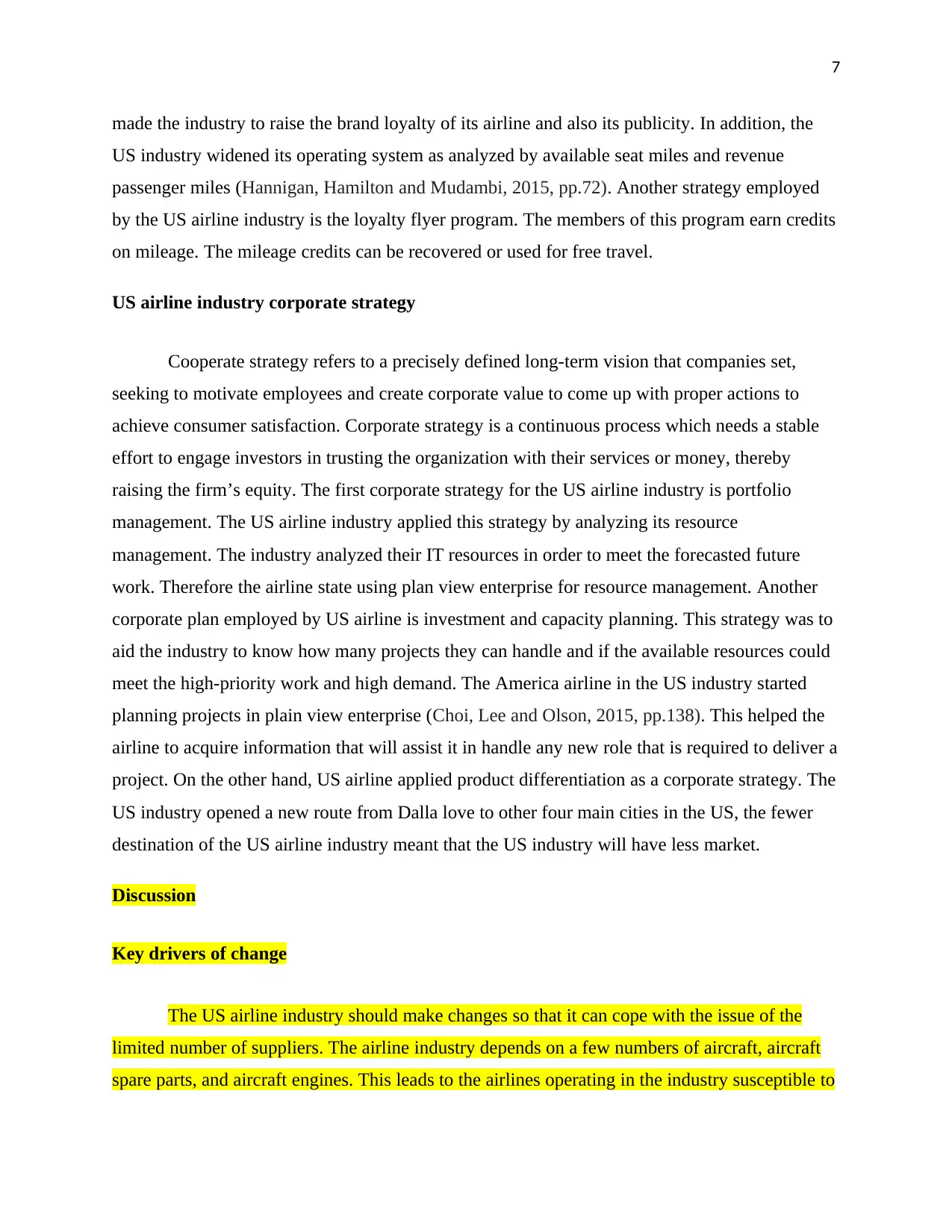
made the industry to raise the brand loyalty of its airline and also its publicity. In addition, the
US industry widened its operating system as analyzed by available seat miles and revenue
passenger miles (Hannigan, Hamilton and Mudambi, 2015, pp.72). Another strategy employed
by the US airline industry is the loyalty flyer program. The members of this program earn credits
on mileage. The mileage credits can be recovered or used for free travel.
US airline industry corporate strategy
Cooperate strategy refers to a precisely defined long-term vision that companies set,
seeking to motivate employees and create corporate value to come up with proper actions to
achieve consumer satisfaction. Corporate strategy is a continuous process which needs a stable
effort to engage investors in trusting the organization with their services or money, thereby
raising the firm’s equity. The first corporate strategy for the US airline industry is portfolio
management. The US airline industry applied this strategy by analyzing its resource
management. The industry analyzed their IT resources in order to meet the forecasted future
work. Therefore the airline state using plan view enterprise for resource management. Another
corporate plan employed by US airline is investment and capacity planning. This strategy was to
aid the industry to know how many projects they can handle and if the available resources could
meet the high-priority work and high demand. The America airline in the US industry started
planning projects in plain view enterprise (Choi, Lee and Olson, 2015, pp.138). This helped the
airline to acquire information that will assist it in handle any new role that is required to deliver a
project. On the other hand, US airline applied product differentiation as a corporate strategy. The
US industry opened a new route from Dalla love to other four main cities in the US, the fewer
destination of the US airline industry meant that the US industry will have less market.
Discussion
Key drivers of change
The US airline industry should make changes so that it can cope with the issue of the
limited number of suppliers. The airline industry depends on a few numbers of aircraft, aircraft
spare parts, and aircraft engines. This leads to the airlines operating in the industry susceptible to
made the industry to raise the brand loyalty of its airline and also its publicity. In addition, the
US industry widened its operating system as analyzed by available seat miles and revenue
passenger miles (Hannigan, Hamilton and Mudambi, 2015, pp.72). Another strategy employed
by the US airline industry is the loyalty flyer program. The members of this program earn credits
on mileage. The mileage credits can be recovered or used for free travel.
US airline industry corporate strategy
Cooperate strategy refers to a precisely defined long-term vision that companies set,
seeking to motivate employees and create corporate value to come up with proper actions to
achieve consumer satisfaction. Corporate strategy is a continuous process which needs a stable
effort to engage investors in trusting the organization with their services or money, thereby
raising the firm’s equity. The first corporate strategy for the US airline industry is portfolio
management. The US airline industry applied this strategy by analyzing its resource
management. The industry analyzed their IT resources in order to meet the forecasted future
work. Therefore the airline state using plan view enterprise for resource management. Another
corporate plan employed by US airline is investment and capacity planning. This strategy was to
aid the industry to know how many projects they can handle and if the available resources could
meet the high-priority work and high demand. The America airline in the US industry started
planning projects in plain view enterprise (Choi, Lee and Olson, 2015, pp.138). This helped the
airline to acquire information that will assist it in handle any new role that is required to deliver a
project. On the other hand, US airline applied product differentiation as a corporate strategy. The
US industry opened a new route from Dalla love to other four main cities in the US, the fewer
destination of the US airline industry meant that the US industry will have less market.
Discussion
Key drivers of change
The US airline industry should make changes so that it can cope with the issue of the
limited number of suppliers. The airline industry depends on a few numbers of aircraft, aircraft
spare parts, and aircraft engines. This leads to the airlines operating in the industry susceptible to
Paraphrase This Document
Need a fresh take? Get an instant paraphrase of this document with our AI Paraphraser
8
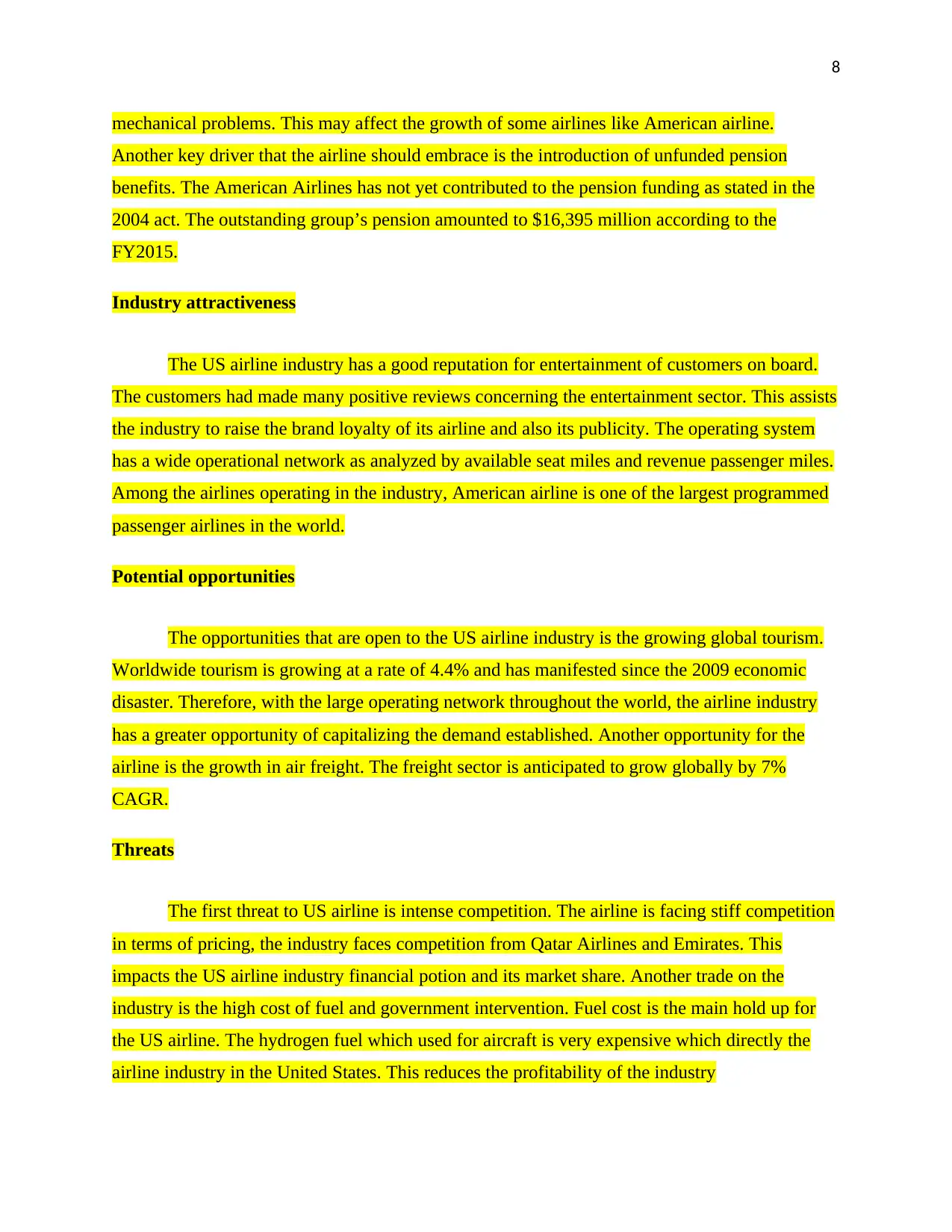
mechanical problems. This may affect the growth of some airlines like American airline.
Another key driver that the airline should embrace is the introduction of unfunded pension
benefits. The American Airlines has not yet contributed to the pension funding as stated in the
2004 act. The outstanding group’s pension amounted to $16,395 million according to the
FY2015.
Industry attractiveness
The US airline industry has a good reputation for entertainment of customers on board.
The customers had made many positive reviews concerning the entertainment sector. This assists
the industry to raise the brand loyalty of its airline and also its publicity. The operating system
has a wide operational network as analyzed by available seat miles and revenue passenger miles.
Among the airlines operating in the industry, American airline is one of the largest programmed
passenger airlines in the world.
Potential opportunities
The opportunities that are open to the US airline industry is the growing global tourism.
Worldwide tourism is growing at a rate of 4.4% and has manifested since the 2009 economic
disaster. Therefore, with the large operating network throughout the world, the airline industry
has a greater opportunity of capitalizing the demand established. Another opportunity for the
airline is the growth in air freight. The freight sector is anticipated to grow globally by 7%
CAGR.
Threats
The first threat to US airline is intense competition. The airline is facing stiff competition
in terms of pricing, the industry faces competition from Qatar Airlines and Emirates. This
impacts the US airline industry financial potion and its market share. Another trade on the
industry is the high cost of fuel and government intervention. Fuel cost is the main hold up for
the US airline. The hydrogen fuel which used for aircraft is very expensive which directly the
airline industry in the United States. This reduces the profitability of the industry
mechanical problems. This may affect the growth of some airlines like American airline.
Another key driver that the airline should embrace is the introduction of unfunded pension
benefits. The American Airlines has not yet contributed to the pension funding as stated in the
2004 act. The outstanding group’s pension amounted to $16,395 million according to the
FY2015.
Industry attractiveness
The US airline industry has a good reputation for entertainment of customers on board.
The customers had made many positive reviews concerning the entertainment sector. This assists
the industry to raise the brand loyalty of its airline and also its publicity. The operating system
has a wide operational network as analyzed by available seat miles and revenue passenger miles.
Among the airlines operating in the industry, American airline is one of the largest programmed
passenger airlines in the world.
Potential opportunities
The opportunities that are open to the US airline industry is the growing global tourism.
Worldwide tourism is growing at a rate of 4.4% and has manifested since the 2009 economic
disaster. Therefore, with the large operating network throughout the world, the airline industry
has a greater opportunity of capitalizing the demand established. Another opportunity for the
airline is the growth in air freight. The freight sector is anticipated to grow globally by 7%
CAGR.
Threats
The first threat to US airline is intense competition. The airline is facing stiff competition
in terms of pricing, the industry faces competition from Qatar Airlines and Emirates. This
impacts the US airline industry financial potion and its market share. Another trade on the
industry is the high cost of fuel and government intervention. Fuel cost is the main hold up for
the US airline. The hydrogen fuel which used for aircraft is very expensive which directly the
airline industry in the United States. This reduces the profitability of the industry
9
Conclusion
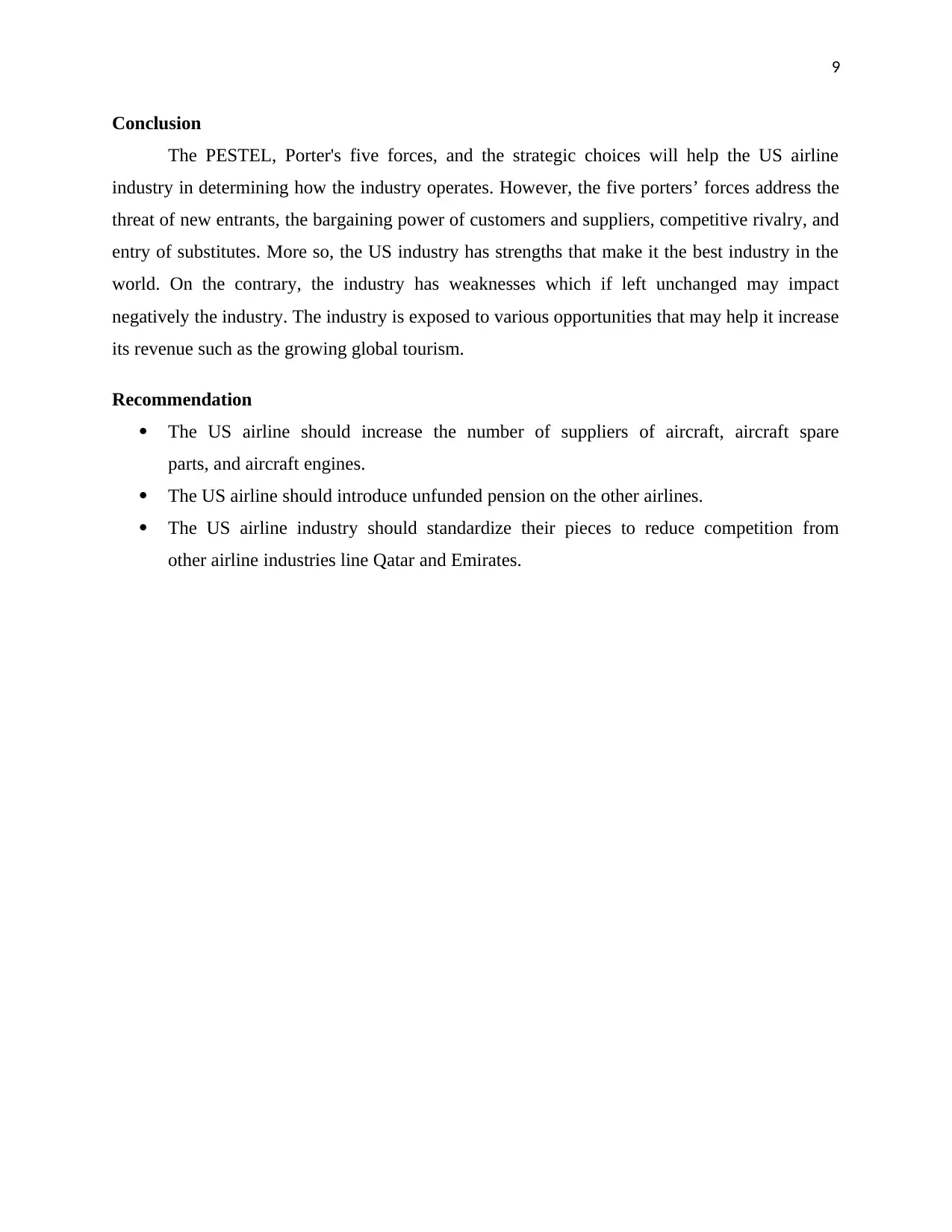
The PESTEL, Porter's five forces, and the strategic choices will help the US airline
industry in determining how the industry operates. However, the five porters’ forces address the
threat of new entrants, the bargaining power of customers and suppliers, competitive rivalry, and
entry of substitutes. More so, the US industry has strengths that make it the best industry in the
world. On the contrary, the industry has weaknesses which if left unchanged may impact
negatively the industry. The industry is exposed to various opportunities that may help it increase
its revenue such as the growing global tourism.
Recommendation
The US airline should increase the number of suppliers of aircraft, aircraft spare
parts, and aircraft engines.
The US airline should introduce unfunded pension on the other airlines.
The US airline industry should standardize their pieces to reduce competition from
other airline industries line Qatar and Emirates.
Conclusion
The PESTEL, Porter's five forces, and the strategic choices will help the US airline
industry in determining how the industry operates. However, the five porters’ forces address the
threat of new entrants, the bargaining power of customers and suppliers, competitive rivalry, and
entry of substitutes. More so, the US industry has strengths that make it the best industry in the
world. On the contrary, the industry has weaknesses which if left unchanged may impact
negatively the industry. The industry is exposed to various opportunities that may help it increase
its revenue such as the growing global tourism.
Recommendation
The US airline should increase the number of suppliers of aircraft, aircraft spare
parts, and aircraft engines.
The US airline should introduce unfunded pension on the other airlines.
The US airline industry should standardize their pieces to reduce competition from
other airline industries line Qatar and Emirates.
⊘ This is a preview!⊘
Do you want full access?
Subscribe today to unlock all pages.
Trusted by 1+ million students worldwide

1 out of 15


Related Documents


Your All-in-One AI-Powered Toolkit for Academic Success.
+13062052269
info@desklib.com
Available 24*7 on WhatsApp / Email
![[object Object]](/_next/static/media/star-bottom.7253800d.svg)
Unlock your academic potential
Copyright © 2020–2026 A2Z Services. All Rights Reserved. Developed and managed by ZUCOL.