HI5016 - US-China Trade War: An Analysis of Impact on Global Trade
VerifiedAdded on 2023/03/31
|7
|1254
|147
Report
AI Summary
This report examines the ongoing trade war between the United States and China, focusing on its potential consequences for other countries, particularly Australia. It begins by outlining the dynamics of the US-China trade war, including the imposition of tariffs and retaliatory measures. The report then delves into the potential effects of a global trade war on Australia, considering both the benefits of protecting domestic producers through tariffs and the risks of reduced trade and welfare loss. It analyzes how tariff imposition can affect prices, demand, and supply, ultimately impacting consumer and producer surplus. The report concludes that while tariff imposition might provide short-term benefits, the long-term costs of participating in a global trade war outweigh the advantages, making it advisable for countries like Australia to avoid direct involvement to minimize welfare losses. Desklib offers similar solved assignments and resources for students.
Running head: INTERNATIONAL TRADE AND ENTERPRISE
International Trade and Enterprise
Name of the Student
Name of the University
Course ID
International Trade and Enterprise
Name of the Student
Name of the University
Course ID
Paraphrase This Document
Need a fresh take? Get an instant paraphrase of this document with our AI Paraphraser

1INTERNATIONAL TRADE AND ENTERPRISE
Table of Contents
Introduction................................................................................................................................2
Trade war between US and China..............................................................................................2
Effect of US-China Trade War on Australia..............................................................................3
Conclusion..................................................................................................................................5
References..................................................................................................................................6
Table of Contents
Introduction................................................................................................................................2
Trade war between US and China..............................................................................................2
Effect of US-China Trade War on Australia..............................................................................3
Conclusion..................................................................................................................................5
References..................................................................................................................................6

2INTERNATIONAL TRADE AND ENTERPRISE
Introduction
Tariff and import duty are the two instruments using which governments control the
import market of a country. They are mostly use to protect domestic producer from the effect
of world competition. This report discusses the trade war between US and China. The
continuous trade war between them might attract other countries to impose tariff on import
goods leading to a situation of global trade war (Li, He and Lin 2018). The report finally
discusses the effect of trade war on Australia if it takes part in it and imposes tariff on its
imported products.
Trade war between US and China
Imposition of tariff on imported goods increase the price of imports as a result
domestic customer consume less imported goods resulting into reduced demand for foreign
goods (Elsheikh, Elbushra and Salih 2015). The price of imported goods falls in the exporting
country generating loss for the country. Thus, US imposed tariff on imported goods from
China with an objective to restrict China from having access technology and investing in US.
Owing to this trade policy by US, export business of China faced adverse consequences and
suffered loss. In response to high tariff policy by US, China retaliated and imposed tariff on
products imported from US (Johnson 2013). Hence, the trade war between the two countries
initiated. However, tariff or trade war between two countries always affects both adversely.
Thus, if this war continues for a longer period then there will be economic break down. If US
continue imposition of tariff then in the long run it will drive itself into phase of recession,
conversely, for China the situation will not be as worse as US. The gross domestic (GDP) of
China will fall to 4% from the expected 5.3% (KPMG 2018). Apart from this, the prospective
East Asian market might help China to recover from the situation of economic downturn.
Longer the trade war is more the number of other countries that follow the suit and lead to a
Introduction
Tariff and import duty are the two instruments using which governments control the
import market of a country. They are mostly use to protect domestic producer from the effect
of world competition. This report discusses the trade war between US and China. The
continuous trade war between them might attract other countries to impose tariff on import
goods leading to a situation of global trade war (Li, He and Lin 2018). The report finally
discusses the effect of trade war on Australia if it takes part in it and imposes tariff on its
imported products.
Trade war between US and China
Imposition of tariff on imported goods increase the price of imports as a result
domestic customer consume less imported goods resulting into reduced demand for foreign
goods (Elsheikh, Elbushra and Salih 2015). The price of imported goods falls in the exporting
country generating loss for the country. Thus, US imposed tariff on imported goods from
China with an objective to restrict China from having access technology and investing in US.
Owing to this trade policy by US, export business of China faced adverse consequences and
suffered loss. In response to high tariff policy by US, China retaliated and imposed tariff on
products imported from US (Johnson 2013). Hence, the trade war between the two countries
initiated. However, tariff or trade war between two countries always affects both adversely.
Thus, if this war continues for a longer period then there will be economic break down. If US
continue imposition of tariff then in the long run it will drive itself into phase of recession,
conversely, for China the situation will not be as worse as US. The gross domestic (GDP) of
China will fall to 4% from the expected 5.3% (KPMG 2018). Apart from this, the prospective
East Asian market might help China to recover from the situation of economic downturn.
Longer the trade war is more the number of other countries that follow the suit and lead to a
⊘ This is a preview!⊘
Do you want full access?
Subscribe today to unlock all pages.

Trusted by 1+ million students worldwide

3INTERNATIONAL TRADE AND ENTERPRISE
global trade war. Once global trade war starts then controlling the entire international trade
business will become tougher and there will be large amount of welfare loss. Therefore, the
trade war between US and China may have negative impact on the rest of the world.
Effect of US-China Trade War on Australia
The prolonged period of trade war between US and China may attract other countries
and initiate a global trade war. The global trade war would affect Australia and its GDP falls
significantly. This will happen only if Australia participates in the trade war by imposing
tariff on its imported goods. On contrary to the above discussed trade war, tariff also benefits
an economy by protecting its domestic producers (Milner 2013). Thus, anticipating the action
of other countries on the global trade war Australia imposes tariff on imported goods to
protect its domestic producers.
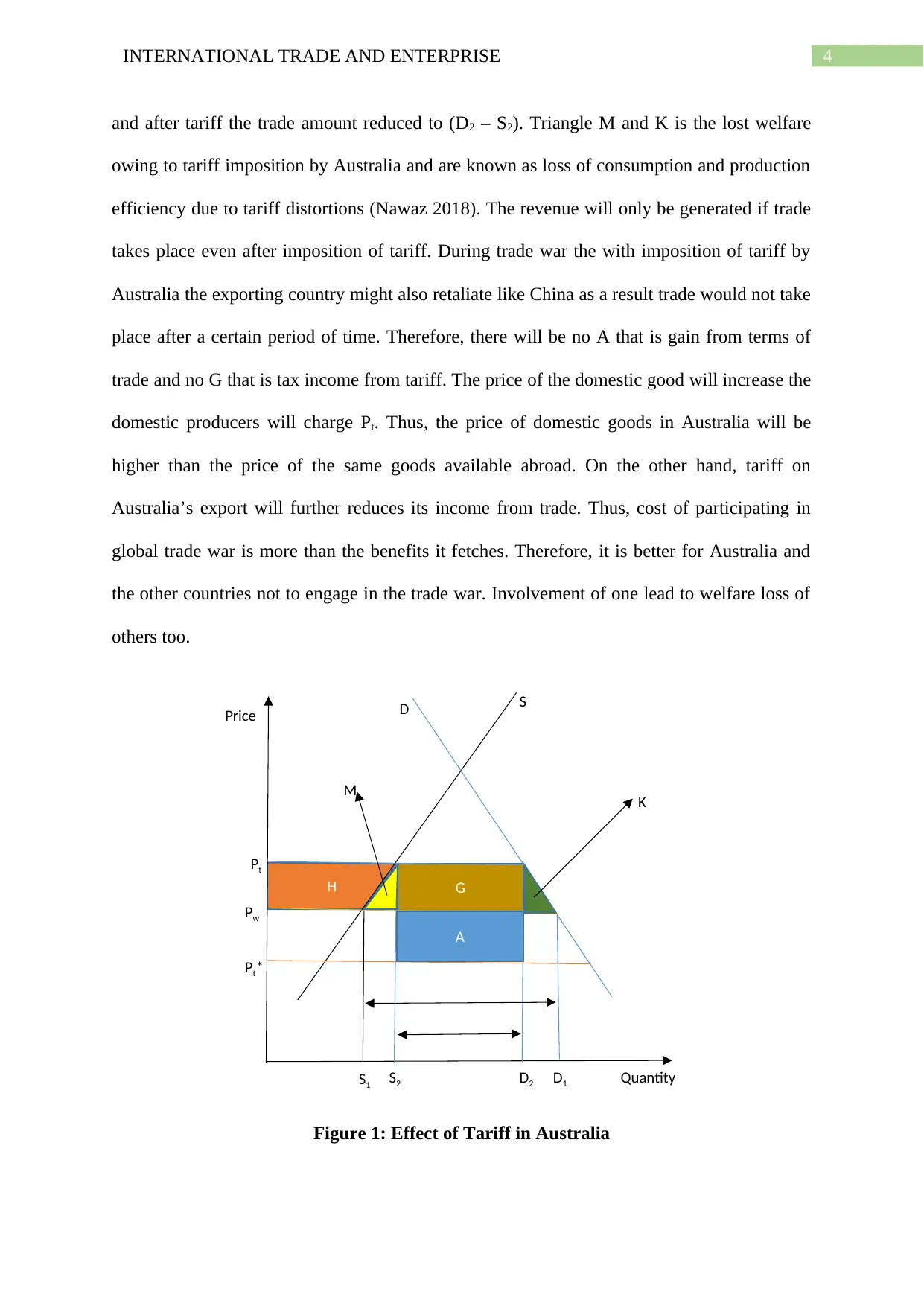
The effect of the tariff imposition can be seen in figure 1. The imposition of tariff
would increase the price of the imported goods from world price (Pw) to tariff price (Pt)
(Krugman, Obstfeld and Melitz 2017). This rise in price would decrease the demand for
imported goods in Australia. The supply of the export will increase but due to less demand
the price of the product in the exporting country will reduce from Pw to price of the product at
exporting country Pt* (Tran and Zikos 2018). However, the trade condition states that if Pt is
greater than Pt* and (Pt -Pt*) is greater than the value of imposed tariff then the trade will
occur. Thus, if value of tariff imposed is so high that it nullifies the effect of this price
difference and then trade completely stops. Under this condition there is gain of producer
surplus and loss of consumer surplus in Australia and the case is opposite in the exporting
country. Due to tariff imposition and increase in price the amount of consumer surplus lost is
given as the sum of HMGK in the figure and A is given as the gain in terms of trade. G and A
is however determining the amount of revenue earned by the Australian government by
imposing tariff. Before tariff the amount of trade is given by the difference between S1 and D1
global trade war. Once global trade war starts then controlling the entire international trade
business will become tougher and there will be large amount of welfare loss. Therefore, the
trade war between US and China may have negative impact on the rest of the world.
Effect of US-China Trade War on Australia
The prolonged period of trade war between US and China may attract other countries
and initiate a global trade war. The global trade war would affect Australia and its GDP falls
significantly. This will happen only if Australia participates in the trade war by imposing
tariff on its imported goods. On contrary to the above discussed trade war, tariff also benefits
an economy by protecting its domestic producers (Milner 2013). Thus, anticipating the action
of other countries on the global trade war Australia imposes tariff on imported goods to
protect its domestic producers.
The effect of the tariff imposition can be seen in figure 1. The imposition of tariff
would increase the price of the imported goods from world price (Pw) to tariff price (Pt)
(Krugman, Obstfeld and Melitz 2017). This rise in price would decrease the demand for
imported goods in Australia. The supply of the export will increase but due to less demand
the price of the product in the exporting country will reduce from Pw to price of the product at
exporting country Pt* (Tran and Zikos 2018). However, the trade condition states that if Pt is
greater than Pt* and (Pt -Pt*) is greater than the value of imposed tariff then the trade will
occur. Thus, if value of tariff imposed is so high that it nullifies the effect of this price
difference and then trade completely stops. Under this condition there is gain of producer
surplus and loss of consumer surplus in Australia and the case is opposite in the exporting
country. Due to tariff imposition and increase in price the amount of consumer surplus lost is
given as the sum of HMGK in the figure and A is given as the gain in terms of trade. G and A
is however determining the amount of revenue earned by the Australian government by
imposing tariff. Before tariff the amount of trade is given by the difference between S1 and D1
Paraphrase This Document
Need a fresh take? Get an instant paraphrase of this document with our AI Paraphraser

4INTERNATIONAL TRADE AND ENTERPRISE
and after tariff the trade amount reduced to (D2 – S2). Triangle M and K is the lost welfare
owing to tariff imposition by Australia and are known as loss of consumption and production
efficiency due to tariff distortions (Nawaz 2018). The revenue will only be generated if trade
takes place even after imposition of tariff. During trade war the with imposition of tariff by
Australia the exporting country might also retaliate like China as a result trade would not take
place after a certain period of time. Therefore, there will be no A that is gain from terms of
trade and no G that is tax income from tariff. The price of the domestic good will increase the
domestic producers will charge Pt. Thus, the price of domestic goods in Australia will be
higher than the price of the same goods available abroad. On the other hand, tariff on
Australia’s export will further reduces its income from trade. Thus, cost of participating in
global trade war is more than the benefits it fetches. Therefore, it is better for Australia and
the other countries not to engage in the trade war. Involvement of one lead to welfare loss of
others too.
Figure 1: Effect of Tariff in Australia
QuantityD1D2S2S1
Pt
Pw
Pt*
Price D S
M K
GH
A
and after tariff the trade amount reduced to (D2 – S2). Triangle M and K is the lost welfare
owing to tariff imposition by Australia and are known as loss of consumption and production
efficiency due to tariff distortions (Nawaz 2018). The revenue will only be generated if trade
takes place even after imposition of tariff. During trade war the with imposition of tariff by
Australia the exporting country might also retaliate like China as a result trade would not take
place after a certain period of time. Therefore, there will be no A that is gain from terms of
trade and no G that is tax income from tariff. The price of the domestic good will increase the
domestic producers will charge Pt. Thus, the price of domestic goods in Australia will be
higher than the price of the same goods available abroad. On the other hand, tariff on
Australia’s export will further reduces its income from trade. Thus, cost of participating in
global trade war is more than the benefits it fetches. Therefore, it is better for Australia and
the other countries not to engage in the trade war. Involvement of one lead to welfare loss of
others too.
Figure 1: Effect of Tariff in Australia
QuantityD1D2S2S1
Pt
Pw
Pt*
Price D S
M K
GH
A

5INTERNATIONAL TRADE AND ENTERPRISE
Source: (Created by the Author)
Conclusion
It can be concluded from the above discussion that if other countries involve
themselves in the trade war following the trade war between US and China then all the
countries will loss significant amount of welfare. Specifically, for Australia there will be
more welfare loss if it directly participates in the trade war and non-participation will also
bring loss but the magnitude will be much lower. Hence, one way or the other Australia will
face negative impacts if global trade war happens.
Source: (Created by the Author)
Conclusion
It can be concluded from the above discussion that if other countries involve
themselves in the trade war following the trade war between US and China then all the
countries will loss significant amount of welfare. Specifically, for Australia there will be
more welfare loss if it directly participates in the trade war and non-participation will also
bring loss but the magnitude will be much lower. Hence, one way or the other Australia will
face negative impacts if global trade war happens.
⊘ This is a preview!⊘
Do you want full access?
Subscribe today to unlock all pages.

Trusted by 1+ million students worldwide

6INTERNATIONAL TRADE AND ENTERPRISE
References
Elsheikh, O.E., Elbushra, A.A. and Salih, A.A., 2015. Economic impacts of changes in
wheat’s import tariff on the Sudanese economy. Journal of the Saudi Society of Agricultural
Sciences, 14(1), pp.68-75.
Johnson, H.G., 2013. Optimum tariffs and retaliation. In International Trade and Economic
Growth (Collected Works of Harry Johnson) (pp. 31-62). Routledge.
KPMG (2018). Trade wars: There are no winners. [online] KPMG. Available at:
https://home.kpmg/au/en/home/insights/2018/08/trade-wars-no-winners.html [Accessed 27
May 2019].
Krugman, P., Obstfeld, M. and Melitz, M., 2017. International Economics: Theory and
Policy, the latest edition. Addison-Wesley.
Li, C., He, C. and Lin, C., 2018. Economic Impacts of the Possible China–US Trade
War. Emerging Markets Finance and Trade, 54(7), pp.1557-1577.
Milner, C., 2013. Declining protection in developing countries: Fact or fiction?. The World
Economy, 36(6), pp.689-700.
Nawaz, N., 2018. A dynamic model for an optimal specific import tariff. The International
Trade Journal, pp.1-22.
Tran, T.T. and Zikos, V., 2018. Endogenous Free Trade Agreements and International R&D
Networks. The Manchester School, 86(5), pp.641-664.
References
Elsheikh, O.E., Elbushra, A.A. and Salih, A.A., 2015. Economic impacts of changes in
wheat’s import tariff on the Sudanese economy. Journal of the Saudi Society of Agricultural
Sciences, 14(1), pp.68-75.
Johnson, H.G., 2013. Optimum tariffs and retaliation. In International Trade and Economic
Growth (Collected Works of Harry Johnson) (pp. 31-62). Routledge.
KPMG (2018). Trade wars: There are no winners. [online] KPMG. Available at:
https://home.kpmg/au/en/home/insights/2018/08/trade-wars-no-winners.html [Accessed 27
May 2019].
Krugman, P., Obstfeld, M. and Melitz, M., 2017. International Economics: Theory and
Policy, the latest edition. Addison-Wesley.
Li, C., He, C. and Lin, C., 2018. Economic Impacts of the Possible China–US Trade
War. Emerging Markets Finance and Trade, 54(7), pp.1557-1577.
Milner, C., 2013. Declining protection in developing countries: Fact or fiction?. The World
Economy, 36(6), pp.689-700.
Nawaz, N., 2018. A dynamic model for an optimal specific import tariff. The International
Trade Journal, pp.1-22.
Tran, T.T. and Zikos, V., 2018. Endogenous Free Trade Agreements and International R&D
Networks. The Manchester School, 86(5), pp.641-664.
1 out of 7
Related Documents
Your All-in-One AI-Powered Toolkit for Academic Success.
+13062052269
info@desklib.com
Available 24*7 on WhatsApp / Email
Unlock your academic potential
Copyright © 2020–2026 A2Z Services. All Rights Reserved. Developed and managed by ZUCOL.