Comprehensive Analysis of USA-Australia Trade and Economic Relations
VerifiedAdded on 2020/04/01
|20
|3608
|40
Report
AI Summary
This report provides a comprehensive analysis of the economic relationship between the United States and Australia. It examines the bilateral trade dynamics, including the influence of the USA's larger economy on Australia's. The report delves into key economic indicators such as real GDP growth, exchange rates, trade balances, and foreign investment flows between the two nations. It explores the impact of these factors on each country's economy, with particular attention to how changes in the US economy affect Australia. The analysis covers the period from 1985 to recent times, providing insights into the evolution of the relationship and its implications. The report also considers the effects of the Free Trade Agreement between the two nations, highlighting the interconnectedness and interdependence of their economies. The conclusion summarizes the key findings and offers a perspective on the future of this important economic partnership.
Running head: ECONOMICS
Economics
Name of the Student
Name of the University
Author note
Economics
Name of the Student
Name of the University
Author note

Paraphrase This Document
Need a fresh take? Get an instant paraphrase of this document with our AI Paraphraser
1ECONOMICS
Table of Contents
Introduction......................................................................................................................................2
Relation between USA and Australia..............................................................................................3
Bilateral Economic Relation........................................................................................................3
A close look over the direction of relation and power of nations....................................................4
Critical Analysis..............................................................................................................................5
Exchange rate and trade balance..................................................................................................7
Foreign investment and movement of interest rate....................................................................10
Great Recession in USA and its impact.....................................................................................13
Conclusion.....................................................................................................................................15
References......................................................................................................................................16
Table of Contents
Introduction......................................................................................................................................2
Relation between USA and Australia..............................................................................................3
Bilateral Economic Relation........................................................................................................3
A close look over the direction of relation and power of nations....................................................4
Critical Analysis..............................................................................................................................5
Exchange rate and trade balance..................................................................................................7
Foreign investment and movement of interest rate....................................................................10
Great Recession in USA and its impact.....................................................................................13
Conclusion.....................................................................................................................................15
References......................................................................................................................................16
2ECONOMICS
Introduction
The aspect of globalization increases the intensity of trade relation on international
platform. No country is self-sufficient. Countries engage in trade relation to import goods and
services, producing which is comparatively disadvantageous for them. Countries export goods in
which they enjoy comparative advantage and can produce in excess of their domestic demand.
In such trade relations, the economies having trade relation become dependent on each other.
Shocks in export or import demand affect the countries engages in trade. The advent of advanced
technology increases mobility of goods and services and factors of production as well. Therefore,
the definition and spectrum of trade have changed.
Now a day, countries establish trade relation with more than one nation with different
weight given on trade basket. New trade avenues have been opened up. In modern world,
Countries are being interconnected in an intensive way. This increases both the advantages and
complexity of trade policies designed in a country. Any change in the existing trade policy is
associated with a change in trade scenario and hence affects its trading partners. Several factors
affect the volume. Exchange rate is one crucial factor determining the term of trade. The report
critically evaluates trade relation between Australia and United States.
In trade relation between a large and a comparatively small country, small country always
dominated and affected more by the policy change in the large country. The paper critically
reviewed the impact of real GDP in USA on Australian economy because of their trading
relation and size of USA economy is bigger than Australian economy. Dynamic movement of
both the economy from 1985 to recent time is analyzed.
Introduction
The aspect of globalization increases the intensity of trade relation on international
platform. No country is self-sufficient. Countries engage in trade relation to import goods and
services, producing which is comparatively disadvantageous for them. Countries export goods in
which they enjoy comparative advantage and can produce in excess of their domestic demand.
In such trade relations, the economies having trade relation become dependent on each other.
Shocks in export or import demand affect the countries engages in trade. The advent of advanced
technology increases mobility of goods and services and factors of production as well. Therefore,
the definition and spectrum of trade have changed.
Now a day, countries establish trade relation with more than one nation with different
weight given on trade basket. New trade avenues have been opened up. In modern world,
Countries are being interconnected in an intensive way. This increases both the advantages and
complexity of trade policies designed in a country. Any change in the existing trade policy is
associated with a change in trade scenario and hence affects its trading partners. Several factors
affect the volume. Exchange rate is one crucial factor determining the term of trade. The report
critically evaluates trade relation between Australia and United States.
In trade relation between a large and a comparatively small country, small country always
dominated and affected more by the policy change in the large country. The paper critically
reviewed the impact of real GDP in USA on Australian economy because of their trading
relation and size of USA economy is bigger than Australian economy. Dynamic movement of
both the economy from 1985 to recent time is analyzed.
⊘ This is a preview!⊘
Do you want full access?
Subscribe today to unlock all pages.

Trusted by 1+ million students worldwide

3ECONOMICS
Paraphrase This Document
Need a fresh take? Get an instant paraphrase of this document with our AI Paraphraser
4ECONOMICS
Relation between USA and Australia
Globally there are different countries involve in bilateral or multilateral trade relation
with one another. The power of the countries to dominate the international market depends on
relative size of the economy. Two countries significantly participating in global trade are United
States of America and Australia. These two countries have considerable trade volume when one
to one trade relation is considered. Trade relation automatically builds socio economic and
political relation among nations. The framework of fiscal and monetary policy now has impact
on the global economic environment (Leamer and Storper 2014). There is an interesting
dynamics of trade relation and relation in other economic aspects between USA and Australia.
The trade relation of USA and Australia went on stronger with passes of time. Strong
trade relation works as a complementary factor in growth of involved nations. USA is one of the
top ten trading partners of Australia. Australia largely depends on its external sector. This is
partly influenced by its relatively small size. USA offers fourth largest export market to
Australia. Australia also imports necessary products from United States.
Bilateral Economic Relation
The Free Trade agreement between USA and Australia has boosted bilateral trade
relation. The export from USA to Australia has increased over 100 percent since its beginning at
2005 (Dittmer and He 2014.). Total goods and services in US traded with Australia amounts to
$65 billion in 2015. USA manages to maintain a trade surplus of $29 billion. The export of USA
supports nearly 250,000 jobs in Australia in different sectors such as travel services, consumer
goods, machinery and financial services. In exchange, Australia exports foods, industrial
Relation between USA and Australia
Globally there are different countries involve in bilateral or multilateral trade relation
with one another. The power of the countries to dominate the international market depends on
relative size of the economy. Two countries significantly participating in global trade are United
States of America and Australia. These two countries have considerable trade volume when one
to one trade relation is considered. Trade relation automatically builds socio economic and
political relation among nations. The framework of fiscal and monetary policy now has impact
on the global economic environment (Leamer and Storper 2014). There is an interesting
dynamics of trade relation and relation in other economic aspects between USA and Australia.
The trade relation of USA and Australia went on stronger with passes of time. Strong
trade relation works as a complementary factor in growth of involved nations. USA is one of the
top ten trading partners of Australia. Australia largely depends on its external sector. This is
partly influenced by its relatively small size. USA offers fourth largest export market to
Australia. Australia also imports necessary products from United States.
Bilateral Economic Relation
The Free Trade agreement between USA and Australia has boosted bilateral trade
relation. The export from USA to Australia has increased over 100 percent since its beginning at
2005 (Dittmer and He 2014.). Total goods and services in US traded with Australia amounts to
$65 billion in 2015. USA manages to maintain a trade surplus of $29 billion. The export of USA
supports nearly 250,000 jobs in Australia in different sectors such as travel services, consumer
goods, machinery and financial services. In exchange, Australia exports foods, industrial
5ECONOMICS
material, supplies, and financial services. Bilateral investment amounts to above $1 trillion.
Australia invested $440 billion in the overseas market of United States. USA is the largest
foreign investor of Australia and hence, dominates Australian stock market (Baylis, Owens and
Smith 2017).
The Free Trade agreement contributes in strengthening the economic and socio political
relation of the two nations. Both the nations are counted in the list of world developed nations.
However, when comes in comparison the size of USA economy is bigger than Australia and
hence, assistance provided by USA to Australia helps Australia to have an prosperous economy.
A close look over the direction of relation and power of nations
Trade relation and analysis of dominance direction is always been an interesting area of
research for the economist and policy makers. There are ongoing debates on the relation
dynamics. The amount of investment USA made in Australia is much bigger than the same in
opposite way. Australia depends on USA for a majority of imports. USA also imports goods
from Australia and henceforth providing a large export market to Australia. USA maintains a
multilateral trade relation with other big nation as well rather than depending only on Australian
suppliers (Baldwin and Lopez‐Gonzalez 2015). USA is always claimed to have the most
influencing economic power in global scenario. Economic policies and strategies taken by this
single nation affect other nations standing on the same platform. This paper evaluates how the
change in USA economy has impacted on overall Australian economy.
Gross domestic product is a measure for monetary value of national output. When base
year market prices are used for computing GDP then it is called real GDP. Growth in real GDP is
material, supplies, and financial services. Bilateral investment amounts to above $1 trillion.
Australia invested $440 billion in the overseas market of United States. USA is the largest
foreign investor of Australia and hence, dominates Australian stock market (Baylis, Owens and
Smith 2017).
The Free Trade agreement contributes in strengthening the economic and socio political
relation of the two nations. Both the nations are counted in the list of world developed nations.
However, when comes in comparison the size of USA economy is bigger than Australia and
hence, assistance provided by USA to Australia helps Australia to have an prosperous economy.
A close look over the direction of relation and power of nations
Trade relation and analysis of dominance direction is always been an interesting area of
research for the economist and policy makers. There are ongoing debates on the relation
dynamics. The amount of investment USA made in Australia is much bigger than the same in
opposite way. Australia depends on USA for a majority of imports. USA also imports goods
from Australia and henceforth providing a large export market to Australia. USA maintains a
multilateral trade relation with other big nation as well rather than depending only on Australian
suppliers (Baldwin and Lopez‐Gonzalez 2015). USA is always claimed to have the most
influencing economic power in global scenario. Economic policies and strategies taken by this
single nation affect other nations standing on the same platform. This paper evaluates how the
change in USA economy has impacted on overall Australian economy.
Gross domestic product is a measure for monetary value of national output. When base
year market prices are used for computing GDP then it is called real GDP. Growth in real GDP is
⊘ This is a preview!⊘
Do you want full access?
Subscribe today to unlock all pages.
Trusted by 1+ million students worldwide
6ECONOMICS
an indicator of economic growth. Change in real GDP means a change income and hence a
changing dynamics of demand. Now, in times of strong trade dependence real GDP change
affects the dependent nation through varying demand of import and export (Grover, Kliesen, and
McCracken 2016). The other related indicators that need to be evaluated before reaching and
conclusion are movement of exchange rate, interest rate, growth of net export (Export – Import).
Many commentators are of belief that changing dynamics of real GDP statistics have
considerable influence on Australian GDP as well through its impact on net export term and can
cause expansion or contraction of Australian economy. The rationale for such thoughts is USA is
a big player in international economies than Australia. Those having optimistic view cannot
support this claim. To draw any final conclusion a comparative analysis on historical data on
different indicators is needed. This is done in the next section of the paper.
Critical Analysis
The economic indicators of both the nations are evaluated for a significantly long period
(1985-2015/16). Larger the time pan clearer is the picture. The Analysis starts with comparison
of USA and Australian’s real GDP for the selected time period. If GDP of both the nation move
in same direction then a relation can be traced between the two nations. There are two channels
through which foreign countries can affect GDP of the domestic economy. One is trade balance
or net export and other is foreign investment (Pagan and Wilcox 2015). Net export depends on
the exchange rate while foreign investment depends on interest rate.
GDP of Australia and USA
an indicator of economic growth. Change in real GDP means a change income and hence a
changing dynamics of demand. Now, in times of strong trade dependence real GDP change
affects the dependent nation through varying demand of import and export (Grover, Kliesen, and
McCracken 2016). The other related indicators that need to be evaluated before reaching and
conclusion are movement of exchange rate, interest rate, growth of net export (Export – Import).
Many commentators are of belief that changing dynamics of real GDP statistics have
considerable influence on Australian GDP as well through its impact on net export term and can
cause expansion or contraction of Australian economy. The rationale for such thoughts is USA is
a big player in international economies than Australia. Those having optimistic view cannot
support this claim. To draw any final conclusion a comparative analysis on historical data on
different indicators is needed. This is done in the next section of the paper.
Critical Analysis
The economic indicators of both the nations are evaluated for a significantly long period
(1985-2015/16). Larger the time pan clearer is the picture. The Analysis starts with comparison
of USA and Australian’s real GDP for the selected time period. If GDP of both the nation move
in same direction then a relation can be traced between the two nations. There are two channels
through which foreign countries can affect GDP of the domestic economy. One is trade balance
or net export and other is foreign investment (Pagan and Wilcox 2015). Net export depends on
the exchange rate while foreign investment depends on interest rate.
GDP of Australia and USA
Paraphrase This Document
Need a fresh take? Get an instant paraphrase of this document with our AI Paraphraser
7ECONOMICS
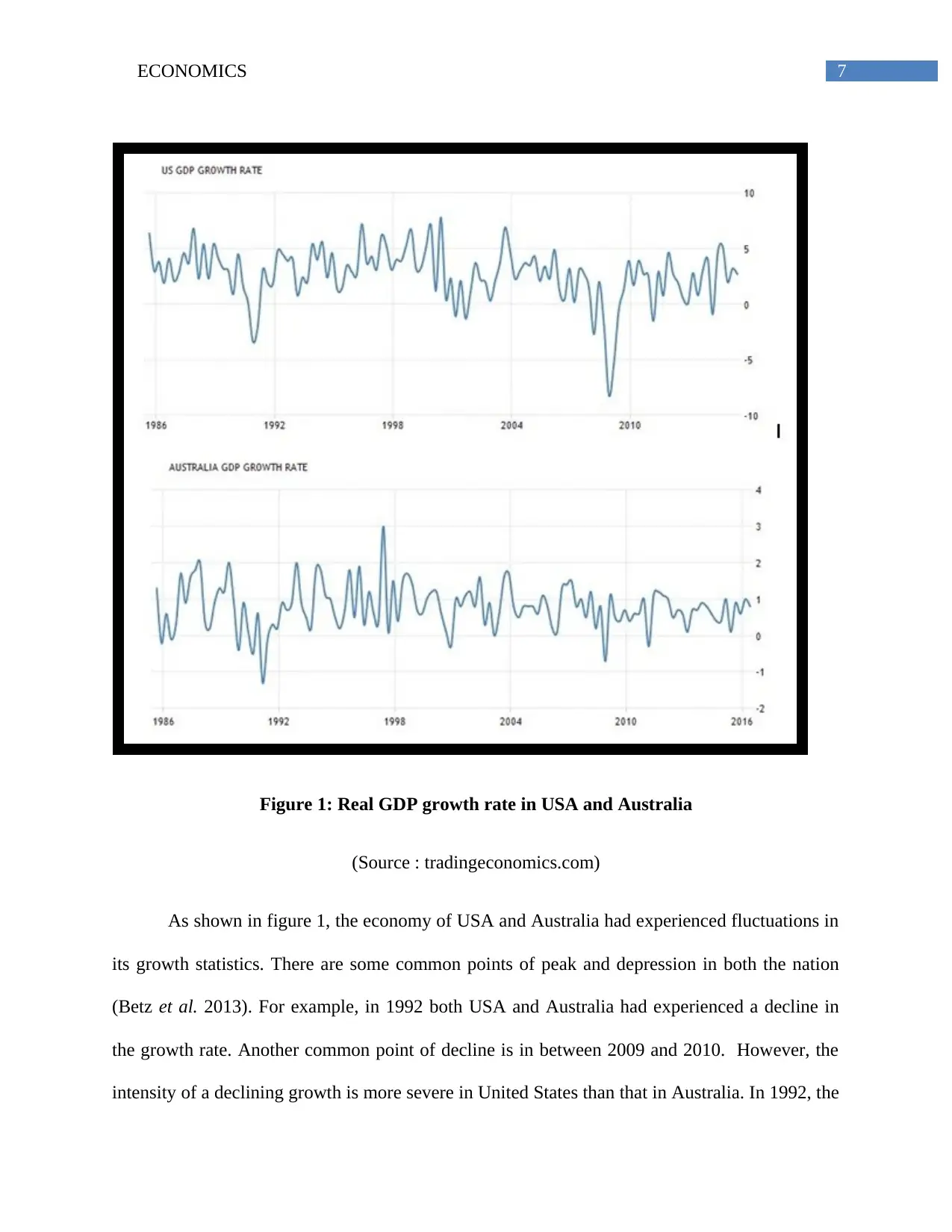
Figure 1: Real GDP growth rate in USA and Australia
(Source : tradingeconomics.com)
As shown in figure 1, the economy of USA and Australia had experienced fluctuations in
its growth statistics. There are some common points of peak and depression in both the nation
(Betz et al. 2013). For example, in 1992 both USA and Australia had experienced a decline in
the growth rate. Another common point of decline is in between 2009 and 2010. However, the
intensity of a declining growth is more severe in United States than that in Australia. In 1992, the
Figure 1: Real GDP growth rate in USA and Australia
(Source : tradingeconomics.com)
As shown in figure 1, the economy of USA and Australia had experienced fluctuations in
its growth statistics. There are some common points of peak and depression in both the nation
(Betz et al. 2013). For example, in 1992 both USA and Australia had experienced a decline in
the growth rate. Another common point of decline is in between 2009 and 2010. However, the
intensity of a declining growth is more severe in United States than that in Australia. In 1992, the
8ECONOMICS
growth rare in Australia is less than -1 where that in USA is almost closer to -5. In the next
declining phase, that is in 209-2010 growth rate in Australia is though declined but remain
positive but that in USA is closer to -10. This shows though some similarity in GDP movement
is found between the two nations, the intensity is not much. During 1997-98 both the economy
had experienced an increase in the growth rate. In 2003 also there was a rising growth trend.
Exchange rate and trade balance
The movement of GDP depends on its different components that again depend on a
number of factors. Economy of USA and Australia is related in terms of investment and trade,
both having impact on GDP and determines health of the economy. When export exceeds import
then trade balance is positive and when import exceeds export then trade balance is negative.
Demand for export and import is determined in terms of the prevailing exchange rate between
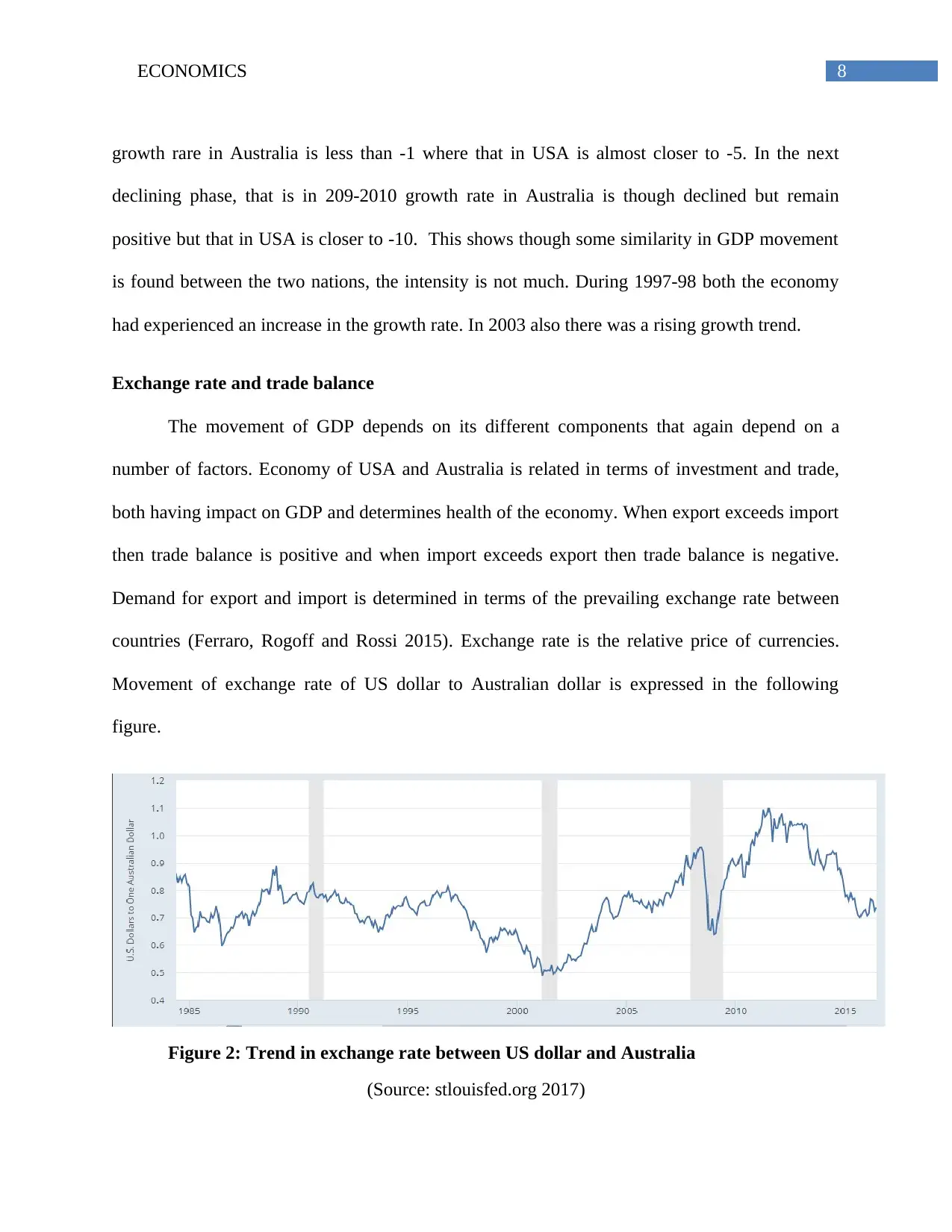
countries (Ferraro, Rogoff and Rossi 2015). Exchange rate is the relative price of currencies.
Movement of exchange rate of US dollar to Australian dollar is expressed in the following
figure.
Figure 2: Trend in exchange rate between US dollar and Australia
(Source: stlouisfed.org 2017)
growth rare in Australia is less than -1 where that in USA is almost closer to -5. In the next
declining phase, that is in 209-2010 growth rate in Australia is though declined but remain
positive but that in USA is closer to -10. This shows though some similarity in GDP movement
is found between the two nations, the intensity is not much. During 1997-98 both the economy
had experienced an increase in the growth rate. In 2003 also there was a rising growth trend.
Exchange rate and trade balance
The movement of GDP depends on its different components that again depend on a
number of factors. Economy of USA and Australia is related in terms of investment and trade,
both having impact on GDP and determines health of the economy. When export exceeds import
then trade balance is positive and when import exceeds export then trade balance is negative.
Demand for export and import is determined in terms of the prevailing exchange rate between
countries (Ferraro, Rogoff and Rossi 2015). Exchange rate is the relative price of currencies.
Movement of exchange rate of US dollar to Australian dollar is expressed in the following
figure.
Figure 2: Trend in exchange rate between US dollar and Australia
(Source: stlouisfed.org 2017)
⊘ This is a preview!⊘
Do you want full access?
Subscribe today to unlock all pages.
Trusted by 1+ million students worldwide
9ECONOMICS
A volatile movement of exchange rate is found between the two countries. When
exchange rate of US dollar to Australian dollar is high then it is cheaper for the Australian to
export from USA as they have to pay less Australian dollar for one unit of US dollar. Opposite is
the case for low exchange rate. The direct impact of exchange rate is on volume of export import
and on the trade balances (Bussière, Delle Chiaie and Peltonen 2014.). The statistics for US trade
of goods with Australia and corresponding trade balance is expressed in the following table
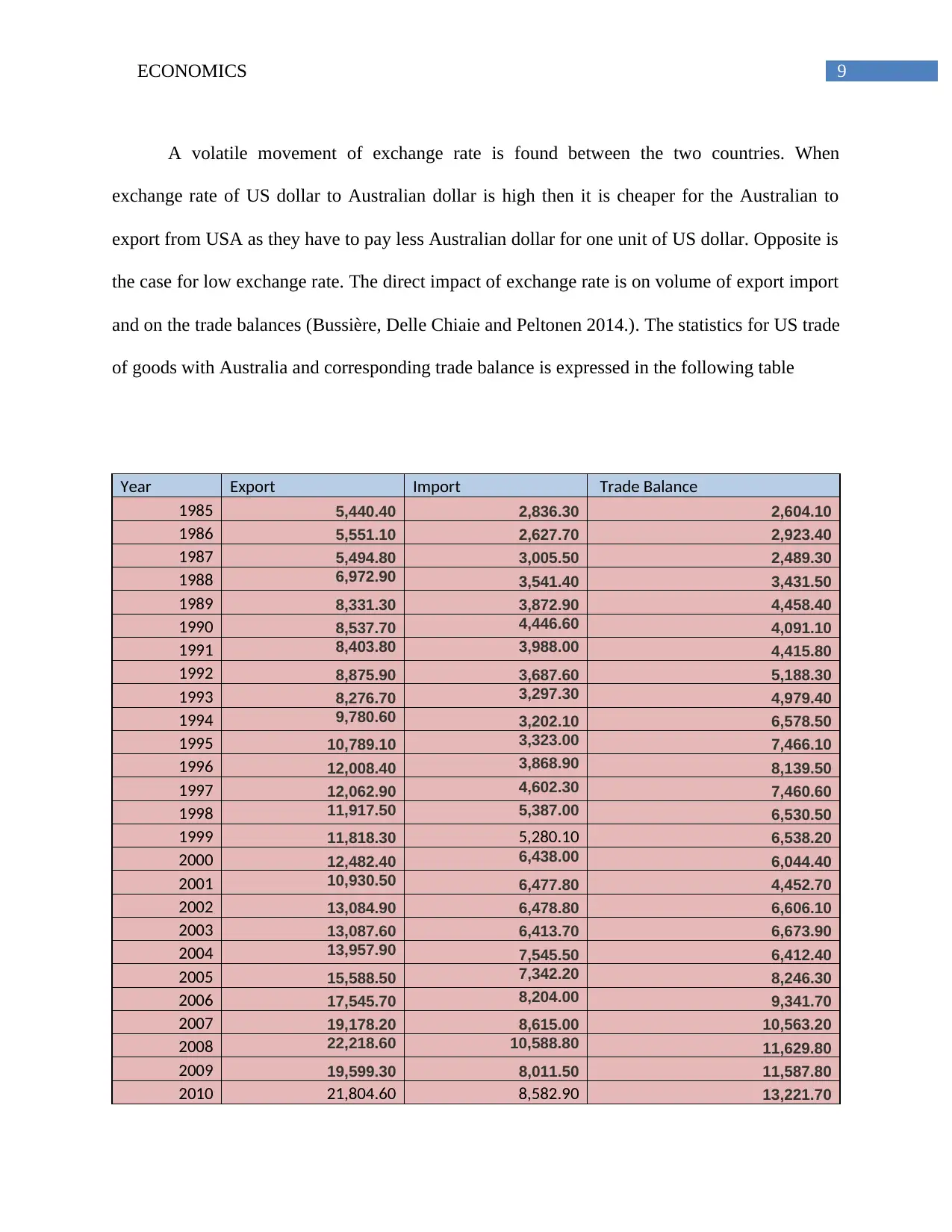
Year Export Import Trade Balance
1985 5,440.40 2,836.30 2,604.10
1986 5,551.10 2,627.70 2,923.40
1987 5,494.80 3,005.50 2,489.30
1988 6,972.90 3,541.40 3,431.50
1989 8,331.30 3,872.90 4,458.40
1990 8,537.70 4,446.60 4,091.10
1991 8,403.80 3,988.00 4,415.80
1992 8,875.90 3,687.60 5,188.30
1993 8,276.70 3,297.30 4,979.40
1994 9,780.60 3,202.10 6,578.50
1995 10,789.10 3,323.00 7,466.10
1996 12,008.40 3,868.90 8,139.50
1997 12,062.90 4,602.30 7,460.60
1998 11,917.50 5,387.00 6,530.50
1999 11,818.30 5,280.10 6,538.20
2000 12,482.40 6,438.00 6,044.40
2001 10,930.50 6,477.80 4,452.70
2002 13,084.90 6,478.80 6,606.10
2003 13,087.60 6,413.70 6,673.90
2004 13,957.90 7,545.50 6,412.40
2005 15,588.50 7,342.20 8,246.30
2006 17,545.70 8,204.00 9,341.70
2007 19,178.20 8,615.00 10,563.20
2008 22,218.60 10,588.80 11,629.80
2009 19,599.30 8,011.50 11,587.80
2010 21,804.60 8,582.90 13,221.70
A volatile movement of exchange rate is found between the two countries. When
exchange rate of US dollar to Australian dollar is high then it is cheaper for the Australian to
export from USA as they have to pay less Australian dollar for one unit of US dollar. Opposite is
the case for low exchange rate. The direct impact of exchange rate is on volume of export import
and on the trade balances (Bussière, Delle Chiaie and Peltonen 2014.). The statistics for US trade
of goods with Australia and corresponding trade balance is expressed in the following table
Year Export Import Trade Balance
1985 5,440.40 2,836.30 2,604.10
1986 5,551.10 2,627.70 2,923.40
1987 5,494.80 3,005.50 2,489.30
1988 6,972.90 3,541.40 3,431.50
1989 8,331.30 3,872.90 4,458.40
1990 8,537.70 4,446.60 4,091.10
1991 8,403.80 3,988.00 4,415.80
1992 8,875.90 3,687.60 5,188.30
1993 8,276.70 3,297.30 4,979.40
1994 9,780.60 3,202.10 6,578.50
1995 10,789.10 3,323.00 7,466.10
1996 12,008.40 3,868.90 8,139.50
1997 12,062.90 4,602.30 7,460.60
1998 11,917.50 5,387.00 6,530.50
1999 11,818.30 5,280.10 6,538.20
2000 12,482.40 6,438.00 6,044.40
2001 10,930.50 6,477.80 4,452.70
2002 13,084.90 6,478.80 6,606.10
2003 13,087.60 6,413.70 6,673.90
2004 13,957.90 7,545.50 6,412.40
2005 15,588.50 7,342.20 8,246.30
2006 17,545.70 8,204.00 9,341.70
2007 19,178.20 8,615.00 10,563.20
2008 22,218.60 10,588.80 11,629.80
2009 19,599.30 8,011.50 11,587.80
2010 21,804.60 8,582.90 13,221.70
Paraphrase This Document
Need a fresh take? Get an instant paraphrase of this document with our AI Paraphraser
10ECONOMICS
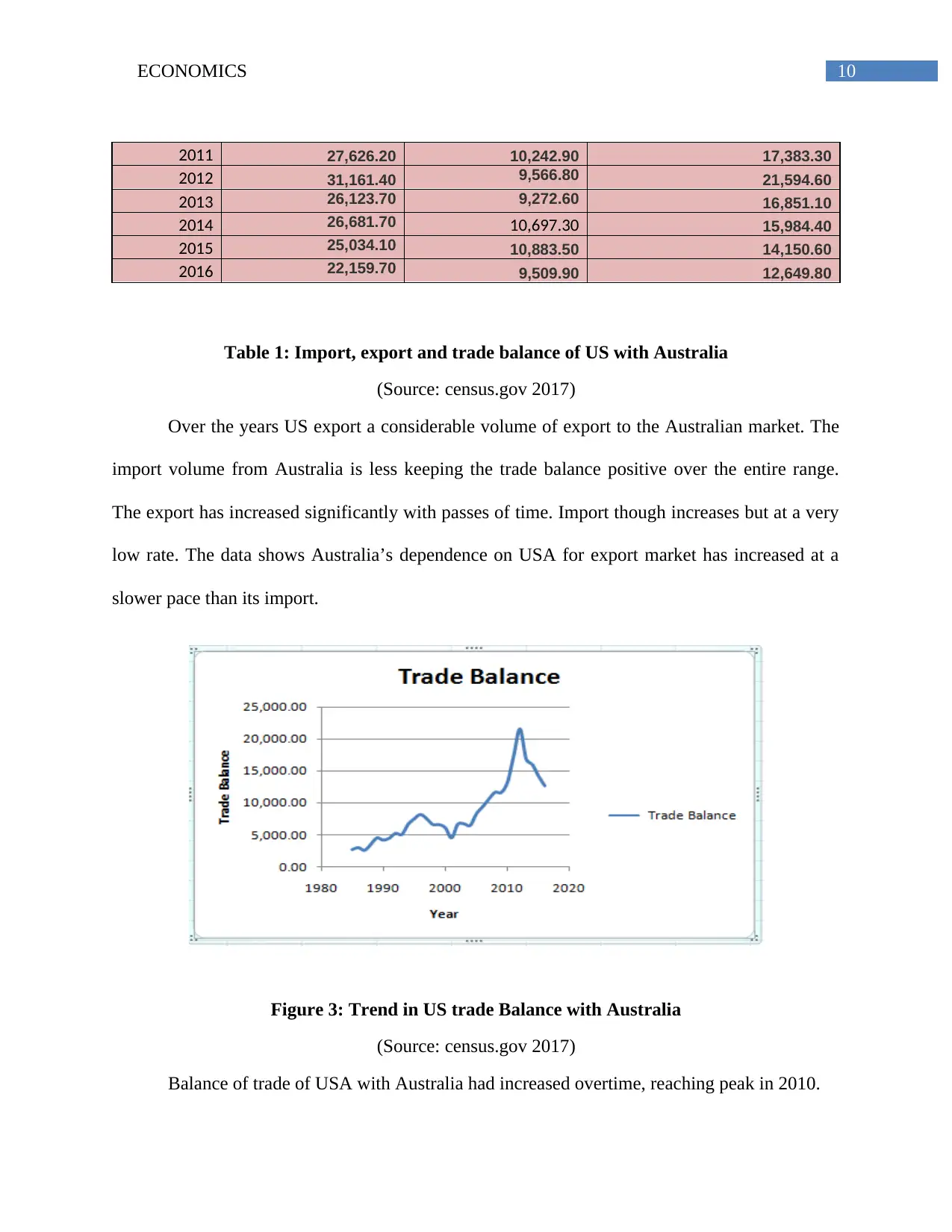
2011 27,626.20 10,242.90 17,383.30
2012 31,161.40 9,566.80 21,594.60
2013 26,123.70 9,272.60 16,851.10
2014 26,681.70 10,697.30 15,984.40
2015 25,034.10 10,883.50 14,150.60
2016 22,159.70 9,509.90 12,649.80
Table 1: Import, export and trade balance of US with Australia
(Source: census.gov 2017)
Over the years US export a considerable volume of export to the Australian market. The
import volume from Australia is less keeping the trade balance positive over the entire range.
The export has increased significantly with passes of time. Import though increases but at a very
low rate. The data shows Australia’s dependence on USA for export market has increased at a
slower pace than its import.
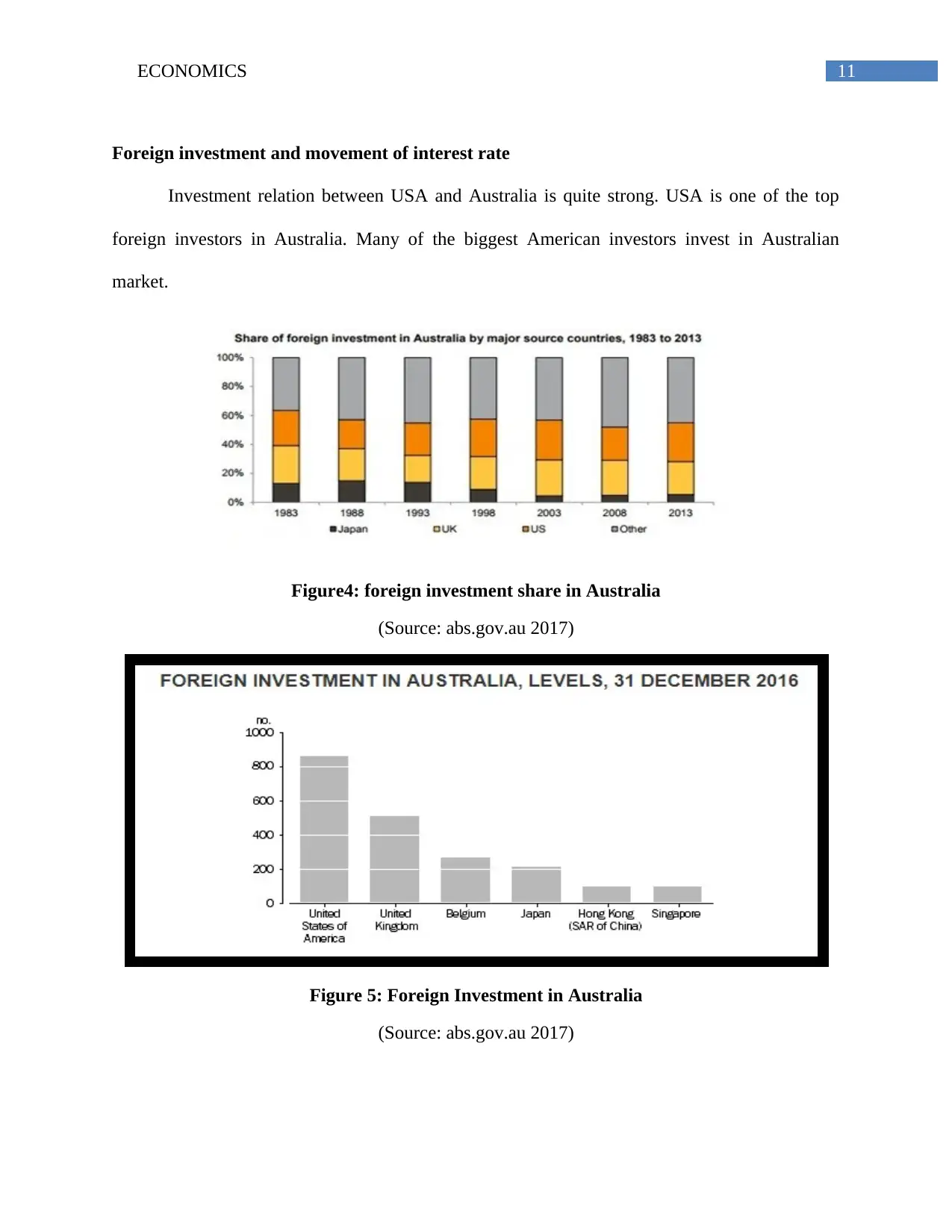
Figure 3: Trend in US trade Balance with Australia
(Source: census.gov 2017)
Balance of trade of USA with Australia had increased overtime, reaching peak in 2010.
2011 27,626.20 10,242.90 17,383.30
2012 31,161.40 9,566.80 21,594.60
2013 26,123.70 9,272.60 16,851.10
2014 26,681.70 10,697.30 15,984.40
2015 25,034.10 10,883.50 14,150.60
2016 22,159.70 9,509.90 12,649.80
Table 1: Import, export and trade balance of US with Australia
(Source: census.gov 2017)
Over the years US export a considerable volume of export to the Australian market. The
import volume from Australia is less keeping the trade balance positive over the entire range.
The export has increased significantly with passes of time. Import though increases but at a very
low rate. The data shows Australia’s dependence on USA for export market has increased at a
slower pace than its import.
Figure 3: Trend in US trade Balance with Australia
(Source: census.gov 2017)
Balance of trade of USA with Australia had increased overtime, reaching peak in 2010.
11ECONOMICS
Foreign investment and movement of interest rate
Investment relation between USA and Australia is quite strong. USA is one of the top
foreign investors in Australia. Many of the biggest American investors invest in Australian
market.
Figure4: foreign investment share in Australia
(Source: abs.gov.au 2017)
Figure 5: Foreign Investment in Australia
(Source: abs.gov.au 2017)
Foreign investment and movement of interest rate
Investment relation between USA and Australia is quite strong. USA is one of the top
foreign investors in Australia. Many of the biggest American investors invest in Australian
market.
Figure4: foreign investment share in Australia
(Source: abs.gov.au 2017)
Figure 5: Foreign Investment in Australia
(Source: abs.gov.au 2017)
⊘ This is a preview!⊘
Do you want full access?
Subscribe today to unlock all pages.
Trusted by 1+ million students worldwide

1 out of 20


Related Documents


Your All-in-One AI-Powered Toolkit for Academic Success.
+13062052269
info@desklib.com
Available 24*7 on WhatsApp / Email
![[object Object]](/_next/static/media/star-bottom.7253800d.svg)
Unlock your academic potential
Copyright © 2020–2026 A2Z Services. All Rights Reserved. Developed and managed by ZUCOL.