Security Policy Report: E-mail Usage Guidelines and Recommendations
VerifiedAdded on 2020/03/04
|12
|2878
|205
Report
AI Summary
This report delves into the critical topic of e-mail usage policies within organizations, offering a comprehensive analysis and practical recommendations. It begins with an abstract outlining the core focus on establishing clear guidelines for employee e-mail behavior to safeguard company assets and information. The report then provides a literature review, exploring various e-mail policies implemented by well-known organizations like French trade union, Volkswagen, Intel, Daimler, Menlo innovations and Ferrari, highlighting both their successes and challenges. Key concepts covered include the importance of email for business purposes only, the use of email as a communication tool, and the need for equal and clear policies. A methodology section details the use of secondary data from academic journals and e-books. The report's key recommendations emphasize the importance of time management, data security, legal compliance, and employee privacy. Finally, the conclusion reinforces the importance of well-defined e-mail usage policies for fostering a productive and secure work environment.
Running head: SECURITY POLICY
E-mail usage policy
Name of the Student
Name of the University
Author Note
E-mail usage policy
Name of the Student
Name of the University
Author Note

Paraphrase This Document
Need a fresh take? Get an instant paraphrase of this document with our AI Paraphraser
1
SECURITY POLICY
Abstract
This report deals with the E-mail policies that the organization takes up as recommendations
and instructions that are provided to the employees through which they get a over view that
hoe to deal with their company’s email accounts. Security policies are those, which actually
are the written documentation that helps the employees aware that the company’s physical as
well as informational assets are monitored and safeguard by the company. Many well known
organizations like for example, French trade union, Volkswagen, Intel, Daimler, Menlo
innovations and Ferrari have taken up various interesting e-mail policies. It has further been
recommended that companies should have equal policies for everyone and they must brief
their employees about the e-mail and security policies beforehand so that the privacy of the
employee is maintained as well as they must be abided by the basic information that how they
should use their official e-mail account.
SECURITY POLICY
Abstract
This report deals with the E-mail policies that the organization takes up as recommendations
and instructions that are provided to the employees through which they get a over view that
hoe to deal with their company’s email accounts. Security policies are those, which actually
are the written documentation that helps the employees aware that the company’s physical as
well as informational assets are monitored and safeguard by the company. Many well known
organizations like for example, French trade union, Volkswagen, Intel, Daimler, Menlo
innovations and Ferrari have taken up various interesting e-mail policies. It has further been
recommended that companies should have equal policies for everyone and they must brief
their employees about the e-mail and security policies beforehand so that the privacy of the
employee is maintained as well as they must be abided by the basic information that how they
should use their official e-mail account.
2
SECURITY POLICY
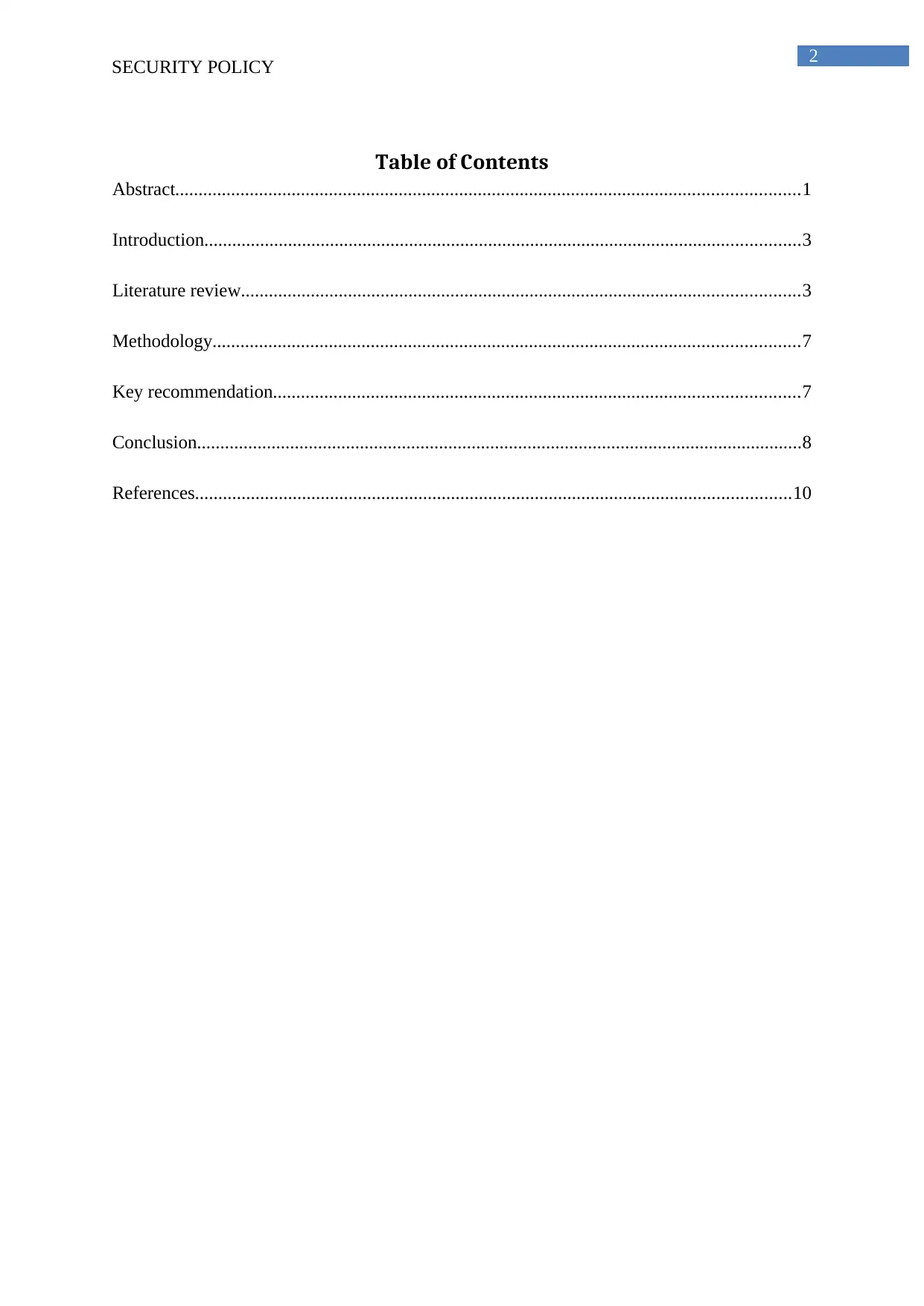
Table of Contents
Abstract......................................................................................................................................1
Introduction................................................................................................................................3
Literature review........................................................................................................................3
Methodology..............................................................................................................................7
Key recommendation.................................................................................................................7
Conclusion..................................................................................................................................8
References................................................................................................................................10
SECURITY POLICY
Table of Contents
Abstract......................................................................................................................................1
Introduction................................................................................................................................3
Literature review........................................................................................................................3
Methodology..............................................................................................................................7
Key recommendation.................................................................................................................7
Conclusion..................................................................................................................................8
References................................................................................................................................10
⊘ This is a preview!⊘
Do you want full access?
Subscribe today to unlock all pages.

Trusted by 1+ million students worldwide
3
SECURITY POLICY
Introduction
The recommendations and commands given to worker regarding the utility of Internet
opportunities like the Web e-mail and chat conferences. It demanded all prohibitions such as
enter to pornographic sites, running illegitimate activities and sexual harassment. It sanctions
who may imparted with associates of the press, rivals and other companies. Employees may
be needed to inscribe such a policy declaration as a promise to honor its moralities or
otherwise be banished. Through email policies the employees gets a clear notion that emails
should be used for suitable business purposes only. Employees often examine e-mail as
informal and may involve comments that could later spook the company (Zickuhr and
Madden 2012).
For a business, a security policy is a document that expresses through writing what
the company’s plans are to safeguard its physical and information technology assets. A
security policy is frequently believed to be ‘living document’, which means that the
document is never consumed rather it is constantly revised as per the changes in technology
and employees. A company’s security policy is actually the plan where it clearly stated how
to protect the company’s assets (Bayuk et al. 2012). This report deals with the chosen topic
E-mail usage policy and a research report is being done based on this topic.
Literature review
The purpose behind implying this email usage policy in workplaces are to guarantee
the actual utilization of email structure and make users enlightened of what is considered as
satisfactory and unsatisfactory utilization of its email structure (Schmidt and Cohen 2013).
This policy shapes the basic essentials for utility of email within the network. However,
technological solutions are not trustworthy (Zhao and Ge 2013). Final users will periodically
SECURITY POLICY
Introduction
The recommendations and commands given to worker regarding the utility of Internet
opportunities like the Web e-mail and chat conferences. It demanded all prohibitions such as
enter to pornographic sites, running illegitimate activities and sexual harassment. It sanctions
who may imparted with associates of the press, rivals and other companies. Employees may
be needed to inscribe such a policy declaration as a promise to honor its moralities or
otherwise be banished. Through email policies the employees gets a clear notion that emails
should be used for suitable business purposes only. Employees often examine e-mail as
informal and may involve comments that could later spook the company (Zickuhr and
Madden 2012).
For a business, a security policy is a document that expresses through writing what
the company’s plans are to safeguard its physical and information technology assets. A
security policy is frequently believed to be ‘living document’, which means that the
document is never consumed rather it is constantly revised as per the changes in technology
and employees. A company’s security policy is actually the plan where it clearly stated how
to protect the company’s assets (Bayuk et al. 2012). This report deals with the chosen topic
E-mail usage policy and a research report is being done based on this topic.
Literature review
The purpose behind implying this email usage policy in workplaces are to guarantee
the actual utilization of email structure and make users enlightened of what is considered as
satisfactory and unsatisfactory utilization of its email structure (Schmidt and Cohen 2013).
This policy shapes the basic essentials for utility of email within the network. However,
technological solutions are not trustworthy (Zhao and Ge 2013). Final users will periodically
Paraphrase This Document
Need a fresh take? Get an instant paraphrase of this document with our AI Paraphraser
4
SECURITY POLICY
avoid the network's safety measures. It is very strenuous to block each possible Web-based e-
mail site, and some are leap to be avoided. Umbrella coverage was launched by applying an
E-mail Usage Policy. It clearly delineate what behaviors comprising adequate utilization of
organization supplied computers, networks, systems and e-mail accounts, and by declaring
the punishments that result from violating the policies, the company can eliminate prevailing
risks (Kiesler 2014).
Email usage policy has been applied in various companies in various ways and with
change in time companies are amending and accepting these policies differently. A study by
Mark, Voida and Cardello (2012), stated that giving people continuous time where they are
not associating with e-mail mostly keep them without stress and better focused. It further
states that without e-mails, employees are less involved in multitasking and thus, found
having prolonged focus in tasks as calculated by the lower frequency of switching between
windows and an extended duration of the time spent performing in each window of the
computer. Moreover, stress is directly calculated operating wearable heart rate detectors and
established that stress level was much lower without e-mails.
Recently in French trade union, they have arranged an agreement for few employees
in their company that permits their employees to switch off their cell phones and computers
after 6 o’clock in the afternoon and not about to bother about checking in. Bit of their policy
is that the organization cannot pressurize or make their workforce feel unpleasant about not
exploring and replying to the mails. However, with this approach the pressure to handle e-
mails after the working hours is minimized (Morgan 2015). Volkswagen group of automobile
manufacturers made a deal with the organization’s work council to restrict workers access to
e-mails on the Blackberry gadget after their working hours. Under this deal, the servers cease
routing emails just 30 minutes after the employees shift has ended and again starting just 30
minutes before their reappearance in work. The employees are permitted to make calls from
SECURITY POLICY
avoid the network's safety measures. It is very strenuous to block each possible Web-based e-
mail site, and some are leap to be avoided. Umbrella coverage was launched by applying an
E-mail Usage Policy. It clearly delineate what behaviors comprising adequate utilization of
organization supplied computers, networks, systems and e-mail accounts, and by declaring
the punishments that result from violating the policies, the company can eliminate prevailing
risks (Kiesler 2014).
Email usage policy has been applied in various companies in various ways and with
change in time companies are amending and accepting these policies differently. A study by
Mark, Voida and Cardello (2012), stated that giving people continuous time where they are
not associating with e-mail mostly keep them without stress and better focused. It further
states that without e-mails, employees are less involved in multitasking and thus, found
having prolonged focus in tasks as calculated by the lower frequency of switching between
windows and an extended duration of the time spent performing in each window of the
computer. Moreover, stress is directly calculated operating wearable heart rate detectors and
established that stress level was much lower without e-mails.
Recently in French trade union, they have arranged an agreement for few employees
in their company that permits their employees to switch off their cell phones and computers
after 6 o’clock in the afternoon and not about to bother about checking in. Bit of their policy
is that the organization cannot pressurize or make their workforce feel unpleasant about not
exploring and replying to the mails. However, with this approach the pressure to handle e-
mails after the working hours is minimized (Morgan 2015). Volkswagen group of automobile
manufacturers made a deal with the organization’s work council to restrict workers access to
e-mails on the Blackberry gadget after their working hours. Under this deal, the servers cease
routing emails just 30 minutes after the employees shift has ended and again starting just 30
minutes before their reappearance in work. The employees are permitted to make calls from
5
SECURITY POLICY
their gadget and this rule however is not applicable to the senior managers (Niehaves, Köffer
and Ortbach 2012).
Intel semiconductor manufacturing company tried to experiment with 300 engineers
and managers where they had to went ‘offline’ each morning of Tuesdays. During Tuesday
mornings, they had to put their emails and IM clients to offline mode, redirecting their
phones to the voice mails, circumvent fixing up meetings, and detaching themselves from the
visitors by placing a sign of do not disturb at the doorway. This experiment was a success as
it helped developing effectiveness of the staffs and productivity and excellence of life for
many employees in various job roles (Tong 2017). Daimler automobile company took up this
policy as in there will be no delivering of E-mails during the vacations of the employees. This
company has executed a new agenda that permits the employees to set their e-mails software
to automatically remove the incoming emails while their employees are in Vacations.
However, when an email arrives the program named ‘Mail on Holiday’ on its own reply back
to the sender that the employee is away from the office and so this email will get erased
moreover also suggesting an information to contact another employee for urgent issues (Grey
2015).
Another software company in Ann Arbor, Michigan named Menlo Innovations has
discarded internal emails in approval of ‘high speed voice activated technology’. Here if any
information is needed from any of the colleagues then that information should be collected by
physically talking to that person. Other companies use similar techniques though but still
employees can obtain emails from outside sources like those of clients and traders but there is
no ways of mailing to the colleagues. This actually showed the way in which other techniques
can be used to replace emails in several cases (Shaer 2013). Ferrari car manufacturing
company has took the initiative where they can enhance direct communication within their
company and so they are encouraging more face to face conversations and lesser emails.
SECURITY POLICY
their gadget and this rule however is not applicable to the senior managers (Niehaves, Köffer
and Ortbach 2012).
Intel semiconductor manufacturing company tried to experiment with 300 engineers
and managers where they had to went ‘offline’ each morning of Tuesdays. During Tuesday
mornings, they had to put their emails and IM clients to offline mode, redirecting their
phones to the voice mails, circumvent fixing up meetings, and detaching themselves from the
visitors by placing a sign of do not disturb at the doorway. This experiment was a success as
it helped developing effectiveness of the staffs and productivity and excellence of life for
many employees in various job roles (Tong 2017). Daimler automobile company took up this
policy as in there will be no delivering of E-mails during the vacations of the employees. This
company has executed a new agenda that permits the employees to set their e-mails software
to automatically remove the incoming emails while their employees are in Vacations.
However, when an email arrives the program named ‘Mail on Holiday’ on its own reply back
to the sender that the employee is away from the office and so this email will get erased
moreover also suggesting an information to contact another employee for urgent issues (Grey
2015).
Another software company in Ann Arbor, Michigan named Menlo Innovations has
discarded internal emails in approval of ‘high speed voice activated technology’. Here if any
information is needed from any of the colleagues then that information should be collected by
physically talking to that person. Other companies use similar techniques though but still
employees can obtain emails from outside sources like those of clients and traders but there is
no ways of mailing to the colleagues. This actually showed the way in which other techniques
can be used to replace emails in several cases (Shaer 2013). Ferrari car manufacturing
company has took the initiative where they can enhance direct communication within their
company and so they are encouraging more face to face conversations and lesser emails.
⊘ This is a preview!⊘
Do you want full access?
Subscribe today to unlock all pages.
Trusted by 1+ million students worldwide
6
SECURITY POLICY
Their technique is that they can at one time send a single email to three people within an
organization. The imprudent posting of emails with abundance of recipients regularly on
themes with no applicability to majority of the latter is one of the chief reasons of loss of time
and incompetency in the normal working day in employment. However, Ferrari has
determined to end the problem from its roots by supplying a very understandable and simple
order to its workers and that is ‘talk to each other more and write less’ (Alidadi 2012).
E-mail draws up 23 percent of the usual employee’s working day, and that
usual employee conveys or accepts 112 emails each day. Taking a view over these
statistics, one begins to understand email as a current structure of knowledge pollution. In
fact, that precise closure is one that Thierry Breton who is CEO of the France-based
Information technology facility firm originated in Atos appeared at some years back. Breton
observed that his workers appeared continuously inattentive by the flow of emails they
received per day. Therefore, he took measures to abolish what he thought were pessimistic
effects on organization’s productivity. In February 2011, Breton declared that he was
forbidding email. Within three years’ of time, he desired Atos to be an organization with
“zero-email” (Silic, Back and Silic 2015).
Prohibiting or placing restrictions on e-mail, a research proposes that it can
histrionically increase employee’s work rate and decrease stress (Wang et al.
2016). Investigators from the University of California, Irvine and the United States Army cut
out email utility for thirteen civilian workplace workers and restrained the consequences on
production and stress. The investigators first took contestant across a three-day baseline
interval in which they are interviewed and scrutinized in visual as well as with computer
observing software. They even studied the contestants’ heart rates as a representative for the
levels of stress. However, they dragged the plug on e-mail, fixing a strainer on the
SECURITY POLICY
Their technique is that they can at one time send a single email to three people within an
organization. The imprudent posting of emails with abundance of recipients regularly on
themes with no applicability to majority of the latter is one of the chief reasons of loss of time
and incompetency in the normal working day in employment. However, Ferrari has
determined to end the problem from its roots by supplying a very understandable and simple
order to its workers and that is ‘talk to each other more and write less’ (Alidadi 2012).
E-mail draws up 23 percent of the usual employee’s working day, and that
usual employee conveys or accepts 112 emails each day. Taking a view over these
statistics, one begins to understand email as a current structure of knowledge pollution. In
fact, that precise closure is one that Thierry Breton who is CEO of the France-based
Information technology facility firm originated in Atos appeared at some years back. Breton
observed that his workers appeared continuously inattentive by the flow of emails they
received per day. Therefore, he took measures to abolish what he thought were pessimistic
effects on organization’s productivity. In February 2011, Breton declared that he was
forbidding email. Within three years’ of time, he desired Atos to be an organization with
“zero-email” (Silic, Back and Silic 2015).
Prohibiting or placing restrictions on e-mail, a research proposes that it can
histrionically increase employee’s work rate and decrease stress (Wang et al.
2016). Investigators from the University of California, Irvine and the United States Army cut
out email utility for thirteen civilian workplace workers and restrained the consequences on
production and stress. The investigators first took contestant across a three-day baseline
interval in which they are interviewed and scrutinized in visual as well as with computer
observing software. They even studied the contestants’ heart rates as a representative for the
levels of stress. However, they dragged the plug on e-mail, fixing a strainer on the
Paraphrase This Document
Need a fresh take? Get an instant paraphrase of this document with our AI Paraphraser
7
SECURITY POLICY
contestants’ email program— that would report all incoming messages for future reading and
erase all notifications (Okoye 2016).
Methodology
The secondary data, which means collecting the data on behalf of the original user,
has been researched from the Journal articles and peer reviewed articles and E-books
(Silverman 2016). For this very research report, the search engine has been used such as
Google scholar and online library for passed data collection. Descriptive analysis has been
done for this particular report. Here descriptive analysis means short illustrative coefficients
that outline the set of data that can be a sample from the entire population or the population as
a whole. Resources of the books are also got from the Google Scholar, which were reviewed
as well.
Key recommendation
From this report, it can be recommended that email usage policy assists prevent
wasting of time, save security of the data and lessens the chances of legal issues. However,
the policy must wrap all the e-mail observing the employees works that they want to carry
out. The employees must keep in mind and be conscious that the email systems that they are
using from their company’s system must be used for business purposes only. Employees must
be encouraged to apply filters so that they can separate the business and personal mails
separately. Employees’ personal use of the companies e-mail should be restricted.
Restrictions should be on repetitive sending of personal mails, illegitimate content in the mail
like sending insulting jokes, involving in illegitimate activities and most importantly apart
from the employees other peoples are restricted from using their official e-mail accounts.
Company should aspire with at what time the employee should and should not utilize their e-
mails.
SECURITY POLICY
contestants’ email program— that would report all incoming messages for future reading and
erase all notifications (Okoye 2016).
Methodology
The secondary data, which means collecting the data on behalf of the original user,
has been researched from the Journal articles and peer reviewed articles and E-books
(Silverman 2016). For this very research report, the search engine has been used such as
Google scholar and online library for passed data collection. Descriptive analysis has been
done for this particular report. Here descriptive analysis means short illustrative coefficients
that outline the set of data that can be a sample from the entire population or the population as
a whole. Resources of the books are also got from the Google Scholar, which were reviewed
as well.
Key recommendation
From this report, it can be recommended that email usage policy assists prevent
wasting of time, save security of the data and lessens the chances of legal issues. However,
the policy must wrap all the e-mail observing the employees works that they want to carry
out. The employees must keep in mind and be conscious that the email systems that they are
using from their company’s system must be used for business purposes only. Employees must
be encouraged to apply filters so that they can separate the business and personal mails
separately. Employees’ personal use of the companies e-mail should be restricted.
Restrictions should be on repetitive sending of personal mails, illegitimate content in the mail
like sending insulting jokes, involving in illegitimate activities and most importantly apart
from the employees other peoples are restricted from using their official e-mail accounts.
Company should aspire with at what time the employee should and should not utilize their e-
mails.
8
SECURITY POLICY
Employees must be clearly guided on what devices they can opt to use their
companies email account to inbox or outbox emails. Employees should be given a briefing on
what formal style and tone they must make the content while sending formal emails from
their company e-mail account. This will however help them realize the difference between
informality in a telephonic conversation and a formal letter, which solely depends on the
clients the employees are contacting. Basic content formal must be clear for example, typing
in capitals might sound rude in a formal letter, when starting a communication with a person
for the first time a formal style is e-mail is important and too short e-mail might look blunt so
these must be avoided. Employees should be motivated to use e-mails when they wish to
keep the documentation of the conversations. Lastly, the companies must provide rules for
handling private information. The potential contractual importance of e-mails must be
explained to them thoroughly. There must be a policy that both inbox and outbox messages in
the company’s email account should be stored. Employees should be aware that for what
reason emails are monitored by using software by the company and the most important part is
that each employee’s privacy should be respected. Employees must also ask for
recommendations that what changes can be brought to the existing e-mail policies and every
policy must be equally available to all.
Conclusion
To conclude this report it can be said that e-mail usage policies are the
recommendations and guidelines that are abided by the employees of the organizations who
wish to keep their official information to themselves. This type of a policy is accepted as to
enhance the moralities of the company’s aims and objectives and through this employees gets
a clear conception that e-mails are for formal purposes only and they not use it in any illegal
affair for which the company may face the consequences latter on. However, the security
SECURITY POLICY
Employees must be clearly guided on what devices they can opt to use their
companies email account to inbox or outbox emails. Employees should be given a briefing on
what formal style and tone they must make the content while sending formal emails from
their company e-mail account. This will however help them realize the difference between
informality in a telephonic conversation and a formal letter, which solely depends on the
clients the employees are contacting. Basic content formal must be clear for example, typing
in capitals might sound rude in a formal letter, when starting a communication with a person
for the first time a formal style is e-mail is important and too short e-mail might look blunt so
these must be avoided. Employees should be motivated to use e-mails when they wish to
keep the documentation of the conversations. Lastly, the companies must provide rules for
handling private information. The potential contractual importance of e-mails must be
explained to them thoroughly. There must be a policy that both inbox and outbox messages in
the company’s email account should be stored. Employees should be aware that for what
reason emails are monitored by using software by the company and the most important part is
that each employee’s privacy should be respected. Employees must also ask for
recommendations that what changes can be brought to the existing e-mail policies and every
policy must be equally available to all.
Conclusion
To conclude this report it can be said that e-mail usage policies are the
recommendations and guidelines that are abided by the employees of the organizations who
wish to keep their official information to themselves. This type of a policy is accepted as to
enhance the moralities of the company’s aims and objectives and through this employees gets
a clear conception that e-mails are for formal purposes only and they not use it in any illegal
affair for which the company may face the consequences latter on. However, the security
⊘ This is a preview!⊘
Do you want full access?
Subscribe today to unlock all pages.
Trusted by 1+ million students worldwide
9
SECURITY POLICY
policy of the company actually notifies in written what the companies measures are to keep
the informational and physical assets of the company.
Moreover, many companies have taken over various policies for emails, which in a
way may be beneficial as well as stressful after their working hours and so few top most
companies have inscribed some amazing policies related to e-mails. Organizations such as
French trade union, Volkswagen, Intel, Daimler, Menlo innovations and Ferrari as well have
taken up certain policies regarding email that help them evolve. However, the main purpose
of this e-mail policy is to assure the employees about the actual utility of the e-mail formation
and the users educated with what is deemed as satisfactory and disappointing utilization of
the email formation.
SECURITY POLICY
policy of the company actually notifies in written what the companies measures are to keep
the informational and physical assets of the company.
Moreover, many companies have taken over various policies for emails, which in a
way may be beneficial as well as stressful after their working hours and so few top most
companies have inscribed some amazing policies related to e-mails. Organizations such as
French trade union, Volkswagen, Intel, Daimler, Menlo innovations and Ferrari as well have
taken up certain policies regarding email that help them evolve. However, the main purpose
of this e-mail policy is to assure the employees about the actual utility of the e-mail formation
and the users educated with what is deemed as satisfactory and disappointing utilization of
the email formation.
Paraphrase This Document
Need a fresh take? Get an instant paraphrase of this document with our AI Paraphraser
10
SECURITY POLICY
References
Alidadi, K., 2012. From Front-Office to Back-Office: Religious Dress Crossing the Public–
Private Divide in the Workplace. Religion in Public Spaces.A European Perspective, pp.159-
189.
Bayuk, J.L., Healey, J., Rohmeyer, P., Sachs, M.H., Schmidt, J. and Weiss, J., 2012. Cyber
security policy guidebook.John Wiley & Sons.
Grey, J., 2015. The healthy mind platter: HR's role.People and Strategy, 38(1), p.18.
Kiesler, S., 2014.Culture of the Internet.Psychology Press.
Mark, G., Voida, S. and Cardello, A., 2012, May. A pace not dictated by electrons: an
empirical study of work without email. In Proceedings of the SIGCHI Conference on Human
Factors in Computing Systems (pp. 555-564).ACM.
Morgan, J., 2015. Book Highlight—Ten Principles of the Future Manager. Global Business
and Organizational Excellence, 34(3), pp.79-93.
Niehaves, B., Köffer, S. and Ortbach, K., 2012. IT consumerization–a theory and practice
review.
Okoye, H.I., 2016. Time Management Techniques Required by Managers and Supervisors in
Medium and Large-Sized Business Organizations in Enugu Metropolis (Doctoral
dissertation).
Schmidt, E. and Cohen, J., 2013. The new digital age.
Shaer, M., 2013. The boss stops here. New York Magazine.
Silic, M., Back, A. and Silic, D., 2015, May. Atos-Towards Zero Email Company. In ECIS.
SECURITY POLICY
References
Alidadi, K., 2012. From Front-Office to Back-Office: Religious Dress Crossing the Public–
Private Divide in the Workplace. Religion in Public Spaces.A European Perspective, pp.159-
189.
Bayuk, J.L., Healey, J., Rohmeyer, P., Sachs, M.H., Schmidt, J. and Weiss, J., 2012. Cyber
security policy guidebook.John Wiley & Sons.
Grey, J., 2015. The healthy mind platter: HR's role.People and Strategy, 38(1), p.18.
Kiesler, S., 2014.Culture of the Internet.Psychology Press.
Mark, G., Voida, S. and Cardello, A., 2012, May. A pace not dictated by electrons: an
empirical study of work without email. In Proceedings of the SIGCHI Conference on Human
Factors in Computing Systems (pp. 555-564).ACM.
Morgan, J., 2015. Book Highlight—Ten Principles of the Future Manager. Global Business
and Organizational Excellence, 34(3), pp.79-93.
Niehaves, B., Köffer, S. and Ortbach, K., 2012. IT consumerization–a theory and practice
review.
Okoye, H.I., 2016. Time Management Techniques Required by Managers and Supervisors in
Medium and Large-Sized Business Organizations in Enugu Metropolis (Doctoral
dissertation).
Schmidt, E. and Cohen, J., 2013. The new digital age.
Shaer, M., 2013. The boss stops here. New York Magazine.
Silic, M., Back, A. and Silic, D., 2015, May. Atos-Towards Zero Email Company. In ECIS.
11
SECURITY POLICY
Silverman, D. ed., 2016. Qualitative research. Sage.
Tong, P.Y., 2017. Think Twice BeforeHitting'Send': The Strategic Uses of Information in
Marketing Channels (Doctoral dissertation, West Virginia University).
Wang, B., Ester, M., Bu, J., Zhu, Y., Guan, Z. and Cai, D., 2016, April. Which to view:
Personalized prioritization for broadcast emails. In Proceedings of the 25th International
Conference on World Wide Web (pp. 1181-1190). International World Wide Web
Conferences Steering Committee.
Zhao, K. and Ge, L., 2013, December.A survey on the internet of things security. In
Computational Intelligence and Security (CIS), 2013 9th International Conference on (pp.
663-667). IEEE.
Zickuhr, K. and Madden, M., 2012. Older adults and internet use.Pew Internet & American
Life Project, 6.
SECURITY POLICY
Silverman, D. ed., 2016. Qualitative research. Sage.
Tong, P.Y., 2017. Think Twice BeforeHitting'Send': The Strategic Uses of Information in
Marketing Channels (Doctoral dissertation, West Virginia University).
Wang, B., Ester, M., Bu, J., Zhu, Y., Guan, Z. and Cai, D., 2016, April. Which to view:
Personalized prioritization for broadcast emails. In Proceedings of the 25th International
Conference on World Wide Web (pp. 1181-1190). International World Wide Web
Conferences Steering Committee.
Zhao, K. and Ge, L., 2013, December.A survey on the internet of things security. In
Computational Intelligence and Security (CIS), 2013 9th International Conference on (pp.
663-667). IEEE.
Zickuhr, K. and Madden, M., 2012. Older adults and internet use.Pew Internet & American
Life Project, 6.
⊘ This is a preview!⊘
Do you want full access?
Subscribe today to unlock all pages.
Trusted by 1+ million students worldwide

1 out of 12


Related Documents


Your All-in-One AI-Powered Toolkit for Academic Success.
+13062052269
info@desklib.com
Available 24*7 on WhatsApp / Email
![[object Object]](/_next/static/media/star-bottom.7253800d.svg)
Unlock your academic potential
Copyright © 2020–2026 A2Z Services. All Rights Reserved. Developed and managed by ZUCOL.