User Pays System in Australian Aged Care: A Critical Evaluation
VerifiedAdded on 2023/06/14
|8
|2109
|462
Essay
AI Summary
This essay provides a critical evaluation of the user pays system for aged care in Australia. It discusses the positives, such as increased sustainability, reduced tax burden, and improved flexibility for care providers, alongside the negatives, including financial burden on patients and potential for bad debts. The essay analyzes the roles of various stakeholders, including providers, the government, and patients, within the user pays model. It highlights how this model aims to deliver services based on patient choice and improve the quality of care through market deregulation and competition. Ultimately, the essay concludes that while the user pays model presents a timely and effective approach to managing the increasing demands of Australia's aging population, it also poses significant challenges related to affordability and access to care for vulnerable individuals. Desklib offers a variety of similar essays and study resources for students.

UNIT:
NAME:
DATE:
NAME:
DATE:
Paraphrase This Document
Need a fresh take? Get an instant paraphrase of this document with our AI Paraphraser

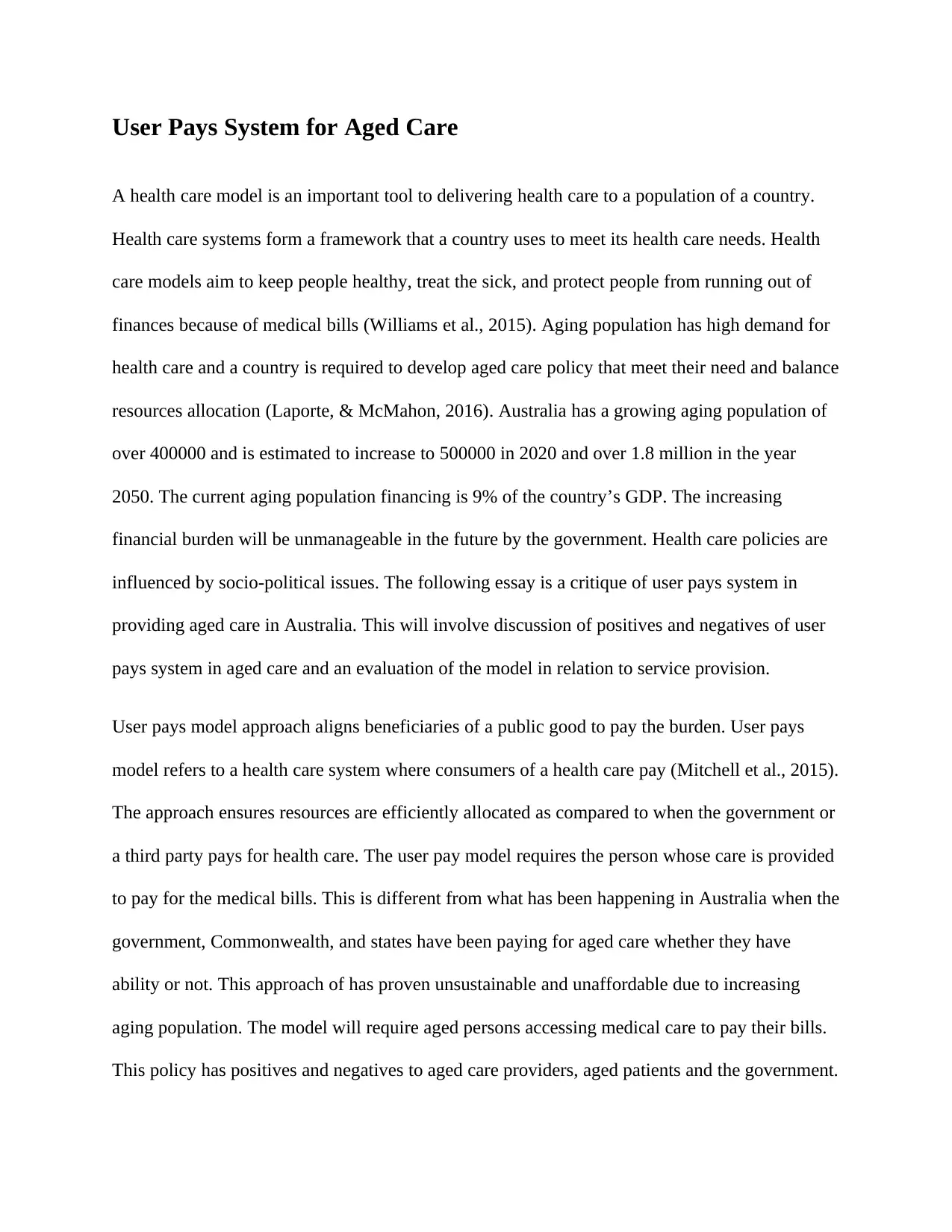
User Pays System for Aged Care
A health care model is an important tool to delivering health care to a population of a country.
Health care systems form a framework that a country uses to meet its health care needs. Health
care models aim to keep people healthy, treat the sick, and protect people from running out of
finances because of medical bills (Williams et al., 2015). Aging population has high demand for
health care and a country is required to develop aged care policy that meet their need and balance
resources allocation (Laporte, & McMahon, 2016). Australia has a growing aging population of
over 400000 and is estimated to increase to 500000 in 2020 and over 1.8 million in the year
2050. The current aging population financing is 9% of the country’s GDP. The increasing
financial burden will be unmanageable in the future by the government. Health care policies are
influenced by socio-political issues. The following essay is a critique of user pays system in
providing aged care in Australia. This will involve discussion of positives and negatives of user
pays system in aged care and an evaluation of the model in relation to service provision.
User pays model approach aligns beneficiaries of a public good to pay the burden. User pays
model refers to a health care system where consumers of a health care pay (Mitchell et al., 2015).
The approach ensures resources are efficiently allocated as compared to when the government or
a third party pays for health care. The user pay model requires the person whose care is provided
to pay for the medical bills. This is different from what has been happening in Australia when the
government, Commonwealth, and states have been paying for aged care whether they have
ability or not. This approach of has proven unsustainable and unaffordable due to increasing
aging population. The model will require aged persons accessing medical care to pay their bills.
This policy has positives and negatives to aged care providers, aged patients and the government.
A health care model is an important tool to delivering health care to a population of a country.
Health care systems form a framework that a country uses to meet its health care needs. Health
care models aim to keep people healthy, treat the sick, and protect people from running out of
finances because of medical bills (Williams et al., 2015). Aging population has high demand for
health care and a country is required to develop aged care policy that meet their need and balance
resources allocation (Laporte, & McMahon, 2016). Australia has a growing aging population of
over 400000 and is estimated to increase to 500000 in 2020 and over 1.8 million in the year
2050. The current aging population financing is 9% of the country’s GDP. The increasing
financial burden will be unmanageable in the future by the government. Health care policies are
influenced by socio-political issues. The following essay is a critique of user pays system in
providing aged care in Australia. This will involve discussion of positives and negatives of user
pays system in aged care and an evaluation of the model in relation to service provision.
User pays model approach aligns beneficiaries of a public good to pay the burden. User pays
model refers to a health care system where consumers of a health care pay (Mitchell et al., 2015).
The approach ensures resources are efficiently allocated as compared to when the government or
a third party pays for health care. The user pay model requires the person whose care is provided
to pay for the medical bills. This is different from what has been happening in Australia when the
government, Commonwealth, and states have been paying for aged care whether they have
ability or not. This approach of has proven unsustainable and unaffordable due to increasing
aging population. The model will require aged persons accessing medical care to pay their bills.
This policy has positives and negatives to aged care providers, aged patients and the government.

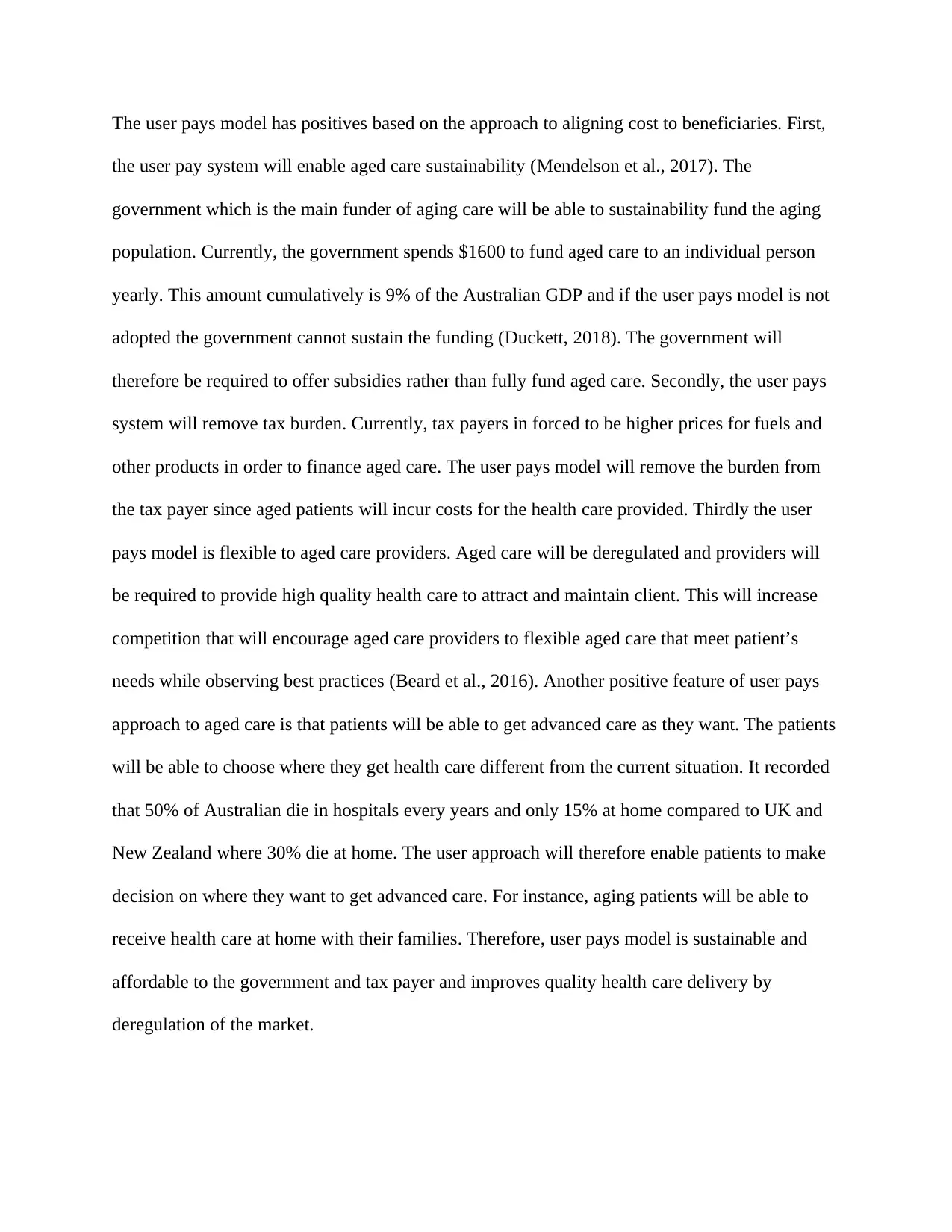
The user pays model has positives based on the approach to aligning cost to beneficiaries. First,
the user pay system will enable aged care sustainability (Mendelson et al., 2017). The
government which is the main funder of aging care will be able to sustainability fund the aging
population. Currently, the government spends $1600 to fund aged care to an individual person
yearly. This amount cumulatively is 9% of the Australian GDP and if the user pays model is not
adopted the government cannot sustain the funding (Duckett, 2018). The government will
therefore be required to offer subsidies rather than fully fund aged care. Secondly, the user pays
system will remove tax burden. Currently, tax payers in forced to be higher prices for fuels and
other products in order to finance aged care. The user pays model will remove the burden from
the tax payer since aged patients will incur costs for the health care provided. Thirdly the user
pays model is flexible to aged care providers. Aged care will be deregulated and providers will
be required to provide high quality health care to attract and maintain client. This will increase
competition that will encourage aged care providers to flexible aged care that meet patient’s
needs while observing best practices (Beard et al., 2016). Another positive feature of user pays
approach to aged care is that patients will be able to get advanced care as they want. The patients
will be able to choose where they get health care different from the current situation. It recorded
that 50% of Australian die in hospitals every years and only 15% at home compared to UK and
New Zealand where 30% die at home. The user approach will therefore enable patients to make
decision on where they want to get advanced care. For instance, aging patients will be able to
receive health care at home with their families. Therefore, user pays model is sustainable and
affordable to the government and tax payer and improves quality health care delivery by
deregulation of the market.
the user pay system will enable aged care sustainability (Mendelson et al., 2017). The
government which is the main funder of aging care will be able to sustainability fund the aging
population. Currently, the government spends $1600 to fund aged care to an individual person
yearly. This amount cumulatively is 9% of the Australian GDP and if the user pays model is not
adopted the government cannot sustain the funding (Duckett, 2018). The government will
therefore be required to offer subsidies rather than fully fund aged care. Secondly, the user pays
system will remove tax burden. Currently, tax payers in forced to be higher prices for fuels and
other products in order to finance aged care. The user pays model will remove the burden from
the tax payer since aged patients will incur costs for the health care provided. Thirdly the user
pays model is flexible to aged care providers. Aged care will be deregulated and providers will
be required to provide high quality health care to attract and maintain client. This will increase
competition that will encourage aged care providers to flexible aged care that meet patient’s
needs while observing best practices (Beard et al., 2016). Another positive feature of user pays
approach to aged care is that patients will be able to get advanced care as they want. The patients
will be able to choose where they get health care different from the current situation. It recorded
that 50% of Australian die in hospitals every years and only 15% at home compared to UK and
New Zealand where 30% die at home. The user approach will therefore enable patients to make
decision on where they want to get advanced care. For instance, aging patients will be able to
receive health care at home with their families. Therefore, user pays model is sustainable and
affordable to the government and tax payer and improves quality health care delivery by
deregulation of the market.
⊘ This is a preview!⊘
Do you want full access?
Subscribe today to unlock all pages.

Trusted by 1+ million students worldwide

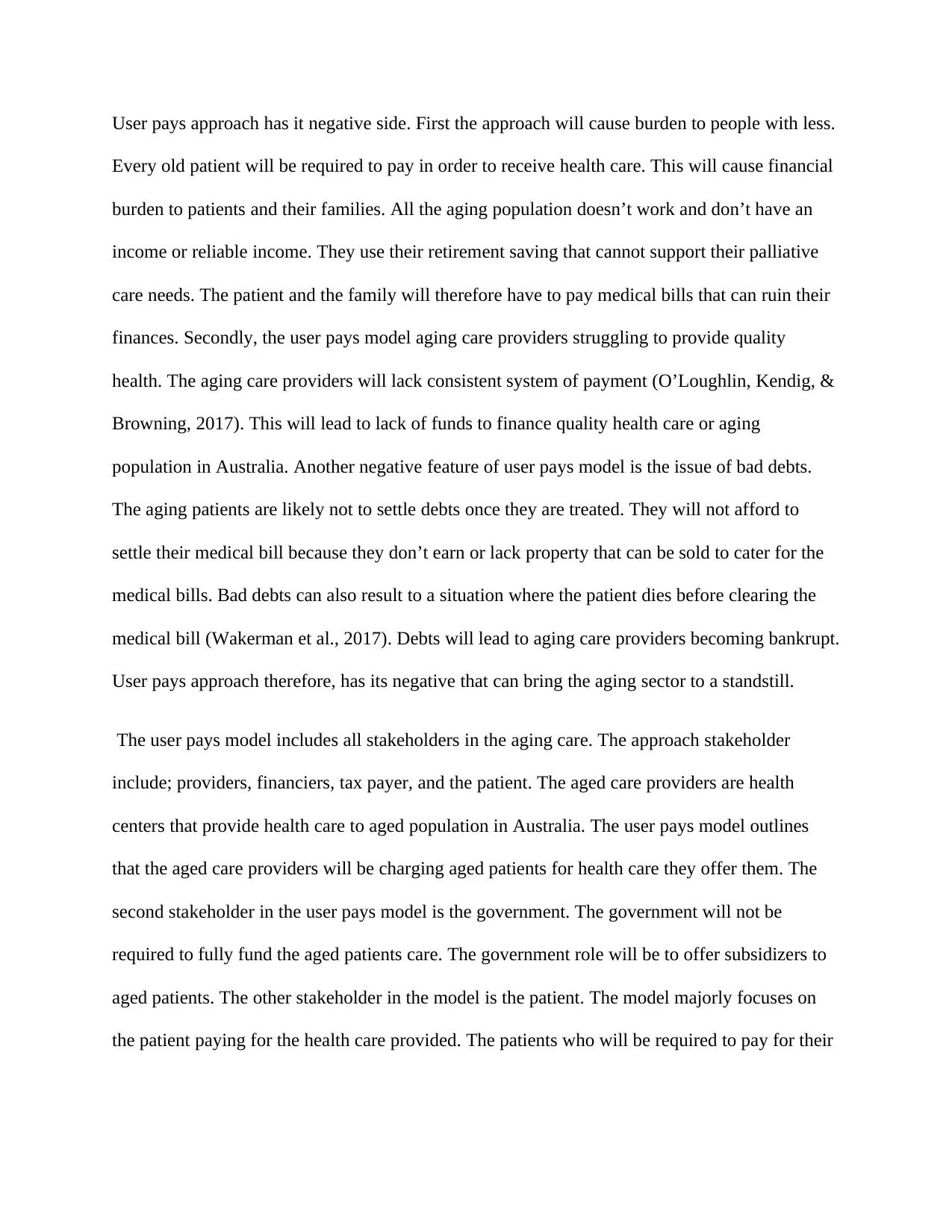
User pays approach has it negative side. First the approach will cause burden to people with less.
Every old patient will be required to pay in order to receive health care. This will cause financial
burden to patients and their families. All the aging population doesn’t work and don’t have an
income or reliable income. They use their retirement saving that cannot support their palliative
care needs. The patient and the family will therefore have to pay medical bills that can ruin their
finances. Secondly, the user pays model aging care providers struggling to provide quality
health. The aging care providers will lack consistent system of payment (O’Loughlin, Kendig, &
Browning, 2017). This will lead to lack of funds to finance quality health care or aging
population in Australia. Another negative feature of user pays model is the issue of bad debts.
The aging patients are likely not to settle debts once they are treated. They will not afford to
settle their medical bill because they don’t earn or lack property that can be sold to cater for the
medical bills. Bad debts can also result to a situation where the patient dies before clearing the
medical bill (Wakerman et al., 2017). Debts will lead to aging care providers becoming bankrupt.
User pays approach therefore, has its negative that can bring the aging sector to a standstill.
The user pays model includes all stakeholders in the aging care. The approach stakeholder
include; providers, financiers, tax payer, and the patient. The aged care providers are health
centers that provide health care to aged population in Australia. The user pays model outlines
that the aged care providers will be charging aged patients for health care they offer them. The
second stakeholder in the user pays model is the government. The government will not be
required to fully fund the aged patients care. The government role will be to offer subsidizers to
aged patients. The other stakeholder in the model is the patient. The model majorly focuses on
the patient paying for the health care provided. The patients who will be required to pay for their
Every old patient will be required to pay in order to receive health care. This will cause financial
burden to patients and their families. All the aging population doesn’t work and don’t have an
income or reliable income. They use their retirement saving that cannot support their palliative
care needs. The patient and the family will therefore have to pay medical bills that can ruin their
finances. Secondly, the user pays model aging care providers struggling to provide quality
health. The aging care providers will lack consistent system of payment (O’Loughlin, Kendig, &
Browning, 2017). This will lead to lack of funds to finance quality health care or aging
population in Australia. Another negative feature of user pays model is the issue of bad debts.
The aging patients are likely not to settle debts once they are treated. They will not afford to
settle their medical bill because they don’t earn or lack property that can be sold to cater for the
medical bills. Bad debts can also result to a situation where the patient dies before clearing the
medical bill (Wakerman et al., 2017). Debts will lead to aging care providers becoming bankrupt.
User pays approach therefore, has its negative that can bring the aging sector to a standstill.
The user pays model includes all stakeholders in the aging care. The approach stakeholder
include; providers, financiers, tax payer, and the patient. The aged care providers are health
centers that provide health care to aged population in Australia. The user pays model outlines
that the aged care providers will be charging aged patients for health care they offer them. The
second stakeholder in the user pays model is the government. The government will not be
required to fully fund the aged patients care. The government role will be to offer subsidizers to
aged patients. The other stakeholder in the model is the patient. The model majorly focuses on
the patient paying for the health care provided. The patients who will be required to pay for their
Paraphrase This Document
Need a fresh take? Get an instant paraphrase of this document with our AI Paraphraser

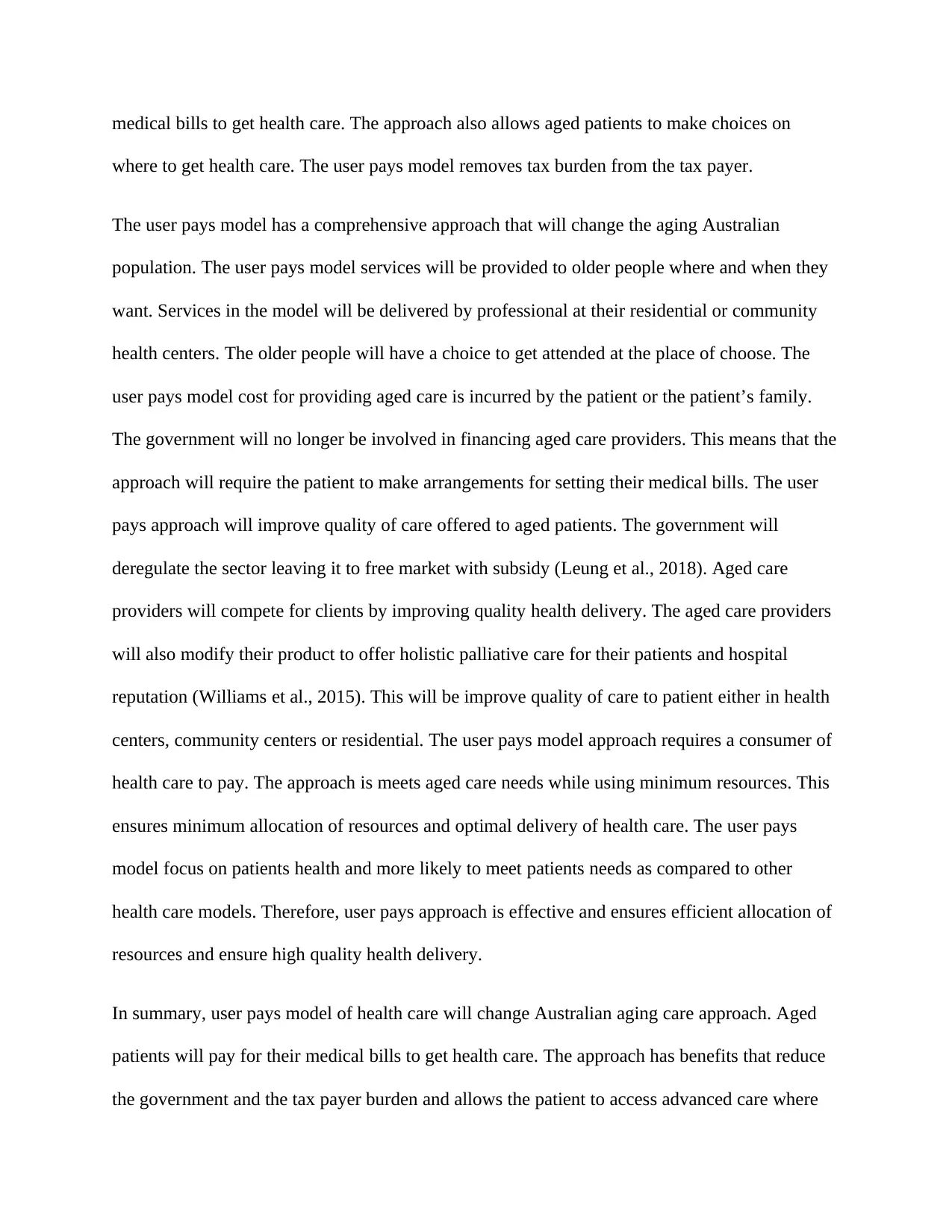
medical bills to get health care. The approach also allows aged patients to make choices on
where to get health care. The user pays model removes tax burden from the tax payer.
The user pays model has a comprehensive approach that will change the aging Australian
population. The user pays model services will be provided to older people where and when they
want. Services in the model will be delivered by professional at their residential or community
health centers. The older people will have a choice to get attended at the place of choose. The
user pays model cost for providing aged care is incurred by the patient or the patient’s family.
The government will no longer be involved in financing aged care providers. This means that the
approach will require the patient to make arrangements for setting their medical bills. The user
pays approach will improve quality of care offered to aged patients. The government will
deregulate the sector leaving it to free market with subsidy (Leung et al., 2018). Aged care
providers will compete for clients by improving quality health delivery. The aged care providers
will also modify their product to offer holistic palliative care for their patients and hospital
reputation (Williams et al., 2015). This will be improve quality of care to patient either in health
centers, community centers or residential. The user pays model approach requires a consumer of
health care to pay. The approach is meets aged care needs while using minimum resources. This
ensures minimum allocation of resources and optimal delivery of health care. The user pays
model focus on patients health and more likely to meet patients needs as compared to other
health care models. Therefore, user pays approach is effective and ensures efficient allocation of
resources and ensure high quality health delivery.
In summary, user pays model of health care will change Australian aging care approach. Aged
patients will pay for their medical bills to get health care. The approach has benefits that reduce
the government and the tax payer burden and allows the patient to access advanced care where
where to get health care. The user pays model removes tax burden from the tax payer.
The user pays model has a comprehensive approach that will change the aging Australian
population. The user pays model services will be provided to older people where and when they
want. Services in the model will be delivered by professional at their residential or community
health centers. The older people will have a choice to get attended at the place of choose. The
user pays model cost for providing aged care is incurred by the patient or the patient’s family.
The government will no longer be involved in financing aged care providers. This means that the
approach will require the patient to make arrangements for setting their medical bills. The user
pays approach will improve quality of care offered to aged patients. The government will
deregulate the sector leaving it to free market with subsidy (Leung et al., 2018). Aged care
providers will compete for clients by improving quality health delivery. The aged care providers
will also modify their product to offer holistic palliative care for their patients and hospital
reputation (Williams et al., 2015). This will be improve quality of care to patient either in health
centers, community centers or residential. The user pays model approach requires a consumer of
health care to pay. The approach is meets aged care needs while using minimum resources. This
ensures minimum allocation of resources and optimal delivery of health care. The user pays
model focus on patients health and more likely to meet patients needs as compared to other
health care models. Therefore, user pays approach is effective and ensures efficient allocation of
resources and ensure high quality health delivery.
In summary, user pays model of health care will change Australian aging care approach. Aged
patients will pay for their medical bills to get health care. The approach has benefits that reduce
the government and the tax payer burden and allows the patient to access advanced care where

and when they want. The user pays approach transfers the financial burden to the patient and the
family. The financial burden will affect the aged care provider, patients, and their families. The
user pays approach will be sustainable and affordable to the Australian government and improve
quality of aged care to aged patients. Therefore, user pays model is a timely and effective
approach for providing health care to the increasing Australian population.
family. The financial burden will affect the aged care provider, patients, and their families. The
user pays approach will be sustainable and affordable to the Australian government and improve
quality of aged care to aged patients. Therefore, user pays model is a timely and effective
approach for providing health care to the increasing Australian population.
⊘ This is a preview!⊘
Do you want full access?
Subscribe today to unlock all pages.

Trusted by 1+ million students worldwide

References
Beard, J. R., Officer, A., de Carvalho, I. A., Sadana, R., Pot, A. M., Michel, J. P., ... &
Thiyagarajan, J. A. (2016). The World report on ageing and health: a policy framework
for healthy ageing. The Lancet, 387(10033), 2145-2154.
Duckett, S. (2018). Expanding the breadth of Medicare: learning from Australia. Health
Economics, Policy and Law, 1-25.
Mendelson, A., Kondo, K., Damberg, C., Low, A., Motúapuaka, M., Freeman, M., ... &
Kansagara, D. (2017). The effects of pay-for-performance programs on health, health
care use, and processes of care: a systematic review. Annals of internal medicine,
166(5), 341-353.
Mitchell, G. K., Burridge, L., Zhang, J., Donald, M., Scott, I. A., Dart, J., & Jackson, C. L.
(2015). Systematic review of integrated models of health care delivered at the primary–
secondary interface: how effective is it and what determines effectiveness?. Australian
Journal of Primary Health, 21(4), 391-408.
Laporte, A., & McMahon, M. (2016). Aging and Long-Term Care. In World Scientific Handbook
of Global Health Economics and Public Policy: Volume 2: Health Determinants and
Outcomes (pp. 43-82).
Leung, E., Chau, C. W., Lee, A., Chen, Y. F., & Lee, D. T. (2018). Integrated care as a strategic
solution for active aging in the community: Tools and models. In Sustainable Health
and Long-Term Care Solutions for an Aging Population (pp. 145-160). IGI Global.
Beard, J. R., Officer, A., de Carvalho, I. A., Sadana, R., Pot, A. M., Michel, J. P., ... &
Thiyagarajan, J. A. (2016). The World report on ageing and health: a policy framework
for healthy ageing. The Lancet, 387(10033), 2145-2154.
Duckett, S. (2018). Expanding the breadth of Medicare: learning from Australia. Health
Economics, Policy and Law, 1-25.
Mendelson, A., Kondo, K., Damberg, C., Low, A., Motúapuaka, M., Freeman, M., ... &
Kansagara, D. (2017). The effects of pay-for-performance programs on health, health
care use, and processes of care: a systematic review. Annals of internal medicine,
166(5), 341-353.
Mitchell, G. K., Burridge, L., Zhang, J., Donald, M., Scott, I. A., Dart, J., & Jackson, C. L.
(2015). Systematic review of integrated models of health care delivered at the primary–
secondary interface: how effective is it and what determines effectiveness?. Australian
Journal of Primary Health, 21(4), 391-408.
Laporte, A., & McMahon, M. (2016). Aging and Long-Term Care. In World Scientific Handbook
of Global Health Economics and Public Policy: Volume 2: Health Determinants and
Outcomes (pp. 43-82).
Leung, E., Chau, C. W., Lee, A., Chen, Y. F., & Lee, D. T. (2018). Integrated care as a strategic
solution for active aging in the community: Tools and models. In Sustainable Health
and Long-Term Care Solutions for an Aging Population (pp. 145-160). IGI Global.
Paraphrase This Document
Need a fresh take? Get an instant paraphrase of this document with our AI Paraphraser

O’Loughlin, K., Kendig, H., & Browning, C. (2017). Challenges and Opportunities for an ageing
Australia. In Ageing in Australia (pp. 1-10). Springer, New York, NY.
Williams, O., Mutch, A., Douglas, P. S., Boyle, F. M., & Hill, P. S. (2015). Proposed changes to
Medicare: undermining equity and outcomes in Australian primary health care?.
Australian and New Zealand journal of public health, 39(2), 106-108.
Wakerman, J., Humphreys, J., Wells, R., Kuipers, P., Entwistle, P., & Jones, J. (2017). A
systematic review of primary health care delivery models in rural and remote Australia
1993-2006.
Australia. In Ageing in Australia (pp. 1-10). Springer, New York, NY.
Williams, O., Mutch, A., Douglas, P. S., Boyle, F. M., & Hill, P. S. (2015). Proposed changes to
Medicare: undermining equity and outcomes in Australian primary health care?.
Australian and New Zealand journal of public health, 39(2), 106-108.
Wakerman, J., Humphreys, J., Wells, R., Kuipers, P., Entwistle, P., & Jones, J. (2017). A
systematic review of primary health care delivery models in rural and remote Australia
1993-2006.
1 out of 8
Related Documents
Your All-in-One AI-Powered Toolkit for Academic Success.
+13062052269
info@desklib.com
Available 24*7 on WhatsApp / Email
Unlock your academic potential
Copyright © 2020–2025 A2Z Services. All Rights Reserved. Developed and managed by ZUCOL.