MGT8073 USQ Project Processes: Literature Review of Complex Systems
VerifiedAdded on 2023/06/13
|9
|2535
|290
Literature Review
AI Summary
This document presents a literature review focusing on projects as complex adaptive systems, particularly within the context of organizational change and management. It examines the strengths and weaknesses of viewing projects through this lens, highlighting the interplay between various agents and components within a project. The review covers key characteristics of complex adaptive systems, such as interaction between components, emergence of changes, integration of autonomous units, self-organization, co-evolution of processes, and time management. It also discusses potential weaknesses, including increased complexity, conflicts, and employee demotivation. The literature review aims to provide insights for improving project functionality and decision-making capabilities, with specific recommendations for ABC Grocery to enhance its operational processes using information systems and shared management strategies. The document concludes that adopting a complex adaptive system approach can significantly improve business activities and profitability.

Project Management

Paraphrase This Document
Need a fresh take? Get an instant paraphrase of this document with our AI Paraphraser

Executive Summary
The research paper is designed for undertaking the literature review study on project as a
complex adaptive system. The analysis of the report helps in analysing the strength and
weaknesses associated with the complex adaptive project. A project is an amalgamation of
different units which works together to achieve the goal of the enterprise. The behaviour and
processes of the project adapt in relation to the project demand and innovation in the new
trends and technology. The literature review helps in analysing the effectiveness of project as
a complex adaptive system.
The research paper is designed for undertaking the literature review study on project as a
complex adaptive system. The analysis of the report helps in analysing the strength and
weaknesses associated with the complex adaptive project. A project is an amalgamation of
different units which works together to achieve the goal of the enterprise. The behaviour and
processes of the project adapt in relation to the project demand and innovation in the new
trends and technology. The literature review helps in analysing the effectiveness of project as
a complex adaptive system.
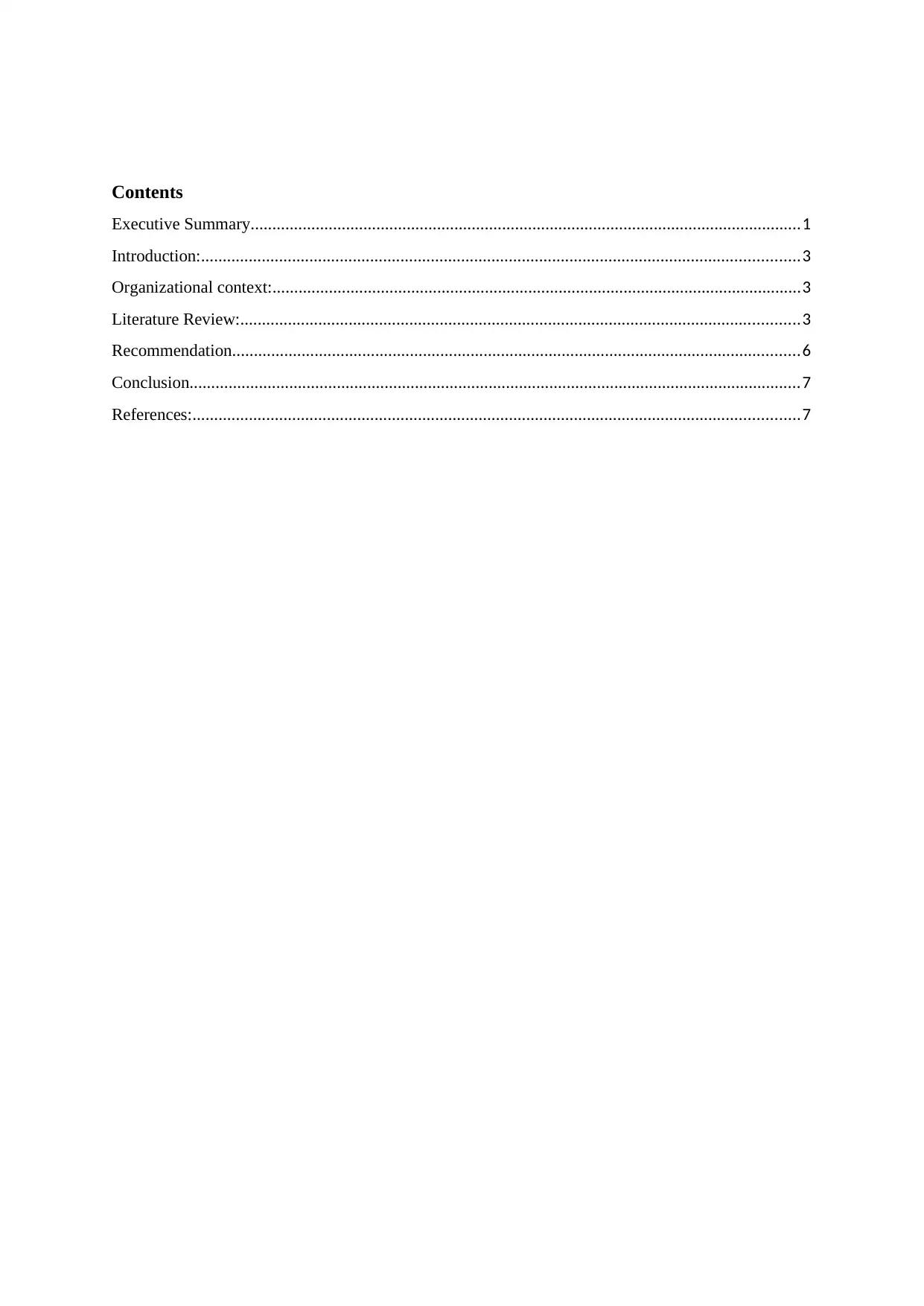
Contents
Executive Summary...............................................................................................................................1
Introduction:..........................................................................................................................................3
Organizational context:..........................................................................................................................3
Literature Review:.................................................................................................................................3
Recommendation...................................................................................................................................6
Conclusion.............................................................................................................................................7
References:............................................................................................................................................7
Executive Summary...............................................................................................................................1
Introduction:..........................................................................................................................................3
Organizational context:..........................................................................................................................3
Literature Review:.................................................................................................................................3
Recommendation...................................................................................................................................6
Conclusion.............................................................................................................................................7
References:............................................................................................................................................7
⊘ This is a preview!⊘
Do you want full access?
Subscribe today to unlock all pages.

Trusted by 1+ million students worldwide
Introduction:
The project as a complex adaptive system means that the project is composed of interaction
between various agents and terminology. The purpose of this paper is to review the effects of
changes on the organizational delivery process and functionality. The literature review helps
in understanding the project as an adaptive complex system. In this paper we are looking
forward to highlights the strength and weaknesses in adapting or changing project
terminology according to the business requirement. A project is an amalgamation of different
units which works together to achieve the goal of the enterprise. The behaviour and processes
of the project adapt in relation to the project demand and innovation in the new trends and
technology (Schilling, Beese, Haki, Aeir, and Winter, 2014). The development of the project
is treated as a complex adaptive system because various units work together following their
own rules and principles to achieve the single target set for bringing efficiency in the working
culture of enterprise. The complexity of the project gets increased with the management of
interrelationship and integration between different units.
Organizational context:
The ABC Grocery food store is facing problems in handling processes at the food store due to
the expansion of the business to various cities. The owner of the company is not able to
synchronise the effective working of the food store. As a project manager, I am looking
forward to bring transformation in the working culture of the enterprise according to the
changing trends and technology to carry out business activities (Bentley and Stacey, 2010).
The adaptive policies are the framework which support project to bring changes in the
working platform. The complexity of the project gets increased with the adaption of new
technology frequently. The profit of the organization can be increased with the use of
effective technology to get quality product. The growth of the organization depend on it
capacity to bring changes in its functional operation (Casella, Tongeren, and Nikolic, 2015).
Literature Review:
From the literature review, we are able to analyse that the operational functionality of the
enterprise get affected by the evolution of new technology. The complexity of the project
increases due to the inclusion of social, legal, cultural, political, and economic factors
(Furneaux, Brown, and Gudmundsson, 2009). The flow of the communication is the major
The project as a complex adaptive system means that the project is composed of interaction
between various agents and terminology. The purpose of this paper is to review the effects of
changes on the organizational delivery process and functionality. The literature review helps
in understanding the project as an adaptive complex system. In this paper we are looking
forward to highlights the strength and weaknesses in adapting or changing project
terminology according to the business requirement. A project is an amalgamation of different
units which works together to achieve the goal of the enterprise. The behaviour and processes
of the project adapt in relation to the project demand and innovation in the new trends and
technology (Schilling, Beese, Haki, Aeir, and Winter, 2014). The development of the project
is treated as a complex adaptive system because various units work together following their
own rules and principles to achieve the single target set for bringing efficiency in the working
culture of enterprise. The complexity of the project gets increased with the management of
interrelationship and integration between different units.
Organizational context:
The ABC Grocery food store is facing problems in handling processes at the food store due to
the expansion of the business to various cities. The owner of the company is not able to
synchronise the effective working of the food store. As a project manager, I am looking
forward to bring transformation in the working culture of the enterprise according to the
changing trends and technology to carry out business activities (Bentley and Stacey, 2010).
The adaptive policies are the framework which support project to bring changes in the
working platform. The complexity of the project gets increased with the adaption of new
technology frequently. The profit of the organization can be increased with the use of
effective technology to get quality product. The growth of the organization depend on it
capacity to bring changes in its functional operation (Casella, Tongeren, and Nikolic, 2015).
Literature Review:
From the literature review, we are able to analyse that the operational functionality of the
enterprise get affected by the evolution of new technology. The complexity of the project
increases due to the inclusion of social, legal, cultural, political, and economic factors
(Furneaux, Brown, and Gudmundsson, 2009). The flow of the communication is the major
Paraphrase This Document
Need a fresh take? Get an instant paraphrase of this document with our AI Paraphraser
problem in the complex project. The complex adaptive system is comprised of some
characteristics such as the development of the relationship among the events and its effects on
the corresponding unit, perception of the project manager in detecting proactively occurrence
of risks associated with the change, association of the roles and responsibilities to the related
subordinates, changing demand of the customer, uniformity in the allocation of resources,
quantification in the generation of new ideas and opinion, and others. The complexity and
uncertainty of occurrence of risks are associated with project based organization. The
complexity of the project means that it is the amalgamation of professional expert in multi-
discipline, increasing number of employees, installation of new hardware and software
according to the requirement of the project, diversity in the flow of information, duration of
time required to finish the job, and association of internal and external parties. The Project as
a complex adaptive system is comprised of six properties which are classified as non-linear
approach in managing interaction between different discipline, interdependency of various
unit in completing their business operation, scaling of the processes involved, emerging
changes in the functionality of the processes due to the inclusion of new and advanced
technology, integration in the management of chaos and distraction which exist between
participating unit, and cooperation and coordination among the business activities and
processes (Pedro, Villagrasa, Quinteiro, and Navarro, 2017).
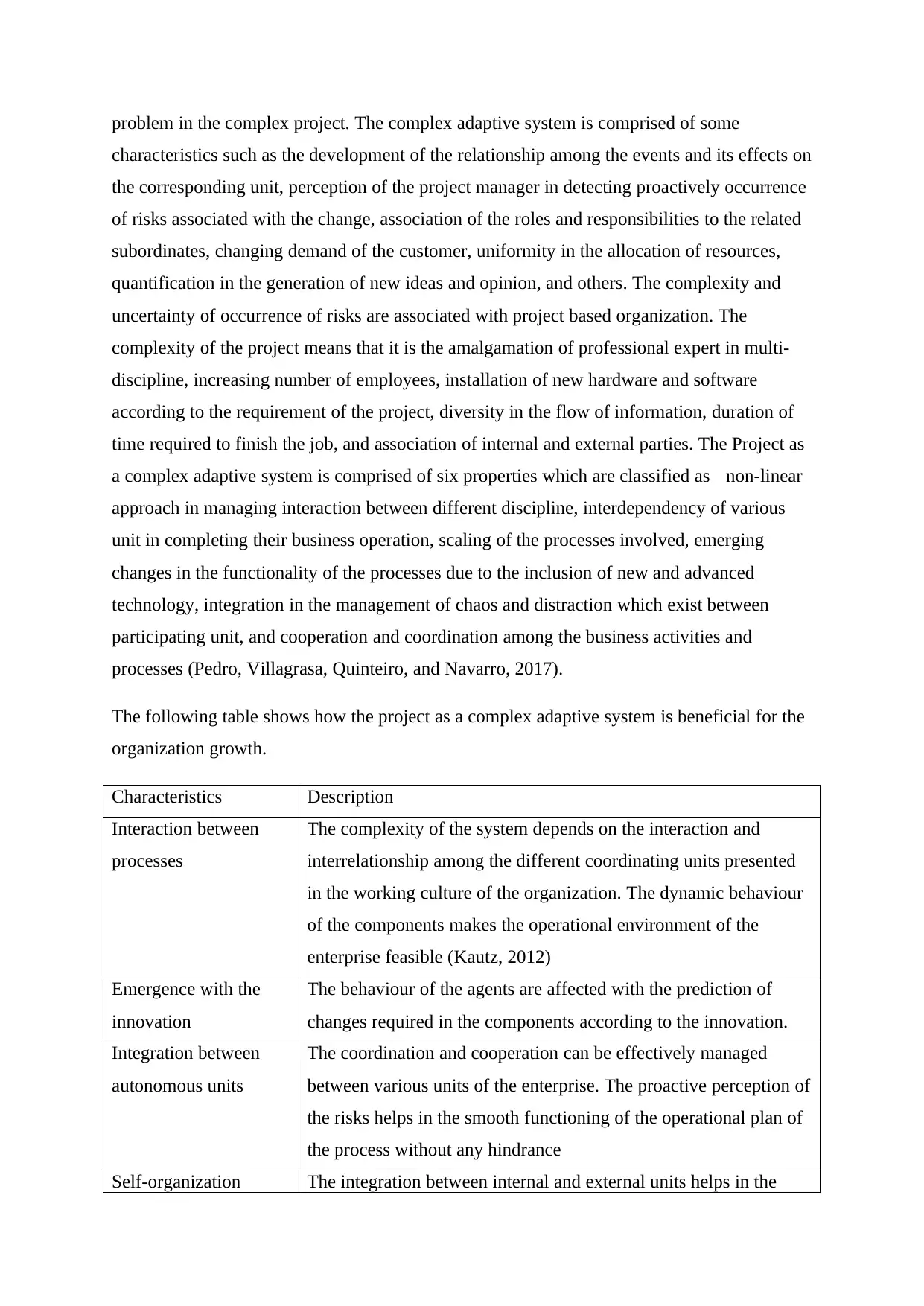
The following table shows how the project as a complex adaptive system is beneficial for the
organization growth.
Characteristics Description
Interaction between
processes
The complexity of the system depends on the interaction and
interrelationship among the different coordinating units presented
in the working culture of the organization. The dynamic behaviour
of the components makes the operational environment of the
enterprise feasible (Kautz, 2012)
Emergence with the
innovation
The behaviour of the agents are affected with the prediction of
changes required in the components according to the innovation.
Integration between
autonomous units
The coordination and cooperation can be effectively managed
between various units of the enterprise. The proactive perception of
the risks helps in the smooth functioning of the operational plan of
the process without any hindrance
Self-organization The integration between internal and external units helps in the
characteristics such as the development of the relationship among the events and its effects on
the corresponding unit, perception of the project manager in detecting proactively occurrence
of risks associated with the change, association of the roles and responsibilities to the related
subordinates, changing demand of the customer, uniformity in the allocation of resources,
quantification in the generation of new ideas and opinion, and others. The complexity and
uncertainty of occurrence of risks are associated with project based organization. The
complexity of the project means that it is the amalgamation of professional expert in multi-
discipline, increasing number of employees, installation of new hardware and software
according to the requirement of the project, diversity in the flow of information, duration of
time required to finish the job, and association of internal and external parties. The Project as
a complex adaptive system is comprised of six properties which are classified as non-linear
approach in managing interaction between different discipline, interdependency of various
unit in completing their business operation, scaling of the processes involved, emerging
changes in the functionality of the processes due to the inclusion of new and advanced
technology, integration in the management of chaos and distraction which exist between
participating unit, and cooperation and coordination among the business activities and
processes (Pedro, Villagrasa, Quinteiro, and Navarro, 2017).
The following table shows how the project as a complex adaptive system is beneficial for the
organization growth.
Characteristics Description
Interaction between
processes
The complexity of the system depends on the interaction and
interrelationship among the different coordinating units presented
in the working culture of the organization. The dynamic behaviour
of the components makes the operational environment of the
enterprise feasible (Kautz, 2012)
Emergence with the
innovation
The behaviour of the agents are affected with the prediction of
changes required in the components according to the innovation.
Integration between
autonomous units
The coordination and cooperation can be effectively managed
between various units of the enterprise. The proactive perception of
the risks helps in the smooth functioning of the operational plan of
the process without any hindrance
Self-organization The integration between internal and external units helps in the
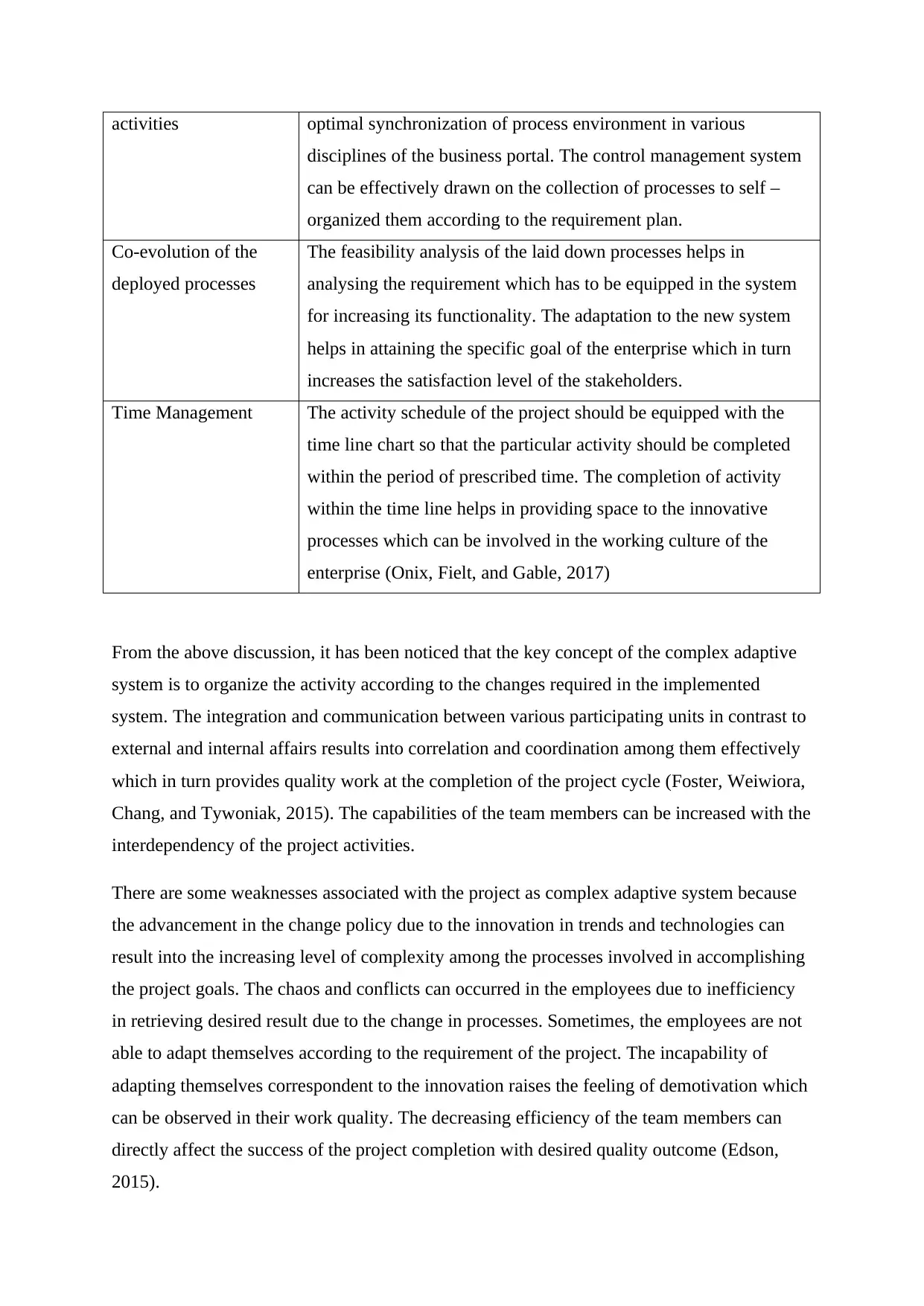
activities optimal synchronization of process environment in various
disciplines of the business portal. The control management system
can be effectively drawn on the collection of processes to self –
organized them according to the requirement plan.
Co-evolution of the
deployed processes
The feasibility analysis of the laid down processes helps in
analysing the requirement which has to be equipped in the system
for increasing its functionality. The adaptation to the new system
helps in attaining the specific goal of the enterprise which in turn
increases the satisfaction level of the stakeholders.
Time Management The activity schedule of the project should be equipped with the
time line chart so that the particular activity should be completed
within the period of prescribed time. The completion of activity
within the time line helps in providing space to the innovative
processes which can be involved in the working culture of the
enterprise (Onix, Fielt, and Gable, 2017)
From the above discussion, it has been noticed that the key concept of the complex adaptive
system is to organize the activity according to the changes required in the implemented
system. The integration and communication between various participating units in contrast to
external and internal affairs results into correlation and coordination among them effectively
which in turn provides quality work at the completion of the project cycle (Foster, Weiwiora,
Chang, and Tywoniak, 2015). The capabilities of the team members can be increased with the
interdependency of the project activities.
There are some weaknesses associated with the project as complex adaptive system because
the advancement in the change policy due to the innovation in trends and technologies can
result into the increasing level of complexity among the processes involved in accomplishing
the project goals. The chaos and conflicts can occurred in the employees due to inefficiency
in retrieving desired result due to the change in processes. Sometimes, the employees are not
able to adapt themselves according to the requirement of the project. The incapability of
adapting themselves correspondent to the innovation raises the feeling of demotivation which
can be observed in their work quality. The decreasing efficiency of the team members can
directly affect the success of the project completion with desired quality outcome (Edson,
2015).
disciplines of the business portal. The control management system
can be effectively drawn on the collection of processes to self –
organized them according to the requirement plan.
Co-evolution of the
deployed processes
The feasibility analysis of the laid down processes helps in
analysing the requirement which has to be equipped in the system
for increasing its functionality. The adaptation to the new system
helps in attaining the specific goal of the enterprise which in turn
increases the satisfaction level of the stakeholders.
Time Management The activity schedule of the project should be equipped with the
time line chart so that the particular activity should be completed
within the period of prescribed time. The completion of activity
within the time line helps in providing space to the innovative
processes which can be involved in the working culture of the
enterprise (Onix, Fielt, and Gable, 2017)
From the above discussion, it has been noticed that the key concept of the complex adaptive
system is to organize the activity according to the changes required in the implemented
system. The integration and communication between various participating units in contrast to
external and internal affairs results into correlation and coordination among them effectively
which in turn provides quality work at the completion of the project cycle (Foster, Weiwiora,
Chang, and Tywoniak, 2015). The capabilities of the team members can be increased with the
interdependency of the project activities.
There are some weaknesses associated with the project as complex adaptive system because
the advancement in the change policy due to the innovation in trends and technologies can
result into the increasing level of complexity among the processes involved in accomplishing
the project goals. The chaos and conflicts can occurred in the employees due to inefficiency
in retrieving desired result due to the change in processes. Sometimes, the employees are not
able to adapt themselves according to the requirement of the project. The incapability of
adapting themselves correspondent to the innovation raises the feeling of demotivation which
can be observed in their work quality. The decreasing efficiency of the team members can
directly affect the success of the project completion with desired quality outcome (Edson,
2015).
⊘ This is a preview!⊘
Do you want full access?
Subscribe today to unlock all pages.
Trusted by 1+ million students worldwide
The application of the complex adaptive system helps in providing strength to the working
capability of the organization. The seven principles of the adaptive system help in improving
the functionality of the project. It works on the principle of getting knowledge of the outcome
according to the processes involved in completing the project goal, emphasis is given on the
development of strategic plans, innovation in process design, testing of the efficiency of the
changes done in the system, breaking down of the project processes into smaller module and
phases, deployment of processes to fulfil the requirement, management of the communication
process, and division of roles and responsibility according to the skills and expertise of the
team members (Wallis, 2015).
Recommendation
The study of the literature review, helps in analysing the strength and weaknesses associated
with the project as a complex adaptive system. It is recommended that the adoption of
complex adaptive system prepares the project for bringing innovation in the processes
undertaken for getting quality result. The diversification in the business processes can be
effectively involved with the association of innovation in different discipline of the project.
The self-organization of the processes helps in completing the project within desired time and
quality. The innovation in the working platform of the organization helps in managing the
project activities with efficiency which results into increasing profit with respect to the
market competitors in the global market. The decision making capability of the project
manager can be enhanced with the utilization of the new processing environment. The social
relationship with the internal and external parties helps in providing better result of the
processes undertaken. The skills and expertise of the human resources can be improved by
indulging innovative working platform which makes use of new technology and trends.
The working process of the ABC Company can be enhanced by approaching the adoption of
information system for managing the operation performed at different site location of the
grocery food store. The inclusion of distributive system helps in getting knowledge of
incidents and working program occurred at different site of the company. The managerial
process can be effectively laid down for handling the business process to get effective result
in the management of food items at the grocery store. The shared management system helps
in resolving the issues of complexities which exist with the traditional working of the
enterprise (Eduardo, Sato, Dergint, and Hatakeyama, 2015). The project as a complex
adaptive system can be applied to every project because it helps in making the business
capability of the organization. The seven principles of the adaptive system help in improving
the functionality of the project. It works on the principle of getting knowledge of the outcome
according to the processes involved in completing the project goal, emphasis is given on the
development of strategic plans, innovation in process design, testing of the efficiency of the
changes done in the system, breaking down of the project processes into smaller module and
phases, deployment of processes to fulfil the requirement, management of the communication
process, and division of roles and responsibility according to the skills and expertise of the
team members (Wallis, 2015).
Recommendation
The study of the literature review, helps in analysing the strength and weaknesses associated
with the project as a complex adaptive system. It is recommended that the adoption of
complex adaptive system prepares the project for bringing innovation in the processes
undertaken for getting quality result. The diversification in the business processes can be
effectively involved with the association of innovation in different discipline of the project.
The self-organization of the processes helps in completing the project within desired time and
quality. The innovation in the working platform of the organization helps in managing the
project activities with efficiency which results into increasing profit with respect to the
market competitors in the global market. The decision making capability of the project
manager can be enhanced with the utilization of the new processing environment. The social
relationship with the internal and external parties helps in providing better result of the
processes undertaken. The skills and expertise of the human resources can be improved by
indulging innovative working platform which makes use of new technology and trends.
The working process of the ABC Company can be enhanced by approaching the adoption of
information system for managing the operation performed at different site location of the
grocery food store. The inclusion of distributive system helps in getting knowledge of
incidents and working program occurred at different site of the company. The managerial
process can be effectively laid down for handling the business process to get effective result
in the management of food items at the grocery store. The shared management system helps
in resolving the issues of complexities which exist with the traditional working of the
enterprise (Eduardo, Sato, Dergint, and Hatakeyama, 2015). The project as a complex
adaptive system can be applied to every project because it helps in making the business
Paraphrase This Document
Need a fresh take? Get an instant paraphrase of this document with our AI Paraphraser
tactics innovative according to the requirement of trends in global market. The adaptability of
the project helps in improving the business process for getting quality work. The integration
between different agents helps in completing the project within approved budget and
prescribed time.
Conclusion
The analysis of the business processes helps in concluding that the project as a complex
adaptive system is beneficial for improving the business activities and undertaken processes
which in turn increases the profitability of the enterprise. The integration and communication
between various participating units in contrast to external and internal affairs results into
correlation and coordination among them effectively which in turn provides quality work at
the completion of the project cycle. The development of the project is treated as a complex
adaptive system because various units work together following their own rules and principles
to achieve the single target set for bringing efficiency in the working culture of enterprise.
References:
Bentley, D., and Stacey, R. (2010). The potential for applying complex adaptive theory to the
process of estimating in the construction industry. 1st ed. [ebook]. Available at:
https://pdfs.semanticscholar.org/92d1/a10a0785eae00a9cb644fa2f222e0f25a1cf.pdf
[Accessed 06 Apr. 2018].
Casella, D., Tongeren, S., and Nikolic, I. (2015). Change in complex adaptive system. 1st ed.
[ebook]. Available at: https://www.ircwash.org/sites/default/files/084-
201605wp_literaturereview05_11.pdf [Accessed 06 Apr. 2018].
Edson, M. (2015). A Complex adaptive system view of resilience in a project team. 1st ed.
[ebook]. Available at: https://onlinelibrary.wiley.com/doi/pdf/10.1002/sres.2153 [Accessed
06 Apr. 2018].
Eduardo, C., Sato, Y., Dergint, D., and Hatakeyama. (2015). A Project based organization as
a complex adaptive system. 1st ed. [ebook]. Available at:
https://www.researchgate.net/publication/251874050_Project-
Based_Organizations_as_Complex_Adaptive_Systems [Accessed 06 Apr. 2018].
the project helps in improving the business process for getting quality work. The integration
between different agents helps in completing the project within approved budget and
prescribed time.
Conclusion
The analysis of the business processes helps in concluding that the project as a complex
adaptive system is beneficial for improving the business activities and undertaken processes
which in turn increases the profitability of the enterprise. The integration and communication
between various participating units in contrast to external and internal affairs results into
correlation and coordination among them effectively which in turn provides quality work at
the completion of the project cycle. The development of the project is treated as a complex
adaptive system because various units work together following their own rules and principles
to achieve the single target set for bringing efficiency in the working culture of enterprise.
References:
Bentley, D., and Stacey, R. (2010). The potential for applying complex adaptive theory to the
process of estimating in the construction industry. 1st ed. [ebook]. Available at:
https://pdfs.semanticscholar.org/92d1/a10a0785eae00a9cb644fa2f222e0f25a1cf.pdf
[Accessed 06 Apr. 2018].
Casella, D., Tongeren, S., and Nikolic, I. (2015). Change in complex adaptive system. 1st ed.
[ebook]. Available at: https://www.ircwash.org/sites/default/files/084-
201605wp_literaturereview05_11.pdf [Accessed 06 Apr. 2018].
Edson, M. (2015). A Complex adaptive system view of resilience in a project team. 1st ed.
[ebook]. Available at: https://onlinelibrary.wiley.com/doi/pdf/10.1002/sres.2153 [Accessed
06 Apr. 2018].
Eduardo, C., Sato, Y., Dergint, D., and Hatakeyama. (2015). A Project based organization as
a complex adaptive system. 1st ed. [ebook]. Available at:
https://www.researchgate.net/publication/251874050_Project-
Based_Organizations_as_Complex_Adaptive_Systems [Accessed 06 Apr. 2018].
Foster, L., Weiwiora, A., Chang, A., and Tywoniak, S. (2015). How does complex adaptive
system theory inform innovation in complex project based organization. 1st ed. [ebook].
Available at:
https://www.researchgate.net/publication/290567005_How_does_Complex_Adaptive_Syste
m_theory_inform_Innovation_in_Complex_Project_Based_Organisations [Accessed 06 Apr.
2018].
Furneaux, C., Brown, K, and Gudmundsson. (2009). Managing infrastructure transitions: A
complex adaptive system perspective. 1st ed. [ebook]. Available at:
https://eprints.qut.edu.au/27041/1/27041(2).pdf [Accessed 06 Apr. 2018].
Kautz, K. (2012). Information system development project as Complex adaptive system.
Australian Conference on International Journal, 3(5). 1st ed. [ebook]. Available at:
http://citeseerx.ist.psu.edu/viewdoc/download?doi=10.1.1.848.1646&rep=rep1&type=pdf
[Accessed 06 Apr. 2018].
Onix, M., Fielt, E., and Gable, G. (2017). Towards a complex adaptive system a roadmap for
information system research. 1st ed. [ebook]. Available at:
https://eprints.qut.edu.au/111590/1/pacis%20-%202017%20-%20Towards%20a%20Complex
%20Adaptive%20Systems%20Roadmap%20for%20Information%20Systems
%20Research.pdf [Accessed 06 Apr. 2018].
Pedro, J., Villagrasa, R., Quinteiro, M., and Navarro, J. (2017). Teams as complex adaptive
system. 1st ed. [ebook]. Available at:
http://journals.sagepub.com/doi/abs/10.1177/1046496417713849 [Accessed 06 Apr. 2018].
Schilling, R., Beese, J., Haki, K., Aeir, S., and Winter, R. (2014). Revisiting the impact of
information system architecture complexity: A complex adaptive system perspective. 1st ed.
[ebook]. Available at:
https://www.alexandria.unisg.ch/252518/1/RevisitingTheImpactOfInformationSystemsArchit
ectureComplexity.pdf [Accessed 06 Apr. 2018].
Wallis, S. (2015). A study of complex adaptive system as Defined. 1st ed. [ebook]. Available
at:
https://www.researchgate.net/publication/283290832_A_STUDY_OF_COMPLEX_ADAPTI
VE_SYSTEMS_THEORY_AS_DEFINED_BY [Accessed 06 Apr. 2018].
system theory inform innovation in complex project based organization. 1st ed. [ebook].
Available at:
https://www.researchgate.net/publication/290567005_How_does_Complex_Adaptive_Syste
m_theory_inform_Innovation_in_Complex_Project_Based_Organisations [Accessed 06 Apr.
2018].
Furneaux, C., Brown, K, and Gudmundsson. (2009). Managing infrastructure transitions: A
complex adaptive system perspective. 1st ed. [ebook]. Available at:
https://eprints.qut.edu.au/27041/1/27041(2).pdf [Accessed 06 Apr. 2018].
Kautz, K. (2012). Information system development project as Complex adaptive system.
Australian Conference on International Journal, 3(5). 1st ed. [ebook]. Available at:
http://citeseerx.ist.psu.edu/viewdoc/download?doi=10.1.1.848.1646&rep=rep1&type=pdf
[Accessed 06 Apr. 2018].
Onix, M., Fielt, E., and Gable, G. (2017). Towards a complex adaptive system a roadmap for
information system research. 1st ed. [ebook]. Available at:
https://eprints.qut.edu.au/111590/1/pacis%20-%202017%20-%20Towards%20a%20Complex
%20Adaptive%20Systems%20Roadmap%20for%20Information%20Systems
%20Research.pdf [Accessed 06 Apr. 2018].
Pedro, J., Villagrasa, R., Quinteiro, M., and Navarro, J. (2017). Teams as complex adaptive
system. 1st ed. [ebook]. Available at:
http://journals.sagepub.com/doi/abs/10.1177/1046496417713849 [Accessed 06 Apr. 2018].
Schilling, R., Beese, J., Haki, K., Aeir, S., and Winter, R. (2014). Revisiting the impact of
information system architecture complexity: A complex adaptive system perspective. 1st ed.
[ebook]. Available at:
https://www.alexandria.unisg.ch/252518/1/RevisitingTheImpactOfInformationSystemsArchit
ectureComplexity.pdf [Accessed 06 Apr. 2018].
Wallis, S. (2015). A study of complex adaptive system as Defined. 1st ed. [ebook]. Available
at:
https://www.researchgate.net/publication/283290832_A_STUDY_OF_COMPLEX_ADAPTI
VE_SYSTEMS_THEORY_AS_DEFINED_BY [Accessed 06 Apr. 2018].
⊘ This is a preview!⊘
Do you want full access?
Subscribe today to unlock all pages.
Trusted by 1+ million students worldwide

1 out of 9


Related Documents


Your All-in-One AI-Powered Toolkit for Academic Success.
+13062052269
info@desklib.com
Available 24*7 on WhatsApp / Email
![[object Object]](/_next/static/media/star-bottom.7253800d.svg)
Unlock your academic potential
Copyright © 2020–2026 A2Z Services. All Rights Reserved. Developed and managed by ZUCOL.