Consumer Control & Product Choice: Wesfarmers Utilitarian Approach

Verified

Added on  2023/06/12

|5
|819
|296
Presentation
AI Summary
This presentation analyzes a research article on how consumer control deprivation motivates the acquisition of utilitarian products. The research indicates that consumers, particularly those experiencing a loss of control, prefer utilitarian products over hedonic ones due to the perception that they are less likely to cause regret or guilt. The presentation recommends that Wesfarmers, a major retail organization, should focus on framing their products as utilitarian to attract more consumers, reduce the import of luxury items, and promote the usefulness of existing luxury products. The presentation also suggests creating effective utility marketing campaigns, prioritizing service, and maintaining communication with consumers through social media platforms to gain long-term consumer loyalty. Desklib provides access to similar solved assignments and resources for students.
Document Page
Running head: SCIENCE OF CONSUMER BEHAVIOR
Science of Consumer Behavior
Name of the student
Name of the University
Author note
tabler-icon-diamond-filled.svg

Paraphrase This Document

Need a fresh take? Get an instant paraphrase of this document with our AI Paraphraser
Document Page
1SCIENCE OF CONSUMER BEHAVIOR
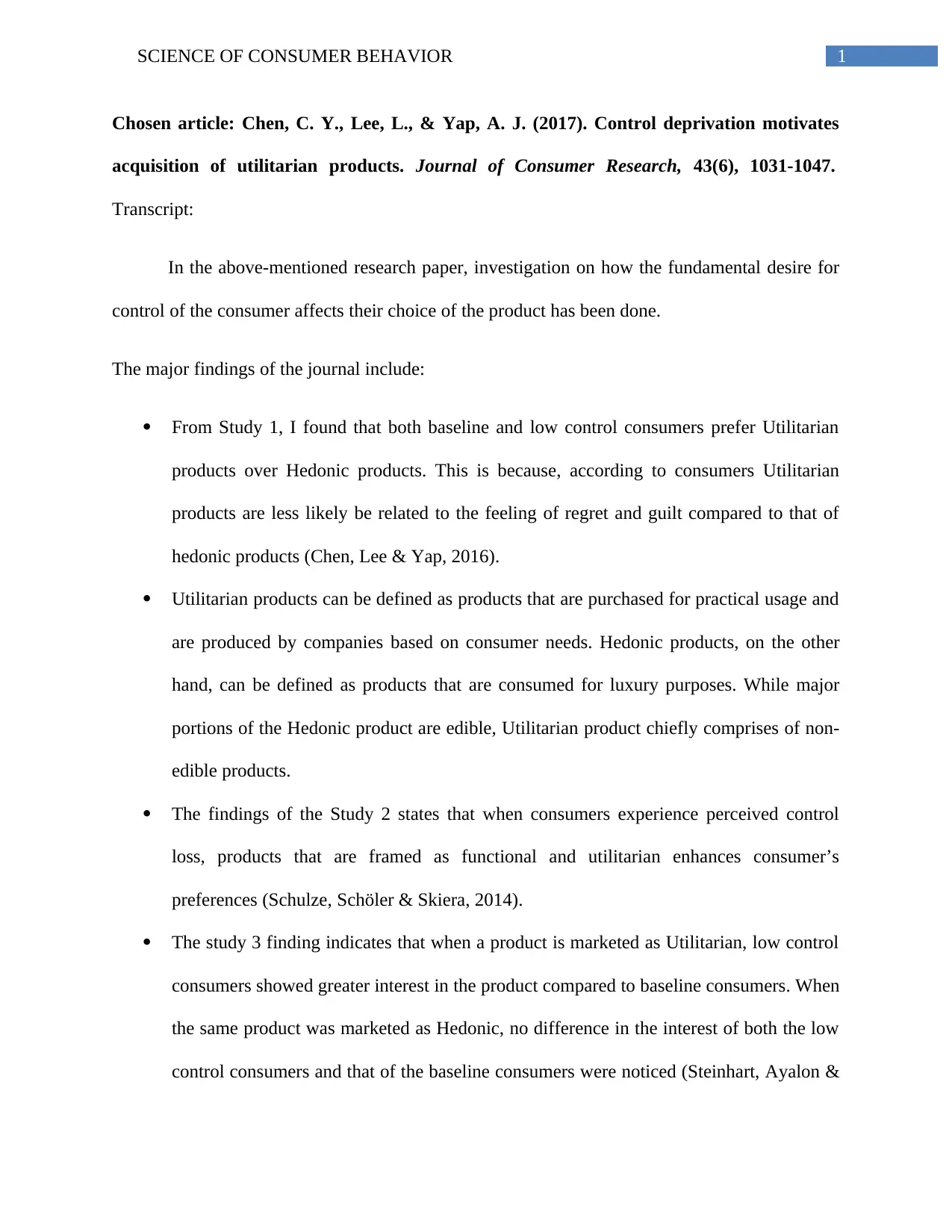
Chosen article: Chen, C. Y., Lee, L., & Yap, A. J. (2017). Control deprivation motivates
acquisition of utilitarian products. Journal of Consumer Research, 43(6), 1031-1047.
Transcript:
In the above-mentioned research paper, investigation on how the fundamental desire for
control of the consumer affects their choice of the product has been done.
The major findings of the journal include:
From Study 1, I found that both baseline and low control consumers prefer Utilitarian
products over Hedonic products. This is because, according to consumers Utilitarian
products are less likely be related to the feeling of regret and guilt compared to that of
hedonic products (Chen, Lee & Yap, 2016).
Utilitarian products can be defined as products that are purchased for practical usage and
are produced by companies based on consumer needs. Hedonic products, on the other
hand, can be defined as products that are consumed for luxury purposes. While major
portions of the Hedonic product are edible, Utilitarian product chiefly comprises of non-
edible products.
The findings of the Study 2 states that when consumers experience perceived control
loss, products that are framed as functional and utilitarian enhances consumer’s
preferences (Schulze, Schöler & Skiera, 2014).
The study 3 finding indicates that when a product is marketed as Utilitarian, low control
consumers showed greater interest in the product compared to baseline consumers. When
the same product was marketed as Hedonic, no difference in the interest of both the low
control consumers and that of the baseline consumers were noticed (Steinhart, Ayalon &
Document Page
2SCIENCE OF CONSUMER BEHAVIOR
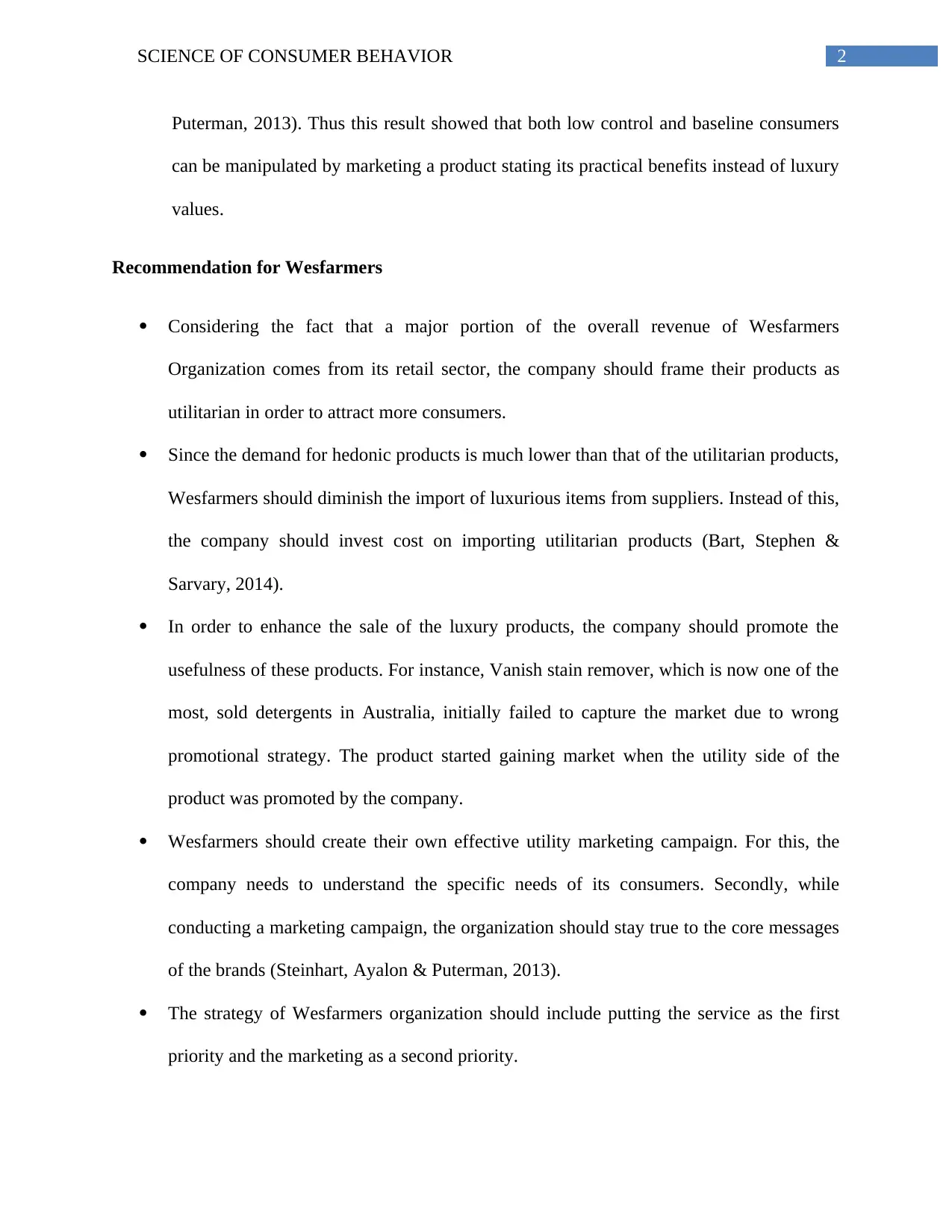
Puterman, 2013). Thus this result showed that both low control and baseline consumers
can be manipulated by marketing a product stating its practical benefits instead of luxury
values.
Recommendation for Wesfarmers
Considering the fact that a major portion of the overall revenue of Wesfarmers
Organization comes from its retail sector, the company should frame their products as
utilitarian in order to attract more consumers.
Since the demand for hedonic products is much lower than that of the utilitarian products,
Wesfarmers should diminish the import of luxurious items from suppliers. Instead of this,
the company should invest cost on importing utilitarian products (Bart, Stephen &
Sarvary, 2014).
In order to enhance the sale of the luxury products, the company should promote the
usefulness of these products. For instance, Vanish stain remover, which is now one of the
most, sold detergents in Australia, initially failed to capture the market due to wrong
promotional strategy. The product started gaining market when the utility side of the
product was promoted by the company.
Wesfarmers should create their own effective utility marketing campaign. For this, the
company needs to understand the specific needs of its consumers. Secondly, while
conducting a marketing campaign, the organization should stay true to the core messages
of the brands (Steinhart, Ayalon & Puterman, 2013).
The strategy of Wesfarmers organization should include putting the service as the first
priority and the marketing as a second priority.
Document Page
3SCIENCE OF CONSUMER BEHAVIOR
In order to gain long-term consumer loyalty, the Wesfarmers organization should
maintain communication with the consumers through various social media platforms as
well as their own official website.
tabler-icon-diamond-filled.svg

Paraphrase This Document

Need a fresh take? Get an instant paraphrase of this document with our AI Paraphraser
Document Page
4SCIENCE OF CONSUMER BEHAVIOR
Reference List
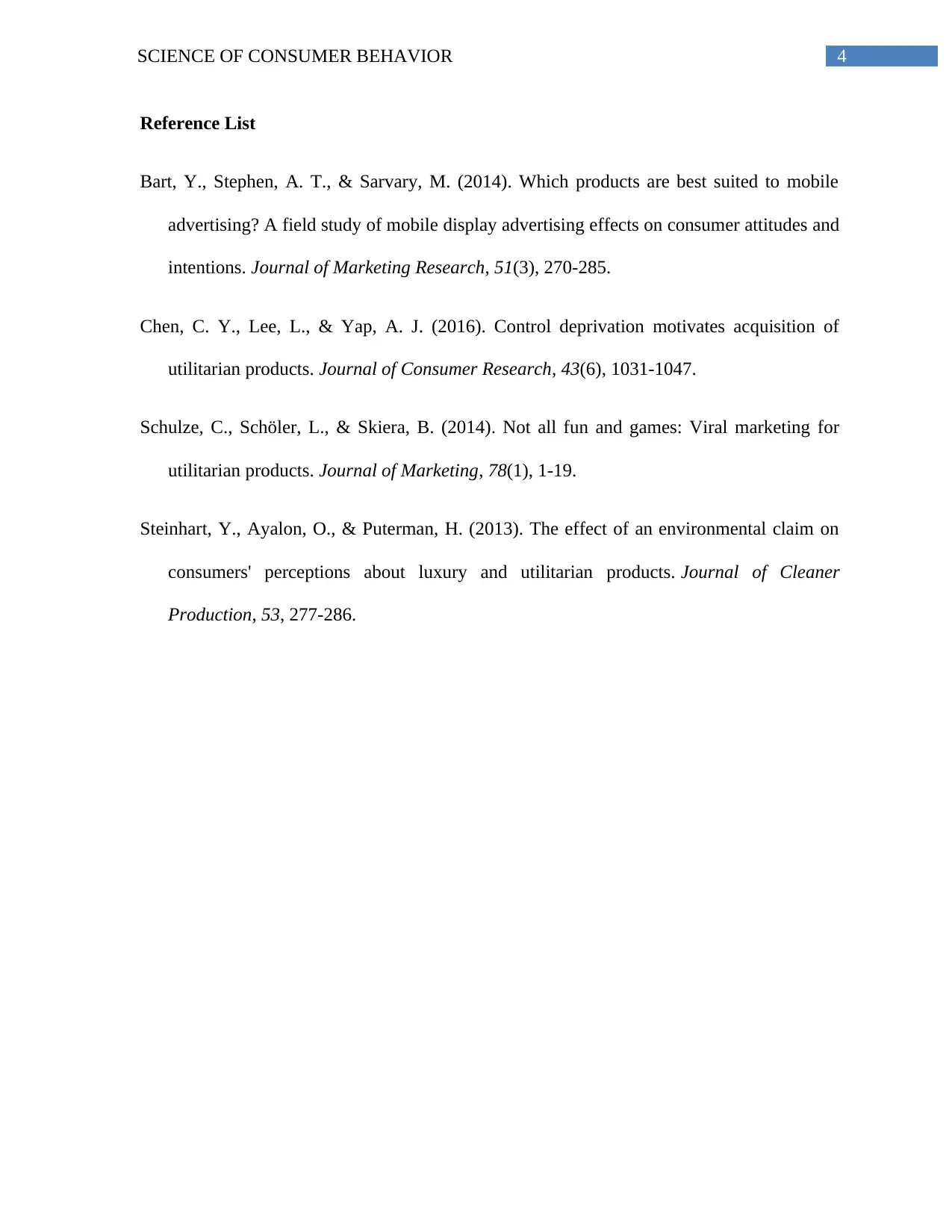
Bart, Y., Stephen, A. T., & Sarvary, M. (2014). Which products are best suited to mobile
advertising? A field study of mobile display advertising effects on consumer attitudes and
intentions. Journal of Marketing Research, 51(3), 270-285.
Chen, C. Y., Lee, L., & Yap, A. J. (2016). Control deprivation motivates acquisition of
utilitarian products. Journal of Consumer Research, 43(6), 1031-1047.
Schulze, C., Schöler, L., & Skiera, B. (2014). Not all fun and games: Viral marketing for
utilitarian products. Journal of Marketing, 78(1), 1-19.
Steinhart, Y., Ayalon, O., & Puterman, H. (2013). The effect of an environmental claim on
consumers' perceptions about luxury and utilitarian products. Journal of Cleaner
Production, 53, 277-286.
chevron_up_icon
1 out of 5
circle_padding
hide_on_mobile
zoom_out_icon
[object Object]