Vacation Policy Implementation Report - University Name

Verified

Added on  2022/11/14

|4
|510
|300
Report
AI Summary
This report analyzes the implementation of vacation policies in Manitoba, Prince Edward Island, and Yukon. It examines the differences in vacation leave, time off, and compensation, comparing the policies across the three jurisdictions. The analysis includes factors such as the length of service required to qualify for vacation time, the duration of consecutive leave, and the percentage of compensation. The report recommends revising the working period to 6 years and a 5% compensation rate for all jurisdictions to create a more sustainable and cost-effective vacation leave policy. The research provides valuable insights for a Payroll Supervisor and Human Resource Manager of an Organic Food Supplier Company, emphasizing the importance of fair and equitable vacation policies.
Document Page
Running Head: IMPLEMENTATION OF VACATION POLICY
IMPLEMENTATION OF VACATION POLICY
Name of the Student
Name of the University
Author Note
tabler-icon-diamond-filled.svg

Paraphrase This Document

Need a fresh take? Get an instant paraphrase of this document with our AI Paraphraser
Document Page
1IMPLEMENTATION OF VACATION POLICY
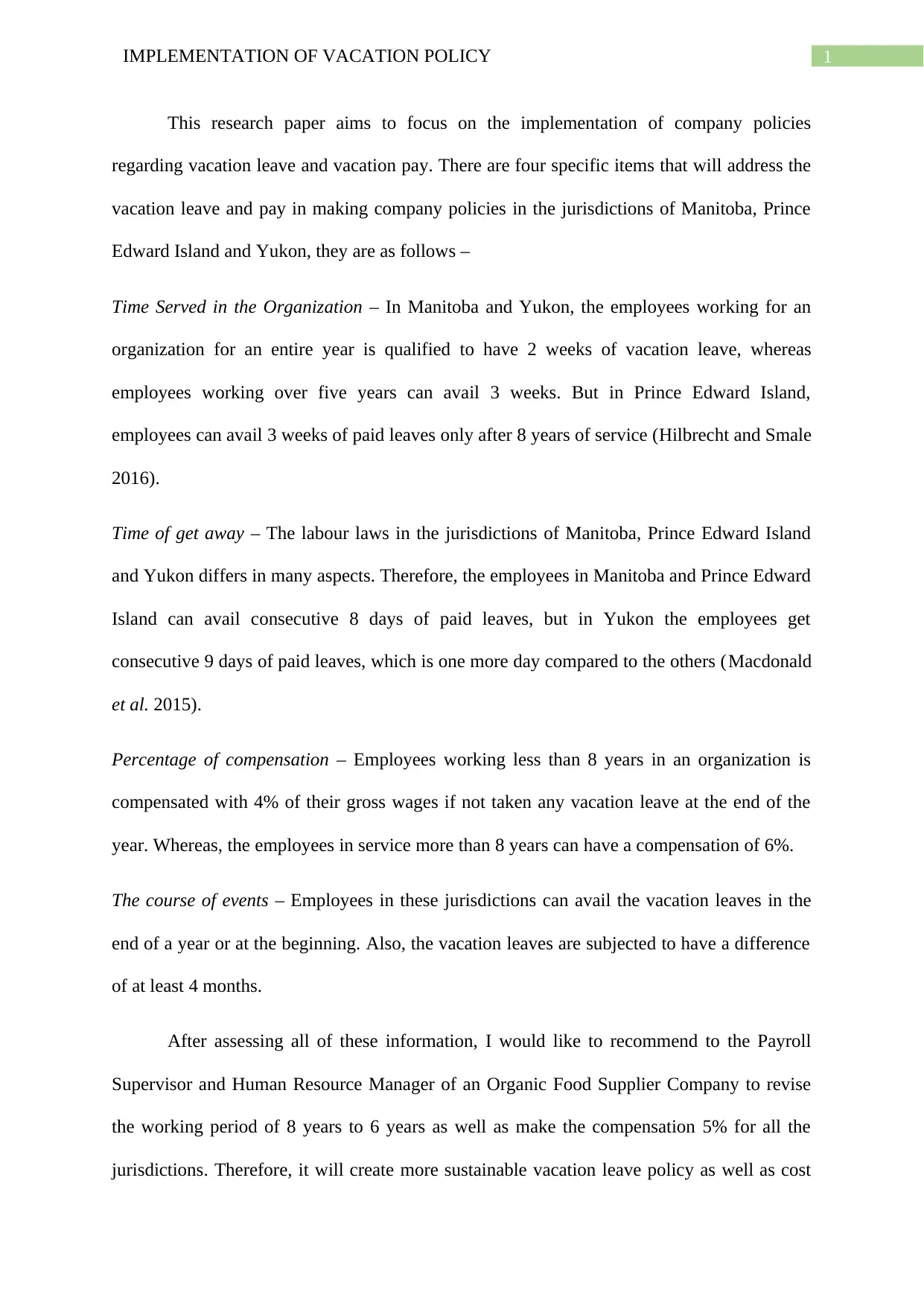
This research paper aims to focus on the implementation of company policies
regarding vacation leave and vacation pay. There are four specific items that will address the
vacation leave and pay in making company policies in the jurisdictions of Manitoba, Prince
Edward Island and Yukon, they are as follows –
Time Served in the Organization – In Manitoba and Yukon, the employees working for an
organization for an entire year is qualified to have 2 weeks of vacation leave, whereas
employees working over five years can avail 3 weeks. But in Prince Edward Island,
employees can avail 3 weeks of paid leaves only after 8 years of service (Hilbrecht and Smale
2016).
Time of get away – The labour laws in the jurisdictions of Manitoba, Prince Edward Island
and Yukon differs in many aspects. Therefore, the employees in Manitoba and Prince Edward
Island can avail consecutive 8 days of paid leaves, but in Yukon the employees get
consecutive 9 days of paid leaves, which is one more day compared to the others (Macdonald
et al. 2015).
Percentage of compensation – Employees working less than 8 years in an organization is
compensated with 4% of their gross wages if not taken any vacation leave at the end of the
year. Whereas, the employees in service more than 8 years can have a compensation of 6%.
The course of events – Employees in these jurisdictions can avail the vacation leaves in the
end of a year or at the beginning. Also, the vacation leaves are subjected to have a difference
of at least 4 months.
After assessing all of these information, I would like to recommend to the Payroll
Supervisor and Human Resource Manager of an Organic Food Supplier Company to revise
the working period of 8 years to 6 years as well as make the compensation 5% for all the
jurisdictions. Therefore, it will create more sustainable vacation leave policy as well as cost
Document Page
2IMPLEMENTATION OF VACATION POLICY
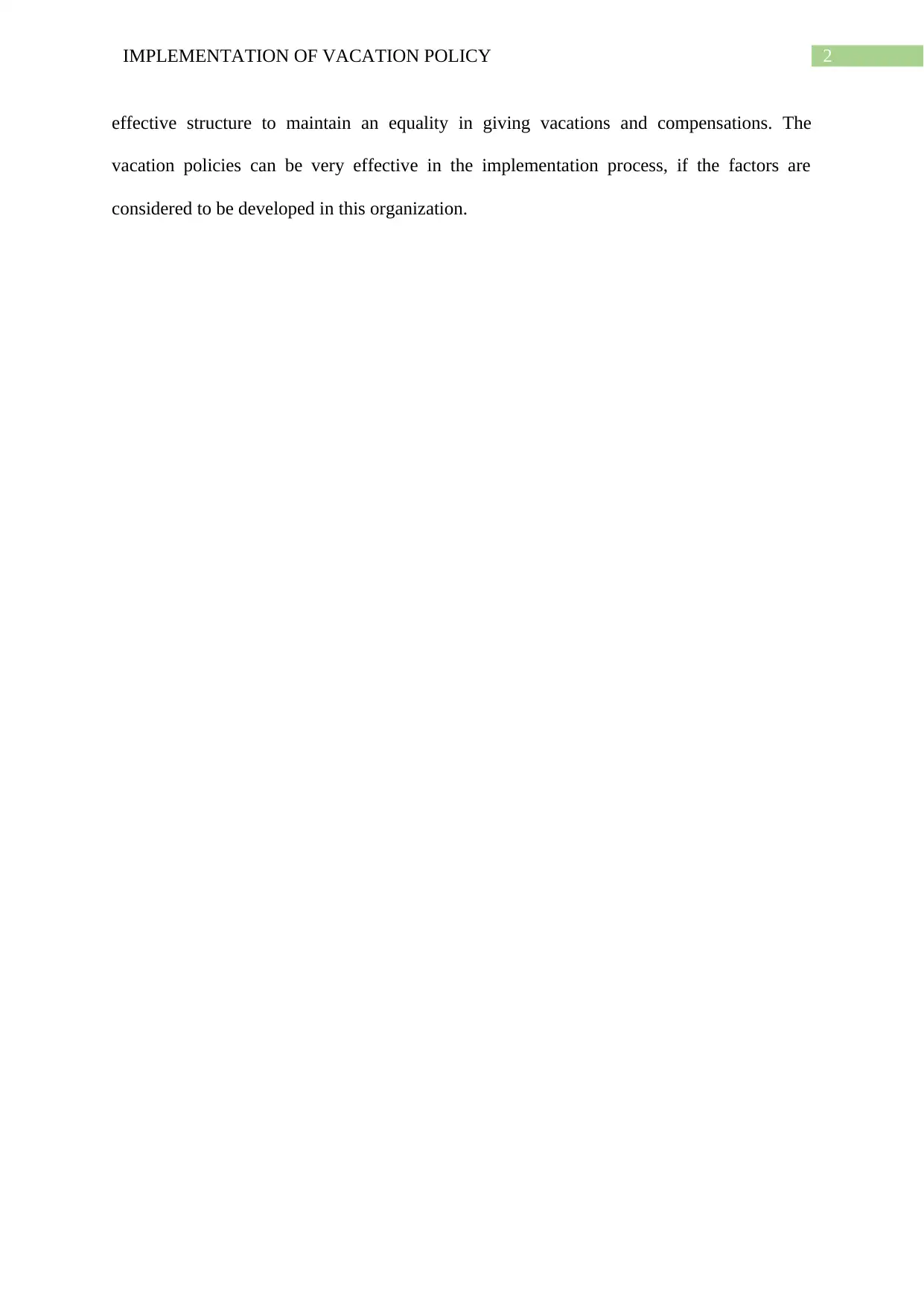
effective structure to maintain an equality in giving vacations and compensations. The
vacation policies can be very effective in the implementation process, if the factors are
considered to be developed in this organization.
Document Page
3IMPLEMENTATION OF VACATION POLICY
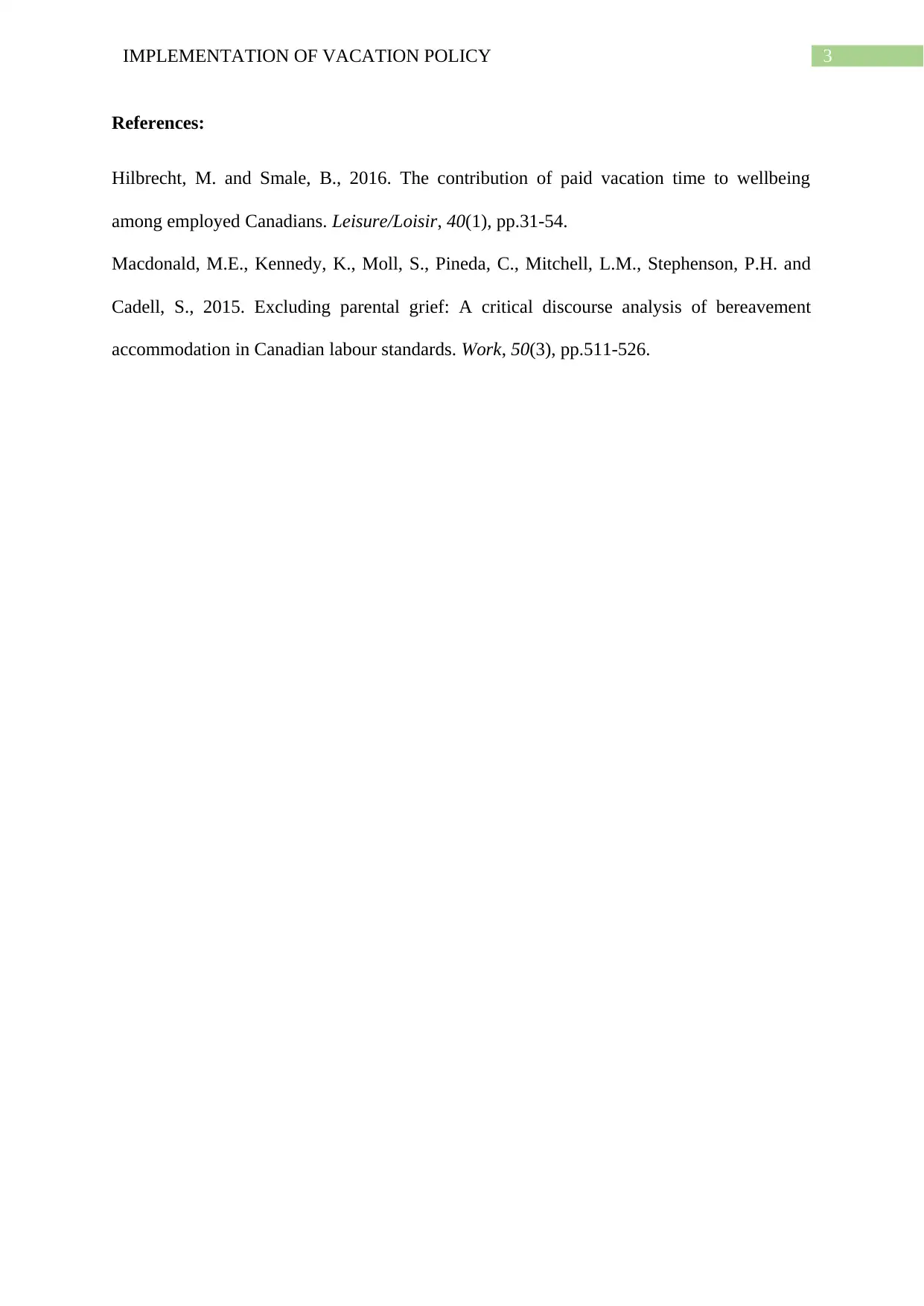
References:
Hilbrecht, M. and Smale, B., 2016. The contribution of paid vacation time to wellbeing
among employed Canadians. Leisure/Loisir, 40(1), pp.31-54.
Macdonald, M.E., Kennedy, K., Moll, S., Pineda, C., Mitchell, L.M., Stephenson, P.H. and
Cadell, S., 2015. Excluding parental grief: A critical discourse analysis of bereavement
accommodation in Canadian labour standards. Work, 50(3), pp.511-526.
chevron_up_icon
1 out of 4
circle_padding
hide_on_mobile
zoom_out_icon
[object Object]