MBS 665: Critique of Article on Guiding Principles in Valuation
VerifiedAdded on 2023/06/13
|5
|3043
|128
Report
AI Summary
This assignment is a critique of an article focusing on the guiding principles of business valuation reports. The article, "Time To Update The Guiding Principles To A Valuation Report," discusses the evolution of valuation reports and introduces five key principles (Precision, Practicality, Plausibility, Proficiency, and Price) for ensuring report quality and reliability. The critique likely involves analyzing the issues raised in the article, relating them to topics covered in the MBS 665 Business Valuation course, evaluating the main arguments, and providing comments and opinions based on the course knowledge. The assignment aims to assess the student's understanding of business valuation principles and their ability to critically evaluate industry-related articles.
May 2017 bvresources.com 9
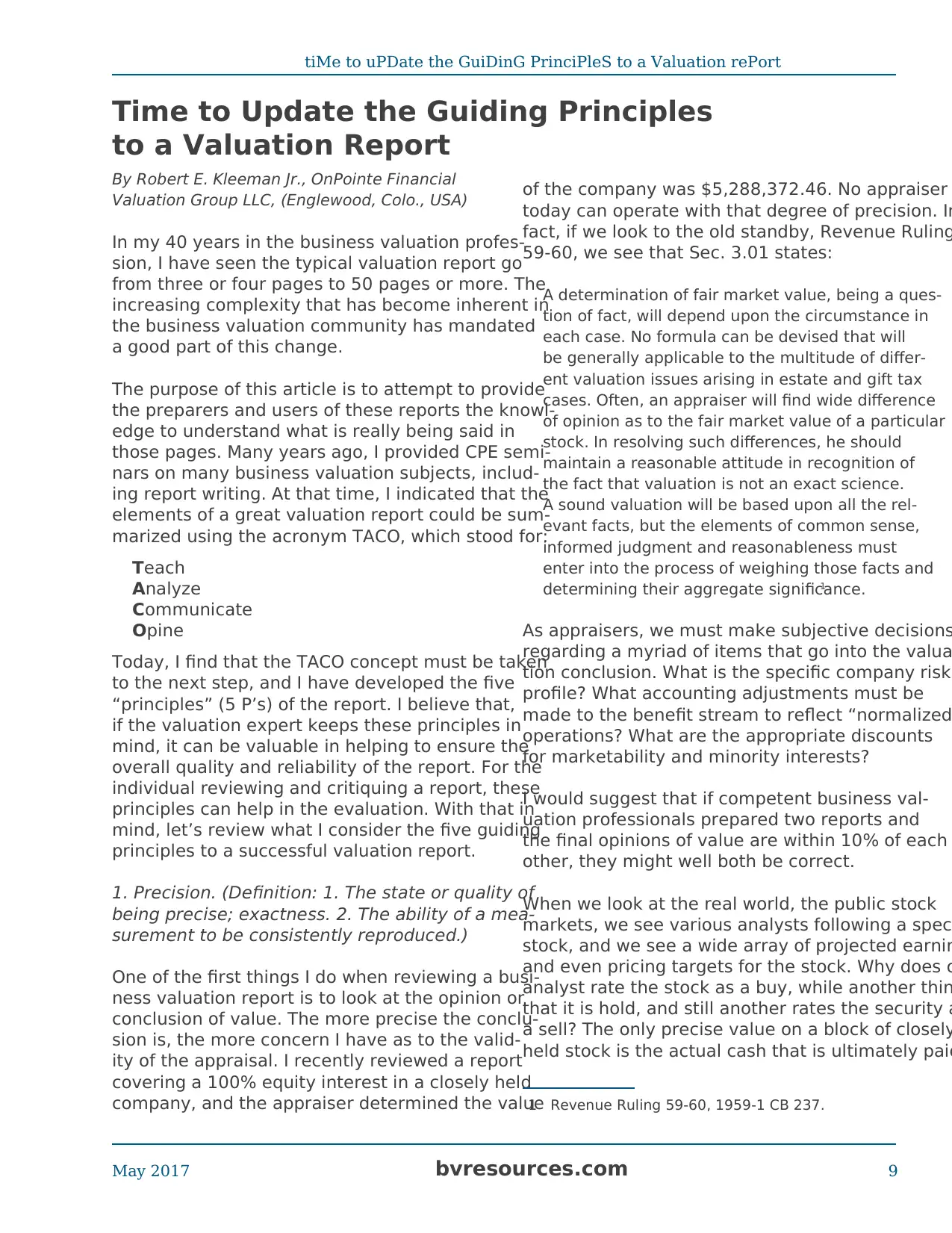
tiMe to uPDate the GuiDinG PrinciPleS to a Valuation rePort
Time to Update the Guiding Principles
to a Valuation Report
By Robert E. Kleeman Jr., OnPointe Financial
Valuation Group LLC, (Englewood, Colo., USA)
In my 40 years in the business valuation profes-
sion, I have seen the typical valuation report go
from three or four pages to 50 pages or more. The
increasing complexity that has become inherent in
the business valuation community has mandated
a good part of this change.
The purpose of this article is to attempt to provide
the preparers and users of these reports the knowl-
edge to understand what is really being said in
those pages. Many years ago, I provided CPE semi-
nars on many business valuation subjects, includ-
ing report writing. At that time, I indicated that the
elements of a great valuation report could be sum-
marized using the acronym TACO, which stood for:
Teach
Analyze
Communicate
Opine
Today, I find that the TACO concept must be taken
to the next step, and I have developed the five
“principles” (5 P’s) of the report. I believe that,
if the valuation expert keeps these principles in
mind, it can be valuable in helping to ensure the
overall quality and reliability of the report. For the
individual reviewing and critiquing a report, these
principles can help in the evaluation. With that in
mind, let’s review what I consider the five guiding
principles to a successful valuation report.
1. Precision. (Definition: 1. The state or quality of
being precise; exactness. 2. The ability of a mea-
surement to be consistently reproduced.)
One of the first things I do when reviewing a busi-
ness valuation report is to look at the opinion or
conclusion of value. The more precise the conclu-
sion is, the more concern I have as to the valid-
ity of the appraisal. I recently reviewed a report
covering a 100% equity interest in a closely held
company, and the appraiser determined the value
of the company was $5,288,372.46. No appraiser
today can operate with that degree of precision. In
fact, if we look to the old standby, Revenue Ruling
59-60, we see that Sec. 3.01 states:
A determination of fair market value, being a ques-
tion of fact, will depend upon the circumstance in
each case. No formula can be devised that will
be generally applicable to the multitude of differ-
ent valuation issues arising in estate and gift tax
cases. Often, an appraiser will find wide difference
of opinion as to the fair market value of a particular
stock. In resolving such differences, he should
maintain a reasonable attitude in recognition of
the fact that valuation is not an exact science.
A sound valuation will be based upon all the rel-
evant facts, but the elements of common sense,
informed judgment and reasonableness must
enter into the process of weighing those facts and
determining their aggregate significance.1
As appraisers, we must make subjective decisions
regarding a myriad of items that go into the valua
tion conclusion. What is the specific company risk
profile? What accounting adjustments must be
made to the benefit stream to reflect “normalized
operations? What are the appropriate discounts
for marketability and minority interests?
I would suggest that if competent business val-
uation professionals prepared two reports and
the final opinions of value are within 10% of each
other, they might well both be correct.
When we look at the real world, the public stock
markets, we see various analysts following a spec
stock, and we see a wide array of projected earnin
and even pricing targets for the stock. Why does o
analyst rate the stock as a buy, while another thin
that it is hold, and still another rates the security a
a sell? The only precise value on a block of closely
held stock is the actual cash that is ultimately paid
1 Revenue Ruling 59-60, 1959-1 CB 237.
tiMe to uPDate the GuiDinG PrinciPleS to a Valuation rePort
Time to Update the Guiding Principles
to a Valuation Report
By Robert E. Kleeman Jr., OnPointe Financial
Valuation Group LLC, (Englewood, Colo., USA)
In my 40 years in the business valuation profes-
sion, I have seen the typical valuation report go
from three or four pages to 50 pages or more. The
increasing complexity that has become inherent in
the business valuation community has mandated
a good part of this change.
The purpose of this article is to attempt to provide
the preparers and users of these reports the knowl-
edge to understand what is really being said in
those pages. Many years ago, I provided CPE semi-
nars on many business valuation subjects, includ-
ing report writing. At that time, I indicated that the
elements of a great valuation report could be sum-
marized using the acronym TACO, which stood for:
Teach
Analyze
Communicate
Opine
Today, I find that the TACO concept must be taken
to the next step, and I have developed the five
“principles” (5 P’s) of the report. I believe that,
if the valuation expert keeps these principles in
mind, it can be valuable in helping to ensure the
overall quality and reliability of the report. For the
individual reviewing and critiquing a report, these
principles can help in the evaluation. With that in
mind, let’s review what I consider the five guiding
principles to a successful valuation report.
1. Precision. (Definition: 1. The state or quality of
being precise; exactness. 2. The ability of a mea-
surement to be consistently reproduced.)
One of the first things I do when reviewing a busi-
ness valuation report is to look at the opinion or
conclusion of value. The more precise the conclu-
sion is, the more concern I have as to the valid-
ity of the appraisal. I recently reviewed a report
covering a 100% equity interest in a closely held
company, and the appraiser determined the value
of the company was $5,288,372.46. No appraiser
today can operate with that degree of precision. In
fact, if we look to the old standby, Revenue Ruling
59-60, we see that Sec. 3.01 states:
A determination of fair market value, being a ques-
tion of fact, will depend upon the circumstance in
each case. No formula can be devised that will
be generally applicable to the multitude of differ-
ent valuation issues arising in estate and gift tax
cases. Often, an appraiser will find wide difference
of opinion as to the fair market value of a particular
stock. In resolving such differences, he should
maintain a reasonable attitude in recognition of
the fact that valuation is not an exact science.
A sound valuation will be based upon all the rel-
evant facts, but the elements of common sense,
informed judgment and reasonableness must
enter into the process of weighing those facts and
determining their aggregate significance.1
As appraisers, we must make subjective decisions
regarding a myriad of items that go into the valua
tion conclusion. What is the specific company risk
profile? What accounting adjustments must be
made to the benefit stream to reflect “normalized
operations? What are the appropriate discounts
for marketability and minority interests?
I would suggest that if competent business val-
uation professionals prepared two reports and
the final opinions of value are within 10% of each
other, they might well both be correct.
When we look at the real world, the public stock
markets, we see various analysts following a spec
stock, and we see a wide array of projected earnin
and even pricing targets for the stock. Why does o
analyst rate the stock as a buy, while another thin
that it is hold, and still another rates the security a
a sell? The only precise value on a block of closely
held stock is the actual cash that is ultimately paid
1 Revenue Ruling 59-60, 1959-1 CB 237.

Paraphrase This Document
Need a fresh take? Get an instant paraphrase of this document with our AI Paraphraser
10 Business Valuation Update May 2017
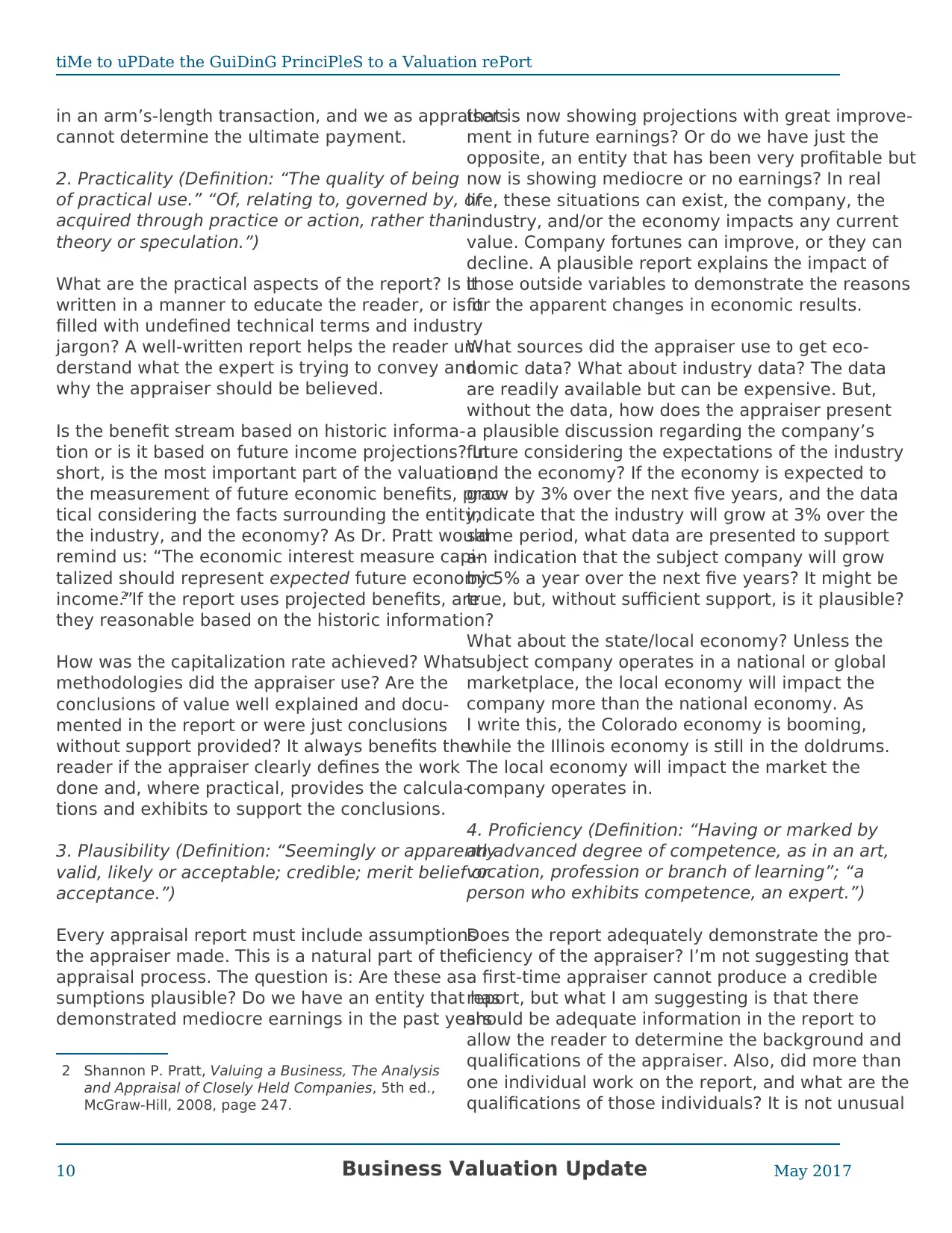
tiMe to uPDate the GuiDinG PrinciPleS to a Valuation rePort
that is now showing projections with great improve-
ment in future earnings? Or do we have just the
opposite, an entity that has been very profitable but
now is showing mediocre or no earnings? In real
life, these situations can exist, the company, the
industry, and/or the economy impacts any current
value. Company fortunes can improve, or they can
decline. A plausible report explains the impact of
those outside variables to demonstrate the reasons
for the apparent changes in economic results.
What sources did the appraiser use to get eco-
nomic data? What about industry data? The data
are readily available but can be expensive. But,
without the data, how does the appraiser present
a plausible discussion regarding the company’s
future considering the expectations of the industry
and the economy? If the economy is expected to
grow by 3% over the next five years, and the data
indicate that the industry will grow at 3% over the
same period, what data are presented to support
an indication that the subject company will grow
by 5% a year over the next five years? It might be
true, but, without sufficient support, is it plausible?
What about the state/local economy? Unless the
subject company operates in a national or global
marketplace, the local economy will impact the
company more than the national economy. As
I write this, the Colorado economy is booming,
while the Illinois economy is still in the doldrums.
The local economy will impact the market the
company operates in.
4. Proficiency (Definition: “Having or marked by
an advanced degree of competence, as in an art,
vocation, profession or branch of learning”; “a
person who exhibits competence, an expert.”)
Does the report adequately demonstrate the pro-
ficiency of the appraiser? I’m not suggesting that
a first-time appraiser cannot produce a credible
report, but what I am suggesting is that there
should be adequate information in the report to
allow the reader to determine the background and
qualifications of the appraiser. Also, did more than
one individual work on the report, and what are the
qualifications of those individuals? It is not unusual
in an arm’s-length transaction, and we as appraisers
cannot determine the ultimate payment.
2. Practicality (Definition: “The quality of being
of practical use.” “Of, relating to, governed by, or
acquired through practice or action, rather than
theory or speculation.”)
What are the practical aspects of the report? Is it
written in a manner to educate the reader, or is it
filled with undefined technical terms and industry
jargon? A well-written report helps the reader un-
derstand what the expert is trying to convey and
why the appraiser should be believed.
Is the benefit stream based on historic informa-
tion or is it based on future income projections? In
short, is the most important part of the valuation,
the measurement of future economic benefits, prac-
tical considering the facts surrounding the entity,
the industry, and the economy? As Dr. Pratt would
remind us: “The economic interest measure capi-
talized should represent expected future economic
income.”2 If the report uses projected benefits, are
they reasonable based on the historic information?
How was the capitalization rate achieved? What
methodologies did the appraiser use? Are the
conclusions of value well explained and docu-
mented in the report or were just conclusions
without support provided? It always benefits the
reader if the appraiser clearly defines the work
done and, where practical, provides the calcula-
tions and exhibits to support the conclusions.
3. Plausibility (Definition: “Seemingly or apparently
valid, likely or acceptable; credible; merit belief or
acceptance.”)
Every appraisal report must include assumptions
the appraiser made. This is a natural part of the
appraisal process. The question is: Are these as-
sumptions plausible? Do we have an entity that has
demonstrated mediocre earnings in the past years
2 Shannon P. Pratt, Valuing a Business, The Analysis
and Appraisal of Closely Held Companies, 5th ed.,
McGraw-Hill, 2008, page 247.
tiMe to uPDate the GuiDinG PrinciPleS to a Valuation rePort
that is now showing projections with great improve-
ment in future earnings? Or do we have just the
opposite, an entity that has been very profitable but
now is showing mediocre or no earnings? In real
life, these situations can exist, the company, the
industry, and/or the economy impacts any current
value. Company fortunes can improve, or they can
decline. A plausible report explains the impact of
those outside variables to demonstrate the reasons
for the apparent changes in economic results.
What sources did the appraiser use to get eco-
nomic data? What about industry data? The data
are readily available but can be expensive. But,
without the data, how does the appraiser present
a plausible discussion regarding the company’s
future considering the expectations of the industry
and the economy? If the economy is expected to
grow by 3% over the next five years, and the data
indicate that the industry will grow at 3% over the
same period, what data are presented to support
an indication that the subject company will grow
by 5% a year over the next five years? It might be
true, but, without sufficient support, is it plausible?
What about the state/local economy? Unless the
subject company operates in a national or global
marketplace, the local economy will impact the
company more than the national economy. As
I write this, the Colorado economy is booming,
while the Illinois economy is still in the doldrums.
The local economy will impact the market the
company operates in.
4. Proficiency (Definition: “Having or marked by
an advanced degree of competence, as in an art,
vocation, profession or branch of learning”; “a
person who exhibits competence, an expert.”)
Does the report adequately demonstrate the pro-
ficiency of the appraiser? I’m not suggesting that
a first-time appraiser cannot produce a credible
report, but what I am suggesting is that there
should be adequate information in the report to
allow the reader to determine the background and
qualifications of the appraiser. Also, did more than
one individual work on the report, and what are the
qualifications of those individuals? It is not unusual
in an arm’s-length transaction, and we as appraisers
cannot determine the ultimate payment.
2. Practicality (Definition: “The quality of being
of practical use.” “Of, relating to, governed by, or
acquired through practice or action, rather than
theory or speculation.”)
What are the practical aspects of the report? Is it
written in a manner to educate the reader, or is it
filled with undefined technical terms and industry
jargon? A well-written report helps the reader un-
derstand what the expert is trying to convey and
why the appraiser should be believed.
Is the benefit stream based on historic informa-
tion or is it based on future income projections? In
short, is the most important part of the valuation,
the measurement of future economic benefits, prac-
tical considering the facts surrounding the entity,
the industry, and the economy? As Dr. Pratt would
remind us: “The economic interest measure capi-
talized should represent expected future economic
income.”2 If the report uses projected benefits, are
they reasonable based on the historic information?
How was the capitalization rate achieved? What
methodologies did the appraiser use? Are the
conclusions of value well explained and docu-
mented in the report or were just conclusions
without support provided? It always benefits the
reader if the appraiser clearly defines the work
done and, where practical, provides the calcula-
tions and exhibits to support the conclusions.
3. Plausibility (Definition: “Seemingly or apparently
valid, likely or acceptable; credible; merit belief or
acceptance.”)
Every appraisal report must include assumptions
the appraiser made. This is a natural part of the
appraisal process. The question is: Are these as-
sumptions plausible? Do we have an entity that has
demonstrated mediocre earnings in the past years
2 Shannon P. Pratt, Valuing a Business, The Analysis
and Appraisal of Closely Held Companies, 5th ed.,
McGraw-Hill, 2008, page 247.
May 2017 bvresources.com 11
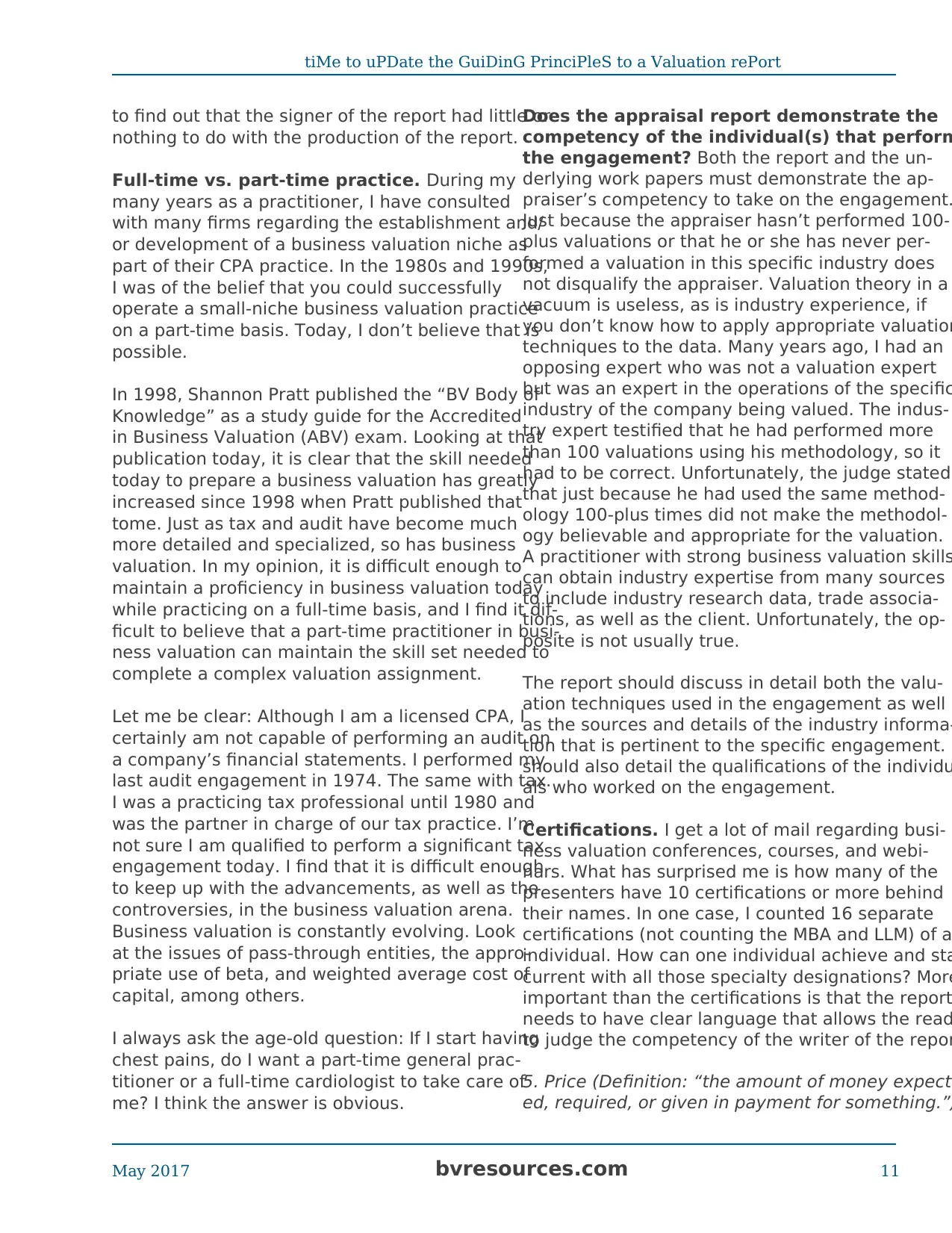
tiMe to uPDate the GuiDinG PrinciPleS to a Valuation rePort
to find out that the signer of the report had little or
nothing to do with the production of the report.
Full-time vs. part-time practice. During my
many years as a practitioner, I have consulted
with many firms regarding the establishment and/
or development of a business valuation niche as
part of their CPA practice. In the 1980s and 1990s,
I was of the belief that you could successfully
operate a small-niche business valuation practice
on a part-time basis. Today, I don’t believe that is
possible.
In 1998, Shannon Pratt published the “BV Body of
Knowledge” as a study guide for the Accredited
in Business Valuation (ABV) exam. Looking at that
publication today, it is clear that the skill needed
today to prepare a business valuation has greatly
increased since 1998 when Pratt published that
tome. Just as tax and audit have become much
more detailed and specialized, so has business
valuation. In my opinion, it is difficult enough to
maintain a proficiency in business valuation today
while practicing on a full-time basis, and I find it dif-
ficult to believe that a part-time practitioner in busi-
ness valuation can maintain the skill set needed to
complete a complex valuation assignment.
Let me be clear: Although I am a licensed CPA, I
certainly am not capable of performing an audit on
a company’s financial statements. I performed my
last audit engagement in 1974. The same with tax.
I was a practicing tax professional until 1980 and
was the partner in charge of our tax practice. I’m
not sure I am qualified to perform a significant tax
engagement today. I find that it is difficult enough
to keep up with the advancements, as well as the
controversies, in the business valuation arena.
Business valuation is constantly evolving. Look
at the issues of pass-through entities, the appro-
priate use of beta, and weighted average cost of
capital, among others.
I always ask the age-old question: If I start having
chest pains, do I want a part-time general prac-
titioner or a full-time cardiologist to take care of
me? I think the answer is obvious.
Does the appraisal report demonstrate the
competency of the individual(s) that perform
the engagement? Both the report and the un-
derlying work papers must demonstrate the ap-
praiser’s competency to take on the engagement.
Just because the appraiser hasn’t performed 100-
plus valuations or that he or she has never per-
formed a valuation in this specific industry does
not disqualify the appraiser. Valuation theory in a
vacuum is useless, as is industry experience, if
you don’t know how to apply appropriate valuation
techniques to the data. Many years ago, I had an
opposing expert who was not a valuation expert
but was an expert in the operations of the specific
industry of the company being valued. The indus-
try expert testified that he had performed more
than 100 valuations using his methodology, so it
had to be correct. Unfortunately, the judge stated
that just because he had used the same method-
ology 100-plus times did not make the methodol-
ogy believable and appropriate for the valuation.
A practitioner with strong business valuation skills
can obtain industry expertise from many sources
to include industry research data, trade associa-
tions, as well as the client. Unfortunately, the op-
posite is not usually true.
The report should discuss in detail both the valu-
ation techniques used in the engagement as well
as the sources and details of the industry informa-
tion that is pertinent to the specific engagement. I
should also detail the qualifications of the individu
als who worked on the engagement.
Certifications. I get a lot of mail regarding busi-
ness valuation conferences, courses, and webi-
nars. What has surprised me is how many of the
presenters have 10 certifications or more behind
their names. In one case, I counted 16 separate
certifications (not counting the MBA and LLM) of a
individual. How can one individual achieve and sta
current with all those specialty designations? More
important than the certifications is that the report
needs to have clear language that allows the read
to judge the competency of the writer of the repor
5. Price (Definition: “the amount of money expect-
ed, required, or given in payment for something.”)
tiMe to uPDate the GuiDinG PrinciPleS to a Valuation rePort
to find out that the signer of the report had little or
nothing to do with the production of the report.
Full-time vs. part-time practice. During my
many years as a practitioner, I have consulted
with many firms regarding the establishment and/
or development of a business valuation niche as
part of their CPA practice. In the 1980s and 1990s,
I was of the belief that you could successfully
operate a small-niche business valuation practice
on a part-time basis. Today, I don’t believe that is
possible.
In 1998, Shannon Pratt published the “BV Body of
Knowledge” as a study guide for the Accredited
in Business Valuation (ABV) exam. Looking at that
publication today, it is clear that the skill needed
today to prepare a business valuation has greatly
increased since 1998 when Pratt published that
tome. Just as tax and audit have become much
more detailed and specialized, so has business
valuation. In my opinion, it is difficult enough to
maintain a proficiency in business valuation today
while practicing on a full-time basis, and I find it dif-
ficult to believe that a part-time practitioner in busi-
ness valuation can maintain the skill set needed to
complete a complex valuation assignment.
Let me be clear: Although I am a licensed CPA, I
certainly am not capable of performing an audit on
a company’s financial statements. I performed my
last audit engagement in 1974. The same with tax.
I was a practicing tax professional until 1980 and
was the partner in charge of our tax practice. I’m
not sure I am qualified to perform a significant tax
engagement today. I find that it is difficult enough
to keep up with the advancements, as well as the
controversies, in the business valuation arena.
Business valuation is constantly evolving. Look
at the issues of pass-through entities, the appro-
priate use of beta, and weighted average cost of
capital, among others.
I always ask the age-old question: If I start having
chest pains, do I want a part-time general prac-
titioner or a full-time cardiologist to take care of
me? I think the answer is obvious.
Does the appraisal report demonstrate the
competency of the individual(s) that perform
the engagement? Both the report and the un-
derlying work papers must demonstrate the ap-
praiser’s competency to take on the engagement.
Just because the appraiser hasn’t performed 100-
plus valuations or that he or she has never per-
formed a valuation in this specific industry does
not disqualify the appraiser. Valuation theory in a
vacuum is useless, as is industry experience, if
you don’t know how to apply appropriate valuation
techniques to the data. Many years ago, I had an
opposing expert who was not a valuation expert
but was an expert in the operations of the specific
industry of the company being valued. The indus-
try expert testified that he had performed more
than 100 valuations using his methodology, so it
had to be correct. Unfortunately, the judge stated
that just because he had used the same method-
ology 100-plus times did not make the methodol-
ogy believable and appropriate for the valuation.
A practitioner with strong business valuation skills
can obtain industry expertise from many sources
to include industry research data, trade associa-
tions, as well as the client. Unfortunately, the op-
posite is not usually true.
The report should discuss in detail both the valu-
ation techniques used in the engagement as well
as the sources and details of the industry informa-
tion that is pertinent to the specific engagement. I
should also detail the qualifications of the individu
als who worked on the engagement.
Certifications. I get a lot of mail regarding busi-
ness valuation conferences, courses, and webi-
nars. What has surprised me is how many of the
presenters have 10 certifications or more behind
their names. In one case, I counted 16 separate
certifications (not counting the MBA and LLM) of a
individual. How can one individual achieve and sta
current with all those specialty designations? More
important than the certifications is that the report
needs to have clear language that allows the read
to judge the competency of the writer of the repor
5. Price (Definition: “the amount of money expect-
ed, required, or given in payment for something.”)
⊘ This is a preview!⊘
Do you want full access?
Subscribe today to unlock all pages.

Trusted by 1+ million students worldwide
12 Business Valuation Update May 2017
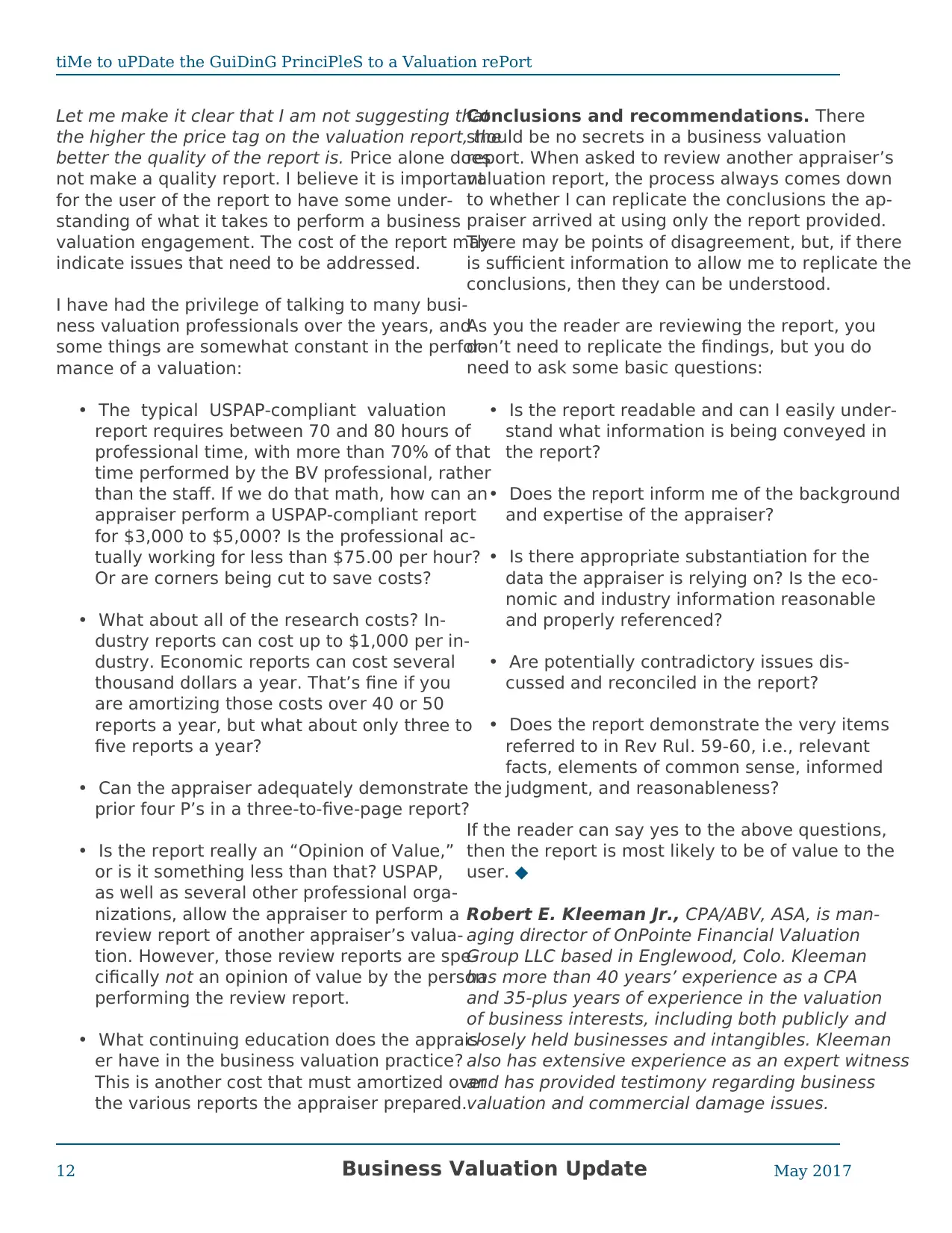
tiMe to uPDate the GuiDinG PrinciPleS to a Valuation rePort
Let me make it clear that I am not suggesting that
the higher the price tag on the valuation report, the
better the quality of the report is. Price alone does
not make a quality report. I believe it is important
for the user of the report to have some under-
standing of what it takes to perform a business
valuation engagement. The cost of the report may
indicate issues that need to be addressed.
I have had the privilege of talking to many busi-
ness valuation professionals over the years, and
some things are somewhat constant in the perfor-
mance of a valuation:
• The typical USPAP-compliant valuation
report requires between 70 and 80 hours of
professional time, with more than 70% of that
time performed by the BV professional, rather
than the staff. If we do that math, how can an
appraiser perform a USPAP-compliant report
for $3,000 to $5,000? Is the professional ac-
tually working for less than $75.00 per hour?
Or are corners being cut to save costs?
• What about all of the research costs? In-
dustry reports can cost up to $1,000 per in-
dustry. Economic reports can cost several
thousand dollars a year. That’s fine if you
are amortizing those costs over 40 or 50
reports a year, but what about only three to
five reports a year?
• Can the appraiser adequately demonstrate the
prior four P’s in a three-to-five-page report?
• Is the report really an “Opinion of Value,”
or is it something less than that? USPAP,
as well as several other professional orga-
nizations, allow the appraiser to perform a
review report of another appraiser’s valua-
tion. However, those review reports are spe-
cifically not an opinion of value by the person
performing the review report.
• What continuing education does the apprais-
er have in the business valuation practice?
This is another cost that must amortized over
the various reports the appraiser prepared.
Conclusions and recommendations. There
should be no secrets in a business valuation
report. When asked to review another appraiser’s
valuation report, the process always comes down
to whether I can replicate the conclusions the ap-
praiser arrived at using only the report provided.
There may be points of disagreement, but, if there
is sufficient information to allow me to replicate the
conclusions, then they can be understood.
As you the reader are reviewing the report, you
don’t need to replicate the findings, but you do
need to ask some basic questions:
• Is the report readable and can I easily under-
stand what information is being conveyed in
the report?
• Does the report inform me of the background
and expertise of the appraiser?
• Is there appropriate substantiation for the
data the appraiser is relying on? Is the eco-
nomic and industry information reasonable
and properly referenced?
• Are potentially contradictory issues dis-
cussed and reconciled in the report?
• Does the report demonstrate the very items
referred to in Rev Rul. 59-60, i.e., relevant
facts, elements of common sense, informed
judgment, and reasonableness?
If the reader can say yes to the above questions,
then the report is most likely to be of value to the
user. ◆
Robert E. Kleeman Jr., CPA/ABV, ASA, is man-
aging director of OnPointe Financial Valuation
Group LLC based in Englewood, Colo. Kleeman
has more than 40 years’ experience as a CPA
and 35-plus years of experience in the valuation
of business interests, including both publicly and
closely held businesses and intangibles. Kleeman
also has extensive experience as an expert witness
and has provided testimony regarding business
valuation and commercial damage issues.
tiMe to uPDate the GuiDinG PrinciPleS to a Valuation rePort
Let me make it clear that I am not suggesting that
the higher the price tag on the valuation report, the
better the quality of the report is. Price alone does
not make a quality report. I believe it is important
for the user of the report to have some under-
standing of what it takes to perform a business
valuation engagement. The cost of the report may
indicate issues that need to be addressed.
I have had the privilege of talking to many busi-
ness valuation professionals over the years, and
some things are somewhat constant in the perfor-
mance of a valuation:
• The typical USPAP-compliant valuation
report requires between 70 and 80 hours of
professional time, with more than 70% of that
time performed by the BV professional, rather
than the staff. If we do that math, how can an
appraiser perform a USPAP-compliant report
for $3,000 to $5,000? Is the professional ac-
tually working for less than $75.00 per hour?
Or are corners being cut to save costs?
• What about all of the research costs? In-
dustry reports can cost up to $1,000 per in-
dustry. Economic reports can cost several
thousand dollars a year. That’s fine if you
are amortizing those costs over 40 or 50
reports a year, but what about only three to
five reports a year?
• Can the appraiser adequately demonstrate the
prior four P’s in a three-to-five-page report?
• Is the report really an “Opinion of Value,”
or is it something less than that? USPAP,
as well as several other professional orga-
nizations, allow the appraiser to perform a
review report of another appraiser’s valua-
tion. However, those review reports are spe-
cifically not an opinion of value by the person
performing the review report.
• What continuing education does the apprais-
er have in the business valuation practice?
This is another cost that must amortized over
the various reports the appraiser prepared.
Conclusions and recommendations. There
should be no secrets in a business valuation
report. When asked to review another appraiser’s
valuation report, the process always comes down
to whether I can replicate the conclusions the ap-
praiser arrived at using only the report provided.
There may be points of disagreement, but, if there
is sufficient information to allow me to replicate the
conclusions, then they can be understood.
As you the reader are reviewing the report, you
don’t need to replicate the findings, but you do
need to ask some basic questions:
• Is the report readable and can I easily under-
stand what information is being conveyed in
the report?
• Does the report inform me of the background
and expertise of the appraiser?
• Is there appropriate substantiation for the
data the appraiser is relying on? Is the eco-
nomic and industry information reasonable
and properly referenced?
• Are potentially contradictory issues dis-
cussed and reconciled in the report?
• Does the report demonstrate the very items
referred to in Rev Rul. 59-60, i.e., relevant
facts, elements of common sense, informed
judgment, and reasonableness?
If the reader can say yes to the above questions,
then the report is most likely to be of value to the
user. ◆
Robert E. Kleeman Jr., CPA/ABV, ASA, is man-
aging director of OnPointe Financial Valuation
Group LLC based in Englewood, Colo. Kleeman
has more than 40 years’ experience as a CPA
and 35-plus years of experience in the valuation
of business interests, including both publicly and
closely held businesses and intangibles. Kleeman
also has extensive experience as an expert witness
and has provided testimony regarding business
valuation and commercial damage issues.
Paraphrase This Document
Need a fresh take? Get an instant paraphrase of this document with our AI Paraphraser

Copyright of Business Valuation Update is the property of Business Valuation Resources,
LLC and its content may not be copied or emailed to multiple sites or posted to a listserv
without the copyright holder's express written permission. However, users may print,
download, or email articles for individual use.
LLC and its content may not be copied or emailed to multiple sites or posted to a listserv
without the copyright holder's express written permission. However, users may print,
download, or email articles for individual use.

1 out of 5


Your All-in-One AI-Powered Toolkit for Academic Success.
+13062052269
info@desklib.com
Available 24*7 on WhatsApp / Email
![[object Object]](/_next/static/media/star-bottom.7253800d.svg)
Unlock your academic potential
Copyright © 2020–2026 A2Z Services. All Rights Reserved. Developed and managed by ZUCOL.