Value Management and Public Procurement in Oman: A Report
VerifiedAdded on 2023/04/24
|14
|3802
|376
Report
AI Summary
This report examines the concept of value for money in Oman's public sector procurement, highlighting the importance of procuring quality goods and services at the right price and quantity to achieve the lowest total cost. It discusses the significance of whole life costing, encompassing acquisition, operational, and disposal costs, and emphasizes the need for transparency, accountability, and competition in the procurement process. The report identifies failure factors in Oman's public sector infrastructure procurement, including lack of competition, inefficiency, lack of accountability, unprofessionalism, and a subjective understanding of value for money. To mitigate these failures, the report recommends ethical standards, restructuring the procurement system, prioritizing transparency and accountability, and providing clear definitions and guidelines for value for money implementation, ultimately aiming for a more efficient and effective public procurement system in Oman. Desklib offers a wealth of similar resources, including past papers and solved assignments, to aid students in their studies.
Value for Money in public procurement 1
VALUE FOR MONEY IN PUBLIC PROCUREMENT
Name
Institution
Lecturer
Date
City/state
VALUE FOR MONEY IN PUBLIC PROCUREMENT
Name
Institution
Lecturer
Date
City/state

Paraphrase This Document
Need a fresh take? Get an instant paraphrase of this document with our AI Paraphraser
Value for Money in public procurement 2
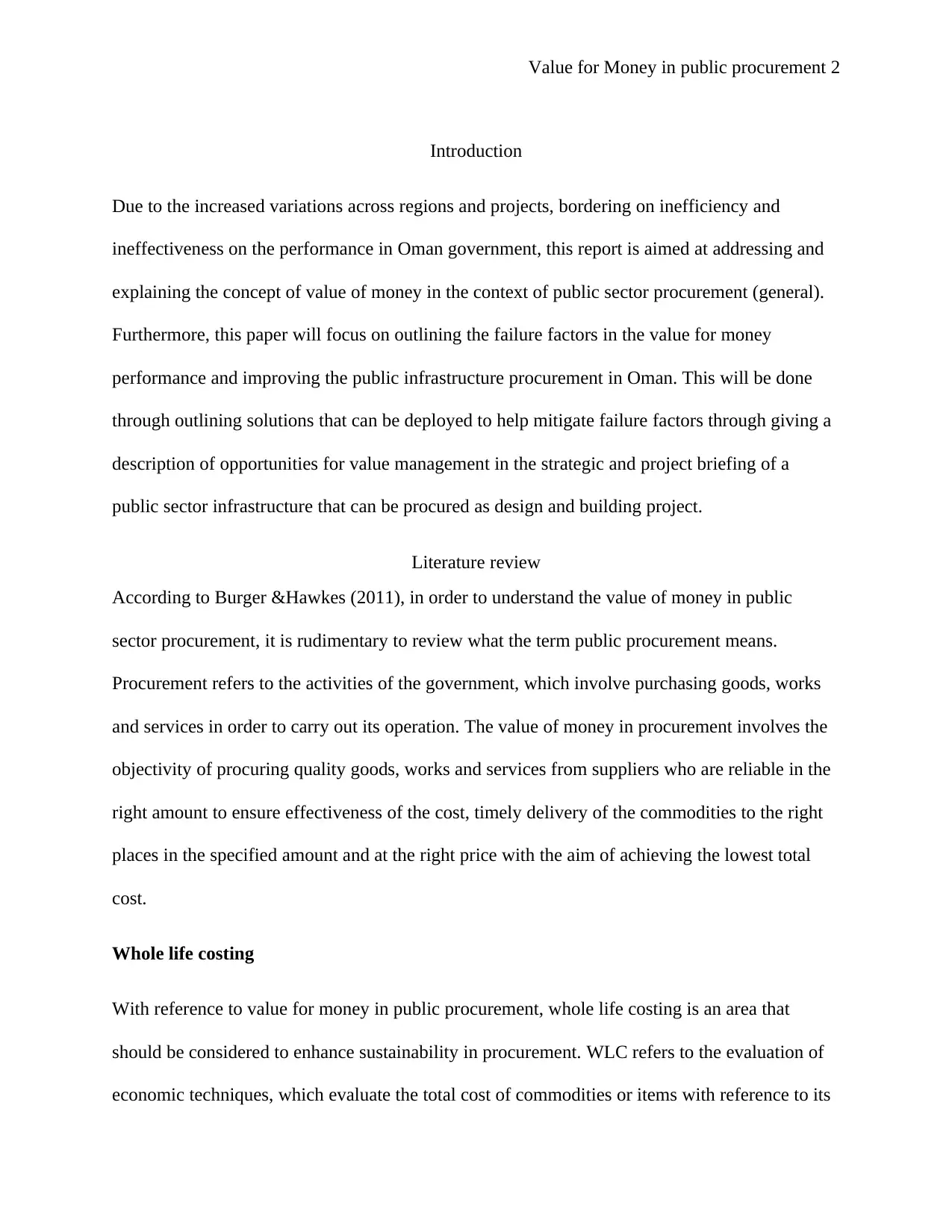
Introduction
Due to the increased variations across regions and projects, bordering on inefficiency and
ineffectiveness on the performance in Oman government, this report is aimed at addressing and
explaining the concept of value of money in the context of public sector procurement (general).
Furthermore, this paper will focus on outlining the failure factors in the value for money
performance and improving the public infrastructure procurement in Oman. This will be done
through outlining solutions that can be deployed to help mitigate failure factors through giving a
description of opportunities for value management in the strategic and project briefing of a
public sector infrastructure that can be procured as design and building project.
Literature review
According to Burger &Hawkes (2011), in order to understand the value of money in public
sector procurement, it is rudimentary to review what the term public procurement means.
Procurement refers to the activities of the government, which involve purchasing goods, works
and services in order to carry out its operation. The value of money in procurement involves the
objectivity of procuring quality goods, works and services from suppliers who are reliable in the
right amount to ensure effectiveness of the cost, timely delivery of the commodities to the right
places in the specified amount and at the right price with the aim of achieving the lowest total
cost.
Whole life costing
With reference to value for money in public procurement, whole life costing is an area that
should be considered to enhance sustainability in procurement. WLC refers to the evaluation of
economic techniques, which evaluate the total cost of commodities or items with reference to its
Introduction
Due to the increased variations across regions and projects, bordering on inefficiency and
ineffectiveness on the performance in Oman government, this report is aimed at addressing and
explaining the concept of value of money in the context of public sector procurement (general).
Furthermore, this paper will focus on outlining the failure factors in the value for money
performance and improving the public infrastructure procurement in Oman. This will be done
through outlining solutions that can be deployed to help mitigate failure factors through giving a
description of opportunities for value management in the strategic and project briefing of a
public sector infrastructure that can be procured as design and building project.
Literature review
According to Burger &Hawkes (2011), in order to understand the value of money in public
sector procurement, it is rudimentary to review what the term public procurement means.
Procurement refers to the activities of the government, which involve purchasing goods, works
and services in order to carry out its operation. The value of money in procurement involves the
objectivity of procuring quality goods, works and services from suppliers who are reliable in the
right amount to ensure effectiveness of the cost, timely delivery of the commodities to the right
places in the specified amount and at the right price with the aim of achieving the lowest total
cost.
Whole life costing
With reference to value for money in public procurement, whole life costing is an area that
should be considered to enhance sustainability in procurement. WLC refers to the evaluation of
economic techniques, which evaluate the total cost of commodities or items with reference to its
Value for Money in public procurement 3
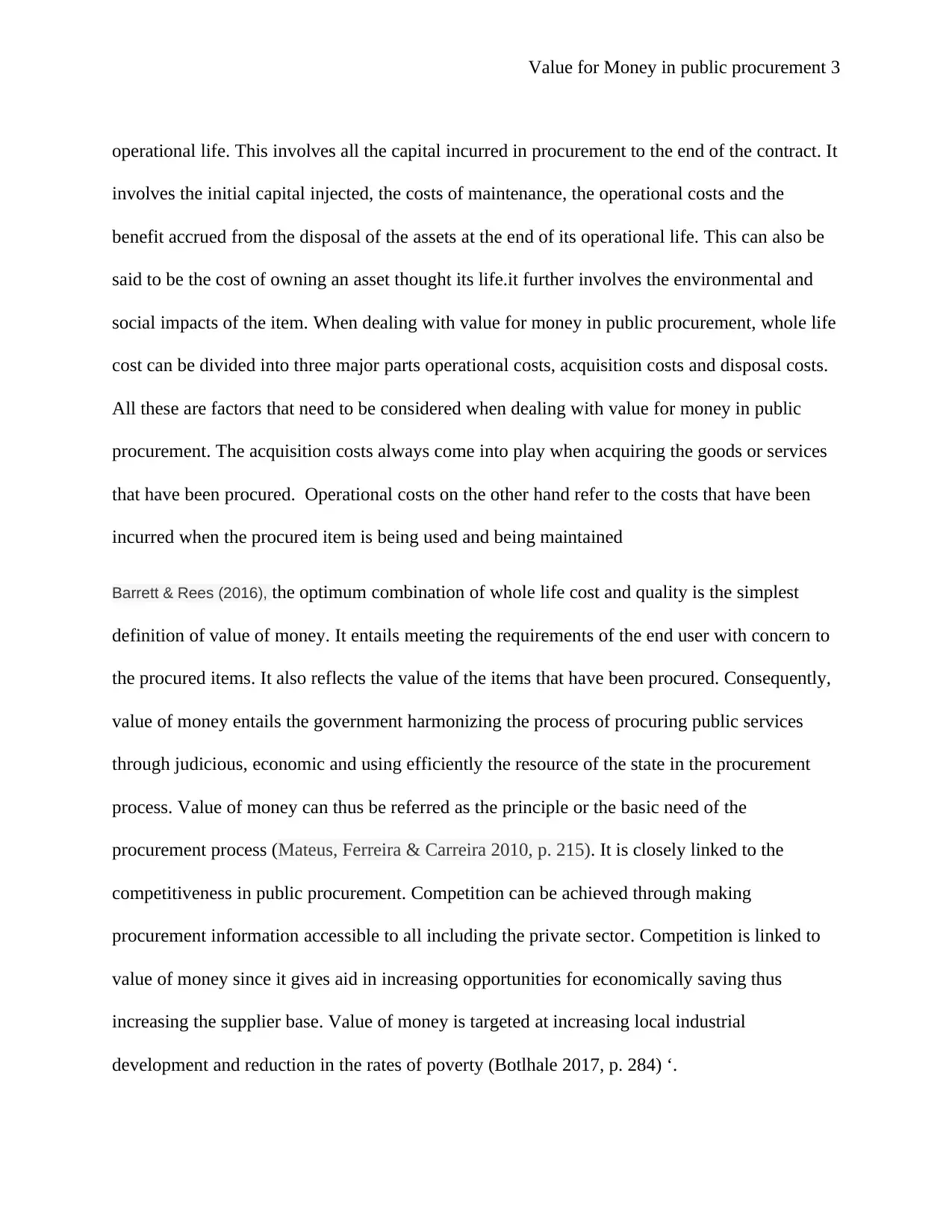
operational life. This involves all the capital incurred in procurement to the end of the contract. It
involves the initial capital injected, the costs of maintenance, the operational costs and the
benefit accrued from the disposal of the assets at the end of its operational life. This can also be
said to be the cost of owning an asset thought its life.it further involves the environmental and
social impacts of the item. When dealing with value for money in public procurement, whole life
cost can be divided into three major parts operational costs, acquisition costs and disposal costs.
All these are factors that need to be considered when dealing with value for money in public
procurement. The acquisition costs always come into play when acquiring the goods or services
that have been procured. Operational costs on the other hand refer to the costs that have been
incurred when the procured item is being used and being maintained
Barrett & Rees (2016), the optimum combination of whole life cost and quality is the simplest
definition of value of money. It entails meeting the requirements of the end user with concern to
the procured items. It also reflects the value of the items that have been procured. Consequently,
value of money entails the government harmonizing the process of procuring public services
through judicious, economic and using efficiently the resource of the state in the procurement
process. Value of money can thus be referred as the principle or the basic need of the
procurement process (Mateus, Ferreira & Carreira 2010, p. 215). It is closely linked to the
competitiveness in public procurement. Competition can be achieved through making
procurement information accessible to all including the private sector. Competition is linked to
value of money since it gives aid in increasing opportunities for economically saving thus
increasing the supplier base. Value of money is targeted at increasing local industrial
development and reduction in the rates of poverty (Botlhale 2017, p. 284) ‘.
operational life. This involves all the capital incurred in procurement to the end of the contract. It
involves the initial capital injected, the costs of maintenance, the operational costs and the
benefit accrued from the disposal of the assets at the end of its operational life. This can also be
said to be the cost of owning an asset thought its life.it further involves the environmental and
social impacts of the item. When dealing with value for money in public procurement, whole life
cost can be divided into three major parts operational costs, acquisition costs and disposal costs.
All these are factors that need to be considered when dealing with value for money in public
procurement. The acquisition costs always come into play when acquiring the goods or services
that have been procured. Operational costs on the other hand refer to the costs that have been
incurred when the procured item is being used and being maintained
Barrett & Rees (2016), the optimum combination of whole life cost and quality is the simplest
definition of value of money. It entails meeting the requirements of the end user with concern to
the procured items. It also reflects the value of the items that have been procured. Consequently,
value of money entails the government harmonizing the process of procuring public services
through judicious, economic and using efficiently the resource of the state in the procurement
process. Value of money can thus be referred as the principle or the basic need of the
procurement process (Mateus, Ferreira & Carreira 2010, p. 215). It is closely linked to the
competitiveness in public procurement. Competition can be achieved through making
procurement information accessible to all including the private sector. Competition is linked to
value of money since it gives aid in increasing opportunities for economically saving thus
increasing the supplier base. Value of money is targeted at increasing local industrial
development and reduction in the rates of poverty (Botlhale 2017, p. 284) ‘.
⊘ This is a preview!⊘
Do you want full access?
Subscribe today to unlock all pages.

Trusted by 1+ million students worldwide
Value for Money in public procurement 4
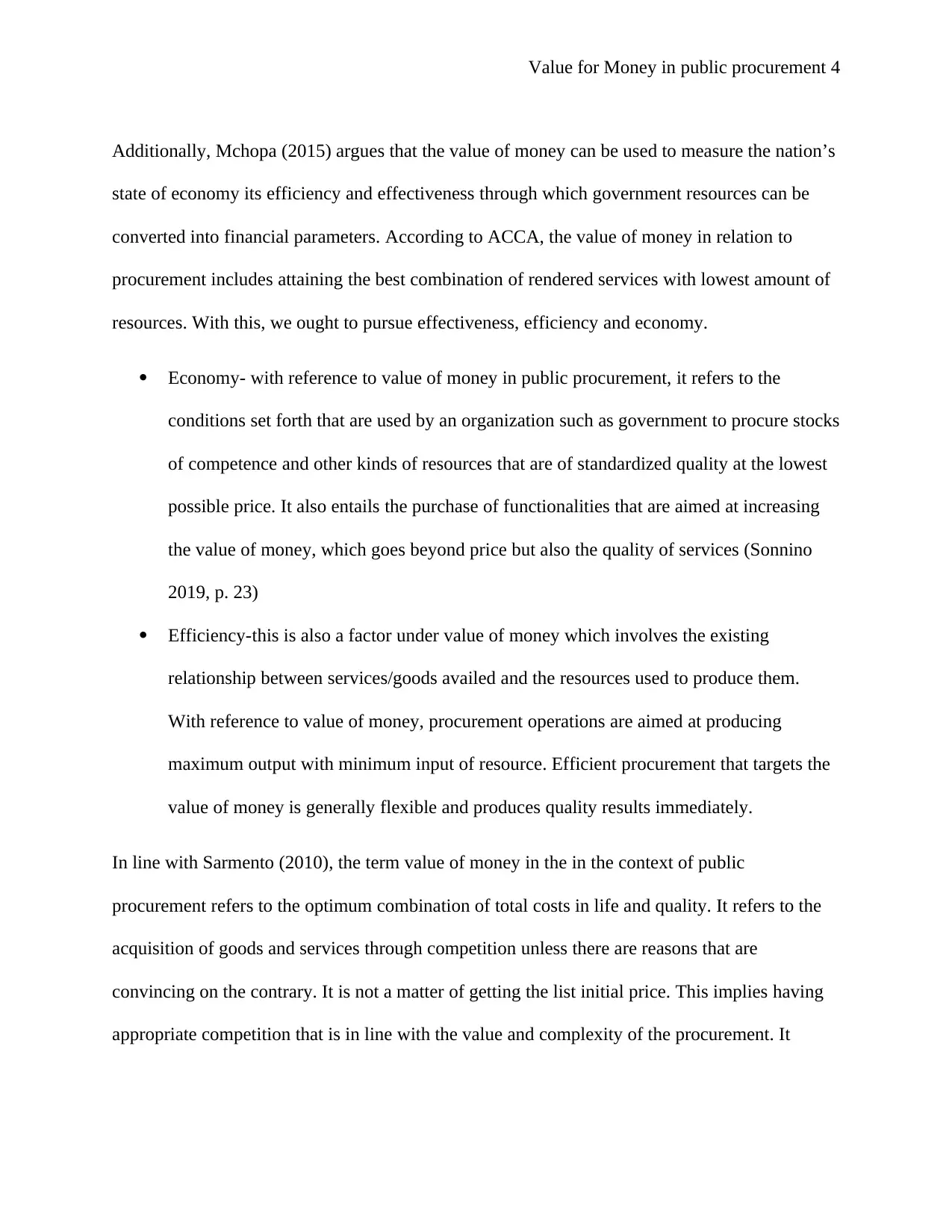
Additionally, Mchopa (2015) argues that the value of money can be used to measure the nation’s
state of economy its efficiency and effectiveness through which government resources can be
converted into financial parameters. According to ACCA, the value of money in relation to
procurement includes attaining the best combination of rendered services with lowest amount of
resources. With this, we ought to pursue effectiveness, efficiency and economy.
Economy- with reference to value of money in public procurement, it refers to the
conditions set forth that are used by an organization such as government to procure stocks
of competence and other kinds of resources that are of standardized quality at the lowest
possible price. It also entails the purchase of functionalities that are aimed at increasing
the value of money, which goes beyond price but also the quality of services (Sonnino
2019, p. 23)
Efficiency-this is also a factor under value of money which involves the existing
relationship between services/goods availed and the resources used to produce them.
With reference to value of money, procurement operations are aimed at producing
maximum output with minimum input of resource. Efficient procurement that targets the
value of money is generally flexible and produces quality results immediately.
In line with Sarmento (2010), the term value of money in the in the context of public
procurement refers to the optimum combination of total costs in life and quality. It refers to the
acquisition of goods and services through competition unless there are reasons that are
convincing on the contrary. It is not a matter of getting the list initial price. This implies having
appropriate competition that is in line with the value and complexity of the procurement. It
Additionally, Mchopa (2015) argues that the value of money can be used to measure the nation’s
state of economy its efficiency and effectiveness through which government resources can be
converted into financial parameters. According to ACCA, the value of money in relation to
procurement includes attaining the best combination of rendered services with lowest amount of
resources. With this, we ought to pursue effectiveness, efficiency and economy.
Economy- with reference to value of money in public procurement, it refers to the
conditions set forth that are used by an organization such as government to procure stocks
of competence and other kinds of resources that are of standardized quality at the lowest
possible price. It also entails the purchase of functionalities that are aimed at increasing
the value of money, which goes beyond price but also the quality of services (Sonnino
2019, p. 23)
Efficiency-this is also a factor under value of money which involves the existing
relationship between services/goods availed and the resources used to produce them.
With reference to value of money, procurement operations are aimed at producing
maximum output with minimum input of resource. Efficient procurement that targets the
value of money is generally flexible and produces quality results immediately.
In line with Sarmento (2010), the term value of money in the in the context of public
procurement refers to the optimum combination of total costs in life and quality. It refers to the
acquisition of goods and services through competition unless there are reasons that are
convincing on the contrary. It is not a matter of getting the list initial price. This implies having
appropriate competition that is in line with the value and complexity of the procurement. It
Paraphrase This Document
Need a fresh take? Get an instant paraphrase of this document with our AI Paraphraser
Value for Money in public procurement 5
further entails omitting all the barriers may prevent suppliers from participating (McKevitt &
Davis2016, p. 263)
With the existing scarce resources that ought to be used by the government, the key to success in
public procurement is through optimizing the usage of scarce resources that are budgeted on by
the government. Value for money is the basic driver in procurement. This involves choosing
items that have the lowest prices Guccio, Pignataro & Rizzo 2012, p.1981) ‘. When the
government goes for products or services that do not accrue the list possible prices, the additional
value must be justified and clearly stated. This involves assessing the bids placed by suppliers by
conducting them according to the set regulations and criterion for evaluation.
Consequently, the value of money in the public sector procurement is also based on the
considerations made with the aim of enhancing the policies of the government. In order to
achieve the best output and performance of the money injected in procurement (Bauld &
McGuiness, 2006, p.20) with reference to this concept, government can issue out procurement to
suppliers considering not only the lowest bidder but also the combination cost of the life cycle of
procurement. According to Barnett et al (2010), transparency and accountability should be
pursued in in public offices when dealing with public procurement in relation value of money
with the absence of accountability and transparency, there the expenditure of the government in
relation procurement will be unjustifiable (Zhang 2005, p. 85).
Failure factors in value of money performance assessment and attainment of Oman in
public
Oman being one of the most developed nations in the world harbors the large procurement
opportunities in the public sector. Despite all this opportunities, the nation suffers from a number
further entails omitting all the barriers may prevent suppliers from participating (McKevitt &
Davis2016, p. 263)
With the existing scarce resources that ought to be used by the government, the key to success in
public procurement is through optimizing the usage of scarce resources that are budgeted on by
the government. Value for money is the basic driver in procurement. This involves choosing
items that have the lowest prices Guccio, Pignataro & Rizzo 2012, p.1981) ‘. When the
government goes for products or services that do not accrue the list possible prices, the additional
value must be justified and clearly stated. This involves assessing the bids placed by suppliers by
conducting them according to the set regulations and criterion for evaluation.
Consequently, the value of money in the public sector procurement is also based on the
considerations made with the aim of enhancing the policies of the government. In order to
achieve the best output and performance of the money injected in procurement (Bauld &
McGuiness, 2006, p.20) with reference to this concept, government can issue out procurement to
suppliers considering not only the lowest bidder but also the combination cost of the life cycle of
procurement. According to Barnett et al (2010), transparency and accountability should be
pursued in in public offices when dealing with public procurement in relation value of money
with the absence of accountability and transparency, there the expenditure of the government in
relation procurement will be unjustifiable (Zhang 2005, p. 85).
Failure factors in value of money performance assessment and attainment of Oman in
public
Oman being one of the most developed nations in the world harbors the large procurement
opportunities in the public sector. Despite all this opportunities, the nation suffers from a number
Value for Money in public procurement 6
of failure factors in the value for money performance assessment and attainment of public sector
infrastructure as discussed below.
Lack of completion in the procurement process in Oman
According to Kiiver & Kodym (2015), absence of competition is one of the areas that have resulted
into failure of performance in value of money performance in Oman’s public infrastructure
procurement. Despite the fact that competition is among the basic factors that should be
considered in order to attain the value of money in the public procurement, the government of
Oman has not always considered this a facture that can lead to whole life cost reduction in the
procurement process. Without competition in public procurement in infrastructure in the
government of Oman, it has made it more stannous and difficult to attain efficiency of high
levels and the value for money. This area needs to be addressed by the government of Oman.
Efficiency, accountability and fairness in procurement of public tenders.
De Gucht & Bamier (2012) assert that judicious expenditure and management of value for
money in procurement highly depends on the three cardinal pillars namely fairness,
accountability and efficiency that always aid in reforming procurement systems. Lack of
efficiency in Oman’s procurement procedures has resulted into failure in procuring public
infrastructure leading to underdevelopment in this areas or provision of low quality product. In
the absence of accountability, the Oman procurement does not enjoy the benefits of
accountability thus resulting to it has weakened the perception of transparency and fairness in the
procurement processes thus leading to malfunctioning. Consequently, the absence of
accountability has resulted in increased rates of corruption due to absence of mutual trust leading
to embezzlement of money directed towards procurement process (Dagbanja, 2014, p.375).
of failure factors in the value for money performance assessment and attainment of public sector
infrastructure as discussed below.
Lack of completion in the procurement process in Oman
According to Kiiver & Kodym (2015), absence of competition is one of the areas that have resulted
into failure of performance in value of money performance in Oman’s public infrastructure
procurement. Despite the fact that competition is among the basic factors that should be
considered in order to attain the value of money in the public procurement, the government of
Oman has not always considered this a facture that can lead to whole life cost reduction in the
procurement process. Without competition in public procurement in infrastructure in the
government of Oman, it has made it more stannous and difficult to attain efficiency of high
levels and the value for money. This area needs to be addressed by the government of Oman.
Efficiency, accountability and fairness in procurement of public tenders.
De Gucht & Bamier (2012) assert that judicious expenditure and management of value for
money in procurement highly depends on the three cardinal pillars namely fairness,
accountability and efficiency that always aid in reforming procurement systems. Lack of
efficiency in Oman’s procurement procedures has resulted into failure in procuring public
infrastructure leading to underdevelopment in this areas or provision of low quality product. In
the absence of accountability, the Oman procurement does not enjoy the benefits of
accountability thus resulting to it has weakened the perception of transparency and fairness in the
procurement processes thus leading to malfunctioning. Consequently, the absence of
accountability has resulted in increased rates of corruption due to absence of mutual trust leading
to embezzlement of money directed towards procurement process (Dagbanja, 2014, p.375).
⊘ This is a preview!⊘
Do you want full access?
Subscribe today to unlock all pages.
Trusted by 1+ million students worldwide
Value for Money in public procurement 7
Unprofessionalism and nascence of transparency
The driving force of any public system is professionalism and transparency. Without these
factors in play, an organization is destined to fail or be chaotic. Many of the procurement officers
in the Oman procurement office fail to act professionally leading to issues such as corruption and
biasness. Additionally the failure in public infrastructure procurement on the value for money
has resulted due to failure of procurement officers to make informed decisions concerning
functions of procurement. Poor decision made due to unprofessionalism and lack of transparency
has resulted into lows rates of development in other areas of the country (Kumar, Nair & Piecha,
2015, p. 368)
Consequently, the unprofessionalism and lack of transparency in public procurement with the
value for money is due to the position that the procurement office has been situated. The
procurement position has not been given critical position that can help determine the economic
development of the nation (Zaato &Hudon 2015, p. 30).
Consequently, within the Oman public procurement system, the term value for money is only an
abstract and subjective term, which has not been put into concrete usage. With regard to lack of
understanding of what it entails, the procurement officers are not implementing it as they lack
full knowledge of what value for money really is.in this case, the Oman public procurement
officers need to be given a more clear definition of this term so that it may enhance its effective
implementation within the Oman government.
Instead of making it a basic requirement in due process of procuring services, the Oman public
procurement system has made value for money in public procurement a choice of goods and
services based on the lowest price. Instead, it should be based on the whole life costs of services
Unprofessionalism and nascence of transparency
The driving force of any public system is professionalism and transparency. Without these
factors in play, an organization is destined to fail or be chaotic. Many of the procurement officers
in the Oman procurement office fail to act professionally leading to issues such as corruption and
biasness. Additionally the failure in public infrastructure procurement on the value for money
has resulted due to failure of procurement officers to make informed decisions concerning
functions of procurement. Poor decision made due to unprofessionalism and lack of transparency
has resulted into lows rates of development in other areas of the country (Kumar, Nair & Piecha,
2015, p. 368)
Consequently, the unprofessionalism and lack of transparency in public procurement with the
value for money is due to the position that the procurement office has been situated. The
procurement position has not been given critical position that can help determine the economic
development of the nation (Zaato &Hudon 2015, p. 30).
Consequently, within the Oman public procurement system, the term value for money is only an
abstract and subjective term, which has not been put into concrete usage. With regard to lack of
understanding of what it entails, the procurement officers are not implementing it as they lack
full knowledge of what value for money really is.in this case, the Oman public procurement
officers need to be given a more clear definition of this term so that it may enhance its effective
implementation within the Oman government.
Instead of making it a basic requirement in due process of procuring services, the Oman public
procurement system has made value for money in public procurement a choice of goods and
services based on the lowest price. Instead, it should be based on the whole life costs of services
Paraphrase This Document
Need a fresh take? Get an instant paraphrase of this document with our AI Paraphraser
Value for Money in public procurement 8
and projects that have been procured with the scarce resources available for the government
usage.
Recommendations/Solution that can help mitigate the failure factors
To achieve a public procurement that is targets value for money in the Oman government, there
need for restructuring the procurement system in Oman government. Aimed at value
management, the following factors can be deployed to ensure value for money in public
procurement and mitigating the failure factors of Oman.
Ethical standard such as transparency and accountability.
For there to exist effective public procurement in Oman, all the stocks of competence need to be
held responsible for enforcing and abiding by the stipulated code of conduct. This will ensure
that all players in public procurement in Oman are subjected to sanctions when they neglect or
bend the stipulated procedures that are to be followed during procurement procedures. The
essence of accountability is to eradicate the issue of corruption and collusion that may appear in
the process of procuring or biding by the suppliers thus ensuring that quality and whole life cost
is prioritized. In this case, value for money in public procurement in infrastructure can be
attained through ensuring that there is procurement system that is sound thus ensures it only
gives opportunity to vendors who are qualified in supplying the procured goods and services.
When accountability becomes the key driving force in the procurement procedures, whole life
cost of the procurement can be realized since efficiency, economy and effectiveness of the
procurement process will be aimed at ensuring value for money is the major point of concern.
Competition
and projects that have been procured with the scarce resources available for the government
usage.
Recommendations/Solution that can help mitigate the failure factors
To achieve a public procurement that is targets value for money in the Oman government, there
need for restructuring the procurement system in Oman government. Aimed at value
management, the following factors can be deployed to ensure value for money in public
procurement and mitigating the failure factors of Oman.
Ethical standard such as transparency and accountability.
For there to exist effective public procurement in Oman, all the stocks of competence need to be
held responsible for enforcing and abiding by the stipulated code of conduct. This will ensure
that all players in public procurement in Oman are subjected to sanctions when they neglect or
bend the stipulated procedures that are to be followed during procurement procedures. The
essence of accountability is to eradicate the issue of corruption and collusion that may appear in
the process of procuring or biding by the suppliers thus ensuring that quality and whole life cost
is prioritized. In this case, value for money in public procurement in infrastructure can be
attained through ensuring that there is procurement system that is sound thus ensures it only
gives opportunity to vendors who are qualified in supplying the procured goods and services.
When accountability becomes the key driving force in the procurement procedures, whole life
cost of the procurement can be realized since efficiency, economy and effectiveness of the
procurement process will be aimed at ensuring value for money is the major point of concern.
Competition
Value for Money in public procurement 9
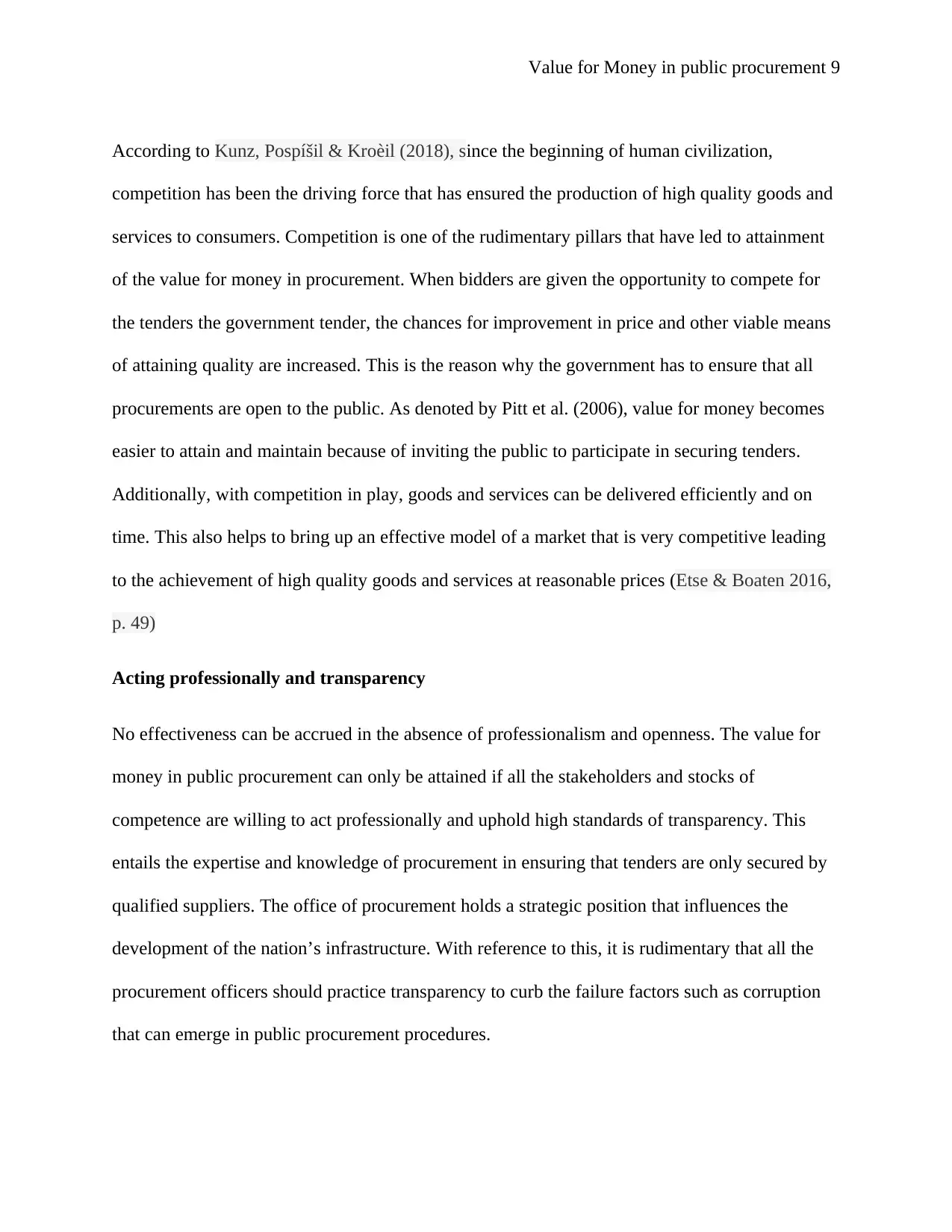
According to Kunz, Pospíšil & Kroèil (2018), since the beginning of human civilization,
competition has been the driving force that has ensured the production of high quality goods and
services to consumers. Competition is one of the rudimentary pillars that have led to attainment
of the value for money in procurement. When bidders are given the opportunity to compete for
the tenders the government tender, the chances for improvement in price and other viable means
of attaining quality are increased. This is the reason why the government has to ensure that all
procurements are open to the public. As denoted by Pitt et al. (2006), value for money becomes
easier to attain and maintain because of inviting the public to participate in securing tenders.
Additionally, with competition in play, goods and services can be delivered efficiently and on
time. This also helps to bring up an effective model of a market that is very competitive leading
to the achievement of high quality goods and services at reasonable prices (Etse & Boaten 2016,
p. 49)
Acting professionally and transparency
No effectiveness can be accrued in the absence of professionalism and openness. The value for
money in public procurement can only be attained if all the stakeholders and stocks of
competence are willing to act professionally and uphold high standards of transparency. This
entails the expertise and knowledge of procurement in ensuring that tenders are only secured by
qualified suppliers. The office of procurement holds a strategic position that influences the
development of the nation’s infrastructure. With reference to this, it is rudimentary that all the
procurement officers should practice transparency to curb the failure factors such as corruption
that can emerge in public procurement procedures.
According to Kunz, Pospíšil & Kroèil (2018), since the beginning of human civilization,
competition has been the driving force that has ensured the production of high quality goods and
services to consumers. Competition is one of the rudimentary pillars that have led to attainment
of the value for money in procurement. When bidders are given the opportunity to compete for
the tenders the government tender, the chances for improvement in price and other viable means
of attaining quality are increased. This is the reason why the government has to ensure that all
procurements are open to the public. As denoted by Pitt et al. (2006), value for money becomes
easier to attain and maintain because of inviting the public to participate in securing tenders.
Additionally, with competition in play, goods and services can be delivered efficiently and on
time. This also helps to bring up an effective model of a market that is very competitive leading
to the achievement of high quality goods and services at reasonable prices (Etse & Boaten 2016,
p. 49)
Acting professionally and transparency
No effectiveness can be accrued in the absence of professionalism and openness. The value for
money in public procurement can only be attained if all the stakeholders and stocks of
competence are willing to act professionally and uphold high standards of transparency. This
entails the expertise and knowledge of procurement in ensuring that tenders are only secured by
qualified suppliers. The office of procurement holds a strategic position that influences the
development of the nation’s infrastructure. With reference to this, it is rudimentary that all the
procurement officers should practice transparency to curb the failure factors such as corruption
that can emerge in public procurement procedures.
⊘ This is a preview!⊘
Do you want full access?
Subscribe today to unlock all pages.
Trusted by 1+ million students worldwide

Value for Money in public procurement 10
Opportunities for value management in the strategic and briefing of public sector in design
and build project.
Value management is the key that can help provide structured framework integrated with other
tools such as proper decision-making and techniques in all projects can help provide the Best
value in design and building. In the design and building procurement, opportunities that can be
accrued involve the management style applied. Value management pays close attention on the
expected outcome that is expected of the project. The opportunities present here are related in
designing and formulating the expected profit or benefits that the business will attain. These are
found in value drivers. Mapulanga, (2015), denotes that when public procurement involves
design and building, construction projects will highly depend on the value of a specific project.
Because construction projects are often one offs there is need to put together the production of
design that will help deliver a project that is single. Since they also consist smaller projects, the
bidder taking the procurement ought to ensure that he is well prepared. The smaller projects
require the input of different disciplines who work in collaboration. This is an opportunity for
value management since the procurement has to ensure that all the standards in the semi-projects
involved the larger design and building project.
Opportunities for value management in the strategic and briefing of public sector in design
and build project.
Value management is the key that can help provide structured framework integrated with other
tools such as proper decision-making and techniques in all projects can help provide the Best
value in design and building. In the design and building procurement, opportunities that can be
accrued involve the management style applied. Value management pays close attention on the
expected outcome that is expected of the project. The opportunities present here are related in
designing and formulating the expected profit or benefits that the business will attain. These are
found in value drivers. Mapulanga, (2015), denotes that when public procurement involves
design and building, construction projects will highly depend on the value of a specific project.
Because construction projects are often one offs there is need to put together the production of
design that will help deliver a project that is single. Since they also consist smaller projects, the
bidder taking the procurement ought to ensure that he is well prepared. The smaller projects
require the input of different disciplines who work in collaboration. This is an opportunity for
value management since the procurement has to ensure that all the standards in the semi-projects
involved the larger design and building project.
Paraphrase This Document
Need a fresh take? Get an instant paraphrase of this document with our AI Paraphraser
Value for Money in public procurement 11
Conclusion
Instead of basing the value for money on the lowest price available, it should be aimed at the
whole life costs of the procured projects by the government. With the scarce resources available
to the government, the Oman government needs to ensure that the value for money in procuring
projects and services is the key to befit the budget placed by the government. this can only be
achieved by the government through ensuring that there is support from the management team
for the value for money programs at every stage of the procurement system . Consequently,
rigorous monitoring of the procurement activities can play part in ensuring that the value for
money is adhered to.
Conclusion
Instead of basing the value for money on the lowest price available, it should be aimed at the
whole life costs of the procured projects by the government. With the scarce resources available
to the government, the Oman government needs to ensure that the value for money in procuring
projects and services is the key to befit the budget placed by the government. this can only be
achieved by the government through ensuring that there is support from the management team
for the value for money programs at every stage of the procurement system . Consequently,
rigorous monitoring of the procurement activities can play part in ensuring that the value for
money is adhered to.
Value for Money in public procurement 12
List of References
Barrett, A. and Rees, D. (2016) ‘Public Sector Procurement - the Challenges Facing a Small
Country’, Public Finance Quarterly (0031-496X), 61(2), pp. 170–177.
Bauld, S., & McGuinness, K. (2006). Value for money. Summit, 9, 20
Botlhale, E. (2017) ‘Infusing Value For Money (Vfm) Into The Public Procurement System In
Botswana’, Journal of Public Procurement, 17(3), pp. 281–314.
Burger, P. and Hawkes worth, I. (2011) ‘How to Attain Value for Money: Comparing PPP and
Traditional Infrastructure Public Procurement’, OECD Journal on Budgeting, 2011(1), pp. 91–
146.
Dagbanja, D. N. (2014) ‘Promoting a Competitive Local Business Community in Ghana: The
Role of the Legal Framework for Public Procurement’, Journal of African Law, 58(2), pp. 350–
375.
De Gucht, K. and Bamier, M. (2012) ‘EU public procurement: Opening markets by example, and
if that doesn’t work …’, OECD Observer, (290/291), p. 75.
Etse, D. and Boateng, M. S. (2016) ‘Effects of Ghana’s Public Procurement Act on the
Acquisition of Academic Library Resources in Ghana’, Journal of Supply Chain Management
Systems, 5(2), pp. 46–55.
Guccio, C., Pignataro, G. and Rizzo, I. (2012) ‘Determinants of adaptation costs in procurement:
an empirical estimation on Italian public works contracts’, Applied Economics, 44(15), pp. 1891–
1909.
List of References
Barrett, A. and Rees, D. (2016) ‘Public Sector Procurement - the Challenges Facing a Small
Country’, Public Finance Quarterly (0031-496X), 61(2), pp. 170–177.
Bauld, S., & McGuinness, K. (2006). Value for money. Summit, 9, 20
Botlhale, E. (2017) ‘Infusing Value For Money (Vfm) Into The Public Procurement System In
Botswana’, Journal of Public Procurement, 17(3), pp. 281–314.
Burger, P. and Hawkes worth, I. (2011) ‘How to Attain Value for Money: Comparing PPP and
Traditional Infrastructure Public Procurement’, OECD Journal on Budgeting, 2011(1), pp. 91–
146.
Dagbanja, D. N. (2014) ‘Promoting a Competitive Local Business Community in Ghana: The
Role of the Legal Framework for Public Procurement’, Journal of African Law, 58(2), pp. 350–
375.
De Gucht, K. and Bamier, M. (2012) ‘EU public procurement: Opening markets by example, and
if that doesn’t work …’, OECD Observer, (290/291), p. 75.
Etse, D. and Boateng, M. S. (2016) ‘Effects of Ghana’s Public Procurement Act on the
Acquisition of Academic Library Resources in Ghana’, Journal of Supply Chain Management
Systems, 5(2), pp. 46–55.
Guccio, C., Pignataro, G. and Rizzo, I. (2012) ‘Determinants of adaptation costs in procurement:
an empirical estimation on Italian public works contracts’, Applied Economics, 44(15), pp. 1891–
1909.
⊘ This is a preview!⊘
Do you want full access?
Subscribe today to unlock all pages.
Trusted by 1+ million students worldwide

1 out of 14


Related Documents


Your All-in-One AI-Powered Toolkit for Academic Success.
+13062052269
info@desklib.com
Available 24*7 on WhatsApp / Email
![[object Object]](/_next/static/media/star-bottom.7253800d.svg)
Unlock your academic potential
Copyright © 2020–2026 A2Z Services. All Rights Reserved. Developed and managed by ZUCOL.