Sociological Report: Vatican City and Religious Significance

Verified

Added on  2022/08/12

|4
|398
|38
Report
AI Summary
This report provides a sociological analysis of Vatican City, examining its architectural and religious significance. It explores the historical context, including the influence of Baroque, Roman, and Gothic elements, and the development of St. Peter's Basilica. The report highlights the Vatican's role as a center for the Catholic Christian faith, discussing its importance for religious ceremonies and its function as the smallest state in the world. The study also touches upon the cultural heritage preserved within the city and its impact on religious tourism, referencing key architectural components like the Border of Leonine City and the Carriage Museum. References to academic sources, such as Kim & Kim (2019) and Paniccia, Leoni & Baiocco (2017), support the analysis of the Vatican City's place in religious and cultural landscapes.
Document Page
Running head: SOCIOLOGY
Sociology
Name of the Student
Name of the University
Author Note
tabler-icon-diamond-filled.svg

Paraphrase This Document

Need a fresh take? Get an instant paraphrase of this document with our AI Paraphraser
Document Page
1SOCIOLOGY
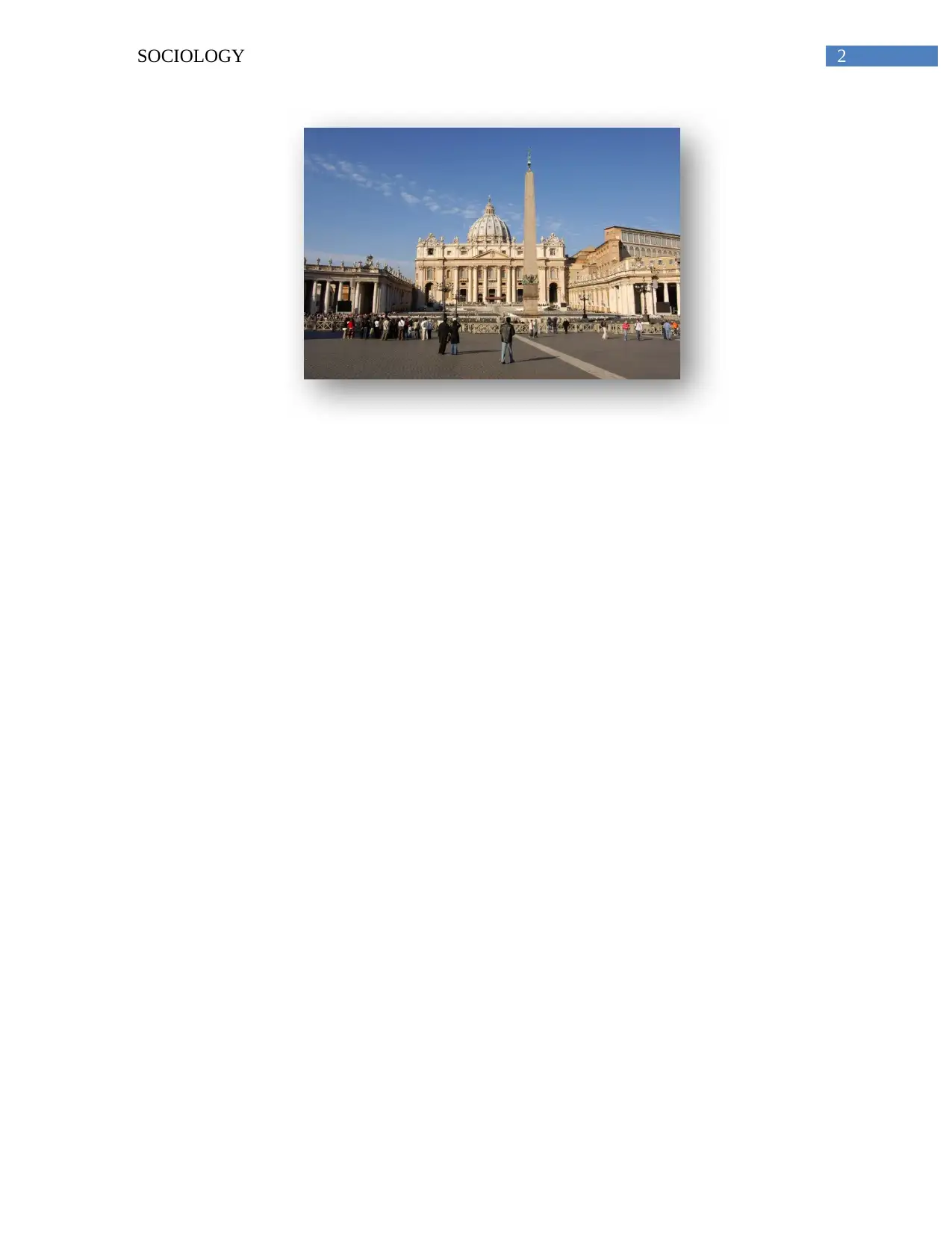
Vatican City is the most sacred religious space for the Catholic Christian worship by all
means. This is considered to be the one of the most brilliant architectural monuments in the
history (Kim & Kim, 2019). This building preserves the cultural heritage of the Christian faith
and Western Rome also. Various architectural backgrounds like Baroque, Roman and Gothic
elements have been included in the architectures of this building. Most developments in the
building process of this structure between the 16th and 18th centuries.
The southeastern part of this church was built in the ancient times and it was named as St.
Peter’s Basilica (Paniccia, Leoni & Baiocco, 2017). Afterwards, in the modern times several
developments have taken place for the building including reception house for the Pope, post
offices and banks. All of these architectural developments are indeed crucial factors for the
development of the Christian faith. Almost all religious ceremonies take place including the
beatification process of the saints (Kim & Kim, 2019). This place is regarded as the smallest
state in the world and it is controlled by the Government of Italy.
The Vatican City in Rome has its own postage stamps and newspapers. Apart from that,
they also mint their own coins. They have a radio station of their own that broadcasts all the
news and live ceremonies Catholic Christian faith all over the world. Some important
components of this building are Border of Leonine City, the Carriage Museum, Museo Plo
Clementino, the Pinacoteca, Stairways of Bramante and others (Paniccia, Leoni & Baiocco,
2017). This is truly the best destination for the people belonging to Christian religious faith.
Document Page
2SOCIOLOGY
Document Page
3SOCIOLOGY
References
Kim, B., & Kim, S. (2019). Hierarchical value map of religious tourists visiting the Vatican
City/Rome. Tourism Geographies, 21(3), 529-550.
Paniccia, P., Leoni, L., & Baiocco, S. (2017). Interpreting sustainability through co-evolution:
Evidence from religious accommodations in Rome. Sustainability, 9(12), 2301.
chevron_up_icon
1 out of 4
circle_padding
hide_on_mobile
zoom_out_icon
[object Object]