Detailed Report on Vegetative Anatomy and Physiology: Biology Course
VerifiedAdded on 2020/11/23
|12
|3796
|252
Report
AI Summary
This report delves into the vegetative anatomy and physiology of plants, covering a range of topics from the structure and function of plant organs like stems, leaves, and roots, to key metabolic processes such as photosynthesis and respiration. The report explores energy transfer mechanisms in plants, highlighting the role of sunlight and the conversion of light energy into chemical energy. It also examines plant adaptive strategies in response to environmental changes, including drought, heat, and salinity, and discusses flower production, seed dispersal methods, and the influence of plant hormones. Furthermore, the report touches upon genetic procedures in plants, and how different species inherit traits, providing a comprehensive overview of plant biology.

VEGETATIVE ANATOMY AND
PHYSIOLOGY
PHYSIOLOGY

Paraphrase This Document
Need a fresh take? Get an instant paraphrase of this document with our AI Paraphraser
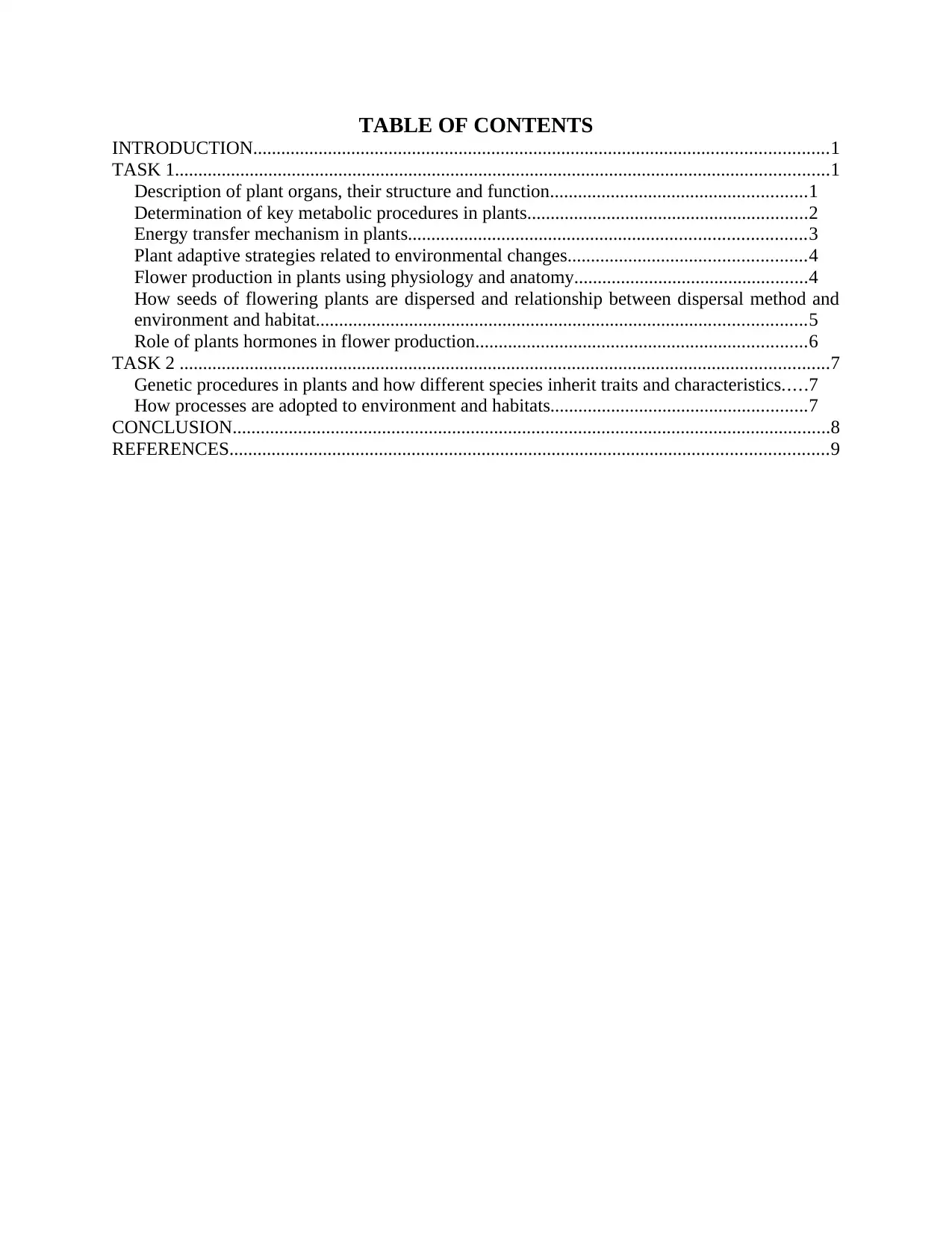
TABLE OF CONTENTS
INTRODUCTION...........................................................................................................................1
TASK 1............................................................................................................................................1
Description of plant organs, their structure and function.......................................................1
Determination of key metabolic procedures in plants............................................................2
Energy transfer mechanism in plants.....................................................................................3
Plant adaptive strategies related to environmental changes...................................................4
Flower production in plants using physiology and anatomy..................................................4
How seeds of flowering plants are dispersed and relationship between dispersal method and
environment and habitat.........................................................................................................5
Role of plants hormones in flower production.......................................................................6
TASK 2 ...........................................................................................................................................7
Genetic procedures in plants and how different species inherit traits and characteristics.....7
How processes are adopted to environment and habitats.......................................................7
CONCLUSION................................................................................................................................8
REFERENCES................................................................................................................................9
INTRODUCTION...........................................................................................................................1
TASK 1............................................................................................................................................1
Description of plant organs, their structure and function.......................................................1
Determination of key metabolic procedures in plants............................................................2
Energy transfer mechanism in plants.....................................................................................3
Plant adaptive strategies related to environmental changes...................................................4
Flower production in plants using physiology and anatomy..................................................4
How seeds of flowering plants are dispersed and relationship between dispersal method and
environment and habitat.........................................................................................................5
Role of plants hormones in flower production.......................................................................6
TASK 2 ...........................................................................................................................................7
Genetic procedures in plants and how different species inherit traits and characteristics.....7
How processes are adopted to environment and habitats.......................................................7
CONCLUSION................................................................................................................................8
REFERENCES................................................................................................................................9
INTRODUCTION
Vegetative anatomy and physiology is related to plant and organism. The report will
cover description of plant organs, their structure and function, determination of key metabolic
procedures in plants, energy transfer mechanism in plants and adaptive strategies related to
environmental changes. In addition to this, flower production in plants using physiology and
anatomy and how seeds of flowering plants are dispersed and relationship between dispersal
method and environment and habitat will be discussed. Finally, the report will demonstrate
Genetic procedures in plants and how different species inherit traits and characteristics and how
processes are adopted to environment and habitats.
TASK 1
Description of plant organs, their structure and function
A tissue which can be simple or complex depending upon whether it is composed of one
or more than one type of cells. It can be said that tissues are further combined and arranged into
organs that carry out functions of life of an organism effectively. Plant organs involve stem, leaf,
root and reproductive structures (Keller, 2015).
Structure and function
Stems, leaves and roots are the main structure or organs found in plants. These are made
up from specialised tissues that have structure suited to the job they perform.
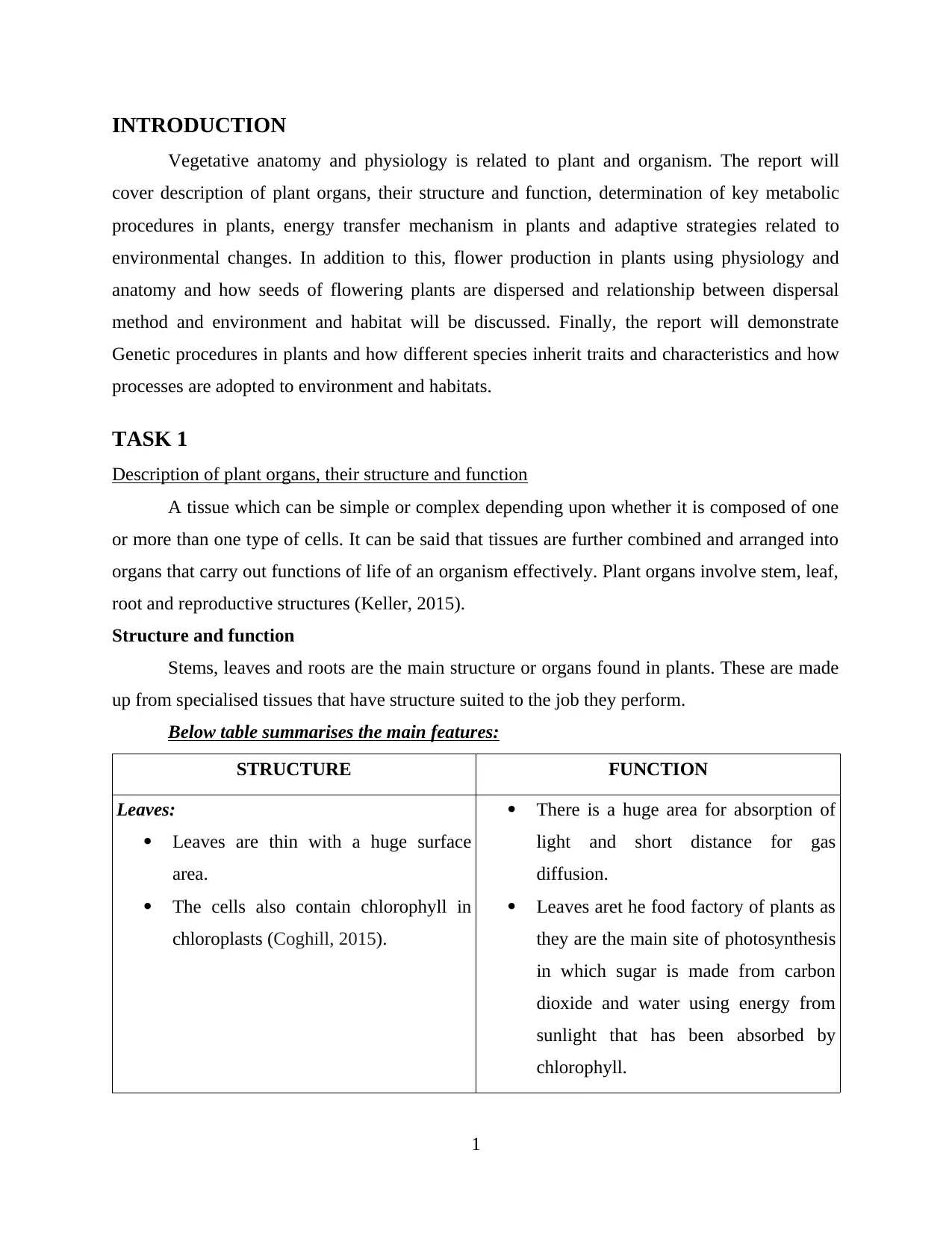
Below table summarises the main features:
STRUCTURE FUNCTION
Leaves:
Leaves are thin with a huge surface
area.
The cells also contain chlorophyll in
chloroplasts (Coghill, 2015).
There is a huge area for absorption of
light and short distance for gas
diffusion.
Leaves aret he food factory of plants as
they are the main site of photosynthesis
in which sugar is made from carbon
dioxide and water using energy from
sunlight that has been absorbed by
chlorophyll.
1
Vegetative anatomy and physiology is related to plant and organism. The report will
cover description of plant organs, their structure and function, determination of key metabolic
procedures in plants, energy transfer mechanism in plants and adaptive strategies related to
environmental changes. In addition to this, flower production in plants using physiology and
anatomy and how seeds of flowering plants are dispersed and relationship between dispersal
method and environment and habitat will be discussed. Finally, the report will demonstrate
Genetic procedures in plants and how different species inherit traits and characteristics and how
processes are adopted to environment and habitats.
TASK 1
Description of plant organs, their structure and function
A tissue which can be simple or complex depending upon whether it is composed of one
or more than one type of cells. It can be said that tissues are further combined and arranged into
organs that carry out functions of life of an organism effectively. Plant organs involve stem, leaf,
root and reproductive structures (Keller, 2015).
Structure and function
Stems, leaves and roots are the main structure or organs found in plants. These are made
up from specialised tissues that have structure suited to the job they perform.
Below table summarises the main features:
STRUCTURE FUNCTION
Leaves:
Leaves are thin with a huge surface
area.
The cells also contain chlorophyll in
chloroplasts (Coghill, 2015).
There is a huge area for absorption of
light and short distance for gas
diffusion.
Leaves aret he food factory of plants as
they are the main site of photosynthesis
in which sugar is made from carbon
dioxide and water using energy from
sunlight that has been absorbed by
chlorophyll.
1
⊘ This is a preview!⊘
Do you want full access?
Subscribe today to unlock all pages.

Trusted by 1+ million students worldwide
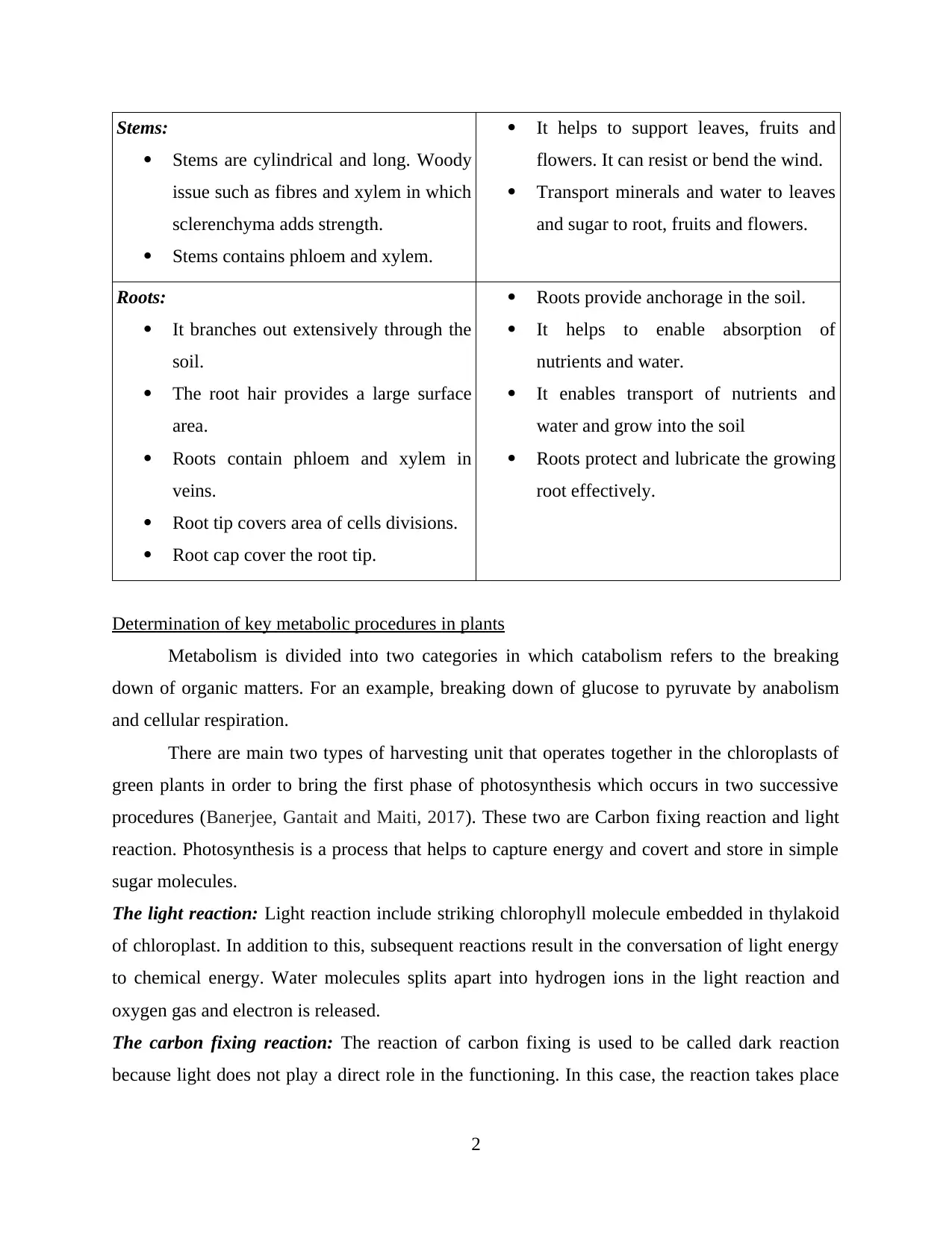
Stems:
Stems are cylindrical and long. Woody
issue such as fibres and xylem in which
sclerenchyma adds strength.
Stems contains phloem and xylem.
It helps to support leaves, fruits and
flowers. It can resist or bend the wind.
Transport minerals and water to leaves
and sugar to root, fruits and flowers.
Roots:
It branches out extensively through the
soil.
The root hair provides a large surface
area.
Roots contain phloem and xylem in
veins.
Root tip covers area of cells divisions.
Root cap cover the root tip.
Roots provide anchorage in the soil.
It helps to enable absorption of
nutrients and water.
It enables transport of nutrients and
water and grow into the soil
Roots protect and lubricate the growing
root effectively.
Determination of key metabolic procedures in plants
Metabolism is divided into two categories in which catabolism refers to the breaking
down of organic matters. For an example, breaking down of glucose to pyruvate by anabolism
and cellular respiration.
There are main two types of harvesting unit that operates together in the chloroplasts of
green plants in order to bring the first phase of photosynthesis which occurs in two successive
procedures (Banerjee, Gantait and Maiti, 2017). These two are Carbon fixing reaction and light
reaction. Photosynthesis is a process that helps to capture energy and covert and store in simple
sugar molecules.
The light reaction: Light reaction include striking chlorophyll molecule embedded in thylakoid
of chloroplast. In addition to this, subsequent reactions result in the conversation of light energy
to chemical energy. Water molecules splits apart into hydrogen ions in the light reaction and
oxygen gas and electron is released.
The carbon fixing reaction: The reaction of carbon fixing is used to be called dark reaction
because light does not play a direct role in the functioning. In this case, the reaction takes place
2
Stems are cylindrical and long. Woody
issue such as fibres and xylem in which
sclerenchyma adds strength.
Stems contains phloem and xylem.
It helps to support leaves, fruits and
flowers. It can resist or bend the wind.
Transport minerals and water to leaves
and sugar to root, fruits and flowers.
Roots:
It branches out extensively through the
soil.
The root hair provides a large surface
area.
Roots contain phloem and xylem in
veins.
Root tip covers area of cells divisions.
Root cap cover the root tip.
Roots provide anchorage in the soil.
It helps to enable absorption of
nutrients and water.
It enables transport of nutrients and
water and grow into the soil
Roots protect and lubricate the growing
root effectively.
Determination of key metabolic procedures in plants
Metabolism is divided into two categories in which catabolism refers to the breaking
down of organic matters. For an example, breaking down of glucose to pyruvate by anabolism
and cellular respiration.
There are main two types of harvesting unit that operates together in the chloroplasts of
green plants in order to bring the first phase of photosynthesis which occurs in two successive
procedures (Banerjee, Gantait and Maiti, 2017). These two are Carbon fixing reaction and light
reaction. Photosynthesis is a process that helps to capture energy and covert and store in simple
sugar molecules.
The light reaction: Light reaction include striking chlorophyll molecule embedded in thylakoid
of chloroplast. In addition to this, subsequent reactions result in the conversation of light energy
to chemical energy. Water molecules splits apart into hydrogen ions in the light reaction and
oxygen gas and electron is released.
The carbon fixing reaction: The reaction of carbon fixing is used to be called dark reaction
because light does not play a direct role in the functioning. In this case, the reaction takes place
2
Paraphrase This Document
Need a fresh take? Get an instant paraphrase of this document with our AI Paraphraser
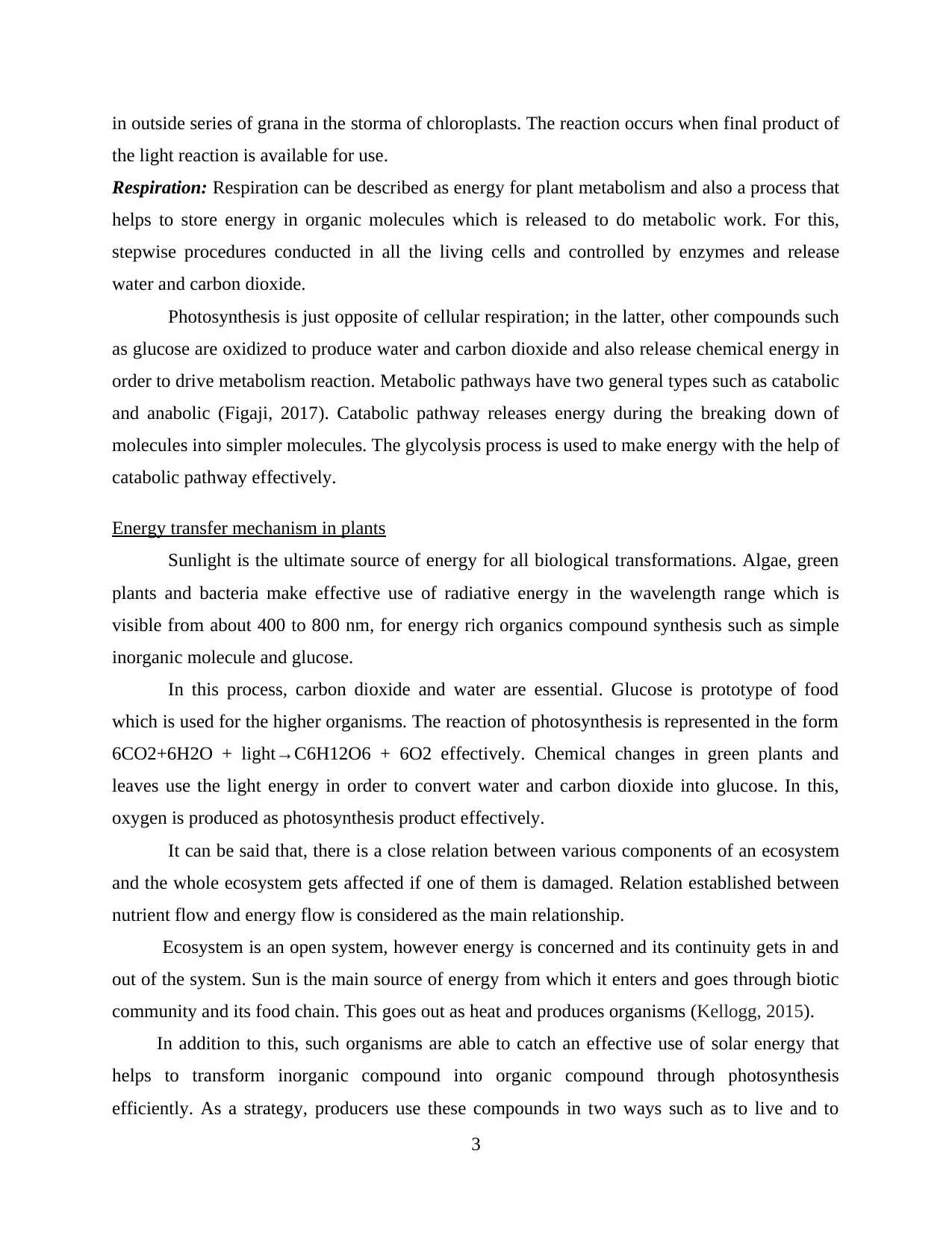
in outside series of grana in the storma of chloroplasts. The reaction occurs when final product of
the light reaction is available for use.
Respiration: Respiration can be described as energy for plant metabolism and also a process that
helps to store energy in organic molecules which is released to do metabolic work. For this,
stepwise procedures conducted in all the living cells and controlled by enzymes and release
water and carbon dioxide.
Photosynthesis is just opposite of cellular respiration; in the latter, other compounds such
as glucose are oxidized to produce water and carbon dioxide and also release chemical energy in
order to drive metabolism reaction. Metabolic pathways have two general types such as catabolic
and anabolic (Figaji, 2017). Catabolic pathway releases energy during the breaking down of
molecules into simpler molecules. The glycolysis process is used to make energy with the help of
catabolic pathway effectively.
Energy transfer mechanism in plants
Sunlight is the ultimate source of energy for all biological transformations. Algae, green
plants and bacteria make effective use of radiative energy in the wavelength range which is
visible from about 400 to 800 nm, for energy rich organics compound synthesis such as simple
inorganic molecule and glucose.
In this process, carbon dioxide and water are essential. Glucose is prototype of food
which is used for the higher organisms. The reaction of photosynthesis is represented in the form
6CO2+6H2O + light→C6H12O6 + 6O2 effectively. Chemical changes in green plants and
leaves use the light energy in order to convert water and carbon dioxide into glucose. In this,
oxygen is produced as photosynthesis product effectively.
It can be said that, there is a close relation between various components of an ecosystem
and the whole ecosystem gets affected if one of them is damaged. Relation established between
nutrient flow and energy flow is considered as the main relationship.
Ecosystem is an open system, however energy is concerned and its continuity gets in and
out of the system. Sun is the main source of energy from which it enters and goes through biotic
community and its food chain. This goes out as heat and produces organisms (Kellogg, 2015).
In addition to this, such organisms are able to catch an effective use of solar energy that
helps to transform inorganic compound into organic compound through photosynthesis
efficiently. As a strategy, producers use these compounds in two ways such as to live and to
3
the light reaction is available for use.
Respiration: Respiration can be described as energy for plant metabolism and also a process that
helps to store energy in organic molecules which is released to do metabolic work. For this,
stepwise procedures conducted in all the living cells and controlled by enzymes and release
water and carbon dioxide.
Photosynthesis is just opposite of cellular respiration; in the latter, other compounds such
as glucose are oxidized to produce water and carbon dioxide and also release chemical energy in
order to drive metabolism reaction. Metabolic pathways have two general types such as catabolic
and anabolic (Figaji, 2017). Catabolic pathway releases energy during the breaking down of
molecules into simpler molecules. The glycolysis process is used to make energy with the help of
catabolic pathway effectively.
Energy transfer mechanism in plants
Sunlight is the ultimate source of energy for all biological transformations. Algae, green
plants and bacteria make effective use of radiative energy in the wavelength range which is
visible from about 400 to 800 nm, for energy rich organics compound synthesis such as simple
inorganic molecule and glucose.
In this process, carbon dioxide and water are essential. Glucose is prototype of food
which is used for the higher organisms. The reaction of photosynthesis is represented in the form
6CO2+6H2O + light→C6H12O6 + 6O2 effectively. Chemical changes in green plants and
leaves use the light energy in order to convert water and carbon dioxide into glucose. In this,
oxygen is produced as photosynthesis product effectively.
It can be said that, there is a close relation between various components of an ecosystem
and the whole ecosystem gets affected if one of them is damaged. Relation established between
nutrient flow and energy flow is considered as the main relationship.
Ecosystem is an open system, however energy is concerned and its continuity gets in and
out of the system. Sun is the main source of energy from which it enters and goes through biotic
community and its food chain. This goes out as heat and produces organisms (Kellogg, 2015).
In addition to this, such organisms are able to catch an effective use of solar energy that
helps to transform inorganic compound into organic compound through photosynthesis
efficiently. As a strategy, producers use these compounds in two ways such as to live and to
3
grow. These organic compounds help to form new elements of plant such as branches and leaves.
The process goes in this way from one organism category to another. In addition, according to
the second principle of thermodynamics, the energy that is transferred with the help of food
chain evaluation, some heat will be lost in the environment.
Plant adaptive strategies related to environmental changes
Interactive relationship provided by bio procedures between plant organ is associated
with management of dynamic balance and self-regulation function. The process of adaptation is
accomplished indissoluble plant unity with the environment. Water helps to connect all the parts
of plant beginning with molecules and ending with organs and tissues. It can be said that plants
are affected when drought overlaps the fund environment pollution by cold weather, harmful
substances and salinity. Adaptation mechanism and problem assessment provides plant
resistance to adverse situations and considers a perpetual value for both futures of humanity and
contemporary biological science effectively.
Several strategies are adapted to adverse situations as one occurs at the cellular level and
involves accommodation macromolecules and micro environments in which they operate.
Environmental changes in plants recognizes its resistance and upright to stress-ogenic factor due
to the retention of functional integrities of all organ (Vennila, Sankaran and Parvez, 2016).
Various environmental conditions such as heat, flood, drought, cooling and salinity in
which dehydration is the first signal which involves response of plant to abiotic stress. The
coordinated adjustment and structure unification expressed by integrity concept in an activity
related to adaptive plant as one whole effectively. In addition to this, in particular, some plants'
species that are distinguished by character of morphological of root system that adapt strategies
in order to avoid impairment caused by drought which also helps to ensure the entire plant
coordination and level of hormones.
Sustain fundamental ecological function
The strategy is useful towards sustain fundamental ecological function related to hydro-
logic and soil condition. For an example, using soil amendments to improve quality of soil.
4
The process goes in this way from one organism category to another. In addition, according to
the second principle of thermodynamics, the energy that is transferred with the help of food
chain evaluation, some heat will be lost in the environment.
Plant adaptive strategies related to environmental changes
Interactive relationship provided by bio procedures between plant organ is associated
with management of dynamic balance and self-regulation function. The process of adaptation is
accomplished indissoluble plant unity with the environment. Water helps to connect all the parts
of plant beginning with molecules and ending with organs and tissues. It can be said that plants
are affected when drought overlaps the fund environment pollution by cold weather, harmful
substances and salinity. Adaptation mechanism and problem assessment provides plant
resistance to adverse situations and considers a perpetual value for both futures of humanity and
contemporary biological science effectively.
Several strategies are adapted to adverse situations as one occurs at the cellular level and
involves accommodation macromolecules and micro environments in which they operate.
Environmental changes in plants recognizes its resistance and upright to stress-ogenic factor due
to the retention of functional integrities of all organ (Vennila, Sankaran and Parvez, 2016).
Various environmental conditions such as heat, flood, drought, cooling and salinity in
which dehydration is the first signal which involves response of plant to abiotic stress. The
coordinated adjustment and structure unification expressed by integrity concept in an activity
related to adaptive plant as one whole effectively. In addition to this, in particular, some plants'
species that are distinguished by character of morphological of root system that adapt strategies
in order to avoid impairment caused by drought which also helps to ensure the entire plant
coordination and level of hormones.
Sustain fundamental ecological function
The strategy is useful towards sustain fundamental ecological function related to hydro-
logic and soil condition. For an example, using soil amendments to improve quality of soil.
4
⊘ This is a preview!⊘
Do you want full access?
Subscribe today to unlock all pages.
Trusted by 1+ million students worldwide
Reduce competition for moisture, light and nutrients
One of the major issues is resource competition between plants rise in the current
environment for the main mechanism in succession of plant. In order to reduce this
environmental issue, a lot of strategies are available. For an example, amending or fertilising soil
to address deficiency of nutrients (Chergui, El Hafid and Melhaoui, 2017).
Flower production in plants using physiology and anatomy
Angiosperms and gymnosperms are seed producing plants, where they are different from
gymnosperm by characteristics including flower, endosperm within seeds and production of
fruits that contains the seeds effectively. In addition to this, they are undifferentiated cell capable
of developing into specialised organ cell such as flower and leaf. It can be said that plant stem
cell is located in meristem of plant and also supply precursor cells from which various parts of a
plant grow efficiently. The molecular mechanism enable plant to adapt quickly and the rate of
flower production in response to changing nutrient level in soil.
The flowering timing is critical in plants. Profound effects on flower, production of seeds,
fruit and agriculture yields can be seen. The process is depended on day’s light and temperature
cues effectively. Light and temperature are the major driving forces of flowering.
During the process of flowering, plants from reproductive shoot structure called
inflorescences. The structure derives from small stem cells population buried inside tiny growing
tip of plant is known as meristems (Brodersen and Roddy, 2016). Everything needs to be timed
perfectly in order for a plant to find out movement to switch from making leaf to flower.
Temperature and day’s light regulate the process of flowering. A new timing mechanism is
founded for flowering. It is analysed that flowering is a coordinative and tight process. A plant
takes time to turn into a flower such that growth and development phase that precedes flowering
when leaf is still being made effectively.
Flowering plant is divided into two groups on their structure characteristics for anatomy
such as dicotyledons and monocotyledons effectively. Monocotyledon plants have a single
cotyledon and the root system presented is adventitious. In this plant, leaves have parallel
venations. The germination of seeds is also normally hypogeal. Apart from this, dicotyledons
plants have two cotyledon and tap root system is presented. Reticulate and net venation infers
that stem turns into solid effectively.
1
One of the major issues is resource competition between plants rise in the current
environment for the main mechanism in succession of plant. In order to reduce this
environmental issue, a lot of strategies are available. For an example, amending or fertilising soil
to address deficiency of nutrients (Chergui, El Hafid and Melhaoui, 2017).
Flower production in plants using physiology and anatomy
Angiosperms and gymnosperms are seed producing plants, where they are different from
gymnosperm by characteristics including flower, endosperm within seeds and production of
fruits that contains the seeds effectively. In addition to this, they are undifferentiated cell capable
of developing into specialised organ cell such as flower and leaf. It can be said that plant stem
cell is located in meristem of plant and also supply precursor cells from which various parts of a
plant grow efficiently. The molecular mechanism enable plant to adapt quickly and the rate of
flower production in response to changing nutrient level in soil.
The flowering timing is critical in plants. Profound effects on flower, production of seeds,
fruit and agriculture yields can be seen. The process is depended on day’s light and temperature
cues effectively. Light and temperature are the major driving forces of flowering.
During the process of flowering, plants from reproductive shoot structure called
inflorescences. The structure derives from small stem cells population buried inside tiny growing
tip of plant is known as meristems (Brodersen and Roddy, 2016). Everything needs to be timed
perfectly in order for a plant to find out movement to switch from making leaf to flower.
Temperature and day’s light regulate the process of flowering. A new timing mechanism is
founded for flowering. It is analysed that flowering is a coordinative and tight process. A plant
takes time to turn into a flower such that growth and development phase that precedes flowering
when leaf is still being made effectively.
Flowering plant is divided into two groups on their structure characteristics for anatomy
such as dicotyledons and monocotyledons effectively. Monocotyledon plants have a single
cotyledon and the root system presented is adventitious. In this plant, leaves have parallel
venations. The germination of seeds is also normally hypogeal. Apart from this, dicotyledons
plants have two cotyledon and tap root system is presented. Reticulate and net venation infers
that stem turns into solid effectively.
1
Paraphrase This Document
Need a fresh take? Get an instant paraphrase of this document with our AI Paraphraser
How seeds of flowering plants are dispersed and relationship between dispersal method and
environment and habitat
There are methods where plants are used to disperse seeds to places with quality and
effective growing situations than direct processes under plant parent involves force, water and
wind and gravity. A plant spread its seeds by a combination of these methods effectively. Before
they grow in a new plant, seeds require leaving the seed pod.
In case, if all the seeds of a plant are landed just underneath the parent plant, it becomes
too crowded. This will reduce the established plant not to leave enough water or light to be
developed properly and efficiently. When seeds are planted thickly in a pot, they grow leggy and
tall and each plant is spindly and weak. The different methods of seed dispersal are designed that
will help to ensure each of the seeds have possibility to grow effectively and produce their own
seeds. Sometimes, the pod or fruit which contains seeds is carry away from the parent plant and
therefore seeds are spread to a new location.
The shape and size of the seed pod or the seed influences on how they are dispersed
(Shekhawat and Manokari, 2018). One of the main methods by which the plant disperses their
seeds to places with conditions that are relevant for growing than directly under the parent plant
include water, force, gravity, wind and animals. Plant will spread its seeds with a combination of
this method. For an example, a fruit fell in ground by gravity may be carried away by an animal
or a seed blown by the wind might land in water and may be transported somewhere else before
germinating effectively.
There is a relationship between dispersal and environment and habitat that dispersal is
natural and happens every time a plant started growing new seeds. It is also connected to
environment that fruit fell in ground by gravity that may be carried away by an animal.
Role of plants hormones in flower production
It can be said that hormones are organic molecules which can affect the physiology of
animals and plants even at low concentration. In addition to this, hormones play an important
role in growth and development of flowering a plant among other things effectively. Hormone is
produced by and transported around the entire plant. This can be described in simple words that
hormones are signals which are sent and received throughout the whole plant.
For an example, in this case, a leaf is able to transmit a signal to the end of stem telling it
to from flower. Plant hormones which are well known are cytokinin, auxin, gibberellin, abscisin
2
environment and habitat
There are methods where plants are used to disperse seeds to places with quality and
effective growing situations than direct processes under plant parent involves force, water and
wind and gravity. A plant spread its seeds by a combination of these methods effectively. Before
they grow in a new plant, seeds require leaving the seed pod.
In case, if all the seeds of a plant are landed just underneath the parent plant, it becomes
too crowded. This will reduce the established plant not to leave enough water or light to be
developed properly and efficiently. When seeds are planted thickly in a pot, they grow leggy and
tall and each plant is spindly and weak. The different methods of seed dispersal are designed that
will help to ensure each of the seeds have possibility to grow effectively and produce their own
seeds. Sometimes, the pod or fruit which contains seeds is carry away from the parent plant and
therefore seeds are spread to a new location.
The shape and size of the seed pod or the seed influences on how they are dispersed
(Shekhawat and Manokari, 2018). One of the main methods by which the plant disperses their
seeds to places with conditions that are relevant for growing than directly under the parent plant
include water, force, gravity, wind and animals. Plant will spread its seeds with a combination of
this method. For an example, a fruit fell in ground by gravity may be carried away by an animal
or a seed blown by the wind might land in water and may be transported somewhere else before
germinating effectively.
There is a relationship between dispersal and environment and habitat that dispersal is
natural and happens every time a plant started growing new seeds. It is also connected to
environment that fruit fell in ground by gravity that may be carried away by an animal.
Role of plants hormones in flower production
It can be said that hormones are organic molecules which can affect the physiology of
animals and plants even at low concentration. In addition to this, hormones play an important
role in growth and development of flowering a plant among other things effectively. Hormone is
produced by and transported around the entire plant. This can be described in simple words that
hormones are signals which are sent and received throughout the whole plant.
For an example, in this case, a leaf is able to transmit a signal to the end of stem telling it
to from flower. Plant hormones which are well known are cytokinin, auxin, gibberellin, abscisin
2
and ethylene. There are some functions which comes in similar way to hormones such as
brassino-steriods, jasmonates, and salicylates. Hormones can be also bonded to amino acids or
sugar. This is the form in which they are inactive and also serve as storage effectively.
A lot of research has been done for transition from development to flowering in plant. It
is not clear how the mechanism works. Development and formation of short day plants depends
on length of night that when the nigh period is over 12 hours they will produce flower. It is
important for flowering to grow in the dark during this period that they are sensitive towards
darkness period and not in the period of light (Gajnullin, Isaev and Korableva, 2016). This
situation is measured in leaves which sent them signal to ends of branches to instruct them to
form flower. The signal is sent by hormones and known as florigen. For an example, the material
use from flowering plant to stimulate other plant to flower under 18 lightening hours.
TASK 2
Genetic procedures in plants and how different species inherit traits and characteristics
It can be said that genetic engineering physically removes DNA from organism and
transfer genes for one or few traits into other effectively. Crossing is not necessary that the
sexual barrier between species is overcome. Thus, living organism traits can be transferred into a
plant. Improvement for crops was achieved by selecting best seeds and plants to save them to
plant for next year crop. The genetic modification is known as traditional plant breeding by
making cross and selecting new genotypes' combination (Banerjee, Gantait and Maiti, 2017).
Traditional plant breeding is one of the most common used and going on for hundreds of years. It
is an important tool but also has some limitations. Firstly, breeding is only possible between two
plants that are sexually active with each other.
This limit the new trait which can be added to those that already exists in the species.
Genetic process for plant is the purposeful addition of a foreign genes or gene to the genome of
an organism. It can be said that a gene holds information that helps to give trait to an organism.
This is method is also more specific in that a single trait can be added to a plant effectively. In
this, DNA extraction is a first step of genetic process of plant.
Traits inheritance by offspring that follow predictable rule. It can be said that genes come
in various varieties such as alleles. Somatic cell has two alleles for every gene in which one
allele is delivered by each organism parent.
3
brassino-steriods, jasmonates, and salicylates. Hormones can be also bonded to amino acids or
sugar. This is the form in which they are inactive and also serve as storage effectively.
A lot of research has been done for transition from development to flowering in plant. It
is not clear how the mechanism works. Development and formation of short day plants depends
on length of night that when the nigh period is over 12 hours they will produce flower. It is
important for flowering to grow in the dark during this period that they are sensitive towards
darkness period and not in the period of light (Gajnullin, Isaev and Korableva, 2016). This
situation is measured in leaves which sent them signal to ends of branches to instruct them to
form flower. The signal is sent by hormones and known as florigen. For an example, the material
use from flowering plant to stimulate other plant to flower under 18 lightening hours.
TASK 2
Genetic procedures in plants and how different species inherit traits and characteristics
It can be said that genetic engineering physically removes DNA from organism and
transfer genes for one or few traits into other effectively. Crossing is not necessary that the
sexual barrier between species is overcome. Thus, living organism traits can be transferred into a
plant. Improvement for crops was achieved by selecting best seeds and plants to save them to
plant for next year crop. The genetic modification is known as traditional plant breeding by
making cross and selecting new genotypes' combination (Banerjee, Gantait and Maiti, 2017).
Traditional plant breeding is one of the most common used and going on for hundreds of years. It
is an important tool but also has some limitations. Firstly, breeding is only possible between two
plants that are sexually active with each other.
This limit the new trait which can be added to those that already exists in the species.
Genetic process for plant is the purposeful addition of a foreign genes or gene to the genome of
an organism. It can be said that a gene holds information that helps to give trait to an organism.
This is method is also more specific in that a single trait can be added to a plant effectively. In
this, DNA extraction is a first step of genetic process of plant.
Traits inheritance by offspring that follow predictable rule. It can be said that genes come
in various varieties such as alleles. Somatic cell has two alleles for every gene in which one
allele is delivered by each organism parent.
3
⊘ This is a preview!⊘
Do you want full access?
Subscribe today to unlock all pages.
Trusted by 1+ million students worldwide
How processes are adopted to environment and habitats
Behaviour or characteristic which helps to provide an organism an edge in the struggle to
survive. In addition to this, Darwinian theory hold that adaptation is the outcome of a stage
consists of two process which are natural selection and random variation. Random variation
outcomes from slightly genetic differences (Coghill, 2015). An adaption is a genetic change or
mutation which helps an organism such as animal or plant to survive in its environment. It can be
said that mutation has a helpful nature so it is passed down from one generation to another or
next effectively.
There are three types of adaption in environment which is based on how genetic changes
as a structural such as expressed, physiological and behavioural adaptation. Most of the
organisms are combination of these three methods. It is important that it helps to protect and
increase natural environment and also provides evidence of sensitivity of natural ecosystem
towards change in climate.
Adaptation is a special feature that helps a plant by allowing to live in a particular habitat
or place. Such kind of adaption is very difficult for the plant to survive in a various place. This
will help to explain why certain plan are found in one area, but not in another. Some unique
opportunities are provided by plants in order to study evolutionary procedures and mechanistic
basis of adaption that helps to diverse environment condition (Keller, 2015). Genetic procedures
are adopted to environment for testing hypotheses reflecting evolutionary history and long term
ecology. For an example, such approaches can infer whether local adaption is caused by
neutrality condition.
CONCLUSION
It can be concluded from the above report that tissues are further combined and arranged
into organs that carry out functions of life of an organism. There are main two types of
harvesting unit operates together in the chloroplasts of green plants. In addition to this, several
strategies are there to adapt to adverse situations that one occurs at cellular level and involve
accommodation macro-molecule. It can be said that plant stem cell is located in meristem of
plant and also supply precursor cell from which the various parts of a plant grow form
efficiently. It is analysed that the shape and size of the seed pod or the seed influence how they
4
Behaviour or characteristic which helps to provide an organism an edge in the struggle to
survive. In addition to this, Darwinian theory hold that adaptation is the outcome of a stage
consists of two process which are natural selection and random variation. Random variation
outcomes from slightly genetic differences (Coghill, 2015). An adaption is a genetic change or
mutation which helps an organism such as animal or plant to survive in its environment. It can be
said that mutation has a helpful nature so it is passed down from one generation to another or
next effectively.
There are three types of adaption in environment which is based on how genetic changes
as a structural such as expressed, physiological and behavioural adaptation. Most of the
organisms are combination of these three methods. It is important that it helps to protect and
increase natural environment and also provides evidence of sensitivity of natural ecosystem
towards change in climate.
Adaptation is a special feature that helps a plant by allowing to live in a particular habitat
or place. Such kind of adaption is very difficult for the plant to survive in a various place. This
will help to explain why certain plan are found in one area, but not in another. Some unique
opportunities are provided by plants in order to study evolutionary procedures and mechanistic
basis of adaption that helps to diverse environment condition (Keller, 2015). Genetic procedures
are adopted to environment for testing hypotheses reflecting evolutionary history and long term
ecology. For an example, such approaches can infer whether local adaption is caused by
neutrality condition.
CONCLUSION
It can be concluded from the above report that tissues are further combined and arranged
into organs that carry out functions of life of an organism. There are main two types of
harvesting unit operates together in the chloroplasts of green plants. In addition to this, several
strategies are there to adapt to adverse situations that one occurs at cellular level and involve
accommodation macro-molecule. It can be said that plant stem cell is located in meristem of
plant and also supply precursor cell from which the various parts of a plant grow form
efficiently. It is analysed that the shape and size of the seed pod or the seed influence how they
4
Paraphrase This Document
Need a fresh take? Get an instant paraphrase of this document with our AI Paraphraser

are dispersed. An adaption is a genetic change or mutation which helps an organism such as
animal or plant to survive in its environment.
5
animal or plant to survive in its environment.
5
REFERENCES
Books and Journals
Banerjee, J., Gantait, S. and Maiti, M.K., 2017. Physiological role of rice germin-like protein 1
(OsGLP1) at early stages of growth and development in indica rice cultivar under salt
stress condition. Plant Cell, Tissue and Organ Culture (PCTOC) 131(1) pp.127-137.
Brodersen, C.R. and Roddy, A.B., 2016. New frontiers in the three‐dimensional visualization of
plant structure and function. American journal of botany 103(2) pp.184-188.
Chergui, A., El Hafid, L. and Melhaoui, M., 2017. Characteristics of Marram Grass (Ammophila
arenaria L.), Plant of The Coastal Dunes of the Mediterranean Eastern Morocco:
Ecological, Morpho-anatomical and Physiological Aspects.
Coghill, G.E., 2015. Anatomy and the Problem of Behaviour. Cambridge University Press.
Figaji, A.A., 2017. Anatomical and physiological differences between children and adults
relevant to traumatic brain injury and the implications for clinical assessment and
care. Frontiers in neurology 8 p.685.
Gajnullin, R.A., Isaev, A.P. and Korableva, I.B., 2016. Assessment of educational process
regional factors’ and tension influence on students’ bloodstream system and homeostasis
vegetative characteristics. Physical education of students 20(4) pp.4-11.
Keller, M., 2015. The science of grapevines: anatomy and physiology. Academic Press.
Kellogg, E.A., 2015. Description of the family, vegetative morphology and anatomy.
In Flowering Plants. Monocots (pp. 3-23). Springer, Cham.
Shekhawat, M.S. and Manokari, M., 2018. Micromorphological and Anatomical Evaluation of in
Vitro and Field Transferred Plants of Coccinia indica. Agricultural Research 7(2) pp.135-
144.
Vennila, C., Sankaran, V.M. and Parvez, R., 2016. Influence of sources of nutrients on leaf
morpho-physiological and anatomical parameters of bajra napier hybrid grass. Research
on Crops 17(4).
6
Books and Journals
Banerjee, J., Gantait, S. and Maiti, M.K., 2017. Physiological role of rice germin-like protein 1
(OsGLP1) at early stages of growth and development in indica rice cultivar under salt
stress condition. Plant Cell, Tissue and Organ Culture (PCTOC) 131(1) pp.127-137.
Brodersen, C.R. and Roddy, A.B., 2016. New frontiers in the three‐dimensional visualization of
plant structure and function. American journal of botany 103(2) pp.184-188.
Chergui, A., El Hafid, L. and Melhaoui, M., 2017. Characteristics of Marram Grass (Ammophila
arenaria L.), Plant of The Coastal Dunes of the Mediterranean Eastern Morocco:
Ecological, Morpho-anatomical and Physiological Aspects.
Coghill, G.E., 2015. Anatomy and the Problem of Behaviour. Cambridge University Press.
Figaji, A.A., 2017. Anatomical and physiological differences between children and adults
relevant to traumatic brain injury and the implications for clinical assessment and
care. Frontiers in neurology 8 p.685.
Gajnullin, R.A., Isaev, A.P. and Korableva, I.B., 2016. Assessment of educational process
regional factors’ and tension influence on students’ bloodstream system and homeostasis
vegetative characteristics. Physical education of students 20(4) pp.4-11.
Keller, M., 2015. The science of grapevines: anatomy and physiology. Academic Press.
Kellogg, E.A., 2015. Description of the family, vegetative morphology and anatomy.
In Flowering Plants. Monocots (pp. 3-23). Springer, Cham.
Shekhawat, M.S. and Manokari, M., 2018. Micromorphological and Anatomical Evaluation of in
Vitro and Field Transferred Plants of Coccinia indica. Agricultural Research 7(2) pp.135-
144.
Vennila, C., Sankaran, V.M. and Parvez, R., 2016. Influence of sources of nutrients on leaf
morpho-physiological and anatomical parameters of bajra napier hybrid grass. Research
on Crops 17(4).
6
⊘ This is a preview!⊘
Do you want full access?
Subscribe today to unlock all pages.
Trusted by 1+ million students worldwide

1 out of 12


Your All-in-One AI-Powered Toolkit for Academic Success.
+13062052269
info@desklib.com
Available 24*7 on WhatsApp / Email
![[object Object]](/_next/static/media/star-bottom.7253800d.svg)
Unlock your academic potential
Copyright © 2020–2026 A2Z Services. All Rights Reserved. Developed and managed by ZUCOL.