Analysis of Ventilation Strategies for Net-Zero Energy Buildings

Verified

Added on  2022/10/02

|3
|377
|94
Report
AI Summary
This report summarizes an article that examines the impact of ventilation strategies on the energy performance of buildings in the Mediterranean region. The study employs an empirical evaluation, exploring various design criteria to achieve energy balance. The author primarily focuses on natural ventilation in the summer months, modifying this strategy with mechanical ventilation and varying ventilation rates. The article provides a detailed explanation of the performance evaluation process, with real-time results from a selected building. A limitation identified is the challenge of determining building parameters to mitigate internal heat loads and solar gain effectively. The author concludes that ventilation techniques are ideal for residential buildings and offers recommendations for commercial buildings. The report highlights the research's contribution to understanding the optimization of zero-energy buildings, emphasizing the need for careful implementation of mechanical ventilation to avoid increased energy demand, and the importance of considering alternative approaches to prevent rising energy demand.
Document Page
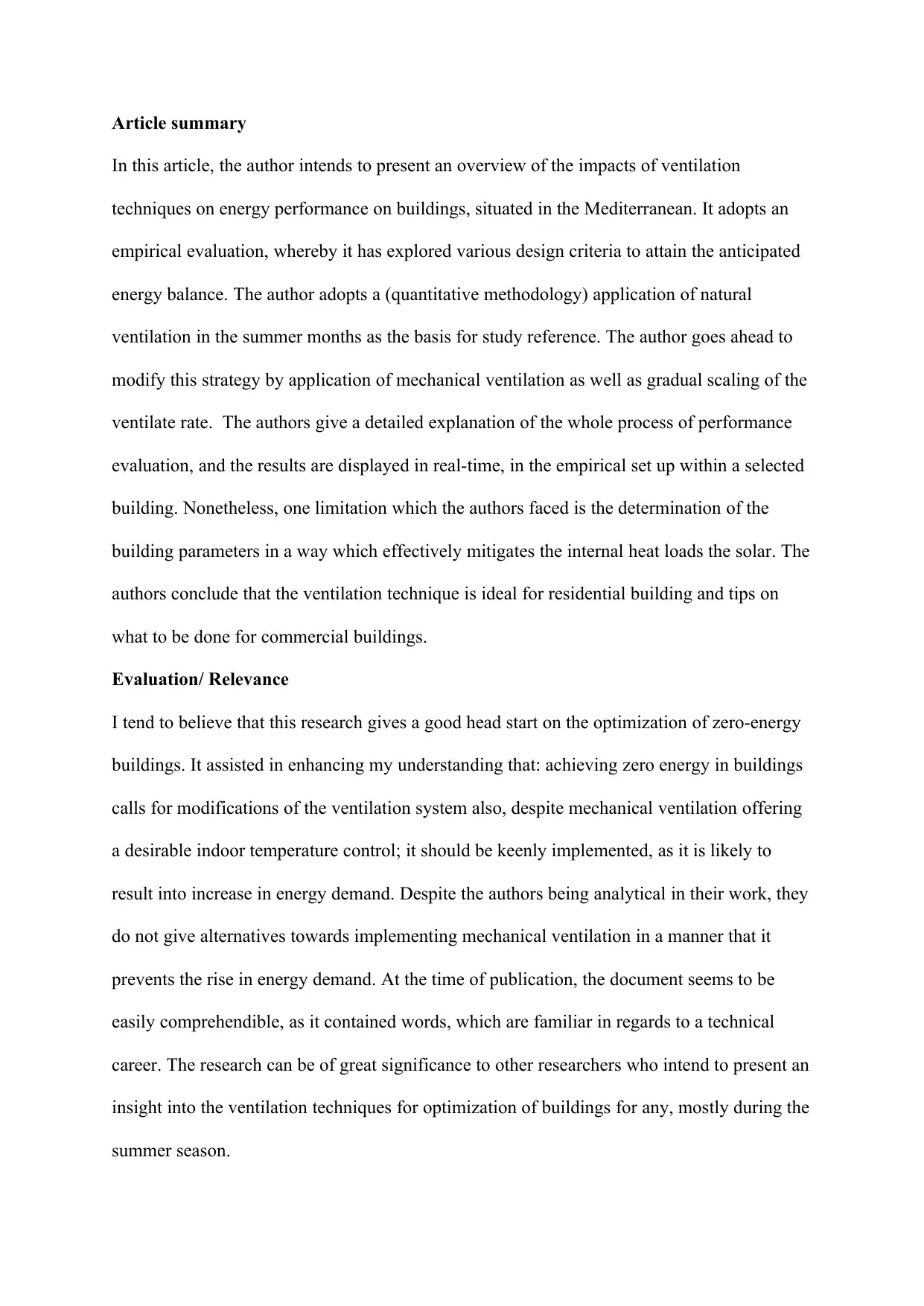
Article summary
In this article, the author intends to present an overview of the impacts of ventilation
techniques on energy performance on buildings, situated in the Mediterranean. It adopts an
empirical evaluation, whereby it has explored various design criteria to attain the anticipated
energy balance. The author adopts a (quantitative methodology) application of natural
ventilation in the summer months as the basis for study reference. The author goes ahead to
modify this strategy by application of mechanical ventilation as well as gradual scaling of the
ventilate rate. The authors give a detailed explanation of the whole process of performance
evaluation, and the results are displayed in real-time, in the empirical set up within a selected
building. Nonetheless, one limitation which the authors faced is the determination of the
building parameters in a way which effectively mitigates the internal heat loads the solar. The
authors conclude that the ventilation technique is ideal for residential building and tips on
what to be done for commercial buildings.
Evaluation/ Relevance
I tend to believe that this research gives a good head start on the optimization of zero-energy
buildings. It assisted in enhancing my understanding that: achieving zero energy in buildings
calls for modifications of the ventilation system also, despite mechanical ventilation offering
a desirable indoor temperature control; it should be keenly implemented, as it is likely to
result into increase in energy demand. Despite the authors being analytical in their work, they
do not give alternatives towards implementing mechanical ventilation in a manner that it
prevents the rise in energy demand. At the time of publication, the document seems to be
easily comprehendible, as it contained words, which are familiar in regards to a technical
career. The research can be of great significance to other researchers who intend to present an
insight into the ventilation techniques for optimization of buildings for any, mostly during the
summer season.
tabler-icon-diamond-filled.svg

Paraphrase This Document

Need a fresh take? Get an instant paraphrase of this document with our AI Paraphraser
Document Page
Document Page
References
[1] Grigoropoulos E, Anastaselos D, Nižetić S, Papadopoulos A. Effective ventilation
strategies for net-zero-energy buildings in Mediterranean climates. International Journal of
Ventilation. 2016;:1-17.
chevron_up_icon
1 out of 3
circle_padding
hide_on_mobile
zoom_out_icon
[object Object]