Case Study Analysis: Challenges and Solutions for VTB Company
VerifiedAdded on 2019/11/25
|12
|2181
|866
Case Study
AI Summary
This case study analysis examines the Vermont Teddy Bear Company (VTB), an e-commerce business founded in 1981. The company faced challenges in managing customer expectations, particularly during peak seasons like Christmas, due to IT infrastructure limitations and supply chain issues. The analysis utilizes tools such as fishbone diagrams and CATWOE to identify root causes, including IT mismanagement, insufficient resources, and outdated software. Recommendations include implementing a CRM system, adopting new enterprise software, improving the supply chain, establishing a data warehouse, outsourcing customer service, and exploring revenue-generating strategies. The study highlights the importance of IT in e-commerce and the need for proactive solutions to ensure customer satisfaction and business growth. The analysis concludes with suggestions for the CEO and CIO to work together for revenue increment and technical improvements.
Running head: CASE STUDY ANALYSIS 1
Case Study Analysis
Student’s Name
University’s Name
Case Study Analysis
Student’s Name
University’s Name

Paraphrase This Document
Need a fresh take? Get an instant paraphrase of this document with our AI Paraphraser
CASE STUDY ANALYSIS 2
Executive Summary
VTB is an e-commerce company founded by John Sortino in Vermont in the year of
1981. Initially the company used to take orders through phone calls but later with improvement
in the technology, the company started taking orders through the web. This raised the business of
the company and generated commendable revenue. But the IT department had issues related to
maintaining the expectations of the customers due to hike in the rate of orders around Christmas.
The insufficient number of employees was not able to provide the promised customer service to
the customers. Apart from this, the middleware, i.e., the vendors did not live upto the
expectations of the brand image and issues such as defective and delayed delivery were raised.
These problems were analyzed using the analysis tools like fishbone diagram, CATWOE, Kaizen
analysis etc. to reach to the point of the problems and prevent the company from facing such
problems in the future. The company appointed Bob Stetzel as the chief IT head and his
appointment brought certain changes in the company strategies. Stetzel made an amazing team
along with Gilbert and the two were able to solve certain issues. A few more recommendations
made below can be utilized to make the company fight issues such as using updated software
versions, increasing the revenues, establishing a data warehouse etc.
Executive Summary
VTB is an e-commerce company founded by John Sortino in Vermont in the year of
1981. Initially the company used to take orders through phone calls but later with improvement
in the technology, the company started taking orders through the web. This raised the business of
the company and generated commendable revenue. But the IT department had issues related to
maintaining the expectations of the customers due to hike in the rate of orders around Christmas.
The insufficient number of employees was not able to provide the promised customer service to
the customers. Apart from this, the middleware, i.e., the vendors did not live upto the
expectations of the brand image and issues such as defective and delayed delivery were raised.
These problems were analyzed using the analysis tools like fishbone diagram, CATWOE, Kaizen
analysis etc. to reach to the point of the problems and prevent the company from facing such
problems in the future. The company appointed Bob Stetzel as the chief IT head and his
appointment brought certain changes in the company strategies. Stetzel made an amazing team
along with Gilbert and the two were able to solve certain issues. A few more recommendations
made below can be utilized to make the company fight issues such as using updated software
versions, increasing the revenues, establishing a data warehouse etc.
CASE STUDY ANALYSIS 3
Table of Contents
Executive Summary.........................................................................................................................2
Background......................................................................................................................................3
Problem Statement...........................................................................................................................4
Analysis...........................................................................................................................................4
Recommendations and Conclusions................................................................................................9
References........................................................................................................................................9
Table of Contents
Executive Summary.........................................................................................................................2
Background......................................................................................................................................3
Problem Statement...........................................................................................................................4
Analysis...........................................................................................................................................4
Recommendations and Conclusions................................................................................................9
References........................................................................................................................................9
⊘ This is a preview!⊘
Do you want full access?
Subscribe today to unlock all pages.

Trusted by 1+ million students worldwide
CASE STUDY ANALYSIS 4
Background
Vermont Teddy Bear Company was founded in 1981 by John Sortino in Vermont. The
company started peaking up its business in 1990 with the introduction of "Bear Gram Service"
by Sortino where the customers used to call to order personalized bears with the desired
costumes and colors. The revenues collected by the company grew to $17 million in 1993 and
the company occupied 21st position in the list of fastest growing companies released by Inc.
Magazine. But the business of the company was restricted to certain occasions such as
Christmas, Valentine's Day etc. To increase the business company started opening departmental
stores in Freeport Maine and New York City. In 1997-1999, Elisabeth B. Robert joined the
company as the new CEO and initiated "Make-a-friend-for-life" venture and took the sales of the
company to $21.5 million. VTB also launched some women accessories in its stores like
handbags, food baskets, pajamas etc. but cut down its products to bears, calyx flowers and
pajamas by 2008. The Company resumed back to its private ownership in 2005-2008 but
Elizabeth Robert resigned from the job in September. Just after this, the stock market crashed
and had disastrous effect on the company and about 35 employees were fired from their
positions. In 2009, John Gilbert joined VTB as the new Chief Bear Officer. The company signed
licensing deals with movie studios, television studios and game makers to promote their
products. Bob Stetzel joined the IT team in 2009 during the peak time of the sales around
Thanksgiving (Gogan & Lewis, 2011). He went through the data of the company and found out
that most of the essential knowledge about the company prospects lied with siloed individuals.
This made him arrange development sessions for other individuals to make them aware of the
company information. The strategies adopted by him taking Gilbert in the scene uplifted the
condition of VTB in the market and the position continues to be the same till date.
Background
Vermont Teddy Bear Company was founded in 1981 by John Sortino in Vermont. The
company started peaking up its business in 1990 with the introduction of "Bear Gram Service"
by Sortino where the customers used to call to order personalized bears with the desired
costumes and colors. The revenues collected by the company grew to $17 million in 1993 and
the company occupied 21st position in the list of fastest growing companies released by Inc.
Magazine. But the business of the company was restricted to certain occasions such as
Christmas, Valentine's Day etc. To increase the business company started opening departmental
stores in Freeport Maine and New York City. In 1997-1999, Elisabeth B. Robert joined the
company as the new CEO and initiated "Make-a-friend-for-life" venture and took the sales of the
company to $21.5 million. VTB also launched some women accessories in its stores like
handbags, food baskets, pajamas etc. but cut down its products to bears, calyx flowers and
pajamas by 2008. The Company resumed back to its private ownership in 2005-2008 but
Elizabeth Robert resigned from the job in September. Just after this, the stock market crashed
and had disastrous effect on the company and about 35 employees were fired from their
positions. In 2009, John Gilbert joined VTB as the new Chief Bear Officer. The company signed
licensing deals with movie studios, television studios and game makers to promote their
products. Bob Stetzel joined the IT team in 2009 during the peak time of the sales around
Thanksgiving (Gogan & Lewis, 2011). He went through the data of the company and found out
that most of the essential knowledge about the company prospects lied with siloed individuals.
This made him arrange development sessions for other individuals to make them aware of the
company information. The strategies adopted by him taking Gilbert in the scene uplifted the
condition of VTB in the market and the position continues to be the same till date.
Paraphrase This Document
Need a fresh take? Get an instant paraphrase of this document with our AI Paraphraser
CASE STUDY ANALYSIS 5
Problem Statement
"The company’s business reaches its peak during special occasions like Valentine's Day,
Christmas, Thanksgiving and many others. Handling the customers during such rush is a major
problem as they do not have adequate IT infrastructure. The IT department faces challenges to
manage the orders of the customers and clients during the season which leads to complications in
customer service and the delivery of products."
Analysis
Problem analysis can be done efficiently when the root cause of the problem is identified
and analyzed. The steps involved in Problem Analysis are-
1) Identifying the problem and its symptoms: The problem in this case is the handling
of customers during the special occasions due to innumerable orders. The symptoms of the
problem include complaints of the customers related to order delivery, improper handling of the
products ordered through mails, web and telephone and problems related to the middleware in
delivering the products.
Problem Statement
"The company’s business reaches its peak during special occasions like Valentine's Day,
Christmas, Thanksgiving and many others. Handling the customers during such rush is a major
problem as they do not have adequate IT infrastructure. The IT department faces challenges to
manage the orders of the customers and clients during the season which leads to complications in
customer service and the delivery of products."
Analysis
Problem analysis can be done efficiently when the root cause of the problem is identified
and analyzed. The steps involved in Problem Analysis are-
1) Identifying the problem and its symptoms: The problem in this case is the handling
of customers during the special occasions due to innumerable orders. The symptoms of the
problem include complaints of the customers related to order delivery, improper handling of the
products ordered through mails, web and telephone and problems related to the middleware in
delivering the products.
CASE STUDY ANALYSIS 6
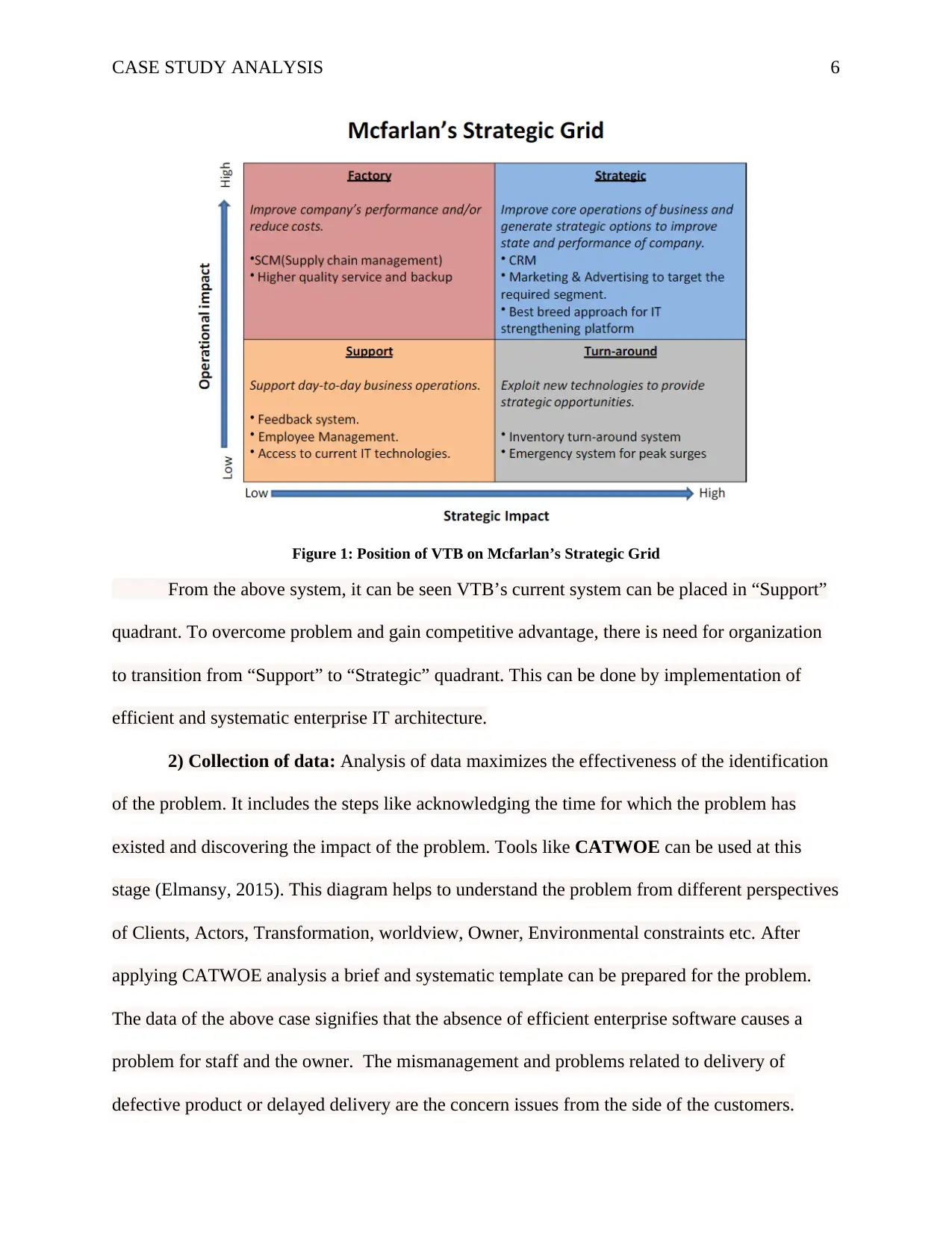
Figure 1: Position of VTB on Mcfarlan’s Strategic Grid
From the above system, it can be seen VTB’s current system can be placed in “Support”
quadrant. To overcome problem and gain competitive advantage, there is need for organization
to transition from “Support” to “Strategic” quadrant. This can be done by implementation of
efficient and systematic enterprise IT architecture.
2) Collection of data: Analysis of data maximizes the effectiveness of the identification
of the problem. It includes the steps like acknowledging the time for which the problem has
existed and discovering the impact of the problem. Tools like CATWOE can be used at this
stage (Elmansy, 2015). This diagram helps to understand the problem from different perspectives
of Clients, Actors, Transformation, worldview, Owner, Environmental constraints etc. After
applying CATWOE analysis a brief and systematic template can be prepared for the problem.
The data of the above case signifies that the absence of efficient enterprise software causes a
problem for staff and the owner. The mismanagement and problems related to delivery of
defective product or delayed delivery are the concern issues from the side of the customers.
Figure 1: Position of VTB on Mcfarlan’s Strategic Grid
From the above system, it can be seen VTB’s current system can be placed in “Support”
quadrant. To overcome problem and gain competitive advantage, there is need for organization
to transition from “Support” to “Strategic” quadrant. This can be done by implementation of
efficient and systematic enterprise IT architecture.
2) Collection of data: Analysis of data maximizes the effectiveness of the identification
of the problem. It includes the steps like acknowledging the time for which the problem has
existed and discovering the impact of the problem. Tools like CATWOE can be used at this
stage (Elmansy, 2015). This diagram helps to understand the problem from different perspectives
of Clients, Actors, Transformation, worldview, Owner, Environmental constraints etc. After
applying CATWOE analysis a brief and systematic template can be prepared for the problem.
The data of the above case signifies that the absence of efficient enterprise software causes a
problem for staff and the owner. The mismanagement and problems related to delivery of
defective product or delayed delivery are the concern issues from the side of the customers.
⊘ This is a preview!⊘
Do you want full access?
Subscribe today to unlock all pages.
Trusted by 1+ million students worldwide
CASE STUDY ANALYSIS 7
3) Identification of the Causal Factors of the problem: In this step, the factors
responsible for the problems are identified. Some of the tools used frequently for this purpose are
- 5 Whys (to get to the root of the problem), Appreciation (to determine the possible
consequences of the problem), Cause and effect diagrams or the Fishbone diagram (to list all
the possible causal factors to see the initiation point of the trouble) and Drill Down method
(breaking the problem into small fragments to understand it in detail) (Mind Tools, 2017) .
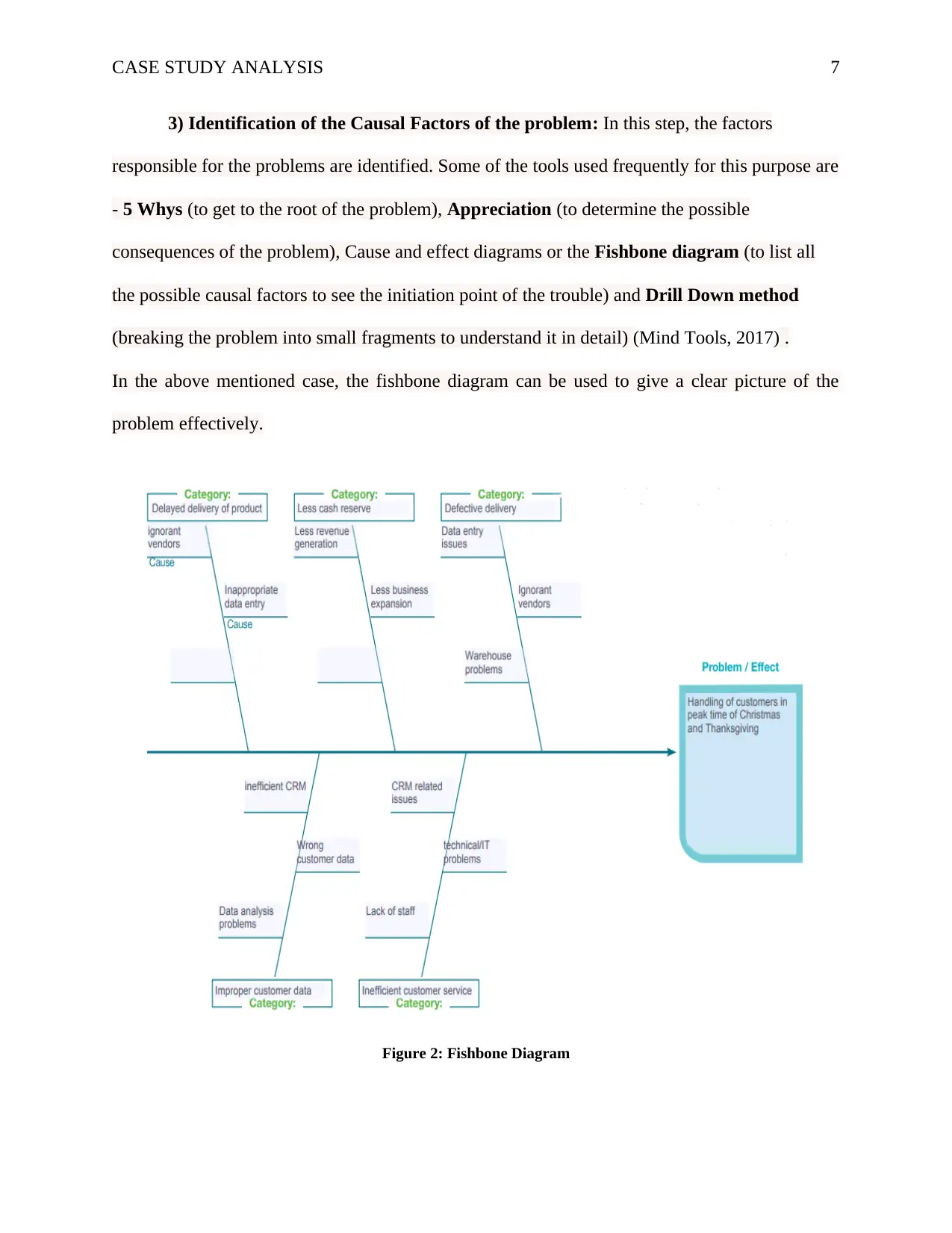
In the above mentioned case, the fishbone diagram can be used to give a clear picture of the
problem effectively.
Figure 2: Fishbone Diagram
3) Identification of the Causal Factors of the problem: In this step, the factors
responsible for the problems are identified. Some of the tools used frequently for this purpose are
- 5 Whys (to get to the root of the problem), Appreciation (to determine the possible
consequences of the problem), Cause and effect diagrams or the Fishbone diagram (to list all
the possible causal factors to see the initiation point of the trouble) and Drill Down method
(breaking the problem into small fragments to understand it in detail) (Mind Tools, 2017) .
In the above mentioned case, the fishbone diagram can be used to give a clear picture of the
problem effectively.
Figure 2: Fishbone Diagram
Paraphrase This Document
Need a fresh take? Get an instant paraphrase of this document with our AI Paraphraser
CASE STUDY ANALYSIS 8
4) Identification of the root causes - This step provides a better understanding of the causes
and effects of the problem. The same tools used in step three can be used for this step as well. In
the case, the root causes of the problem are-
Mismanagement in the IT department
Insufficient availability of the human resources in the IT department
Unavailability of the required high level software technology despite of being an e-
commerce site
Lack of an efficient leader
Absence of a separate warehouse for the company
Lack of cash reserve for the establishment of a warehouse
Discrepancies in the enterprise software may be responsible for issues related to sales,
entry of the orders and management of the inventory.
Issues related to the middleware
5) Recommendations and implementation of the solutions: The final step includes the
steps one can suggest to prevent the company from the problems identified above in step 3 and 4.
This step also ensures mentioning the steps which can be taken to prevent the company from
such problems in the future. The methods that can be used to plan the solutions for the causal
problems are Failure Mode and Effects Analysis (FMEA) to analyze the risks of failure of the
predicted solutions (Quality-One International, 2015); Impact analysis which deals with the
impact of both negative and positive outcomes of the changes introduced into the organization
through the recommendation process; and Continuous Improvement or the Kaizen analysis
favors the introduction of small changes to create a good overall impact.
4) Identification of the root causes - This step provides a better understanding of the causes
and effects of the problem. The same tools used in step three can be used for this step as well. In
the case, the root causes of the problem are-
Mismanagement in the IT department
Insufficient availability of the human resources in the IT department
Unavailability of the required high level software technology despite of being an e-
commerce site
Lack of an efficient leader
Absence of a separate warehouse for the company
Lack of cash reserve for the establishment of a warehouse
Discrepancies in the enterprise software may be responsible for issues related to sales,
entry of the orders and management of the inventory.
Issues related to the middleware
5) Recommendations and implementation of the solutions: The final step includes the
steps one can suggest to prevent the company from the problems identified above in step 3 and 4.
This step also ensures mentioning the steps which can be taken to prevent the company from
such problems in the future. The methods that can be used to plan the solutions for the causal
problems are Failure Mode and Effects Analysis (FMEA) to analyze the risks of failure of the
predicted solutions (Quality-One International, 2015); Impact analysis which deals with the
impact of both negative and positive outcomes of the changes introduced into the organization
through the recommendation process; and Continuous Improvement or the Kaizen analysis
favors the introduction of small changes to create a good overall impact.
CASE STUDY ANALYSIS 9
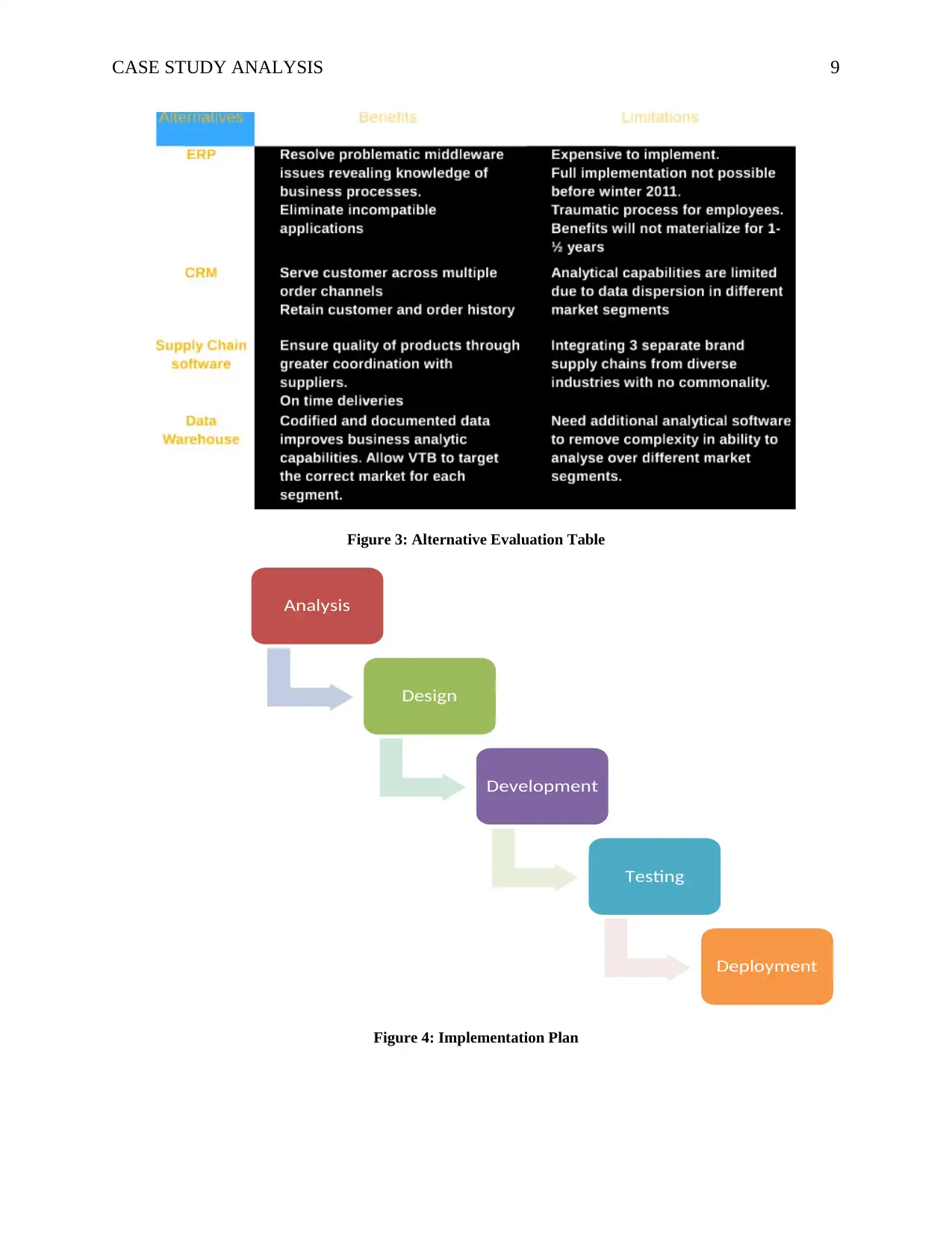
Figure 3: Alternative Evaluation Table
Figure 4: Implementation Plan
Analysis
Design
Development
Testing
Deployment
Figure 3: Alternative Evaluation Table
Figure 4: Implementation Plan
Analysis
Design
Development
Testing
Deployment
⊘ This is a preview!⊘
Do you want full access?
Subscribe today to unlock all pages.
Trusted by 1+ million students worldwide
CASE STUDY ANALYSIS 10
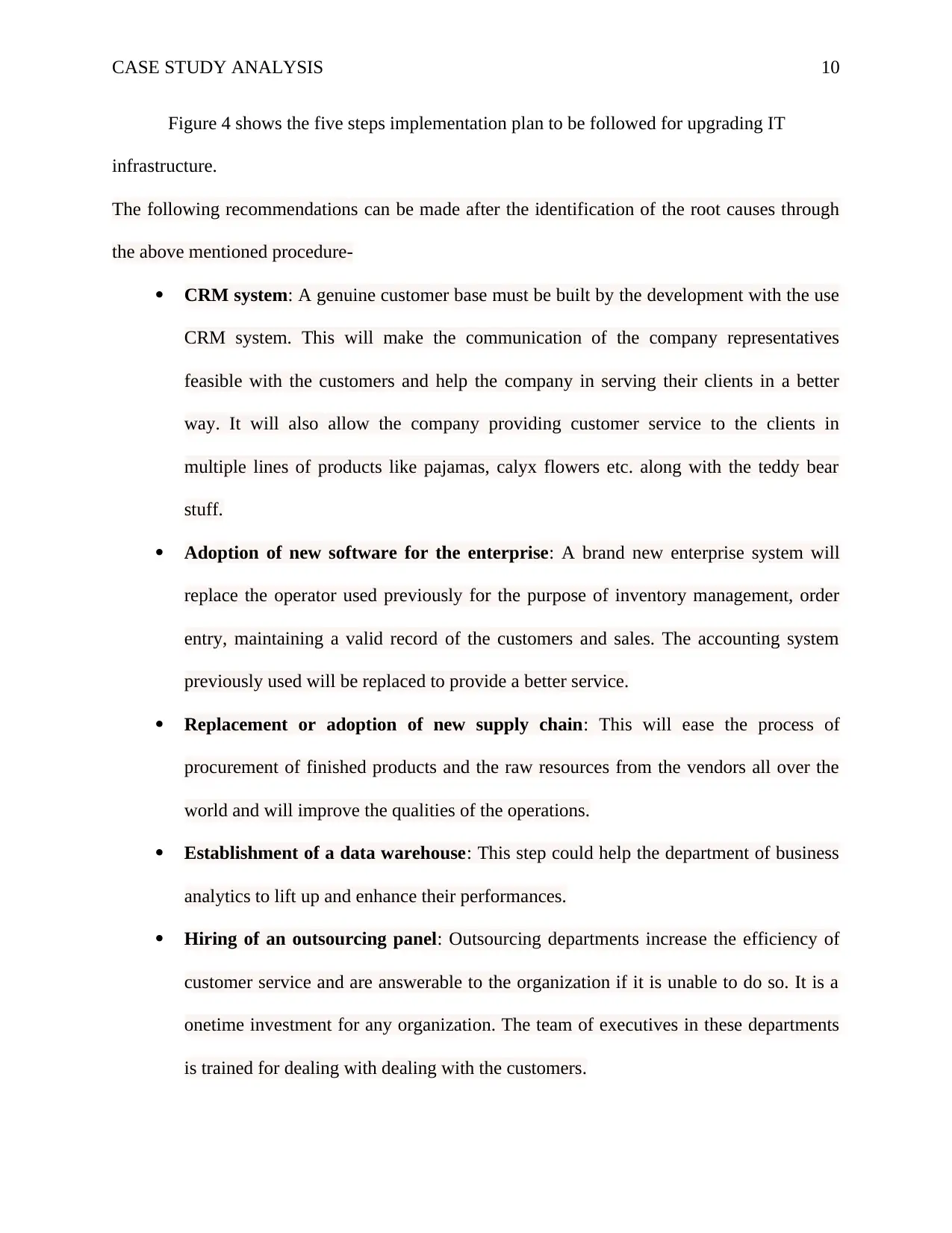
Figure 4 shows the five steps implementation plan to be followed for upgrading IT
infrastructure.
The following recommendations can be made after the identification of the root causes through
the above mentioned procedure-
CRM system: A genuine customer base must be built by the development with the use
CRM system. This will make the communication of the company representatives
feasible with the customers and help the company in serving their clients in a better
way. It will also allow the company providing customer service to the clients in
multiple lines of products like pajamas, calyx flowers etc. along with the teddy bear
stuff.
Adoption of new software for the enterprise: A brand new enterprise system will
replace the operator used previously for the purpose of inventory management, order
entry, maintaining a valid record of the customers and sales. The accounting system
previously used will be replaced to provide a better service.
Replacement or adoption of new supply chain: This will ease the process of
procurement of finished products and the raw resources from the vendors all over the
world and will improve the qualities of the operations.
Establishment of a data warehouse: This step could help the department of business
analytics to lift up and enhance their performances.
Hiring of an outsourcing panel: Outsourcing departments increase the efficiency of
customer service and are answerable to the organization if it is unable to do so. It is a
onetime investment for any organization. The team of executives in these departments
is trained for dealing with dealing with the customers.
Figure 4 shows the five steps implementation plan to be followed for upgrading IT
infrastructure.
The following recommendations can be made after the identification of the root causes through
the above mentioned procedure-
CRM system: A genuine customer base must be built by the development with the use
CRM system. This will make the communication of the company representatives
feasible with the customers and help the company in serving their clients in a better
way. It will also allow the company providing customer service to the clients in
multiple lines of products like pajamas, calyx flowers etc. along with the teddy bear
stuff.
Adoption of new software for the enterprise: A brand new enterprise system will
replace the operator used previously for the purpose of inventory management, order
entry, maintaining a valid record of the customers and sales. The accounting system
previously used will be replaced to provide a better service.
Replacement or adoption of new supply chain: This will ease the process of
procurement of finished products and the raw resources from the vendors all over the
world and will improve the qualities of the operations.
Establishment of a data warehouse: This step could help the department of business
analytics to lift up and enhance their performances.
Hiring of an outsourcing panel: Outsourcing departments increase the efficiency of
customer service and are answerable to the organization if it is unable to do so. It is a
onetime investment for any organization. The team of executives in these departments
is trained for dealing with dealing with the customers.
Paraphrase This Document
Need a fresh take? Get an instant paraphrase of this document with our AI Paraphraser
CASE STUDY ANALYSIS 11
Development of the methods to increase the revenue resources: The CEO of VTB
should find alternative methods for the expansion of the business so that it may
generate sufficient revenue for the establishment of warehouses and adopting better
software.
Hiring of experts in the IT: During the time of recession, many of the employees
were laid off from their jobs. So, the new employees must be hired with expertise in the
IT field.
Paying similar attention towards other business ventures started by the company may
help in the generation of extra revenue. This generated revenue can be used in bringing
new IT tools to the company and uplifting its sales.
Recommendations and Conclusions
Being an e-commerce site, IT department plays a vital role in the business development
and sales of VBT. Christmas proves to be a critical time for the company business as a lot of
online orders pave their way during this period. This leads to the problem for the IT department
of the company to manage the orders. This becomes an issue for the customers as they are not
able to get their correct orders on time. Bob Stetzel, the chief of the IT department recommended
and adopted so many methodologies to improve the business analytics such as transfer of the
essential company knowledge to rest of the employees apart from the siloed employees. In my
recommendation the company CEO must find out the ways to expand the business and must
establish data warehouses at certain locations to manage the customer data. Adoption of new
enterprise software can help in maintaining the accounting problems. The vendors must be dealt
appropriately and strictly to prepare the orders on time. These steps may be included to cure the
Development of the methods to increase the revenue resources: The CEO of VTB
should find alternative methods for the expansion of the business so that it may
generate sufficient revenue for the establishment of warehouses and adopting better
software.
Hiring of experts in the IT: During the time of recession, many of the employees
were laid off from their jobs. So, the new employees must be hired with expertise in the
IT field.
Paying similar attention towards other business ventures started by the company may
help in the generation of extra revenue. This generated revenue can be used in bringing
new IT tools to the company and uplifting its sales.
Recommendations and Conclusions
Being an e-commerce site, IT department plays a vital role in the business development
and sales of VBT. Christmas proves to be a critical time for the company business as a lot of
online orders pave their way during this period. This leads to the problem for the IT department
of the company to manage the orders. This becomes an issue for the customers as they are not
able to get their correct orders on time. Bob Stetzel, the chief of the IT department recommended
and adopted so many methodologies to improve the business analytics such as transfer of the
essential company knowledge to rest of the employees apart from the siloed employees. In my
recommendation the company CEO must find out the ways to expand the business and must
establish data warehouses at certain locations to manage the customer data. Adoption of new
enterprise software can help in maintaining the accounting problems. The vendors must be dealt
appropriately and strictly to prepare the orders on time. These steps may be included to cure the
CASE STUDY ANALYSIS 12
causes of the problem and prevent the company from the reoccurrence of such problems in the
near future. The CEO and CIO need to take collaborative steps where CEO needs to plan on the
revenue increment and the CIO should look into the technical matters to increase the sales of the
company.
References
Elmansy, R. (2015). CATWOE: Building a Problem-Solving Checklist. Retrieved from
http://www.designorate.com: http://www.designorate.com/catwoe-problem-solving/
Janis L Gogan, M. O. (2011). Peak experiences and strategic IT alignment at Vermont Teddy
Bear. Journal of Information Technology Teaching Cases, 61-70.
mindtools. (2017). Root Cause Analysis. Retrieved from www.mindtools.com:
https://www.mindtools.com/pages/article/newTMC_80.htm
Quality-One International. (2015). Failure Mode and Effects Analysis (FMEA). Retrieved from
quality-one.com: https://quality-one.com/fmea/
causes of the problem and prevent the company from the reoccurrence of such problems in the
near future. The CEO and CIO need to take collaborative steps where CEO needs to plan on the
revenue increment and the CIO should look into the technical matters to increase the sales of the
company.
References
Elmansy, R. (2015). CATWOE: Building a Problem-Solving Checklist. Retrieved from
http://www.designorate.com: http://www.designorate.com/catwoe-problem-solving/
Janis L Gogan, M. O. (2011). Peak experiences and strategic IT alignment at Vermont Teddy
Bear. Journal of Information Technology Teaching Cases, 61-70.
mindtools. (2017). Root Cause Analysis. Retrieved from www.mindtools.com:
https://www.mindtools.com/pages/article/newTMC_80.htm
Quality-One International. (2015). Failure Mode and Effects Analysis (FMEA). Retrieved from
quality-one.com: https://quality-one.com/fmea/
⊘ This is a preview!⊘
Do you want full access?
Subscribe today to unlock all pages.
Trusted by 1+ million students worldwide

1 out of 12


Your All-in-One AI-Powered Toolkit for Academic Success.
+13062052269
info@desklib.com
Available 24*7 on WhatsApp / Email
![[object Object]](/_next/static/media/star-bottom.7253800d.svg)
Unlock your academic potential
Copyright © 2020–2026 A2Z Services. All Rights Reserved. Developed and managed by ZUCOL.