ENEC20003 - Vibrocompaction: Design, Construction, and Quality Control
VerifiedAdded on 2023/06/10
|14
|6378
|233
Report
AI Summary
This report provides a comprehensive overview of vibrocompaction and vibroflotation techniques used for soil improvement in construction. It details the process of vibrocompaction, including the materials used, design considerations, and construction procedures. The report also emphasizes the importance of quality control during the process and discusses factors affecting the quality of vibroflotation. Furthermore, it explores the advantages of vibroflotation, such as reducing foundation settlement, ensuring slope stability, and preventing natural disasters like earthquakes and liquefaction. A literature review is included, highlighting various research studies on numerical modeling, homogenization methods, biological precipitation, remediation measures, and spatial variation of compaction effects. The report concludes by summarizing the key aspects of vibrocompaction and its significance in enhancing soil strength and stability for construction purposes.
Table of contents
Introduction:...............................................................................................................................1
Process of vibrocompaction...................................................................................................2
Material for vibrocompaction................................................................................................3
Design of vibrocompaction....................................................................................................3
Construction procedure..........................................................................................................4
Quality control during the process.........................................................................................4
Factors affecting the vibroflotation quality:...............................................................................5
Why there is need of vibroflotation?..........................................................................................5
Advantages of vibroflotation......................................................................................................5
Literature review........................................................................................................................6
Conclusion................................................................................................................................11
References................................................................................................................................12
Introduction:...............................................................................................................................1
Process of vibrocompaction...................................................................................................2
Material for vibrocompaction................................................................................................3
Design of vibrocompaction....................................................................................................3
Construction procedure..........................................................................................................4
Quality control during the process.........................................................................................4
Factors affecting the vibroflotation quality:...............................................................................5
Why there is need of vibroflotation?..........................................................................................5
Advantages of vibroflotation......................................................................................................5
Literature review........................................................................................................................6
Conclusion................................................................................................................................11
References................................................................................................................................12

Paraphrase This Document
Need a fresh take? Get an instant paraphrase of this document with our AI Paraphraser
Introduction:
Loose soil in the ground surfaces is a very common problem in the construction industries.
This problem of loose soil required immediate solution which can be achieved by
vibroflotation. Vibroflotation can be defined as a technique to enhance the strength of the soil
and capacity of bearing of the ground surface with the help of vibration and spouting of the
water. It is used at the depth of the ground surface where the soil is loose.
Vibroflotation sometimes also called as vibrocompaction in general, but there exists a
difference between two. Vibroflotation is one kind of vibrocompaction technique, in
vibroflotation a device called as vibroflot is used which moves horizontally for settling of the
loose soil. While in the second kind of vibrocompaction technique a device names as
vibrating plate is used which moves vertically for settling of the loose soil. It is a vibro-
replacement mechanism combining the backfilling of gravel and vibroflotation to produce the
columns of the stone.
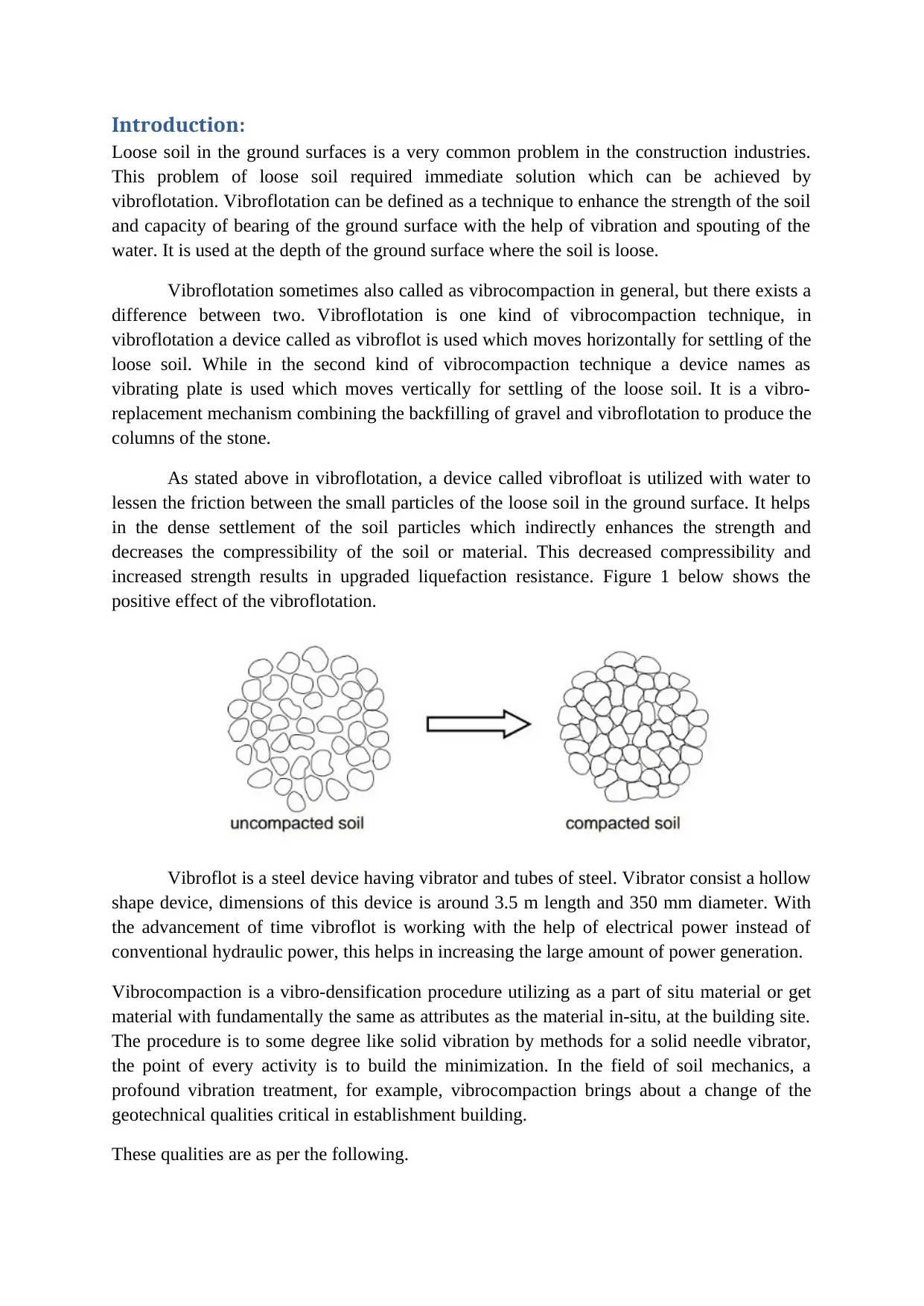
As stated above in vibroflotation, a device called vibrofloat is utilized with water to
lessen the friction between the small particles of the loose soil in the ground surface. It helps
in the dense settlement of the soil particles which indirectly enhances the strength and
decreases the compressibility of the soil or material. This decreased compressibility and
increased strength results in upgraded liquefaction resistance. Figure 1 below shows the
positive effect of the vibroflotation.
Vibroflot is a steel device having vibrator and tubes of steel. Vibrator consist a hollow
shape device, dimensions of this device is around 3.5 m length and 350 mm diameter. With
the advancement of time vibroflot is working with the help of electrical power instead of
conventional hydraulic power, this helps in increasing the large amount of power generation.
Vibrocompaction is a vibro-densification procedure utilizing as a part of situ material or get
material with fundamentally the same as attributes as the material in-situ, at the building site.
The procedure is to some degree like solid vibration by methods for a solid needle vibrator,
the point of every activity is to build the minimization. In the field of soil mechanics, a
profound vibration treatment, for example, vibrocompaction brings about a change of the
geotechnical qualities critical in establishment building.
These qualities are as per the following.
Loose soil in the ground surfaces is a very common problem in the construction industries.
This problem of loose soil required immediate solution which can be achieved by
vibroflotation. Vibroflotation can be defined as a technique to enhance the strength of the soil
and capacity of bearing of the ground surface with the help of vibration and spouting of the
water. It is used at the depth of the ground surface where the soil is loose.
Vibroflotation sometimes also called as vibrocompaction in general, but there exists a
difference between two. Vibroflotation is one kind of vibrocompaction technique, in
vibroflotation a device called as vibroflot is used which moves horizontally for settling of the
loose soil. While in the second kind of vibrocompaction technique a device names as
vibrating plate is used which moves vertically for settling of the loose soil. It is a vibro-
replacement mechanism combining the backfilling of gravel and vibroflotation to produce the
columns of the stone.
As stated above in vibroflotation, a device called vibrofloat is utilized with water to
lessen the friction between the small particles of the loose soil in the ground surface. It helps
in the dense settlement of the soil particles which indirectly enhances the strength and
decreases the compressibility of the soil or material. This decreased compressibility and
increased strength results in upgraded liquefaction resistance. Figure 1 below shows the
positive effect of the vibroflotation.
Vibroflot is a steel device having vibrator and tubes of steel. Vibrator consist a hollow
shape device, dimensions of this device is around 3.5 m length and 350 mm diameter. With
the advancement of time vibroflot is working with the help of electrical power instead of
conventional hydraulic power, this helps in increasing the large amount of power generation.
Vibrocompaction is a vibro-densification procedure utilizing as a part of situ material or get
material with fundamentally the same as attributes as the material in-situ, at the building site.
The procedure is to some degree like solid vibration by methods for a solid needle vibrator,
the point of every activity is to build the minimization. In the field of soil mechanics, a
profound vibration treatment, for example, vibrocompaction brings about a change of the
geotechnical qualities critical in establishment building.
These qualities are as per the following.
Modulus of elasticity
Internal friction angle
In-situ density
With enhancement in the parameters of soil, it is conceivable to increment extensively
bearing limit and to lessen the auxiliary burdens clearings. Compact soil accomplished with
the help of profound vibro process. Notwithstanding, viability of system relies upon in-situ
attributes. Vibro-compaction consequences are not indistinguishable for each experienced.
Results of strong soils and granular soils are altogether different.
Process of vibrocompaction
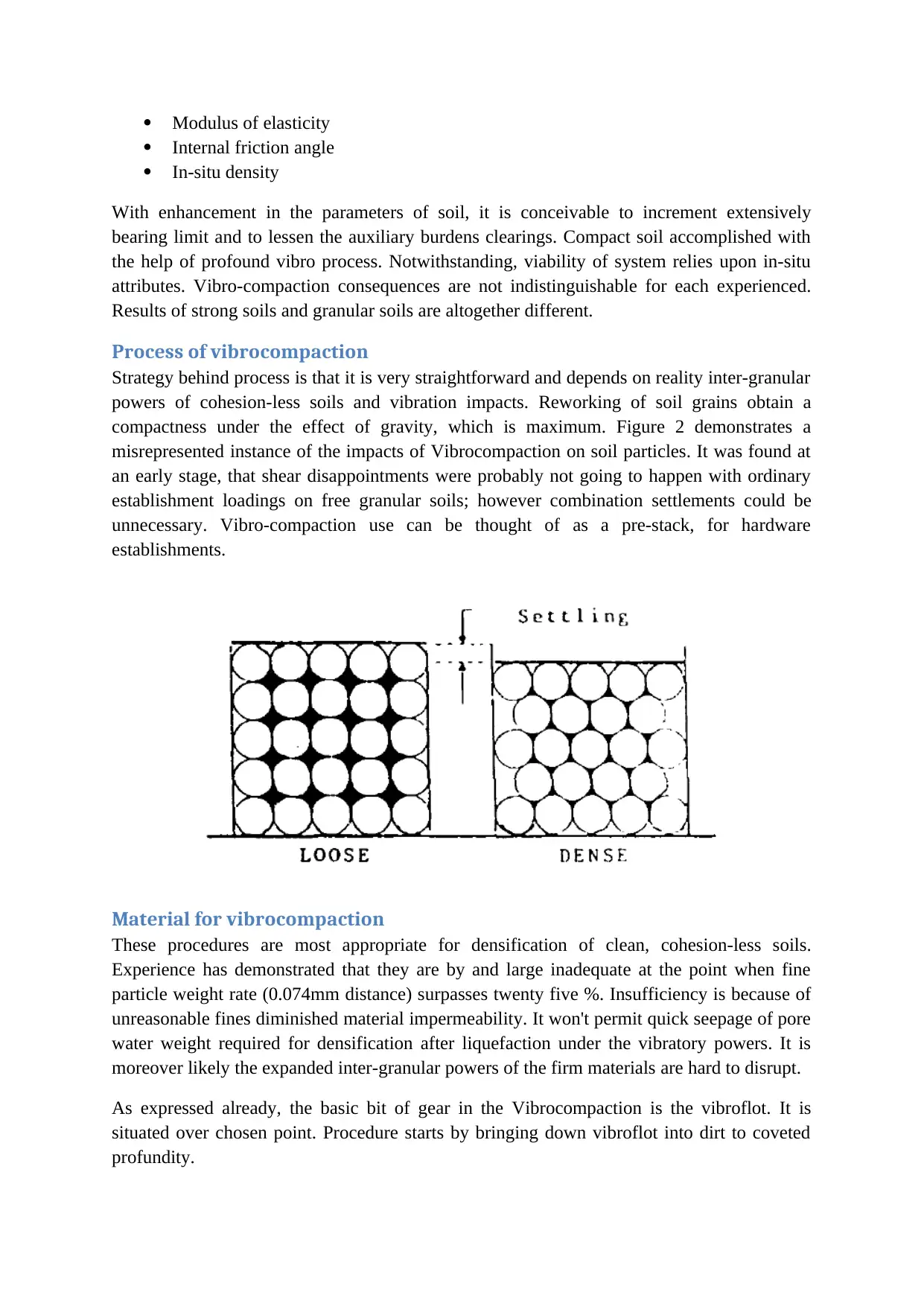
Strategy behind process is that it is very straightforward and depends on reality inter-granular
powers of cohesion-less soils and vibration impacts. Reworking of soil grains obtain a
compactness under the effect of gravity, which is maximum. Figure 2 demonstrates a
misrepresented instance of the impacts of Vibrocompaction on soil particles. It was found at
an early stage, that shear disappointments were probably not going to happen with ordinary
establishment loadings on free granular soils; however combination settlements could be
unnecessary. Vibro-compaction use can be thought of as a pre-stack, for hardware
establishments.
Material for vibrocompaction
These procedures are most appropriate for densification of clean, cohesion-less soils.
Experience has demonstrated that they are by and large inadequate at the point when fine
particle weight rate (0.074mm distance) surpasses twenty five %. Insufficiency is because of
unreasonable fines diminished material impermeability. It won't permit quick seepage of pore
water weight required for densification after liquefaction under the vibratory powers. It is
moreover likely the expanded inter-granular powers of the firm materials are hard to disrupt.
As expressed already, the basic bit of gear in the Vibrocompaction is the vibroflot. It is
situated over chosen point. Procedure starts by bringing down vibroflot into dirt to coveted
profundity.
Internal friction angle
In-situ density
With enhancement in the parameters of soil, it is conceivable to increment extensively
bearing limit and to lessen the auxiliary burdens clearings. Compact soil accomplished with
the help of profound vibro process. Notwithstanding, viability of system relies upon in-situ
attributes. Vibro-compaction consequences are not indistinguishable for each experienced.
Results of strong soils and granular soils are altogether different.
Process of vibrocompaction
Strategy behind process is that it is very straightforward and depends on reality inter-granular
powers of cohesion-less soils and vibration impacts. Reworking of soil grains obtain a
compactness under the effect of gravity, which is maximum. Figure 2 demonstrates a
misrepresented instance of the impacts of Vibrocompaction on soil particles. It was found at
an early stage, that shear disappointments were probably not going to happen with ordinary
establishment loadings on free granular soils; however combination settlements could be
unnecessary. Vibro-compaction use can be thought of as a pre-stack, for hardware
establishments.
Material for vibrocompaction
These procedures are most appropriate for densification of clean, cohesion-less soils.
Experience has demonstrated that they are by and large inadequate at the point when fine
particle weight rate (0.074mm distance) surpasses twenty five %. Insufficiency is because of
unreasonable fines diminished material impermeability. It won't permit quick seepage of pore
water weight required for densification after liquefaction under the vibratory powers. It is
moreover likely the expanded inter-granular powers of the firm materials are hard to disrupt.
As expressed already, the basic bit of gear in the Vibrocompaction is the vibroflot. It is
situated over chosen point. Procedure starts by bringing down vibroflot into dirt to coveted
profundity.
⊘ This is a preview!⊘
Do you want full access?
Subscribe today to unlock all pages.

Trusted by 1+ million students worldwide
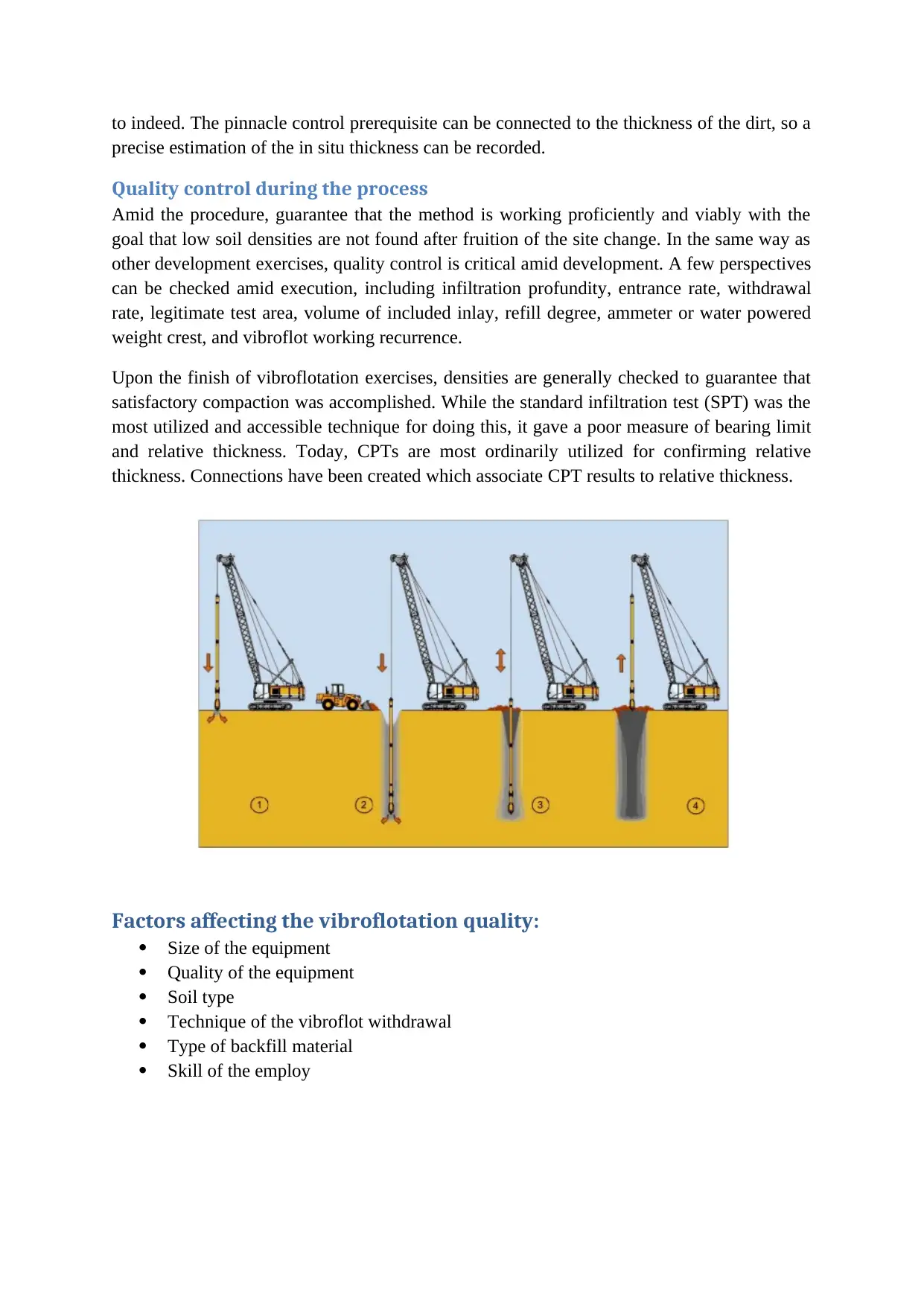
Amid compaction arrange (withdrawal) vibroflot is raised gradually enough to create the
required densification; ordinarily a rate of one foot for each minute is suitable. At the point
when utilized as a part of spotless, coarse sands, an expansion in thickness makes the
obstruction vibroflot movement to build, in this way expanding the engine vitality. The
vitality increment, when checked, can give the premise for controlling the compaction
procedure. This procedure refills the soil with extra compactness with high thickness.
When processing densification measure by checking the measure of fill settlement, it is vital
to represent soil in the exit of vibroflot. 3 Level of compaction is most extreme at focal point
of round and hollow section, and declines with outspread separation. Compaction measure is
relative with the radially outward.
Design of vibrocompaction
Normal establishment outline issues are stresses foreseen circulation foundation.
Geotechnical specialist picks attractive establishment sizes and profundities in view of
foreseen settlements inside a middle of as far as possible. All establishments, accordingly,
ought to be intended to give bolster with least differential settlements. Whenever pushed,
generally auxiliary architects will concur the lion's share of structures, due to a great extent to
strategies utilized as a part of the plan of the structure individuals.
The outline of Vibro-compaction methods separates to two variables - profundity and
separating. Profundity of the treatment can ordinarily be dictated by the connection of
actuated worries by the foreseen establishment loads. Dispersing is dictated by the level of
change of the dirt properties required to restrict settlements and to accomplish safe bearing
limits.
Construction procedure
The vibroflot is embedded into the ground and ordinarily can be utilized to enhance soil up to
profundities of 150 feet. Vibroflotation uses water and the mechanical vibrations of the
vibroflot to move the particles into a denser state. Average outspread separations influenced
go from 5 to 15 feet.
The vibroflot is suspended from a crane and seats on the surface of the ground that will be
moved forward. To infiltrate the material, the base fly is enacted and the vibration starts. The
water immerses the material to make a "sand trap" condition (i.e. incidentally melting the
material), which permits the vibroflot to sink to the coveted profundity of change. By then,
the base fly is ceased and the water is exchanged to the upper fly. This is done to make a
soaked domain encompassing the vibroflot, subsequently improving the compaction of the
material. The vibroflot stays at the coveted profundity of change until the material achieves
satisfactory thickness. The thickness of the dirt is estimated by utilizing the power input (by
means of the electric present or water driven weight) as a list. As the material densities, the
vibroflot requires more capacity to keep vibrating and soon thereafter an ammeter or weight
measure shows a crest in required power.
When this point is come to, the vibroflot is raised one lift (for the most part running from 1 to
3 feet) and compaction results until the pinnacle amperage or water powered weight is come
required densification; ordinarily a rate of one foot for each minute is suitable. At the point
when utilized as a part of spotless, coarse sands, an expansion in thickness makes the
obstruction vibroflot movement to build, in this way expanding the engine vitality. The
vitality increment, when checked, can give the premise for controlling the compaction
procedure. This procedure refills the soil with extra compactness with high thickness.
When processing densification measure by checking the measure of fill settlement, it is vital
to represent soil in the exit of vibroflot. 3 Level of compaction is most extreme at focal point
of round and hollow section, and declines with outspread separation. Compaction measure is
relative with the radially outward.
Design of vibrocompaction
Normal establishment outline issues are stresses foreseen circulation foundation.
Geotechnical specialist picks attractive establishment sizes and profundities in view of
foreseen settlements inside a middle of as far as possible. All establishments, accordingly,
ought to be intended to give bolster with least differential settlements. Whenever pushed,
generally auxiliary architects will concur the lion's share of structures, due to a great extent to
strategies utilized as a part of the plan of the structure individuals.
The outline of Vibro-compaction methods separates to two variables - profundity and
separating. Profundity of the treatment can ordinarily be dictated by the connection of
actuated worries by the foreseen establishment loads. Dispersing is dictated by the level of
change of the dirt properties required to restrict settlements and to accomplish safe bearing
limits.
Construction procedure
The vibroflot is embedded into the ground and ordinarily can be utilized to enhance soil up to
profundities of 150 feet. Vibroflotation uses water and the mechanical vibrations of the
vibroflot to move the particles into a denser state. Average outspread separations influenced
go from 5 to 15 feet.
The vibroflot is suspended from a crane and seats on the surface of the ground that will be
moved forward. To infiltrate the material, the base fly is enacted and the vibration starts. The
water immerses the material to make a "sand trap" condition (i.e. incidentally melting the
material), which permits the vibroflot to sink to the coveted profundity of change. By then,
the base fly is ceased and the water is exchanged to the upper fly. This is done to make a
soaked domain encompassing the vibroflot, subsequently improving the compaction of the
material. The vibroflot stays at the coveted profundity of change until the material achieves
satisfactory thickness. The thickness of the dirt is estimated by utilizing the power input (by
means of the electric present or water driven weight) as a list. As the material densities, the
vibroflot requires more capacity to keep vibrating and soon thereafter an ammeter or weight
measure shows a crest in required power.
When this point is come to, the vibroflot is raised one lift (for the most part running from 1 to
3 feet) and compaction results until the pinnacle amperage or water powered weight is come
Paraphrase This Document
Need a fresh take? Get an instant paraphrase of this document with our AI Paraphraser
to indeed. The pinnacle control prerequisite can be connected to the thickness of the dirt, so a
precise estimation of the in situ thickness can be recorded.
Quality control during the process
Amid the procedure, guarantee that the method is working proficiently and viably with the
goal that low soil densities are not found after fruition of the site change. In the same way as
other development exercises, quality control is critical amid development. A few perspectives
can be checked amid execution, including infiltration profundity, entrance rate, withdrawal
rate, legitimate test area, volume of included inlay, refill degree, ammeter or water powered
weight crest, and vibroflot working recurrence.
Upon the finish of vibroflotation exercises, densities are generally checked to guarantee that
satisfactory compaction was accomplished. While the standard infiltration test (SPT) was the
most utilized and accessible technique for doing this, it gave a poor measure of bearing limit
and relative thickness. Today, CPTs are most ordinarily utilized for confirming relative
thickness. Connections have been created which associate CPT results to relative thickness.
Factors affecting the vibroflotation quality:
Size of the equipment
Quality of the equipment
Soil type
Technique of the vibroflot withdrawal
Type of backfill material
Skill of the employ
precise estimation of the in situ thickness can be recorded.
Quality control during the process
Amid the procedure, guarantee that the method is working proficiently and viably with the
goal that low soil densities are not found after fruition of the site change. In the same way as
other development exercises, quality control is critical amid development. A few perspectives
can be checked amid execution, including infiltration profundity, entrance rate, withdrawal
rate, legitimate test area, volume of included inlay, refill degree, ammeter or water powered
weight crest, and vibroflot working recurrence.
Upon the finish of vibroflotation exercises, densities are generally checked to guarantee that
satisfactory compaction was accomplished. While the standard infiltration test (SPT) was the
most utilized and accessible technique for doing this, it gave a poor measure of bearing limit
and relative thickness. Today, CPTs are most ordinarily utilized for confirming relative
thickness. Connections have been created which associate CPT results to relative thickness.
Factors affecting the vibroflotation quality:
Size of the equipment
Quality of the equipment
Soil type
Technique of the vibroflot withdrawal
Type of backfill material
Skill of the employ
Why there is need of vibroflotation?
Increment in the population, construction and industrialisation is resulting in the development
in the areas where quality and strength of the soil is poor, which needs to be upgraded. And
due to the environment effect features of the quality soils are getting degraded regularly. To
enhance the strength and decrease the compressibility vibroflotation is conducted before
starting of any construction, this increases the life and bearing capacity of the building
structures.
Advantages of vibroflotation
Reduction in the foundation settlement
Arrange for slope steadiness
Prevention of natural disasters like earthquake
Reducing the potential of liquefaction
Literature review
Numerical modelling on vibroflotation soil improvement techniques using a densification
constitutive law is conducted. They utilized finite element modelling to analyse soil
improvements using vibroflotation. They developed a mean densification function for each
and every spatial point. They also optimize the distance between the vibration points (Querol,
Peco & Trujillo 2014).
A simplified homogenization method in stone column design is conducted by establishing the
equivalent material properties. They proposed an effective way of predicting the performance
of stone column, and are termed as equivalent column method. Their model provides
permeability and stiffness. Model developed by them is simpler to the other models available
in the literature as it accurately predicts the consolidation time (Ng & Tan 2015).
Evaluation of the ability to control biological precipitation to improve sandy soils is
conducted. They utilized microbiologically induced calcite precipitation technique for soil
improvements. They targeted their study towards finding the time and location when calcium
carbonate sediments are biologically formed. Model developed by them works very well and
can be used in different applications like control of soil erosion, mitigation of liquefaction
and pollution immobilization (Kalantary & Kahani 2015).
Experimental study of remediation measures of anchored sheet pile quay walls using soil
compaction is conducted. They analysed the effectiveness of soil improvements near to
embedded regions using recorded dynamic responses. The countermeasures used by them
help in reducing the anchor and wall deformations. They found that front densification
increases the tensile force and limited the seaward displacement (Zekri et al 2015)
Experimental research of spatial variation of compaction effect on vibratory probe
compaction method for ground improvement is conducted. They conducted field pilot test for
analysing the spatial variation of the compaction. They found maximum strength at the point
where vibration occurs (Cheng et al, 2017).
Increment in the population, construction and industrialisation is resulting in the development
in the areas where quality and strength of the soil is poor, which needs to be upgraded. And
due to the environment effect features of the quality soils are getting degraded regularly. To
enhance the strength and decrease the compressibility vibroflotation is conducted before
starting of any construction, this increases the life and bearing capacity of the building
structures.
Advantages of vibroflotation
Reduction in the foundation settlement
Arrange for slope steadiness
Prevention of natural disasters like earthquake
Reducing the potential of liquefaction
Literature review
Numerical modelling on vibroflotation soil improvement techniques using a densification
constitutive law is conducted. They utilized finite element modelling to analyse soil
improvements using vibroflotation. They developed a mean densification function for each
and every spatial point. They also optimize the distance between the vibration points (Querol,
Peco & Trujillo 2014).
A simplified homogenization method in stone column design is conducted by establishing the
equivalent material properties. They proposed an effective way of predicting the performance
of stone column, and are termed as equivalent column method. Their model provides
permeability and stiffness. Model developed by them is simpler to the other models available
in the literature as it accurately predicts the consolidation time (Ng & Tan 2015).
Evaluation of the ability to control biological precipitation to improve sandy soils is
conducted. They utilized microbiologically induced calcite precipitation technique for soil
improvements. They targeted their study towards finding the time and location when calcium
carbonate sediments are biologically formed. Model developed by them works very well and
can be used in different applications like control of soil erosion, mitigation of liquefaction
and pollution immobilization (Kalantary & Kahani 2015).
Experimental study of remediation measures of anchored sheet pile quay walls using soil
compaction is conducted. They analysed the effectiveness of soil improvements near to
embedded regions using recorded dynamic responses. The countermeasures used by them
help in reducing the anchor and wall deformations. They found that front densification
increases the tensile force and limited the seaward displacement (Zekri et al 2015)
Experimental research of spatial variation of compaction effect on vibratory probe
compaction method for ground improvement is conducted. They conducted field pilot test for
analysing the spatial variation of the compaction. They found maximum strength at the point
where vibration occurs (Cheng et al, 2017).
⊘ This is a preview!⊘
Do you want full access?
Subscribe today to unlock all pages.
Trusted by 1+ million students worldwide
Ground improvement with the help of rapid impact compaction (RIC), vibroflotation with
stone columns and dynamic cone penetration is conducted. In their study the studied various
ground improvements techniques and selected rapid impact compaction as per the
requirements of the place of the application. They used total of five drills between 15 ft to 30
ft depth. Dynamic cone penetration technique was utilized to check the soil dense quality.
The dynamic cone penetration technique was further increased to 38-46 ft. Their results
indicate that there is chance of liquefaction in the site. They adopted RIC over vibroflotation
and dynamic compaction for the liquefaction as this technique gives better results
(Kristiansen & Davies 2004)
(Liausu and Scache 2009) depict investigation, with impressive dug fill volumes, set
generally thick up to depth of 15m. Paper exhibits part of auxiliary solidification what's more,
broad site observing. The settlement expectation is in light of the technique, dissemination of
pore water with what one anticipates from the combination hypothesis. (Esfahanizadeh &
Atashband 2012) conducted analysis on vibro-probe technique evaluation in soil
improvements against liquefaction. They conducted experimental analysis before and after
the use of vibro-probe to study the liquefaction on the site. They calculated the safety factor
shown in eq. 1 based on the liquefaction.
Safety factor= CRR1 ave
CSR × MSF × K σ × Kα
Where, CRR1ave is cyclic resistance ratio
MSF is magnitude scaling factor
Kσ is stress concentration factor
Kα is ground slope correction factor
(Kim et al. 2009) portrays adjusted application of vacuum weight through pre-assembled
vertical channels. Primary contrast is the non-attendance of any extra charge fills in the
suction depletes technique, which is most helpful in alleviating parallel removals that are
unavoidable under extra charge fill dikes. Likewise, this strategy embraced round depletes
into distinctive segments. Without add up to pressure (surface additional charge fill), the
suction deplete strategy enhances the powerful pressure increment specifically through most
extreme suction impact. This process sometimes suggested as most appropriate process for
shear terms changes. Limited component examination gives an adequate correlation in field
perceptions and figured qualities at different types of soil profundities.
(Burgos, Samper & Alonso 2009) analysed place with mud, by joining spiral waste with a
dirt bond surface outside for included base firmness supporting right around 10 meter of
additional charge. This demonstrates over multiyear is taken for the mud to merge to a decent
level of combination (@ 95%) and to acquire a worthy increment in shear quality drawing
nearer or surpassing the plan an incentive. It appears contrasted with the locales where
vacuum preloading can essentially eliminate the tallness of extra charge fill and solidification
stone columns and dynamic cone penetration is conducted. In their study the studied various
ground improvements techniques and selected rapid impact compaction as per the
requirements of the place of the application. They used total of five drills between 15 ft to 30
ft depth. Dynamic cone penetration technique was utilized to check the soil dense quality.
The dynamic cone penetration technique was further increased to 38-46 ft. Their results
indicate that there is chance of liquefaction in the site. They adopted RIC over vibroflotation
and dynamic compaction for the liquefaction as this technique gives better results
(Kristiansen & Davies 2004)
(Liausu and Scache 2009) depict investigation, with impressive dug fill volumes, set
generally thick up to depth of 15m. Paper exhibits part of auxiliary solidification what's more,
broad site observing. The settlement expectation is in light of the technique, dissemination of
pore water with what one anticipates from the combination hypothesis. (Esfahanizadeh &
Atashband 2012) conducted analysis on vibro-probe technique evaluation in soil
improvements against liquefaction. They conducted experimental analysis before and after
the use of vibro-probe to study the liquefaction on the site. They calculated the safety factor
shown in eq. 1 based on the liquefaction.
Safety factor= CRR1 ave
CSR × MSF × K σ × Kα
Where, CRR1ave is cyclic resistance ratio
MSF is magnitude scaling factor
Kσ is stress concentration factor
Kα is ground slope correction factor
(Kim et al. 2009) portrays adjusted application of vacuum weight through pre-assembled
vertical channels. Primary contrast is the non-attendance of any extra charge fills in the
suction depletes technique, which is most helpful in alleviating parallel removals that are
unavoidable under extra charge fill dikes. Likewise, this strategy embraced round depletes
into distinctive segments. Without add up to pressure (surface additional charge fill), the
suction deplete strategy enhances the powerful pressure increment specifically through most
extreme suction impact. This process sometimes suggested as most appropriate process for
shear terms changes. Limited component examination gives an adequate correlation in field
perceptions and figured qualities at different types of soil profundities.
(Burgos, Samper & Alonso 2009) analysed place with mud, by joining spiral waste with a
dirt bond surface outside for included base firmness supporting right around 10 meter of
additional charge. This demonstrates over multiyear is taken for the mud to merge to a decent
level of combination (@ 95%) and to acquire a worthy increment in shear quality drawing
nearer or surpassing the plan an incentive. It appears contrasted with the locales where
vacuum preloading can essentially eliminate the tallness of extra charge fill and solidification
Paraphrase This Document
Need a fresh take? Get an instant paraphrase of this document with our AI Paraphraser
period, this approach may not be the best if the test is to lessen sidelong developments that
are tragically not given by the Creators.
(Karunawardena & Nithiwana 2009) display a preliminary bank balanced out by vertical
depletes and vacuum union on an extremely delicate and soil which is compressible. The dike
was built multi-organize what's more, rose to a most extreme stature of 11m to accomplish a
high level of solidification with essential combination completely finished following
multiyear of stacking. The settlement and pore weight plots, which obviously demonstrate
that the settlements step by step happen even at hindered abundance pore water weight
scattering. Decrement in the pore water is noted and plotted for 300 days (generally little
increment of suction noted), however increment in settlement is watched and found that there
is very less change, given 25 kPa pressure. Taking note of the simple high bank fill stature
nearly achieving 12m, the little estimation of vacuum weight is by all accounts adequate for
this undertaking. Independent of cost suggestions, an expanded vacuum weight up to state -
50 kPa has shown very large decrement, and required extra charge fill tallness and in addition
giving a superior control of parallel developments.
(Basu, Basu & Prezzi 2009) talks about a diagnostic answer for outspread combination
catching soil aggravation, for a progression of various profile of water. They also studied the
relation between the undistributed and spread zone, to make these water driven conductivity
circulations smoother and that's only the tip of the iceberg sensible, and take after some
change of the first water driven conductivity profiles of the spread zone. They explored the
impact of soil unsettling influence or on the other hand spread impacts utilizing 6 test zones
with a scope of PVD separating differing from 0.9m to 2m. Of course the rate of union
expanded as the dividing diminished, however when the separating was decreased beneath a
basic esteem, the dirt unsettling influence caused was critical that the related increment in
combination was peripheral. They have proposed based on great field information, that the
solidification adequacy will be immaterial if the deplete dividing to successful mandrel
measurement is diminished to an esteem under 8.
(Indraratna, Fatahi, & Khabbaz 2006 and Indraratna et al. 2005) studied about vacuum
preloading and PVD. This type of hypothesis of two dimensions combinations gives nearly a
similar bends as that of three dimensional analyses. It is likewise demonstrated that a relative
high vacuum weight of up to 70 kPa can essentially diminish the required fill tallness for
accomplishing an attractive level of combination surpassing 95%. They additionally
demonstrate that for this regularly solidified delicate dirt, the altered Cam-earth parameters
are adequate to anticipate with satisfactory precision, the settlements, pore weights and
sidelong removals.
(Kurka and Zavoral 2009) exhibit a complete logical strategy to ascertain strains and stresses,
enhanced by a gathering of smashed rock sections in their study, Takahashi et al. in their
study utilized a model to examine distortion examples of sand compaction heaps. They
reason that the uprooting of enhanced ground expanded with refill stacking. Execution of
granular heaps introduced with oil tank capacity. (Ranjan, Sundaram & Gupta 2009) watch
that the proportion of settlement amongst soil and heaps isn't in an indistinguishable
are tragically not given by the Creators.
(Karunawardena & Nithiwana 2009) display a preliminary bank balanced out by vertical
depletes and vacuum union on an extremely delicate and soil which is compressible. The dike
was built multi-organize what's more, rose to a most extreme stature of 11m to accomplish a
high level of solidification with essential combination completely finished following
multiyear of stacking. The settlement and pore weight plots, which obviously demonstrate
that the settlements step by step happen even at hindered abundance pore water weight
scattering. Decrement in the pore water is noted and plotted for 300 days (generally little
increment of suction noted), however increment in settlement is watched and found that there
is very less change, given 25 kPa pressure. Taking note of the simple high bank fill stature
nearly achieving 12m, the little estimation of vacuum weight is by all accounts adequate for
this undertaking. Independent of cost suggestions, an expanded vacuum weight up to state -
50 kPa has shown very large decrement, and required extra charge fill tallness and in addition
giving a superior control of parallel developments.
(Basu, Basu & Prezzi 2009) talks about a diagnostic answer for outspread combination
catching soil aggravation, for a progression of various profile of water. They also studied the
relation between the undistributed and spread zone, to make these water driven conductivity
circulations smoother and that's only the tip of the iceberg sensible, and take after some
change of the first water driven conductivity profiles of the spread zone. They explored the
impact of soil unsettling influence or on the other hand spread impacts utilizing 6 test zones
with a scope of PVD separating differing from 0.9m to 2m. Of course the rate of union
expanded as the dividing diminished, however when the separating was decreased beneath a
basic esteem, the dirt unsettling influence caused was critical that the related increment in
combination was peripheral. They have proposed based on great field information, that the
solidification adequacy will be immaterial if the deplete dividing to successful mandrel
measurement is diminished to an esteem under 8.
(Indraratna, Fatahi, & Khabbaz 2006 and Indraratna et al. 2005) studied about vacuum
preloading and PVD. This type of hypothesis of two dimensions combinations gives nearly a
similar bends as that of three dimensional analyses. It is likewise demonstrated that a relative
high vacuum weight of up to 70 kPa can essentially diminish the required fill tallness for
accomplishing an attractive level of combination surpassing 95%. They additionally
demonstrate that for this regularly solidified delicate dirt, the altered Cam-earth parameters
are adequate to anticipate with satisfactory precision, the settlements, pore weights and
sidelong removals.
(Kurka and Zavoral 2009) exhibit a complete logical strategy to ascertain strains and stresses,
enhanced by a gathering of smashed rock sections in their study, Takahashi et al. in their
study utilized a model to examine distortion examples of sand compaction heaps. They
reason that the uprooting of enhanced ground expanded with refill stacking. Execution of
granular heaps introduced with oil tank capacity. (Ranjan, Sundaram & Gupta 2009) watch
that the proportion of settlement amongst soil and heaps isn't in an indistinguishable
proportion from the expansion in the heap top size. (Indraratna, Fatahi, & Khabbaz 2006)
concluded that the use of sand compaction helps in controlling the dislodging of the soil and
also helps in increasing the strength.
(Kasper et al. 2009) in their study used joined bond profound blending to control the very
fine type of dirt settlements. SCP value is clarified to quicken abundance pore weight
dispersal along these lines accomplishing brisk quality pick up of the marine dirt, while the
bond profound blending technique was utilized to build the firmness of the establishment for
the small duration. SCP quality liquefaction study is also carried out with the help of triaxial
type testing. They concluded that liquefaction quality can be enhanced by SCP with infused
air. They conducted analyses on soil and foundation stability improvements by stone column.
They selected the Adapazari city of Turkey as their place of study because painful experience
of its in earthquakes. As most of the structures build in this area have very less strength due
to the loose soil. They targeted their study towards strengthening the building structure with
the improvements in the soil quality. They introduced a new method of using modified dry
bottom feed stone column. They also conducted the numerical analysis considering the same
type of initial conditions and validated them with the results. They utilized finite element
modelling for the plain stress condition numerical analysis. Finite element analysis is an
advanced method to analysis any practical application. In finite element analysis we divide
the domain into number of smaller elements, all the elements has some kind of boundary
conditions. Finite element analysis is basically an approach of design in which one divide its
domain or system into elements, on which analysis is conducted. Finite element analysis has
two siblings named as finite volume analysis and finite volume analysis. Finite difference
analysis is the easiest way of solving a problem using numerical methods while finite volume
method is the most difficult one. As the name suggest in finite difference method one divide
the system into small number of discrete part, while in finite element analysis one divide the
system into smaller number of elements while in finite volume method one divide the system
into smaller number of finite volumes. Finite difference method is mostly utilized in the
academic industries while finite element method and finite volume method are mostly
utilized in the industries dealing with real life problem solution. All the methods finite
difference method (FDM), finite element method (FEM) and finite volume method (FVM)
are based on the partial differential equation. These all three method converts the partial
differential into some sort of algebraic form which further utilized to solve the problem with
the help of applied boundary conditions. In these methods we divide the domain into number
of nodes or elements, which is also called as meshing. Meshing is a very important part of the
finite element analysis, as meshing can also give inaccurate results in spite of the accurate
boundary condition or mathematical model used. Higher the meshing accurate the results will
be, but higher meshing also results in higher large computation time and memory used of the
computer. So to solve a problem using FEM one needs an expert before doing the solution of
the problem.
(Ameratunga et al. 2009) display a contextual investigation of profound soil blending
utilizing the Cutter Soil Mixing procedure under a capacity tank. They composed the heap
top to encourage the heap dispersion and breaking point the differential settlements over the
concluded that the use of sand compaction helps in controlling the dislodging of the soil and
also helps in increasing the strength.
(Kasper et al. 2009) in their study used joined bond profound blending to control the very
fine type of dirt settlements. SCP value is clarified to quicken abundance pore weight
dispersal along these lines accomplishing brisk quality pick up of the marine dirt, while the
bond profound blending technique was utilized to build the firmness of the establishment for
the small duration. SCP quality liquefaction study is also carried out with the help of triaxial
type testing. They concluded that liquefaction quality can be enhanced by SCP with infused
air. They conducted analyses on soil and foundation stability improvements by stone column.
They selected the Adapazari city of Turkey as their place of study because painful experience
of its in earthquakes. As most of the structures build in this area have very less strength due
to the loose soil. They targeted their study towards strengthening the building structure with
the improvements in the soil quality. They introduced a new method of using modified dry
bottom feed stone column. They also conducted the numerical analysis considering the same
type of initial conditions and validated them with the results. They utilized finite element
modelling for the plain stress condition numerical analysis. Finite element analysis is an
advanced method to analysis any practical application. In finite element analysis we divide
the domain into number of smaller elements, all the elements has some kind of boundary
conditions. Finite element analysis is basically an approach of design in which one divide its
domain or system into elements, on which analysis is conducted. Finite element analysis has
two siblings named as finite volume analysis and finite volume analysis. Finite difference
analysis is the easiest way of solving a problem using numerical methods while finite volume
method is the most difficult one. As the name suggest in finite difference method one divide
the system into small number of discrete part, while in finite element analysis one divide the
system into smaller number of elements while in finite volume method one divide the system
into smaller number of finite volumes. Finite difference method is mostly utilized in the
academic industries while finite element method and finite volume method are mostly
utilized in the industries dealing with real life problem solution. All the methods finite
difference method (FDM), finite element method (FEM) and finite volume method (FVM)
are based on the partial differential equation. These all three method converts the partial
differential into some sort of algebraic form which further utilized to solve the problem with
the help of applied boundary conditions. In these methods we divide the domain into number
of nodes or elements, which is also called as meshing. Meshing is a very important part of the
finite element analysis, as meshing can also give inaccurate results in spite of the accurate
boundary condition or mathematical model used. Higher the meshing accurate the results will
be, but higher meshing also results in higher large computation time and memory used of the
computer. So to solve a problem using FEM one needs an expert before doing the solution of
the problem.
(Ameratunga et al. 2009) display a contextual investigation of profound soil blending
utilizing the Cutter Soil Mixing procedure under a capacity tank. They composed the heap
top to encourage the heap dispersion and breaking point the differential settlements over the
⊘ This is a preview!⊘
Do you want full access?
Subscribe today to unlock all pages.
Trusted by 1+ million students worldwide
establishment. (Ishikura, Ochiai, & Matsui 2009) in view of the profound blending section,
examined the idea of homogenized composite ground to foresee the settlement precisely.
Green et al. proposed a scope of coordinated quality control of twist drill heaps to kill
vulnerability with respect to the pressure exchange between the heap base what's more,
bedrock. Various 100mm measurement steel tubes were put in a round course of action into
the augured opening along with the steel strengthening to check for voids or inconsistencies
in the solid.
(Martin and Olgun 2009) think about the waste condition and quality of micro piles, they
utilized a scaled physical model in the research facility to contemplate the execution of micro
piles. The test comes about suggest that the micro piles can initiate spiral union, and
furthermore lessen add up to settlement by expanded distance across. They utilized a 3-D
dynamic FEM to examine a conceivable lessening in seismic ground movements in different
ground change methods including stone sections, stream grouting, and soil blending. Their
outcomes demonstrate that solid ground fortifications masterminded in cross section write
soil-blend boards may essentially diminish ground developments.
Rich research facility axes think about was led by (Pooley 2005) on a dirt landfill that is
exceedingly inhomogeneous. These earth knots are twofold porosity by definition due to the
between molecule voids inside the over-united single earth protuberances, and the intra-
molecule voids between the knots. Scale down earth knots (from 50cm to 10mm) were
utilized as a part of the drum axis and dynamic compaction was done in trip to demonstrate
the worry in the dirt, utilizing a formerly created compaction apparatus (Chikatamarla 2006).
The pore weight reaction because of effect is all around checked over the affect zone. By and
large, the test outcomes gave a great relationship between compaction vitality and the related
soil firmness, subsequently the net soil weight dislodging connections. Be that as it may, a
confinement of the investigation could be the real exchange of the vitality levels to the field,
given the distinctive limit states of the rotator.
(Ouni, Bouassida, & Das 2009) portray the utilization of this strategy for enhancing the
liquefaction capability of Tunisian sand, with both SPT and CPT comes about previously,
then after the fact densification for an earth dam establishment, principally comprising of
alluvial sands and rises. The made strides soils are found to limit potential harm from tremors
at 0.15-0.20g. Run of the mill enhanced SPT esteems. (Rodriguez 2010) analysed vibro
techniques for ground improvements. They analysed different vibro techniques like Wet Top-
Feed or Blanket Feed Method, Wet Bottom-Feed Method (Aquacaster System), Marine
Vibrocompaction, Dredged Trench Method.
Profound blending strategy was produced in Japan and Scandinavian nations in mid-1970's.
From that point forward a considerable measure of investigate have been done on the around
there of ground change. (Lemanza & Lesmana 2009) have exhibited profound blending with
fly grouting strategy as a moderately new system. Creators trust that the joining of the two
techniques can join the upsides of the two strategies and diminish the restrictions in fact and
financially. In view of the case consider comes about, both mechanical blending part and
examined the idea of homogenized composite ground to foresee the settlement precisely.
Green et al. proposed a scope of coordinated quality control of twist drill heaps to kill
vulnerability with respect to the pressure exchange between the heap base what's more,
bedrock. Various 100mm measurement steel tubes were put in a round course of action into
the augured opening along with the steel strengthening to check for voids or inconsistencies
in the solid.
(Martin and Olgun 2009) think about the waste condition and quality of micro piles, they
utilized a scaled physical model in the research facility to contemplate the execution of micro
piles. The test comes about suggest that the micro piles can initiate spiral union, and
furthermore lessen add up to settlement by expanded distance across. They utilized a 3-D
dynamic FEM to examine a conceivable lessening in seismic ground movements in different
ground change methods including stone sections, stream grouting, and soil blending. Their
outcomes demonstrate that solid ground fortifications masterminded in cross section write
soil-blend boards may essentially diminish ground developments.
Rich research facility axes think about was led by (Pooley 2005) on a dirt landfill that is
exceedingly inhomogeneous. These earth knots are twofold porosity by definition due to the
between molecule voids inside the over-united single earth protuberances, and the intra-
molecule voids between the knots. Scale down earth knots (from 50cm to 10mm) were
utilized as a part of the drum axis and dynamic compaction was done in trip to demonstrate
the worry in the dirt, utilizing a formerly created compaction apparatus (Chikatamarla 2006).
The pore weight reaction because of effect is all around checked over the affect zone. By and
large, the test outcomes gave a great relationship between compaction vitality and the related
soil firmness, subsequently the net soil weight dislodging connections. Be that as it may, a
confinement of the investigation could be the real exchange of the vitality levels to the field,
given the distinctive limit states of the rotator.
(Ouni, Bouassida, & Das 2009) portray the utilization of this strategy for enhancing the
liquefaction capability of Tunisian sand, with both SPT and CPT comes about previously,
then after the fact densification for an earth dam establishment, principally comprising of
alluvial sands and rises. The made strides soils are found to limit potential harm from tremors
at 0.15-0.20g. Run of the mill enhanced SPT esteems. (Rodriguez 2010) analysed vibro
techniques for ground improvements. They analysed different vibro techniques like Wet Top-
Feed or Blanket Feed Method, Wet Bottom-Feed Method (Aquacaster System), Marine
Vibrocompaction, Dredged Trench Method.
Profound blending strategy was produced in Japan and Scandinavian nations in mid-1970's.
From that point forward a considerable measure of investigate have been done on the around
there of ground change. (Lemanza & Lesmana 2009) have exhibited profound blending with
fly grouting strategy as a moderately new system. Creators trust that the joining of the two
techniques can join the upsides of the two strategies and diminish the restrictions in fact and
financially. In view of the case consider comes about, both mechanical blending part and
Paraphrase This Document
Need a fresh take? Get an instant paraphrase of this document with our AI Paraphraser
stream grouting part can deliver sensible treatment likenesses as far as thickness, quality and
firmness.
(Dejong et al. 2009) have exhibited the capability of biomediated soil change for geotechnical
application. Biomediated soil change depends on the geotechnical forms that are encouraged
by huge natural action. Creators have introduced the aftereffects of their starter examination
completed on extensive scale research centre types of gear, non-dangerous geophysical
estimations and demonstrating to build up an improved advertisement unsurprising bio-
interceded treatment strategy. Creators additionally feature the on-going examination in this
territory and have called attention to the requirement for more ecological well-disposed
techniques in the territory of soil change. (Molendijk, Van-der-Zon & Van-Meurs 2009)
displayed the dirt change technique in view of microbiologically prompted precipitation of
calcium carbonate. The hastened calcium carbonate precious stones shape connects between
the sand grains, which builds the quality of sand mass and named this new method as
BioGrout/brilliant soils. As of late, they have demonstrated the potential advantage of
lignosulfonate for delicate soil change. Lignosulfonate has a place with a group of lignin
based natural polymers inferred as a loss result from wood and paper handling industry.
(Khasanov, Khasanov, & Ikramov 2009) examined base twisting structures and (ii) diverse
strategies for reinforcing establishment for various chronicled landmarks. Creators assert that
the principle explanations behind base disfigurements might be non-uniform structures and
materilas. Likewise, contextual analyses they prescribe utilization of innovation for fortifying
soils on establishments of landmarks. (Noorzad, Falamaki, & Shariatmadari 2009) studied
change of fine grained soils by electro-kinetic infusion. (Mohammad, Hashim and Salman
2010) analysed effective improvement depth for ground treated with rapid impact
compaction. They analysed the rapid impact compaction efficiency and compared it with the
deep dynamic compaction technique. They utilized this technique with the help of 7 tone
weight. They dropped it from a height of 0.8 meter, 35 times per minute. They compared the
tip resistance before and after the pre-treatment process. They developed a formula for
calculation of the effective depth, they also discussed the improvements in the effective depth
and factors which affect the effective depth. They concluded that effective depth measure by
rapid impact compaction technique is depending upon the energy applied and properties of
the soil. They concluded that vibrations measure by rapid impact compaction machine is
within the permissible limit.
(Jiang et al 2015) conducted numerical simulation of vibroflotation without the use of
backfill. They targeted their study towards analysing the macro reinforcement mechanism of
the vibroflotation. They utilized discrete element method for their numerical simulation study
as this technique is very helpful in studying the failure and deformation. They utilized a
model proposed in the literature based on the inter-particle rolling resistance. They proposed
a new variable β, which includes the effect of the irregular shapes of the particles. They also
examined the other rolling resistance parameters which affect the passive earth pressure.
They conducted total of 12 number of numerical simulation for their analysis. They utilized
UCM (under compaction multi-layer) technique for development of the ground surface. They
firmness.
(Dejong et al. 2009) have exhibited the capability of biomediated soil change for geotechnical
application. Biomediated soil change depends on the geotechnical forms that are encouraged
by huge natural action. Creators have introduced the aftereffects of their starter examination
completed on extensive scale research centre types of gear, non-dangerous geophysical
estimations and demonstrating to build up an improved advertisement unsurprising bio-
interceded treatment strategy. Creators additionally feature the on-going examination in this
territory and have called attention to the requirement for more ecological well-disposed
techniques in the territory of soil change. (Molendijk, Van-der-Zon & Van-Meurs 2009)
displayed the dirt change technique in view of microbiologically prompted precipitation of
calcium carbonate. The hastened calcium carbonate precious stones shape connects between
the sand grains, which builds the quality of sand mass and named this new method as
BioGrout/brilliant soils. As of late, they have demonstrated the potential advantage of
lignosulfonate for delicate soil change. Lignosulfonate has a place with a group of lignin
based natural polymers inferred as a loss result from wood and paper handling industry.
(Khasanov, Khasanov, & Ikramov 2009) examined base twisting structures and (ii) diverse
strategies for reinforcing establishment for various chronicled landmarks. Creators assert that
the principle explanations behind base disfigurements might be non-uniform structures and
materilas. Likewise, contextual analyses they prescribe utilization of innovation for fortifying
soils on establishments of landmarks. (Noorzad, Falamaki, & Shariatmadari 2009) studied
change of fine grained soils by electro-kinetic infusion. (Mohammad, Hashim and Salman
2010) analysed effective improvement depth for ground treated with rapid impact
compaction. They analysed the rapid impact compaction efficiency and compared it with the
deep dynamic compaction technique. They utilized this technique with the help of 7 tone
weight. They dropped it from a height of 0.8 meter, 35 times per minute. They compared the
tip resistance before and after the pre-treatment process. They developed a formula for
calculation of the effective depth, they also discussed the improvements in the effective depth
and factors which affect the effective depth. They concluded that effective depth measure by
rapid impact compaction technique is depending upon the energy applied and properties of
the soil. They concluded that vibrations measure by rapid impact compaction machine is
within the permissible limit.
(Jiang et al 2015) conducted numerical simulation of vibroflotation without the use of
backfill. They targeted their study towards analysing the macro reinforcement mechanism of
the vibroflotation. They utilized discrete element method for their numerical simulation study
as this technique is very helpful in studying the failure and deformation. They utilized a
model proposed in the literature based on the inter-particle rolling resistance. They proposed
a new variable β, which includes the effect of the irregular shapes of the particles. They also
examined the other rolling resistance parameters which affect the passive earth pressure.
They conducted total of 12 number of numerical simulation for their analysis. They utilized
UCM (under compaction multi-layer) technique for development of the ground surface. They
concluded that their results are good and matched with the practical observations. They
calculated the void ratio and fond that it fluctuates with the process and slowly diminishes.
(Kachra, Patel, & Patel 2016) studied different ground improvements techniques. They
utilized different vibrocompaction techniques like, vibro consolidation, grouting method,
dewatering method and soil nailing. They used vacuum pump for softening of the soil in
vacuum consolidation.
Conclusion
In the present work a study of different ground improvement techniques have been studied in
details. Different techniques which help in increasing the soil strength and decreasing the
compressibility are also studied in details. There are wide varieties of methods and techniques
which can help in increasing the soil strength. Rapid impact compaction is a very great
method which increases the strength of the soil by great amount which further helps in
increasing the strength of the building or structures. Vibroflotation is a very good technique
which automatically increases the soil quality after the utilization of the vibroflot which
increases the strength at the point where necessary.
References
Ameratunga, J., Brown, D., Ramachandran, M., & Denny, R., (2009), Ground improvement
for a large above ground storage tank using cutter soil mix columns, Proceedings of the 17th
International Conference on Soil Mechanics and Geotechnical Engineering, 2280-2283.
Basu, D., Basu, P., & Prezzi, M., (2009), Analytical Solutions for Vertical Drains
Considering Soil Disturbance, Proceedings of the 17th International Conference on Soil
Mechanics and Geotechnical Engineering, 2220-2223.
Burgos, M., Samper, F., & Alonso, J.J., (2009), Very soft dredged mud improvement in the
Port of Valencia, 7th International Conference on Soil Mechanics and Geotechnical
Engineering, 2342-2345.
Cheng, Y., Zhu, H., Jing, F., Du, G., Yan, C., & Liu, Z., (2017), Experimental research of
spatial variation of compaction effect on vibratory probe compaction method for ground
improvement, Procedia Engineering, 189, 466-471.
Chikatamarla, R., (2006), Modelling of rock falls on protection galleries, 2nd International
Conference on Physical Modelling in Geotechnical Engineering, 331-336.
Dejong, J. T., Mortensen, B., Martinez, B., & Nelson, D., (2009), Upscaling of bio-mediated
soil improvement, 17th International Conference on Soil Mechanics and Geotechnical
Engineering, 2300-2303.
Esfahanizadeh, M., & Atashband, S., (2012), Vibro-Probe Technique Evaluation in Soil
Improvement against Liquefaction, 15 WCEE, LISBOA.
calculated the void ratio and fond that it fluctuates with the process and slowly diminishes.
(Kachra, Patel, & Patel 2016) studied different ground improvements techniques. They
utilized different vibrocompaction techniques like, vibro consolidation, grouting method,
dewatering method and soil nailing. They used vacuum pump for softening of the soil in
vacuum consolidation.
Conclusion
In the present work a study of different ground improvement techniques have been studied in
details. Different techniques which help in increasing the soil strength and decreasing the
compressibility are also studied in details. There are wide varieties of methods and techniques
which can help in increasing the soil strength. Rapid impact compaction is a very great
method which increases the strength of the soil by great amount which further helps in
increasing the strength of the building or structures. Vibroflotation is a very good technique
which automatically increases the soil quality after the utilization of the vibroflot which
increases the strength at the point where necessary.
References
Ameratunga, J., Brown, D., Ramachandran, M., & Denny, R., (2009), Ground improvement
for a large above ground storage tank using cutter soil mix columns, Proceedings of the 17th
International Conference on Soil Mechanics and Geotechnical Engineering, 2280-2283.
Basu, D., Basu, P., & Prezzi, M., (2009), Analytical Solutions for Vertical Drains
Considering Soil Disturbance, Proceedings of the 17th International Conference on Soil
Mechanics and Geotechnical Engineering, 2220-2223.
Burgos, M., Samper, F., & Alonso, J.J., (2009), Very soft dredged mud improvement in the
Port of Valencia, 7th International Conference on Soil Mechanics and Geotechnical
Engineering, 2342-2345.
Cheng, Y., Zhu, H., Jing, F., Du, G., Yan, C., & Liu, Z., (2017), Experimental research of
spatial variation of compaction effect on vibratory probe compaction method for ground
improvement, Procedia Engineering, 189, 466-471.
Chikatamarla, R., (2006), Modelling of rock falls on protection galleries, 2nd International
Conference on Physical Modelling in Geotechnical Engineering, 331-336.
Dejong, J. T., Mortensen, B., Martinez, B., & Nelson, D., (2009), Upscaling of bio-mediated
soil improvement, 17th International Conference on Soil Mechanics and Geotechnical
Engineering, 2300-2303.
Esfahanizadeh, M., & Atashband, S., (2012), Vibro-Probe Technique Evaluation in Soil
Improvement against Liquefaction, 15 WCEE, LISBOA.
⊘ This is a preview!⊘
Do you want full access?
Subscribe today to unlock all pages.
Trusted by 1+ million students worldwide

1 out of 14


Your All-in-One AI-Powered Toolkit for Academic Success.
+13062052269
info@desklib.com
Available 24*7 on WhatsApp / Email
![[object Object]](/_next/static/media/star-bottom.7253800d.svg)
Unlock your academic potential
Copyright © 2020–2026 A2Z Services. All Rights Reserved. Developed and managed by ZUCOL.