The Impact of Vicarious Trauma on Therapists: A Reflective Essay
VerifiedAdded on 2022/11/14
|7
|1417
|215
Essay
AI Summary
This essay delves into the concept of vicarious trauma, a form of compassion fatigue affecting therapists who work with trauma survivors. The essay begins by defining vicarious trauma, drawing upon research and literature to explain its causes and manifestations. It then explores the risk factors that make therapists vulnerable, including work environment, personal experiences, and social aspects, with the author reflecting on their own experiences within an underdeveloped healthcare setting. The essay further discusses strategies for buffering against and managing vicarious traumatization, such as self-awareness, exercise, and professional development, offering insights into the author's personal approach to these strategies. The essay concludes by emphasizing the importance of controlled empathy and seeking support when necessary, providing a comprehensive understanding of vicarious trauma and its impact on mental health professionals.
Running head; VICARIOUS TRAUMA 1
VICARIOUS TRAUMA
Name
Affiliate institution
Tutor
Date
VICARIOUS TRAUMA
Name
Affiliate institution
Tutor
Date
Paraphrase This Document
Need a fresh take? Get an instant paraphrase of this document with our AI Paraphraser

VICARIOUS TRAUMA 2
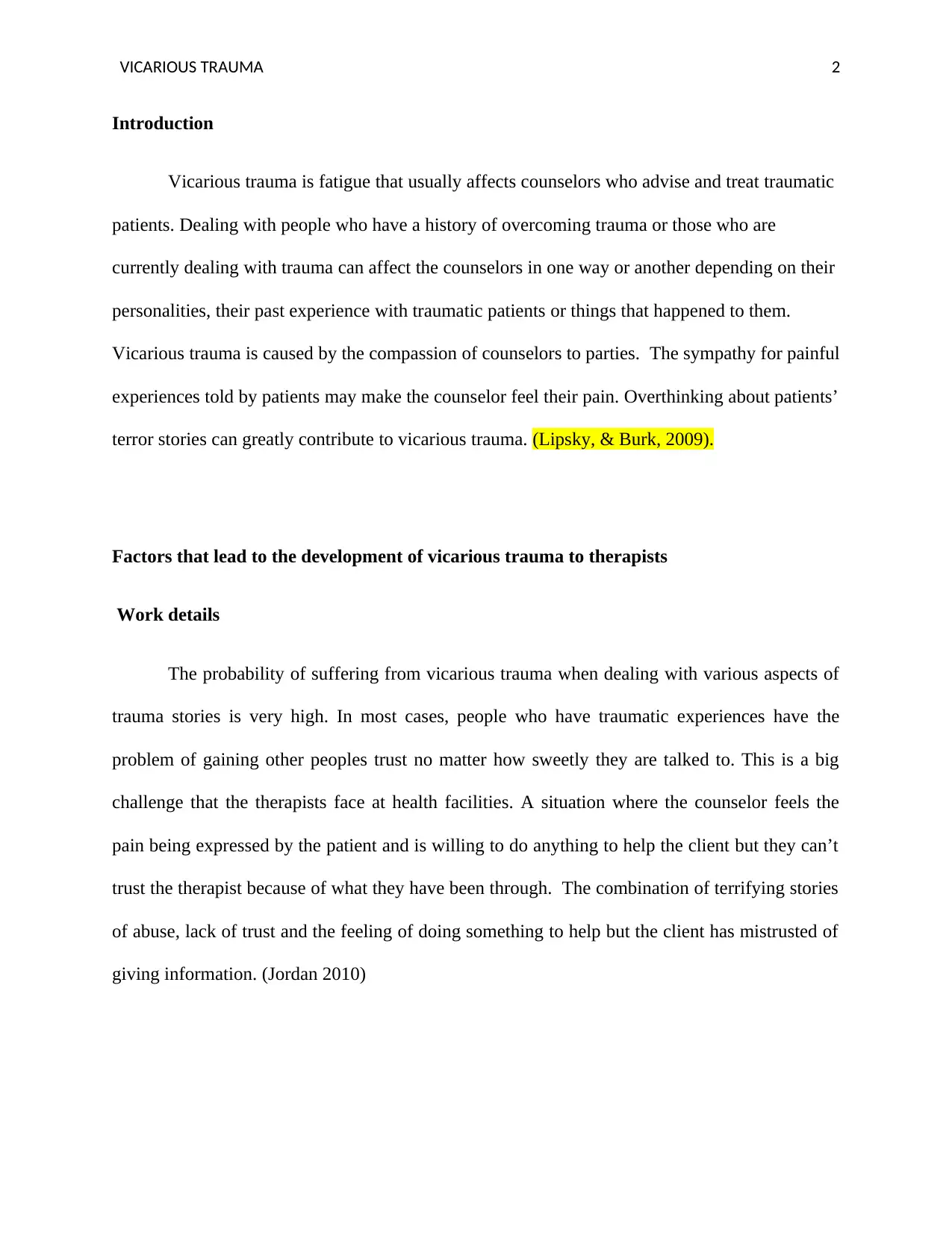
Introduction
Vicarious trauma is fatigue that usually affects counselors who advise and treat traumatic
patients. Dealing with people who have a history of overcoming trauma or those who are
currently dealing with trauma can affect the counselors in one way or another depending on their
personalities, their past experience with traumatic patients or things that happened to them.
Vicarious trauma is caused by the compassion of counselors to parties. The sympathy for painful
experiences told by patients may make the counselor feel their pain. Overthinking about patients’
terror stories can greatly contribute to vicarious trauma. (Lipsky, & Burk, 2009).
Factors that lead to the development of vicarious trauma to therapists
Work details
The probability of suffering from vicarious trauma when dealing with various aspects of
trauma stories is very high. In most cases, people who have traumatic experiences have the
problem of gaining other peoples trust no matter how sweetly they are talked to. This is a big
challenge that the therapists face at health facilities. A situation where the counselor feels the
pain being expressed by the patient and is willing to do anything to help the client but they can’t
trust the therapist because of what they have been through. The combination of terrifying stories
of abuse, lack of trust and the feeling of doing something to help but the client has mistrusted of
giving information. (Jordan 2010)
Introduction
Vicarious trauma is fatigue that usually affects counselors who advise and treat traumatic
patients. Dealing with people who have a history of overcoming trauma or those who are
currently dealing with trauma can affect the counselors in one way or another depending on their
personalities, their past experience with traumatic patients or things that happened to them.
Vicarious trauma is caused by the compassion of counselors to parties. The sympathy for painful
experiences told by patients may make the counselor feel their pain. Overthinking about patients’
terror stories can greatly contribute to vicarious trauma. (Lipsky, & Burk, 2009).
Factors that lead to the development of vicarious trauma to therapists
Work details
The probability of suffering from vicarious trauma when dealing with various aspects of
trauma stories is very high. In most cases, people who have traumatic experiences have the
problem of gaining other peoples trust no matter how sweetly they are talked to. This is a big
challenge that the therapists face at health facilities. A situation where the counselor feels the
pain being expressed by the patient and is willing to do anything to help the client but they can’t
trust the therapist because of what they have been through. The combination of terrifying stories
of abuse, lack of trust and the feeling of doing something to help but the client has mistrusted of
giving information. (Jordan 2010)

VICARIOUS TRAUMA 3
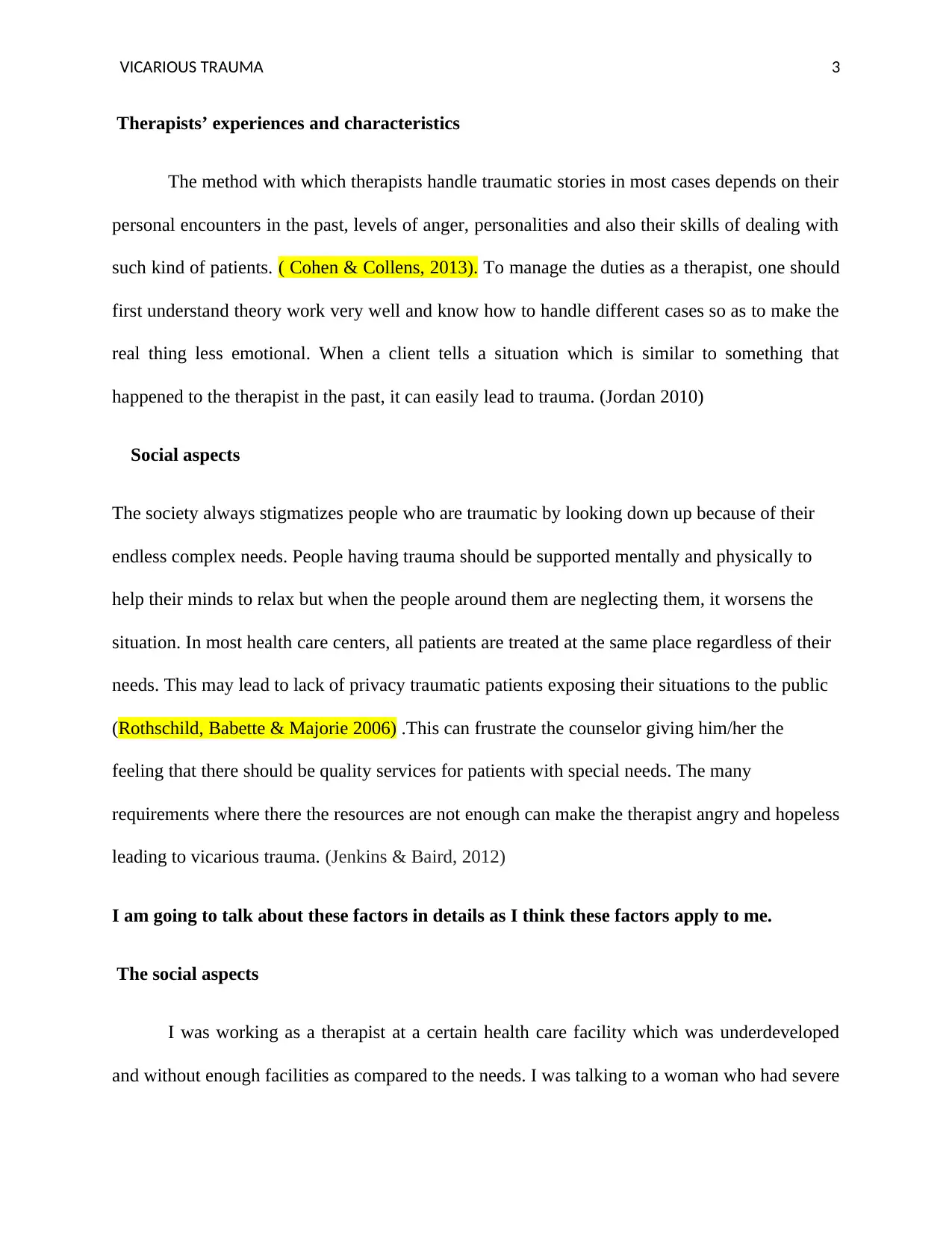
Therapists’ experiences and characteristics
The method with which therapists handle traumatic stories in most cases depends on their
personal encounters in the past, levels of anger, personalities and also their skills of dealing with
such kind of patients. ( Cohen & Collens, 2013). To manage the duties as a therapist, one should
first understand theory work very well and know how to handle different cases so as to make the
real thing less emotional. When a client tells a situation which is similar to something that
happened to the therapist in the past, it can easily lead to trauma. (Jordan 2010)
Social aspects
The society always stigmatizes people who are traumatic by looking down up because of their
endless complex needs. People having trauma should be supported mentally and physically to
help their minds to relax but when the people around them are neglecting them, it worsens the
situation. In most health care centers, all patients are treated at the same place regardless of their
needs. This may lead to lack of privacy traumatic patients exposing their situations to the public
(Rothschild, Babette & Majorie 2006) .This can frustrate the counselor giving him/her the
feeling that there should be quality services for patients with special needs. The many
requirements where there the resources are not enough can make the therapist angry and hopeless
leading to vicarious trauma. (Jenkins & Baird, 2012)
I am going to talk about these factors in details as I think these factors apply to me.
The social aspects
I was working as a therapist at a certain health care facility which was underdeveloped
and without enough facilities as compared to the needs. I was talking to a woman who had severe
Therapists’ experiences and characteristics
The method with which therapists handle traumatic stories in most cases depends on their
personal encounters in the past, levels of anger, personalities and also their skills of dealing with
such kind of patients. ( Cohen & Collens, 2013). To manage the duties as a therapist, one should
first understand theory work very well and know how to handle different cases so as to make the
real thing less emotional. When a client tells a situation which is similar to something that
happened to the therapist in the past, it can easily lead to trauma. (Jordan 2010)
Social aspects
The society always stigmatizes people who are traumatic by looking down up because of their
endless complex needs. People having trauma should be supported mentally and physically to
help their minds to relax but when the people around them are neglecting them, it worsens the
situation. In most health care centers, all patients are treated at the same place regardless of their
needs. This may lead to lack of privacy traumatic patients exposing their situations to the public
(Rothschild, Babette & Majorie 2006) .This can frustrate the counselor giving him/her the
feeling that there should be quality services for patients with special needs. The many
requirements where there the resources are not enough can make the therapist angry and hopeless
leading to vicarious trauma. (Jenkins & Baird, 2012)
I am going to talk about these factors in details as I think these factors apply to me.
The social aspects
I was working as a therapist at a certain health care facility which was underdeveloped
and without enough facilities as compared to the needs. I was talking to a woman who had severe
⊘ This is a preview!⊘
Do you want full access?
Subscribe today to unlock all pages.

Trusted by 1+ million students worldwide

VICARIOUS TRAUMA 4
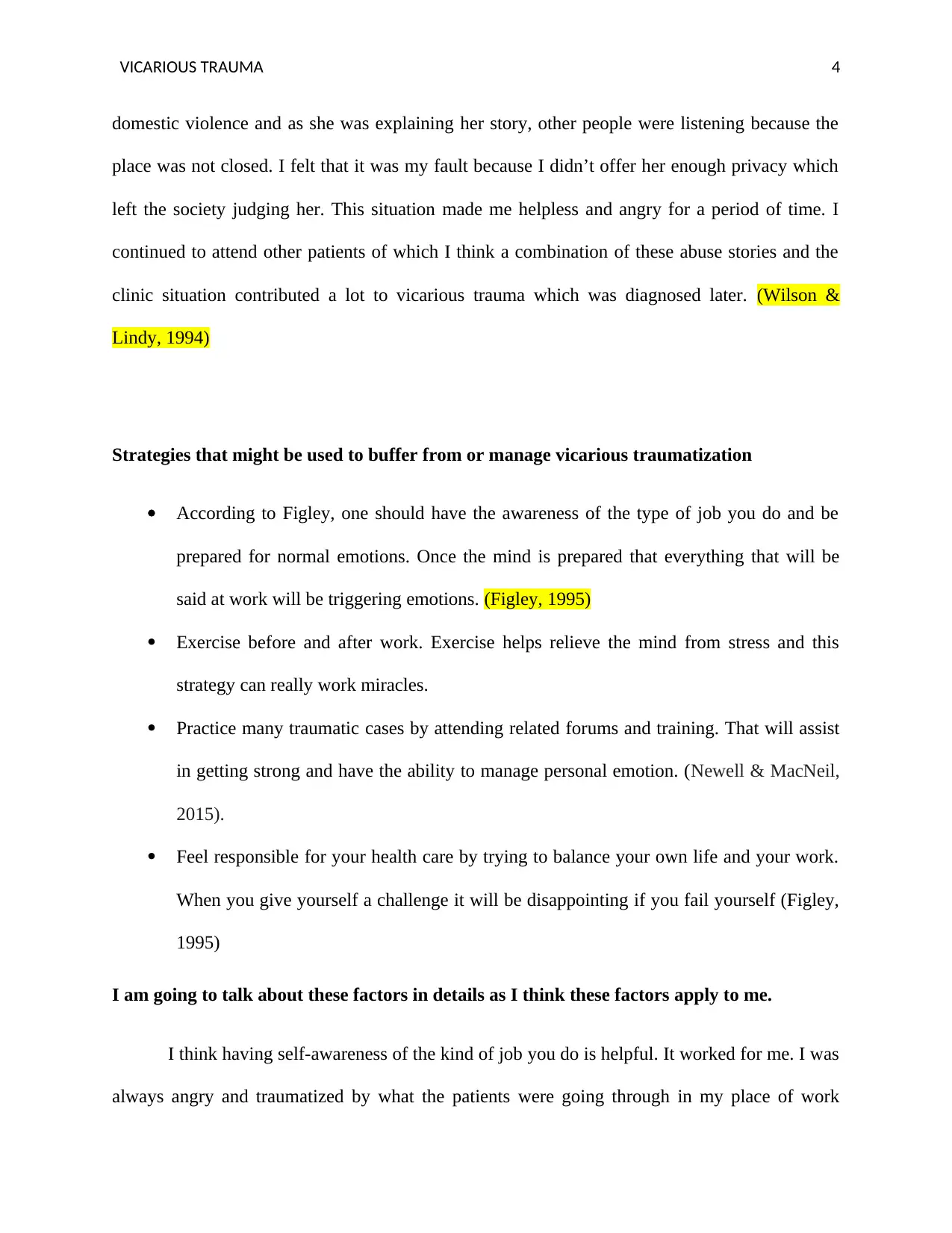
domestic violence and as she was explaining her story, other people were listening because the
place was not closed. I felt that it was my fault because I didn’t offer her enough privacy which
left the society judging her. This situation made me helpless and angry for a period of time. I
continued to attend other patients of which I think a combination of these abuse stories and the
clinic situation contributed a lot to vicarious trauma which was diagnosed later. (Wilson &
Lindy, 1994)
Strategies that might be used to buffer from or manage vicarious traumatization
According to Figley, one should have the awareness of the type of job you do and be
prepared for normal emotions. Once the mind is prepared that everything that will be
said at work will be triggering emotions. (Figley, 1995)
Exercise before and after work. Exercise helps relieve the mind from stress and this
strategy can really work miracles.
Practice many traumatic cases by attending related forums and training. That will assist
in getting strong and have the ability to manage personal emotion. (Newell & MacNeil,
2015).
Feel responsible for your health care by trying to balance your own life and your work.
When you give yourself a challenge it will be disappointing if you fail yourself (Figley,
1995)
I am going to talk about these factors in details as I think these factors apply to me.
I think having self-awareness of the kind of job you do is helpful. It worked for me. I was
always angry and traumatized by what the patients were going through in my place of work
domestic violence and as she was explaining her story, other people were listening because the
place was not closed. I felt that it was my fault because I didn’t offer her enough privacy which
left the society judging her. This situation made me helpless and angry for a period of time. I
continued to attend other patients of which I think a combination of these abuse stories and the
clinic situation contributed a lot to vicarious trauma which was diagnosed later. (Wilson &
Lindy, 1994)
Strategies that might be used to buffer from or manage vicarious traumatization
According to Figley, one should have the awareness of the type of job you do and be
prepared for normal emotions. Once the mind is prepared that everything that will be
said at work will be triggering emotions. (Figley, 1995)
Exercise before and after work. Exercise helps relieve the mind from stress and this
strategy can really work miracles.
Practice many traumatic cases by attending related forums and training. That will assist
in getting strong and have the ability to manage personal emotion. (Newell & MacNeil,
2015).
Feel responsible for your health care by trying to balance your own life and your work.
When you give yourself a challenge it will be disappointing if you fail yourself (Figley,
1995)
I am going to talk about these factors in details as I think these factors apply to me.
I think having self-awareness of the kind of job you do is helpful. It worked for me. I was
always angry and traumatized by what the patients were going through in my place of work
Paraphrase This Document
Need a fresh take? Get an instant paraphrase of this document with our AI Paraphraser

VICARIOUS TRAUMA 5
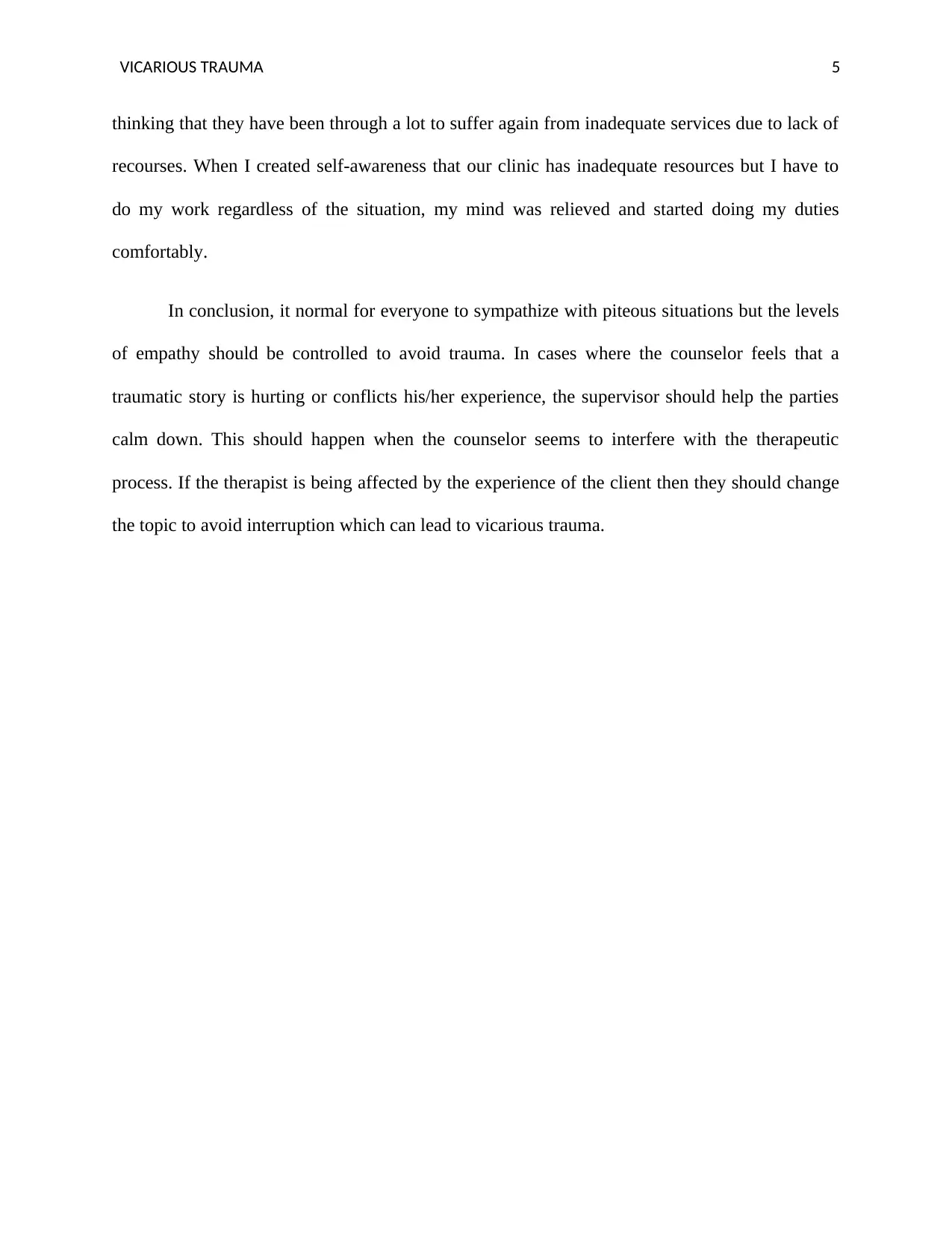
thinking that they have been through a lot to suffer again from inadequate services due to lack of
recourses. When I created self-awareness that our clinic has inadequate resources but I have to
do my work regardless of the situation, my mind was relieved and started doing my duties
comfortably.
In conclusion, it normal for everyone to sympathize with piteous situations but the levels
of empathy should be controlled to avoid trauma. In cases where the counselor feels that a
traumatic story is hurting or conflicts his/her experience, the supervisor should help the parties
calm down. This should happen when the counselor seems to interfere with the therapeutic
process. If the therapist is being affected by the experience of the client then they should change
the topic to avoid interruption which can lead to vicarious trauma.
thinking that they have been through a lot to suffer again from inadequate services due to lack of
recourses. When I created self-awareness that our clinic has inadequate resources but I have to
do my work regardless of the situation, my mind was relieved and started doing my duties
comfortably.
In conclusion, it normal for everyone to sympathize with piteous situations but the levels
of empathy should be controlled to avoid trauma. In cases where the counselor feels that a
traumatic story is hurting or conflicts his/her experience, the supervisor should help the parties
calm down. This should happen when the counselor seems to interfere with the therapeutic
process. If the therapist is being affected by the experience of the client then they should change
the topic to avoid interruption which can lead to vicarious trauma.

VICARIOUS TRAUMA 6
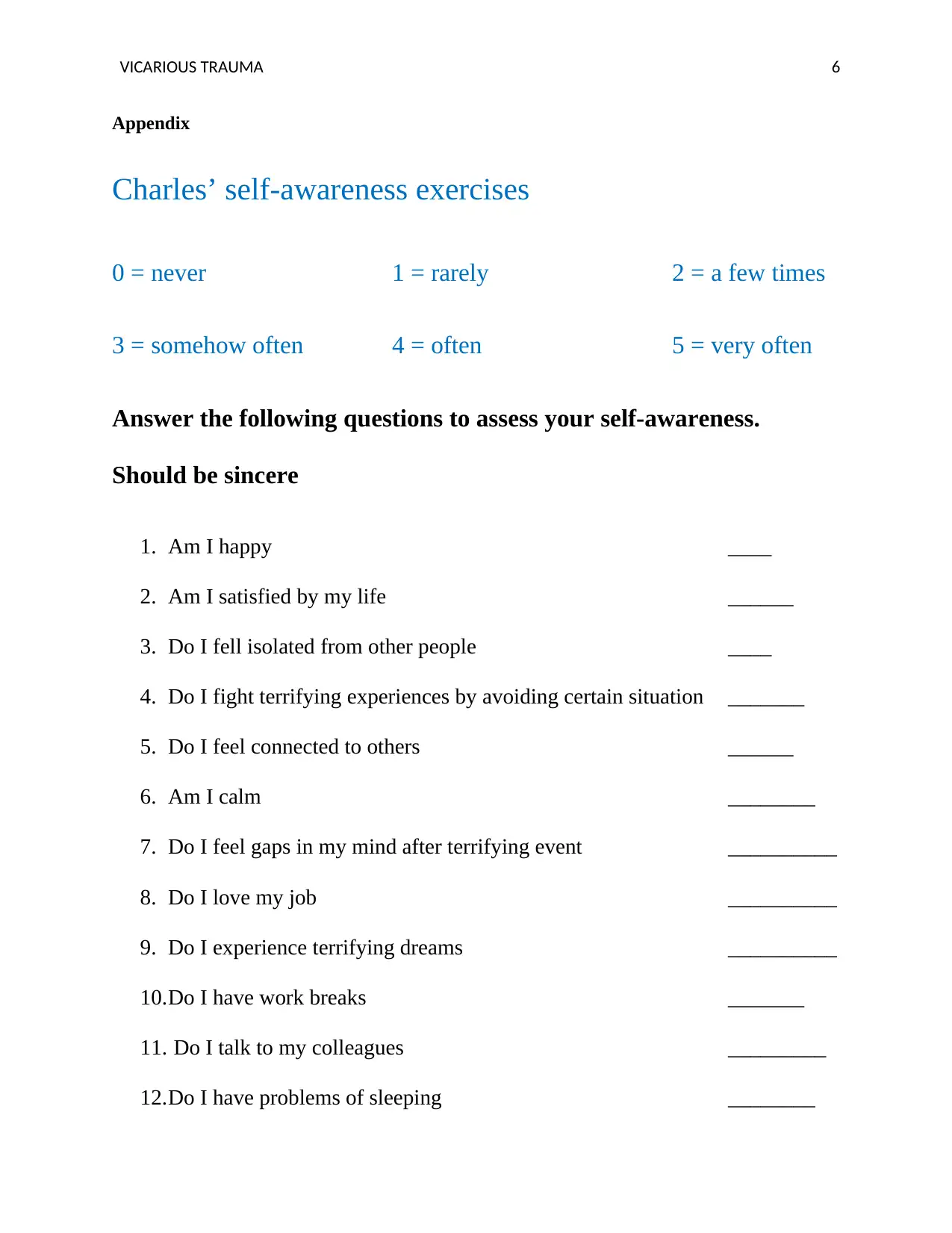
Appendix
Charles’ self-awareness exercises
0 = never 1 = rarely 2 = a few times
3 = somehow often 4 = often 5 = very often
Answer the following questions to assess your self-awareness.
Should be sincere
1. Am I happy ____
2. Am I satisfied by my life ______
3. Do I fell isolated from other people ____
4. Do I fight terrifying experiences by avoiding certain situation _______
5. Do I feel connected to others ______
6. Am I calm ________
7. Do I feel gaps in my mind after terrifying event __________
8. Do I love my job __________
9. Do I experience terrifying dreams __________
10.Do I have work breaks _______
11. Do I talk to my colleagues _________
12.Do I have problems of sleeping ________
Appendix
Charles’ self-awareness exercises
0 = never 1 = rarely 2 = a few times
3 = somehow often 4 = often 5 = very often
Answer the following questions to assess your self-awareness.
Should be sincere
1. Am I happy ____
2. Am I satisfied by my life ______
3. Do I fell isolated from other people ____
4. Do I fight terrifying experiences by avoiding certain situation _______
5. Do I feel connected to others ______
6. Am I calm ________
7. Do I feel gaps in my mind after terrifying event __________
8. Do I love my job __________
9. Do I experience terrifying dreams __________
10.Do I have work breaks _______
11. Do I talk to my colleagues _________
12.Do I have problems of sleeping ________
⊘ This is a preview!⊘
Do you want full access?
Subscribe today to unlock all pages.

Trusted by 1+ million students worldwide

VICARIOUS TRAUMA 7
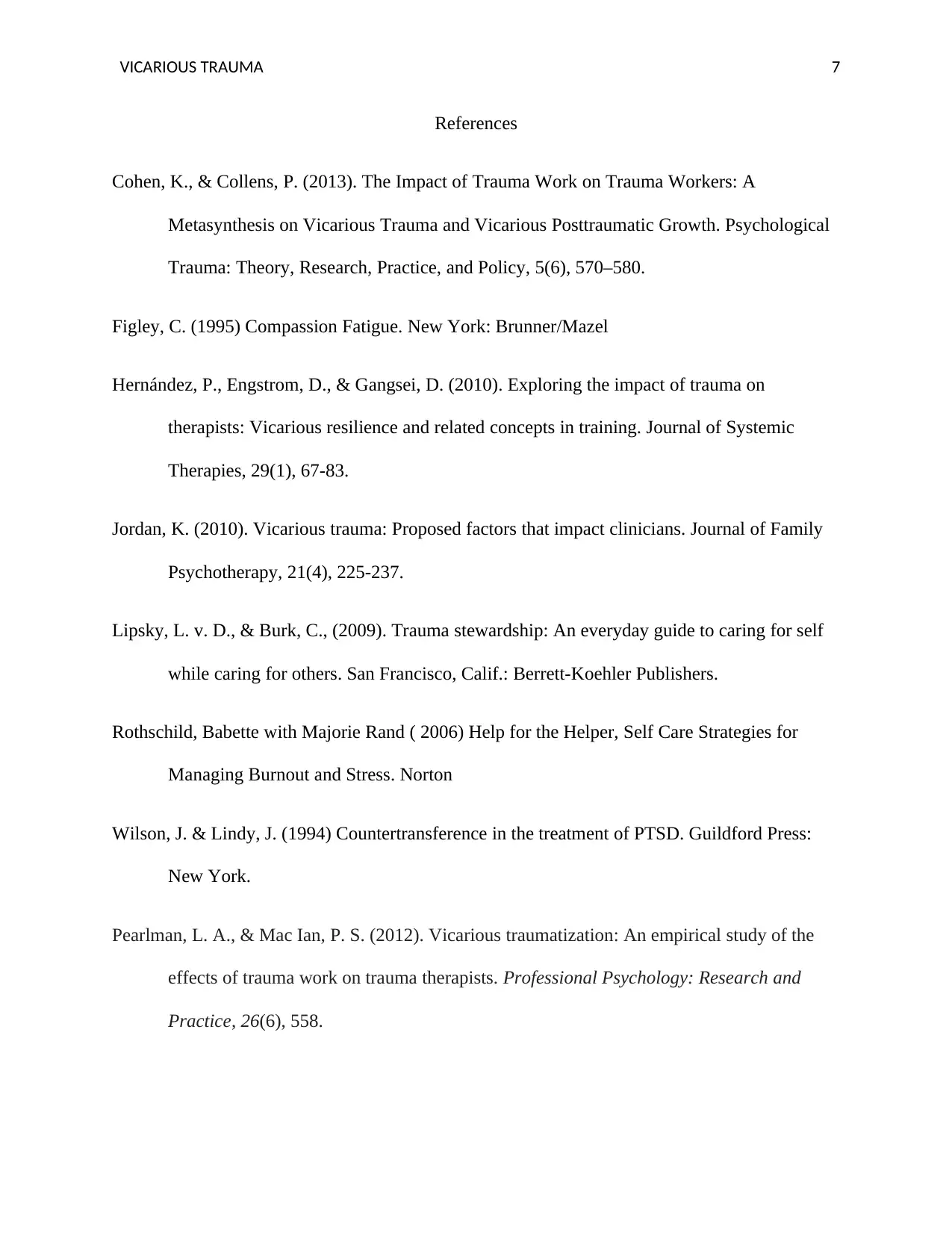
References
Cohen, K., & Collens, P. (2013). The Impact of Trauma Work on Trauma Workers: A
Metasynthesis on Vicarious Trauma and Vicarious Posttraumatic Growth. Psychological
Trauma: Theory, Research, Practice, and Policy, 5(6), 570–580.
Figley, C. (1995) Compassion Fatigue. New York: Brunner/Mazel
Hernández, P., Engstrom, D., & Gangsei, D. (2010). Exploring the impact of trauma on
therapists: Vicarious resilience and related concepts in training. Journal of Systemic
Therapies, 29(1), 67-83.
Jordan, K. (2010). Vicarious trauma: Proposed factors that impact clinicians. Journal of Family
Psychotherapy, 21(4), 225-237.
Lipsky, L. v. D., & Burk, C., (2009). Trauma stewardship: An everyday guide to caring for self
while caring for others. San Francisco, Calif.: Berrett-Koehler Publishers.
Rothschild, Babette with Majorie Rand ( 2006) Help for the Helper, Self Care Strategies for
Managing Burnout and Stress. Norton
Wilson, J. & Lindy, J. (1994) Countertransference in the treatment of PTSD. Guildford Press:
New York.
Pearlman, L. A., & Mac Ian, P. S. (2012). Vicarious traumatization: An empirical study of the
effects of trauma work on trauma therapists. Professional Psychology: Research and
Practice, 26(6), 558.
References
Cohen, K., & Collens, P. (2013). The Impact of Trauma Work on Trauma Workers: A
Metasynthesis on Vicarious Trauma and Vicarious Posttraumatic Growth. Psychological
Trauma: Theory, Research, Practice, and Policy, 5(6), 570–580.
Figley, C. (1995) Compassion Fatigue. New York: Brunner/Mazel
Hernández, P., Engstrom, D., & Gangsei, D. (2010). Exploring the impact of trauma on
therapists: Vicarious resilience and related concepts in training. Journal of Systemic
Therapies, 29(1), 67-83.
Jordan, K. (2010). Vicarious trauma: Proposed factors that impact clinicians. Journal of Family
Psychotherapy, 21(4), 225-237.
Lipsky, L. v. D., & Burk, C., (2009). Trauma stewardship: An everyday guide to caring for self
while caring for others. San Francisco, Calif.: Berrett-Koehler Publishers.
Rothschild, Babette with Majorie Rand ( 2006) Help for the Helper, Self Care Strategies for
Managing Burnout and Stress. Norton
Wilson, J. & Lindy, J. (1994) Countertransference in the treatment of PTSD. Guildford Press:
New York.
Pearlman, L. A., & Mac Ian, P. S. (2012). Vicarious traumatization: An empirical study of the
effects of trauma work on trauma therapists. Professional Psychology: Research and
Practice, 26(6), 558.
1 out of 7
Related Documents
Your All-in-One AI-Powered Toolkit for Academic Success.
+13062052269
info@desklib.com
Available 24*7 on WhatsApp / Email
Unlock your academic potential
Copyright © 2020–2026 A2Z Services. All Rights Reserved. Developed and managed by ZUCOL.