Victimology: Correctional Officers, Victims, and Personal Insights

Verified

Added on  2023/04/21

|4
|718
|63
Discussion Board Post
AI Summary
This discussion post delves into the field of victimology and its significance for correctional officers. It addresses the importance of educating correctional officers on victimology, considering their responsibilities for inmate security and accountability. The post examines a quotation by Susan Sontag regarding victims and innocence, exploring its relevance within the context of victimology. The author provides two real-life examples to support the quotation, illustrating instances where individuals claiming innocence were later found guilty. The post further discusses how officers may have differing views on victims, influenced by factors such as victim characteristics and the nature of the crime. The role of victimologists in assisting correctional officers is also considered, highlighting the common objective of effectively managing convicts. The post references several academic sources to support its arguments and analysis.
Document Page
Victimology
tabler-icon-diamond-filled.svg

Paraphrase This Document

Need a fresh take? Get an instant paraphrase of this document with our AI Paraphraser
Document Page
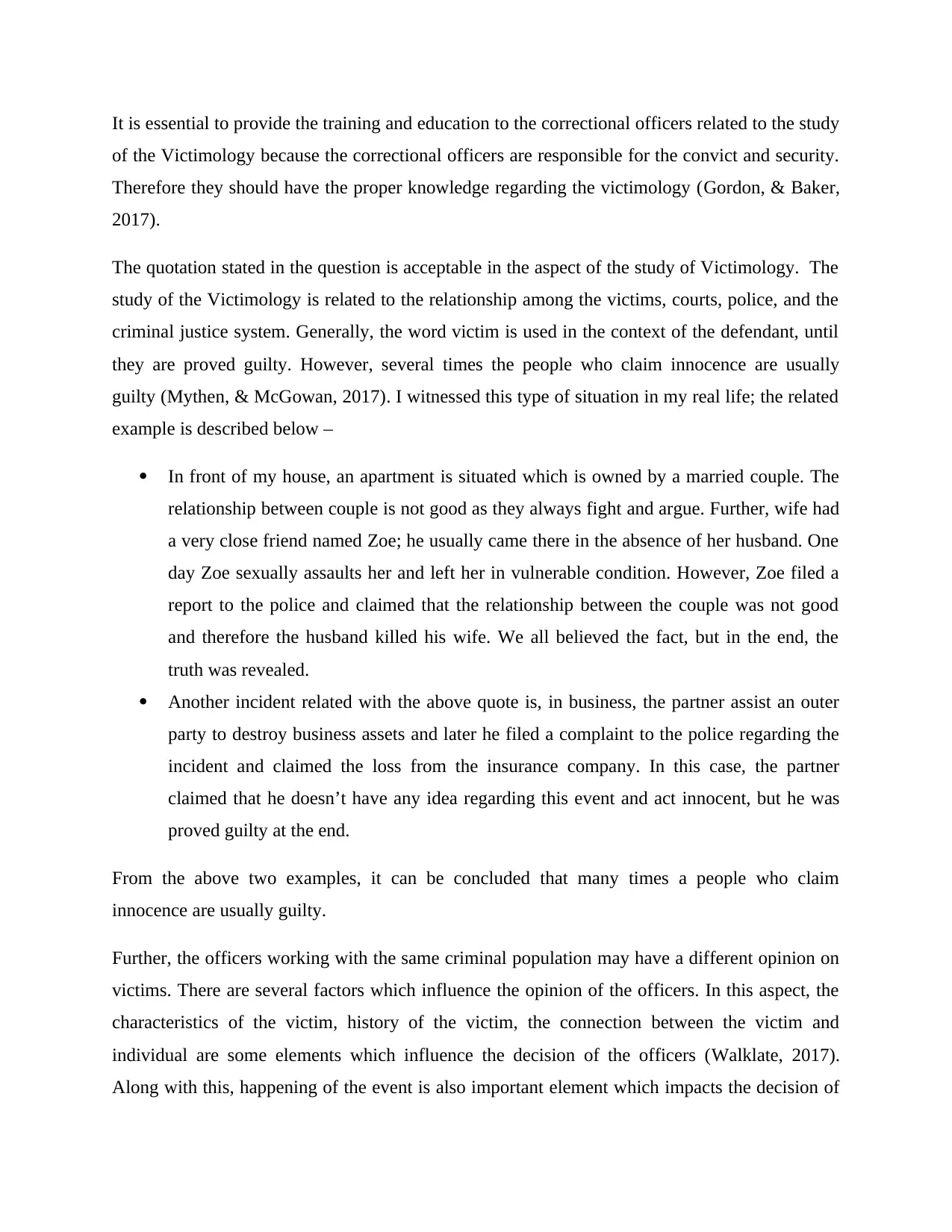
It is essential to provide the training and education to the correctional officers related to the study
of the Victimology because the correctional officers are responsible for the convict and security.
Therefore they should have the proper knowledge regarding the victimology (Gordon, & Baker,
2017).
The quotation stated in the question is acceptable in the aspect of the study of Victimology. The
study of the Victimology is related to the relationship among the victims, courts, police, and the
criminal justice system. Generally, the word victim is used in the context of the defendant, until
they are proved guilty. However, several times the people who claim innocence are usually
guilty (Mythen, & McGowan, 2017). I witnessed this type of situation in my real life; the related
example is described below –
In front of my house, an apartment is situated which is owned by a married couple. The
relationship between couple is not good as they always fight and argue. Further, wife had
a very close friend named Zoe; he usually came there in the absence of her husband. One
day Zoe sexually assaults her and left her in vulnerable condition. However, Zoe filed a
report to the police and claimed that the relationship between the couple was not good
and therefore the husband killed his wife. We all believed the fact, but in the end, the
truth was revealed.
Another incident related with the above quote is, in business, the partner assist an outer
party to destroy business assets and later he filed a complaint to the police regarding the
incident and claimed the loss from the insurance company. In this case, the partner
claimed that he doesn’t have any idea regarding this event and act innocent, but he was
proved guilty at the end.
From the above two examples, it can be concluded that many times a people who claim
innocence are usually guilty.
Further, the officers working with the same criminal population may have a different opinion on
victims. There are several factors which influence the opinion of the officers. In this aspect, the
characteristics of the victim, history of the victim, the connection between the victim and
individual are some elements which influence the decision of the officers (Walklate, 2017).
Along with this, happening of the event is also important element which impacts the decision of
Document Page
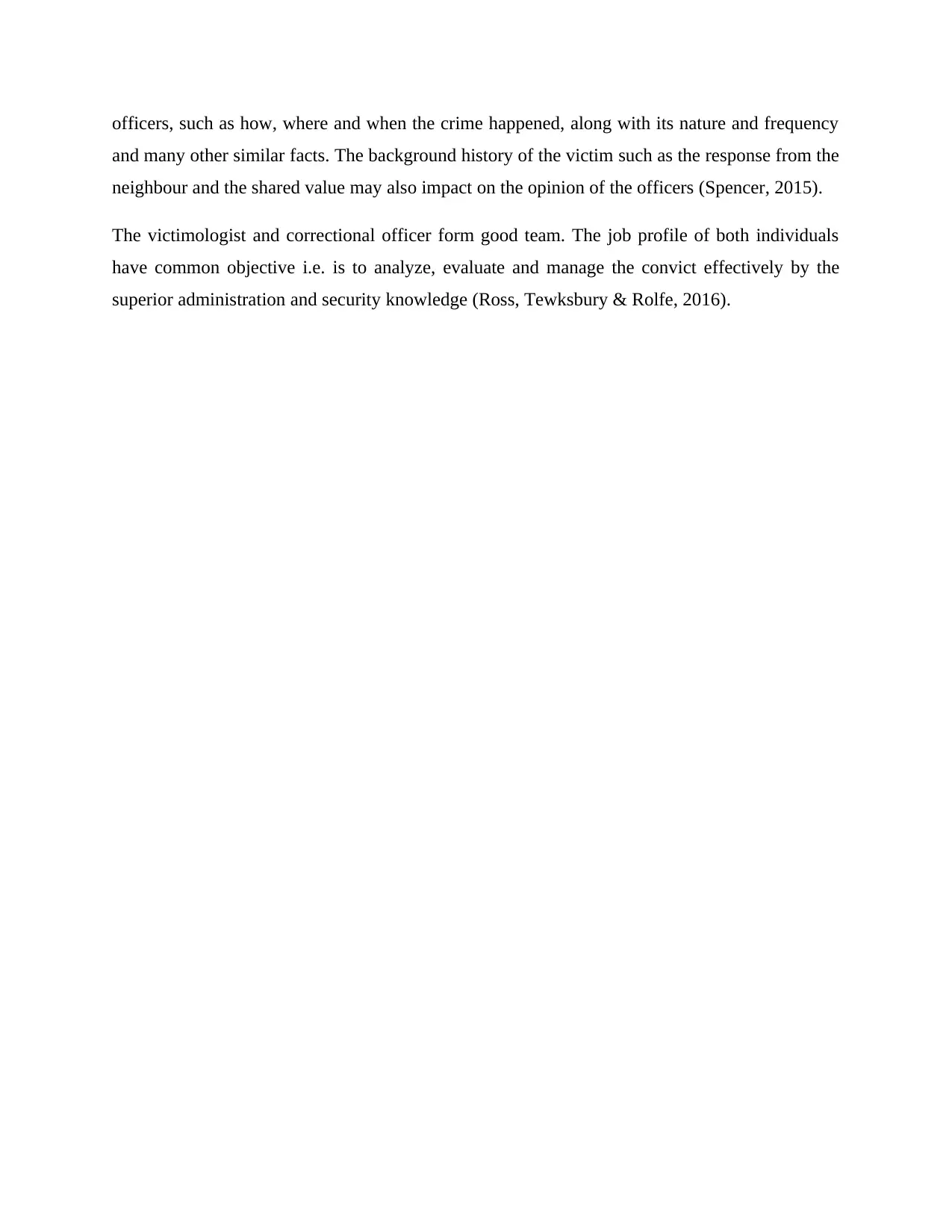
officers, such as how, where and when the crime happened, along with its nature and frequency
and many other similar facts. The background history of the victim such as the response from the
neighbour and the shared value may also impact on the opinion of the officers (Spencer, 2015).
The victimologist and correctional officer form good team. The job profile of both individuals
have common objective i.e. is to analyze, evaluate and manage the convict effectively by the
superior administration and security knowledge (Ross, Tewksbury & Rolfe, 2016).
Document Page
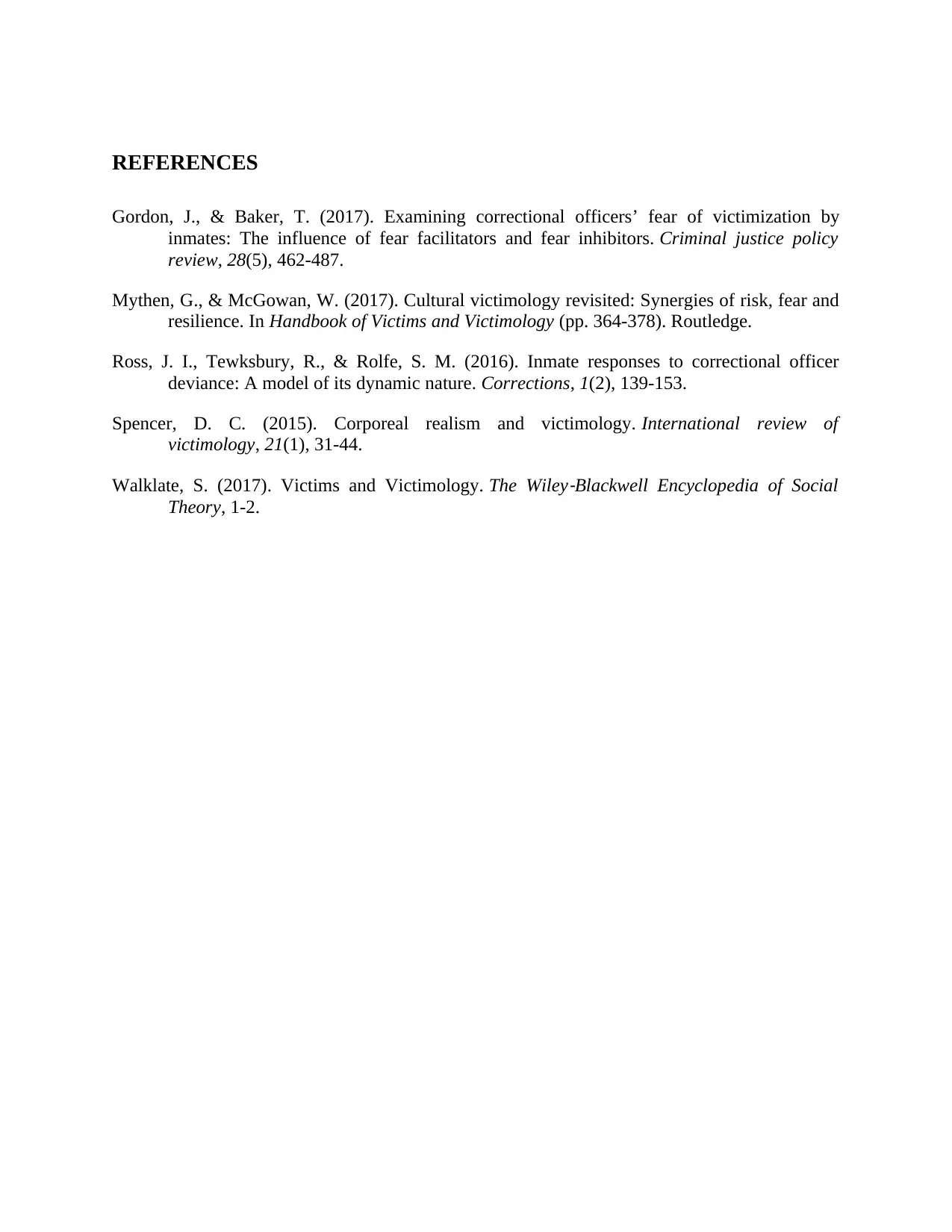
REFERENCES
Gordon, J., & Baker, T. (2017). Examining correctional officers’ fear of victimization by
inmates: The influence of fear facilitators and fear inhibitors. Criminal justice policy
review, 28(5), 462-487.
Mythen, G., & McGowan, W. (2017). Cultural victimology revisited: Synergies of risk, fear and
resilience. In Handbook of Victims and Victimology (pp. 364-378). Routledge.
Ross, J. I., Tewksbury, R., & Rolfe, S. M. (2016). Inmate responses to correctional officer
deviance: A model of its dynamic nature. Corrections, 1(2), 139-153.
Spencer, D. C. (2015). Corporeal realism and victimology. International review of
victimology, 21(1), 31-44.
Walklate, S. (2017). Victims and Victimology. The Wiley
Blackwell Encyclopedia of Social
Theory, 1-2.
chevron_up_icon
1 out of 4
circle_padding
hide_on_mobile
zoom_out_icon
[object Object]