Detailed Analysis of Vines v ASIC 2006 Case: Legal Implications
VerifiedAdded on 2020/04/07
|9
|2417
|81
Case Study
AI Summary
This case study analyzes the landmark case of Vines v ASIC 2006, focusing on the application of Section 232(4) of the Corporation Law. The assignment utilizes the IRAC method to dissect the facts, issues, relevant laws, arguments presented by both parties, and the court's analysis. The case revolves around Geoffrey Vines, an auditor and CFO of GIO Australia Holdings Limited, and the ASIC's claims regarding the accuracy of profit forecasts in GIO's Part B statement, particularly concerning the impact of Hurricane Georges on GIO Re. The analysis examines Vines' arguments, the court's rejection of those arguments, and the various contraventions of duty of care found against him. The court's outcome, including specific contraventions related to management sign-offs and advice given to the Due Diligence Committee, is thoroughly examined. The significance of the case, particularly in imposing a duty of care on a senior executive officer, is highlighted, emphasizing the importance of accurate information disclosure to shareholders and the need for officers to ensure the completeness and accuracy of information prior to investment decisions. The case underscores the responsibilities of company officers in ensuring transparency and accountability in financial reporting.

1
Cover Page
Name of the Student
Student ID
Word count
Cover Page
Name of the Student
Student ID
Word count

Paraphrase This Document
Need a fresh take? Get an instant paraphrase of this document with our AI Paraphraser
2
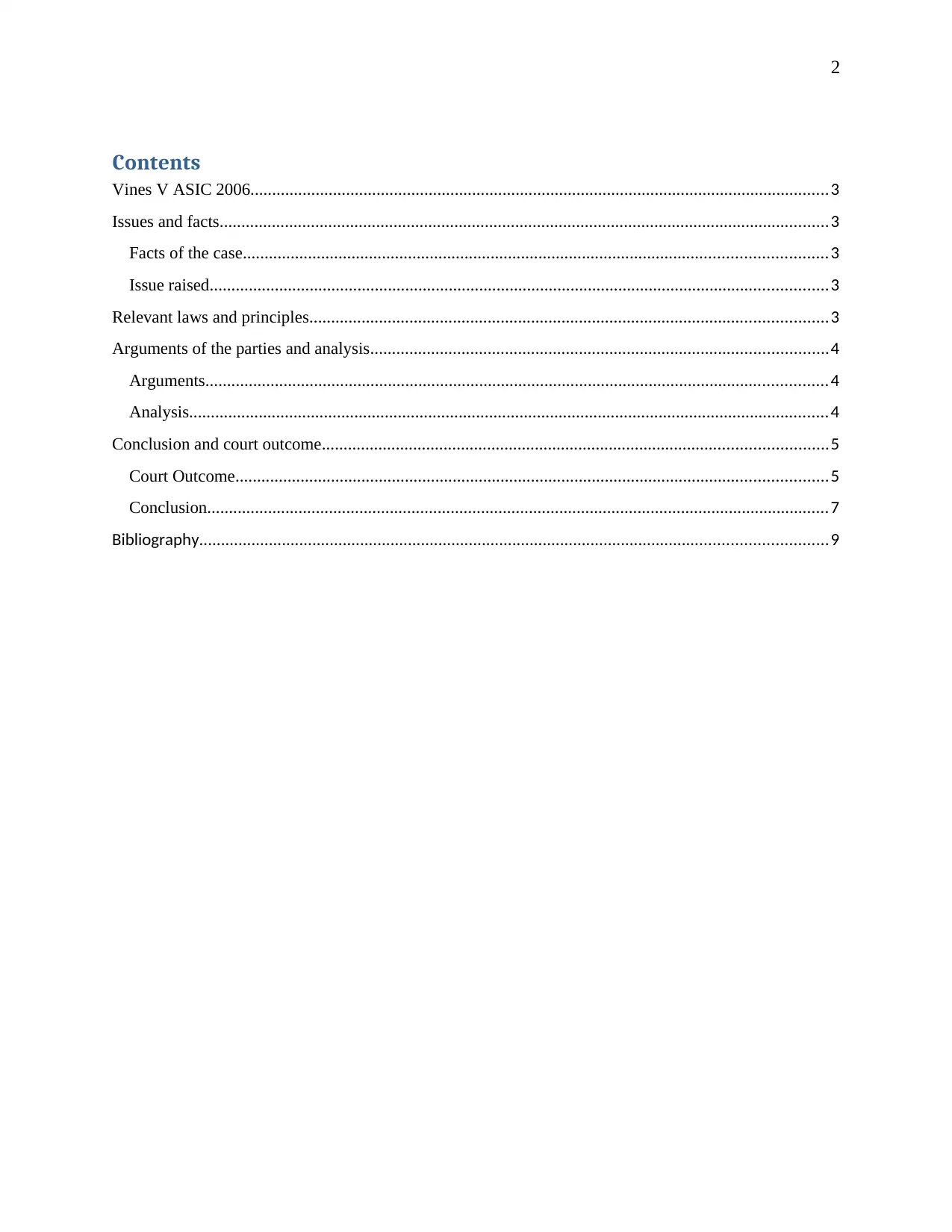
Contents
Vines V ASIC 2006.....................................................................................................................................3
Issues and facts............................................................................................................................................3
Facts of the case......................................................................................................................................3
Issue raised..............................................................................................................................................3
Relevant laws and principles.......................................................................................................................3
Arguments of the parties and analysis.........................................................................................................4
Arguments...............................................................................................................................................4
Analysis...................................................................................................................................................4
Conclusion and court outcome....................................................................................................................5
Court Outcome........................................................................................................................................5
Conclusion...............................................................................................................................................7
Bibliography................................................................................................................................................9
Contents
Vines V ASIC 2006.....................................................................................................................................3
Issues and facts............................................................................................................................................3
Facts of the case......................................................................................................................................3
Issue raised..............................................................................................................................................3
Relevant laws and principles.......................................................................................................................3
Arguments of the parties and analysis.........................................................................................................4
Arguments...............................................................................................................................................4
Analysis...................................................................................................................................................4
Conclusion and court outcome....................................................................................................................5
Court Outcome........................................................................................................................................5
Conclusion...............................................................................................................................................7
Bibliography................................................................................................................................................9
3
Vines V ASIC 2006
The leading case of (Vines v ASIC, 2006) is analyzed by using IRAC technique.
Issues and facts
Facts of the case
Geoffrey Vines (The Appellant) was the auditor and a Charted Accountant and in 1995 he
joined GIO Australia Holdings Limited (“GIO”) as a Chief Financial Officer.
In 1998 (25th August), AMP Limited (“AMP”) announced a takeover bid of the shares of GIO.
The board of GIO resisted the bid considering the same as hostile.
Later on 16th December 1998, GIO published its Part B statement which contains the profit
forecast for 1998-99 wherein the profit forecast for one of the subsidiary of GIO, GIO
Re, was declared to be AUD$80 million. This forecast had a significant impact on the
takeover bid. When the part B statement is being prepared by GIO, at that time (around
21-28 September 1998) GIO Re was hit by a hurricane Georges. (Wong)
On the basis of these facts the ASIC has initiated civil proceedings against Mr Robertson and Mr
Fox (two executives) and Mr Vines regarding the claims that are made in Part B. ASIC
submitted that no reasonableness was taken while forecasting the profits of AUD$80
million for GIO Re and thus the directors are in violation of section 232 (4) of the
Corporation Law. (Farrand, 2007)
Based on these facts, the major that is raised is submitted herein under.
Issue raised
i. The major issue that was raised in the leading case was whether there is violation of
section 232 (4) of the Corporation law by Mr Vines?
ii. If Yes, then to what extend he is liable as per the provisions of the Corporation law?
(Dayman & Kinsey, 2007)
Relevant laws and principles
The relevant law and principles that are applicable in order to resolve the raised issues are:
(Allens, 2007)
i. The analysis of section 232 (4) of the Corporation Law. The court while interpreting
section 232 (4) of the Corporation Law submitted that the level of care that is required in
Vines V ASIC 2006
The leading case of (Vines v ASIC, 2006) is analyzed by using IRAC technique.
Issues and facts
Facts of the case
Geoffrey Vines (The Appellant) was the auditor and a Charted Accountant and in 1995 he
joined GIO Australia Holdings Limited (“GIO”) as a Chief Financial Officer.
In 1998 (25th August), AMP Limited (“AMP”) announced a takeover bid of the shares of GIO.
The board of GIO resisted the bid considering the same as hostile.
Later on 16th December 1998, GIO published its Part B statement which contains the profit
forecast for 1998-99 wherein the profit forecast for one of the subsidiary of GIO, GIO
Re, was declared to be AUD$80 million. This forecast had a significant impact on the
takeover bid. When the part B statement is being prepared by GIO, at that time (around
21-28 September 1998) GIO Re was hit by a hurricane Georges. (Wong)
On the basis of these facts the ASIC has initiated civil proceedings against Mr Robertson and Mr
Fox (two executives) and Mr Vines regarding the claims that are made in Part B. ASIC
submitted that no reasonableness was taken while forecasting the profits of AUD$80
million for GIO Re and thus the directors are in violation of section 232 (4) of the
Corporation Law. (Farrand, 2007)
Based on these facts, the major that is raised is submitted herein under.
Issue raised
i. The major issue that was raised in the leading case was whether there is violation of
section 232 (4) of the Corporation law by Mr Vines?
ii. If Yes, then to what extend he is liable as per the provisions of the Corporation law?
(Dayman & Kinsey, 2007)
Relevant laws and principles
The relevant law and principles that are applicable in order to resolve the raised issues are:
(Allens, 2007)
i. The analysis of section 232 (4) of the Corporation Law. The court while interpreting
section 232 (4) of the Corporation Law submitted that the level of care that is required in
⊘ This is a preview!⊘
Do you want full access?
Subscribe today to unlock all pages.

Trusted by 1+ million students worldwide
4
the given statutory provision does not demand the level of care that is needed in cases of
negligence.
ii. Whether there is reasonableness that was taken by Mr Vines and the other directors while
including the profit forecast of $80 million for GIO Re in part B Statement after the
Hurricane Georges.
The issue of duty of care and reasonableness was dealt by the courts and there are various
contraventions that are found to be incurred by Mr Vines. However, prior analyzing the
decision of the court, it is important to find out the main arguments that are raised by Mr
Vines to support his case.
Arguments of the parties and analysis
Arguments
The main arguments that are raised by Mr Vines and submitted and analyzed herein under:
(Farrand, 2007)
Argument 1 – The main argument of Mr Vine was that Austin J was in error in holding that he
has violated section 232 (4) of the Corporation Law.
Argument 2 – Mr Vines argued that the liability that is imposed upon him under section 1317JA
of the Corporation Law was not correct. He argued that section 1317JA grants discretion
to the court to alleviate a person from the consequences provided such person should
have acted honestly and considering the situation of the case such liability should be
excused.
Argument 3 – It is argued by Mr Vines that the level of care that is required to be prove
negligence on the part of Mr Vines in order to hold him liable for the violation of section
232 (4) of the Corporation Law is much higher when the same is compared in common
law. he argued that thus to consider that there is breach of section 232 (4) of the
Corporation law, the violation must be gross enough so that it become an issue of state
interest and public concern.
Analysis
The arguments that are raised by Mr Vines are rejected by the court. The court submitted that the
level of care that is applicable and is required under section 232 (4) of the Corporation
the given statutory provision does not demand the level of care that is needed in cases of
negligence.
ii. Whether there is reasonableness that was taken by Mr Vines and the other directors while
including the profit forecast of $80 million for GIO Re in part B Statement after the
Hurricane Georges.
The issue of duty of care and reasonableness was dealt by the courts and there are various
contraventions that are found to be incurred by Mr Vines. However, prior analyzing the
decision of the court, it is important to find out the main arguments that are raised by Mr
Vines to support his case.
Arguments of the parties and analysis
Arguments
The main arguments that are raised by Mr Vines and submitted and analyzed herein under:
(Farrand, 2007)
Argument 1 – The main argument of Mr Vine was that Austin J was in error in holding that he
has violated section 232 (4) of the Corporation Law.
Argument 2 – Mr Vines argued that the liability that is imposed upon him under section 1317JA
of the Corporation Law was not correct. He argued that section 1317JA grants discretion
to the court to alleviate a person from the consequences provided such person should
have acted honestly and considering the situation of the case such liability should be
excused.
Argument 3 – It is argued by Mr Vines that the level of care that is required to be prove
negligence on the part of Mr Vines in order to hold him liable for the violation of section
232 (4) of the Corporation Law is much higher when the same is compared in common
law. he argued that thus to consider that there is breach of section 232 (4) of the
Corporation law, the violation must be gross enough so that it become an issue of state
interest and public concern.
Analysis
The arguments that are raised by Mr Vines are rejected by the court. The court submitted that the
level of care that is applicable and is required under section 232 (4) of the Corporation
Paraphrase This Document
Need a fresh take? Get an instant paraphrase of this document with our AI Paraphraser
5
law does not require any kind of higher level of negligence in the part of Mr Vine in
order to hold him negligent. The arguments of Mr Vines were rejected and he was held to
be in contravention of duty of care on his part. The basic reasons for the rejection are:
(ASIC, 2007)
i. That he made no attempt to let the due diligence committee be aware that he is fine with
the truthfulness of the gains that are forecasted in part B statements;
ii. He provide no report or analysis which is the core reason for the forecast of profits that
are made in the Part B statements;
iii. A statement was made by him on 9th November 1998 regarding the profits but statement
is an incompetent declaration of confidence.
iv. He gave no opinion whether the forecast that is declared on Part B statement is
achievable during the term of after the statements but prior the end of the takeover period.
v. He authenticated a management sign off without indulging in adequate steps to guide the
due diligence committee of GIO on the basis of the presupposition which form the basis
of $80million profit forecast
It is now important to analyse the court outcome and the conclusion.
Conclusion and court outcome
Court Outcome
The court which lay down the final judgment was constituted by Spigelman CJ, Ipp and Santow
JJA.
The majority of the decision is provided by Spigelman CJ and Ipp JA and the Santow JA is of
the minority opinion.
The court of Appeal decided the case on 4th April 2007 and submitted that Mr Vine is in
contravention of his duty of care as enshrined under section 232 (4) of the Corporation
Law.
The main outcomes of the court are submitted herein under. (Farrand, 2007)
The grounds upon which it was considered that Mr Vines is in violation of his duty of care:
law does not require any kind of higher level of negligence in the part of Mr Vine in
order to hold him negligent. The arguments of Mr Vines were rejected and he was held to
be in contravention of duty of care on his part. The basic reasons for the rejection are:
(ASIC, 2007)
i. That he made no attempt to let the due diligence committee be aware that he is fine with
the truthfulness of the gains that are forecasted in part B statements;
ii. He provide no report or analysis which is the core reason for the forecast of profits that
are made in the Part B statements;
iii. A statement was made by him on 9th November 1998 regarding the profits but statement
is an incompetent declaration of confidence.
iv. He gave no opinion whether the forecast that is declared on Part B statement is
achievable during the term of after the statements but prior the end of the takeover period.
v. He authenticated a management sign off without indulging in adequate steps to guide the
due diligence committee of GIO on the basis of the presupposition which form the basis
of $80million profit forecast
It is now important to analyse the court outcome and the conclusion.
Conclusion and court outcome
Court Outcome
The court which lay down the final judgment was constituted by Spigelman CJ, Ipp and Santow
JJA.
The majority of the decision is provided by Spigelman CJ and Ipp JA and the Santow JA is of
the minority opinion.
The court of Appeal decided the case on 4th April 2007 and submitted that Mr Vine is in
contravention of his duty of care as enshrined under section 232 (4) of the Corporation
Law.
The main outcomes of the court are submitted herein under. (Farrand, 2007)
The grounds upon which it was considered that Mr Vines is in violation of his duty of care:
6
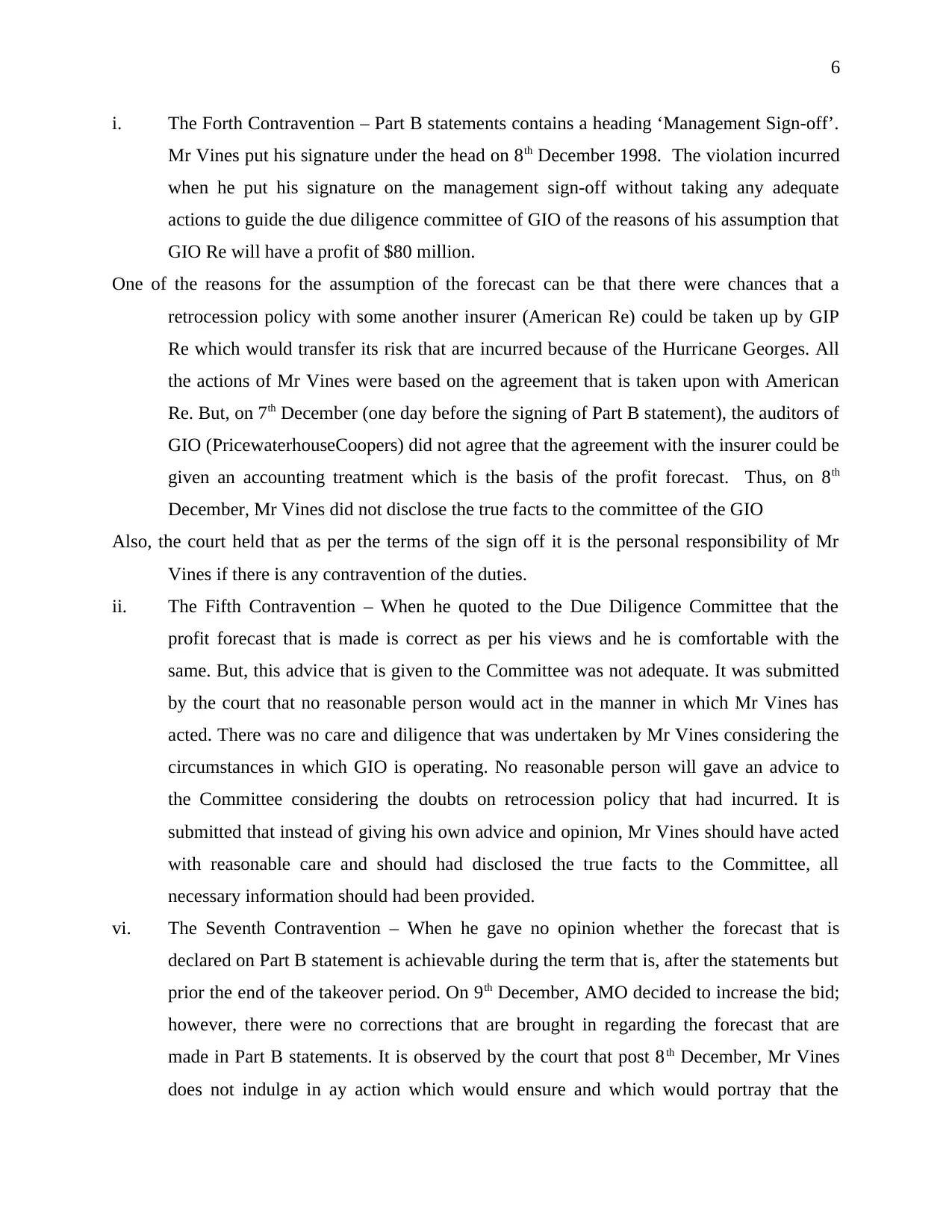
i. The Forth Contravention – Part B statements contains a heading ‘Management Sign-off’.
Mr Vines put his signature under the head on 8th December 1998. The violation incurred
when he put his signature on the management sign-off without taking any adequate
actions to guide the due diligence committee of GIO of the reasons of his assumption that
GIO Re will have a profit of $80 million.
One of the reasons for the assumption of the forecast can be that there were chances that a
retrocession policy with some another insurer (American Re) could be taken up by GIP
Re which would transfer its risk that are incurred because of the Hurricane Georges. All
the actions of Mr Vines were based on the agreement that is taken upon with American
Re. But, on 7th December (one day before the signing of Part B statement), the auditors of
GIO (PricewaterhouseCoopers) did not agree that the agreement with the insurer could be
given an accounting treatment which is the basis of the profit forecast. Thus, on 8th
December, Mr Vines did not disclose the true facts to the committee of the GIO
Also, the court held that as per the terms of the sign off it is the personal responsibility of Mr
Vines if there is any contravention of the duties.
ii. The Fifth Contravention – When he quoted to the Due Diligence Committee that the
profit forecast that is made is correct as per his views and he is comfortable with the
same. But, this advice that is given to the Committee was not adequate. It was submitted
by the court that no reasonable person would act in the manner in which Mr Vines has
acted. There was no care and diligence that was undertaken by Mr Vines considering the
circumstances in which GIO is operating. No reasonable person will gave an advice to
the Committee considering the doubts on retrocession policy that had incurred. It is
submitted that instead of giving his own advice and opinion, Mr Vines should have acted
with reasonable care and should had disclosed the true facts to the Committee, all
necessary information should had been provided.
vi. The Seventh Contravention – When he gave no opinion whether the forecast that is
declared on Part B statement is achievable during the term that is, after the statements but
prior the end of the takeover period. On 9th December, AMO decided to increase the bid;
however, there were no corrections that are brought in regarding the forecast that are
made in Part B statements. It is observed by the court that post 8th December, Mr Vines
does not indulge in ay action which would ensure and which would portray that the
i. The Forth Contravention – Part B statements contains a heading ‘Management Sign-off’.
Mr Vines put his signature under the head on 8th December 1998. The violation incurred
when he put his signature on the management sign-off without taking any adequate
actions to guide the due diligence committee of GIO of the reasons of his assumption that
GIO Re will have a profit of $80 million.
One of the reasons for the assumption of the forecast can be that there were chances that a
retrocession policy with some another insurer (American Re) could be taken up by GIP
Re which would transfer its risk that are incurred because of the Hurricane Georges. All
the actions of Mr Vines were based on the agreement that is taken upon with American
Re. But, on 7th December (one day before the signing of Part B statement), the auditors of
GIO (PricewaterhouseCoopers) did not agree that the agreement with the insurer could be
given an accounting treatment which is the basis of the profit forecast. Thus, on 8th
December, Mr Vines did not disclose the true facts to the committee of the GIO
Also, the court held that as per the terms of the sign off it is the personal responsibility of Mr
Vines if there is any contravention of the duties.
ii. The Fifth Contravention – When he quoted to the Due Diligence Committee that the
profit forecast that is made is correct as per his views and he is comfortable with the
same. But, this advice that is given to the Committee was not adequate. It was submitted
by the court that no reasonable person would act in the manner in which Mr Vines has
acted. There was no care and diligence that was undertaken by Mr Vines considering the
circumstances in which GIO is operating. No reasonable person will gave an advice to
the Committee considering the doubts on retrocession policy that had incurred. It is
submitted that instead of giving his own advice and opinion, Mr Vines should have acted
with reasonable care and should had disclosed the true facts to the Committee, all
necessary information should had been provided.
vi. The Seventh Contravention – When he gave no opinion whether the forecast that is
declared on Part B statement is achievable during the term that is, after the statements but
prior the end of the takeover period. On 9th December, AMO decided to increase the bid;
however, there were no corrections that are brought in regarding the forecast that are
made in Part B statements. It is observed by the court that post 8th December, Mr Vines
does not indulge in ay action which would ensure and which would portray that the
⊘ This is a preview!⊘
Do you want full access?
Subscribe today to unlock all pages.
Trusted by 1+ million students worldwide
7
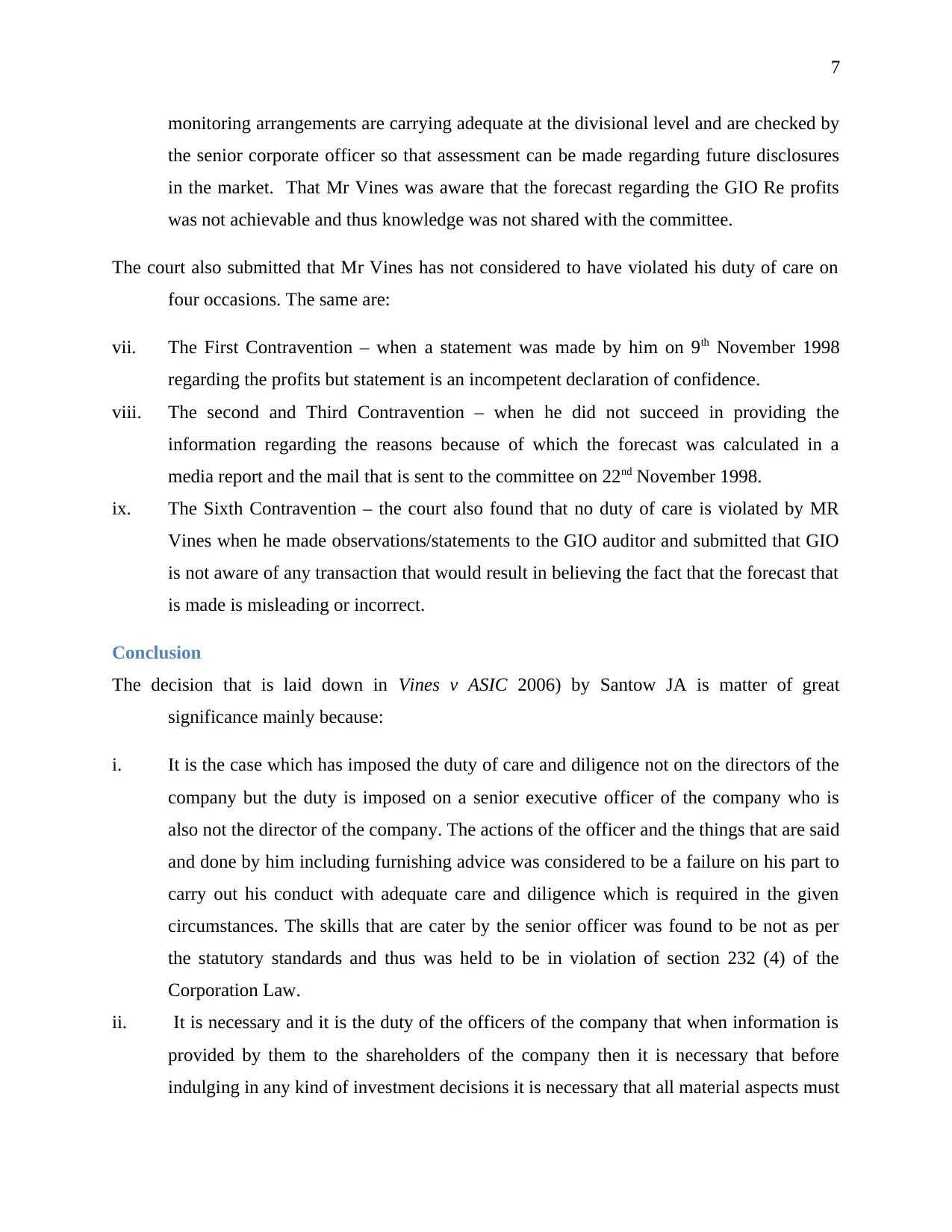
monitoring arrangements are carrying adequate at the divisional level and are checked by
the senior corporate officer so that assessment can be made regarding future disclosures
in the market. That Mr Vines was aware that the forecast regarding the GIO Re profits
was not achievable and thus knowledge was not shared with the committee.
The court also submitted that Mr Vines has not considered to have violated his duty of care on
four occasions. The same are:
vii. The First Contravention – when a statement was made by him on 9th November 1998
regarding the profits but statement is an incompetent declaration of confidence.
viii. The second and Third Contravention – when he did not succeed in providing the
information regarding the reasons because of which the forecast was calculated in a
media report and the mail that is sent to the committee on 22nd November 1998.
ix. The Sixth Contravention – the court also found that no duty of care is violated by MR
Vines when he made observations/statements to the GIO auditor and submitted that GIO
is not aware of any transaction that would result in believing the fact that the forecast that
is made is misleading or incorrect.
Conclusion
The decision that is laid down in Vines v ASIC 2006) by Santow JA is matter of great
significance mainly because:
i. It is the case which has imposed the duty of care and diligence not on the directors of the
company but the duty is imposed on a senior executive officer of the company who is
also not the director of the company. The actions of the officer and the things that are said
and done by him including furnishing advice was considered to be a failure on his part to
carry out his conduct with adequate care and diligence which is required in the given
circumstances. The skills that are cater by the senior officer was found to be not as per
the statutory standards and thus was held to be in violation of section 232 (4) of the
Corporation Law.
ii. It is necessary and it is the duty of the officers of the company that when information is
provided by them to the shareholders of the company then it is necessary that before
indulging in any kind of investment decisions it is necessary that all material aspects must
monitoring arrangements are carrying adequate at the divisional level and are checked by
the senior corporate officer so that assessment can be made regarding future disclosures
in the market. That Mr Vines was aware that the forecast regarding the GIO Re profits
was not achievable and thus knowledge was not shared with the committee.
The court also submitted that Mr Vines has not considered to have violated his duty of care on
four occasions. The same are:
vii. The First Contravention – when a statement was made by him on 9th November 1998
regarding the profits but statement is an incompetent declaration of confidence.
viii. The second and Third Contravention – when he did not succeed in providing the
information regarding the reasons because of which the forecast was calculated in a
media report and the mail that is sent to the committee on 22nd November 1998.
ix. The Sixth Contravention – the court also found that no duty of care is violated by MR
Vines when he made observations/statements to the GIO auditor and submitted that GIO
is not aware of any transaction that would result in believing the fact that the forecast that
is made is misleading or incorrect.
Conclusion
The decision that is laid down in Vines v ASIC 2006) by Santow JA is matter of great
significance mainly because:
i. It is the case which has imposed the duty of care and diligence not on the directors of the
company but the duty is imposed on a senior executive officer of the company who is
also not the director of the company. The actions of the officer and the things that are said
and done by him including furnishing advice was considered to be a failure on his part to
carry out his conduct with adequate care and diligence which is required in the given
circumstances. The skills that are cater by the senior officer was found to be not as per
the statutory standards and thus was held to be in violation of section 232 (4) of the
Corporation Law.
ii. It is necessary and it is the duty of the officers of the company that when information is
provided by them to the shareholders of the company then it is necessary that before
indulging in any kind of investment decisions it is necessary that all material aspects must
Paraphrase This Document
Need a fresh take? Get an instant paraphrase of this document with our AI Paraphraser
8
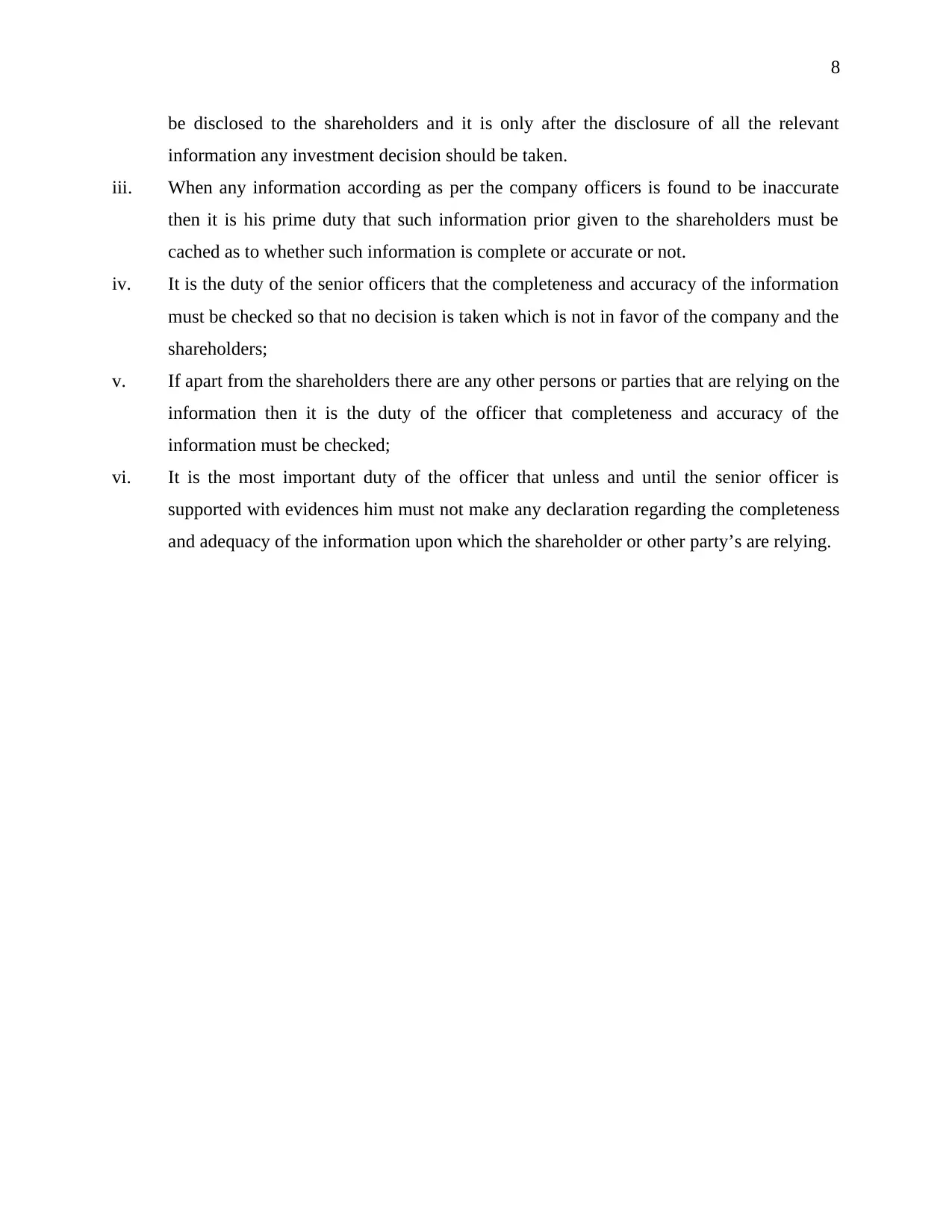
be disclosed to the shareholders and it is only after the disclosure of all the relevant
information any investment decision should be taken.
iii. When any information according as per the company officers is found to be inaccurate
then it is his prime duty that such information prior given to the shareholders must be
cached as to whether such information is complete or accurate or not.
iv. It is the duty of the senior officers that the completeness and accuracy of the information
must be checked so that no decision is taken which is not in favor of the company and the
shareholders;
v. If apart from the shareholders there are any other persons or parties that are relying on the
information then it is the duty of the officer that completeness and accuracy of the
information must be checked;
vi. It is the most important duty of the officer that unless and until the senior officer is
supported with evidences him must not make any declaration regarding the completeness
and adequacy of the information upon which the shareholder or other party’s are relying.
be disclosed to the shareholders and it is only after the disclosure of all the relevant
information any investment decision should be taken.
iii. When any information according as per the company officers is found to be inaccurate
then it is his prime duty that such information prior given to the shareholders must be
cached as to whether such information is complete or accurate or not.
iv. It is the duty of the senior officers that the completeness and accuracy of the information
must be checked so that no decision is taken which is not in favor of the company and the
shareholders;
v. If apart from the shareholders there are any other persons or parties that are relying on the
information then it is the duty of the officer that completeness and accuracy of the
information must be checked;
vi. It is the most important duty of the officer that unless and until the senior officer is
supported with evidences him must not make any declaration regarding the completeness
and adequacy of the information upon which the shareholder or other party’s are relying.
9
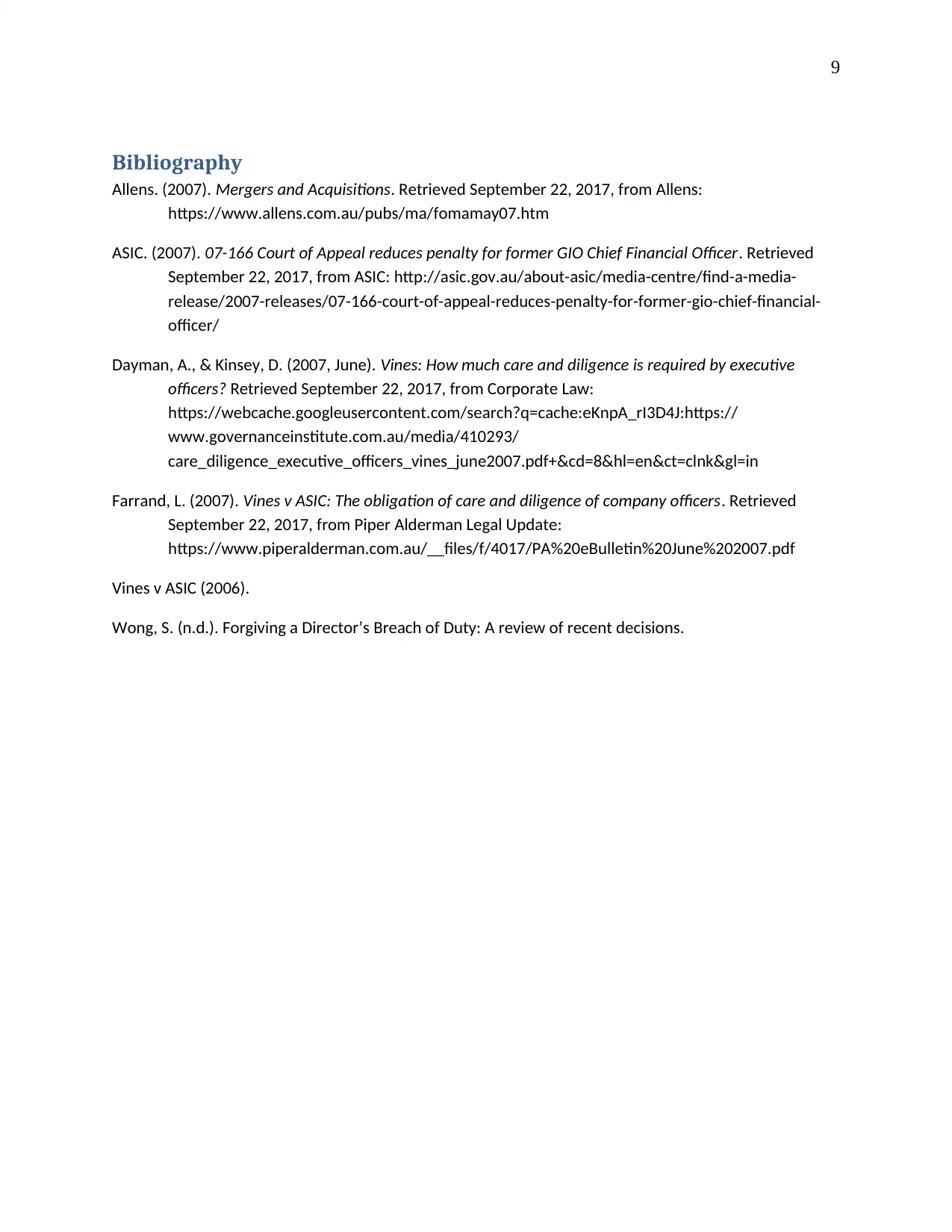
Bibliography
Allens. (2007). Mergers and Acquisitions. Retrieved September 22, 2017, from Allens:
https://www.allens.com.au/pubs/ma/fomamay07.htm
ASIC. (2007). 07-166 Court of Appeal reduces penalty for former GIO Chief Financial Officer. Retrieved
September 22, 2017, from ASIC: http://asic.gov.au/about-asic/media-centre/find-a-media-
release/2007-releases/07-166-court-of-appeal-reduces-penalty-for-former-gio-chief-financial-
officer/
Dayman, A., & Kinsey, D. (2007, June). Vines: How much care and diligence is required by executive
officers? Retrieved September 22, 2017, from Corporate Law:
https://webcache.googleusercontent.com/search?q=cache:eKnpA_rI3D4J:https://
www.governanceinstitute.com.au/media/410293/
care_diligence_executive_officers_vines_june2007.pdf+&cd=8&hl=en&ct=clnk&gl=in
Farrand, L. (2007). Vines v ASIC: The obligation of care and diligence of company officers. Retrieved
September 22, 2017, from Piper Alderman Legal Update:
https://www.piperalderman.com.au/__files/f/4017/PA%20eBulletin%20June%202007.pdf
Vines v ASIC (2006).
Wong, S. (n.d.). Forgiving a Director’s Breach of Duty: A review of recent decisions.
Bibliography
Allens. (2007). Mergers and Acquisitions. Retrieved September 22, 2017, from Allens:
https://www.allens.com.au/pubs/ma/fomamay07.htm
ASIC. (2007). 07-166 Court of Appeal reduces penalty for former GIO Chief Financial Officer. Retrieved
September 22, 2017, from ASIC: http://asic.gov.au/about-asic/media-centre/find-a-media-
release/2007-releases/07-166-court-of-appeal-reduces-penalty-for-former-gio-chief-financial-
officer/
Dayman, A., & Kinsey, D. (2007, June). Vines: How much care and diligence is required by executive
officers? Retrieved September 22, 2017, from Corporate Law:
https://webcache.googleusercontent.com/search?q=cache:eKnpA_rI3D4J:https://
www.governanceinstitute.com.au/media/410293/
care_diligence_executive_officers_vines_june2007.pdf+&cd=8&hl=en&ct=clnk&gl=in
Farrand, L. (2007). Vines v ASIC: The obligation of care and diligence of company officers. Retrieved
September 22, 2017, from Piper Alderman Legal Update:
https://www.piperalderman.com.au/__files/f/4017/PA%20eBulletin%20June%202007.pdf
Vines v ASIC (2006).
Wong, S. (n.d.). Forgiving a Director’s Breach of Duty: A review of recent decisions.
⊘ This is a preview!⊘
Do you want full access?
Subscribe today to unlock all pages.
Trusted by 1+ million students worldwide

1 out of 9


Related Documents


![Case Analysis: Statutory Duties and Penalties in ASIC v Vines [2006]](/_next/image/?url=https%3A%2F%2Fdesklib.com%2Fmedia%2Fimages%2Foq%2F5d32e4edaaf547ae897c3c471b73e238.jpg&w=256&q=75)

Your All-in-One AI-Powered Toolkit for Academic Success.
+13062052269
info@desklib.com
Available 24*7 on WhatsApp / Email
![[object Object]](/_next/static/media/star-bottom.7253800d.svg)
Unlock your academic potential
Copyright © 2020–2026 A2Z Services. All Rights Reserved. Developed and managed by ZUCOL.