MATH 1225 Test 2 Solution - Free Response Problems (Spring 2020)

Verified

Added on  2022/09/01

|9
|251
|19
Homework Assignment
AI Summary
This document contains the solutions to the MATH 1225 Test 2, a free-response exam from Spring 2020. The solutions cover a range of calculus concepts including finding the domain of a function, determining the derivative, analyzing particle motion, and calculating the rate of change. The solutions are detailed and include explanations of the steps taken to arrive at the answers. The problems addressed include finding the interval where a particle is slowing down, identifying errors in student work, and calculating the rate of change of volume. The document provides complete and correct solutions to each problem, demonstrating the application of calculus principles to solve them. The solution also includes a discussion on the correct usage of notations and theorems.
Document Page
MATH 1225 TEST 2
[DATE]
tabler-icon-diamond-filled.svg

Paraphrase This Document

Need a fresh take? Get an instant paraphrase of this document with our AI Paraphraser
Document Page
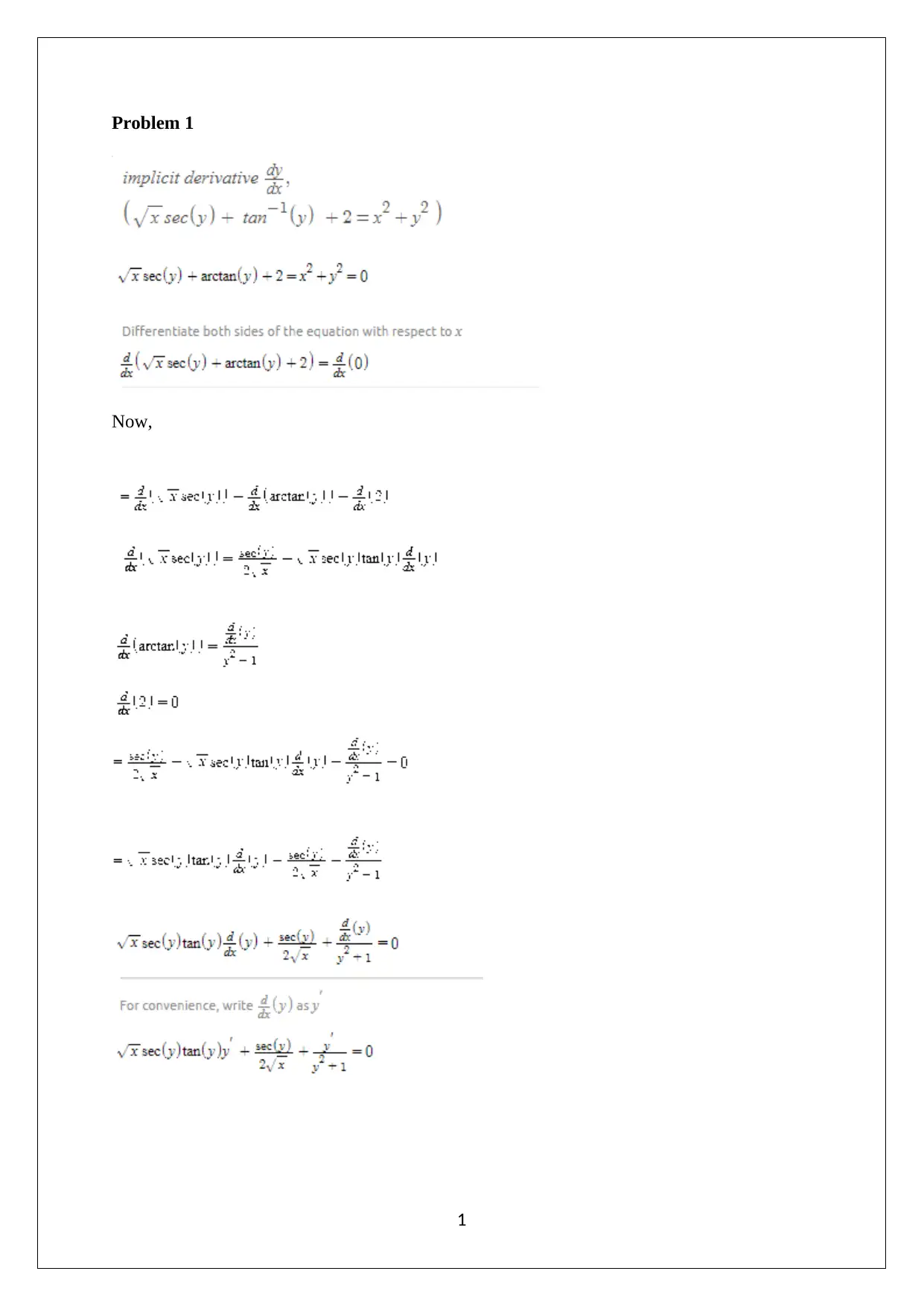
Problem 1
Now,
1
Document Page
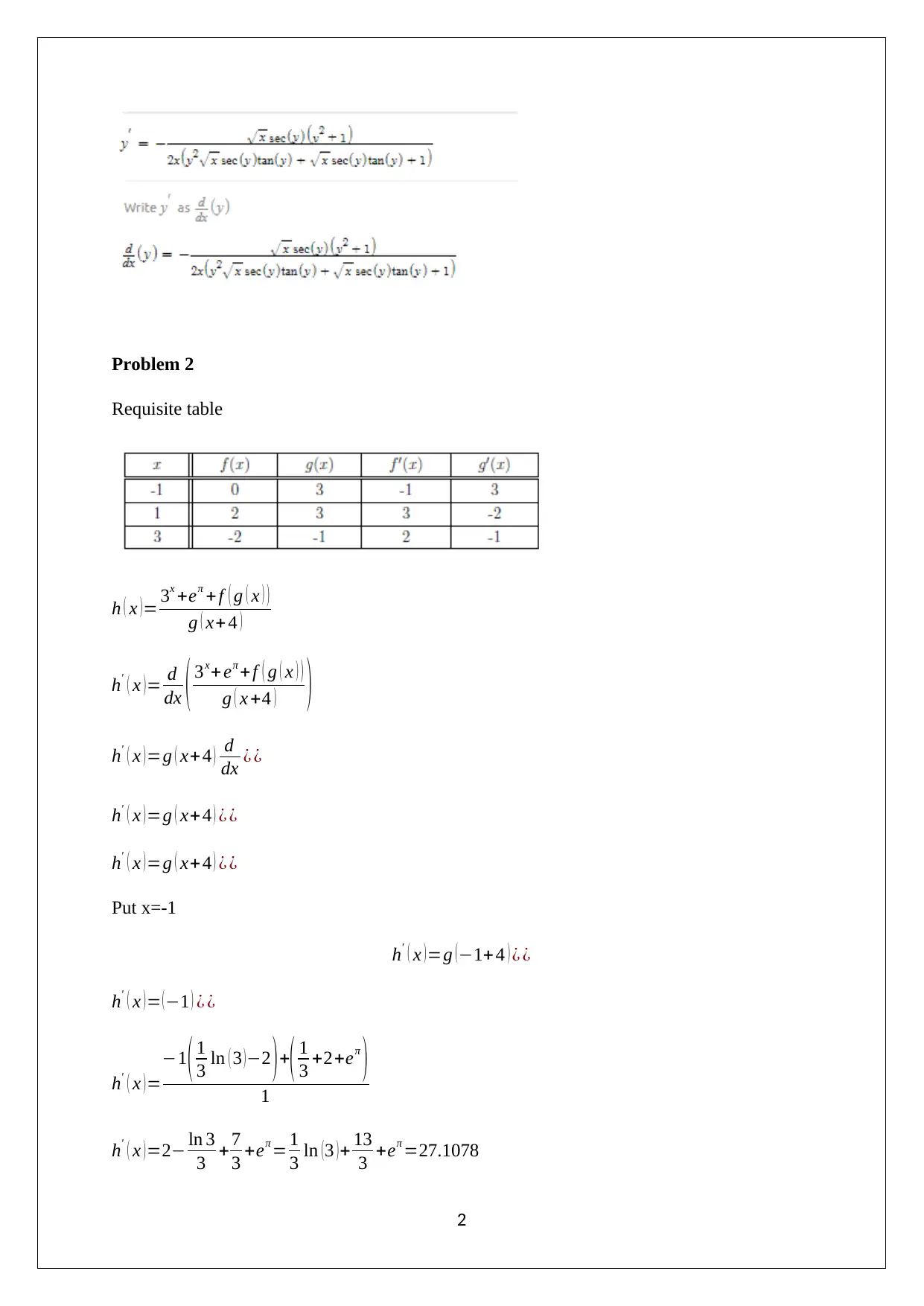
Problem 2
Requisite table
h ( x ) = 3x +eπ + f ( g ( x ) )
g ( x+ 4 )
h' ( x ) = d
dx ( 3x+ eπ +f ( g ( x ) )
g ( x +4 ) )
h' ( x )=g ( x+ 4 ) d
dx ¿ ¿
h' ( x )=g ( x+ 4 ) ¿ ¿
Put x=-1
h' ( x )=g (1+4 ) ¿ ¿
h' ( x )= (1 ) ¿ ¿
h' ( x )=
1 ( 1
3 ln ( 3 )2 )+( 1
3 +2+eπ
)
1
h' ( x )=2 ln 3
3 +7
3 +eπ = 1
3 ln (3 )+ 13
3 +eπ =27.1078
2
Document Page
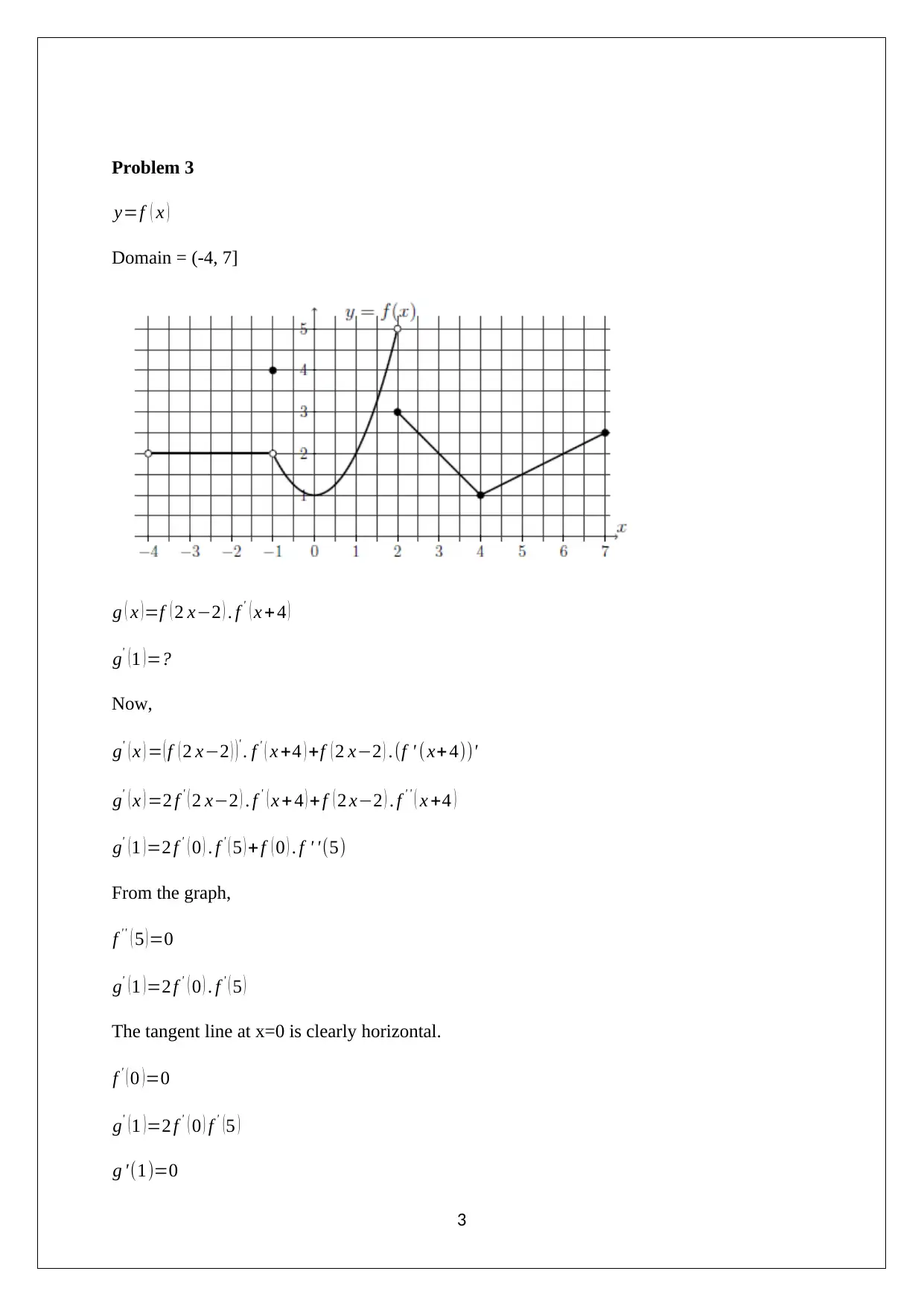
Problem 3
y=f ( x )
Domain = (-4, 7]
g ( x ) =f ( 2 x2 ) . f ' ( x + 4 )
g' (1 )=?
Now,
g' ( x ) = ( f ( 2 x2 ) ) ' . f ' ( x +4 ) +f ( 2 x2 ) .(f ' (x+ 4))'
g' ( x ) =2 f ' ( 2 x2 ) . f ' ( x + 4 ) + f ( 2 x2 ) . f ' ' ( x +4 )
g' ( 1 ) =2 f ' ( 0 ) . f ' ( 5 ) + f ( 0 ) . f ' '(5)
From the graph,
f '' ( 5 )=0
g' (1 )=2 f ' ( 0 ) . f ' ( 5 )
The tangent line at x=0 is clearly horizontal.
f ' ( 0 )=0
g' ( 1 ) =2 f ' ( 0 ) f ' ( 5 )
g '(1)=0
3
tabler-icon-diamond-filled.svg

Paraphrase This Document

Need a fresh take? Get an instant paraphrase of this document with our AI Paraphraser
Document Page
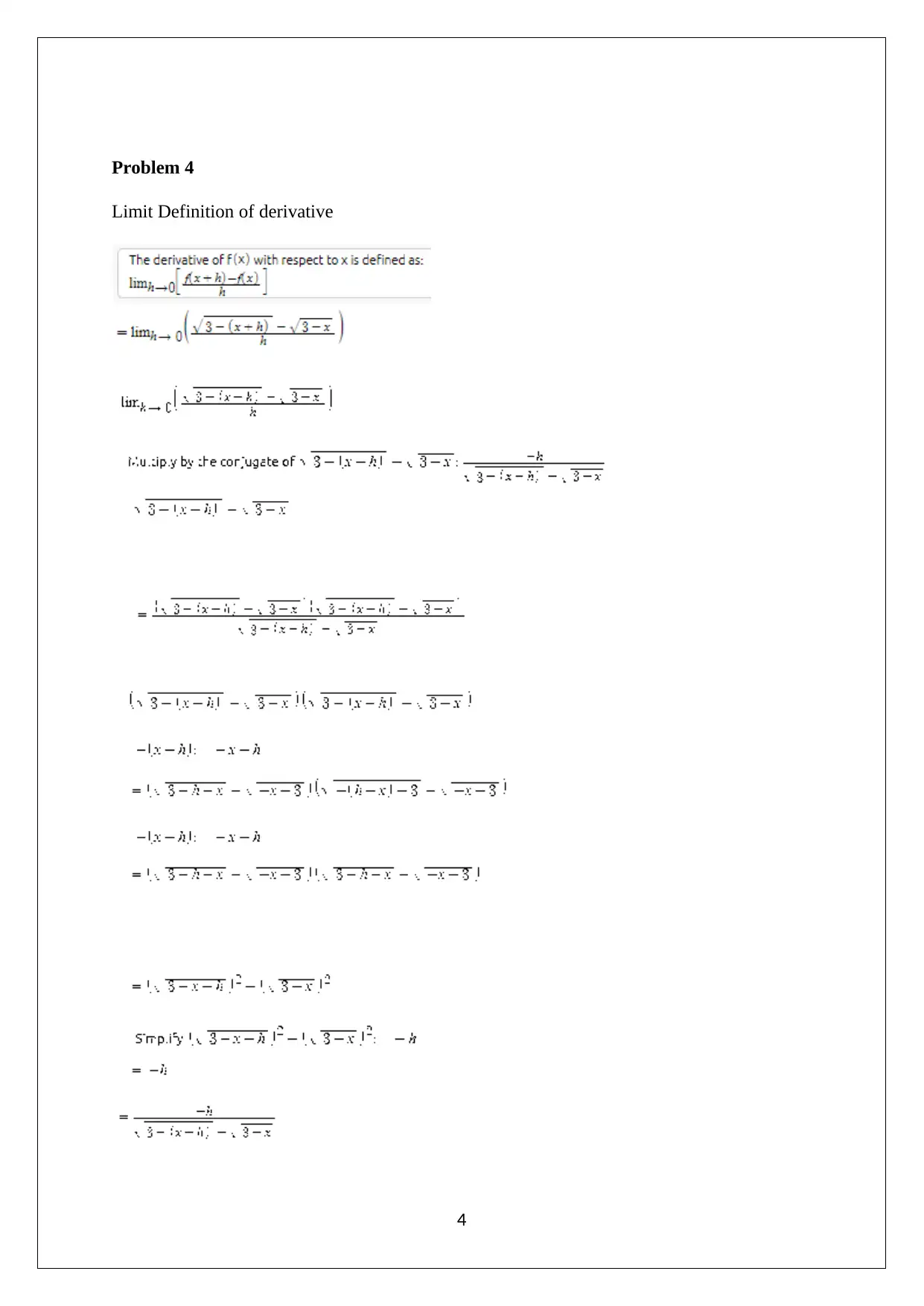
Problem 4
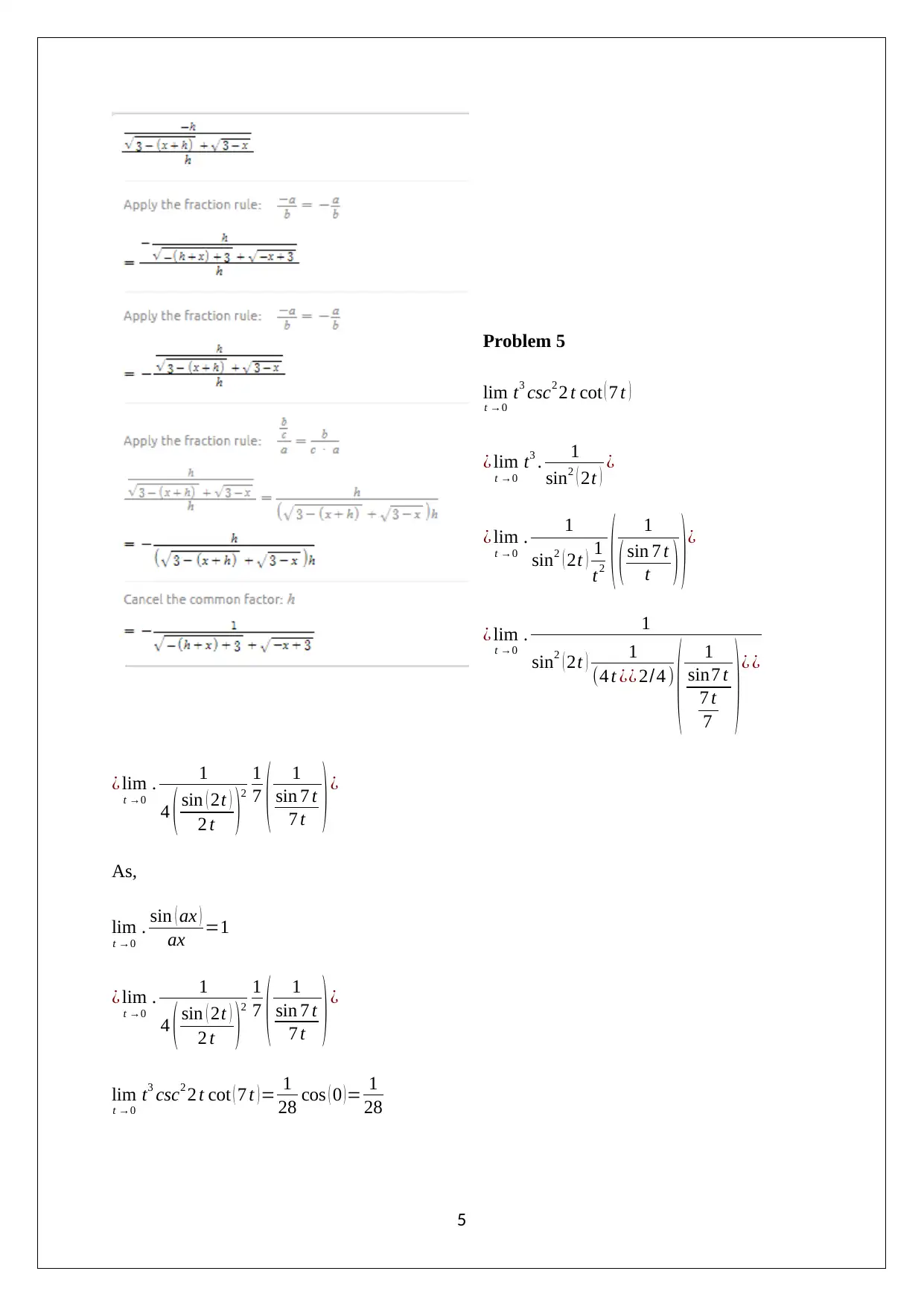
Limit Definition of derivative
4
Document Page
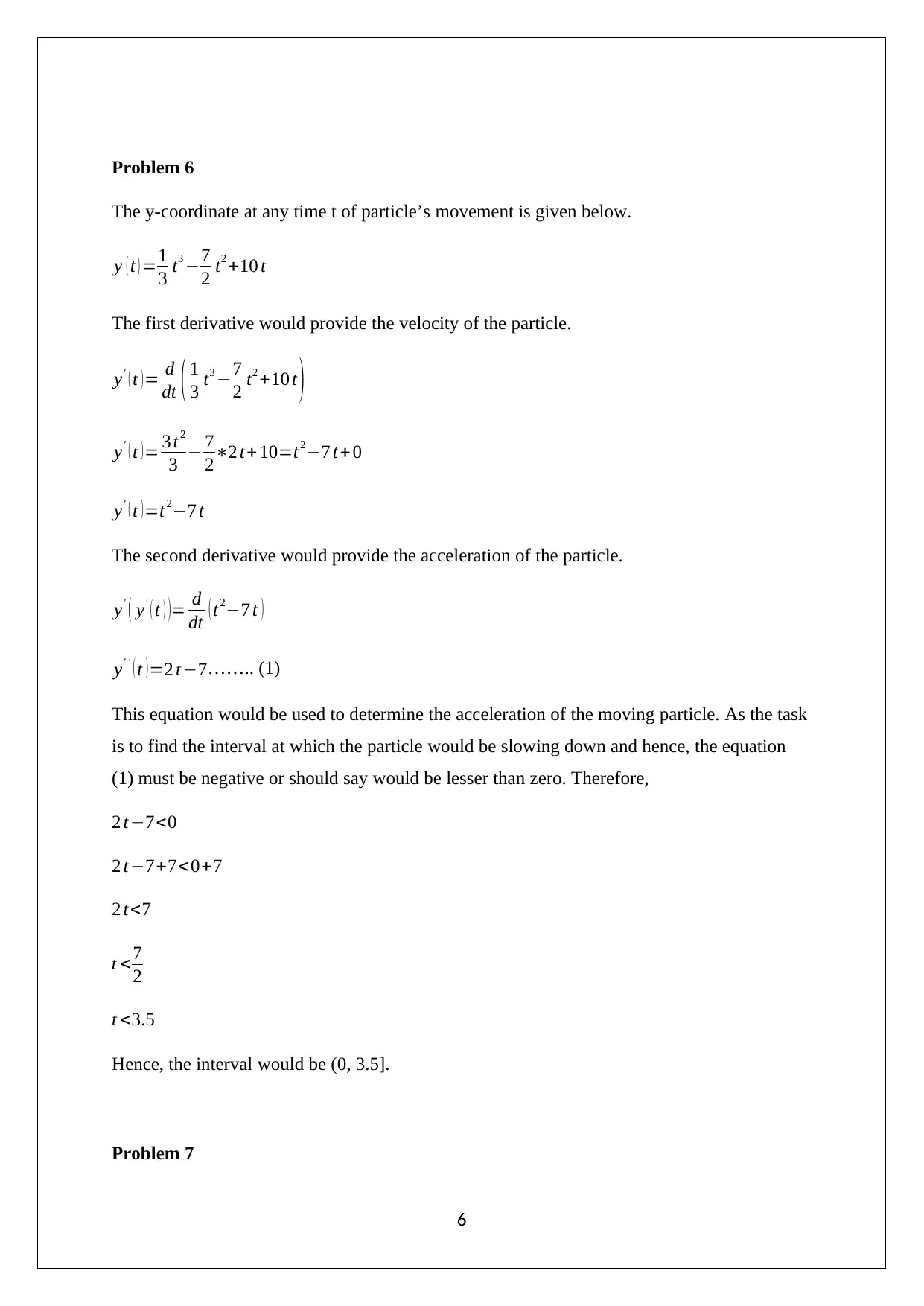
Problem 5
lim
t 0
t3 csc2 2 t cot ( 7 t )
¿ lim
t 0
t3 . 1
sin2 ( 2t ) ¿
¿ lim
t 0
. 1
sin2 ( 2t ) 1
t2 ( 1
( sin 7 t
t ) )¿
¿ lim
t 0
. 1
sin2 ( 2t ) 1
(4 t ¿¿ 2/4 )
( 1
sin7 t
7 t
7 ) ¿ ¿
¿ lim
t 0
. 1
4 ( sin ( 2t )
2 t )
2
1
7 ( 1
sin 7 t
7 t ) ¿
As,
lim
t 0
. sin ( ax )
ax =1
¿ lim
t 0
. 1
4 ( sin ( 2t )
2 t )
2
1
7 ( 1
sin 7 t
7 t ) ¿
lim
t 0
t3 csc2 2 t cot ( 7 t )= 1
28 cos ( 0 )= 1
28
5
Document Page
Problem 6
The y-coordinate at any time t of particle’s movement is given below.
y ( t ) =1
3 t3 7
2 t2 +10 t
The first derivative would provide the velocity of the particle.
y' ( t )= d
dt ( 1
3 t3 7
2 t2 +10 t )
y' ( t )= 3 t2
3 7
22 t+10=t27 t+ 0
y' ( t )=t27 t
The second derivative would provide the acceleration of the particle.
y' ( y' ( t ) )= d
dt ( t27 t )
y' ' ( t ) =2 t7…….. (1)
This equation would be used to determine the acceleration of the moving particle. As the task
is to find the interval at which the particle would be slowing down and hence, the equation
(1) must be negative or should say would be lesser than zero. Therefore,
2 t7<0
2 t7+7< 0+7
2 t<7
t < 7
2
t <3.5
Hence, the interval would be (0, 3.5].
Problem 7
6
tabler-icon-diamond-filled.svg

Paraphrase This Document

Need a fresh take? Get an instant paraphrase of this document with our AI Paraphraser
Document Page
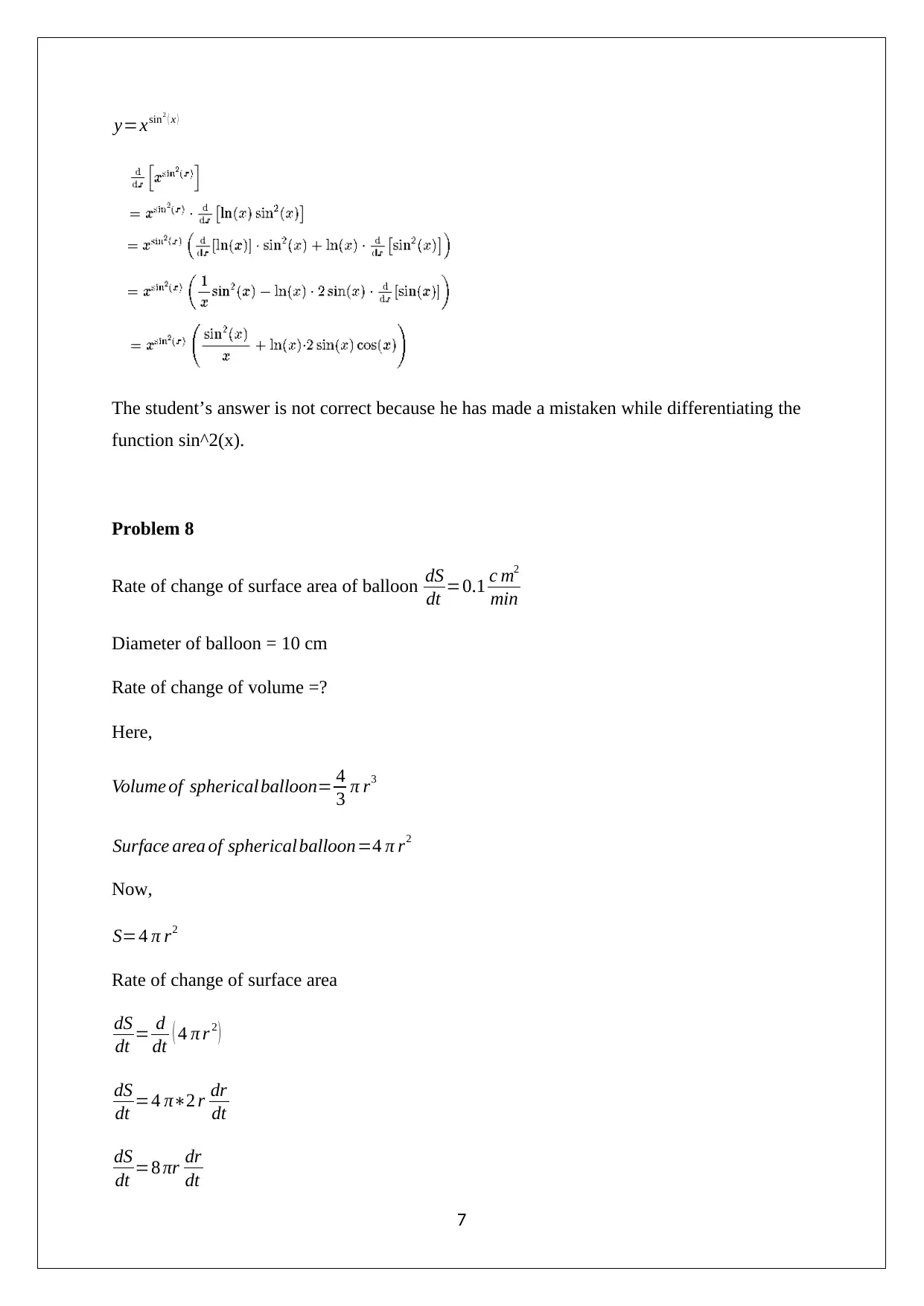
y=xsin2 ( x )
The student’s answer is not correct because he has made a mistaken while differentiating the
function sin^2(x).
Problem 8
Rate of change of surface area of balloon dS
dt =0.1 c m2
min
Diameter of balloon = 10 cm
Rate of change of volume =?
Here,
Volume of spherical balloon= 4
3 π r3
Surface area of spherical balloon=4 π r2
Now,
S=4 π r2
Rate of change of surface area
dS
dt = d
dt ( 4 π r 2 )
dS
dt =4 π2 r dr
dt
dS
dt =8 πr dr
dt
7
Document Page
0.1=8 πr dr
dt
dr
dt = 0.1
8 πr (eq .1 .)
Similarly,
Rate of change of volume
V = 4
3 π r3
dV
dt = d
dt ( 4
3 π r3
)
dV
dt = 4
3 π 3 r2 dr
dt
dV
dt =4 π r2 dr
dt
From equation 1
dV
dt =4 π r2 0.1
8 πr = 0.1 r
2
Radius of balloon = 5 cm
Hence,
dV
dt = 0.15
2 =0.25 c m3 /min
Therefore, rate of change of volume would be 0.25 cm^3/min.
8
chevron_up_icon
1 out of 9
circle_padding
hide_on_mobile
zoom_out_icon
[object Object]