Comprehensive Analysis of 'Who's Afraid of Virginia Woolf?' Play

Verified

Added on  2023/06/11

|4
|864
|147
Essay
AI Summary
This essay provides an analysis of Edward Albee's play 'Who's Afraid of Virginia Woolf?', focusing on acting styles, characterization, and the use of music and lighting effects. The play, a significant work of the 20th century, delves into the complexities of modern marriage and the use of illusions to escape reality. The analysis examines the contrasting characters of George and Martha, an embittered couple, against Nick and Honey, representing different aspects of modern life. The essay highlights how the actors' performances, combined with strategic music and lighting, effectively convey the play's message and enhance the audience's understanding of the characters' inner lives and the play's themes.
Document Page
Running head: PLAY ANALYSIS
Play Analysis
Name of the Student:
Name of the University:
Author’s Note:
tabler-icon-diamond-filled.svg

Paraphrase This Document

Need a fresh take? Get an instant paraphrase of this document with our AI Paraphraser
Document Page
1PLAY ANALYSIS
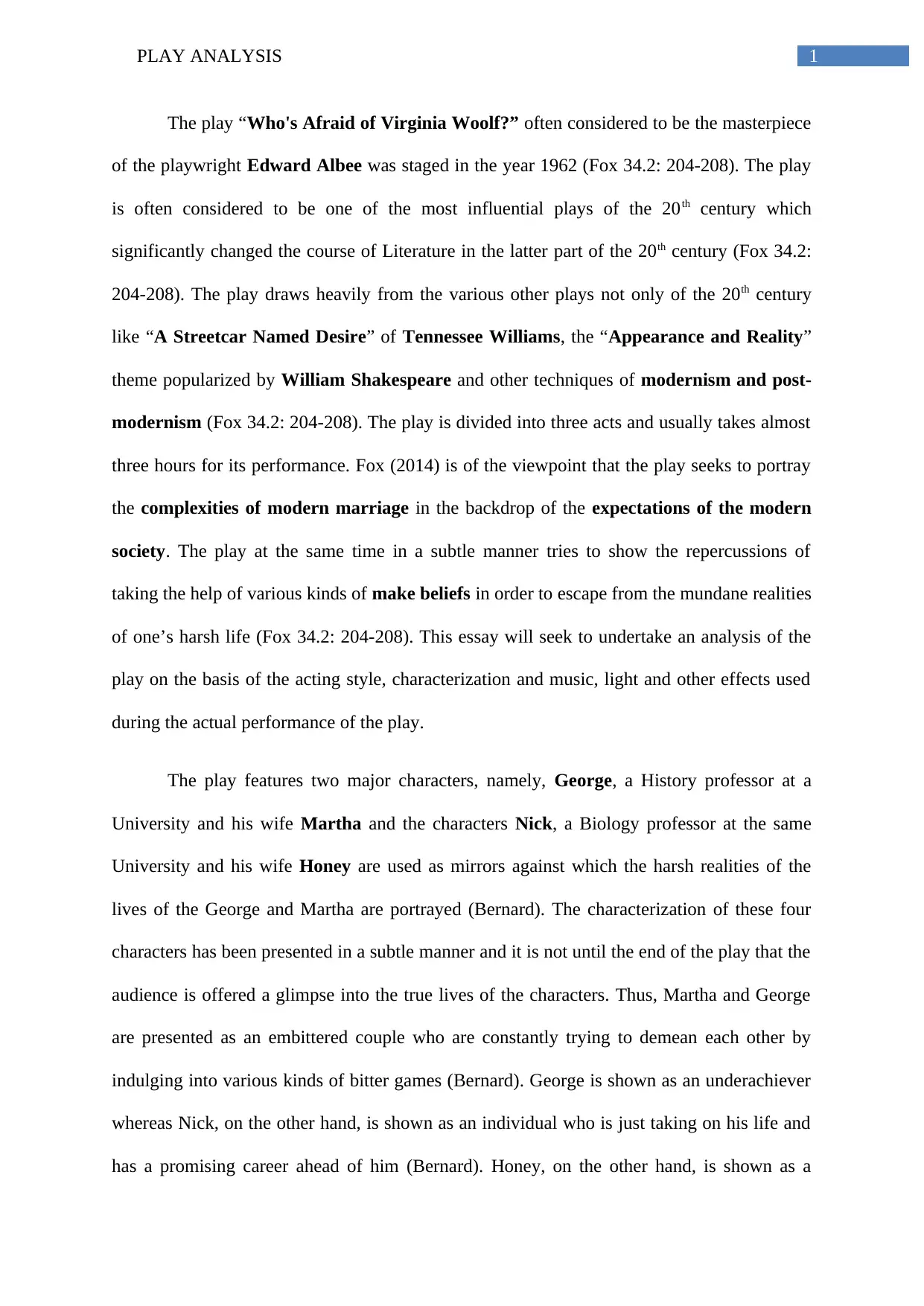
The play “Who's Afraid of Virginia Woolf?” often considered to be the masterpiece
of the playwright Edward Albee was staged in the year 1962 (Fox 34.2: 204-208). The play
is often considered to be one of the most influential plays of the 20th century which
significantly changed the course of Literature in the latter part of the 20th century (Fox 34.2:
204-208). The play draws heavily from the various other plays not only of the 20th century
like “A Streetcar Named Desire” of Tennessee Williams, the “Appearance and Reality
theme popularized by William Shakespeare and other techniques of modernism and post-
modernism (Fox 34.2: 204-208). The play is divided into three acts and usually takes almost
three hours for its performance. Fox (2014) is of the viewpoint that the play seeks to portray
the complexities of modern marriage in the backdrop of the expectations of the modern
society. The play at the same time in a subtle manner tries to show the repercussions of
taking the help of various kinds of make beliefs in order to escape from the mundane realities
of one’s harsh life (Fox 34.2: 204-208). This essay will seek to undertake an analysis of the
play on the basis of the acting style, characterization and music, light and other effects used
during the actual performance of the play.
The play features two major characters, namely, George, a History professor at a
University and his wife Martha and the characters Nick, a Biology professor at the same
University and his wife Honey are used as mirrors against which the harsh realities of the
lives of the George and Martha are portrayed (Bernard). The characterization of these four
characters has been presented in a subtle manner and it is not until the end of the play that the
audience is offered a glimpse into the true lives of the characters. Thus, Martha and George
are presented as an embittered couple who are constantly trying to demean each other by
indulging into various kinds of bitter games (Bernard). George is shown as an underachiever
whereas Nick, on the other hand, is shown as an individual who is just taking on his life and
has a promising career ahead of him (Bernard). Honey, on the other hand, is shown as a
Document Page
2PLAY ANALYSIS
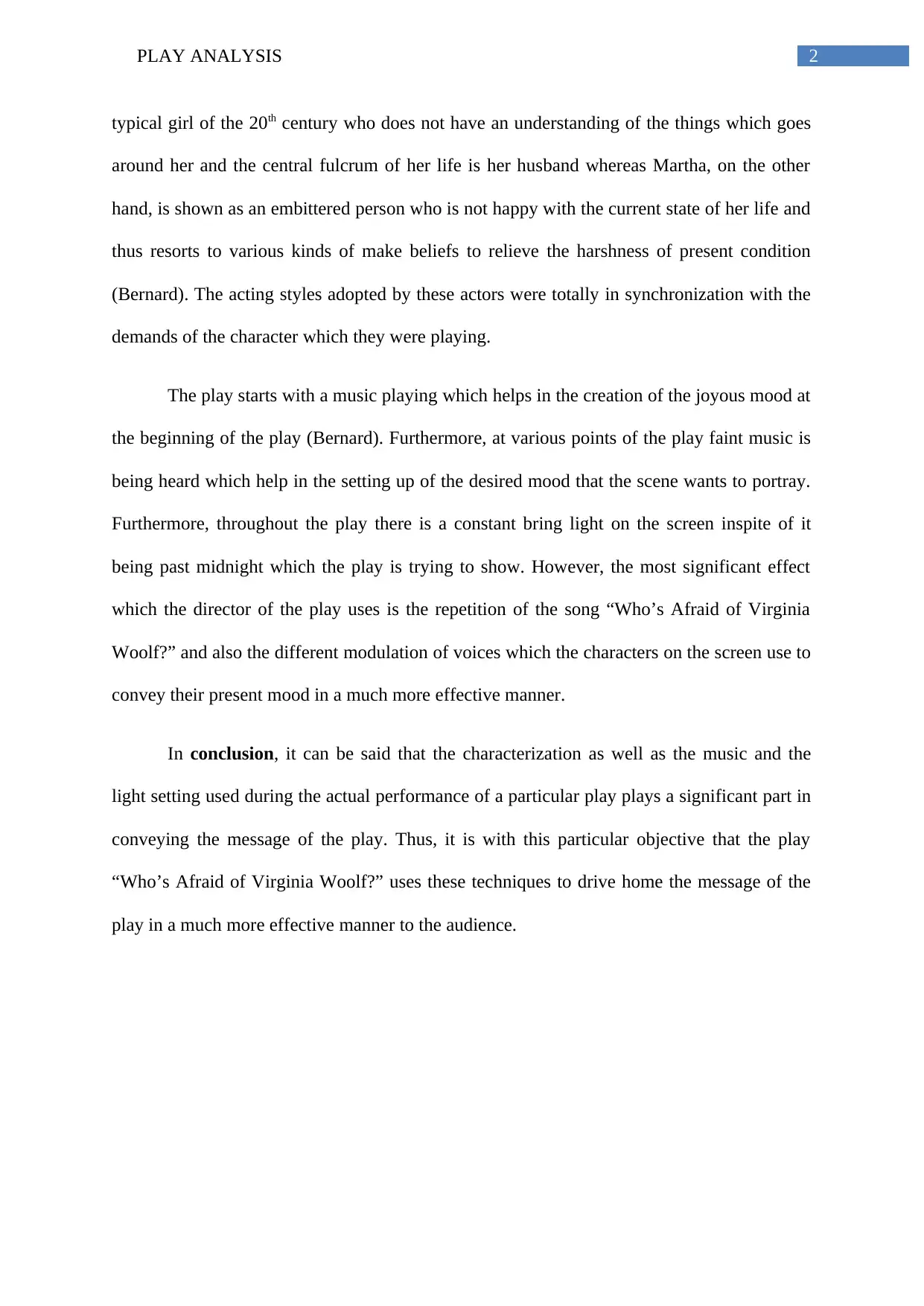
typical girl of the 20th century who does not have an understanding of the things which goes
around her and the central fulcrum of her life is her husband whereas Martha, on the other
hand, is shown as an embittered person who is not happy with the current state of her life and
thus resorts to various kinds of make beliefs to relieve the harshness of present condition
(Bernard). The acting styles adopted by these actors were totally in synchronization with the
demands of the character which they were playing.
The play starts with a music playing which helps in the creation of the joyous mood at
the beginning of the play (Bernard). Furthermore, at various points of the play faint music is
being heard which help in the setting up of the desired mood that the scene wants to portray.
Furthermore, throughout the play there is a constant bring light on the screen inspite of it
being past midnight which the play is trying to show. However, the most significant effect
which the director of the play uses is the repetition of the song “Who’s Afraid of Virginia
Woolf?” and also the different modulation of voices which the characters on the screen use to
convey their present mood in a much more effective manner.
In conclusion, it can be said that the characterization as well as the music and the
light setting used during the actual performance of a particular play plays a significant part in
conveying the message of the play. Thus, it is with this particular objective that the play
“Who’s Afraid of Virginia Woolf?” uses these techniques to drive home the message of the
play in a much more effective manner to the audience.
Document Page
3PLAY ANALYSIS
References
Bernard, Albin. Who’S Afraid Of Virginia Woolf? / Part 1. 2018. Web. 8 June 2018.
Bernard, Albin. Who’S Afraid Of Virginia Woolf? / Part 2. 2018. Web. 8 June 2018.
Fox, Ragan. "Who's Afraid of the Author of Who's Afraid of Virginia Woolf?." Text and
Performance Quarterly 34.2 (2014): 204-208.
chevron_up_icon
1 out of 4
circle_padding
hide_on_mobile
zoom_out_icon
[object Object]