Engineering Management: Virtual Lock Business Plan for UK & Australia
VerifiedAdded on 2023/06/13
|13
|4186
|340
Report
AI Summary
This report presents a business plan for introducing virtual locks in the UK and Australian markets, leveraging Wi-Fi communication and the Internet of Things. It details the characteristics of the target markets, financial considerations, and associated risks. The plan includes a market analysis highlighting the potential for digital door locks due to the increasing adoption of smart devices. It also addresses cultural factors influencing product adoption and provides an overview of the economies of the UK and Australia. The report further discusses financing strategies, including bootstrapping, debt financing, and potential angel investment. A SWOT analysis identifies strengths, weaknesses, opportunities, and threats, while hedging strategies are proposed to mitigate risks like cyber hacks. The report concludes with recommendations for successful market entry and business operation. Desklib provides access to this and other solved assignments for students.
Page 1 of 13
ENGINEERING MANAGEMENT
INTERNATIONAL BUSINESS
ENGINEERING MANAGEMENT
INTERNATIONAL BUSINESS

Paraphrase This Document
Need a fresh take? Get an instant paraphrase of this document with our AI Paraphraser
Page 2 of 13
Executive Summary
The technology and the communication have improved a lot since the last decade.
This has also given rise to the introduction of new products which applies the new
technologies and communication. This paper presents a proposed business plan which intends
to introduce virtual locks in the markets of UK and Australia. The product takes into
consideration the Wi-Fi communication and internet of things. This proposal discusses the
characteristics of the destination market, finance and the risk associated with the products of
the company. The paper also contains recommendations based on the proposal of the new
business.
Executive Summary
The technology and the communication have improved a lot since the last decade.
This has also given rise to the introduction of new products which applies the new
technologies and communication. This paper presents a proposed business plan which intends
to introduce virtual locks in the markets of UK and Australia. The product takes into
consideration the Wi-Fi communication and internet of things. This proposal discusses the
characteristics of the destination market, finance and the risk associated with the products of
the company. The paper also contains recommendations based on the proposal of the new
business.
Page 3 of 13
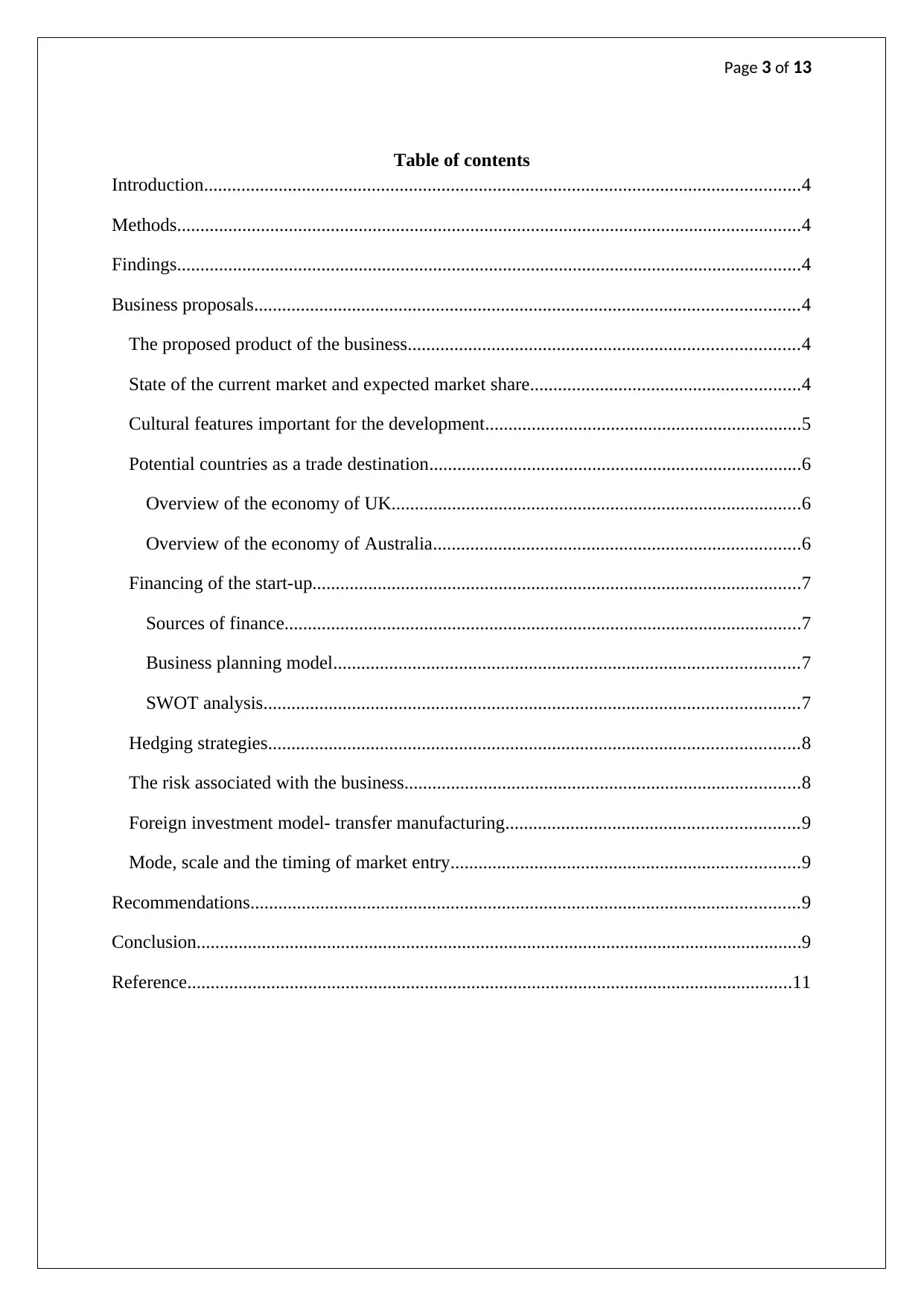
Table of contents
Introduction................................................................................................................................4
Methods......................................................................................................................................4
Findings......................................................................................................................................4
Business proposals.....................................................................................................................4
The proposed product of the business....................................................................................4
State of the current market and expected market share..........................................................4
Cultural features important for the development....................................................................5
Potential countries as a trade destination................................................................................6
Overview of the economy of UK........................................................................................6
Overview of the economy of Australia...............................................................................6
Financing of the start-up.........................................................................................................7
Sources of finance...............................................................................................................7
Business planning model....................................................................................................7
SWOT analysis...................................................................................................................7
Hedging strategies..................................................................................................................8
The risk associated with the business.....................................................................................8
Foreign investment model- transfer manufacturing...............................................................9
Mode, scale and the timing of market entry...........................................................................9
Recommendations......................................................................................................................9
Conclusion..................................................................................................................................9
Reference..................................................................................................................................11
Table of contents
Introduction................................................................................................................................4
Methods......................................................................................................................................4
Findings......................................................................................................................................4
Business proposals.....................................................................................................................4
The proposed product of the business....................................................................................4
State of the current market and expected market share..........................................................4
Cultural features important for the development....................................................................5
Potential countries as a trade destination................................................................................6
Overview of the economy of UK........................................................................................6
Overview of the economy of Australia...............................................................................6
Financing of the start-up.........................................................................................................7
Sources of finance...............................................................................................................7
Business planning model....................................................................................................7
SWOT analysis...................................................................................................................7
Hedging strategies..................................................................................................................8
The risk associated with the business.....................................................................................8
Foreign investment model- transfer manufacturing...............................................................9
Mode, scale and the timing of market entry...........................................................................9
Recommendations......................................................................................................................9
Conclusion..................................................................................................................................9
Reference..................................................................................................................................11
⊘ This is a preview!⊘
Do you want full access?
Subscribe today to unlock all pages.

Trusted by 1+ million students worldwide
Page 4 of 13
Introduction
Business proposals are formal documentation forwarded to the client or business
managers for the future business relationships. The business proposals allow the client to
collect information regarding the capabilities of the business so that they can be offered new
contracts in the future. These proposals include the features, intent and the uniqueness of the
business. The aim of this paper is to present a proposal for a business related to electronic
products that will be traded with international clients based in another country.
Methods
The information and the data used in the paper have been collected from published
journals and articles related to the business proposal and new product development.
Findings
The business proposes to enter the markets of UK and Australia due to the fact that
the needs and the preferences of the customers of these markets match with the features of the
digital products such as the virtual lock. The company proposes to enter the market using the
direct export method in the initial phase of the business. There are a number of risks which
can create a problem for the proposed product and the business as a whole. These involve the
cyber hacks and unauthorised access.
Business proposals
The proposed product of the business
The proposed business is going to produce digital app based door lock. This product
of the company will also allow the customers to share the keys virtually with the family and
friends through the internet. The product will be based on digital network and communication
between the door lock, which needs to be placed in the door and the app which needs to be
installed in the smartphone of the user. UK and Australia is the target market for the products
of the company. The usefulness and the advantages of the proposed product fit perfectly with
the cosmopolitan lifestyle and the needs of the customers of these markets.
State of the current market and expected market share
Due to the advancement in the field of technology and networking between the digital
devices, a lot of new virtual products have emerged in the market. This virtual lock or the
other similar product is also a result of rapid advancement in the field of technology. [20]
stated that the change in the technology is so rapid that products and their features also keep
on changing with each advancement in technology. For example, the previous digital door
lock products could operate through Bluetooth and therefore product only worked when the
virtual key holder was near the Bluetooth connectivity range of the door lock. However, the
Introduction
Business proposals are formal documentation forwarded to the client or business
managers for the future business relationships. The business proposals allow the client to
collect information regarding the capabilities of the business so that they can be offered new
contracts in the future. These proposals include the features, intent and the uniqueness of the
business. The aim of this paper is to present a proposal for a business related to electronic
products that will be traded with international clients based in another country.
Methods
The information and the data used in the paper have been collected from published
journals and articles related to the business proposal and new product development.
Findings
The business proposes to enter the markets of UK and Australia due to the fact that
the needs and the preferences of the customers of these markets match with the features of the
digital products such as the virtual lock. The company proposes to enter the market using the
direct export method in the initial phase of the business. There are a number of risks which
can create a problem for the proposed product and the business as a whole. These involve the
cyber hacks and unauthorised access.
Business proposals
The proposed product of the business
The proposed business is going to produce digital app based door lock. This product
of the company will also allow the customers to share the keys virtually with the family and
friends through the internet. The product will be based on digital network and communication
between the door lock, which needs to be placed in the door and the app which needs to be
installed in the smartphone of the user. UK and Australia is the target market for the products
of the company. The usefulness and the advantages of the proposed product fit perfectly with
the cosmopolitan lifestyle and the needs of the customers of these markets.
State of the current market and expected market share
Due to the advancement in the field of technology and networking between the digital
devices, a lot of new virtual products have emerged in the market. This virtual lock or the
other similar product is also a result of rapid advancement in the field of technology. [20]
stated that the change in the technology is so rapid that products and their features also keep
on changing with each advancement in technology. For example, the previous digital door
lock products could operate through Bluetooth and therefore product only worked when the
virtual key holder was near the Bluetooth connectivity range of the door lock. However, the
Paraphrase This Document
Need a fresh take? Get an instant paraphrase of this document with our AI Paraphraser
Page 5 of 13
current technology which is being used in most of the digital door lock products of the market
includes Wi-Fi connectivity. Therefore, a virtual key holder can now control the digital lock
from a distance apart using the internet [9]. The new products establish a connection with the
home Wi-Fi so that it can be controlled by the virtual key holder through the app.
The current market for the proposed product of the company is moderately high due
to the huge user base of smart devices. The current worth of the digital door lock market is
256 million USD. [1] Highlighted that, with the estimated increase in the number of smart
phone users, the worth of the market is expected to increase further in the future. Currently,
there are a small number of producers of the product in the market and none of them has been
able to capture the market strongly. This is due to the fact that, compared to the number of
smart phone and Wi-Fi users, the demand for the digital door lock is still significantly very
low. [14] Pointed out that, digital platforms are yet to convince the customers that they can be
used as a substitute for the physical products that they currently use. With the increase in the
number of new generation customers who are comparatively more leaned towards
technology, the demand for these products is expected to rise in the future. The product of
this company has some extra features compared to the other products of the market and based
on this the potential market share can be more than 35% in if unique strategies of the
company work out well [10].
Cultural features important for the development
The proposed product will be traded between China and the destination markets such
as UK and Australia. The proposed product and the benefit that can be derived from the
product highly match the needs of the customers of these countries. The common
characteristics between the chosen countries are that both of them are full of people following
cosmopolitan culture. According to [5], people following a cosmopolitan culture tend to get
attracted and become dependent on technology. This is also due to the fact that people
belonging to this group have become busier due to globalisation and other economic
amplifications throughout the world. Therefore, the features of the products are also
influenced by the cultural characteristics and corresponding needs of the people of these
countries. In addition to that, future upgrade of the products of the company will also take
into account the features of the culture in order to meet the needs of the customers accurately.
According to [12], the needs and the preferences of the customers are highly influenced by
the lifestyle they live and the culture they belong to. Thus, the intended market for the
product has been chosen such that it the features of the product fit perfectly given the needs
and the preferences of the customers.
current technology which is being used in most of the digital door lock products of the market
includes Wi-Fi connectivity. Therefore, a virtual key holder can now control the digital lock
from a distance apart using the internet [9]. The new products establish a connection with the
home Wi-Fi so that it can be controlled by the virtual key holder through the app.
The current market for the proposed product of the company is moderately high due
to the huge user base of smart devices. The current worth of the digital door lock market is
256 million USD. [1] Highlighted that, with the estimated increase in the number of smart
phone users, the worth of the market is expected to increase further in the future. Currently,
there are a small number of producers of the product in the market and none of them has been
able to capture the market strongly. This is due to the fact that, compared to the number of
smart phone and Wi-Fi users, the demand for the digital door lock is still significantly very
low. [14] Pointed out that, digital platforms are yet to convince the customers that they can be
used as a substitute for the physical products that they currently use. With the increase in the
number of new generation customers who are comparatively more leaned towards
technology, the demand for these products is expected to rise in the future. The product of
this company has some extra features compared to the other products of the market and based
on this the potential market share can be more than 35% in if unique strategies of the
company work out well [10].
Cultural features important for the development
The proposed product will be traded between China and the destination markets such
as UK and Australia. The proposed product and the benefit that can be derived from the
product highly match the needs of the customers of these countries. The common
characteristics between the chosen countries are that both of them are full of people following
cosmopolitan culture. According to [5], people following a cosmopolitan culture tend to get
attracted and become dependent on technology. This is also due to the fact that people
belonging to this group have become busier due to globalisation and other economic
amplifications throughout the world. Therefore, the features of the products are also
influenced by the cultural characteristics and corresponding needs of the people of these
countries. In addition to that, future upgrade of the products of the company will also take
into account the features of the culture in order to meet the needs of the customers accurately.
According to [12], the needs and the preferences of the customers are highly influenced by
the lifestyle they live and the culture they belong to. Thus, the intended market for the
product has been chosen such that it the features of the product fit perfectly given the needs
and the preferences of the customers.
Page 6 of 13
Potential countries as a trade destination
Overview of the economy of UK
The UK is one of the largest and well developed economies having 5th place in the list
of the largest national economy in the world. The economy of the country is mostly driven by
the market operations, however, the intervention from the government and other authorities
can also be seen in specific events. In terms of the purchasing power parity, the country is the
ninth largest economy in the world. According to [4], the GDP of the country is 3.5% of the
overall GDP of the world. The GDP of the country is 2.565 trillion USD and it is growing
annually at the rate of 0.4%. The GDP growth rate of the economy fluctuates around the
value of 0.5%. The service sector accounts for 80% of the GDP of the country [17]. Apart
from that agriculture and financial service sector is also strong compared to the other
countries of the world.
The bank of England is the central bank of the country which is responsible for
regulating the interest rates, monitory and the financial policies of the country [13].
Currently, the interest rate of the country stands at 5% and the inflation is around 2.7%. Since
the financial crisis in the year 2008, the interest rate of the country has been constant with no
significant changes. The inflation in the country shows an increasing trend as the inflation has
increased from 0% in the year 2010 to 2.5% in the year 2015. [11] Highlighted that the
economy of the country is relatively risk-free compared to the other economies of Europe.
This is due to the controlled financial and economic policies of the government that has been
undertaken since the crises it survived in the year 2008. The high amount of working
population and middle-class citizen of the country also makes it an attractive market for most
of the international businesses of the world [18].
Overview of the economy of Australia
Australia is one of the largest mixed economies of the world with significant
intervention from the side of the government. The GDP of the country is around 1.67 trillion
as per the data of the year 2016. The country is currently enjoying an uninterrupted growth in
the GDP of the country. The growth rate of the GDP has been constant since the year 2008
with slight short-term fluctuations [10]. The current growth rate of the country is around
0.6%. The most part of the economy is comprised of the service sector which accounts for
61% of the GDP of the country. This sector of the economy of Australia employs 79% of the
overall labour force of the country [7].
The reserve bank of Australia is the central bank of the country that takes care of the
monitory and the financial policies. The interest rates of the country stand at 1.5% which has
Potential countries as a trade destination
Overview of the economy of UK
The UK is one of the largest and well developed economies having 5th place in the list
of the largest national economy in the world. The economy of the country is mostly driven by
the market operations, however, the intervention from the government and other authorities
can also be seen in specific events. In terms of the purchasing power parity, the country is the
ninth largest economy in the world. According to [4], the GDP of the country is 3.5% of the
overall GDP of the world. The GDP of the country is 2.565 trillion USD and it is growing
annually at the rate of 0.4%. The GDP growth rate of the economy fluctuates around the
value of 0.5%. The service sector accounts for 80% of the GDP of the country [17]. Apart
from that agriculture and financial service sector is also strong compared to the other
countries of the world.
The bank of England is the central bank of the country which is responsible for
regulating the interest rates, monitory and the financial policies of the country [13].
Currently, the interest rate of the country stands at 5% and the inflation is around 2.7%. Since
the financial crisis in the year 2008, the interest rate of the country has been constant with no
significant changes. The inflation in the country shows an increasing trend as the inflation has
increased from 0% in the year 2010 to 2.5% in the year 2015. [11] Highlighted that the
economy of the country is relatively risk-free compared to the other economies of Europe.
This is due to the controlled financial and economic policies of the government that has been
undertaken since the crises it survived in the year 2008. The high amount of working
population and middle-class citizen of the country also makes it an attractive market for most
of the international businesses of the world [18].
Overview of the economy of Australia
Australia is one of the largest mixed economies of the world with significant
intervention from the side of the government. The GDP of the country is around 1.67 trillion
as per the data of the year 2016. The country is currently enjoying an uninterrupted growth in
the GDP of the country. The growth rate of the GDP has been constant since the year 2008
with slight short-term fluctuations [10]. The current growth rate of the country is around
0.6%. The most part of the economy is comprised of the service sector which accounts for
61% of the GDP of the country. This sector of the economy of Australia employs 79% of the
overall labour force of the country [7].
The reserve bank of Australia is the central bank of the country that takes care of the
monitory and the financial policies. The interest rates of the country stand at 1.5% which has
⊘ This is a preview!⊘
Do you want full access?
Subscribe today to unlock all pages.
Trusted by 1+ million students worldwide
Page 7 of 13
dropped significantly since the year 2008 when it was around 6%. The inflation rate of the
country has also gone down since the year 2008. It has dropped from 4.2% in the year 2008
to 1.8% in the year 2016. As per the trend of the country, the inflation after the year 2010 has
been constant with some insignificant fluctuations around the constant level. [2] Stated the
economy of the country has been mostly stable after the shock that it survived following the
financial crisis of 2008. The dollar value of the Australian currency reached its peak in the
year 2010. However, after that, the value of the currency has gone down with the time [15].
Similar to the characteristics of the economy of UK, the economy of Australia is also high in
the number of the population working in the field of the service sector [22].
Financing of the start-up
Sources of finance
The necessary fund for the initial stages of the business will be collected from the
owners of the proposed business. Apart from that, funds will also be collected from friends
and families. Funds collected from friends and families will be collected as debts and
therefore, none of the shares of the company will be provided to them. Furthermore, finance
of the company can also be sourced from bank loans against collaterals. [21] Stated that the
advantage of debt financing is that the control over the ownership remains intact. Apart from
that, after a certain point of time, the company also has proposed to seek investment from
angel investors as well. The angel investors will invest a moderate amount for the running of
the company. In this case, the company will hand over few shares of the company based on
the value of the company at that time and the amount of investment being made. According
to [3], equity financing allows the owners of the business to attract a high amount of fund
against the transfer of shares of the company.
Business planning model
Objectives: The objective of the company is to produce technologically advanced
door lock and ensure the security of customers of the market.
Measure: The positive feedback from the customers and the sales figure of the
product will allow the owner to measure the accomplishment.
Initiatives: In order to set the product of the company apart from the other products
of the market, the company will have its own R&D unit in order to experiment with
new technologies.
SWOT analysis
Strength Weakness
The strength of the company is that it The company is not aware of the
dropped significantly since the year 2008 when it was around 6%. The inflation rate of the
country has also gone down since the year 2008. It has dropped from 4.2% in the year 2008
to 1.8% in the year 2016. As per the trend of the country, the inflation after the year 2010 has
been constant with some insignificant fluctuations around the constant level. [2] Stated the
economy of the country has been mostly stable after the shock that it survived following the
financial crisis of 2008. The dollar value of the Australian currency reached its peak in the
year 2010. However, after that, the value of the currency has gone down with the time [15].
Similar to the characteristics of the economy of UK, the economy of Australia is also high in
the number of the population working in the field of the service sector [22].
Financing of the start-up
Sources of finance
The necessary fund for the initial stages of the business will be collected from the
owners of the proposed business. Apart from that, funds will also be collected from friends
and families. Funds collected from friends and families will be collected as debts and
therefore, none of the shares of the company will be provided to them. Furthermore, finance
of the company can also be sourced from bank loans against collaterals. [21] Stated that the
advantage of debt financing is that the control over the ownership remains intact. Apart from
that, after a certain point of time, the company also has proposed to seek investment from
angel investors as well. The angel investors will invest a moderate amount for the running of
the company. In this case, the company will hand over few shares of the company based on
the value of the company at that time and the amount of investment being made. According
to [3], equity financing allows the owners of the business to attract a high amount of fund
against the transfer of shares of the company.
Business planning model
Objectives: The objective of the company is to produce technologically advanced
door lock and ensure the security of customers of the market.
Measure: The positive feedback from the customers and the sales figure of the
product will allow the owner to measure the accomplishment.
Initiatives: In order to set the product of the company apart from the other products
of the market, the company will have its own R&D unit in order to experiment with
new technologies.
SWOT analysis
Strength Weakness
The strength of the company is that it The company is not aware of the
Paraphrase This Document
Need a fresh take? Get an instant paraphrase of this document with our AI Paraphraser
Page 8 of 13
will have its own R&D unit and
hence it will be easier for the
company to adopt new technologies.
The emphasis of the company is on
security and this will allow the
company to increase customer base in
the market creating its own USP.
behaviours of the customers and the
other sellers of the market.
The lack available cases and studies
of the market do not allow the
company to gather information
regarding the pattern of the market
and the approach of the government.
Opportunity Threat
The number of smartphone users is
rising and hence there is an
expectation that the demand for the
virtual lock will go up in the future.
The working population in the
intended market is growing and most
of them are young professionals and
hence potential customers of the
market.
The other sellers have been operating
for a long time and they have the
better overview of the market.
Any kind of mishap from the side of
any company can impact the demand
for the product of this company as the
industry is still very vulnerable.
Hedging strategies
As part of the hedging strategies, the company will use a price fixing with the
importer of the products of the company in the chosen organisation. This will allow the
company to take benefit of a stable market price. This stability in the initial phase of the
business will also allow the company to attract more funds for the future activities of the
organisation.
The risk associated with the business
There a number of risks associated with the proposal of the business. First and the
foremost are the rapid changes in the technology. Dependency on the state of the technology
increases the vulnerability of the company [8]. Apart from that, the industry is still in its
experimental stage and hence any kind of mishaps from the products of any company can
lead to a decrease in the demand for the products of the company and the industry as a whole.
The most important threat that is associated with the proposed business is the unauthorised
access and network hacks that can destroy the value of the products.
will have its own R&D unit and
hence it will be easier for the
company to adopt new technologies.
The emphasis of the company is on
security and this will allow the
company to increase customer base in
the market creating its own USP.
behaviours of the customers and the
other sellers of the market.
The lack available cases and studies
of the market do not allow the
company to gather information
regarding the pattern of the market
and the approach of the government.
Opportunity Threat
The number of smartphone users is
rising and hence there is an
expectation that the demand for the
virtual lock will go up in the future.
The working population in the
intended market is growing and most
of them are young professionals and
hence potential customers of the
market.
The other sellers have been operating
for a long time and they have the
better overview of the market.
Any kind of mishap from the side of
any company can impact the demand
for the product of this company as the
industry is still very vulnerable.
Hedging strategies
As part of the hedging strategies, the company will use a price fixing with the
importer of the products of the company in the chosen organisation. This will allow the
company to take benefit of a stable market price. This stability in the initial phase of the
business will also allow the company to attract more funds for the future activities of the
organisation.
The risk associated with the business
There a number of risks associated with the proposal of the business. First and the
foremost are the rapid changes in the technology. Dependency on the state of the technology
increases the vulnerability of the company [8]. Apart from that, the industry is still in its
experimental stage and hence any kind of mishaps from the products of any company can
lead to a decrease in the demand for the products of the company and the industry as a whole.
The most important threat that is associated with the proposed business is the unauthorised
access and network hacks that can destroy the value of the products.
Page 9 of 13
Foreign investment model- transfer manufacturing
The foreign investment model will be selected for the business. Under this process,
the company will transfer the manufactured product to the destination market. The company
will produce in the home country which in this case is china and transfer the products through
the direct exporting channels in the selected countries. It is also notable that, in the future
with the rise in the demand of the product company will also be able use the economics of
scale so that per unit cost of the products can be reduced.
Figure 1: The foreign investment model to be used by the company
(Source: Developed by the learner)
Mode, scale and the timing of market entry
The company proposes to enter the chosen market through direct export at its initial
stages. The company will have its representatives who will be the face of the company in
these markets. [6] Stated that, in the initial stages of businesses, direct exporting is the best
tool to use as this is the cheapest option available to the companies. This will also allow the
company to extract valuable market information through the representative as well. This
information can further be used in the articulation of the future decisions and new products
development. The company will export 14000 USD worth of products in both the countries.
Depending on the sales and the preferences of the customers of the market, it will increase
the export. After a point of time, the company will also change the method of market entry
Foreign investment model- transfer manufacturing
The foreign investment model will be selected for the business. Under this process,
the company will transfer the manufactured product to the destination market. The company
will produce in the home country which in this case is china and transfer the products through
the direct exporting channels in the selected countries. It is also notable that, in the future
with the rise in the demand of the product company will also be able use the economics of
scale so that per unit cost of the products can be reduced.
Figure 1: The foreign investment model to be used by the company
(Source: Developed by the learner)
Mode, scale and the timing of market entry
The company proposes to enter the chosen market through direct export at its initial
stages. The company will have its representatives who will be the face of the company in
these markets. [6] Stated that, in the initial stages of businesses, direct exporting is the best
tool to use as this is the cheapest option available to the companies. This will also allow the
company to extract valuable market information through the representative as well. This
information can further be used in the articulation of the future decisions and new products
development. The company will export 14000 USD worth of products in both the countries.
Depending on the sales and the preferences of the customers of the market, it will increase
the export. After a point of time, the company will also change the method of market entry
⊘ This is a preview!⊘
Do you want full access?
Subscribe today to unlock all pages.
Trusted by 1+ million students worldwide
Page 10 of 13
and select a licensing model in order to enter these markets [16]. The company proposes to
enter the market in the next 6 months from the establishment of the company.
Recommendations
As per the finding of the paper, recommendations are given to the business owners
regarding the security of the product. The owners of the company need to invest money to in
order to increase the awareness of the customers of the market. Apart from that, anti-theft
hack proof technologies can also be used with the help of third-party assistance as well.
Another recommendation to the company is to select the representative of the company
carefully in order to excel in the chosen market. The representative will be the face of the
company in these markets and hence his behaviour and skills are important factors for the
future performance of the company.
Conclusion
Thus, two of the chosen countries are UK and Australia, economic characteristics of
which are mostly similar to each other. Due to the increase in the number of the young
working population the proposed product of the company has the opportunity to successfully
capture a part of the market. The company, as proposed in the report will start with a direct
export method in order to enter the chosen market. There are a number of risks associated
with the proposed business and the products. These needs to be the concern for the
management of the company and it will help the company to establish a positive image
among the customers regarding the products of the company.
and select a licensing model in order to enter these markets [16]. The company proposes to
enter the market in the next 6 months from the establishment of the company.
Recommendations
As per the finding of the paper, recommendations are given to the business owners
regarding the security of the product. The owners of the company need to invest money to in
order to increase the awareness of the customers of the market. Apart from that, anti-theft
hack proof technologies can also be used with the help of third-party assistance as well.
Another recommendation to the company is to select the representative of the company
carefully in order to excel in the chosen market. The representative will be the face of the
company in these markets and hence his behaviour and skills are important factors for the
future performance of the company.
Conclusion
Thus, two of the chosen countries are UK and Australia, economic characteristics of
which are mostly similar to each other. Due to the increase in the number of the young
working population the proposed product of the company has the opportunity to successfully
capture a part of the market. The company, as proposed in the report will start with a direct
export method in order to enter the chosen market. There are a number of risks associated
with the proposed business and the products. These needs to be the concern for the
management of the company and it will help the company to establish a positive image
among the customers regarding the products of the company.
Paraphrase This Document
Need a fresh take? Get an instant paraphrase of this document with our AI Paraphraser
Page 11 of 13
Reference
[1] Aguiar, L., Waldfogel, J. Even the losers get lucky sometimes: New products and the
evolution of music quality since Napster. Information Economics and Policy, 34, pp.
1-15. Jun 2016.
[2] Chen, P. L., Kor, Y., Mahoney, J. T., Tan, D. Pre‐Market Entry Experience and Post‐
Market Entry Learning of the Board of Directors: Implications for Post‐Entry
Performance. Strategic Entrepreneurship Journal, 11(4), pp. 441-463. Mar 2017.
[3] Chetty, S., Ojala, A., Leppäaho, T. Effectuation and foreign market entry of
entrepreneurial firms. European Journal of Marketing, 49(9/10), pp. 1436-1459. Jul
2015.
[4] Eden, L. Multinationals and Foreign Investment Policies in a Digital World.
In E15Initiative, International Centre for Trade and Sustainable Development and
World Economic Forum, Geneva. www. e15initiative. org. Pp.45-49. Aug 2016.
[5] Hartl, R. F., Kort, P. M. Possible market entry of a firm with an additive
manufacturing technology. International Journal of Production Economics, 194, pp.
190-199. Oct 2017.
[6] Jiang, Z., Jain, D. C., Jiang, S. Now or never revisited: an analysis of market entry
timing for successive product generation. pp.56-57 Feb 2015.
[7] Kang, J. S., Downing, S. Keystone effect on entry into two-sided markets: An
analysis of the market entry of WiMAX. Technological Forecasting and Social
Change, 94, pp.170-186. Feb 2015.
[8] Khajavi, S. H., Partanen, J., Holmström, J., Tuomi, J. Risk reduction in new product
launch: a hybrid approach combining direct digital and tool-based
manufacturing. Computers in Industry, 74, pp.29-42. May 2016.
[9] Laufs, K., Bembom, M., Schwens, C. CEO characteristics and SME foreign market
entry mode choice: The moderating effect of firm’s geographic experience and host-
country political risk. International Marketing Review, 33(2), pp.246-275. Dec 2016.
Reference
[1] Aguiar, L., Waldfogel, J. Even the losers get lucky sometimes: New products and the
evolution of music quality since Napster. Information Economics and Policy, 34, pp.
1-15. Jun 2016.
[2] Chen, P. L., Kor, Y., Mahoney, J. T., Tan, D. Pre‐Market Entry Experience and Post‐
Market Entry Learning of the Board of Directors: Implications for Post‐Entry
Performance. Strategic Entrepreneurship Journal, 11(4), pp. 441-463. Mar 2017.
[3] Chetty, S., Ojala, A., Leppäaho, T. Effectuation and foreign market entry of
entrepreneurial firms. European Journal of Marketing, 49(9/10), pp. 1436-1459. Jul
2015.
[4] Eden, L. Multinationals and Foreign Investment Policies in a Digital World.
In E15Initiative, International Centre for Trade and Sustainable Development and
World Economic Forum, Geneva. www. e15initiative. org. Pp.45-49. Aug 2016.
[5] Hartl, R. F., Kort, P. M. Possible market entry of a firm with an additive
manufacturing technology. International Journal of Production Economics, 194, pp.
190-199. Oct 2017.
[6] Jiang, Z., Jain, D. C., Jiang, S. Now or never revisited: an analysis of market entry
timing for successive product generation. pp.56-57 Feb 2015.
[7] Kang, J. S., Downing, S. Keystone effect on entry into two-sided markets: An
analysis of the market entry of WiMAX. Technological Forecasting and Social
Change, 94, pp.170-186. Feb 2015.
[8] Khajavi, S. H., Partanen, J., Holmström, J., Tuomi, J. Risk reduction in new product
launch: a hybrid approach combining direct digital and tool-based
manufacturing. Computers in Industry, 74, pp.29-42. May 2016.
[9] Laufs, K., Bembom, M., Schwens, C. CEO characteristics and SME foreign market
entry mode choice: The moderating effect of firm’s geographic experience and host-
country political risk. International Marketing Review, 33(2), pp.246-275. Dec 2016.
Page 12 of 13
[10] Lu, S., Yang, S. Investigating the Spillover Effect of Keyword Market Entry in
Sponsored Search Advertising. Marketing Science, 36(6), pp.976-998. Jun 2017
[11] Maumbe, N. J., Cheng, Y., Fernando, K. The Market Entry Strategy for Japan, South
Africa, and Spain. Pp.65-78. Dec 2016.
[12] Miller, D. J., Yang, H. S. Product turnover: Simultaneous product market entry and
exit. In Resource redeployment and corporate strategy (pp. 49-87). Emerald Group
Publishing Limited.pp.125-128. Jan 2016.
[13] Palacios Fenech, J., Tellis, G. J. The dive and disruption of successful current
products: Measures, global patterns, and predictive model. Journal of Product
Innovation Management, 33(1), pp.53-68. Mar 2016
[14] Paunov, C., Guellec, D. Digital innovation and the distribution of income. Measuring
and accounting for innovation in the 21st century», NBER, Book Series in Income and
Wealth. pp.56-76. Jan 2015.
[15] Piller, F. T., Weller, C., Kleer, R. Business models with additive manufacturing—
opportunities and challenges from the perspective of economics and management.
In Advances in Production Technology (pp. 39-48). Springer, Cham.pp.32-65. Nov
2015.
[16] Porter, M. E., Heppelmann, J. E. How smart, connected products are transforming
companies. Harvard Business Review, 93(10), pp.96-114. Nov 2015.
[17] Staykova, K. S., Damsgaard, J. The race to dominate the mobile payments platform:
Entry and expansion strategies. Electronic Commerce Research and
Applications, 14(5), pp.319-330. Sept 2015.
[18] Waldfogel, J., Reimers, I. Storming the gatekeepers: Digital disintermediation in the
market for books. Information economics and policy, 31, pp.47-58 Dec 2015.
[19] Weinman, J. Digital Disciplines: Attaining Market Leadership via the Cloud, Big
Data, Mobility, Social Media, and the Internet of Everything. John Wiley & Sons. pp.
12-17.Dec 2015
[10] Lu, S., Yang, S. Investigating the Spillover Effect of Keyword Market Entry in
Sponsored Search Advertising. Marketing Science, 36(6), pp.976-998. Jun 2017
[11] Maumbe, N. J., Cheng, Y., Fernando, K. The Market Entry Strategy for Japan, South
Africa, and Spain. Pp.65-78. Dec 2016.
[12] Miller, D. J., Yang, H. S. Product turnover: Simultaneous product market entry and
exit. In Resource redeployment and corporate strategy (pp. 49-87). Emerald Group
Publishing Limited.pp.125-128. Jan 2016.
[13] Palacios Fenech, J., Tellis, G. J. The dive and disruption of successful current
products: Measures, global patterns, and predictive model. Journal of Product
Innovation Management, 33(1), pp.53-68. Mar 2016
[14] Paunov, C., Guellec, D. Digital innovation and the distribution of income. Measuring
and accounting for innovation in the 21st century», NBER, Book Series in Income and
Wealth. pp.56-76. Jan 2015.
[15] Piller, F. T., Weller, C., Kleer, R. Business models with additive manufacturing—
opportunities and challenges from the perspective of economics and management.
In Advances in Production Technology (pp. 39-48). Springer, Cham.pp.32-65. Nov
2015.
[16] Porter, M. E., Heppelmann, J. E. How smart, connected products are transforming
companies. Harvard Business Review, 93(10), pp.96-114. Nov 2015.
[17] Staykova, K. S., Damsgaard, J. The race to dominate the mobile payments platform:
Entry and expansion strategies. Electronic Commerce Research and
Applications, 14(5), pp.319-330. Sept 2015.
[18] Waldfogel, J., Reimers, I. Storming the gatekeepers: Digital disintermediation in the
market for books. Information economics and policy, 31, pp.47-58 Dec 2015.
[19] Weinman, J. Digital Disciplines: Attaining Market Leadership via the Cloud, Big
Data, Mobility, Social Media, and the Internet of Everything. John Wiley & Sons. pp.
12-17.Dec 2015
⊘ This is a preview!⊘
Do you want full access?
Subscribe today to unlock all pages.
Trusted by 1+ million students worldwide

1 out of 13


Related Documents


Your All-in-One AI-Powered Toolkit for Academic Success.
+13062052269
info@desklib.com
Available 24*7 on WhatsApp / Email
![[object Object]](/_next/static/media/star-bottom.7253800d.svg)
Unlock your academic potential
Copyright © 2020–2026 A2Z Services. All Rights Reserved. Developed and managed by ZUCOL.