GSOC-110 Sociology I: Analyzing Gender Roles Through Visuals

Verified

Added on  2023/06/03

|5
|1040
|385
Report
AI Summary
This report provides a visual sociology analysis of gender roles and women's empowerment, drawing from a photograph depicting a modern professional setting. The analysis employs structural functionalism and interactionist theory to explain the shift in gender roles, highlighting women's increasing participation in traditionally male-dominated spheres. The report emphasizes the evolution of societal norms and the disintegration of rigid gender roles in contemporary society, as evidenced by the interactions and dynamics within the visual material. It concludes that the photo is an ideal model of the modern women empowerment.
Document Page
Running head: REFORMS ON GENDER ROLES 1
Reforms in Gender Roles: A visual Sociology Paper on Women Empowerment
Name
Institutional Affiliation
tabler-icon-diamond-filled.svg

Paraphrase This Document

Need a fresh take? Get an instant paraphrase of this document with our AI Paraphraser
Document Page
REFORMS ON GENDER ROLES 2
Introduction
We all visualize social processes differently, and hence we can hardly form similar
interpretations of everyday life. A single visual material is subject to varied sociological
interpretations based on individual thoughts and perceptions (Doucet, 2018). This paper presents
a photo analysis drawing closely from visual sociology. The paper is based on a single photo,
and the analysis is based on the portrayal of women in the 21st century. Ideally, the issue of
gender roles has always been sharply contested on. The gender debate seems to have similar
magnitudes of compliance and resistance. I chose to analyze the photo because it touches on a
major social issue which is universal to all communities. The female gender has seen massive
empowerment in the past few decades and has risen to take roles that were predominantly
preserved for the male gender. The 21st-century societies are characterized by a constant call for
gender equality which has yielded major reforms and improved the standing of women in the
society.
Document Page
REFORMS ON GENDER ROLES 3
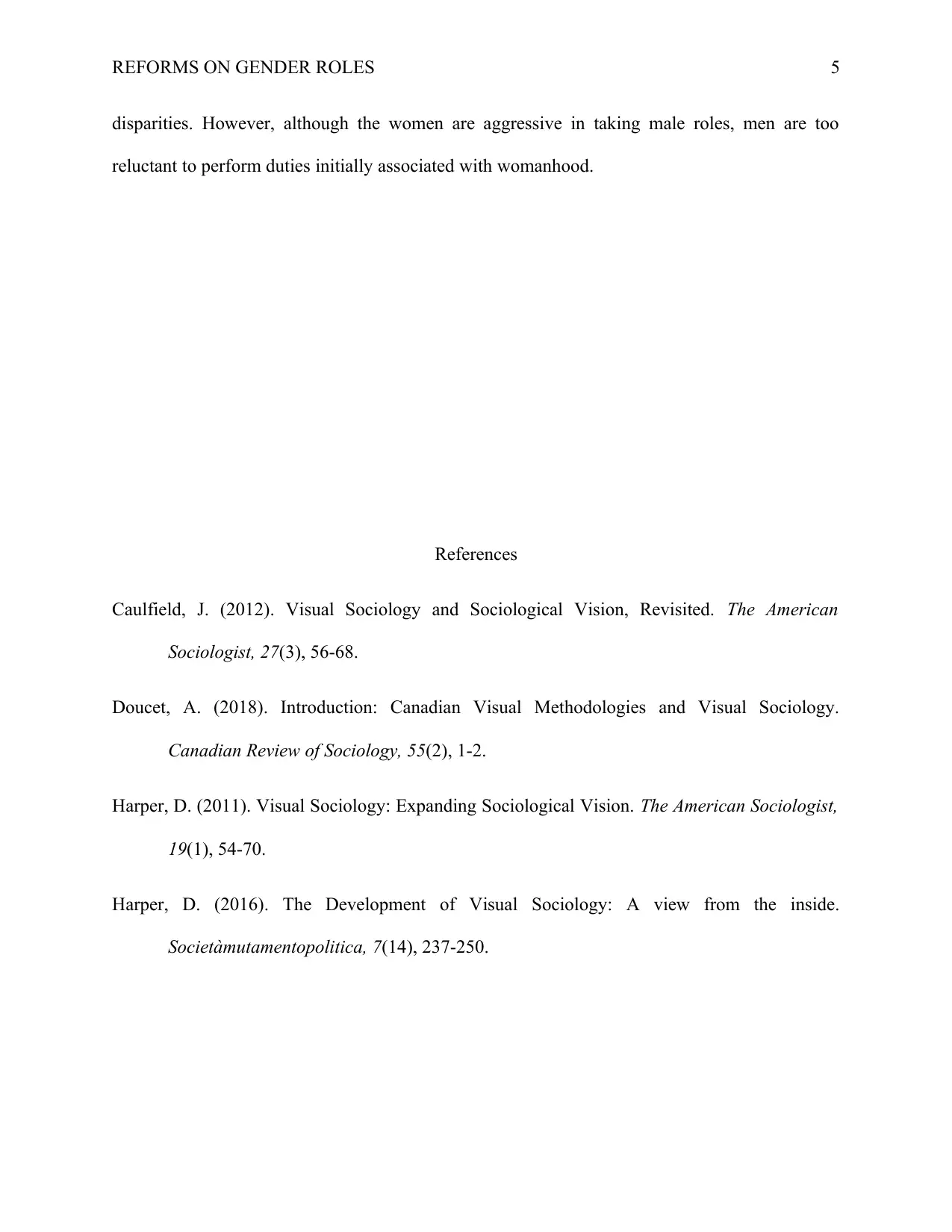
Source: https://visualsociology.org/wp-content/uploads/DSC05462.jpg
The photo is a caption of five people (3 women and two men) seemingly discussing an
important matter. The people are seated around a table with the women occupying the front
seats. The woman at the middle is explaining something to her colleagues. This could be easily
concluded from her posture. Her hand are raised in a position typical to the body movements one
would assume when explaining an important aspect. The two other women and the man created
close to them appear to be following the explanation keenly. However, a man at the back seat
appears bored or not even part of the discussion. He seems to be in deep thoughts unrelated to
the discussion in progress. Although one man may not be following the conversation, it is quite
evident from the photo that the men accord some respect to the women. They have sat in the
same panel, a practice which was not encouraged in the past. The fact that one man exhibits the
required facial expression in the discussions sends a message that he respects the ideas being put
forth by the woman.
Traditionally, gender roles were distinctive and clearly dictated at the societal roles.
Women were not expected to take the roles which were presumed to be authoritative (Harper,
2016). As a result, all the matters requiring serious decision-making were left for men. Men
would never sit down and listen to women talk. Instead, women practiced submissiveness and
did all that was told to them by their male counterparts without raising a grudge. In
contemporary societies, women have been empowered to perform the roles that were solely left
for men formerly. Women can, therefore, get similar employment positions as men as long as
they have the required qualifications. The two genders can now coexist peacefully in a single
environment without the male gender oppressing the female gender. This is the aspect witnessed
Document Page
REFORMS ON GENDER ROLES 4
in the picture. Even though one man does not show much interest, he sits still and waits for the
woman to finish speaking.
The aspect of the disintegration of gender roles as witnessed in the photo could be well
explained by structural functionalism. Before industrialization, gender roles were well
established (Harper, Visual Sociology: Expanding Sociological Vision, 2011). Men took the
roles outside the homestead while the women performed household chores. The changes in both
the economic and climatic dimensions forced for a reshuffling consequently leading to many
women assuming the roles of breadwinners in the family. The men had gone to war, and the
women were left to cater for all the roles initially performed by men. After the adoption of the
traditionally masculine roles, women have retained them up to date. This explains why the men
in the visual material take the role of listening as a woman speaks. According to the interactionist
theory, both sex and gender are constructed aspects. Initially, gender roles were constructed
based on symbols of interaction. The society has evolved to construct different symbols which
have led to less recognition of the gender roles (Caulfield, 2012). The changes in the
construction of symbols explain the current interactions between men and women. The visual
material is an ideal example of the reconstruction of symbols. The modern societies have
deconstructed the initial view of gender based on the given roles. Hence, women can perform
most of the tasks hat men perform.
Conclusion
Conclusively, the photo is an ideal model of the modern women empowerment. It sends a
clear message to any viewer that womanhood has evolved to equal manhood especially in the
aspects of role sharing. The gradual changes in the social structures result in limited gender
tabler-icon-diamond-filled.svg

Paraphrase This Document

Need a fresh take? Get an instant paraphrase of this document with our AI Paraphraser
Document Page
REFORMS ON GENDER ROLES 5
disparities. However, although the women are aggressive in taking male roles, men are too
reluctant to perform duties initially associated with womanhood.
References
Caulfield, J. (2012). Visual Sociology and Sociological Vision, Revisited. The American
Sociologist, 27(3), 56-68.
Doucet, A. (2018). Introduction: Canadian Visual Methodologies and Visual Sociology.
Canadian Review of Sociology, 55(2), 1-2.
Harper, D. (2011). Visual Sociology: Expanding Sociological Vision. The American Sociologist,
19(1), 54-70.
Harper, D. (2016). The Development of Visual Sociology: A view from the inside.
Societàmutamentopolitica, 7(14), 237-250.
chevron_up_icon
1 out of 5
circle_padding
hide_on_mobile
zoom_out_icon
[object Object]