Queensland Uni: Research Proposal - Vitamin B-1 and Brain Development
VerifiedAdded on 2022/10/06
|19
|4762
|19
Report
AI Summary
This research proposal investigates the impact of Vitamin B-1 (thiamine) on baby brain development in Australia, focusing on the importance of nutrition during pregnancy. The study addresses the research gap by exploring the positive and negative effects of Vitamin B-1 deficiency on infant brain development, considering the critical role of thiamine and the potential consequences of its deficiency. The research employs an exploratory research design, utilizing a survey through a questionnaire for primary data collection, supplemented by secondary data from various sources like books, articles, and websites. The proposal outlines data evaluation methods, including quantitative analysis, and addresses ethical considerations such as consent, confidentiality, and plagiarism. The research aims to provide knowledge and understanding for pregnant women and their families regarding Vitamin B-1's role in healthy pregnancy and infant brain development, contributing to awareness of the impact of B1 deficiency and guiding future research in this area.
Running Head: BUSINESS RESEARCH
BUSINESS RESEARCH
BUSINESS RESEARCH

Paraphrase This Document
Need a fresh take? Get an instant paraphrase of this document with our AI Paraphraser
BUSINESS RESEARCH 2
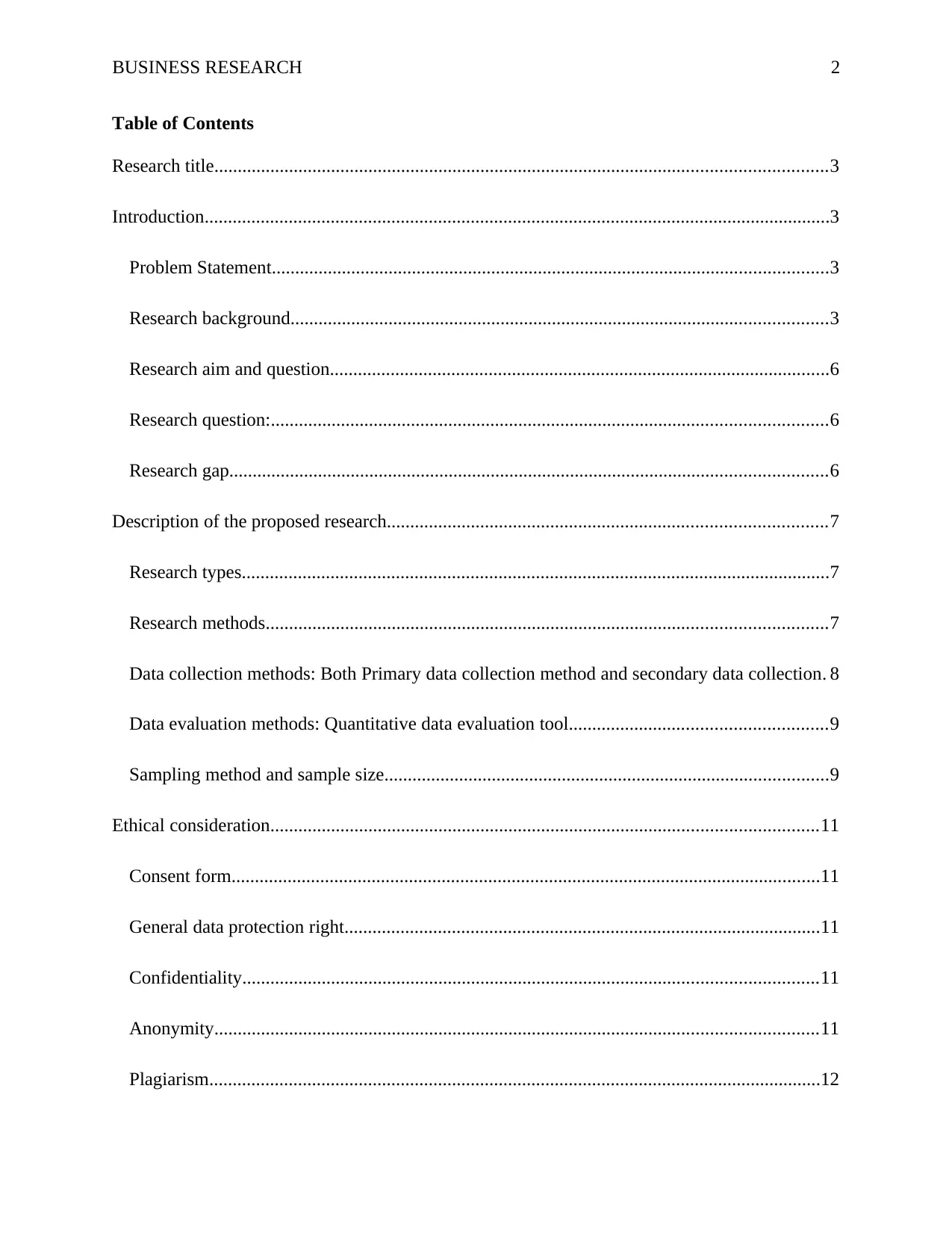
Table of Contents
Research title...................................................................................................................................3
Introduction......................................................................................................................................3
Problem Statement.......................................................................................................................3
Research background...................................................................................................................3
Research aim and question...........................................................................................................6
Research question:.......................................................................................................................6
Research gap................................................................................................................................6
Description of the proposed research..............................................................................................7
Research types..............................................................................................................................7
Research methods........................................................................................................................7
Data collection methods: Both Primary data collection method and secondary data collection. 8
Data evaluation methods: Quantitative data evaluation tool.......................................................9
Sampling method and sample size...............................................................................................9
Ethical consideration.....................................................................................................................11
Consent form..............................................................................................................................11
General data protection right......................................................................................................11
Confidentiality...........................................................................................................................11
Anonymity.................................................................................................................................11
Plagiarism...................................................................................................................................12
Table of Contents
Research title...................................................................................................................................3
Introduction......................................................................................................................................3
Problem Statement.......................................................................................................................3
Research background...................................................................................................................3
Research aim and question...........................................................................................................6
Research question:.......................................................................................................................6
Research gap................................................................................................................................6
Description of the proposed research..............................................................................................7
Research types..............................................................................................................................7
Research methods........................................................................................................................7
Data collection methods: Both Primary data collection method and secondary data collection. 8
Data evaluation methods: Quantitative data evaluation tool.......................................................9
Sampling method and sample size...............................................................................................9
Ethical consideration.....................................................................................................................11
Consent form..............................................................................................................................11
General data protection right......................................................................................................11
Confidentiality...........................................................................................................................11
Anonymity.................................................................................................................................11
Plagiarism...................................................................................................................................12
BUSINESS RESEARCH 3
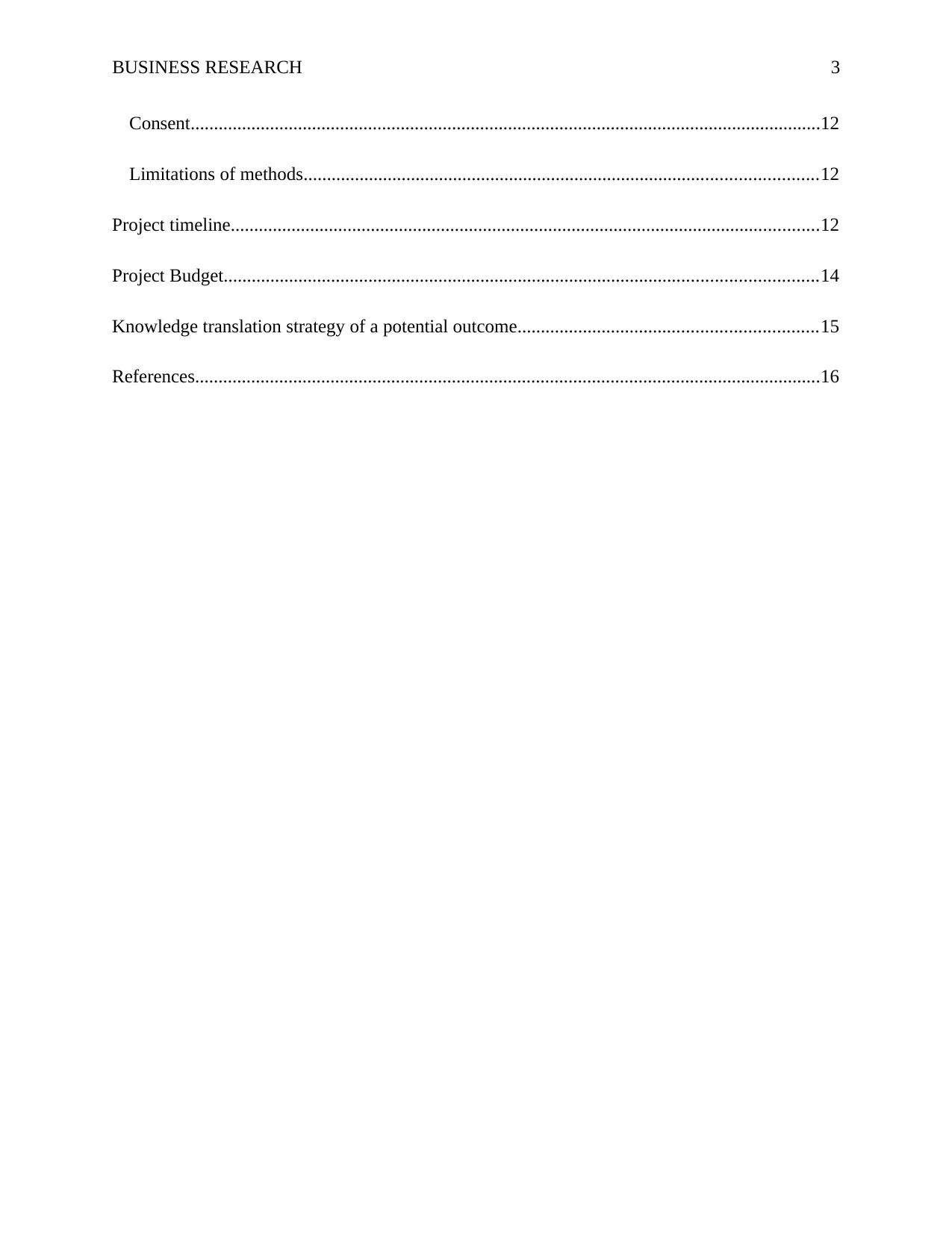
Consent.......................................................................................................................................12
Limitations of methods..............................................................................................................12
Project timeline..............................................................................................................................12
Project Budget...............................................................................................................................14
Knowledge translation strategy of a potential outcome................................................................15
References......................................................................................................................................16
Consent.......................................................................................................................................12
Limitations of methods..............................................................................................................12
Project timeline..............................................................................................................................12
Project Budget...............................................................................................................................14
Knowledge translation strategy of a potential outcome................................................................15
References......................................................................................................................................16
⊘ This is a preview!⊘
Do you want full access?
Subscribe today to unlock all pages.

Trusted by 1+ million students worldwide
BUSINESS RESEARCH 4
Research title
To investigate the impact of Vitamin B-1 on Babies Brain Development in Australia
Introduction
Problem Statement
In the recent era, the development of the brain requires proper food and nutrition that
include different vitamins and minerals. Proper nutrition among people will be possible with the
proper knowledge about food and nutrition. It is witnessed that there is a relationship between
diet and brain development. Food and nutrition include different Vitamin that can affect the
development of brain positively and negatively (Connor, Patton, Oexle, & Allen, 2017). The
objective of the research proposal is to investigate the negative and positive impact of Vitamin
B-1 on Babies Brain Development in Australia. Moreover, deficiency of Vitamin B1 (thiamine)
could directly affect the motor act of preschoolers that were fed faulty formulation in the initial
year of its lives. Vitamin B is more effective for boosting the natural energy of pregnant women
that is essential for the growth of the baby (Champoux, Yaqub, Alturki, Desjardins, Marcoux,
Maleki, & Feyz, 2014). Vitamins B could support to ensure a healthy pregnancy. The pregnant
women need to increase their depth awareness in the context of Vitamin B1 as it would be
imperative for healthy pregnancy (Bø, Artal, Barakat, Brown, Davies, Dooley, & Kinnunen,
2016). The research is conducted with the hope to find out the importance of vitamin B1 for the
brain development of babies majorly at the stage of pregnancy. The research is important to be
undertaken because it will provide the knowledge and understanding of pregnant women and
their family member towards Vitamin B1.
Research background
Research title
To investigate the impact of Vitamin B-1 on Babies Brain Development in Australia
Introduction
Problem Statement
In the recent era, the development of the brain requires proper food and nutrition that
include different vitamins and minerals. Proper nutrition among people will be possible with the
proper knowledge about food and nutrition. It is witnessed that there is a relationship between
diet and brain development. Food and nutrition include different Vitamin that can affect the
development of brain positively and negatively (Connor, Patton, Oexle, & Allen, 2017). The
objective of the research proposal is to investigate the negative and positive impact of Vitamin
B-1 on Babies Brain Development in Australia. Moreover, deficiency of Vitamin B1 (thiamine)
could directly affect the motor act of preschoolers that were fed faulty formulation in the initial
year of its lives. Vitamin B is more effective for boosting the natural energy of pregnant women
that is essential for the growth of the baby (Champoux, Yaqub, Alturki, Desjardins, Marcoux,
Maleki, & Feyz, 2014). Vitamins B could support to ensure a healthy pregnancy. The pregnant
women need to increase their depth awareness in the context of Vitamin B1 as it would be
imperative for healthy pregnancy (Bø, Artal, Barakat, Brown, Davies, Dooley, & Kinnunen,
2016). The research is conducted with the hope to find out the importance of vitamin B1 for the
brain development of babies majorly at the stage of pregnancy. The research is important to be
undertaken because it will provide the knowledge and understanding of pregnant women and
their family member towards Vitamin B1.
Research background
Paraphrase This Document
Need a fresh take? Get an instant paraphrase of this document with our AI Paraphraser
BUSINESS RESEARCH 5
In every stage of life, there is a need for a healthy and balanced diet which is essential for
a healthy lifestyle. The deficiency of Vitamin B leads to complexity, which is an imperative
aspect for the bouncing baby. According to Murray, Barber, Foreman, Ozgoren, Abd-Allah,
Abera, & Abu-Rmeileh (2015), the pregnant women generally, focuses on vitamins named as
B6, B9, and B12 as they want to eliminate the probability of baby birth risk. The entire B
complex is a combination of eight vitamins that support the healthiest lifestyle of pregnant
women.
It could also support the women to become imperative that helps them to improve their health
while pregnancy. The researcher states this that Vitamin B performs a vital role for pregnant
women for baby’s brain.
Considering the view of Das, Laha, Mandal, Pal, & Siddiqui, (2018), during the third and first
trimesters, most of the women feel that they are more exhausts as well as run-down as compared
to the women who were not pregnant. Even though B complex could come in the supplement
which is an effective way to absorb such nutrients is considering vitamin-rich foods. Also,
Vitamin B food could support to boost the health of women who are pregnant. It could also
directly affect the brain growth of the baby. Vitamin B1 (Thiamine) deficiency is majorly
observed in the women who are pregnant that have improved the demands for thiamine
(Hechtman & Pizzorno, 2015). In Australia, complication at the time of pregnancy is recognized
majorly in the brain of a baby due to deficiency of Thiamine.
Agreeing to this, Murray, Barber, Foreman, Ozgoren, Abd-Allah, Abera, & Abu-Rmeileh
(2015) says that, Thiamine plays an imperative role in the body development to support the body
so that they can consume 1.4 mg each day. Besides, deficiency of vitamin B1 will affect
In every stage of life, there is a need for a healthy and balanced diet which is essential for
a healthy lifestyle. The deficiency of Vitamin B leads to complexity, which is an imperative
aspect for the bouncing baby. According to Murray, Barber, Foreman, Ozgoren, Abd-Allah,
Abera, & Abu-Rmeileh (2015), the pregnant women generally, focuses on vitamins named as
B6, B9, and B12 as they want to eliminate the probability of baby birth risk. The entire B
complex is a combination of eight vitamins that support the healthiest lifestyle of pregnant
women.
It could also support the women to become imperative that helps them to improve their health
while pregnancy. The researcher states this that Vitamin B performs a vital role for pregnant
women for baby’s brain.
Considering the view of Das, Laha, Mandal, Pal, & Siddiqui, (2018), during the third and first
trimesters, most of the women feel that they are more exhausts as well as run-down as compared
to the women who were not pregnant. Even though B complex could come in the supplement
which is an effective way to absorb such nutrients is considering vitamin-rich foods. Also,
Vitamin B food could support to boost the health of women who are pregnant. It could also
directly affect the brain growth of the baby. Vitamin B1 (Thiamine) deficiency is majorly
observed in the women who are pregnant that have improved the demands for thiamine
(Hechtman & Pizzorno, 2015). In Australia, complication at the time of pregnancy is recognized
majorly in the brain of a baby due to deficiency of Thiamine.
Agreeing to this, Murray, Barber, Foreman, Ozgoren, Abd-Allah, Abera, & Abu-Rmeileh
(2015) says that, Thiamine plays an imperative role in the body development to support the body
so that they can consume 1.4 mg each day. Besides, deficiency of vitamin B1 will affect
BUSINESS RESEARCH 6
pregnant women, as they would not be capable to improve the brain development track (Murray,
Barber, Foreman, Ozgoren, Abd-Allah, Abera, & Abu-Rmeileh, 2015). There are certain food
and nutrition that can contribute in improving the deficiency of vitamin B named as Brazil Nuts,
Whole Grain Pasta, Fortified bread or Cereals, Pecans, Oats, Salmon, Wheat Germ, Lentils,
Dried Beans, Pork, Nutritional Yeast, and Peas. B1 affects the overall outer layers as well as
cereals germ in beef, pulses, whole grains, pork, and yeast. There are some vegetables as well as
fruits could consider different contains named as eggs, asparagus, potatoes, cauliflower, liver,
and oranges, and kale (Bhattacharjya, 2017).
Dunford, Louie, Byrne, Walker, & Flood (2015) presented that blackstrap molasses, as
well as brewer's yeast, could be vital in obtaining higher competitive advantages. Moreover,
pregnant women breakfast product should include white Flore and white rice that is enriched
with high Vitamin B. Most of the people in the US consume half of required vitamin B1 by
entailing the drinking or consumption of food during the pregnancy. This will help them in
maintaining the Vitamin B1 that will positively affect their baby’s brain development (Murray,
Barber, Foreman, Ozgoren, Abd-Allah, Abera, & Abu-Rmeileh, 2015).
As per the views of author Murray, Barber, Foreman, Ozgoren, Abd-Allah, Abera, &
Abu-Rmeileh (2015) thiamin might get destroyed at the time of cooking, heating, water boiling,
and food processing. The vitamin B1 gets dissolve in the cooking water. For illustration, if an
individual prepare white rice with boiled water then individual become unable to consume
minerals of vitamin B1 properly. The vitamin of white rice get dissolve in the boiled water will
destroy the same. However, at the same time, it is examined that brown rice could not fully
dissolve the vitamins of rice.
pregnant women, as they would not be capable to improve the brain development track (Murray,
Barber, Foreman, Ozgoren, Abd-Allah, Abera, & Abu-Rmeileh, 2015). There are certain food
and nutrition that can contribute in improving the deficiency of vitamin B named as Brazil Nuts,
Whole Grain Pasta, Fortified bread or Cereals, Pecans, Oats, Salmon, Wheat Germ, Lentils,
Dried Beans, Pork, Nutritional Yeast, and Peas. B1 affects the overall outer layers as well as
cereals germ in beef, pulses, whole grains, pork, and yeast. There are some vegetables as well as
fruits could consider different contains named as eggs, asparagus, potatoes, cauliflower, liver,
and oranges, and kale (Bhattacharjya, 2017).
Dunford, Louie, Byrne, Walker, & Flood (2015) presented that blackstrap molasses, as
well as brewer's yeast, could be vital in obtaining higher competitive advantages. Moreover,
pregnant women breakfast product should include white Flore and white rice that is enriched
with high Vitamin B. Most of the people in the US consume half of required vitamin B1 by
entailing the drinking or consumption of food during the pregnancy. This will help them in
maintaining the Vitamin B1 that will positively affect their baby’s brain development (Murray,
Barber, Foreman, Ozgoren, Abd-Allah, Abera, & Abu-Rmeileh, 2015).
As per the views of author Murray, Barber, Foreman, Ozgoren, Abd-Allah, Abera, &
Abu-Rmeileh (2015) thiamin might get destroyed at the time of cooking, heating, water boiling,
and food processing. The vitamin B1 gets dissolve in the cooking water. For illustration, if an
individual prepare white rice with boiled water then individual become unable to consume
minerals of vitamin B1 properly. The vitamin of white rice get dissolve in the boiled water will
destroy the same. However, at the same time, it is examined that brown rice could not fully
dissolve the vitamins of rice.
⊘ This is a preview!⊘
Do you want full access?
Subscribe today to unlock all pages.
Trusted by 1+ million students worldwide
BUSINESS RESEARCH 7
Based on NIH (National Institutes of Health), fortified breakfast offers 1.5 milligrams
(mg) of thiamin that is more than a hundred percent. It can be evaluated that the whole wheat
bread consists of 7 percent of daily need. Further, pregnant women should be aware of the fact
that some healthy products do not include thiamin that is an apple, chicken, and cheese. An
individual requisite of continuously vitamin B1 supply from their body could not be stored in the
body. It could be part of the daily diet. Thiamin or vitamin B enables preventing all
complications of the nervous system. It could control on brain, stomach, heart, as well as
intestines. It could also support to prevent the diseases named as digestive, heart, and nerves
system due to which the influence of Thiamin is high on pregnant women (Hechtman &
Pizzorno, 2015).
The literature says that the problem of deficiency B1 generally occurs in pregnant women
due to which they deal with the complications in their pregnancy. The deficiency of the B1 might
affect the child after birth also which will not be considered by the researcher in their research
that shows the gap that this research proposal. The contribution of this research will be that it
allows the other research to conduct the different elements while researching the near future.
Along with this, it will generate awareness about the impact on the child brain development due
to deficiency of B1, which will allow them to take the essential steps.
Research aim and question
The research aims to investigate the impact of Vitamin B-1 on Babies Brain Development in
Australia that can be positive or negative. The below given is the research question.
Research question:
What is the impact of Vitamin B-1 on Babies Brain Development in Australia?
Based on NIH (National Institutes of Health), fortified breakfast offers 1.5 milligrams
(mg) of thiamin that is more than a hundred percent. It can be evaluated that the whole wheat
bread consists of 7 percent of daily need. Further, pregnant women should be aware of the fact
that some healthy products do not include thiamin that is an apple, chicken, and cheese. An
individual requisite of continuously vitamin B1 supply from their body could not be stored in the
body. It could be part of the daily diet. Thiamin or vitamin B enables preventing all
complications of the nervous system. It could control on brain, stomach, heart, as well as
intestines. It could also support to prevent the diseases named as digestive, heart, and nerves
system due to which the influence of Thiamin is high on pregnant women (Hechtman &
Pizzorno, 2015).
The literature says that the problem of deficiency B1 generally occurs in pregnant women
due to which they deal with the complications in their pregnancy. The deficiency of the B1 might
affect the child after birth also which will not be considered by the researcher in their research
that shows the gap that this research proposal. The contribution of this research will be that it
allows the other research to conduct the different elements while researching the near future.
Along with this, it will generate awareness about the impact on the child brain development due
to deficiency of B1, which will allow them to take the essential steps.
Research aim and question
The research aims to investigate the impact of Vitamin B-1 on Babies Brain Development in
Australia that can be positive or negative. The below given is the research question.
Research question:
What is the impact of Vitamin B-1 on Babies Brain Development in Australia?
Paraphrase This Document
Need a fresh take? Get an instant paraphrase of this document with our AI Paraphraser
BUSINESS RESEARCH 8
Research gap
In the review of literature, the gap lies when the researcher only focuses on Vitamin B1
whose decencies can affect the brain development of babies majorly at the time of pregnancy.
The researcher should consider different types of vitamin B also that can affect health. Further,
the researcher majorly focuses on pregnant women and do not consider the infant baby who is
dealing with brain development issues.
Description of the proposed research
This section includes a description of the proposed research methodology that will be
used by the researcher (Mutiso, 2017). The methodology is a theoretical and systematic analysis
of the different methods that investigator use for conducting the research. The research methods
will help the investigator to gather accurate and reliable information for their study (Rauch,
2016). The below segment shows how the researcher will use research strategies, data collection
methods, data evaluation methods, and data sampling tool for their study that is to investigate the
impact of Vitamin B1 on Babies Brain Development in Australia.
Research types
While conducting the study, there are different kinds of investigation that support the researcher
to determine the specific design of the research plan. The researcher types include descriptive,
exploratory, and explanatory research design. The researcher will use the exploratory research
with the motive to conduct the study and to get the outcome for the particular problem that is the
impact of Vitamin B-1 on Babies Brain Development in Australia.
Research methods
The research scholar practices different methods before researching so that they can
understand the concept and can meet the purpose of the study. For conducting this research, the
Research gap
In the review of literature, the gap lies when the researcher only focuses on Vitamin B1
whose decencies can affect the brain development of babies majorly at the time of pregnancy.
The researcher should consider different types of vitamin B also that can affect health. Further,
the researcher majorly focuses on pregnant women and do not consider the infant baby who is
dealing with brain development issues.
Description of the proposed research
This section includes a description of the proposed research methodology that will be
used by the researcher (Mutiso, 2017). The methodology is a theoretical and systematic analysis
of the different methods that investigator use for conducting the research. The research methods
will help the investigator to gather accurate and reliable information for their study (Rauch,
2016). The below segment shows how the researcher will use research strategies, data collection
methods, data evaluation methods, and data sampling tool for their study that is to investigate the
impact of Vitamin B1 on Babies Brain Development in Australia.
Research types
While conducting the study, there are different kinds of investigation that support the researcher
to determine the specific design of the research plan. The researcher types include descriptive,
exploratory, and explanatory research design. The researcher will use the exploratory research
with the motive to conduct the study and to get the outcome for the particular problem that is the
impact of Vitamin B-1 on Babies Brain Development in Australia.
Research methods
The research scholar practices different methods before researching so that they can
understand the concept and can meet the purpose of the study. For conducting this research, the
BUSINESS RESEARCH 9
investigator will use a survey through questionnaire tool that enables to get feasible information
in the context of research issue that deficiency Vitamin B1 and their impact on babies. This tool
is preferred more as compared to other methods named as content analysis method and case
study. It will assist to offer a path to the team for accomplishing the investigation about the
positive and negative impact of Vitamin B1 on Babies Brain Development in Australia. It will
also aid to reach a reliable conclusion in the context of the research that will be conducted
(Truscott, 2014).
Data collection methods: Both Primary data collection method and secondary data
collection
Data collection is techniques included in the research methodology that helps the
investigator to pool and access the facts about the research problem. Different techniques are
used by the researcher to collect the data with the help of secondary or/and primary research
method. In performing this research, secondary as well as primary data method of collection will
be used by the investigator for gathering the relevant information about the deficiency of
Vitamin B1 and its impact on child brain development. The primary data-gathering tool is
imperative to obtain first-hand information that would be imperative in meeting the study
question (Connor, Patton, Oexle, & Allen, 2017). Further, the secondary data collection is also
vital for collecting reliable information that is effective in obtaining the information by existing
sources such as books, offline, and articles, and websites (Das, Laha, Mandal, Pal, & Siddiqui,
2018).
It will assist to accomplish the study purpose in the least time and cost. The primary data
collecting technique will be used to examine the information by considering the survey through a
questionnaire. This tool aids to effectively communicate with the investigators that desire to
investigator will use a survey through questionnaire tool that enables to get feasible information
in the context of research issue that deficiency Vitamin B1 and their impact on babies. This tool
is preferred more as compared to other methods named as content analysis method and case
study. It will assist to offer a path to the team for accomplishing the investigation about the
positive and negative impact of Vitamin B1 on Babies Brain Development in Australia. It will
also aid to reach a reliable conclusion in the context of the research that will be conducted
(Truscott, 2014).
Data collection methods: Both Primary data collection method and secondary data
collection
Data collection is techniques included in the research methodology that helps the
investigator to pool and access the facts about the research problem. Different techniques are
used by the researcher to collect the data with the help of secondary or/and primary research
method. In performing this research, secondary as well as primary data method of collection will
be used by the investigator for gathering the relevant information about the deficiency of
Vitamin B1 and its impact on child brain development. The primary data-gathering tool is
imperative to obtain first-hand information that would be imperative in meeting the study
question (Connor, Patton, Oexle, & Allen, 2017). Further, the secondary data collection is also
vital for collecting reliable information that is effective in obtaining the information by existing
sources such as books, offline, and articles, and websites (Das, Laha, Mandal, Pal, & Siddiqui,
2018).
It will assist to accomplish the study purpose in the least time and cost. The primary data
collecting technique will be used to examine the information by considering the survey through a
questionnaire. This tool aids to effectively communicate with the investigators that desire to
⊘ This is a preview!⊘
Do you want full access?
Subscribe today to unlock all pages.
Trusted by 1+ million students worldwide
BUSINESS RESEARCH 10
being the study part by sharing its experience about research matter (Champoux, Yaqub, Alturki,
Desjardins, Marcoux, Maleki, & Feyz, 2014).
The study will entail many different sources at the time of collecting information by
entailing data towards articles, magazines, offline, and journals that will support to accomplish
the research issue. This technique will support the conceptual as statistical data towards the
research issue. The secondary as well as primary data-gathering tool aids to obtain conceptual
and statistical data in the context of deficiency of Vitamin B1 and its impact on child brain
development (Morel, 2017).
Data evaluation methods: Quantitative data evaluation tool
Once the investigator gathers the data, they evaluate the same so that they can reach
towards the result of the study. The investigator generally entailed two types of methods that are
considered in the study named as quantitative data evaluation method and qualitative data
examination method (Chen, Zhang, Zhu, Peng, Liu, Zhang, & Zhao, 2017). The quantitative
information examination techniques will be used to evaluate fact-based data by entailing
different sources named SPSS and Ms-excel.
It will support to meet reliable study result and will assist to meet the research purpose.
This tool will support to accomplish the study purpose to investigate the impact of Vitamin B1
on the brain development of babies. Besides, it is also illustrated that qualitative investigator will
not entail data examination as it could take higher costs as well as time (Bø, Artal, Barakat,
Brown, Davies, Dooley, & Kinnunen, 2016).
Sampling method and sample size
The sampling is a tool that may aid to select appropriate sample sizes for gathering
reliable information towards the research issue. For this research, the investigator will use the
being the study part by sharing its experience about research matter (Champoux, Yaqub, Alturki,
Desjardins, Marcoux, Maleki, & Feyz, 2014).
The study will entail many different sources at the time of collecting information by
entailing data towards articles, magazines, offline, and journals that will support to accomplish
the research issue. This technique will support the conceptual as statistical data towards the
research issue. The secondary as well as primary data-gathering tool aids to obtain conceptual
and statistical data in the context of deficiency of Vitamin B1 and its impact on child brain
development (Morel, 2017).
Data evaluation methods: Quantitative data evaluation tool
Once the investigator gathers the data, they evaluate the same so that they can reach
towards the result of the study. The investigator generally entailed two types of methods that are
considered in the study named as quantitative data evaluation method and qualitative data
examination method (Chen, Zhang, Zhu, Peng, Liu, Zhang, & Zhao, 2017). The quantitative
information examination techniques will be used to evaluate fact-based data by entailing
different sources named SPSS and Ms-excel.
It will support to meet reliable study result and will assist to meet the research purpose.
This tool will support to accomplish the study purpose to investigate the impact of Vitamin B1
on the brain development of babies. Besides, it is also illustrated that qualitative investigator will
not entail data examination as it could take higher costs as well as time (Bø, Artal, Barakat,
Brown, Davies, Dooley, & Kinnunen, 2016).
Sampling method and sample size
The sampling is a tool that may aid to select appropriate sample sizes for gathering
reliable information towards the research issue. For this research, the investigator will use the
Paraphrase This Document
Need a fresh take? Get an instant paraphrase of this document with our AI Paraphraser
BUSINESS RESEARCH 11
simple random sampling tool will be practised to support the information towards the research
matter (Gerber & O'Byrne, 2016). The sampling method will allow the investigator to
accomplish the entire study by selecting the respondents from the large population. The
researcher will conduct the survey any three different hospitals in Queensland that will include
gynaecologist hospital doctors. The doctor’s gynaecologist and supportive nurse’s gynaecologist
of the hospital will be able to participate in the survey. To become eligible for the survey they
are required to be a gynaecologist or should be aware of it. The doctors and nurses who are not
gynaecologist will not be able to take participation. The patients will be considered as the
exclusion for the survey participants as some of them do not have much knowledge about the
research topic.
The investigator can use the different methods for getting the information towards
research matters named education, region, race, gender, experience, age. It would also enable to
eliminate the research biases of study matter. It would also facilitate increase the productivity of
study. This tool of sampling could enable to decline biases from the study and support to get the
accuracy of research result. The convenience sampling could be imperative in evaluating the
study effectively. Moreover, the researcher will use the probability sampling technique that is
practised to examine the data effectively. It would aid in randomly select the research candidates
about research issues (Ormerod, Wood, Lachner, Gellatly, Daly, Parsons, & Morrison, 2016).
To collect information about the impact of vitamin B1 in the development of a child's
brain, the researcher will select 20 Australians food nutrition’s. The researcher will establish an
effective relationship between researcher and research candidates. It will be imperative in
collecting the favourable reaction for the favour of research matter (Morong, 2017). Probability
sampling techniques will be practised for collecting the depth data in the context of the research
simple random sampling tool will be practised to support the information towards the research
matter (Gerber & O'Byrne, 2016). The sampling method will allow the investigator to
accomplish the entire study by selecting the respondents from the large population. The
researcher will conduct the survey any three different hospitals in Queensland that will include
gynaecologist hospital doctors. The doctor’s gynaecologist and supportive nurse’s gynaecologist
of the hospital will be able to participate in the survey. To become eligible for the survey they
are required to be a gynaecologist or should be aware of it. The doctors and nurses who are not
gynaecologist will not be able to take participation. The patients will be considered as the
exclusion for the survey participants as some of them do not have much knowledge about the
research topic.
The investigator can use the different methods for getting the information towards
research matters named education, region, race, gender, experience, age. It would also enable to
eliminate the research biases of study matter. It would also facilitate increase the productivity of
study. This tool of sampling could enable to decline biases from the study and support to get the
accuracy of research result. The convenience sampling could be imperative in evaluating the
study effectively. Moreover, the researcher will use the probability sampling technique that is
practised to examine the data effectively. It would aid in randomly select the research candidates
about research issues (Ormerod, Wood, Lachner, Gellatly, Daly, Parsons, & Morrison, 2016).
To collect information about the impact of vitamin B1 in the development of a child's
brain, the researcher will select 20 Australians food nutrition’s. The researcher will establish an
effective relationship between researcher and research candidates. It will be imperative in
collecting the favourable reaction for the favour of research matter (Morong, 2017). Probability
sampling techniques will be practised for collecting the depth data in the context of the research
BUSINESS RESEARCH 12
issue. The researcher will give higher value to probability sampling tool than the non-probability
sampling technique. Moreover, probability sampling tool will be practised to meet the research
issue effectively (Eykelbosh, Werry, & Kosatsky, 2018).
Ethical consideration
Consent form
For imperatively performing this research, a consent form will be entailed by the
investigator to permit research candidates for securing all the private data, which is shared by
them. It will remain supportive for making reliable information between the investigators as well
as research candidates. From the application of consent form, the investigator will ensure that the
study would not be harmful to the atmosphere (McKenzie, Guo, Witter, Savitz, Newman, &
Adgate, 2014). The investigator will consider diverse components in evaluating the ethical issues
from this study and assisting the research matters. These components are shown are given below:
General data protection right
General data protection rights will be considered by the researcher for securing secrecy
with references to informal information that could be shared by specified candidates. The
researcher will not distribute or share the information to any individual (Champoux, Yaqub,
Alturki, Desjardins, Marcoux, Maleki, & Feyz, 2014).
Confidentiality
The researcher will collect the data by assuring the respondent that they will not share
any of the people. It will be used for conducting the study only and the results of the survey will
be kept confidential (Gibson & Makrides, 2016).
Anonymity
issue. The researcher will give higher value to probability sampling tool than the non-probability
sampling technique. Moreover, probability sampling tool will be practised to meet the research
issue effectively (Eykelbosh, Werry, & Kosatsky, 2018).
Ethical consideration
Consent form
For imperatively performing this research, a consent form will be entailed by the
investigator to permit research candidates for securing all the private data, which is shared by
them. It will remain supportive for making reliable information between the investigators as well
as research candidates. From the application of consent form, the investigator will ensure that the
study would not be harmful to the atmosphere (McKenzie, Guo, Witter, Savitz, Newman, &
Adgate, 2014). The investigator will consider diverse components in evaluating the ethical issues
from this study and assisting the research matters. These components are shown are given below:
General data protection right
General data protection rights will be considered by the researcher for securing secrecy
with references to informal information that could be shared by specified candidates. The
researcher will not distribute or share the information to any individual (Champoux, Yaqub,
Alturki, Desjardins, Marcoux, Maleki, & Feyz, 2014).
Confidentiality
The researcher will collect the data by assuring the respondent that they will not share
any of the people. It will be used for conducting the study only and the results of the survey will
be kept confidential (Gibson & Makrides, 2016).
Anonymity
⊘ This is a preview!⊘
Do you want full access?
Subscribe today to unlock all pages.
Trusted by 1+ million students worldwide

1 out of 19


Related Documents


Your All-in-One AI-Powered Toolkit for Academic Success.
+13062052269
info@desklib.com
Available 24*7 on WhatsApp / Email
![[object Object]](/_next/static/media/star-bottom.7253800d.svg)
Unlock your academic potential
Copyright © 2020–2026 A2Z Services. All Rights Reserved. Developed and managed by ZUCOL.