Vodafone: In-depth Analysis of Structure, Culture, and Leadership
VerifiedAdded on 2021/02/20
|12
|2499
|740
Report
AI Summary
This report provides a comprehensive analysis of Vodafone's organizational structure and culture. It begins with definitions of culture and its importance, followed by a discussion of Vodafone's history, structure, and operational scope. The report then delves into the different types of organizational structures, highlighting Vodafone's functional structure. A detailed examination of Vodafone's culture, including formal and informal aspects, is presented, along with potential issues. The report also explores Hofstede's national culture model and its relevance to Vodafone's global operations. Furthermore, the report discusses Maslow's Hierarchy of Needs and Theory X and Y to understand employee motivation within the company. Finally, the report offers recommendations for improving Vodafone's structure, culture, and overall performance, culminating in a conclusion summarizing the key findings and insights.
STRUCTURE AND CULTURE
IN VODAFONE
IN VODAFONE

Paraphrase This Document
Need a fresh take? Get an instant paraphrase of this document with our AI Paraphraser
Table of Contents
INTRODUCTION...........................................................................................................................1
MAIN BODY...................................................................................................................................1
Definitions of culture and its importance.....................................................................................1
STRUCTURE..................................................................................................................................2
Discuss different structure of organizational...............................................................................2
CULTURE......................................................................................................................................6
What is there culture. ..................................................................................................................6
PEOPLE...........................................................................................................................................7
Maslow Theory............................................................................................................................7
Theory X and Theory Y...............................................................................................................8
RECOMMENDATIONS.................................................................................................................9
CONCLUSION................................................................................................................................9
REFERENCES..............................................................................................................................10
Online.........................................................................................................................................10
Maslow's Hierarchy of Needs. 2018. [Online]. Available through:
<https://www.simplypsychology.org/maslow.html>.................................................................10
INTRODUCTION...........................................................................................................................1
MAIN BODY...................................................................................................................................1
Definitions of culture and its importance.....................................................................................1
STRUCTURE..................................................................................................................................2
Discuss different structure of organizational...............................................................................2
CULTURE......................................................................................................................................6
What is there culture. ..................................................................................................................6
PEOPLE...........................................................................................................................................7
Maslow Theory............................................................................................................................7
Theory X and Theory Y...............................................................................................................8
RECOMMENDATIONS.................................................................................................................9
CONCLUSION................................................................................................................................9
REFERENCES..............................................................................................................................10
Online.........................................................................................................................................10
Maslow's Hierarchy of Needs. 2018. [Online]. Available through:
<https://www.simplypsychology.org/maslow.html>.................................................................10
INTRODUCTION
Organization structure and culture is the actual frame work of organization they refer to
the rules and regulation of the firm it induces the ethical beviur of employees, attire, work ethic,
and overall organization culture (Hung and Chou, 2019). The term organization structure is
reflects the actual performance activity of the firm that means the overall work of the firm
depends on the structure.
The present report is based on Organization structure and culture of Vodafone. Ii is the
largest telecommunication company in the world. Thus, report will cover the various structure
and culture of the organization such as Vodafone brief history, number of people, revenues,
countries they operate in etc. Furthermore, report will explain the different structure of business,
culture of the Vodafone. Moreover, report will describe the Hofstede national culture model.
Furthermore, report will explain the Maslow hierarchy of needs theory and x and y theory to
motivate the employees. Lastly, report will provide the recommendation to improve the
structure, culture and performance of the firm.
MAIN BODY
Definitions of culture and its importance
Culture refers to the symbol of ethical behaviour of the firm. Thus, This is the activity of
share the knowledge to relative and large group of people it includes the knowledge, experience,
beliefs, values, attitudes, meanings, hierarchies, religion, notions of time, roles, spatial relations,
concepts of the universe etc (Jyoti and Rani, 2019).
Importance
Organization culture is provided the equity to employees that helps to bring the
employees on common platforms.
The good culture helps to build the good and healthy relationships among the employees
The healthy culture is helps to firm for enhance the brand image of the firm.
The predefine policies is maintained the wolf place environment it helps to achieve the
objective of the firm.
History of Vodafone
Vodafone established in 1982, in 1989 Vodafone build their network and continue to increase.
Coverage and capacity. In 1991, recall and Vodafone de merge, and Vodafone listed in London
1
Organization structure and culture is the actual frame work of organization they refer to
the rules and regulation of the firm it induces the ethical beviur of employees, attire, work ethic,
and overall organization culture (Hung and Chou, 2019). The term organization structure is
reflects the actual performance activity of the firm that means the overall work of the firm
depends on the structure.
The present report is based on Organization structure and culture of Vodafone. Ii is the
largest telecommunication company in the world. Thus, report will cover the various structure
and culture of the organization such as Vodafone brief history, number of people, revenues,
countries they operate in etc. Furthermore, report will explain the different structure of business,
culture of the Vodafone. Moreover, report will describe the Hofstede national culture model.
Furthermore, report will explain the Maslow hierarchy of needs theory and x and y theory to
motivate the employees. Lastly, report will provide the recommendation to improve the
structure, culture and performance of the firm.
MAIN BODY
Definitions of culture and its importance
Culture refers to the symbol of ethical behaviour of the firm. Thus, This is the activity of
share the knowledge to relative and large group of people it includes the knowledge, experience,
beliefs, values, attitudes, meanings, hierarchies, religion, notions of time, roles, spatial relations,
concepts of the universe etc (Jyoti and Rani, 2019).
Importance
Organization culture is provided the equity to employees that helps to bring the
employees on common platforms.
The good culture helps to build the good and healthy relationships among the employees
The healthy culture is helps to firm for enhance the brand image of the firm.
The predefine policies is maintained the wolf place environment it helps to achieve the
objective of the firm.
History of Vodafone
Vodafone established in 1982, in 1989 Vodafone build their network and continue to increase.
Coverage and capacity. In 1991, recall and Vodafone de merge, and Vodafone listed in London
1
⊘ This is a preview!⊘
Do you want full access?
Subscribe today to unlock all pages.

Trusted by 1+ million students worldwide
stock exchange. In 1999, Vodafone AirTouch is created. In 2001 firm acqired the business of
mobile communications' company, Eircell. In 2002 Vodafone is globally famous, and they
introduce the international mobile payment system. In 2003, to introduce the Vodafone’s global
services into all over the world signed the agreement with Mobilkom Austria Group.
Number of people are 98,996. Thus, firm generate the £ 43.666 billion revenue.
Vodafone operates in different counties — Albania, Austria, Belgium, Bosnia and
Herzegovina, Bulgaria, Canary Islands, Croatia, Channel Islands, Cyprus, Czech Republic,
Denmark, Estonia, Faroe Islands, Finland, France, French Territories, Germany, Gibraltar,
Greece, Hungary, Iceland, Ireland, Isle of Man, Italy, Latvia, Liechtenstein, Lithuania,
Luxembourg, Malta, Monaco, Netherlands, Norway, Poland, Portugal, Romania, Slovakia,
Slovenia, Spain, Sweden, San Marino, Switzerland, Turkey, Asia, Europe.
Leadership and management — The management and leadership is good in Vodafone. The
manager of the firm make the best marketing strategies to compete with competitors and also the
supervisors and subordinates are helpful they work hard to achieve the overall goal of the firm.
STRUCTURE
Discuss different structure of organizational
Organization structure is defined the different hierarchy which follows by the
organization to manage the work. This structure helps to distribute each job and also they help to
organization to how the organization operates their work in order to achieve its goals.
There are different types of organizational structure such as Functional, Divisional, Matrix and
Flatarchy.
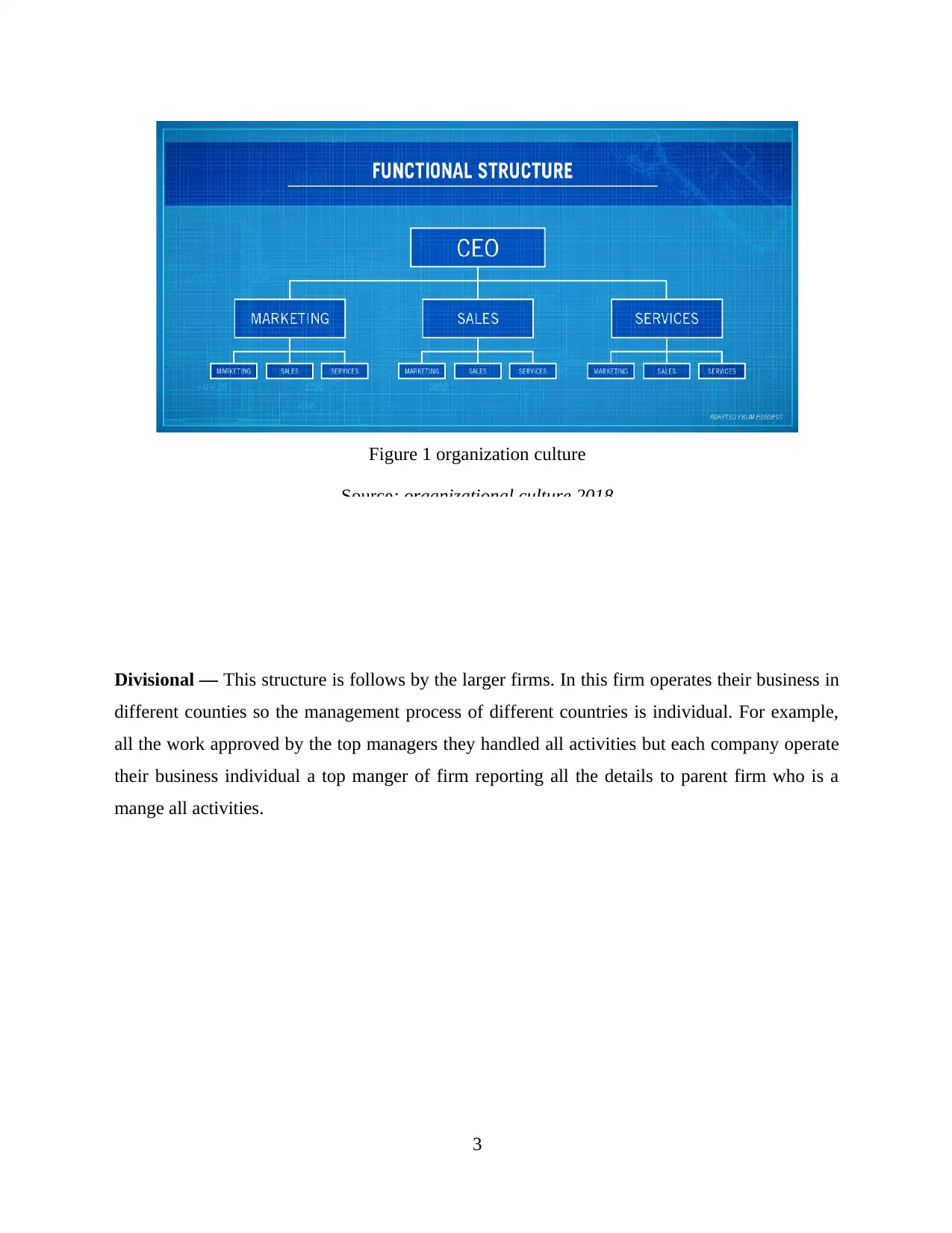
Functional — This structure is based on different smaller groups, firm divide the job into a
small groups. For example, organization divide then job in different departments such as
finance, information technology, human resources, marketing department etc. in this structure
each department has a manger who operates the work and control the employees.
2
mobile communications' company, Eircell. In 2002 Vodafone is globally famous, and they
introduce the international mobile payment system. In 2003, to introduce the Vodafone’s global
services into all over the world signed the agreement with Mobilkom Austria Group.
Number of people are 98,996. Thus, firm generate the £ 43.666 billion revenue.
Vodafone operates in different counties — Albania, Austria, Belgium, Bosnia and
Herzegovina, Bulgaria, Canary Islands, Croatia, Channel Islands, Cyprus, Czech Republic,
Denmark, Estonia, Faroe Islands, Finland, France, French Territories, Germany, Gibraltar,
Greece, Hungary, Iceland, Ireland, Isle of Man, Italy, Latvia, Liechtenstein, Lithuania,
Luxembourg, Malta, Monaco, Netherlands, Norway, Poland, Portugal, Romania, Slovakia,
Slovenia, Spain, Sweden, San Marino, Switzerland, Turkey, Asia, Europe.
Leadership and management — The management and leadership is good in Vodafone. The
manager of the firm make the best marketing strategies to compete with competitors and also the
supervisors and subordinates are helpful they work hard to achieve the overall goal of the firm.
STRUCTURE
Discuss different structure of organizational
Organization structure is defined the different hierarchy which follows by the
organization to manage the work. This structure helps to distribute each job and also they help to
organization to how the organization operates their work in order to achieve its goals.
There are different types of organizational structure such as Functional, Divisional, Matrix and
Flatarchy.
Functional — This structure is based on different smaller groups, firm divide the job into a
small groups. For example, organization divide then job in different departments such as
finance, information technology, human resources, marketing department etc. in this structure
each department has a manger who operates the work and control the employees.
2
Paraphrase This Document
Need a fresh take? Get an instant paraphrase of this document with our AI Paraphraser
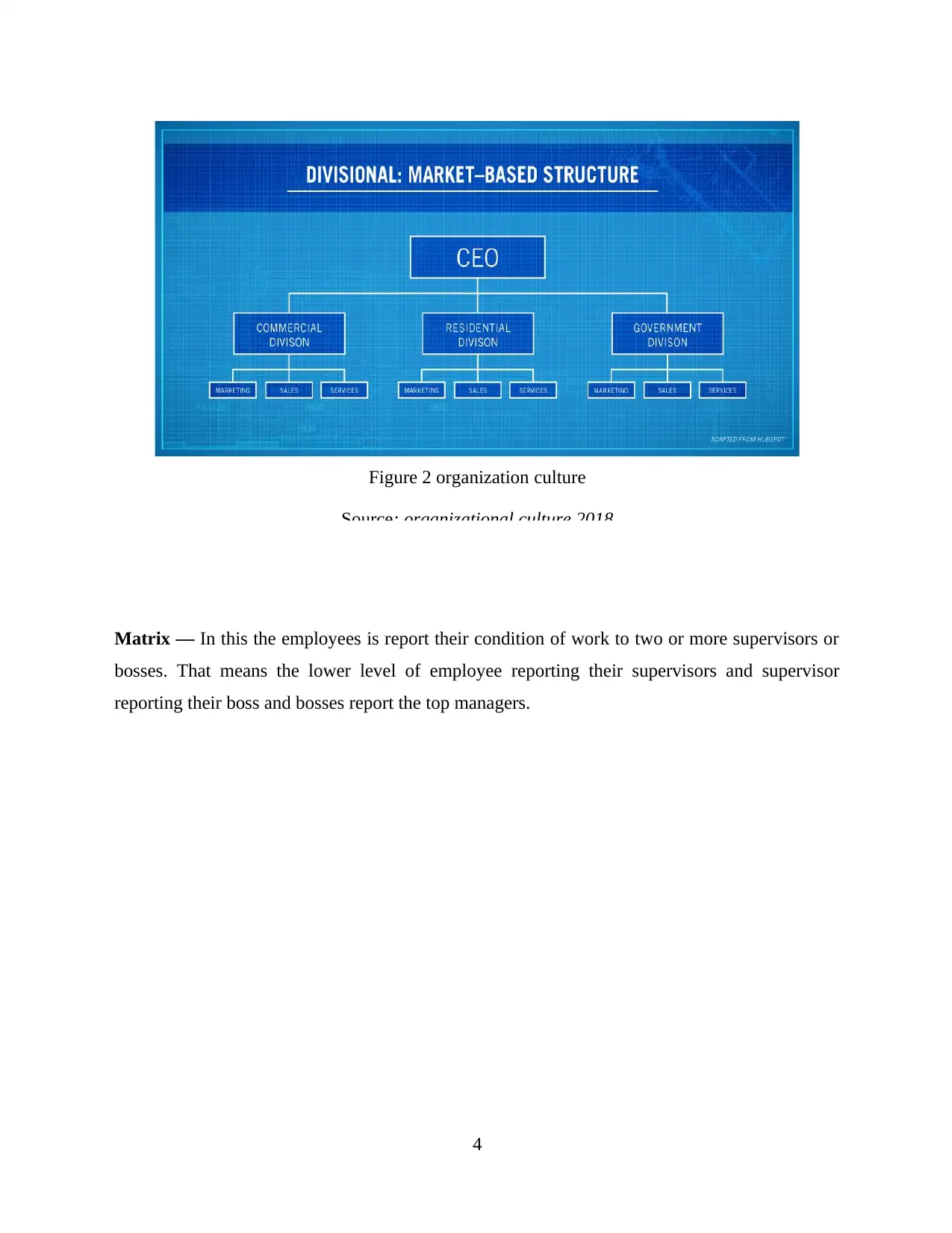
Divisional — This structure is follows by the larger firms. In this firm operates their business in
different counties so the management process of different countries is individual. For example,
all the work approved by the top managers they handled all activities but each company operate
their business individual a top manger of firm reporting all the details to parent firm who is a
mange all activities.
3
Figure 1 organization culture
Source: organizational culture 2018
different counties so the management process of different countries is individual. For example,
all the work approved by the top managers they handled all activities but each company operate
their business individual a top manger of firm reporting all the details to parent firm who is a
mange all activities.
3
Figure 1 organization culture
Source: organizational culture 2018
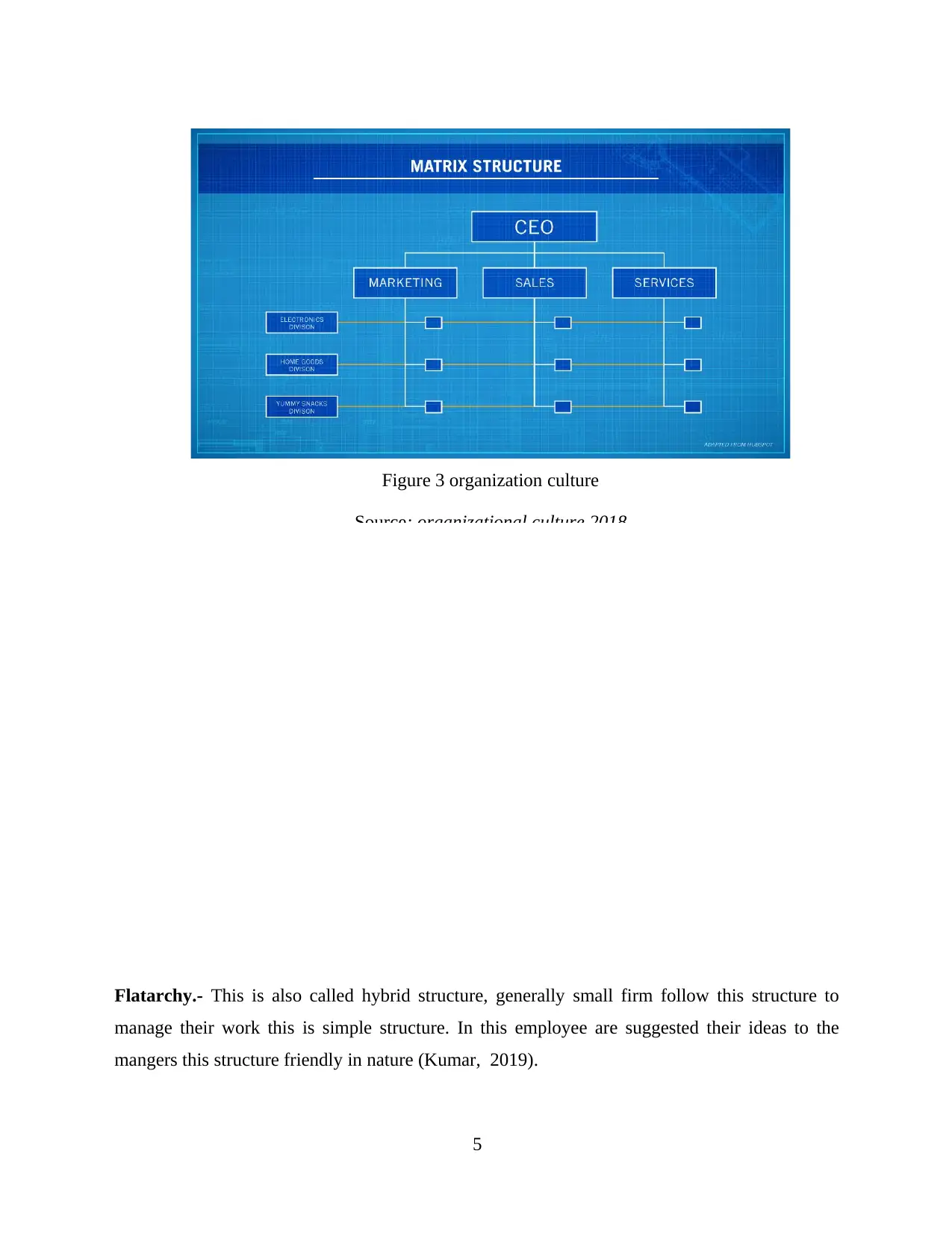
Matrix — In this the employees is report their condition of work to two or more supervisors or
bosses. That means the lower level of employee reporting their supervisors and supervisor
reporting their boss and bosses report the top managers.
4
Figure 2 organization culture
Source: organizational culture 2018
bosses. That means the lower level of employee reporting their supervisors and supervisor
reporting their boss and bosses report the top managers.
4
Figure 2 organization culture
Source: organizational culture 2018
⊘ This is a preview!⊘
Do you want full access?
Subscribe today to unlock all pages.
Trusted by 1+ million students worldwide
Flatarchy.- This is also called hybrid structure, generally small firm follow this structure to
manage their work this is simple structure. In this employee are suggested their ideas to the
mangers this structure friendly in nature (Kumar, 2019).
5
Figure 3 organization culture
Source: organizational culture 2018
manage their work this is simple structure. In this employee are suggested their ideas to the
mangers this structure friendly in nature (Kumar, 2019).
5
Figure 3 organization culture
Source: organizational culture 2018
Paraphrase This Document
Need a fresh take? Get an instant paraphrase of this document with our AI Paraphraser
Thus, Vodafone follows the Functional structure because this structure is provides the
better management opportunity. Thus, Vodafone divide their job responsibility in different
departments such as financial, marketing, human resources departments etc.
CULTURE
What is there culture.
Culture of Vodafone is systematic in nature, employee and supervisors are followed all
the rules and regulation also the policy of Vodafone is managed the work life balance of
employees. Thus, Everything depends on the top managers and boss. The employees of the firm
are as diverse as firm customers. It’s a strength of the firm that helps to achieve the goal of the
firm.
Discuss informal and formal cultures
Informal culture — This culture is not followed any rules the main motive is complete the
project on time. For example, lunch groups and special project groups (Khan and Suhaib, 2019).
Formal culture —In This culture people follow all the rules and regulation regarding the
organization. For Example, include the corporate hierarchical structure, written company
policies.
Possible issues
There are some issue in Vodafone like the high work pressure is affects the motivation of
employees as when employee are not motivated they do not work properly and not helps firm
for achieve the overall objective.
Hofstede's National Culture
Hofstede in his research has defines the various cultures that distinguish the way of doing
the business at global level. It is used in various different nations. Mentioned culture are as
follows -
Individulaism - In this it has been defined that some countries societies value the individual's
performance. Some values the team performance. The implications of the financial rewards
varies as there is differentiation between the profits sharing in the group of the people and
6
better management opportunity. Thus, Vodafone divide their job responsibility in different
departments such as financial, marketing, human resources departments etc.
CULTURE
What is there culture.
Culture of Vodafone is systematic in nature, employee and supervisors are followed all
the rules and regulation also the policy of Vodafone is managed the work life balance of
employees. Thus, Everything depends on the top managers and boss. The employees of the firm
are as diverse as firm customers. It’s a strength of the firm that helps to achieve the goal of the
firm.
Discuss informal and formal cultures
Informal culture — This culture is not followed any rules the main motive is complete the
project on time. For example, lunch groups and special project groups (Khan and Suhaib, 2019).
Formal culture —In This culture people follow all the rules and regulation regarding the
organization. For Example, include the corporate hierarchical structure, written company
policies.
Possible issues
There are some issue in Vodafone like the high work pressure is affects the motivation of
employees as when employee are not motivated they do not work properly and not helps firm
for achieve the overall objective.
Hofstede's National Culture
Hofstede in his research has defines the various cultures that distinguish the way of doing
the business at global level. It is used in various different nations. Mentioned culture are as
follows -
Individulaism - In this it has been defined that some countries societies value the individual's
performance. Some values the team performance. The implications of the financial rewards
varies as there is differentiation between the profits sharing in the group of the people and
6
bonuses. Vodafone uses team building approach to run operations at global level (Kresak,
Corvington and Williamson, 2016).
Long Term positioning – This reflects that there is various national culture that have influence
on the timely planning of the business objectives and their performance level. Some countries
put emphasis on the short term performance whereas some provides rewards and bonuses in the
period of the month and years.
Power Distance – The high Power distance encourages the authority and ranking. A lower
Power distance suggest a culture that supports and encourages a flat organization structure. This
focuses on personal autonomy.
Masculinity – This indicates that there is difference in decision making. This put emphasis that
there is higher degree of consultation.
Precariousness Avoidance – This provides the attitudes of the people varies country to country
in context of risk taking capacity. Low level of risk avoidance indicates that people are willing to
take more risk.
Restraint – This indicates that society allows to have natural human drives in their culture in
terms of having fun and enjoyment in the life.
Thus, the Vodafone consider all the culture while doing operations at global level
(Chiang, 2018).
PEOPLE
Maslow Theory
This theory is introduced by Maslow in the year 1943. This theory major discussed the
employee's satisfaction level in the company. Abraham Maslow has explained that how the
employee's satisfaction can increased in the company by the motivational factors. It is only
achieved by fulfilling their needs. Various needs have been described in this theory to enhance
the motivational level of the employees in the company. Vodafone can resolve its one of the
issue which is lack of motivation among the employees by fulfilling this needs (Danso, 2016).
These are the psychological needs that is proper water, food and rest. Safety needs defines the
security of the employees (Maslow's Hierarchy of Needs, 2018). Belongingness refers to the
sense of appreciation to the employees. Esteem needs are the feeling of prestige. Lastly self
7
Corvington and Williamson, 2016).
Long Term positioning – This reflects that there is various national culture that have influence
on the timely planning of the business objectives and their performance level. Some countries
put emphasis on the short term performance whereas some provides rewards and bonuses in the
period of the month and years.
Power Distance – The high Power distance encourages the authority and ranking. A lower
Power distance suggest a culture that supports and encourages a flat organization structure. This
focuses on personal autonomy.
Masculinity – This indicates that there is difference in decision making. This put emphasis that
there is higher degree of consultation.
Precariousness Avoidance – This provides the attitudes of the people varies country to country
in context of risk taking capacity. Low level of risk avoidance indicates that people are willing to
take more risk.
Restraint – This indicates that society allows to have natural human drives in their culture in
terms of having fun and enjoyment in the life.
Thus, the Vodafone consider all the culture while doing operations at global level
(Chiang, 2018).
PEOPLE
Maslow Theory
This theory is introduced by Maslow in the year 1943. This theory major discussed the
employee's satisfaction level in the company. Abraham Maslow has explained that how the
employee's satisfaction can increased in the company by the motivational factors. It is only
achieved by fulfilling their needs. Various needs have been described in this theory to enhance
the motivational level of the employees in the company. Vodafone can resolve its one of the
issue which is lack of motivation among the employees by fulfilling this needs (Danso, 2016).
These are the psychological needs that is proper water, food and rest. Safety needs defines the
security of the employees (Maslow's Hierarchy of Needs, 2018). Belongingness refers to the
sense of appreciation to the employees. Esteem needs are the feeling of prestige. Lastly self
7
⊘ This is a preview!⊘
Do you want full access?
Subscribe today to unlock all pages.
Trusted by 1+ million students worldwide
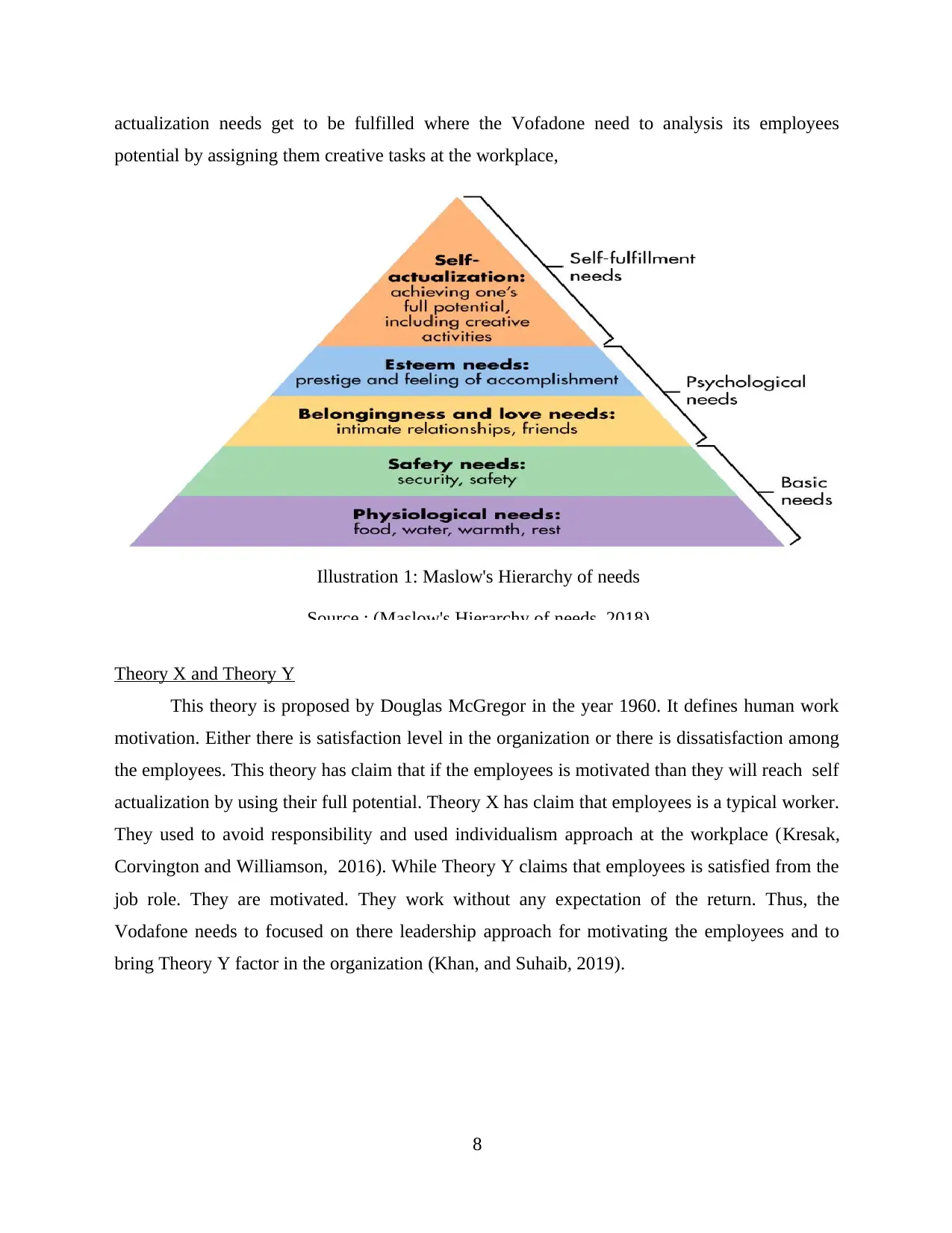
actualization needs get to be fulfilled where the Vofadone need to analysis its employees
potential by assigning them creative tasks at the workplace,
Illustration 1: Maslow's Hierarchy of needs
Source : (Maslow's Hierarchy of needs, 2018)
Theory X and Theory Y
This theory is proposed by Douglas McGregor in the year 1960. It defines human work
motivation. Either there is satisfaction level in the organization or there is dissatisfaction among
the employees. This theory has claim that if the employees is motivated than they will reach self
actualization by using their full potential. Theory X has claim that employees is a typical worker.
They used to avoid responsibility and used individualism approach at the workplace (Kresak,
Corvington and Williamson, 2016). While Theory Y claims that employees is satisfied from the
job role. They are motivated. They work without any expectation of the return. Thus, the
Vodafone needs to focused on there leadership approach for motivating the employees and to
bring Theory Y factor in the organization (Khan, and Suhaib, 2019).
8
potential by assigning them creative tasks at the workplace,
Illustration 1: Maslow's Hierarchy of needs
Source : (Maslow's Hierarchy of needs, 2018)
Theory X and Theory Y
This theory is proposed by Douglas McGregor in the year 1960. It defines human work
motivation. Either there is satisfaction level in the organization or there is dissatisfaction among
the employees. This theory has claim that if the employees is motivated than they will reach self
actualization by using their full potential. Theory X has claim that employees is a typical worker.
They used to avoid responsibility and used individualism approach at the workplace (Kresak,
Corvington and Williamson, 2016). While Theory Y claims that employees is satisfied from the
job role. They are motivated. They work without any expectation of the return. Thus, the
Vodafone needs to focused on there leadership approach for motivating the employees and to
bring Theory Y factor in the organization (Khan, and Suhaib, 2019).
8
Paraphrase This Document
Need a fresh take? Get an instant paraphrase of this document with our AI Paraphraser
RECOMMENDATIONS
This suggestions will help the Vodafone to take competitive lead -
The firm needs to follow the divisional structure so that there work can managed
efficiently.
Vodafone needs to follow democratic culture where the employees are free to tell about
there problems and queries at the workplace (Kumari, 2017).
They should give bonuses and compensatory benefits on timely basis so that employees
morale get increased.
CONCLUSION
It has been concluded from the above project report that Vodafone organizational culture
wants to bring a change. It has been determined that one of the major issue is employees
engagement. Thus, they are working towards it for boosting their morale. The people are not
connected seamlessly. There approach is structured. It has been evaluated that Vodafone is
giving personalized experience to its customers. Employees engagement is the key challenge
faced by the company and needs to be resolved by the company. It has been concluded that
Organization culture is provided the equity to employees. It has been determined that Abraham
Maslow talk about the employee's satisfaction in his theory, that can increased in the company
by the motivational factors. It is only achieved by fulfilling the employees needs.
9
This suggestions will help the Vodafone to take competitive lead -
The firm needs to follow the divisional structure so that there work can managed
efficiently.
Vodafone needs to follow democratic culture where the employees are free to tell about
there problems and queries at the workplace (Kumari, 2017).
They should give bonuses and compensatory benefits on timely basis so that employees
morale get increased.
CONCLUSION
It has been concluded from the above project report that Vodafone organizational culture
wants to bring a change. It has been determined that one of the major issue is employees
engagement. Thus, they are working towards it for boosting their morale. The people are not
connected seamlessly. There approach is structured. It has been evaluated that Vodafone is
giving personalized experience to its customers. Employees engagement is the key challenge
faced by the company and needs to be resolved by the company. It has been concluded that
Organization culture is provided the equity to employees. It has been determined that Abraham
Maslow talk about the employee's satisfaction in his theory, that can increased in the company
by the motivational factors. It is only achieved by fulfilling the employees needs.
9
REFERENCES
Books and Journals
Chiang, T.W., 2018. Anti-Arbitration Injunctions in Investment Arbitration: Lessons Learnt
from the India v. Vodafone Case.Contemp. Asia Arb. J.11. p.251.
Danso, A., 2016. The effects of market orientation on business performance: the mediating role
of internal communication. Case study of Vodafone Ghana (Doctoral dissertation).
Hung, C.L. and Chou, J.C.L. 2019. Major Constructs: Culture and Technology
Acceptance. Managing Mobile Technologies: An Analysis From Multiple Perspectives. 4,
p.35.
Jyoti, J. and Rani, A. 2019. Role of burnout and mentoring between high performance work
system and intention to leave: Moderated mediation model. Journal of Business
Research, 98, pp.166-176.
Khan, S.S. and Suhaib, M. 2019. Evaluating an International Human Resource Management
Strategy for New Telecommunication Group in Developing Countries, Concentrating on
Pakistan (A Case Study of Vodafone).Science International-Lahore. 31(3), pp.457-461.
Khan, S.S. and Suhaib, M., 2019. Evaluating an International Human Resource Management
Strategy for New Telecommunication Group in Developing Countries, Concentrating
on Pakistan (A Case Study of Vodafone).Science International-Lahore.31(3).pp.457-
461.
Kresak, M., Corvington, L. and Williamson, P., 2016. Vodafone answers call to
transformation. Business Transformation Essentials: Case Studies and Articles. p.127.
Kresak, M., Corvington, L. and Williamson, P., 2016. Vodafone answers call to
transformation. Business Transformation Essentials: Case Studies and Articles.p.127.
Kumar, B.R., 2019. Vodafone Acquisition of Mannesmann. InWealth Creation in the World’s
Largest Mergers and Acquisitions (pp. 17-29). Springer, Cham.
Kumari, N., 2017. Cultural Changes at Hutchinson-Essar Post Acquisition. Research Journal of
Business Management.11. pp.91-101.
Online
Maslow's Hierarchy of Needs. 2018. [Online]. Available through:
<https://www.simplypsychology.org/maslow.html>
Types of Organizational Structures 2018 [Online]. Available through : <
https://online.pointpark.edu/business/types-of-organizational-structures/>.
10
Books and Journals
Chiang, T.W., 2018. Anti-Arbitration Injunctions in Investment Arbitration: Lessons Learnt
from the India v. Vodafone Case.Contemp. Asia Arb. J.11. p.251.
Danso, A., 2016. The effects of market orientation on business performance: the mediating role
of internal communication. Case study of Vodafone Ghana (Doctoral dissertation).
Hung, C.L. and Chou, J.C.L. 2019. Major Constructs: Culture and Technology
Acceptance. Managing Mobile Technologies: An Analysis From Multiple Perspectives. 4,
p.35.
Jyoti, J. and Rani, A. 2019. Role of burnout and mentoring between high performance work
system and intention to leave: Moderated mediation model. Journal of Business
Research, 98, pp.166-176.
Khan, S.S. and Suhaib, M. 2019. Evaluating an International Human Resource Management
Strategy for New Telecommunication Group in Developing Countries, Concentrating on
Pakistan (A Case Study of Vodafone).Science International-Lahore. 31(3), pp.457-461.
Khan, S.S. and Suhaib, M., 2019. Evaluating an International Human Resource Management
Strategy for New Telecommunication Group in Developing Countries, Concentrating
on Pakistan (A Case Study of Vodafone).Science International-Lahore.31(3).pp.457-
461.
Kresak, M., Corvington, L. and Williamson, P., 2016. Vodafone answers call to
transformation. Business Transformation Essentials: Case Studies and Articles. p.127.
Kresak, M., Corvington, L. and Williamson, P., 2016. Vodafone answers call to
transformation. Business Transformation Essentials: Case Studies and Articles.p.127.
Kumar, B.R., 2019. Vodafone Acquisition of Mannesmann. InWealth Creation in the World’s
Largest Mergers and Acquisitions (pp. 17-29). Springer, Cham.
Kumari, N., 2017. Cultural Changes at Hutchinson-Essar Post Acquisition. Research Journal of
Business Management.11. pp.91-101.
Online
Maslow's Hierarchy of Needs. 2018. [Online]. Available through:
<https://www.simplypsychology.org/maslow.html>
Types of Organizational Structures 2018 [Online]. Available through : <
https://online.pointpark.edu/business/types-of-organizational-structures/>.
10
⊘ This is a preview!⊘
Do you want full access?
Subscribe today to unlock all pages.
Trusted by 1+ million students worldwide

1 out of 12


Related Documents


Your All-in-One AI-Powered Toolkit for Academic Success.
+13062052269
info@desklib.com
Available 24*7 on WhatsApp / Email
![[object Object]](/_next/static/media/star-bottom.7253800d.svg)
Unlock your academic potential
Copyright © 2020–2026 A2Z Services. All Rights Reserved. Developed and managed by ZUCOL.