Vodafone PLC's Organizational Behaviour: Culture and Motivation
VerifiedAdded on 2023/06/18
|11
|3323
|219
Report
AI Summary
This report provides an analysis of organizational behaviour within Vodafone PLC, focusing on the impact of organizational culture on employee motivation and overall business success. It examines various models of organizational culture, including Charles Handy's model and Maslow's hierarchy of needs, to understand how Vodafone cultivates a positive workplace environment. The report also explores the role of communication in enhancing organizational effectiveness, referencing Berlo's model of communication. Furthermore, it delves into theories of motivation, such as Adams' equity theory, to explain how Vodafone motivates its employees through fair rewards and opportunities for growth. The study concludes by suggesting key points for improving company culture, emphasizing strong relationships between workers and managers, promoting a team environment, and fostering a knowledge-sharing culture, ultimately contributing to Vodafone's continued success.
ORGANISATIONAL
BEHAVIOUR
BEHAVIOUR

Paraphrase This Document
Need a fresh take? Get an instant paraphrase of this document with our AI Paraphraser
TABLE OF CONTENTS
INTRODUCTION...........................................................................................................................3
Culture and its model..................................................................................................................3
Culture improves organizational effectiveness with a focus on communication........................4
Role of culture on employee motivation in the company...........................................................6
Theories of organizational Culture to further enhance its success..............................................8
CONCLUSION..............................................................................................................................10
REFERENCES..............................................................................................................................12
INTRODUCTION...........................................................................................................................3
Culture and its model..................................................................................................................3
Culture improves organizational effectiveness with a focus on communication........................4
Role of culture on employee motivation in the company...........................................................6
Theories of organizational Culture to further enhance its success..............................................8
CONCLUSION..............................................................................................................................10
REFERENCES..............................................................................................................................12
INTRODUCTION
Organizational behaviour is defined as the analysis of human behaviour in the firm. The
current study will be based on evaluation of human behaviour in Vodafone PLC. Including
motivation, performance and other factors. The present study will show the study of
organizational culture, theories, models and concepts to learn about human behaviour in the
workplace. The report will also analyse the role of culture on employee motivation to evaluate
the primary and secondary research. This research will identify the culture of organization using
both the research. To make organization more effective the company needs to explain
communication method and their approach to motivating staff. At last, the report will evaluate
the impact of organizational culture on the success of business and will link the models of
company using research technique.
Culture and its model
Organisational culture is the study of human behaviour in the company. As it is directly
related to individuals and group of employees working together the study becomes more
difficult. The management of the company need to predict about the individual behaviour of
employees (Lam and et.al., 2021). The company must evaluate human behaviour on the basis of
skill, experience and knowledge. This study shows efficiency of group of people working in the
organization while taking various decision related to human policies in business. Organizational
behaviour stated scientific management theory to study each element of a job, selecting and give
proper training to the best workers. According to Charles Handy's model, there are four kinds of
organizational culture the company must follows
Power
The power culture under the Handy model states that power remains in the hands of only
few people and each decision are taken by them. Those people are most important part at
the workplace enjoying special treatment. In this culture workers strictly follow their
supervisor instructions. The workers are not having liberty to express their point of view
and have to agree on mangers decisions.
Task culture
Organizational behaviour is defined as the analysis of human behaviour in the firm. The
current study will be based on evaluation of human behaviour in Vodafone PLC. Including
motivation, performance and other factors. The present study will show the study of
organizational culture, theories, models and concepts to learn about human behaviour in the
workplace. The report will also analyse the role of culture on employee motivation to evaluate
the primary and secondary research. This research will identify the culture of organization using
both the research. To make organization more effective the company needs to explain
communication method and their approach to motivating staff. At last, the report will evaluate
the impact of organizational culture on the success of business and will link the models of
company using research technique.
Culture and its model
Organisational culture is the study of human behaviour in the company. As it is directly
related to individuals and group of employees working together the study becomes more
difficult. The management of the company need to predict about the individual behaviour of
employees (Lam and et.al., 2021). The company must evaluate human behaviour on the basis of
skill, experience and knowledge. This study shows efficiency of group of people working in the
organization while taking various decision related to human policies in business. Organizational
behaviour stated scientific management theory to study each element of a job, selecting and give
proper training to the best workers. According to Charles Handy's model, there are four kinds of
organizational culture the company must follows
Power
The power culture under the Handy model states that power remains in the hands of only
few people and each decision are taken by them. Those people are most important part at
the workplace enjoying special treatment. In this culture workers strictly follow their
supervisor instructions. The workers are not having liberty to express their point of view
and have to agree on mangers decisions.
Task culture
⊘ This is a preview!⊘
Do you want full access?
Subscribe today to unlock all pages.

Trusted by 1+ million students worldwide
In the organization people of same field interest comes together to achieve the targets or
solve various problems as a team. In this culture every team member has to work equally
and achieve business goals in the most innovative way.
Role culture
In the organization where every employee is getting various roles and responsibilities
according to his skill, knowledge, work experience, qualification, interest is known as
role culture. In this culture workers decide what best they can do in the firm to achieve
business goals.
Person culture
Sometimes the employees feel that they are more important than their company is called
person culture (Batilmurik and et.al., 2020). Workers are more concerned about their own
self and their focus is to earn money.
Person culture shows workers should always remember that company comes first to
maintain stability.
To achieve goals in the business, Vodafone has adopted task culture and role culture. The
company distributed roles among workers as per their qualifications skill and knowledge. Thus,
in this way workers decide what best they can give to achieve targets. Workers from same field
are gathered as team and work equally thus this lead to high communication and team work.
Workplace culture encourage communication and helps employees to control over job
responsibilities.
Culture improves organizational effectiveness with a focus on communication.
The key concepts in the communication theory is skyline of understanding between
workers. Communicative tasks arise when workers understand each other from very different
point of view. The positional difference between workers and managers can make it difficult to
reach aims however these kinds of challenges can be analysed in organizational culture. The
company must need to have attention, improve shared language and misinterpretation.
Organizational culture improves effectiveness by adopting Berlo's model of communication.
This model assists the company to work on emotional aspect of the message and operates on the
SMCR
S- source
solve various problems as a team. In this culture every team member has to work equally
and achieve business goals in the most innovative way.
Role culture
In the organization where every employee is getting various roles and responsibilities
according to his skill, knowledge, work experience, qualification, interest is known as
role culture. In this culture workers decide what best they can do in the firm to achieve
business goals.
Person culture
Sometimes the employees feel that they are more important than their company is called
person culture (Batilmurik and et.al., 2020). Workers are more concerned about their own
self and their focus is to earn money.
Person culture shows workers should always remember that company comes first to
maintain stability.
To achieve goals in the business, Vodafone has adopted task culture and role culture. The
company distributed roles among workers as per their qualifications skill and knowledge. Thus,
in this way workers decide what best they can give to achieve targets. Workers from same field
are gathered as team and work equally thus this lead to high communication and team work.
Workplace culture encourage communication and helps employees to control over job
responsibilities.
Culture improves organizational effectiveness with a focus on communication.
The key concepts in the communication theory is skyline of understanding between
workers. Communicative tasks arise when workers understand each other from very different
point of view. The positional difference between workers and managers can make it difficult to
reach aims however these kinds of challenges can be analysed in organizational culture. The
company must need to have attention, improve shared language and misinterpretation.
Organizational culture improves effectiveness by adopting Berlo's model of communication.
This model assists the company to work on emotional aspect of the message and operates on the
SMCR
S- source
Paraphrase This Document
Need a fresh take? Get an instant paraphrase of this document with our AI Paraphraser
It is the study of attitudes, knowledge, culture, skills and other repective factors. To make
communication effective workers must work on good skills and create an impression among the
listeners. Employees must take care of their accent and always cross-check with recipients. The
pronunciation of word must be correct otherwise it will create a bad conversation. One must give
clear information to the second party to avoid misunderstanding. Employees need to be familiar
with what they are speaking. An employee might be a very good speaker but if he fails to show
right attitude he would never emerge as a winner in the organization.
M – message
This is the study in which an individual converts his thoughts into words, a message is
generated. To make communication better workers must convert their thoughts into word and
generate a content. The content should be very accurate and sensible in nature (Schlaile, Bogner
and Mülder, 2021). The speech must be expressed with the help of elements like lots of postures
and hand movement to capture the listener's attention. One must understand the importance of
message and know how to treat it. Employees body movements and expressions are codes of the
message so it is mandatory to be accurate otherwise listener's will never able to understanding
the meaning.
C – channel
This study must include all the senses like hearing, tasting, touching, seeing, smelling to
communicate with each other in the organization. It is the process in which message is
transmitted through various sources like television, social media and newspaper articles.
Hearing- the messages received through hearing.
Seeing- message are transmitted through eye contact and actions.
Touching- the exchange of messages from touching like holding hands.
Smelling- in this sense, the information which is collected from smelling.
Tasting- in this sense, the information is transmitted through tasting.
R- receiver.
This study assists the workers in the company to have right attitude to understand the
message in as very positive way. Hence, this could be only possible when employees possess
good knowledge and skills (Urinov, 2020). The key elements are skills, social system, culture
and others. The company adopts this to create effective communication by thinking pattern.
From the above mentioned theory one can understand organizational culture and its model helps
communication effective workers must work on good skills and create an impression among the
listeners. Employees must take care of their accent and always cross-check with recipients. The
pronunciation of word must be correct otherwise it will create a bad conversation. One must give
clear information to the second party to avoid misunderstanding. Employees need to be familiar
with what they are speaking. An employee might be a very good speaker but if he fails to show
right attitude he would never emerge as a winner in the organization.
M – message
This is the study in which an individual converts his thoughts into words, a message is
generated. To make communication better workers must convert their thoughts into word and
generate a content. The content should be very accurate and sensible in nature (Schlaile, Bogner
and Mülder, 2021). The speech must be expressed with the help of elements like lots of postures
and hand movement to capture the listener's attention. One must understand the importance of
message and know how to treat it. Employees body movements and expressions are codes of the
message so it is mandatory to be accurate otherwise listener's will never able to understanding
the meaning.
C – channel
This study must include all the senses like hearing, tasting, touching, seeing, smelling to
communicate with each other in the organization. It is the process in which message is
transmitted through various sources like television, social media and newspaper articles.
Hearing- the messages received through hearing.
Seeing- message are transmitted through eye contact and actions.
Touching- the exchange of messages from touching like holding hands.
Smelling- in this sense, the information which is collected from smelling.
Tasting- in this sense, the information is transmitted through tasting.
R- receiver.
This study assists the workers in the company to have right attitude to understand the
message in as very positive way. Hence, this could be only possible when employees possess
good knowledge and skills (Urinov, 2020). The key elements are skills, social system, culture
and others. The company adopts this to create effective communication by thinking pattern.
From the above mentioned theory one can understand organizational culture and its model helps
to improve efficiency with a focus on communication. Although there are no barriers in
communication process and no concept of feedback.
The main purpose of every organization is to connect for a better future and unique
opportunities to drive positive change for society. Vodafone creates a place where
everyone can truly be themselves to achieve success.
To develop future skills and technique the firm has adopted theory of communication and
various methods to improve organizational method.
Employees at Vodafone are generally happy with communication culture and motivation
theory. They are satisfied with their total compensation and rewards which includes job
security and basic needs.
The majority believe that the meeting at company are effective and helpful to interacting
with each other.
All the employees are satisfied about communication culture and homely atmosphere.
Hence, in this way organizational culture improve effective communication.
Role of culture on employee motivation in the company
With the help of innovative motivational ideas and technique the organization can
achieve its motivation theory. The task oriented culture promotes and motivate the employees in
the company to be more effective in his job and realize his potential. Motivating employees is
very important to fulfil organizational task.
Theories of motivation: Hierarchy culture by Maslow (content model of motivation)
The case study also explain about hierarchy culture in which model is all about planning
and policy. The main objective of this culture is growth and development of business by
motivating their employees.
Five steps to fulfil hierarchy theory
1. Physiological needs- this needs consists of necessities like shelter and food. Vodafone
provides basic needs to their employees to fulfil motivate them.
2. Security needs- Maslow show the advantages of security needs which consist job security
in the firm. Therefore, to motivate workers Vodafone keep updating its security policies.
3. Social needs- this is the third basic need for humans to socialize with other humans
(Goula and et.al., 2021). To keep motivate the employees in the firm arrange get together
to achieve socialization.
communication process and no concept of feedback.
The main purpose of every organization is to connect for a better future and unique
opportunities to drive positive change for society. Vodafone creates a place where
everyone can truly be themselves to achieve success.
To develop future skills and technique the firm has adopted theory of communication and
various methods to improve organizational method.
Employees at Vodafone are generally happy with communication culture and motivation
theory. They are satisfied with their total compensation and rewards which includes job
security and basic needs.
The majority believe that the meeting at company are effective and helpful to interacting
with each other.
All the employees are satisfied about communication culture and homely atmosphere.
Hence, in this way organizational culture improve effective communication.
Role of culture on employee motivation in the company
With the help of innovative motivational ideas and technique the organization can
achieve its motivation theory. The task oriented culture promotes and motivate the employees in
the company to be more effective in his job and realize his potential. Motivating employees is
very important to fulfil organizational task.
Theories of motivation: Hierarchy culture by Maslow (content model of motivation)
The case study also explain about hierarchy culture in which model is all about planning
and policy. The main objective of this culture is growth and development of business by
motivating their employees.
Five steps to fulfil hierarchy theory
1. Physiological needs- this needs consists of necessities like shelter and food. Vodafone
provides basic needs to their employees to fulfil motivate them.
2. Security needs- Maslow show the advantages of security needs which consist job security
in the firm. Therefore, to motivate workers Vodafone keep updating its security policies.
3. Social needs- this is the third basic need for humans to socialize with other humans
(Goula and et.al., 2021). To keep motivate the employees in the firm arrange get together
to achieve socialization.
⊘ This is a preview!⊘
Do you want full access?
Subscribe today to unlock all pages.
Trusted by 1+ million students worldwide
4. Self-esteem needs- this need consists of success in the organization and promotional
chance. The firm presents various encouraging steps to promote their employees.
5. Self-actualization- this consists of professional growth and development in the
organization. The firm keep encouraging their employees by fulfilling their creative self-
growth. The company adopts various tips to motivate the employees like get comfortable
with your company and accepting things in life.
Vodafone adopts Maslow theory to fulfil basic need in the business to enhance its
success. Employee motivation in the organizational culture includes reward system, mission,
healthy involvement, and positive response. The motivation is the only way to fill up the gap
between ability to work and willingness to work. It enhances the employees to contribute their
positive efforts to achieve business oriented goals. Motivation boosts the morale of workers to
achieve extraordinary results. There are many ways to motivate the staff of company to enhance
its success. This includes job security, growth opportunity, promotions, rewards, bonuses,
working hours, positive response, monetary factors.
Process models of motivation
This study focus on the behavioural and psychological processes that employees follow.
By understanding this process company can elaborate the workers' behaviour, actions and how
they interact at workplace.
Adams' equity theory
The theory says that individual needs to receive rewards from work to seem fair in
relation to the contribution that they produced. The study considers the concept of fairness and
equality as employees want fair compensation for inputs, thus in this way workers may remain
motivated.
This theory of motivation says that the relationship between contribution and reward plays a vital
role.
Contribution
There are various types of factors that can be come under contribution like education, loyalty,
hard work, determination, tolerance, trust, quick learning skills, flexibility, experience,
acceptance (Mulyana, 2021). These factors are captured as emotional and physical labour in the
organization. Vodafone has adopted this theory to motivate their employees to achieve its target.
Rewards
chance. The firm presents various encouraging steps to promote their employees.
5. Self-actualization- this consists of professional growth and development in the
organization. The firm keep encouraging their employees by fulfilling their creative self-
growth. The company adopts various tips to motivate the employees like get comfortable
with your company and accepting things in life.
Vodafone adopts Maslow theory to fulfil basic need in the business to enhance its
success. Employee motivation in the organizational culture includes reward system, mission,
healthy involvement, and positive response. The motivation is the only way to fill up the gap
between ability to work and willingness to work. It enhances the employees to contribute their
positive efforts to achieve business oriented goals. Motivation boosts the morale of workers to
achieve extraordinary results. There are many ways to motivate the staff of company to enhance
its success. This includes job security, growth opportunity, promotions, rewards, bonuses,
working hours, positive response, monetary factors.
Process models of motivation
This study focus on the behavioural and psychological processes that employees follow.
By understanding this process company can elaborate the workers' behaviour, actions and how
they interact at workplace.
Adams' equity theory
The theory says that individual needs to receive rewards from work to seem fair in
relation to the contribution that they produced. The study considers the concept of fairness and
equality as employees want fair compensation for inputs, thus in this way workers may remain
motivated.
This theory of motivation says that the relationship between contribution and reward plays a vital
role.
Contribution
There are various types of factors that can be come under contribution like education, loyalty,
hard work, determination, tolerance, trust, quick learning skills, flexibility, experience,
acceptance (Mulyana, 2021). These factors are captured as emotional and physical labour in the
organization. Vodafone has adopted this theory to motivate their employees to achieve its target.
Rewards
Paraphrase This Document
Need a fresh take? Get an instant paraphrase of this document with our AI Paraphraser
Rewards are the things that an employee of the company receives as a result example
salary, bonus, certificates, Trophies, job security (FAKHRI and et.al., 2021). Anything that an
employee receives against contribution comes under rewards. To motivate the workers'
organization has adopted this theory to achieve success. When individuals feel satisfy with fair
reward they may increase effort or develop adaptability. Vodafone considered social comparison
for workers to feel that things are going fair so in this way they are fairly motivated.
Theories of organizational Culture to further enhance its success.
The organization must adopt this study to identify a unique combination of culture. This
means a company must recruit right employees to achieve target. Vodafone PLC cultivate a
positive workplace culture to achieve organizational goals. This culture approaches humanism
and optimism. This study determine Adhocracy culture in which innovative ideas are being taken
into consideration to adopt employee engagement.
Key points to improve company culture.
1. By cultivate strong relationship between workers and managers would enhance
communication. Workplace flexibility would be helpful in enhancing the company
success like work from home opportunities (Puplampu and Lewis, 2021). The managers
should understand the work interest of employees and distribute the work according to
their interest. It's up to a leader how efficiently they are adopting leadership to connect
their employees.
2. Promoting a team environment would be helpful to achieve results. The managers should
give regular feedback to their team members. The organization must arrange general
meeting weekly or monthly to make employees understand the company's mission,
vision, goals.
3. A firm is suggested to follow knowledge sharing culture to enhance success. Great
company culture can improve quality of work at workplace by encouraging social
learning, protect employee well-being, socialization process would be helpful for new
starters.
4. There are many theories related to organizational culture which shows the detail
information about design culture at workplace. It says create a detailed plan about
strategy, budget, timeline and set benchmarks. It is advisable to company that they must
host one social event per quarter to create connection between managers and employees.
salary, bonus, certificates, Trophies, job security (FAKHRI and et.al., 2021). Anything that an
employee receives against contribution comes under rewards. To motivate the workers'
organization has adopted this theory to achieve success. When individuals feel satisfy with fair
reward they may increase effort or develop adaptability. Vodafone considered social comparison
for workers to feel that things are going fair so in this way they are fairly motivated.
Theories of organizational Culture to further enhance its success.
The organization must adopt this study to identify a unique combination of culture. This
means a company must recruit right employees to achieve target. Vodafone PLC cultivate a
positive workplace culture to achieve organizational goals. This culture approaches humanism
and optimism. This study determine Adhocracy culture in which innovative ideas are being taken
into consideration to adopt employee engagement.
Key points to improve company culture.
1. By cultivate strong relationship between workers and managers would enhance
communication. Workplace flexibility would be helpful in enhancing the company
success like work from home opportunities (Puplampu and Lewis, 2021). The managers
should understand the work interest of employees and distribute the work according to
their interest. It's up to a leader how efficiently they are adopting leadership to connect
their employees.
2. Promoting a team environment would be helpful to achieve results. The managers should
give regular feedback to their team members. The organization must arrange general
meeting weekly or monthly to make employees understand the company's mission,
vision, goals.
3. A firm is suggested to follow knowledge sharing culture to enhance success. Great
company culture can improve quality of work at workplace by encouraging social
learning, protect employee well-being, socialization process would be helpful for new
starters.
4. There are many theories related to organizational culture which shows the detail
information about design culture at workplace. It says create a detailed plan about
strategy, budget, timeline and set benchmarks. It is advisable to company that they must
host one social event per quarter to create connection between managers and employees.
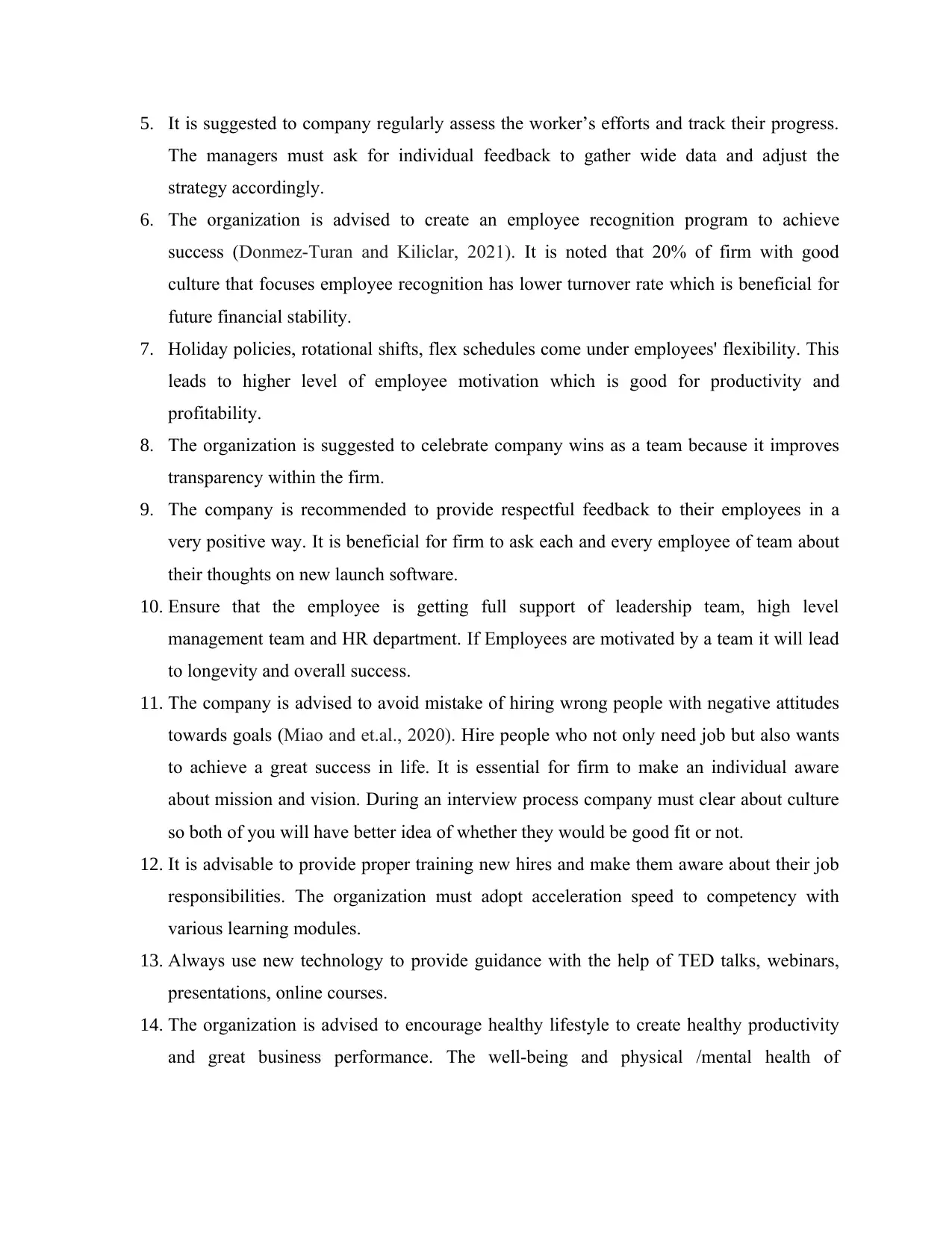
5. It is suggested to company regularly assess the worker’s efforts and track their progress.
The managers must ask for individual feedback to gather wide data and adjust the
strategy accordingly.
6. The organization is advised to create an employee recognition program to achieve
success (Donmez-Turan and Kiliclar, 2021). It is noted that 20% of firm with good
culture that focuses employee recognition has lower turnover rate which is beneficial for
future financial stability.
7. Holiday policies, rotational shifts, flex schedules come under employees' flexibility. This
leads to higher level of employee motivation which is good for productivity and
profitability.
8. The organization is suggested to celebrate company wins as a team because it improves
transparency within the firm.
9. The company is recommended to provide respectful feedback to their employees in a
very positive way. It is beneficial for firm to ask each and every employee of team about
their thoughts on new launch software.
10. Ensure that the employee is getting full support of leadership team, high level
management team and HR department. If Employees are motivated by a team it will lead
to longevity and overall success.
11. The company is advised to avoid mistake of hiring wrong people with negative attitudes
towards goals (Miao and et.al., 2020). Hire people who not only need job but also wants
to achieve a great success in life. It is essential for firm to make an individual aware
about mission and vision. During an interview process company must clear about culture
so both of you will have better idea of whether they would be good fit or not.
12. It is advisable to provide proper training new hires and make them aware about their job
responsibilities. The organization must adopt acceleration speed to competency with
various learning modules.
13. Always use new technology to provide guidance with the help of TED talks, webinars,
presentations, online courses.
14. The organization is advised to encourage healthy lifestyle to create healthy productivity
and great business performance. The well-being and physical /mental health of
The managers must ask for individual feedback to gather wide data and adjust the
strategy accordingly.
6. The organization is advised to create an employee recognition program to achieve
success (Donmez-Turan and Kiliclar, 2021). It is noted that 20% of firm with good
culture that focuses employee recognition has lower turnover rate which is beneficial for
future financial stability.
7. Holiday policies, rotational shifts, flex schedules come under employees' flexibility. This
leads to higher level of employee motivation which is good for productivity and
profitability.
8. The organization is suggested to celebrate company wins as a team because it improves
transparency within the firm.
9. The company is recommended to provide respectful feedback to their employees in a
very positive way. It is beneficial for firm to ask each and every employee of team about
their thoughts on new launch software.
10. Ensure that the employee is getting full support of leadership team, high level
management team and HR department. If Employees are motivated by a team it will lead
to longevity and overall success.
11. The company is advised to avoid mistake of hiring wrong people with negative attitudes
towards goals (Miao and et.al., 2020). Hire people who not only need job but also wants
to achieve a great success in life. It is essential for firm to make an individual aware
about mission and vision. During an interview process company must clear about culture
so both of you will have better idea of whether they would be good fit or not.
12. It is advisable to provide proper training new hires and make them aware about their job
responsibilities. The organization must adopt acceleration speed to competency with
various learning modules.
13. Always use new technology to provide guidance with the help of TED talks, webinars,
presentations, online courses.
14. The organization is advised to encourage healthy lifestyle to create healthy productivity
and great business performance. The well-being and physical /mental health of
⊘ This is a preview!⊘
Do you want full access?
Subscribe today to unlock all pages.
Trusted by 1+ million students worldwide
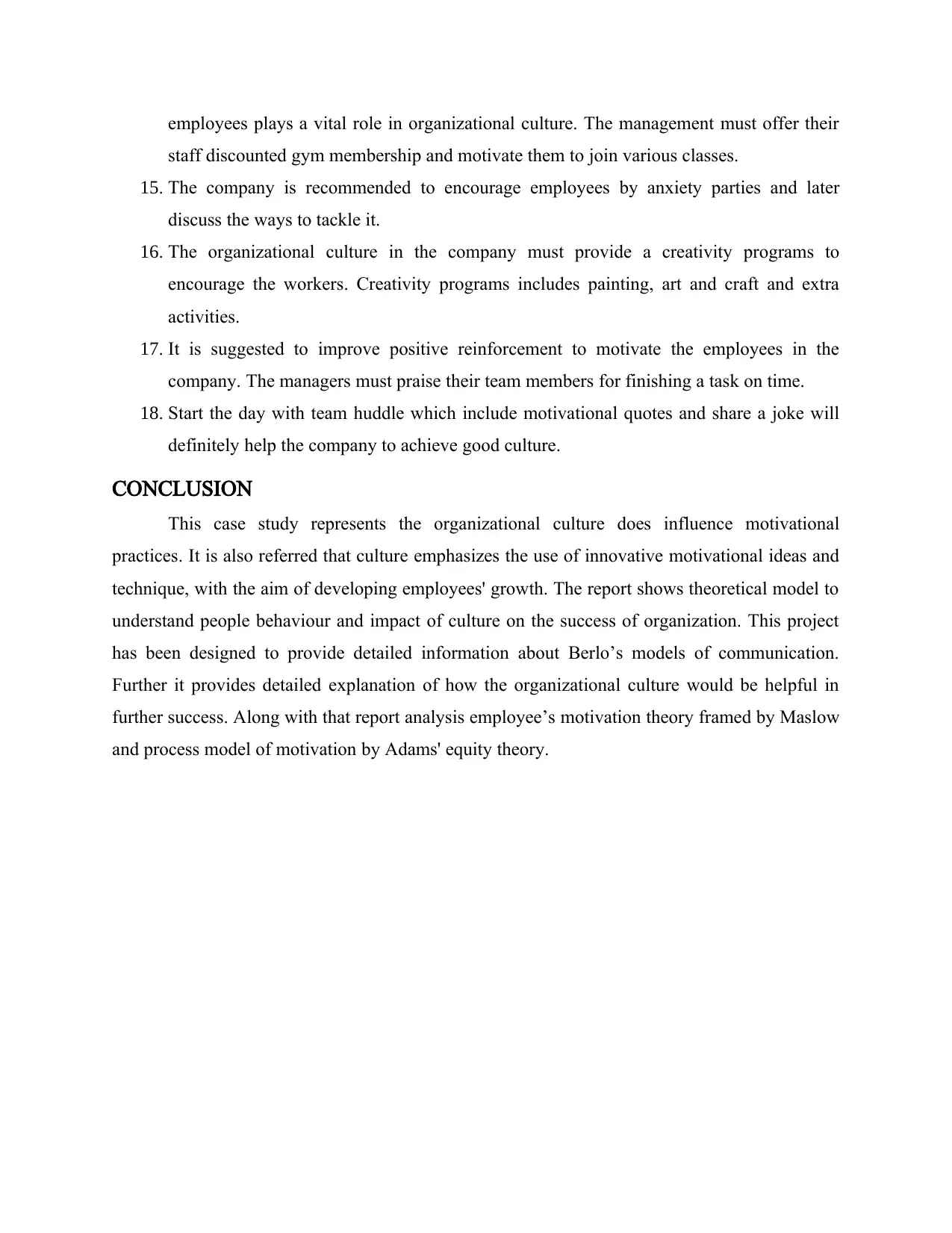
employees plays a vital role in organizational culture. The management must offer their
staff discounted gym membership and motivate them to join various classes.
15. The company is recommended to encourage employees by anxiety parties and later
discuss the ways to tackle it.
16. The organizational culture in the company must provide a creativity programs to
encourage the workers. Creativity programs includes painting, art and craft and extra
activities.
17. It is suggested to improve positive reinforcement to motivate the employees in the
company. The managers must praise their team members for finishing a task on time.
18. Start the day with team huddle which include motivational quotes and share a joke will
definitely help the company to achieve good culture.
CONCLUSION
This case study represents the organizational culture does influence motivational
practices. It is also referred that culture emphasizes the use of innovative motivational ideas and
technique, with the aim of developing employees' growth. The report shows theoretical model to
understand people behaviour and impact of culture on the success of organization. This project
has been designed to provide detailed information about Berlo’s models of communication.
Further it provides detailed explanation of how the organizational culture would be helpful in
further success. Along with that report analysis employee’s motivation theory framed by Maslow
and process model of motivation by Adams' equity theory.
staff discounted gym membership and motivate them to join various classes.
15. The company is recommended to encourage employees by anxiety parties and later
discuss the ways to tackle it.
16. The organizational culture in the company must provide a creativity programs to
encourage the workers. Creativity programs includes painting, art and craft and extra
activities.
17. It is suggested to improve positive reinforcement to motivate the employees in the
company. The managers must praise their team members for finishing a task on time.
18. Start the day with team huddle which include motivational quotes and share a joke will
definitely help the company to achieve good culture.
CONCLUSION
This case study represents the organizational culture does influence motivational
practices. It is also referred that culture emphasizes the use of innovative motivational ideas and
technique, with the aim of developing employees' growth. The report shows theoretical model to
understand people behaviour and impact of culture on the success of organization. This project
has been designed to provide detailed information about Berlo’s models of communication.
Further it provides detailed explanation of how the organizational culture would be helpful in
further success. Along with that report analysis employee’s motivation theory framed by Maslow
and process model of motivation by Adams' equity theory.
Paraphrase This Document
Need a fresh take? Get an instant paraphrase of this document with our AI Paraphraser
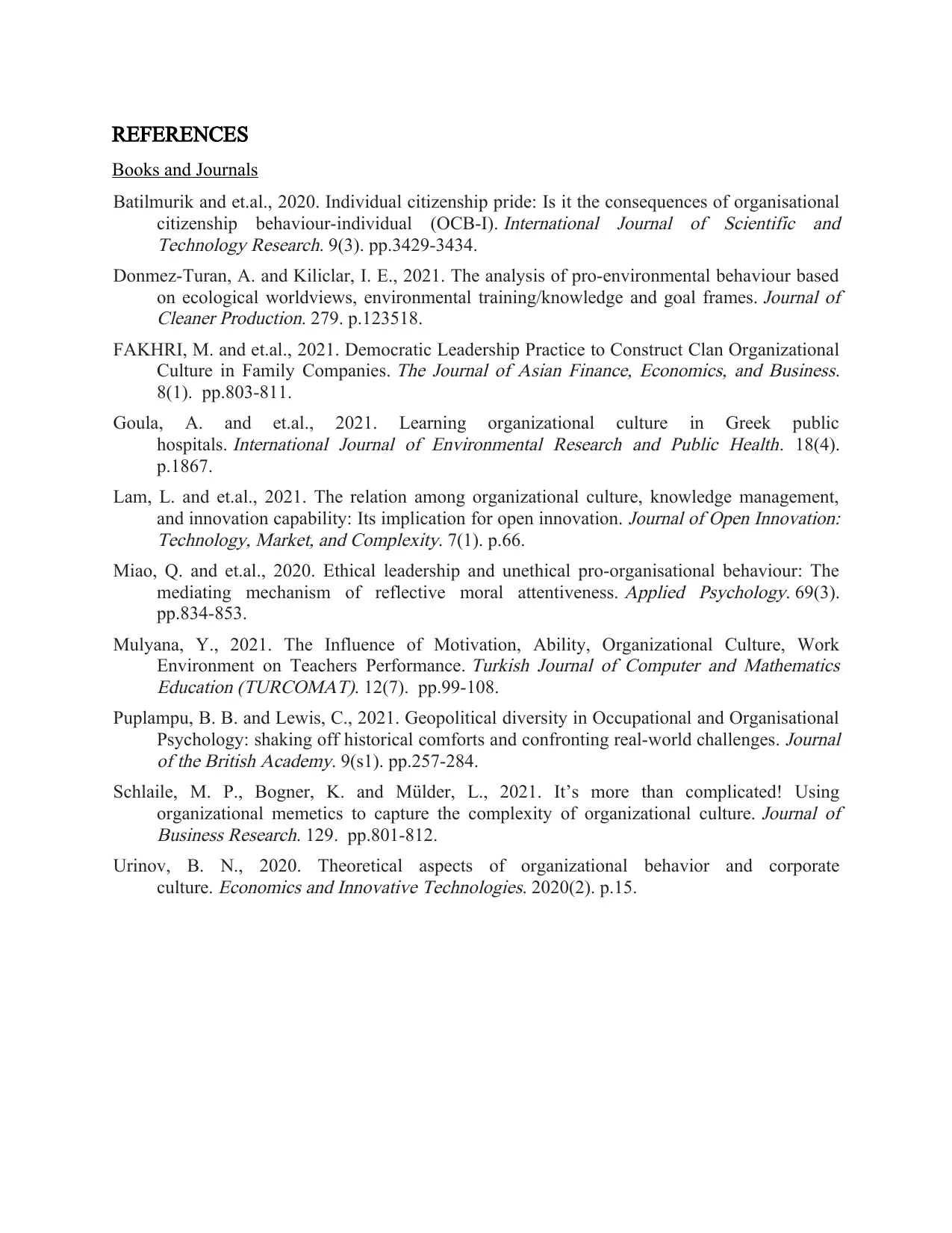
REFERENCES
Books and Journals
Batilmurik and et.al., 2020. Individual citizenship pride: Is it the consequences of organisational
citizenship behaviour-individual (OCB-I).
International Journal of Scientific and
Technology Research. 9(3). pp.3429-3434.
Donmez-Turan, A. and Kiliclar, I. E., 2021. The analysis of pro-environmental behaviour based
on ecological worldviews, environmental training/knowledge and goal frames.
Journal of
Cleaner Production. 279. p.123518.
FAKHRI, M. and et.al., 2021. Democratic Leadership Practice to Construct Clan Organizational
Culture in Family Companies.
The Journal of Asian Finance, Economics, and Business.
8(1). pp.803-811.
Goula, A. and et.al., 2021. Learning organizational culture in Greek public
hospitals.
International Journal of Environmental Research and Public Health. 18(4).
p.1867.
Lam, L. and et.al., 2021. The relation among organizational culture, knowledge management,
and innovation capability: Its implication for open innovation.
Journal of Open Innovation:
Technology, Market, and Complexity. 7(1). p.66.
Miao, Q. and et.al., 2020. Ethical leadership and unethical pro‐organisational behaviour: The
mediating mechanism of reflective moral attentiveness.
Applied Psychology. 69(3).
pp.834-853.
Mulyana, Y., 2021. The Influence of Motivation, Ability, Organizational Culture, Work
Environment on Teachers Performance.
Turkish Journal of Computer and Mathematics
Education (TURCOMAT). 12(7). pp.99-108.
Puplampu, B. B. and Lewis, C., 2021. Geopolitical diversity in Occupational and Organisational
Psychology: shaking off historical comforts and confronting real-world challenges.
Journal
of the British Academy. 9(s1). pp.257-284.
Schlaile, M. P., Bogner, K. and Mülder, L., 2021. It’s more than complicated! Using
organizational memetics to capture the complexity of organizational culture.
Journal of
Business Research. 129. pp.801-812.
Urinov, B. N., 2020. Theoretical aspects of organizational behavior and corporate
culture.
Economics and Innovative Technologies. 2020(2). p.15.
Books and Journals
Batilmurik and et.al., 2020. Individual citizenship pride: Is it the consequences of organisational
citizenship behaviour-individual (OCB-I).
International Journal of Scientific and
Technology Research. 9(3). pp.3429-3434.
Donmez-Turan, A. and Kiliclar, I. E., 2021. The analysis of pro-environmental behaviour based
on ecological worldviews, environmental training/knowledge and goal frames.
Journal of
Cleaner Production. 279. p.123518.
FAKHRI, M. and et.al., 2021. Democratic Leadership Practice to Construct Clan Organizational
Culture in Family Companies.
The Journal of Asian Finance, Economics, and Business.
8(1). pp.803-811.
Goula, A. and et.al., 2021. Learning organizational culture in Greek public
hospitals.
International Journal of Environmental Research and Public Health. 18(4).
p.1867.
Lam, L. and et.al., 2021. The relation among organizational culture, knowledge management,
and innovation capability: Its implication for open innovation.
Journal of Open Innovation:
Technology, Market, and Complexity. 7(1). p.66.
Miao, Q. and et.al., 2020. Ethical leadership and unethical pro‐organisational behaviour: The
mediating mechanism of reflective moral attentiveness.
Applied Psychology. 69(3).
pp.834-853.
Mulyana, Y., 2021. The Influence of Motivation, Ability, Organizational Culture, Work
Environment on Teachers Performance.
Turkish Journal of Computer and Mathematics
Education (TURCOMAT). 12(7). pp.99-108.
Puplampu, B. B. and Lewis, C., 2021. Geopolitical diversity in Occupational and Organisational
Psychology: shaking off historical comforts and confronting real-world challenges.
Journal
of the British Academy. 9(s1). pp.257-284.
Schlaile, M. P., Bogner, K. and Mülder, L., 2021. It’s more than complicated! Using
organizational memetics to capture the complexity of organizational culture.
Journal of
Business Research. 129. pp.801-812.
Urinov, B. N., 2020. Theoretical aspects of organizational behavior and corporate
culture.
Economics and Innovative Technologies. 2020(2). p.15.

1 out of 11


Related Documents


Your All-in-One AI-Powered Toolkit for Academic Success.
+13062052269
info@desklib.com
Available 24*7 on WhatsApp / Email
![[object Object]](/_next/static/media/star-bottom.7253800d.svg)
Unlock your academic potential
Copyright © 2020–2026 A2Z Services. All Rights Reserved. Developed and managed by ZUCOL.