Supply Chain and Marketing Analysis of Vodafone: A Detailed Report
VerifiedAdded on 2021/02/21
|21
|7688
|127
Report
AI Summary
This report provides a comprehensive analysis of Vodafone's supply chain management and international marketing strategies. It begins by examining the supply chain, including upstream, downstream, and value chain activities, and highlights the importance of an effective supply chain in maximizing customer value. The report then explores the impact of the Internet of Things (IoT) on manufacturing and marketing, describing its implementation and benefits within Vodafone. Section A analyzes Vodafone's supply chain, while Section B discusses recent changes in supply chain management, technological advancements, and introduces a new product launch strategy, including the marketing mix. The report emphasizes Vodafone's multi-tiered supply chain structure and the company's approach to supplier relationships, the impact of IoT in manufacturing, and marketing, and concludes with an overview of the company's marketing strategies.
Supply Chain Management
and International Marketing
and International Marketing

Paraphrase This Document
Need a fresh take? Get an instant paraphrase of this document with our AI Paraphraser
Table of Contents
INTRODUCTION...........................................................................................................................3
SECTION A.....................................................................................................................................3
1. Analysing supply chain of Vodafone.................................................................................3
2. Impact of Internet of Things in manufacturing and marketing and describing
implementation and benefit of IoT in Vodafone....................................................................7
SECTION B...................................................................................................................................10
Presenting recent change in supply chain management and some technological advancement
which are expected to emerge as a key contributor in the area of supply chain management10
2. Introducing the new product into market.........................................................................14
Strategies which Vodafone will use to launch the product in the market ...........................14
Marketing mix for the new service to be launched by Vodafone.......................................16
CONCLUSION..............................................................................................................................17
REFERENCES..............................................................................................................................19
INTRODUCTION...........................................................................................................................3
SECTION A.....................................................................................................................................3
1. Analysing supply chain of Vodafone.................................................................................3
2. Impact of Internet of Things in manufacturing and marketing and describing
implementation and benefit of IoT in Vodafone....................................................................7
SECTION B...................................................................................................................................10
Presenting recent change in supply chain management and some technological advancement
which are expected to emerge as a key contributor in the area of supply chain management10
2. Introducing the new product into market.........................................................................14
Strategies which Vodafone will use to launch the product in the market ...........................14
Marketing mix for the new service to be launched by Vodafone.......................................16
CONCLUSION..............................................................................................................................17
REFERENCES..............................................................................................................................19
INTRODUCTION
Supply chain management is the broad variety of activities which is required to plan,
control and execute the product's flow by acquiring raw material and produce effective
distribution channels and then reaches to final customers in cost effective way. While on the
other side, internation marketing is the use of effective marketing principles that satisfy different
needs and wants of customer who reside at national boarders. In the same way, report main aim
is to provide an importance of supply chain management system so that it will help a firm to
maximize the customer value and then accomplish the sustainable competitive advantages as
well. The chosen firm for this report is Vodafone which serve its unit in Saudi Arabia as well.
The quoted firm is operates its network in 45 countries and the division of Vodafone provides
telecommunication as well as IT services to corporate clients in more than 145 countries. From
2009 onwards, Vodafone also operates in UAE and the agreement also involved co-operation on
international clients, handset procurement and mobile broadband.
The report is divided into two parts such that in Part A, report will analyse the supply
chain of Vodafone which includes Upstream supply chain, downstream supply chain and value
Supply chain management is the broad variety of activities which is required to plan,
control and execute the product's flow by acquiring raw material and produce effective
distribution channels and then reaches to final customers in cost effective way. While on the
other side, internation marketing is the use of effective marketing principles that satisfy different
needs and wants of customer who reside at national boarders. In the same way, report main aim
is to provide an importance of supply chain management system so that it will help a firm to
maximize the customer value and then accomplish the sustainable competitive advantages as
well. The chosen firm for this report is Vodafone which serve its unit in Saudi Arabia as well.
The quoted firm is operates its network in 45 countries and the division of Vodafone provides
telecommunication as well as IT services to corporate clients in more than 145 countries. From
2009 onwards, Vodafone also operates in UAE and the agreement also involved co-operation on
international clients, handset procurement and mobile broadband.
The report is divided into two parts such that in Part A, report will analyse the supply
chain of Vodafone which includes Upstream supply chain, downstream supply chain and value
⊘ This is a preview!⊘
Do you want full access?
Subscribe today to unlock all pages.

Trusted by 1+ million students worldwide
chain activity. Further, study will describe the impact of Internet of Things IoT in a
manufacturing and marketing. Then, report will describe how Vodafone implemented IoT and its
benefited from the implementation of Internet of Things. In part B, report will describe recent
trends in supply chain management and also describe technological advancement which are
expected to emerge in this area. Report will introduce new product for Vodafone and describe
the strategy that will be used by the firm and also describe the marketing mix for new product.
SECTION A
1. Analysing supply chain of Vodafone
Supply chain is a system of organization, people, activities and information which are
involved in moving products from supplier to users. Therefore, an effective supply chain
management of Vodafone will help to boost its customer service and reduce operating cost,
further it also improve the financial position of the firm as well. That is why every big firm uses
supply chain management system in order to amend the overall system. In the context of
Vodafone, the firm spend approx £22 billion a year with more than 10800 direct suppliers in a
world in order to meet the customer as well as business needs. The analysis of supply chain is
based upon different key aspect such as:
Upstream supply chain: It is the supply network of a company suppliers and their own
suppliers. Such that anything that coming into Vodafone from a raw material to finished goods
and this can be used in order to deliver to customers who are in the upstream part of a supply
chain (Pettit, Croxton and Fiksel, 2019). This is mainly used in Vodafone by transporting and
shipping to the plant because its main focus is to provide effective and quick service to their
customers. In addition to this, the main target of upstream supply chain is to reduce the cost,
increases visibility and control, match the demand of their customers. Further, it directly creates
impact upon supply chain cost and also require the strong system as well as supplier
coordination.
Beside this, the main advantages of using upstream chain analysis in Vodafone is such
that it helps to reduce the operating cost and decrease the production cost so that the overall
financial system of the firm will be stable. Moreover, it has been analysed that if company uses
this supply chain then it will help to boost the customer service by providing effective quality of
products to their firm. Therefore, the manufacturer and retailers are depend on the supply chain
manufacturing and marketing. Then, report will describe how Vodafone implemented IoT and its
benefited from the implementation of Internet of Things. In part B, report will describe recent
trends in supply chain management and also describe technological advancement which are
expected to emerge in this area. Report will introduce new product for Vodafone and describe
the strategy that will be used by the firm and also describe the marketing mix for new product.
SECTION A
1. Analysing supply chain of Vodafone
Supply chain is a system of organization, people, activities and information which are
involved in moving products from supplier to users. Therefore, an effective supply chain
management of Vodafone will help to boost its customer service and reduce operating cost,
further it also improve the financial position of the firm as well. That is why every big firm uses
supply chain management system in order to amend the overall system. In the context of
Vodafone, the firm spend approx £22 billion a year with more than 10800 direct suppliers in a
world in order to meet the customer as well as business needs. The analysis of supply chain is
based upon different key aspect such as:
Upstream supply chain: It is the supply network of a company suppliers and their own
suppliers. Such that anything that coming into Vodafone from a raw material to finished goods
and this can be used in order to deliver to customers who are in the upstream part of a supply
chain (Pettit, Croxton and Fiksel, 2019). This is mainly used in Vodafone by transporting and
shipping to the plant because its main focus is to provide effective and quick service to their
customers. In addition to this, the main target of upstream supply chain is to reduce the cost,
increases visibility and control, match the demand of their customers. Further, it directly creates
impact upon supply chain cost and also require the strong system as well as supplier
coordination.
Beside this, the main advantages of using upstream chain analysis in Vodafone is such
that it helps to reduce the operating cost and decrease the production cost so that the overall
financial system of the firm will be stable. Moreover, it has been analysed that if company uses
this supply chain then it will help to boost the customer service by providing effective quality of
products to their firm. Therefore, the manufacturer and retailers are depend on the supply chain
Paraphrase This Document
Need a fresh take? Get an instant paraphrase of this document with our AI Paraphraser
manager in order to design the network which help to meet the demand of customer and their
service goals too.
For example, upstream, activity of Vodafone mainly includes the suppliers of raw
material like aluminium and copper. Even transporting and shipping is also considered an
example of upstream activity.
Downstream Supply chain: It means that everything that goes out of the firm after the
production cycle which means that products are ready for sell. Even it also refers as the process
which is required in order to produce the goods in order to reach the customers in an efficient
manner. In this, type of supply chain, inventory management is common downstream activity in
Vodafone where it is the responsibility of wholesaler in order to make sure that it maintain all
level of inventory to refill suppliers (Li, Holsapple and Goldsby, 2019). Logistic, transportation,
marketing and sales are most common downstream activity which is engaged in it, even all the
payment and billing system also consider as a part of downstream supply chain management.
The biggest advantages of using the downstream supply chain management system is
such that it helps to all channel members and provide the right quality of products at best value to
their customers. Even in this, the brand also plays an important role such that customer mainly
prefer to purchase the products from their favourite brand and this type of chain is follows by
manufacturers, wholesalers and retail in order to promote the finished goods to the consumer,
therefore, entire member of the chain are benefited from it (Hugos, 2018).
For example, in a cola manufacturing plant which have source and supply of raw material which
are syrups, concentrate, glass, plastics and these constitute the upstream and the final products
i.e. Cola which is distribution to whole seller, retailer and consumer which are come under
downstream supply chain.
Value Chain activity: It is the set of activity in which a firm operating in a particular
industry so that the company can easily deliver the valuable products and services to a market.
The value chain of Vodafone create and strengthen a competitive advantage and also leads to
increases the sales of a firm so that firm creates brand value in market. The value chain also
helps to examine other activity and also analyse how they are connected (Vanichchinchai, 2019).
Through value chain management, the company can easily improve the bids and proposal, it also
improve the ability to capture, track and manage the customer or marketing requirement for
better design, planning and procurement so that it generate more accurate cost estimates. Overall,
service goals too.
For example, upstream, activity of Vodafone mainly includes the suppliers of raw
material like aluminium and copper. Even transporting and shipping is also considered an
example of upstream activity.
Downstream Supply chain: It means that everything that goes out of the firm after the
production cycle which means that products are ready for sell. Even it also refers as the process
which is required in order to produce the goods in order to reach the customers in an efficient
manner. In this, type of supply chain, inventory management is common downstream activity in
Vodafone where it is the responsibility of wholesaler in order to make sure that it maintain all
level of inventory to refill suppliers (Li, Holsapple and Goldsby, 2019). Logistic, transportation,
marketing and sales are most common downstream activity which is engaged in it, even all the
payment and billing system also consider as a part of downstream supply chain management.
The biggest advantages of using the downstream supply chain management system is
such that it helps to all channel members and provide the right quality of products at best value to
their customers. Even in this, the brand also plays an important role such that customer mainly
prefer to purchase the products from their favourite brand and this type of chain is follows by
manufacturers, wholesalers and retail in order to promote the finished goods to the consumer,
therefore, entire member of the chain are benefited from it (Hugos, 2018).
For example, in a cola manufacturing plant which have source and supply of raw material which
are syrups, concentrate, glass, plastics and these constitute the upstream and the final products
i.e. Cola which is distribution to whole seller, retailer and consumer which are come under
downstream supply chain.
Value Chain activity: It is the set of activity in which a firm operating in a particular
industry so that the company can easily deliver the valuable products and services to a market.
The value chain of Vodafone create and strengthen a competitive advantage and also leads to
increases the sales of a firm so that firm creates brand value in market. The value chain also
helps to examine other activity and also analyse how they are connected (Vanichchinchai, 2019).
Through value chain management, the company can easily improve the bids and proposal, it also
improve the ability to capture, track and manage the customer or marketing requirement for
better design, planning and procurement so that it generate more accurate cost estimates. Overall,
it helps to gain high competitive edge and boost the profit for the welfare of a firm. Therefore, it
helps to enhancement to a value chain that can improve the production capacity and further
reduces the cost.
For example, McDonald's whose main mission is to provide customer with low price products
and this helps to grow the large market share with an effective value chain analysis.
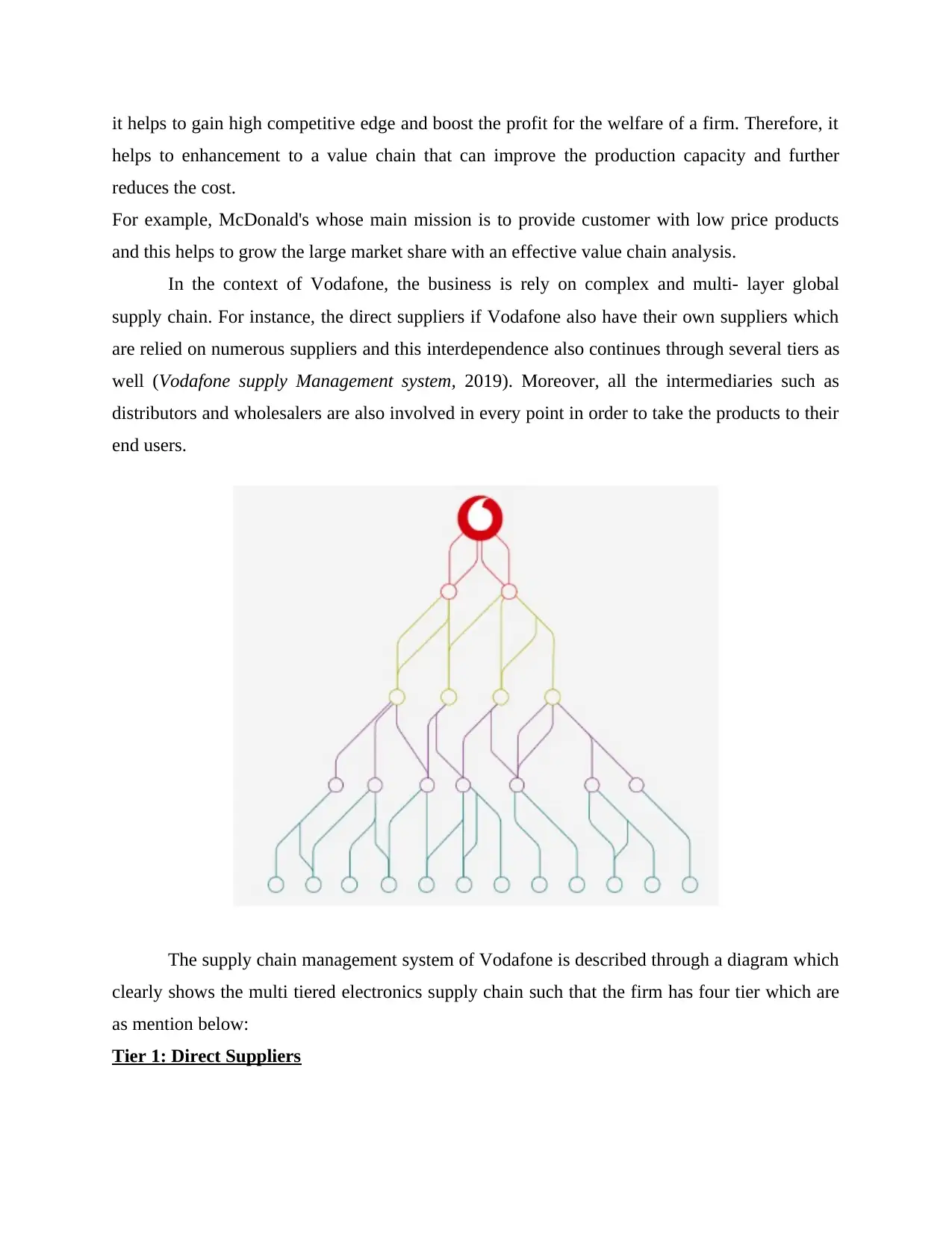
In the context of Vodafone, the business is rely on complex and multi- layer global
supply chain. For instance, the direct suppliers if Vodafone also have their own suppliers which
are relied on numerous suppliers and this interdependence also continues through several tiers as
well (Vodafone supply Management system, 2019). Moreover, all the intermediaries such as
distributors and wholesalers are also involved in every point in order to take the products to their
end users.
The supply chain management system of Vodafone is described through a diagram which
clearly shows the multi tiered electronics supply chain such that the firm has four tier which are
as mention below:
Tier 1: Direct Suppliers
helps to enhancement to a value chain that can improve the production capacity and further
reduces the cost.
For example, McDonald's whose main mission is to provide customer with low price products
and this helps to grow the large market share with an effective value chain analysis.
In the context of Vodafone, the business is rely on complex and multi- layer global
supply chain. For instance, the direct suppliers if Vodafone also have their own suppliers which
are relied on numerous suppliers and this interdependence also continues through several tiers as
well (Vodafone supply Management system, 2019). Moreover, all the intermediaries such as
distributors and wholesalers are also involved in every point in order to take the products to their
end users.
The supply chain management system of Vodafone is described through a diagram which
clearly shows the multi tiered electronics supply chain such that the firm has four tier which are
as mention below:
Tier 1: Direct Suppliers
⊘ This is a preview!⊘
Do you want full access?
Subscribe today to unlock all pages.
Trusted by 1+ million students worldwide
The quoted firm buy product and services from more than 10000 suppliers and the firm
spend its majority of part with large Multinational Company (Christopher, 2016). The firm also
work closely with its suppliers in order to introduce new and innovative products and service.
Further, Vodafone also engage with its leadership and also assessing how they assure agreement
across their operations.
Tier 2: Electronic manufacturers
In this, the electronic manufacturers and suppliers of Vodafone also have their own
suppliers and company also work with tier-1 suppliers in order to gain insights into their
suppliers, and they used tier 2 when company believe that supplier is high risk.
Tier 3: Component suppliers
In this type of tier, components are source from significant number of suppliers in order
to form a part of a product which is being produced.
Tier 4:
The products are made from material which are source from variety of commodity and
raw material which may be found many layers down to the supply chain.
From the above, it has been analysed that Vodafone supplier chain management is
dynamic such that the network of suppliers and sub suppliers are changing continuously as per
the demand of market and the company also have the relationship with local supplier which are
involved in service related procurement. Apart from this, the supply chain management also
support local business which create positive impact upon the communities and also providing
employment in the local operating unit of the Vodafone (Lanier, Wempe and Swink, 2019). The
company also have the influence over the infrastructure suppliers which can supply, install and
maintain the network so that provided the branded products and service. Therefore, it also works
with the direct supplier for monitoring and managing the risk up to the level.
2. Impact of Internet of Things in manufacturing and marketing and describing implementation
and benefit of IoT in Vodafone
Internet of things is the interconnection between the internet of computing devices which
are connected to the everyday objects that helps to send and receive the data. In the context of
business purpose, IoT has evolved due to convergence of multiple technologies and for customer
market, it cover all the devices which further support to ecosystem and it is controlled by the
smart phones.
spend its majority of part with large Multinational Company (Christopher, 2016). The firm also
work closely with its suppliers in order to introduce new and innovative products and service.
Further, Vodafone also engage with its leadership and also assessing how they assure agreement
across their operations.
Tier 2: Electronic manufacturers
In this, the electronic manufacturers and suppliers of Vodafone also have their own
suppliers and company also work with tier-1 suppliers in order to gain insights into their
suppliers, and they used tier 2 when company believe that supplier is high risk.
Tier 3: Component suppliers
In this type of tier, components are source from significant number of suppliers in order
to form a part of a product which is being produced.
Tier 4:
The products are made from material which are source from variety of commodity and
raw material which may be found many layers down to the supply chain.
From the above, it has been analysed that Vodafone supplier chain management is
dynamic such that the network of suppliers and sub suppliers are changing continuously as per
the demand of market and the company also have the relationship with local supplier which are
involved in service related procurement. Apart from this, the supply chain management also
support local business which create positive impact upon the communities and also providing
employment in the local operating unit of the Vodafone (Lanier, Wempe and Swink, 2019). The
company also have the influence over the infrastructure suppliers which can supply, install and
maintain the network so that provided the branded products and service. Therefore, it also works
with the direct supplier for monitoring and managing the risk up to the level.
2. Impact of Internet of Things in manufacturing and marketing and describing implementation
and benefit of IoT in Vodafone
Internet of things is the interconnection between the internet of computing devices which
are connected to the everyday objects that helps to send and receive the data. In the context of
business purpose, IoT has evolved due to convergence of multiple technologies and for customer
market, it cover all the devices which further support to ecosystem and it is controlled by the
smart phones.
Paraphrase This Document
Need a fresh take? Get an instant paraphrase of this document with our AI Paraphraser
Impact of IoT in manufacturing: It has a major impact upon the manufacturing. such
that it creates positive impact upon the business of manufacturing, which are as mention below:
Predictive maintenance: It is one of the most popular use of IoT because it helps to
track the usage of machines and predict, when the machines are going to break down.
Apart from this, it has been analysed that in order to eliminate the unplanned downtime,
factories has to cut out some costly variables which may leads to delay and unneeded cost
during manufacturing process (Caputo, Marzi and Pellegrini, 2016).
Movement of goods: It is another positive impact of using IoT such that movement of
good is considered one of the leading cause of accidents in manufacturing plants is
human error. If the process will automated than manufacturing plants will be safer.
Therefore, by using IoT, the chances of error is reduced and it also reduces the cost and
improve the efficiency as well.
Visibility into supply chain: It is the biggest challenge for the manufacturing industry
because of many suppliers are involved and implementation of new regulation.
Therefore, by implementation of IoT ensures that the real time visibility into the process
and also saves a million of dollars as well as time (Johnson and et.al., 2019).
Impact of IoT in marketing: IoT also affect the marketing in huge way such that it can
easily handle the network traffic and also improve the overall performance of a business. These
are as mention below:
Optimizing operation management: IoT helps to reduce the operational cost up to 40%
in manufacturing as it send the advance information about the need of repair, therefore, it
helps to boost the data output up to 5% and also increases the overall productivity up to
25%. Thus, IoT also help to determine the real time flow of data between the inventory
and end customer (Dong and et.al., 2017).
Customer management: With an advance technology, the marketers will easily analyse
the customer behaviour such that it provides key insights about the behaviour of customer
and helps marketers to reach their customer to implement the plan. Even it has been
predicted that more than 75 billion devices are connected in coming years and also
provide pool of data to the marketers.
Instant customer analysis: By using IoT, marketers also enable CRM tool in order to
gather and analyse the data to create exact plan. IoT also helps marketers to understand
that it creates positive impact upon the business of manufacturing, which are as mention below:
Predictive maintenance: It is one of the most popular use of IoT because it helps to
track the usage of machines and predict, when the machines are going to break down.
Apart from this, it has been analysed that in order to eliminate the unplanned downtime,
factories has to cut out some costly variables which may leads to delay and unneeded cost
during manufacturing process (Caputo, Marzi and Pellegrini, 2016).
Movement of goods: It is another positive impact of using IoT such that movement of
good is considered one of the leading cause of accidents in manufacturing plants is
human error. If the process will automated than manufacturing plants will be safer.
Therefore, by using IoT, the chances of error is reduced and it also reduces the cost and
improve the efficiency as well.
Visibility into supply chain: It is the biggest challenge for the manufacturing industry
because of many suppliers are involved and implementation of new regulation.
Therefore, by implementation of IoT ensures that the real time visibility into the process
and also saves a million of dollars as well as time (Johnson and et.al., 2019).
Impact of IoT in marketing: IoT also affect the marketing in huge way such that it can
easily handle the network traffic and also improve the overall performance of a business. These
are as mention below:
Optimizing operation management: IoT helps to reduce the operational cost up to 40%
in manufacturing as it send the advance information about the need of repair, therefore, it
helps to boost the data output up to 5% and also increases the overall productivity up to
25%. Thus, IoT also help to determine the real time flow of data between the inventory
and end customer (Dong and et.al., 2017).
Customer management: With an advance technology, the marketers will easily analyse
the customer behaviour such that it provides key insights about the behaviour of customer
and helps marketers to reach their customer to implement the plan. Even it has been
predicted that more than 75 billion devices are connected in coming years and also
provide pool of data to the marketers.
Instant customer analysis: By using IoT, marketers also enable CRM tool in order to
gather and analyse the data to create exact plan. IoT also helps marketers to understand
the prospects in their marketing journey and this also help to serve the right information
so that they can deal with their customer in right way (Hammer, 2019).
IoT system of Vodafone
In Vodafone, IoT is mainly used to increase their use and integrating it with the core
system as well and the firm publish its first Barometer in 2013 and it is implemented to create
completely new service and to transforms their business. In this competitive era, every company
wants to stay ahead and that is using digital devices will be more beneficial for the firm and that
is why, Vodafone uses IoT into its working place. Further, it has been analysed that Vodafone
uses IoT that provides solution for vehicles manufacturers, Vodafone automotive is tier one
partner to the Asian Car for which it develops connected and for non- connected products. The
company also aim is to help the vehicle manufacturer and the customers in order to stay
connected with their car or motorcycle (IoT system of Vodafone, 2016).
Even Vodafone also create dedicated mobile application which enable the remote
management of security and safety functions. Such that the IoT connected device also helps to
track and monitor the vehicles and also enhances the responsible driving, this provides safety and
security to the employees. As Vodafone mission is to help by simplify IoT and the company also
offer the wide range of high quality of end to end solution that helps to meet the specific
requirement. it also uses cloud and hosting service to the customers and using IoT, quoted firm
also bring new featured products and services into market so that customer will feel free to use
those (Nair, Abu-Mahfouz and Lefophane, 2019). In addition to this, it has been analysed that
Vodafone uses IoT in order to provide the best mobile voice and data tariffs that helps to reduce
the barriers of mobile communication and managed messaging as well that helps to communicate
with world-wide audience with the help of company's secure application to person SMS
messaging service.
In addition to this, the company also establish its IP-VAN services that builds private
MPLS based WAN for multinational and national business in more than 150 countries. It is so
because it provides secure and reliable network with an intelligent optimizes with a wide area
communication and best business application as well. Therefore, it has been evaluated that the
company uses the best Internet of Things that helps to provide the ways that helps to run the
business in effective way and as a result, it also reduces the operational cost of the company so
that it will reach at international level (Chang, Srirama and Buyya, 2019).
so that they can deal with their customer in right way (Hammer, 2019).
IoT system of Vodafone
In Vodafone, IoT is mainly used to increase their use and integrating it with the core
system as well and the firm publish its first Barometer in 2013 and it is implemented to create
completely new service and to transforms their business. In this competitive era, every company
wants to stay ahead and that is using digital devices will be more beneficial for the firm and that
is why, Vodafone uses IoT into its working place. Further, it has been analysed that Vodafone
uses IoT that provides solution for vehicles manufacturers, Vodafone automotive is tier one
partner to the Asian Car for which it develops connected and for non- connected products. The
company also aim is to help the vehicle manufacturer and the customers in order to stay
connected with their car or motorcycle (IoT system of Vodafone, 2016).
Even Vodafone also create dedicated mobile application which enable the remote
management of security and safety functions. Such that the IoT connected device also helps to
track and monitor the vehicles and also enhances the responsible driving, this provides safety and
security to the employees. As Vodafone mission is to help by simplify IoT and the company also
offer the wide range of high quality of end to end solution that helps to meet the specific
requirement. it also uses cloud and hosting service to the customers and using IoT, quoted firm
also bring new featured products and services into market so that customer will feel free to use
those (Nair, Abu-Mahfouz and Lefophane, 2019). In addition to this, it has been analysed that
Vodafone uses IoT in order to provide the best mobile voice and data tariffs that helps to reduce
the barriers of mobile communication and managed messaging as well that helps to communicate
with world-wide audience with the help of company's secure application to person SMS
messaging service.
In addition to this, the company also establish its IP-VAN services that builds private
MPLS based WAN for multinational and national business in more than 150 countries. It is so
because it provides secure and reliable network with an intelligent optimizes with a wide area
communication and best business application as well. Therefore, it has been evaluated that the
company uses the best Internet of Things that helps to provide the ways that helps to run the
business in effective way and as a result, it also reduces the operational cost of the company so
that it will reach at international level (Chang, Srirama and Buyya, 2019).
⊘ This is a preview!⊘
Do you want full access?
Subscribe today to unlock all pages.
Trusted by 1+ million students worldwide
Benefits of implementing IoT in Vodafone
IoT is one of the revolutionising the way in which a firm do their business and in the
similar way, Vodafone with its SuperIoT Suite, provides end to end solution with a single point
of contact such that through this, business can ensure that the business is run smoothly and it also
have experts who have detailed knowledge and run its operation smoothly (Öberg and Graham,
2016). Thereby, ensuring better accountability, faster implementation and quicker return on
investment are some key benefits of using IoT in Vodafone. Some key benefits are as mention
below:
Reduction of Operating cost: Vodafone achieves significant return through IoT
investment such that it reduces cost reduction, increases revenue and also find some new
revenue stream. Therefore, it completely transforms its new business. It is also analysed
that IoT solution also help a firm to cut cost and maintain competitive advantages
(Benefits of IoT, 2018). Further, business also save the energy cost and improve electrical
efficiency by using IoT and smart building system in order to monitor and control
unnecessary usage.
Understanding of consumer behaviour: IoT also helps Vodafone to determine the
customer preference and behaviour. Such that through this, business will be able to
collect, monitor and analyse the data from social media, mobile and internet. Therefore, it
also helps Vodafone to keep engaging their customers and produce the services as per
demand of customers (Nikolaidis, 2019).
Improve productivity and efficiency: It has been analysed that maximizing productivity
and efficiency is considered as a high priority for a business. By using IoT, Vodafone
will easily track the parts of machine and further, it also improves facility management
by informing the employees about technical disruption, enabling remote troubleshooting
and repair of workstation. Therefore, this will help to increase the production level of the
company in positive way.
Improve safety and security: It is another benefit of using IoT such that these service
also integrate with sensor and videos camera that help to keep monitor the workplace In
order to make sure the equipment safety and also protect against physical threats.
Therefore, using IoT, Vodafone also keep tracking their employees and also coordinate
IoT is one of the revolutionising the way in which a firm do their business and in the
similar way, Vodafone with its SuperIoT Suite, provides end to end solution with a single point
of contact such that through this, business can ensure that the business is run smoothly and it also
have experts who have detailed knowledge and run its operation smoothly (Öberg and Graham,
2016). Thereby, ensuring better accountability, faster implementation and quicker return on
investment are some key benefits of using IoT in Vodafone. Some key benefits are as mention
below:
Reduction of Operating cost: Vodafone achieves significant return through IoT
investment such that it reduces cost reduction, increases revenue and also find some new
revenue stream. Therefore, it completely transforms its new business. It is also analysed
that IoT solution also help a firm to cut cost and maintain competitive advantages
(Benefits of IoT, 2018). Further, business also save the energy cost and improve electrical
efficiency by using IoT and smart building system in order to monitor and control
unnecessary usage.
Understanding of consumer behaviour: IoT also helps Vodafone to determine the
customer preference and behaviour. Such that through this, business will be able to
collect, monitor and analyse the data from social media, mobile and internet. Therefore, it
also helps Vodafone to keep engaging their customers and produce the services as per
demand of customers (Nikolaidis, 2019).
Improve productivity and efficiency: It has been analysed that maximizing productivity
and efficiency is considered as a high priority for a business. By using IoT, Vodafone
will easily track the parts of machine and further, it also improves facility management
by informing the employees about technical disruption, enabling remote troubleshooting
and repair of workstation. Therefore, this will help to increase the production level of the
company in positive way.
Improve safety and security: It is another benefit of using IoT such that these service
also integrate with sensor and videos camera that help to keep monitor the workplace In
order to make sure the equipment safety and also protect against physical threats.
Therefore, using IoT, Vodafone also keep tracking their employees and also coordinate
Paraphrase This Document
Need a fresh take? Get an instant paraphrase of this document with our AI Paraphraser
multiple teams that helps to resolve the issues promptly and further, it will also help to
ensure the protection of important assets as well (Mwakwata and et.al., 2019).
SECTION B
Presenting recent change in supply chain management and some technological advancement
which are expected to emerge as a key contributor in the area of supply chain management
In today's competitive world, there are some changes in supply chain management
because a poorly and inefficient functioning of supply chain can create negative impact upon the
every aspect of an organization. Therefore, some of the recent trend are as mention below:
Globalization: in this competitive era, the business landscape Is rapidly becoming global
and due to improvement in communication, globalization is creating negative impact upon
business (Gopal and Thakkar, 2016). Even, no area of a business is more affected by the sudden
trend other than supply chain and manufacturing, distribution and invoicing also been impacted
by the increase integration of a global customer and supplier base, but many companies also find
the new ways to cope with such situation.
Increased competition and price pressure: In the marketplace, price, product and brand
recognition is quite enough to differentiate the products from other and as the increased
competition, company also find new ways that distinguish themselves. In this time, company is
also looking to their supply chain in some ways that help to offset this new trend. Such that
initially they look at the ways in order to reduce the cost and also create better value chain in
order to remain cost competitive (Nóbrega and et.al., 2019). Next is to provide the value added
services in order to meet the demand of their customers. Therefore, company should not only
look to their supply chain in order to drive the cost improvement but it should also increase the
abilities in order to stay competitive in the marketplace. Therefore, streamlining process with a
better design and better collaboration across network and new service will also help a firm to
stay competitive and strengthen the relationship as well.
Shortened and more complex product life cycle: In this modern world, many company
are under pressure to develop some innovative products and then bring those in a market so that
it will help to minimize the savage of an existing product. Apart from this, it has been analysed
that in order to meet of customers, company needs more efficient product life cycle management
process and this takes a long time to implement this. Therefore, by focusing more in product life
ensure the protection of important assets as well (Mwakwata and et.al., 2019).
SECTION B
Presenting recent change in supply chain management and some technological advancement
which are expected to emerge as a key contributor in the area of supply chain management
In today's competitive world, there are some changes in supply chain management
because a poorly and inefficient functioning of supply chain can create negative impact upon the
every aspect of an organization. Therefore, some of the recent trend are as mention below:
Globalization: in this competitive era, the business landscape Is rapidly becoming global
and due to improvement in communication, globalization is creating negative impact upon
business (Gopal and Thakkar, 2016). Even, no area of a business is more affected by the sudden
trend other than supply chain and manufacturing, distribution and invoicing also been impacted
by the increase integration of a global customer and supplier base, but many companies also find
the new ways to cope with such situation.
Increased competition and price pressure: In the marketplace, price, product and brand
recognition is quite enough to differentiate the products from other and as the increased
competition, company also find new ways that distinguish themselves. In this time, company is
also looking to their supply chain in some ways that help to offset this new trend. Such that
initially they look at the ways in order to reduce the cost and also create better value chain in
order to remain cost competitive (Nóbrega and et.al., 2019). Next is to provide the value added
services in order to meet the demand of their customers. Therefore, company should not only
look to their supply chain in order to drive the cost improvement but it should also increase the
abilities in order to stay competitive in the marketplace. Therefore, streamlining process with a
better design and better collaboration across network and new service will also help a firm to
stay competitive and strengthen the relationship as well.
Shortened and more complex product life cycle: In this modern world, many company
are under pressure to develop some innovative products and then bring those in a market so that
it will help to minimize the savage of an existing product. Apart from this, it has been analysed
that in order to meet of customers, company needs more efficient product life cycle management
process and this takes a long time to implement this. Therefore, by focusing more in product life
cycle process, the firm will reduce the risk of obsolescence write-offs and increases the cost
leverage as well (Zayas and Merino, 2017). That is why, by focusing product life cycle
management, the company will also manage the risk of unplanned cost increase and a poor new
product launch and also enhances the overall customer perception of the company through an
effective innovator.
For instance, in order to launch a new product into a market, the company has to begin
the process of introduction new product to market, then coordinate them with marketing,
engineering and develop sales in order to forecast the end result. In this time, an effective
product life cycle will help to manage the supply chain in better way which helps to create
positive impact upon the business as well.
Collaboration between the stakeholder in an extended supply chain: It is another new
trend that affect the business supply chain management and the goal of collaboration is to raise
the visibility throughout the value chain in order to make better management decision and
decrease the value chain cost. With the right tools, process and organizational structure in place
of collaboration that provides a key people within a value chain with a better information tat is
needed to make the decision in critical way. For example, collaboration is mainly seen in the
expansion of sales and operational planning process which mainly includes the upstream and
downstream value chain (Monczka and et.al., 2015). Apart from this, it has been analysed that
the company must expand the usage of sales and operations planning which have greater
visibility across the value chain and improve the promotional planning and increase the revenue
predictability.
Growing E-commerce: It is another trend that also affect the supply chain management
in negative way because online sales is increases from last many years and selling the products
directly to the customers without using supply chain will create negative impact upon the supply
chain management (Stadtler, 2015). Even the supply chain can also go directly from the
warehouse to a customer without following the traditional chain using variety of distribution
centres. Even being less reliant on some retail store also means that the company has to change
their sales instead of focusing in buyers from stores. In this way, the supply chain management
also affected and the company need to replace small deliveries to the people's homes.
Technological Advancement in the area of supply chain management
leverage as well (Zayas and Merino, 2017). That is why, by focusing product life cycle
management, the company will also manage the risk of unplanned cost increase and a poor new
product launch and also enhances the overall customer perception of the company through an
effective innovator.
For instance, in order to launch a new product into a market, the company has to begin
the process of introduction new product to market, then coordinate them with marketing,
engineering and develop sales in order to forecast the end result. In this time, an effective
product life cycle will help to manage the supply chain in better way which helps to create
positive impact upon the business as well.
Collaboration between the stakeholder in an extended supply chain: It is another new
trend that affect the business supply chain management and the goal of collaboration is to raise
the visibility throughout the value chain in order to make better management decision and
decrease the value chain cost. With the right tools, process and organizational structure in place
of collaboration that provides a key people within a value chain with a better information tat is
needed to make the decision in critical way. For example, collaboration is mainly seen in the
expansion of sales and operational planning process which mainly includes the upstream and
downstream value chain (Monczka and et.al., 2015). Apart from this, it has been analysed that
the company must expand the usage of sales and operations planning which have greater
visibility across the value chain and improve the promotional planning and increase the revenue
predictability.
Growing E-commerce: It is another trend that also affect the supply chain management
in negative way because online sales is increases from last many years and selling the products
directly to the customers without using supply chain will create negative impact upon the supply
chain management (Stadtler, 2015). Even the supply chain can also go directly from the
warehouse to a customer without following the traditional chain using variety of distribution
centres. Even being less reliant on some retail store also means that the company has to change
their sales instead of focusing in buyers from stores. In this way, the supply chain management
also affected and the company need to replace small deliveries to the people's homes.
Technological Advancement in the area of supply chain management
⊘ This is a preview!⊘
Do you want full access?
Subscribe today to unlock all pages.
Trusted by 1+ million students worldwide

1 out of 21


Related Documents


Your All-in-One AI-Powered Toolkit for Academic Success.
+13062052269
info@desklib.com
Available 24*7 on WhatsApp / Email
![[object Object]](/_next/static/media/star-bottom.7253800d.svg)
Unlock your academic potential
Copyright © 2020–2026 A2Z Services. All Rights Reserved. Developed and managed by ZUCOL.