Case Study: HRM Practices and Workforce Planning at Volkswagen
VerifiedAdded on 2024/05/29
|28
|5663
|424
Case Study
AI Summary
This case study examines Human Resource Management (HRM) practices at Volkswagen, focusing on workforce planning, recruitment, employee relations, and the impact of employment legislation. It assesses the purpose and functions of HRM, evaluating different approaches to recruitment and selection, and explores the benefits and effectiveness of various HRM practices for both employers and employees. The study also analyzes the importance of employee relations in HRM decision-making and identifies key elements of employment legislation. It further provides a rationale for the application of specific HRM practices within Volkswagen to enhance organizational profit and productivity. This document is available on Desklib, a platform offering study tools and solved assignments for students.

HUMAN RESOURCE MANAGEMENT
A Case Study of Volkswagen
A Case Study of Volkswagen

Paraphrase This Document
Need a fresh take? Get an instant paraphrase of this document with our AI Paraphraser
Table of Contents
INTRODUCTION...............................................................................................................3
OVERVIEW OF THE VOLKSWAGEN ORGANIZATION..................................................4
LO1....................................................................................................................................5
P1 PURPOSE AND THE FUNCTIONS OF HRM, APPLICABLE TO WORKFORCE
PLANNING AND RESOURCES IN VOLKSWAGEN.....................................................5
M1 ASSESS HOW THE HRM FUNCTIONS IN YOUR CHOSEN ORGANISATION
CAN PROVIDE TALENT AND SKILLS APPROPRIATE TO FULFIL BUSINESS
OBJECTIVES USING APPROPRIATE THEORIES AND MODELS.............................6
P2 STRENGTHS AND WEAKNESSES OF DIFFERENT APPROACHES TO
RECRUITMENT AND SELECTION...............................................................................8
M2 EVALUATE THE STRENGTHS AND WEAKNESSES OF DIFFERENT
APPROACHES TO RECRUITMENT AND SELECTION USING SUITABLE
THEORIES AND MODELS............................................................................................9
LO2..................................................................................................................................12
P3 EXPLAIN THE BENEFITS OF DIFFERENT HRM PRACTICES WITHIN AN
ORGANISATION FOR BOTH THE EMPLOYER AND EMPLOYEE...........................12
P4 EVALUATE THE EFFECTIVENESS OF DIFFERENT HRM PRACTICES IN
TERMS OF RAISING ORGANISATIONAL PROFIT AND PRODUCTIVITY..............14
M3 EXPLORE DIFFERENT METHODS USED IN HRM PRACTICES.......................15
LO3..................................................................................................................................16
P5 ANALYSE THE IMPORTANCE OF EMPLOYEE RELATIONS IN RESPECT TO
INFLUENCING HRM DECISION- MAKING................................................................16
P6 IDENTIFY THE KEY ELEMENTS OF EMPLOYMENT LEGISLATION AND THE
IMPACT IT HAS UPON HRM DECISION- MAKING...................................................17
M4 IDENTIFY THE KEY ASPECTS OF EMPLOYEE RELATIONS MANAGEMENT
AND EMPLOYMENT LEGISLATIONS........................................................................17
1
INTRODUCTION...............................................................................................................3
OVERVIEW OF THE VOLKSWAGEN ORGANIZATION..................................................4
LO1....................................................................................................................................5
P1 PURPOSE AND THE FUNCTIONS OF HRM, APPLICABLE TO WORKFORCE
PLANNING AND RESOURCES IN VOLKSWAGEN.....................................................5
M1 ASSESS HOW THE HRM FUNCTIONS IN YOUR CHOSEN ORGANISATION
CAN PROVIDE TALENT AND SKILLS APPROPRIATE TO FULFIL BUSINESS
OBJECTIVES USING APPROPRIATE THEORIES AND MODELS.............................6
P2 STRENGTHS AND WEAKNESSES OF DIFFERENT APPROACHES TO
RECRUITMENT AND SELECTION...............................................................................8
M2 EVALUATE THE STRENGTHS AND WEAKNESSES OF DIFFERENT
APPROACHES TO RECRUITMENT AND SELECTION USING SUITABLE
THEORIES AND MODELS............................................................................................9
LO2..................................................................................................................................12
P3 EXPLAIN THE BENEFITS OF DIFFERENT HRM PRACTICES WITHIN AN
ORGANISATION FOR BOTH THE EMPLOYER AND EMPLOYEE...........................12
P4 EVALUATE THE EFFECTIVENESS OF DIFFERENT HRM PRACTICES IN
TERMS OF RAISING ORGANISATIONAL PROFIT AND PRODUCTIVITY..............14
M3 EXPLORE DIFFERENT METHODS USED IN HRM PRACTICES.......................15
LO3..................................................................................................................................16
P5 ANALYSE THE IMPORTANCE OF EMPLOYEE RELATIONS IN RESPECT TO
INFLUENCING HRM DECISION- MAKING................................................................16
P6 IDENTIFY THE KEY ELEMENTS OF EMPLOYMENT LEGISLATION AND THE
IMPACT IT HAS UPON HRM DECISION- MAKING...................................................17
M4 IDENTIFY THE KEY ASPECTS OF EMPLOYEE RELATIONS MANAGEMENT
AND EMPLOYMENT LEGISLATIONS........................................................................17
1
LO 4.................................................................................................................................19
P7 THE APPLICATION OF HRM PRACTICES IN A WORK-RELATED CONTEXT..19
M5 A RATIONALE FOR THE APPLICATION OF SPECIFIC HRM............................19
CONCLUSION.................................................................................................................24
REFERENCES................................................................................................................25
2
P7 THE APPLICATION OF HRM PRACTICES IN A WORK-RELATED CONTEXT..19
M5 A RATIONALE FOR THE APPLICATION OF SPECIFIC HRM............................19
CONCLUSION.................................................................................................................24
REFERENCES................................................................................................................25
2
⊘ This is a preview!⊘
Do you want full access?
Subscribe today to unlock all pages.

Trusted by 1+ million students worldwide
INTRODUCTION
This report helps in the understanding of the human resource management role in UK
organization of Volkswagen. The concept of human resource management describes
the management related to the human resources of the organization for the purpose of
achieving the goals as well objectives of the organization by improving the performance
of the employees (Boxall and Purcell, 2011). It further helps in increasing the human
capital of the organization. The purpose and scope of human resource management as
well as the key elements in this resource management, its different practices are
discussed in this report for increasing the effectiveness of the Volkswagen by assessing
the main functions of HR. in addition to this, the planning, recruitment, selection,
development, training, and the reward policies are also discussed in this report.
3
This report helps in the understanding of the human resource management role in UK
organization of Volkswagen. The concept of human resource management describes
the management related to the human resources of the organization for the purpose of
achieving the goals as well objectives of the organization by improving the performance
of the employees (Boxall and Purcell, 2011). It further helps in increasing the human
capital of the organization. The purpose and scope of human resource management as
well as the key elements in this resource management, its different practices are
discussed in this report for increasing the effectiveness of the Volkswagen by assessing
the main functions of HR. in addition to this, the planning, recruitment, selection,
development, training, and the reward policies are also discussed in this report.
3
Paraphrase This Document
Need a fresh take? Get an instant paraphrase of this document with our AI Paraphraser
OVERVIEW OF THE VOLKSWAGEN ORGANIZATION
Volkswagen is an automobile manufacturing company established in the year of 1937
for producing cars of low prices. It is headquartered at Wolfsburg, in Germany. Initially,
the operation of the company was undertaken and looked after by the Nazi organization
(Cavico and Mujtaba, 2016). The production of this company was expanded in the year
of 1950’s. These cares of the company gained the popularity after being represented by
the American agency of advertising. The Volkswagen group consists of the twelve
brands namely the Audi, Bentley, MAN, Porsche, Bugatti, Passenger Cars of
Volkswagen, Scania, SKODA, Commercial vehicles of Volkswagen, Ducati, etc. these
brands are of seven countries of Europe.
The services provided by the Volkswagen group banking, financing of the customer,
insurance activities, leasing, and the management related to the Fleet. The company
consist of the 120 plants of Production (Zhang, et al. 2016). The company consists of
the two divisions namely the automobile division as well as the division of financial
services. The mission of the company is to provide the customers with attractive as well
as environmentally sound vehicles for competing in the market.
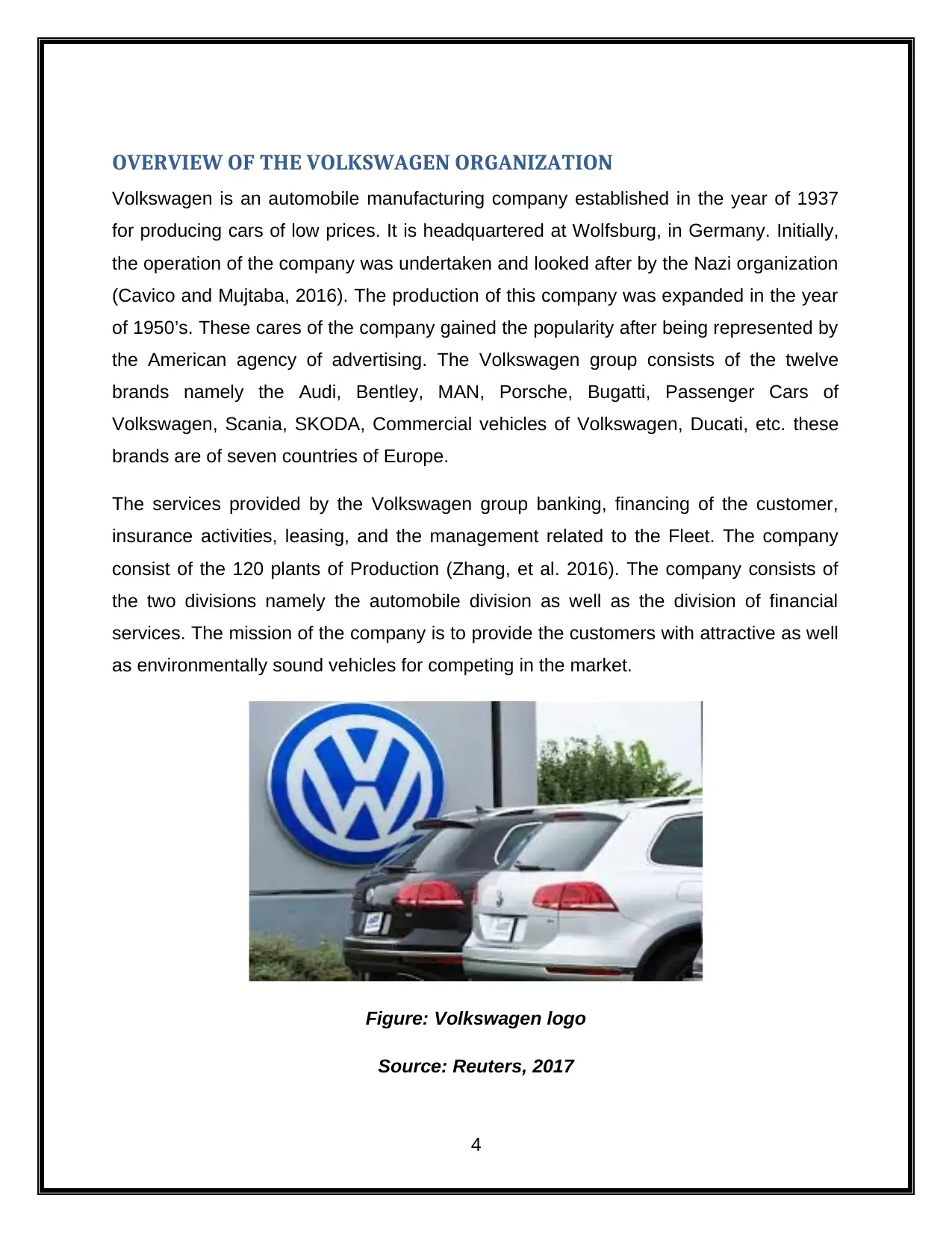
Figure: Volkswagen logo
Source: Reuters, 2017
4
Volkswagen is an automobile manufacturing company established in the year of 1937
for producing cars of low prices. It is headquartered at Wolfsburg, in Germany. Initially,
the operation of the company was undertaken and looked after by the Nazi organization
(Cavico and Mujtaba, 2016). The production of this company was expanded in the year
of 1950’s. These cares of the company gained the popularity after being represented by
the American agency of advertising. The Volkswagen group consists of the twelve
brands namely the Audi, Bentley, MAN, Porsche, Bugatti, Passenger Cars of
Volkswagen, Scania, SKODA, Commercial vehicles of Volkswagen, Ducati, etc. these
brands are of seven countries of Europe.
The services provided by the Volkswagen group banking, financing of the customer,
insurance activities, leasing, and the management related to the Fleet. The company
consist of the 120 plants of Production (Zhang, et al. 2016). The company consists of
the two divisions namely the automobile division as well as the division of financial
services. The mission of the company is to provide the customers with attractive as well
as environmentally sound vehicles for competing in the market.
Figure: Volkswagen logo
Source: Reuters, 2017
4
LO1
P1 PURPOSE AND THE FUNCTIONS OF HRM, APPLICABLE TO WORKFORCE
PLANNING AND RESOURCES IN VOLKSWAGEN
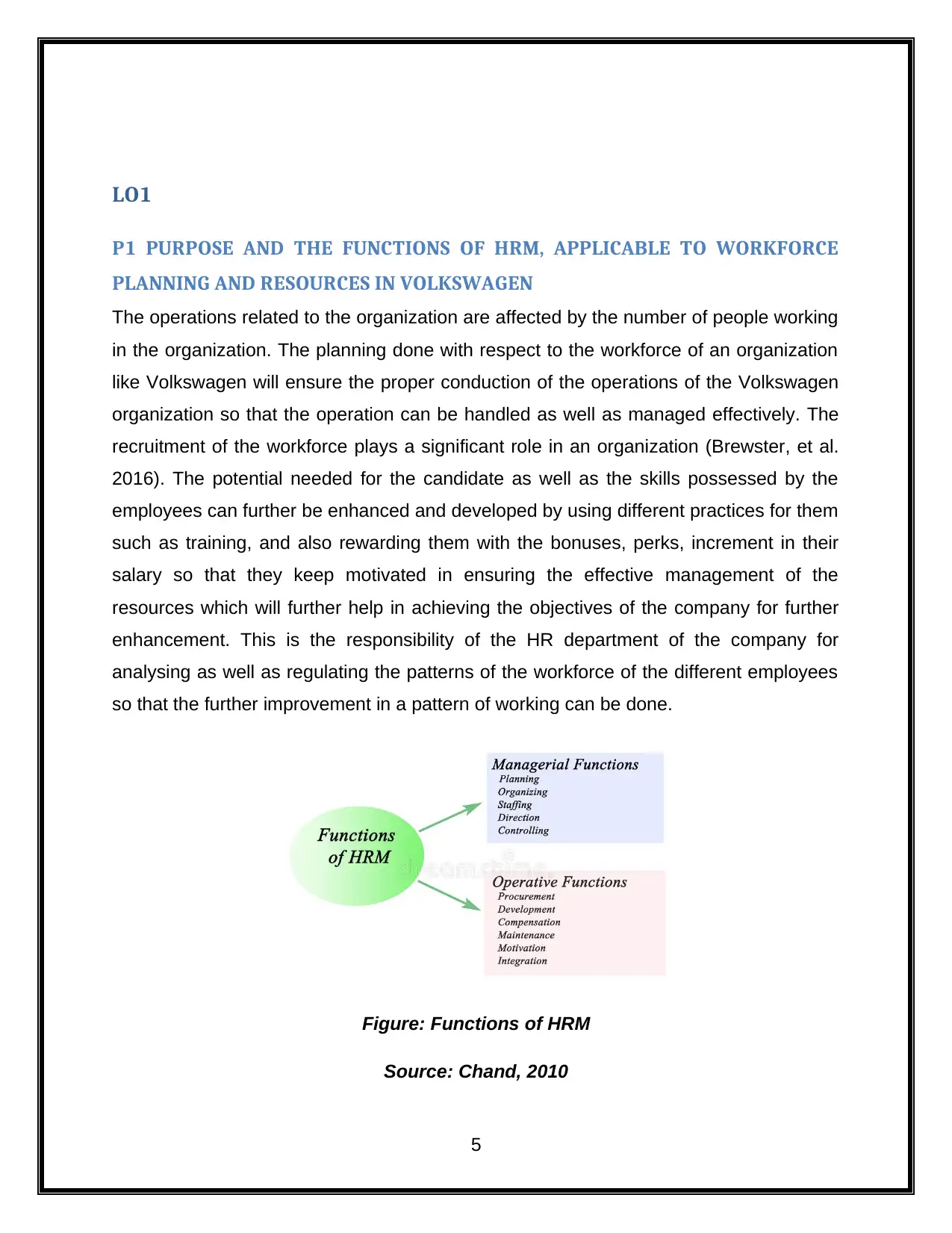
The operations related to the organization are affected by the number of people working
in the organization. The planning done with respect to the workforce of an organization
like Volkswagen will ensure the proper conduction of the operations of the Volkswagen
organization so that the operation can be handled as well as managed effectively. The
recruitment of the workforce plays a significant role in an organization (Brewster, et al.
2016). The potential needed for the candidate as well as the skills possessed by the
employees can further be enhanced and developed by using different practices for them
such as training, and also rewarding them with the bonuses, perks, increment in their
salary so that they keep motivated in ensuring the effective management of the
resources which will further help in achieving the objectives of the company for further
enhancement. This is the responsibility of the HR department of the company for
analysing as well as regulating the patterns of the workforce of the different employees
so that the further improvement in a pattern of working can be done.
Figure: Functions of HRM
Source: Chand, 2010
5
P1 PURPOSE AND THE FUNCTIONS OF HRM, APPLICABLE TO WORKFORCE
PLANNING AND RESOURCES IN VOLKSWAGEN
The operations related to the organization are affected by the number of people working
in the organization. The planning done with respect to the workforce of an organization
like Volkswagen will ensure the proper conduction of the operations of the Volkswagen
organization so that the operation can be handled as well as managed effectively. The
recruitment of the workforce plays a significant role in an organization (Brewster, et al.
2016). The potential needed for the candidate as well as the skills possessed by the
employees can further be enhanced and developed by using different practices for them
such as training, and also rewarding them with the bonuses, perks, increment in their
salary so that they keep motivated in ensuring the effective management of the
resources which will further help in achieving the objectives of the company for further
enhancement. This is the responsibility of the HR department of the company for
analysing as well as regulating the patterns of the workforce of the different employees
so that the further improvement in a pattern of working can be done.
Figure: Functions of HRM
Source: Chand, 2010
5
⊘ This is a preview!⊘
Do you want full access?
Subscribe today to unlock all pages.
Trusted by 1+ million students worldwide
The position of the different staff members must be analysed so that the vacant
positions of the company can be filled. These vacant positions can be filled by the
conducting the recruitment process for the different candidates who applied for it. Their
strength must be analysed and the potential needed by the candidates must be
understood by the HR department for hiring the desired candidates (Wang and Shultz,
2010). These approaches must be looked into for implementing the operations of the
organization effectively. Also, apart from these, different issues related to the workforce
must be analysed for solving them in order to prevent hindrances of the working of the
operations of the management.
M1 ASSESS HOW THE HRM FUNCTIONS IN YOUR CHOSEN ORGANISATION CAN
PROVIDE TALENT AND SKILLS APPROPRIATE TO FULFIL BUSINESS
OBJECTIVES USING APPROPRIATE THEORIES AND MODELS
The functions of HRM with respect to the Volkswagen in providing the talent and skills
for fulfilling the business objectives can be done by assigning the jobs with respect to
the different roles as well as the responsibilities of the different types of employees for
analysing the needs of the workforce needed for carrying out the operations of the
organization. Further, the positions of the employees are identified for the purpose of
linking the objectives of the business (Armstrong and Taylor, 2014). The planning is
done with respect to the employees of an organization such as providing them with
training for further improvement and development so that their talents can be analysed
as well as identified in order to increase the efficiency of the employees of an
organization. The abilities of the different workers are utilised in an effective way for the
purpose of achieving the objectives of an organization.
The management functions of the organization deal with the planning done for
maintaining the human resources, different activities are organized with a view for an
effective implementation of the different strategies adopted by the organization (Iles, et
al. 2010). Further, the employees are given direction in conducting the efficient working
of an organization. The skills, as well as the talents possessed by the organization, can
be recognized by the HR department during their training session, their working
analysis, etc.
6
positions of the company can be filled. These vacant positions can be filled by the
conducting the recruitment process for the different candidates who applied for it. Their
strength must be analysed and the potential needed by the candidates must be
understood by the HR department for hiring the desired candidates (Wang and Shultz,
2010). These approaches must be looked into for implementing the operations of the
organization effectively. Also, apart from these, different issues related to the workforce
must be analysed for solving them in order to prevent hindrances of the working of the
operations of the management.
M1 ASSESS HOW THE HRM FUNCTIONS IN YOUR CHOSEN ORGANISATION CAN
PROVIDE TALENT AND SKILLS APPROPRIATE TO FULFIL BUSINESS
OBJECTIVES USING APPROPRIATE THEORIES AND MODELS
The functions of HRM with respect to the Volkswagen in providing the talent and skills
for fulfilling the business objectives can be done by assigning the jobs with respect to
the different roles as well as the responsibilities of the different types of employees for
analysing the needs of the workforce needed for carrying out the operations of the
organization. Further, the positions of the employees are identified for the purpose of
linking the objectives of the business (Armstrong and Taylor, 2014). The planning is
done with respect to the employees of an organization such as providing them with
training for further improvement and development so that their talents can be analysed
as well as identified in order to increase the efficiency of the employees of an
organization. The abilities of the different workers are utilised in an effective way for the
purpose of achieving the objectives of an organization.
The management functions of the organization deal with the planning done for
maintaining the human resources, different activities are organized with a view for an
effective implementation of the different strategies adopted by the organization (Iles, et
al. 2010). Further, the employees are given direction in conducting the efficient working
of an organization. The skills, as well as the talents possessed by the organization, can
be recognized by the HR department during their training session, their working
analysis, etc.
6
Paraphrase This Document
Need a fresh take? Get an instant paraphrase of this document with our AI Paraphraser

These were the functions of the HRM department for recognizing the talent as well as
the skills possessed by the workforce of an organization in achieving the desired
objectives of the business with respect to the organization.
7
the skills possessed by the workforce of an organization in achieving the desired
objectives of the business with respect to the organization.
7
P2 STRENGTHS AND WEAKNESSES OF DIFFERENT APPROACHES TO
RECRUITMENT AND SELECTION
The various practices were included in the different process of recruitment as well as
the selection in the HRM department. These processes play a significant role in
recognizing the desired candidates who possess high potential and skills in order to
achieve the objectives of the organization.
The selection process helps in selecting the desired candidate according to the
organization requirement (Furnham, 2012). The desired candidate selected for the
profile will help in easing the operations of the business by utilising its efficiency and
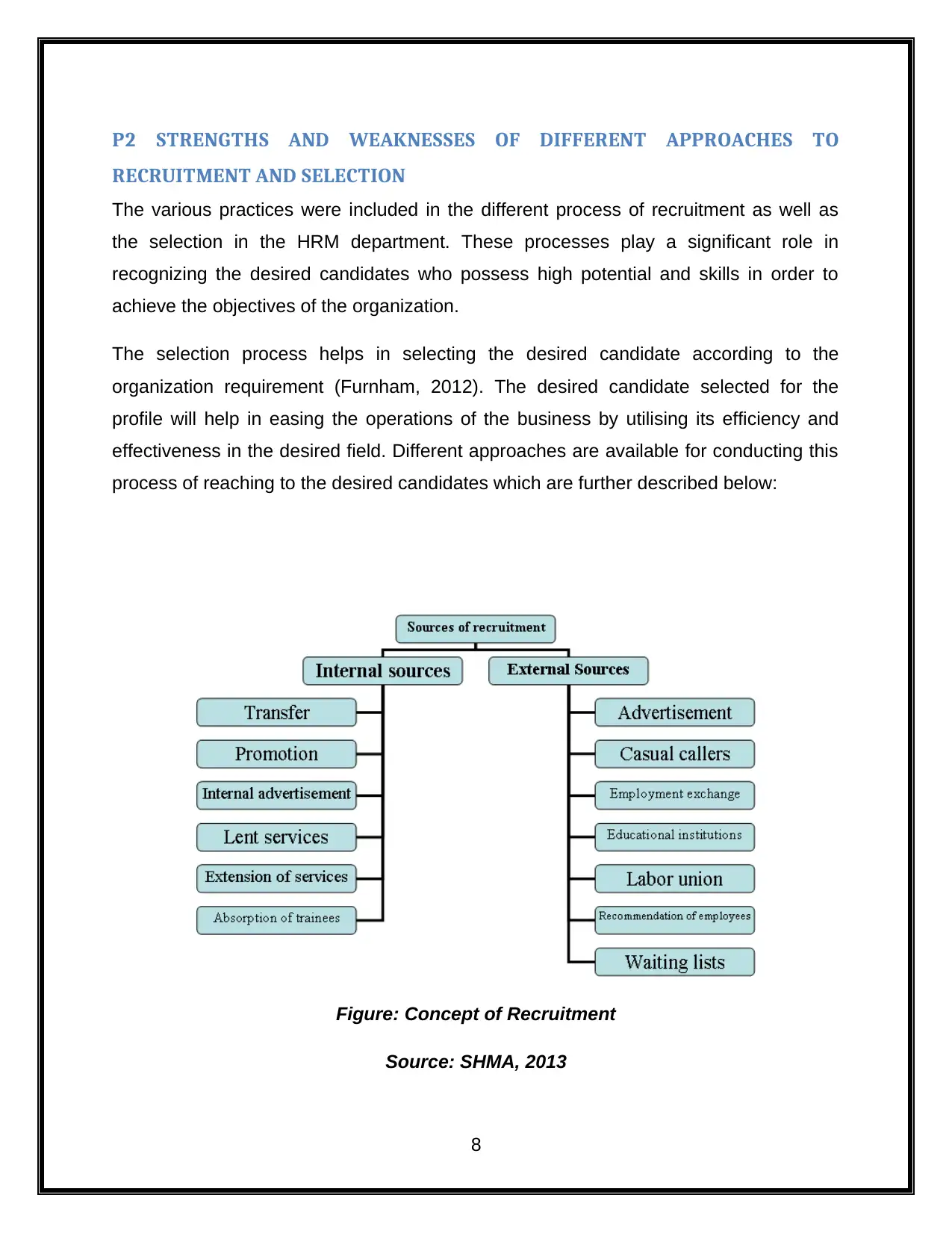
effectiveness in the desired field. Different approaches are available for conducting this
process of reaching to the desired candidates which are further described below:
Figure: Concept of Recruitment
Source: SHMA, 2013
8
RECRUITMENT AND SELECTION
The various practices were included in the different process of recruitment as well as
the selection in the HRM department. These processes play a significant role in
recognizing the desired candidates who possess high potential and skills in order to
achieve the objectives of the organization.
The selection process helps in selecting the desired candidate according to the
organization requirement (Furnham, 2012). The desired candidate selected for the
profile will help in easing the operations of the business by utilising its efficiency and
effectiveness in the desired field. Different approaches are available for conducting this
process of reaching to the desired candidates which are further described below:
Figure: Concept of Recruitment
Source: SHMA, 2013
8
⊘ This is a preview!⊘
Do you want full access?
Subscribe today to unlock all pages.
Trusted by 1+ million students worldwide
EXTERNAL SOURCING
With the help of external sourcing, a huge number of candidates participate in the
recruitment process for selection (DeVaro and Morita, 2013). As the huge number of
people arrives, there are chances of the people possessing the potential and the skills
required for the job. As the Volkswagen Company is big, the candidate might spend a
lot of time in understanding the operating environment of the organization. The cost of
conducting the recruitment process is high as a large sum of money is spent on the
advertisement.
THIRD-PARTY SOURCING
The third party sourcing is the approaching including the third party who recognizes the
talents as well as the skills of the candidate and send them to the organization fulfilling
the needs of it (Haski-Leventhal, et al. 2010). Such parties are generally the agencies,
consultancies, as well as the company who does only the recruitment procedure. It is a
time-saving approach and also less cost is involved in it as the candidates pay only the
registration charges demanded by these agencies.
INTERNAL SOURCING
In this approach, the organization conducts the recruitment process within an
organization which not only saves the money but will also help in understanding the
different procedures as well as the policies associated with it (Holtbrügge, et al. 2010). It
does affect the productivity of the organization with respect to the different opinions
possessed by the different employees of an organization.
M2 EVALUATE THE STRENGTHS AND WEAKNESSES OF DIFFERENT
APPROACHES TO RECRUITMENT AND SELECTION USING SUITABLE THEORIES
AND MODELS
The different approaches conducted in the recruitment process are the internal
sourcing, external sourcing, and the third party sourcing.
The strength of the internal sourcing are described below:
9
With the help of external sourcing, a huge number of candidates participate in the
recruitment process for selection (DeVaro and Morita, 2013). As the huge number of
people arrives, there are chances of the people possessing the potential and the skills
required for the job. As the Volkswagen Company is big, the candidate might spend a
lot of time in understanding the operating environment of the organization. The cost of
conducting the recruitment process is high as a large sum of money is spent on the
advertisement.
THIRD-PARTY SOURCING
The third party sourcing is the approaching including the third party who recognizes the
talents as well as the skills of the candidate and send them to the organization fulfilling
the needs of it (Haski-Leventhal, et al. 2010). Such parties are generally the agencies,
consultancies, as well as the company who does only the recruitment procedure. It is a
time-saving approach and also less cost is involved in it as the candidates pay only the
registration charges demanded by these agencies.
INTERNAL SOURCING
In this approach, the organization conducts the recruitment process within an
organization which not only saves the money but will also help in understanding the
different procedures as well as the policies associated with it (Holtbrügge, et al. 2010). It
does affect the productivity of the organization with respect to the different opinions
possessed by the different employees of an organization.
M2 EVALUATE THE STRENGTHS AND WEAKNESSES OF DIFFERENT
APPROACHES TO RECRUITMENT AND SELECTION USING SUITABLE THEORIES
AND MODELS
The different approaches conducted in the recruitment process are the internal
sourcing, external sourcing, and the third party sourcing.
The strength of the internal sourcing are described below:
9
Paraphrase This Document
Need a fresh take? Get an instant paraphrase of this document with our AI Paraphraser
This approach saves a lot of time and also is a cost-effective approach.
The skills, as well as the abilities possessed by the candidates, are already
known to the organization.
The motivation factor helps in enhancing the performance of the candidate.
The weakness of the External sourcing are described below:
The scope of the candidate is constrained within the organization.
The entry of the innovative, as well as the new ideas, is prohibited.
A candidate is selected on the basis of vacancy and not on the basis of skills
possessed by them.
Sometimes, the desired candidate fails in impressing the recruitment department.
The strength of external sourcing is described below:
The new employees help in bringing the innovative ideas.
The new employees increase the productivity of the company as well as the ratio
of the profit.
The new employees help in bringing the several opportunities for the company
towards growth and enhancement.
The weakness of the external sourcing is described below:
High investment is made by a company for doing the promotion of recruiting the
candidates.
An interview cannot judge the skills, capabilities, and the potential possessed by
the candidate.
The advantages of third-party sourcing are described below:
10
The skills, as well as the abilities possessed by the candidates, are already
known to the organization.
The motivation factor helps in enhancing the performance of the candidate.
The weakness of the External sourcing are described below:
The scope of the candidate is constrained within the organization.
The entry of the innovative, as well as the new ideas, is prohibited.
A candidate is selected on the basis of vacancy and not on the basis of skills
possessed by them.
Sometimes, the desired candidate fails in impressing the recruitment department.
The strength of external sourcing is described below:
The new employees help in bringing the innovative ideas.
The new employees increase the productivity of the company as well as the ratio
of the profit.
The new employees help in bringing the several opportunities for the company
towards growth and enhancement.
The weakness of the external sourcing is described below:
High investment is made by a company for doing the promotion of recruiting the
candidates.
An interview cannot judge the skills, capabilities, and the potential possessed by
the candidate.
The advantages of third-party sourcing are described below:
10
The candidates recruited from this type of recruitment are often provided with the
guidance of the company.
The third party sourcing helps in giving the personality testing of the candidate.
An efficient relationship is established between the different candidates through
the third party agency.
The disadvantages of the third party sourcing are described below:
This third party charge candidates with the cost of recruiting them.
The lack of control is possessed by the third party as the agency has to read
again and again resumes of different candidates.
There are also some communication issues encountered by these third-party
agencies.
11
guidance of the company.
The third party sourcing helps in giving the personality testing of the candidate.
An efficient relationship is established between the different candidates through
the third party agency.
The disadvantages of the third party sourcing are described below:
This third party charge candidates with the cost of recruiting them.
The lack of control is possessed by the third party as the agency has to read
again and again resumes of different candidates.
There are also some communication issues encountered by these third-party
agencies.
11
⊘ This is a preview!⊘
Do you want full access?
Subscribe today to unlock all pages.
Trusted by 1+ million students worldwide

1 out of 28


Related Documents


Your All-in-One AI-Powered Toolkit for Academic Success.
+13062052269
info@desklib.com
Available 24*7 on WhatsApp / Email
![[object Object]](/_next/static/media/star-bottom.7253800d.svg)
Unlock your academic potential
Copyright © 2020–2026 A2Z Services. All Rights Reserved. Developed and managed by ZUCOL.