Strategic Analysis of Warehouse Management in Diverse Cultures
VerifiedAdded on 2020/10/22
|15
|5216
|427
AI Summary
The analysis focuses on evaluating the strategic role of warehouse management systems within diverse cultural contexts, assessing how these systems can be optimized for better efficiency and adaptability. By examining socio-economic factors and cultural nuances, the study aims to provide insights into creating robust strategies that accommodate diversity in operational practices. The assignment also explores the implications of cultural differences on organizational performance and stakeholder relations, offering a comprehensive understanding of contemporary issues in warehouse management and business strategy.
Contemporary Issues
in Management
in Management

Paraphrase This Document
Need a fresh take? Get an instant paraphrase of this document with our AI Paraphraser
Executive Summary
Contemporary business environment is such that it continuously bring new challenges for
the managers to handle the various areas of management along with the most vital aspect,
namely, Human Resource Management. Some of the major issue faced in contemporary
environment are workforce diversity, differences in approaches of management and operations,
globalisation etc. It is required by every company to handle the various aspects of management
wisely so as to conduct operations of entity effectively. The most essential element of this is
human resources as they are the persons who execute any activity and work towards the
upliftment of organisation (Scholte, van Teeffelen and Verburg, 2015). Also, for an entity that
carries out business in international market, it is necessary that the importance of effective and
efficient management of human resource is done so as to ensure the sustainability of business in
the long run. It deals with cross-cultural management as every country has different set of norms,
beliefs, values and culture which affects the conduct of business.
This assignment is based upon a case study wherein the two managers, Jose and Enya
face very challenges and issues while carrying out the effective management of a warehouse.
These issues mainly include inefficient behaviour of employees which affects the operations as
well as profitability of business entity. Along with this, it is seen that due to these issues,
management fail to complete the various orders placed by customers, on time. Furthermore,
various strategies to combat these issues like Green Human Resource Management, Milliken's
model of communication and Whittington’s Model of profit maximisation has been discussed.
Besides this, for executing the change in present practices, Kotter’s Model of change
management has been used. All these help Enya and Jose to tackle the contemporary issues faced
by them while conducting business.
Contemporary business environment is such that it continuously bring new challenges for
the managers to handle the various areas of management along with the most vital aspect,
namely, Human Resource Management. Some of the major issue faced in contemporary
environment are workforce diversity, differences in approaches of management and operations,
globalisation etc. It is required by every company to handle the various aspects of management
wisely so as to conduct operations of entity effectively. The most essential element of this is
human resources as they are the persons who execute any activity and work towards the
upliftment of organisation (Scholte, van Teeffelen and Verburg, 2015). Also, for an entity that
carries out business in international market, it is necessary that the importance of effective and
efficient management of human resource is done so as to ensure the sustainability of business in
the long run. It deals with cross-cultural management as every country has different set of norms,
beliefs, values and culture which affects the conduct of business.
This assignment is based upon a case study wherein the two managers, Jose and Enya
face very challenges and issues while carrying out the effective management of a warehouse.
These issues mainly include inefficient behaviour of employees which affects the operations as
well as profitability of business entity. Along with this, it is seen that due to these issues,
management fail to complete the various orders placed by customers, on time. Furthermore,
various strategies to combat these issues like Green Human Resource Management, Milliken's
model of communication and Whittington’s Model of profit maximisation has been discussed.
Besides this, for executing the change in present practices, Kotter’s Model of change
management has been used. All these help Enya and Jose to tackle the contemporary issues faced
by them while conducting business.
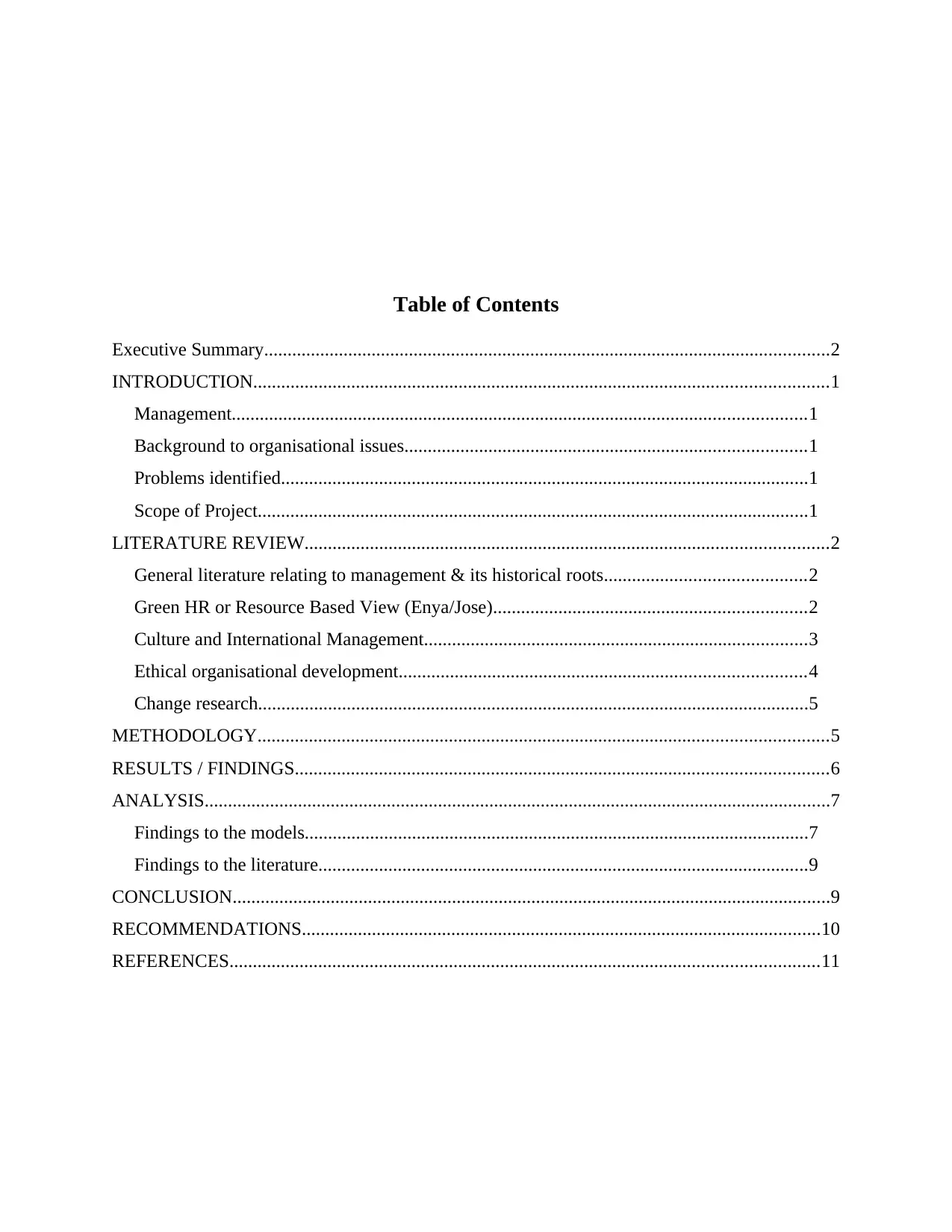
Table of Contents
Executive Summary.........................................................................................................................2
INTRODUCTION...........................................................................................................................1
Management...........................................................................................................................1
Background to organisational issues......................................................................................1
Problems identified.................................................................................................................1
Scope of Project......................................................................................................................1
LITERATURE REVIEW................................................................................................................2
General literature relating to management & its historical roots...........................................2
Green HR or Resource Based View (Enya/Jose)...................................................................2
Culture and International Management..................................................................................3
Ethical organisational development.......................................................................................4
Change research......................................................................................................................5
METHODOLOGY..........................................................................................................................5
RESULTS / FINDINGS..................................................................................................................6
ANALYSIS......................................................................................................................................7
Findings to the models............................................................................................................7
Findings to the literature.........................................................................................................9
CONCLUSION................................................................................................................................9
RECOMMENDATIONS...............................................................................................................10
REFERENCES..............................................................................................................................11
Executive Summary.........................................................................................................................2
INTRODUCTION...........................................................................................................................1
Management...........................................................................................................................1
Background to organisational issues......................................................................................1
Problems identified.................................................................................................................1
Scope of Project......................................................................................................................1
LITERATURE REVIEW................................................................................................................2
General literature relating to management & its historical roots...........................................2
Green HR or Resource Based View (Enya/Jose)...................................................................2
Culture and International Management..................................................................................3
Ethical organisational development.......................................................................................4
Change research......................................................................................................................5
METHODOLOGY..........................................................................................................................5
RESULTS / FINDINGS..................................................................................................................6
ANALYSIS......................................................................................................................................7
Findings to the models............................................................................................................7
Findings to the literature.........................................................................................................9
CONCLUSION................................................................................................................................9
RECOMMENDATIONS...............................................................................................................10
REFERENCES..............................................................................................................................11
⊘ This is a preview!⊘
Do you want full access?
Subscribe today to unlock all pages.

Trusted by 1+ million students worldwide

Paraphrase This Document
Need a fresh take? Get an instant paraphrase of this document with our AI Paraphraser
INTRODUCTION
Management
It refers to the process through which an individual takes control of another person or
activity. In the context of business, management is generally considered as the act of setting a
strategy for an organisation so as to align the behaviour of employees towards accomplishment
of goals and objectives of company (Berry and Sam, 2013). It includes aspects like financial,
human and technological resources which have to be handled in a systematic manner.
Background to organisational issues
Contemporary issues in business are the various challenges faced by the personnel
working in an organisation. Such issues are likely to arise in every field of work in the modern
world due to diverse workforce, cross-cultural issues or inefficient working of staff. These
challenges often act as barriers to performance and function as a hurdle for those closely
involved in the operations and management of entity (Bellini and et. al., 2013). As per the case
study, it can be seen that Jose and Enya face a number of issues, especially in relation to their
approaches of management and handling of employees of the organisation. Also, it has been
observed that they Jose and Enya have contradictory views upon management of operations and
human resources along with profitability ratio. Here, it is required by the managers to effectively
deal with these hindrances so that they do not hamper the performance of employees and ensure
the sustainability of business in international market. Management is following various
approaches and strategies to tackle the contemporary challenges effectively.
Problems identified
The problems identified are the contrary approaches of owner and the HR manager. Also,
the ineffective and inefficient performance of employees is identified due to which warehouse is
not able to make delivery on time.
Scope of Project
The contemporary issues that arise in an organisation need to be handled in an effective
manner by the management so that they do not cause harm to the performance of business. In
relation to this project, the scope is wide as the various methodologies and strategies adopted by
Jose and Enya has been covered along with the Nudge theory of change management so as to
incorporate any change that seems necessary to deal with the challenges. Also, the effect of these
1
Management
It refers to the process through which an individual takes control of another person or
activity. In the context of business, management is generally considered as the act of setting a
strategy for an organisation so as to align the behaviour of employees towards accomplishment
of goals and objectives of company (Berry and Sam, 2013). It includes aspects like financial,
human and technological resources which have to be handled in a systematic manner.
Background to organisational issues
Contemporary issues in business are the various challenges faced by the personnel
working in an organisation. Such issues are likely to arise in every field of work in the modern
world due to diverse workforce, cross-cultural issues or inefficient working of staff. These
challenges often act as barriers to performance and function as a hurdle for those closely
involved in the operations and management of entity (Bellini and et. al., 2013). As per the case
study, it can be seen that Jose and Enya face a number of issues, especially in relation to their
approaches of management and handling of employees of the organisation. Also, it has been
observed that they Jose and Enya have contradictory views upon management of operations and
human resources along with profitability ratio. Here, it is required by the managers to effectively
deal with these hindrances so that they do not hamper the performance of employees and ensure
the sustainability of business in international market. Management is following various
approaches and strategies to tackle the contemporary challenges effectively.
Problems identified
The problems identified are the contrary approaches of owner and the HR manager. Also,
the ineffective and inefficient performance of employees is identified due to which warehouse is
not able to make delivery on time.
Scope of Project
The contemporary issues that arise in an organisation need to be handled in an effective
manner by the management so that they do not cause harm to the performance of business. In
relation to this project, the scope is wide as the various methodologies and strategies adopted by
Jose and Enya has been covered along with the Nudge theory of change management so as to
incorporate any change that seems necessary to deal with the challenges. Also, the effect of these
1
strategies upon the warehouse management and scope of company to deal with the international
processes and the diverse practices and beliefs of workforce has been discussed. These strategies
and models, if executed well, along with removing the diversities in views of Enya and Jose can
bring improvement in the warehouse system and enhance the overall profitability.
LITERATURE REVIEW
General literature relating to management & its historical roots
Management is related to the aspect of handling persons and things in an effective and
efficient manner. It is basically concerned with the practices adopted by management to orderly
manage and deal with the employees, processes, methods, techniques and strategies adopted by
organisation so as to sustain in market in long run. Also, it deals with the various aspects of
behavioural pattern of workforce such that it can be aligned towards the realisation of
organisational goal. The practice of management has been adopted by people since years.
Organised methods and processes involving planning, organising, evaluating, monitoring and
controlling has been utilised by individuals for thousands of years (Oteros-Rozas and et. al.,
2014).
Green HR or Resource Based View (Enya/Jose)
Contemporary issues have arisen in the warehouse because of ineffective and inefficient
practices of employees of the organisation. This becomes a challenge for the management as
these cause hindrance in performance of workforce due to which the operational efficiency of
organisation is affected. As a result of this, warehouse becomes incapable to deliver timely
orders in international market which poses threat to its brand image and position in industry. AD
per the case study, it can be said that Jose Fernandez is planning to design and develop a
warehouse system at international level. This system would provide the facility of delivering
products to consumers overnight or within a span of 2 days from the receipt of order. For the
effective execution of this warehouse system, it is essential that management adopt such
practices and processes which can ensure the timely receipt and delivery of orders along with
maintaining the quality of products delivered.
To deal with this, Enya has proposed Green HRM practices. Green human resource
management can be referred to as the fair practices adopted by the management for the overall
enhancement of productivity of employees (Liepiņa, Lapiņa and Mazais, 2014). This method
2
processes and the diverse practices and beliefs of workforce has been discussed. These strategies
and models, if executed well, along with removing the diversities in views of Enya and Jose can
bring improvement in the warehouse system and enhance the overall profitability.
LITERATURE REVIEW
General literature relating to management & its historical roots
Management is related to the aspect of handling persons and things in an effective and
efficient manner. It is basically concerned with the practices adopted by management to orderly
manage and deal with the employees, processes, methods, techniques and strategies adopted by
organisation so as to sustain in market in long run. Also, it deals with the various aspects of
behavioural pattern of workforce such that it can be aligned towards the realisation of
organisational goal. The practice of management has been adopted by people since years.
Organised methods and processes involving planning, organising, evaluating, monitoring and
controlling has been utilised by individuals for thousands of years (Oteros-Rozas and et. al.,
2014).
Green HR or Resource Based View (Enya/Jose)
Contemporary issues have arisen in the warehouse because of ineffective and inefficient
practices of employees of the organisation. This becomes a challenge for the management as
these cause hindrance in performance of workforce due to which the operational efficiency of
organisation is affected. As a result of this, warehouse becomes incapable to deliver timely
orders in international market which poses threat to its brand image and position in industry. AD
per the case study, it can be said that Jose Fernandez is planning to design and develop a
warehouse system at international level. This system would provide the facility of delivering
products to consumers overnight or within a span of 2 days from the receipt of order. For the
effective execution of this warehouse system, it is essential that management adopt such
practices and processes which can ensure the timely receipt and delivery of orders along with
maintaining the quality of products delivered.
To deal with this, Enya has proposed Green HRM practices. Green human resource
management can be referred to as the fair practices adopted by the management for the overall
enhancement of productivity of employees (Liepiņa, Lapiņa and Mazais, 2014). This method
2
⊘ This is a preview!⊘
Do you want full access?
Subscribe today to unlock all pages.
Trusted by 1+ million students worldwide
involves optimum utilisation and management of human resources such that these individuals
develop a feeling of being to the organisation and work for the timely delivery of orders. Green
HRM includes practices like training, development, induction, welfare programmes, reward and
compensation etc. Such activities can help in increasing the capability and increase the interest of
personnel towards the warehouse system, thus creating a healthy working environment. This
practice can be well executed along with Milliken's Model of communication which proposes
that it is essential for managers to gain an insight into the various employees’ influences as well
as their feedback regarding different scenarios. Also, this ensures satisfaction among the
workforce as they are given a chance to express their views.
In contrast to this, Jose intends to implement Whittington's Model of profit maximisation.
Jose being a practical person assumes that it is imperative to look at the financial side of business
and adopt such practices that are in accordance with generation of income as well as profitability.
Besides this, he focuses upon implementation of Wittington's Model which emphasizes that it is
necessary that the financial side of the business is well taken care of as each business is run for
the motive of profit maximisation. Jose proposes that for the warehouse to run effectively in
international market, it need to align the behaviour of employees towards increasing profits.
Culture and International Management
For an entity to conduct its operations at international level, it is necessary that the
organisation takes into account various aspects of cross national boundaries. These areas include
political laws and regulations, culture, traditions and nature of people in the country. Amongst all
these aspects, the most essential element is culture. Culture can be referred to as the set of
beliefs, practices, norms, traditions and values followed by individuals or groups in a particular
country (Vom Brocke and et. al., 2014). When a business carries out business at global level, it
needs to keep in consideration the diversities in culture of the countries and workforce. As Jose
Fernandez is planning to carry out the operations of warehouse system internationally, it is
required that he understands the need to develop an understanding of the cultural and national
differences. Furthermore, he needs to take measures so as to reconcile these differences and
maintain a healthy environment where the individual or national diversities do not hamper the
performance of business.
It is vital that Jose develops an understanding of cross-cultural and international
management. As the concept of globalisation is spreading rapidly, managers need to have a
3
develop a feeling of being to the organisation and work for the timely delivery of orders. Green
HRM includes practices like training, development, induction, welfare programmes, reward and
compensation etc. Such activities can help in increasing the capability and increase the interest of
personnel towards the warehouse system, thus creating a healthy working environment. This
practice can be well executed along with Milliken's Model of communication which proposes
that it is essential for managers to gain an insight into the various employees’ influences as well
as their feedback regarding different scenarios. Also, this ensures satisfaction among the
workforce as they are given a chance to express their views.
In contrast to this, Jose intends to implement Whittington's Model of profit maximisation.
Jose being a practical person assumes that it is imperative to look at the financial side of business
and adopt such practices that are in accordance with generation of income as well as profitability.
Besides this, he focuses upon implementation of Wittington's Model which emphasizes that it is
necessary that the financial side of the business is well taken care of as each business is run for
the motive of profit maximisation. Jose proposes that for the warehouse to run effectively in
international market, it need to align the behaviour of employees towards increasing profits.
Culture and International Management
For an entity to conduct its operations at international level, it is necessary that the
organisation takes into account various aspects of cross national boundaries. These areas include
political laws and regulations, culture, traditions and nature of people in the country. Amongst all
these aspects, the most essential element is culture. Culture can be referred to as the set of
beliefs, practices, norms, traditions and values followed by individuals or groups in a particular
country (Vom Brocke and et. al., 2014). When a business carries out business at global level, it
needs to keep in consideration the diversities in culture of the countries and workforce. As Jose
Fernandez is planning to carry out the operations of warehouse system internationally, it is
required that he understands the need to develop an understanding of the cultural and national
differences. Furthermore, he needs to take measures so as to reconcile these differences and
maintain a healthy environment where the individual or national diversities do not hamper the
performance of business.
It is vital that Jose develops an understanding of cross-cultural and international
management. As the concept of globalisation is spreading rapidly, managers need to have a
3
Paraphrase This Document
Need a fresh take? Get an instant paraphrase of this document with our AI Paraphraser
holistic understanding of the practices and culture followed by people in the countries where they
wish to operate so that they can deliver products according to their preferences and requirements.
Consideration of workforce diversity across different parts of globe is crucial for the effective
management of business at global level. Thus, by gaining knowledge about the various aspects of
culture and nation so as to analyse the needs and requirements of consumers, Jose can effectively
run the warehouse system in international market. This will ensure timely delivery of all the
orders placed by customers.
Ethical organisational development
Ethics is a branch of philosophy that deals with making decisions about what is right and
what is wrong as a practice. Business ethics is mainly concerned with adoption of such methods,
practices and techniques that result in social welfare and do not pose harm to environment.
Ethics play a vital role in ascertaining the sustainability of business in long run. A business
mainly functions for the purpose of growth and expansion. Thus, it becomes necessary that entity
adopts such processes which ensure the widespread acceptability from public. This will result in
strengthening the corporate image and position of business. In today's globalised world, it is
required by managers to understand the importance of adopting ethical practices so that it can
easily and effectively carry out the operations without any major interference from government
or local communities (Baker and Faulkner, 2017). There are various ethical challenges that are
faced by managers or practitioners while performing their work in international marketplace.
According to the case study, it can be said that it is imperative that Jose realises the need
of adoption of ethical methods and thus, implement them effectively in the warehouse. It is
required by Jose to take care of the methods being utilised by the employees in workforce and to
supervise it continuously so that no individual indulges in any unfair practice (Grant, 2016). By
ensuring this, Jose can look upon the growth and expansion of business along with getting
support from public. It can be said that stressing upon such practices can help the business and
workforce in timely completion of orders placed by customers. Also, it is required by Jose to
engage in ethical practices while dealing with the human resource of warehouse. This will result
in gaining satisfaction of employees. Consequently, they will be aligned towards the
accomplishment of organisational goals.
4
wish to operate so that they can deliver products according to their preferences and requirements.
Consideration of workforce diversity across different parts of globe is crucial for the effective
management of business at global level. Thus, by gaining knowledge about the various aspects of
culture and nation so as to analyse the needs and requirements of consumers, Jose can effectively
run the warehouse system in international market. This will ensure timely delivery of all the
orders placed by customers.
Ethical organisational development
Ethics is a branch of philosophy that deals with making decisions about what is right and
what is wrong as a practice. Business ethics is mainly concerned with adoption of such methods,
practices and techniques that result in social welfare and do not pose harm to environment.
Ethics play a vital role in ascertaining the sustainability of business in long run. A business
mainly functions for the purpose of growth and expansion. Thus, it becomes necessary that entity
adopts such processes which ensure the widespread acceptability from public. This will result in
strengthening the corporate image and position of business. In today's globalised world, it is
required by managers to understand the importance of adopting ethical practices so that it can
easily and effectively carry out the operations without any major interference from government
or local communities (Baker and Faulkner, 2017). There are various ethical challenges that are
faced by managers or practitioners while performing their work in international marketplace.
According to the case study, it can be said that it is imperative that Jose realises the need
of adoption of ethical methods and thus, implement them effectively in the warehouse. It is
required by Jose to take care of the methods being utilised by the employees in workforce and to
supervise it continuously so that no individual indulges in any unfair practice (Grant, 2016). By
ensuring this, Jose can look upon the growth and expansion of business along with getting
support from public. It can be said that stressing upon such practices can help the business and
workforce in timely completion of orders placed by customers. Also, it is required by Jose to
engage in ethical practices while dealing with the human resource of warehouse. This will result
in gaining satisfaction of employees. Consequently, they will be aligned towards the
accomplishment of organisational goals.
4
Change research
Changes take place at a rapid pace in an entity. Thus, it becomes imperative that
organisation takes into account these changes and ascertains the behavioural pattern of
employees in response to this. Also, it is required that managers adopt measures and techniques
for the effective execution of change while ensuring that employees do not resist the same.
Furthermore, it is necessary that managers changes at all levels and functions of management
like IT, operations, HR, marketing, finance etc. Also, it is required that the change is facilitated
with the help of a specified model. Change can be in terms of the position of people, process,
management or business associates (Habidin and et. al., 2015). Entity can achieve the long term
business goal by communicating the need of change to employees. It is essential that workforce
has the knowledge of interrelation between change and vision of company. For successful
implementation of change, a set framework with systematic steps is necessary so that it can be
effectively executed in the business environment. The process of formulation of change along
with monitoring and controlling its affect on the employees of entity can be termed as change
management.
Change management process is effective in increasing the satisfaction of employees by
communicating the need of change to workforce. In relation to the case study, Jose is developing
a warehouse at international level. He has observed the negative effects of bad image of
company on the overall business environment along with the corporate name and position in
marketplace. To prevent the same thing in case of his warehouse, Jose has adopted Kotter's 8
Step Change Model to facilitate certain necessary changes in the overall conduct so that
organisation can effectively function at global level.
METHODOLOGY
According to the case study, there are various models used and proposed by management
of warehouse. These are explained in brief below:-
Whittington's Model of profit maximisation
This model is basically used by management to ensure profit maximisation of business.
Also, it offers the option of taking a more flexible and reflective approach to systems and
processes. This model is basically made up of 4 elements namely, classical, evolutionary,
systemic and processual (Wellington, 2015). This approach focuses upon keeping the cost low
5
Changes take place at a rapid pace in an entity. Thus, it becomes imperative that
organisation takes into account these changes and ascertains the behavioural pattern of
employees in response to this. Also, it is required that managers adopt measures and techniques
for the effective execution of change while ensuring that employees do not resist the same.
Furthermore, it is necessary that managers changes at all levels and functions of management
like IT, operations, HR, marketing, finance etc. Also, it is required that the change is facilitated
with the help of a specified model. Change can be in terms of the position of people, process,
management or business associates (Habidin and et. al., 2015). Entity can achieve the long term
business goal by communicating the need of change to employees. It is essential that workforce
has the knowledge of interrelation between change and vision of company. For successful
implementation of change, a set framework with systematic steps is necessary so that it can be
effectively executed in the business environment. The process of formulation of change along
with monitoring and controlling its affect on the employees of entity can be termed as change
management.
Change management process is effective in increasing the satisfaction of employees by
communicating the need of change to workforce. In relation to the case study, Jose is developing
a warehouse at international level. He has observed the negative effects of bad image of
company on the overall business environment along with the corporate name and position in
marketplace. To prevent the same thing in case of his warehouse, Jose has adopted Kotter's 8
Step Change Model to facilitate certain necessary changes in the overall conduct so that
organisation can effectively function at global level.
METHODOLOGY
According to the case study, there are various models used and proposed by management
of warehouse. These are explained in brief below:-
Whittington's Model of profit maximisation
This model is basically used by management to ensure profit maximisation of business.
Also, it offers the option of taking a more flexible and reflective approach to systems and
processes. This model is basically made up of 4 elements namely, classical, evolutionary,
systemic and processual (Wellington, 2015). This approach focuses upon keeping the cost low
5
⊘ This is a preview!⊘
Do you want full access?
Subscribe today to unlock all pages.
Trusted by 1+ million students worldwide
along with abiding by the rules of local community. Jose proposes this model as this is
considered by him as the key to financial success of the entity.
Kotter’s 8 step change model
This is a change management model which is aimed at ensuring that the change is
successfully executed in the organisation. It starts with communicating the need of change to
employees. After that, the change is linked to the vision of company and communicated well to
the workforce as to how the implementation of change would foster the growth of business
entity. Any hurdle to the implementation of change is ascertained and then removed by taking
necessary measures. This can be done by reviewing the organisational structure, performance
and compensation criteria to see if they are aligned to the change (Gill and Singh, 2014). Another
way of removing hurdles can be recognizing and rewarding the employees that tend to make the
change happen. Also it is imperative that those individuals who resist the change as determined
and made them understand the necessity of change in the organisation. Also, the short term
success of change can be presented in front of the workforce to make them realise the
significance of change in long run.
Milliken's model of communication
This model is used a way of communication to build networking between individuals in
an entity. Also, it is often seen as a way to began interaction with the local community within
which the organisation functions (Dilger, 2012). This can be seen as a successful step towards
gaining the acceptance and satisfaction from the community in which warehouse operates, acting
as a measure to enhance the overall corporate image and positi9on of business.
RESULTS / FINDINGS
From the above discussion and the case study, it has been found that there are various
issues in the warehouse system run by Jose Fernandez internationally. Also, it has been evaluated
that there are contradictory views of Jose and his HR Manager, Enya. While Jose focuses upon
profit making and in particular, the financial success of the organisation, Enya consider the
welfare and satisfaction of employees as the yardstick to growth and success of entity.
Difference between Jose and Enya
Jose Enya
Jose has a practical approach towards doing Enya follows an ethical approach to avoid
6
considered by him as the key to financial success of the entity.
Kotter’s 8 step change model
This is a change management model which is aimed at ensuring that the change is
successfully executed in the organisation. It starts with communicating the need of change to
employees. After that, the change is linked to the vision of company and communicated well to
the workforce as to how the implementation of change would foster the growth of business
entity. Any hurdle to the implementation of change is ascertained and then removed by taking
necessary measures. This can be done by reviewing the organisational structure, performance
and compensation criteria to see if they are aligned to the change (Gill and Singh, 2014). Another
way of removing hurdles can be recognizing and rewarding the employees that tend to make the
change happen. Also it is imperative that those individuals who resist the change as determined
and made them understand the necessity of change in the organisation. Also, the short term
success of change can be presented in front of the workforce to make them realise the
significance of change in long run.
Milliken's model of communication
This model is used a way of communication to build networking between individuals in
an entity. Also, it is often seen as a way to began interaction with the local community within
which the organisation functions (Dilger, 2012). This can be seen as a successful step towards
gaining the acceptance and satisfaction from the community in which warehouse operates, acting
as a measure to enhance the overall corporate image and positi9on of business.
RESULTS / FINDINGS
From the above discussion and the case study, it has been found that there are various
issues in the warehouse system run by Jose Fernandez internationally. Also, it has been evaluated
that there are contradictory views of Jose and his HR Manager, Enya. While Jose focuses upon
profit making and in particular, the financial success of the organisation, Enya consider the
welfare and satisfaction of employees as the yardstick to growth and success of entity.
Difference between Jose and Enya
Jose Enya
Jose has a practical approach towards doing Enya follows an ethical approach to avoid
6
Paraphrase This Document
Need a fresh take? Get an instant paraphrase of this document with our AI Paraphraser
and managing things and individuals in the
entity.
interference from government or any local
body in the operations of warehouse.
According to him, financial success is the key
to measure overall condition of business as any
business primarily runs for the motive of profit
making.
She considers social welfare and development
of employees as the key to success and growth
of an organisation because according to her,
satisfied and motivated workforce operates in a
better manner for the realisation of
organisational goals.
Jose intends to use Whittington’s profit
maximisation model along with top down
approach for communication which is difficult
to be followed by Gen Z employees.
Enya stresses upon employing Green HRM
practices in operations as this would mean
training, development and welfare of
employees so that they can enhance their
productivity and deliver successfully.
It can be said that Enya’s approach is more logical and feasible as she stresses upon the
welfare of employees. The biggest asset of a company is human resource and thus, it becomes
necessary that business takes proper care and manages this resource well so as to sustain in
market for long time. Also, by employing Green HRM practices, employees can be motivated
and they will develop a sense of belongingness to the entity (Evertson and Weinstein, 2013).
Consequently, their productivity will increase as they will be willing to deliver best to their
potential.
ANALYSIS
Findings to the models
This report explains relationship and different approaches of a warehouse owner Jose
Fernandez and his HR manager, Enya Murray. Both of them have a different approach towards
management of warehouse and formulation of various policies for growth and development. Jose
Fernandez is a very practical person who finds out financial success of his business as his
greatest achievement. Also he rates financial success greatest and above all other different
aspects of business activities. For this type of approach, Whittington's model is suitably
considered which lays emphasis on profit maximisation (Baruffaldi, Accorsi and Manzini, 2018).
7
entity.
interference from government or any local
body in the operations of warehouse.
According to him, financial success is the key
to measure overall condition of business as any
business primarily runs for the motive of profit
making.
She considers social welfare and development
of employees as the key to success and growth
of an organisation because according to her,
satisfied and motivated workforce operates in a
better manner for the realisation of
organisational goals.
Jose intends to use Whittington’s profit
maximisation model along with top down
approach for communication which is difficult
to be followed by Gen Z employees.
Enya stresses upon employing Green HRM
practices in operations as this would mean
training, development and welfare of
employees so that they can enhance their
productivity and deliver successfully.
It can be said that Enya’s approach is more logical and feasible as she stresses upon the
welfare of employees. The biggest asset of a company is human resource and thus, it becomes
necessary that business takes proper care and manages this resource well so as to sustain in
market for long time. Also, by employing Green HRM practices, employees can be motivated
and they will develop a sense of belongingness to the entity (Evertson and Weinstein, 2013).
Consequently, their productivity will increase as they will be willing to deliver best to their
potential.
ANALYSIS
Findings to the models
This report explains relationship and different approaches of a warehouse owner Jose
Fernandez and his HR manager, Enya Murray. Both of them have a different approach towards
management of warehouse and formulation of various policies for growth and development. Jose
Fernandez is a very practical person who finds out financial success of his business as his
greatest achievement. Also he rates financial success greatest and above all other different
aspects of business activities. For this type of approach, Whittington's model is suitably
considered which lays emphasis on profit maximisation (Baruffaldi, Accorsi and Manzini, 2018).
7
Whittington's model of profit maximisation is further divided into 4 broad levels namely
classical, evolutionary, systematic and processual. Jose is highly impressed by this type of hustle
model that works on prioritization of profit maximisation. This warehouse is a franchise based
warehouse so it normally does its delivery during night hours or within 2 days from date of
ordering. For Jose, it is great opportunity to capture market and therefore increase his profit rates.
This view of Jose is based upon Whittington's model.
Furthermore, Jose does not work for welfare of his employees and feels practice of Green
HRM practices is not practical in his point of view whereas Enya, his HR manager thinks about
growth and welfare of his employees. She considers Green HRM practices as a vital part of any
business concern as it helps in retaining existing employees and customers for a longer period of
time. Also, it aims at boosting morale of employees and further help in overall growth of
business organisation. It may be sometimes an expensive technique in its initial days as it does
not focus on profit maximisation directly but in long run it helps to achieve goals and objectives
on a timely basis (Alhyasat and Al-Dalahmeh, 2013).
For practising Green HRM, Enya suggests Milliken's model of communication but is
confused whether this model will also serve profit maximisation purpose. This model is further
classified into 5 categories that deal in effective communication namely voice, emotional states,
cognitive states, behavioural outcomes and extra organisational relationships. Also there is a
positive factor known as community engagement which aims at improving level of
communication. Jose being a practical person follows top down approach of communication in
his warehouse which makes it quite difficult for maintaining effective communication and
assigning tasks to bottom level in his warehouse. To maintain effective communication, it is
mandatory for Jose to implement new model of communication for example Milliken's model in
this context. This change of communication process may even change his mindset and ideology
thereby making him more creative in his approach (Faber, 2015). Milliken's approach, on the
other hand, relates to Green HRM policies that are recommended and followed by Enya.
Also, Jose, in consideration with competitive businesses and industry, realises the need of
bringing changes in warehouse so that business can easily operate at international level. For
execution of change in warehouse, Jose has adopted Kotter’s 8 Step Model. By using this
model , Jose aims at gaining satisfaction from employees by communicating the need of change
and linking it with the vision of company. Jose is logical in approach and considers that change
8
classical, evolutionary, systematic and processual. Jose is highly impressed by this type of hustle
model that works on prioritization of profit maximisation. This warehouse is a franchise based
warehouse so it normally does its delivery during night hours or within 2 days from date of
ordering. For Jose, it is great opportunity to capture market and therefore increase his profit rates.
This view of Jose is based upon Whittington's model.
Furthermore, Jose does not work for welfare of his employees and feels practice of Green
HRM practices is not practical in his point of view whereas Enya, his HR manager thinks about
growth and welfare of his employees. She considers Green HRM practices as a vital part of any
business concern as it helps in retaining existing employees and customers for a longer period of
time. Also, it aims at boosting morale of employees and further help in overall growth of
business organisation. It may be sometimes an expensive technique in its initial days as it does
not focus on profit maximisation directly but in long run it helps to achieve goals and objectives
on a timely basis (Alhyasat and Al-Dalahmeh, 2013).
For practising Green HRM, Enya suggests Milliken's model of communication but is
confused whether this model will also serve profit maximisation purpose. This model is further
classified into 5 categories that deal in effective communication namely voice, emotional states,
cognitive states, behavioural outcomes and extra organisational relationships. Also there is a
positive factor known as community engagement which aims at improving level of
communication. Jose being a practical person follows top down approach of communication in
his warehouse which makes it quite difficult for maintaining effective communication and
assigning tasks to bottom level in his warehouse. To maintain effective communication, it is
mandatory for Jose to implement new model of communication for example Milliken's model in
this context. This change of communication process may even change his mindset and ideology
thereby making him more creative in his approach (Faber, 2015). Milliken's approach, on the
other hand, relates to Green HRM policies that are recommended and followed by Enya.
Also, Jose, in consideration with competitive businesses and industry, realises the need of
bringing changes in warehouse so that business can easily operate at international level. For
execution of change in warehouse, Jose has adopted Kotter’s 8 Step Model. By using this
model , Jose aims at gaining satisfaction from employees by communicating the need of change
and linking it with the vision of company. Jose is logical in approach and considers that change
8
⊘ This is a preview!⊘
Do you want full access?
Subscribe today to unlock all pages.
Trusted by 1+ million students worldwide

1 out of 15


Related Documents


Your All-in-One AI-Powered Toolkit for Academic Success.
+13062052269
info@desklib.com
Available 24*7 on WhatsApp / Email
![[object Object]](/_next/static/media/star-bottom.7253800d.svg)
Unlock your academic potential
Copyright © 2020–2025 A2Z Services. All Rights Reserved. Developed and managed by ZUCOL.