Waste Management and Environmental Impact Research Proposal - SRR720
VerifiedAdded on 2023/04/26
|14
|4863
|124
Project
AI Summary
This research project proposal, submitted for the SRR720 Research Methodology course at Deakin University, investigates the critical issue of waste management, specifically focusing on the construction industry's significant contribution to global waste generation. The proposal begins with an abstract that highlights the problem of non-biodegradable construction waste and its negative impact on the environment, emphasizing the need for effective waste management strategies. The proposal then delves into the research's significance, scope, aim, and objectives. It examines current waste management techniques like landfill and incineration, while also highlighting their limitations and negative environmental consequences. The research aims to explore the environmental damage caused by construction waste, determine the annual global construction waste generation, analyze existing management techniques, develop long-term solutions, and create a roadmap for future research. The methodology section outlines a mixed-methods approach, combining qualitative data from interviews and online sources with quantitative data from questionnaire surveys. The project's timeline is provided, detailing the various stages of the research. The proposal concludes by emphasizing the importance of finding sustainable solutions to mitigate the environmental impact of construction waste and protect human health and the environment.
SRR720 Assignment 3 Submission Template
Research Project Proposal
SRR 720 Research Methodology
(50% of Total Grade)
Student Name:
Student No.:
Course: (CM, Architecture, etc)
Research Title: Waste Management and its Impact on
Environment
Research Project Proposal
SRR 720 Research Methodology
(50% of Total Grade)
Student Name:
Student No.:
Course: (CM, Architecture, etc)
Research Title: Waste Management and its Impact on
Environment

Paraphrase This Document
Need a fresh take? Get an instant paraphrase of this document with our AI Paraphraser
I. ABSTRACT/SUMMARY
Wastes can be of two types depending on their degradation nature – bio-degradable
and non-biodegradable. Bio-degradable wastes can be managed easily as they can
be degraded and neutralized by various types of bacteria. However, the most
problematic wastes are the non-biodegradable wastes that cannot be broken down
by the bacteria. There are some waste management techniques that are used to
manage and reduce the volumes of these wastes. The wastes that originate from the
construction industry are non-biodegradable and cannot be decomposed by
bacteria. Although there are several waste management activities undertaken for the
construction wastes, they are not very effective and have other negative impacts on
the environment. One of the most common techniques of waste management
followed around the world is land fill. In this technique, a certain part of land is dug
and the wastes are dumped before filling the land again with the soil. This is an
effective technique for biodegradable wastes as they can be decomposed and the
land can be used for agriculture. Not only the human beings but also the animals
and plants around the world are affected by the pollution created by the wastes. The
focus of this research is on the construction wastes because the construction
industry contributes to 40% of total wastes generated. Moreover, the wastes
generated by the construction industry cannot be decomposed and hence, urgent
solution is necessary. Some of the recommended management technique includes
reuse of the construction wastes like sand, ceramics and other materials.
II. THE PROPOSAL
A. An Opening Statement
As per reports around the world, everyday, tons of various wastes are generated at
accelerating rates that have significant negative impact on the global environment. In
order to manage these wastes, several waste management techniques are utilized
that aim to dump the wastes such that they do not have negative impact on the
ecosystems. Land fill is one of the most common techniques of waste management
in which the wastes are dumped within the soil far away from residential areas.
According to a study conducted in Australia, 40% of all the wastes that are dumped
in landfills are construction and demolition wastes (Rhyner et al. 2017). In other
words, the construction industry significantly contributes to the generation of wastes
every day. Thus it is clear that if the waste generation continues to grow at this
alarming rate without proper management measures, it will cause even greater
negative impacts on the environment even after land fill, incineration and other
current measures taken. Some common techniques used to manage the
construction wastes include land fill and incineration. While land fill will only provide
sufficient space for some period of time, incineration results in expense of energy
and generation of toxic gases that also harm the environment at an alarming rate
(Blackman Jr 2016). Hence, it is important to develop some effective solutions for
managing the construction wastes as it is also evident that the amount of
construction wastes is constantly increasing with the increasing number of building
constructions in Australia.
B. Research Significance & Scope
Since the industrial age, production of various types of wastes has increased
considerably. Throughout the years, the wastes have had negative impact on the
Wastes can be of two types depending on their degradation nature – bio-degradable
and non-biodegradable. Bio-degradable wastes can be managed easily as they can
be degraded and neutralized by various types of bacteria. However, the most
problematic wastes are the non-biodegradable wastes that cannot be broken down
by the bacteria. There are some waste management techniques that are used to
manage and reduce the volumes of these wastes. The wastes that originate from the
construction industry are non-biodegradable and cannot be decomposed by
bacteria. Although there are several waste management activities undertaken for the
construction wastes, they are not very effective and have other negative impacts on
the environment. One of the most common techniques of waste management
followed around the world is land fill. In this technique, a certain part of land is dug
and the wastes are dumped before filling the land again with the soil. This is an
effective technique for biodegradable wastes as they can be decomposed and the
land can be used for agriculture. Not only the human beings but also the animals
and plants around the world are affected by the pollution created by the wastes. The
focus of this research is on the construction wastes because the construction
industry contributes to 40% of total wastes generated. Moreover, the wastes
generated by the construction industry cannot be decomposed and hence, urgent
solution is necessary. Some of the recommended management technique includes
reuse of the construction wastes like sand, ceramics and other materials.
II. THE PROPOSAL
A. An Opening Statement
As per reports around the world, everyday, tons of various wastes are generated at
accelerating rates that have significant negative impact on the global environment. In
order to manage these wastes, several waste management techniques are utilized
that aim to dump the wastes such that they do not have negative impact on the
ecosystems. Land fill is one of the most common techniques of waste management
in which the wastes are dumped within the soil far away from residential areas.
According to a study conducted in Australia, 40% of all the wastes that are dumped
in landfills are construction and demolition wastes (Rhyner et al. 2017). In other
words, the construction industry significantly contributes to the generation of wastes
every day. Thus it is clear that if the waste generation continues to grow at this
alarming rate without proper management measures, it will cause even greater
negative impacts on the environment even after land fill, incineration and other
current measures taken. Some common techniques used to manage the
construction wastes include land fill and incineration. While land fill will only provide
sufficient space for some period of time, incineration results in expense of energy
and generation of toxic gases that also harm the environment at an alarming rate
(Blackman Jr 2016). Hence, it is important to develop some effective solutions for
managing the construction wastes as it is also evident that the amount of
construction wastes is constantly increasing with the increasing number of building
constructions in Australia.
B. Research Significance & Scope
Since the industrial age, production of various types of wastes has increased
considerably. Throughout the years, the wastes have had negative impact on the
environment that has now reached an alarming level. Wastes can be solid, liquid or
gas depending on the nature of the sources. Again, wastes can be of two types
depending on their degradation nature – bio-degradable and non-biodegradable.
Bio-degradable wastes can be managed easily as they can be degraded and
neutralized by various types of bacteria. However, the most problematic wastes are
the non-biodegradable wastes that cannot be broken down by the bacteria. These
wastes can accumulate and result in high amount of pollution including soil pollution,
water pollution, air pollution and others. There are some waste management
techniques that are used to manage and reduce the volumes of these wastes. The
wastes that originate from the construction industry are non-biodegradable and
cannot be decomposed by bacteria (Jambeck et al. 2015). On the other hand, due to
accelerating rate of construction of structures like buildings, bridges, monuments and
others, the volume of construction wastes is also increasing at a very fast pace.
Although there are several waste management activities undertaken for the
construction wastes, they are not very effective and have other negative impacts on
the environment. Construction wastes are mainly managed using any of the three
R’s – Reuse, Recycle and Reduce. Some of the common methods that are
implemented for the management of construction wastes and their impacts are
discussed below.
Land Fill – One of the most common techniques of waste management followed
around the world is land fill. In this technique, a certain part of land is dug and the
wastes are dumped before filling the land again with the soil. This is an effective
technique for biodegradable wastes as they can be decomposed and the land can
be used for agriculture (Reinhardt 2018). However, for the wastes coming from the
construction industry, this is not an effective technique and the land fill with these
wastes will only result in creating dump hills.
Incineration – Another technique used for managing the construction wastes is
incineration. In this technique, the disposed wastes are taken at a remote location
and incinerated. This is an effective technique for reducing the volume of the solid
waste but on the other hand, a huge volume of gas waste is generated. This gas
waste contains high amount of toxic gases that accumulate in the atmosphere and
create greenhouse effect and ozone layer depletion (Kinnaman 2017). Furthermore,
these gases also increase the toxicity of the air that the people and the animals
breathe every instant. The incineration process also requires expense of huge
amount of energy that could be used elsewhere.
From the analysis of the waste management procedures, it can be said that none of
these waste management techniques are effective for the construction wastes and
moreover, unless suitable waste management techniques are developed, it will
create a huge global problem as the volume of construction wastes is increasing at a
fast pace.
The significance of this research is that it aims to explore a major global problem that
has to be solved or at least reduced within a very short time span. Due to the
growing problem regarding pollution, the human life expectancy around the world is
decreasing and the condition of the living environment around the world is changing
rapidly in a negative way (Sadef et al. 2016). Not only the human beings but also the
animals and plants around the world are affected by the pollution created by the
wastes. The focus of this research is on the construction wastes because the
construction industry contributes to 40% of total wastes generated. Moreover, the
wastes generated by the construction industry cannot be decomposed and hence,
urgent solution is necessary.
Some of the recommended management technique includes reuse of the
construction wastes like sand, ceramics and other materials. While this can be a
possible situation, the broken materials like ceramics and bricks cannot be reused.
Another suggested solution is to recycle the materials for other purposes so that the
gas depending on the nature of the sources. Again, wastes can be of two types
depending on their degradation nature – bio-degradable and non-biodegradable.
Bio-degradable wastes can be managed easily as they can be degraded and
neutralized by various types of bacteria. However, the most problematic wastes are
the non-biodegradable wastes that cannot be broken down by the bacteria. These
wastes can accumulate and result in high amount of pollution including soil pollution,
water pollution, air pollution and others. There are some waste management
techniques that are used to manage and reduce the volumes of these wastes. The
wastes that originate from the construction industry are non-biodegradable and
cannot be decomposed by bacteria (Jambeck et al. 2015). On the other hand, due to
accelerating rate of construction of structures like buildings, bridges, monuments and
others, the volume of construction wastes is also increasing at a very fast pace.
Although there are several waste management activities undertaken for the
construction wastes, they are not very effective and have other negative impacts on
the environment. Construction wastes are mainly managed using any of the three
R’s – Reuse, Recycle and Reduce. Some of the common methods that are
implemented for the management of construction wastes and their impacts are
discussed below.
Land Fill – One of the most common techniques of waste management followed
around the world is land fill. In this technique, a certain part of land is dug and the
wastes are dumped before filling the land again with the soil. This is an effective
technique for biodegradable wastes as they can be decomposed and the land can
be used for agriculture (Reinhardt 2018). However, for the wastes coming from the
construction industry, this is not an effective technique and the land fill with these
wastes will only result in creating dump hills.
Incineration – Another technique used for managing the construction wastes is
incineration. In this technique, the disposed wastes are taken at a remote location
and incinerated. This is an effective technique for reducing the volume of the solid
waste but on the other hand, a huge volume of gas waste is generated. This gas
waste contains high amount of toxic gases that accumulate in the atmosphere and
create greenhouse effect and ozone layer depletion (Kinnaman 2017). Furthermore,
these gases also increase the toxicity of the air that the people and the animals
breathe every instant. The incineration process also requires expense of huge
amount of energy that could be used elsewhere.
From the analysis of the waste management procedures, it can be said that none of
these waste management techniques are effective for the construction wastes and
moreover, unless suitable waste management techniques are developed, it will
create a huge global problem as the volume of construction wastes is increasing at a
fast pace.
The significance of this research is that it aims to explore a major global problem that
has to be solved or at least reduced within a very short time span. Due to the
growing problem regarding pollution, the human life expectancy around the world is
decreasing and the condition of the living environment around the world is changing
rapidly in a negative way (Sadef et al. 2016). Not only the human beings but also the
animals and plants around the world are affected by the pollution created by the
wastes. The focus of this research is on the construction wastes because the
construction industry contributes to 40% of total wastes generated. Moreover, the
wastes generated by the construction industry cannot be decomposed and hence,
urgent solution is necessary.
Some of the recommended management technique includes reuse of the
construction wastes like sand, ceramics and other materials. While this can be a
possible situation, the broken materials like ceramics and bricks cannot be reused.
Another suggested solution is to recycle the materials for other purposes so that the
⊘ This is a preview!⊘
Do you want full access?
Subscribe today to unlock all pages.

Trusted by 1+ million students worldwide
wastes need to be dumped or incinerated.
The scope of the project involves the study of the problem caused by the
construction wastes and the possible management techniques that can be applied to
reduce the amount of wastes effectively without affecting the environment. The
research focuses on the condition of Australia regarding the generation of
construction wastes although the solution will be explored based on the global
context rather than local.
The existing research has significant gap as they have not yet provided a long term
solution to the growing problem of construction wastes. The management
techniques that are discussed are already known and are only suitable for short term
solution rather than long term.
C. Aim & Objectives
The question to be answered in this research is “How can the environmental impacts
of construction wastes can be eliminated using proper techniques that will have long
term effects?”
The main aim of this research is to explore the problems caused by construction
wastes and find suitable long term solutions to prevent their impacts on the
environment.
The main objectives of the research are as follows.
To find the amount of damage caused to the environment by the construction
wastes
To determine the amount of construction waste generated globally every year
To explore current management techniques used for managing construction
wastes
To develop suitable long term solutions for managing the construction wastes
To develop a roadmap for further research in the future
D. Methods
Research method is of three types and is mainly selected based on the
type and nature of the research. These research methods are discussed
as follows.
Qualitative Research – This type of research generally involves study of
data that cannot be quantified and can only be expressed in terms of
some quality or characteristics. Qualitative research is generally
conducted when there are no requirements for statistical data and the
analysis only involves study of characteristics and quality of the research
topic.
Quantitative Research – Quantitative research involves the study of the
data that are quantifiable. In other words, this type of research involves
the study of statistical data that is used to deduce answers and reach
suitable conclusion regarding the research topic.
Mixed Research – This type of research is conducted when both
qualitative and quantitative data is utilized for reaching the research
conclusion. In this type of research, both quantifiable and non-
The scope of the project involves the study of the problem caused by the
construction wastes and the possible management techniques that can be applied to
reduce the amount of wastes effectively without affecting the environment. The
research focuses on the condition of Australia regarding the generation of
construction wastes although the solution will be explored based on the global
context rather than local.
The existing research has significant gap as they have not yet provided a long term
solution to the growing problem of construction wastes. The management
techniques that are discussed are already known and are only suitable for short term
solution rather than long term.
C. Aim & Objectives
The question to be answered in this research is “How can the environmental impacts
of construction wastes can be eliminated using proper techniques that will have long
term effects?”
The main aim of this research is to explore the problems caused by construction
wastes and find suitable long term solutions to prevent their impacts on the
environment.
The main objectives of the research are as follows.
To find the amount of damage caused to the environment by the construction
wastes
To determine the amount of construction waste generated globally every year
To explore current management techniques used for managing construction
wastes
To develop suitable long term solutions for managing the construction wastes
To develop a roadmap for further research in the future
D. Methods
Research method is of three types and is mainly selected based on the
type and nature of the research. These research methods are discussed
as follows.
Qualitative Research – This type of research generally involves study of
data that cannot be quantified and can only be expressed in terms of
some quality or characteristics. Qualitative research is generally
conducted when there are no requirements for statistical data and the
analysis only involves study of characteristics and quality of the research
topic.
Quantitative Research – Quantitative research involves the study of the
data that are quantifiable. In other words, this type of research involves
the study of statistical data that is used to deduce answers and reach
suitable conclusion regarding the research topic.
Mixed Research – This type of research is conducted when both
qualitative and quantitative data is utilized for reaching the research
conclusion. In this type of research, both quantifiable and non-
Paraphrase This Document
Need a fresh take? Get an instant paraphrase of this document with our AI Paraphraser
quantifiable data and information are collected from primary and
secondary sources before proceeding with the analysis process.
In this particular research, the main data that is required is the
characteristics of the construction wastes and the management
techniques of these wastes. Statistical data is required to analyze the
volumes of construction wastes generated and the amount by which the
volume can be reduced using suitable techniques. Hence, the most
suitable research method for this particular research is mixed method. In
this research, the qualitative data will be collected by conducting
interviews of various construction managers and also from data sources
published online. The quantitative data will be collected by conducting
questionnaire surveys in which the target audience will answer several
multiple choice questions regarding the research topic. However, the
main focus of the research is to identify the gaps in existing research and
conduct study on the development of more effective waste management
techniques.
E. Timeline
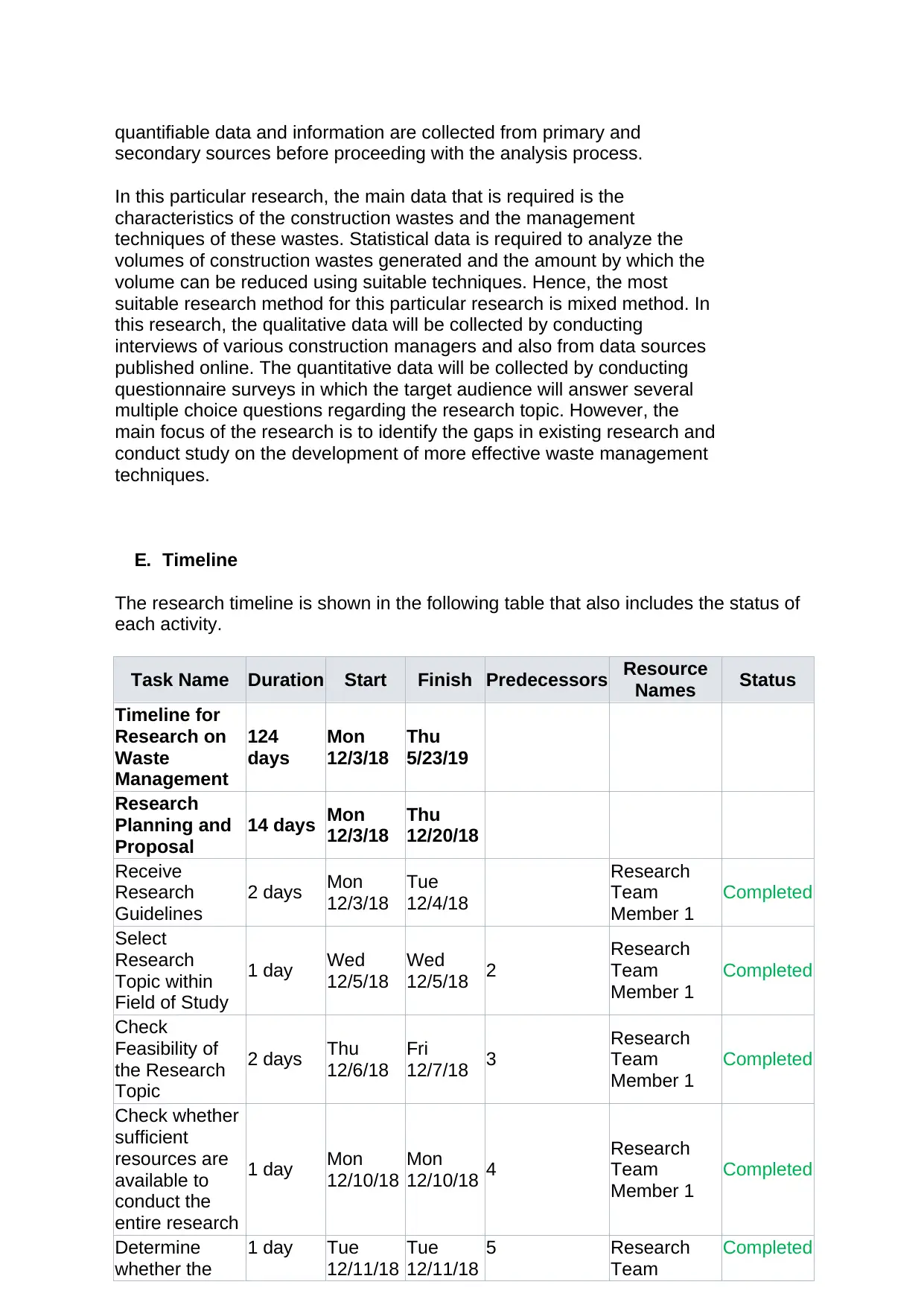
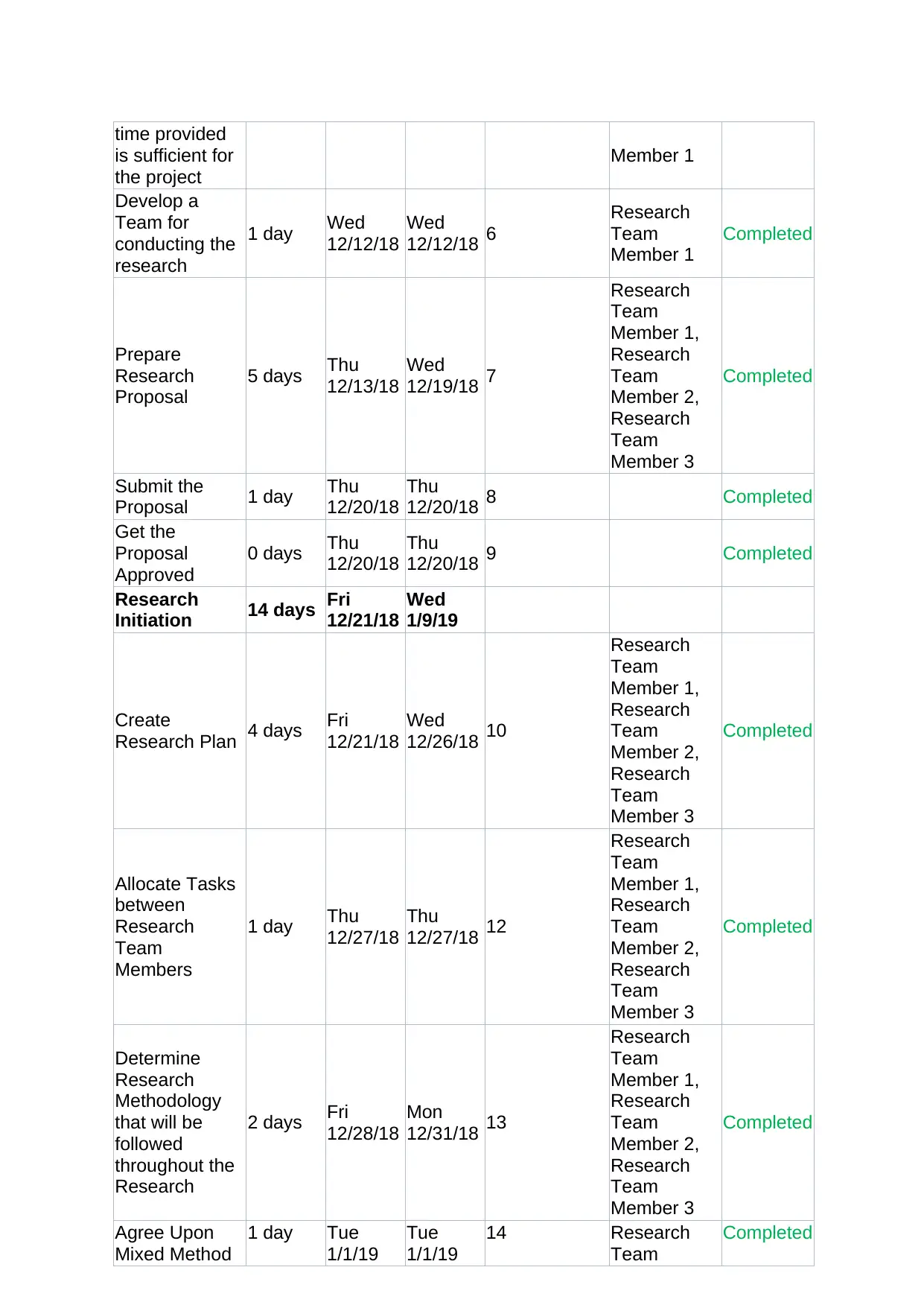
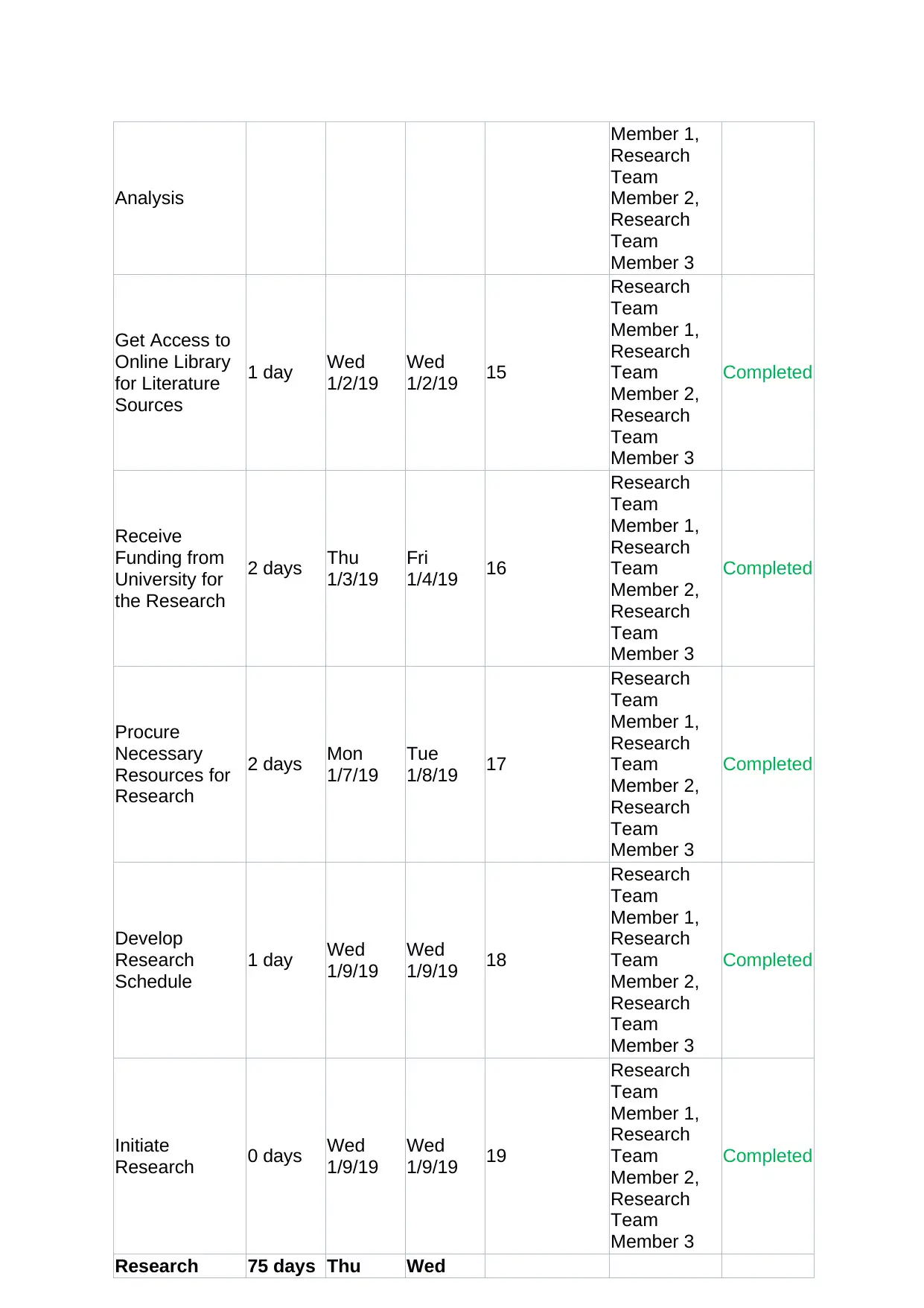
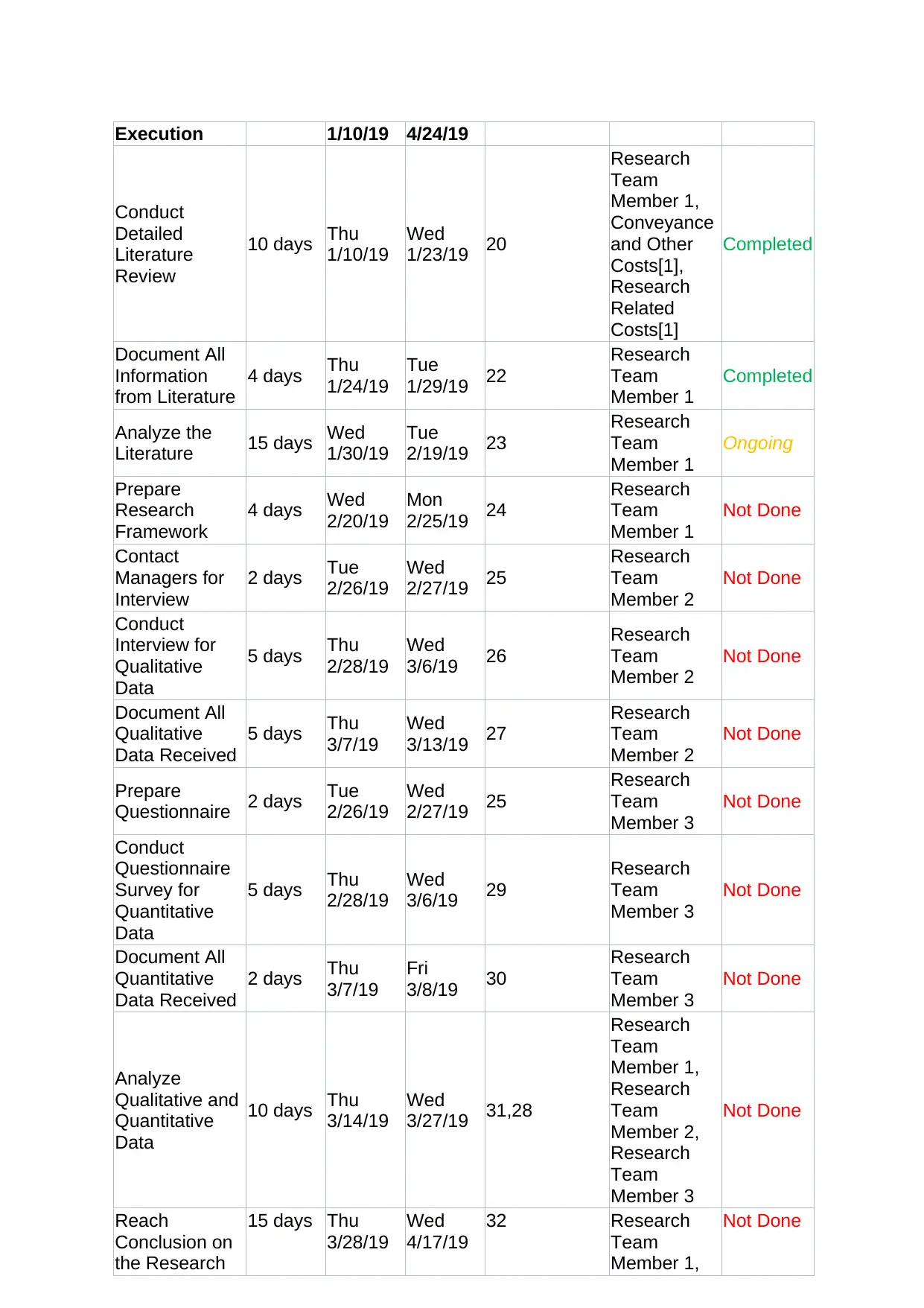
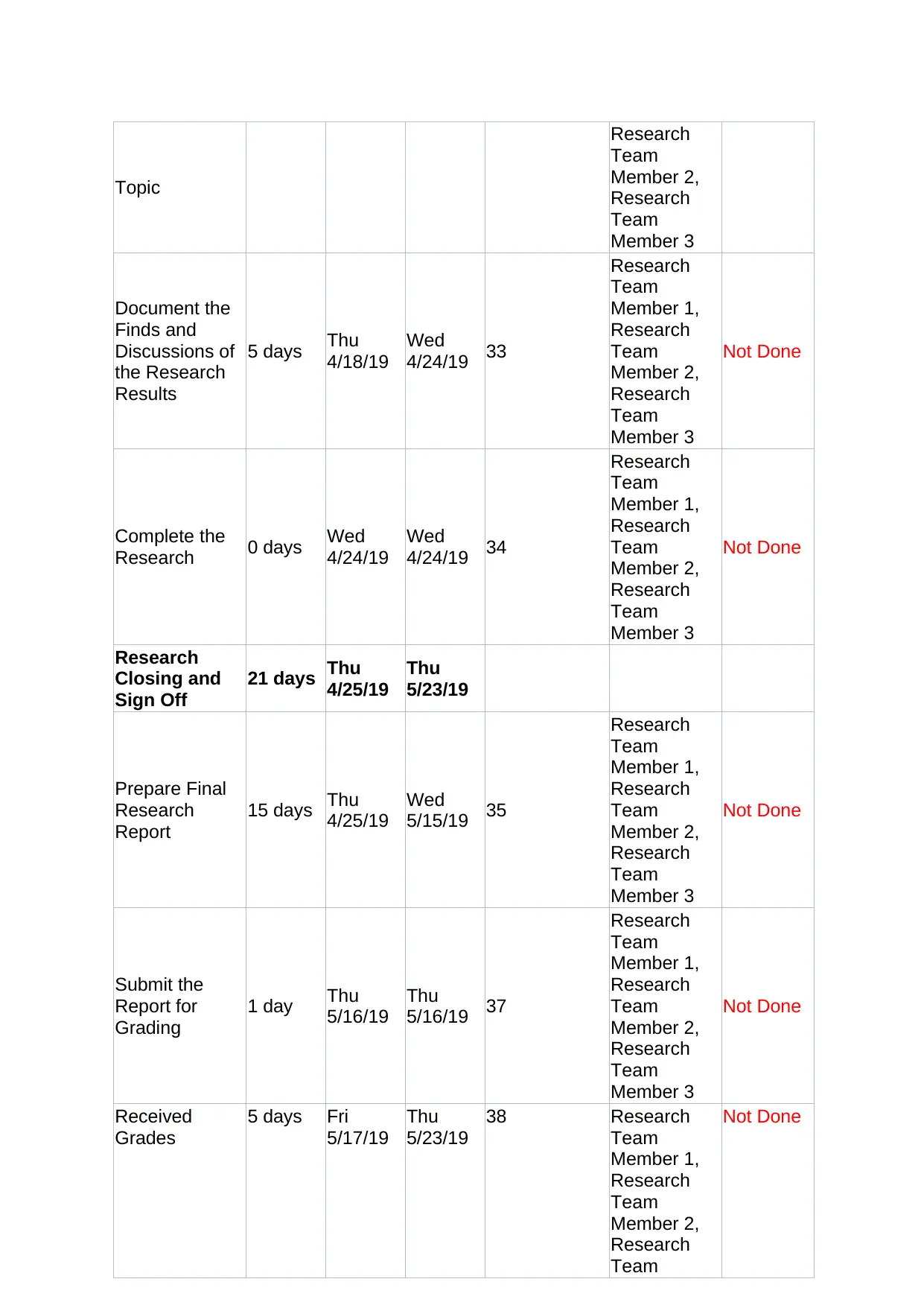
The research timeline is shown in the following table that also includes the status of
each activity.
Task Name Duration Start Finish Predecessors Resource
Names Status
Timeline for
Research on
Waste
Management
124
days
Mon
12/3/18
Thu
5/23/19
Research
Planning and
Proposal
14 days Mon
12/3/18
Thu
12/20/18
Receive
Research
Guidelines
2 days Mon
12/3/18
Tue
12/4/18
Research
Team
Member 1
Completed
Select
Research
Topic within
Field of Study
1 day Wed
12/5/18
Wed
12/5/18 2
Research
Team
Member 1
Completed
Check
Feasibility of
the Research
Topic
2 days Thu
12/6/18
Fri
12/7/18 3
Research
Team
Member 1
Completed
Check whether
sufficient
resources are
available to
conduct the
entire research
1 day Mon
12/10/18
Mon
12/10/18 4
Research
Team
Member 1
Completed
Determine
whether the
1 day Tue
12/11/18
Tue
12/11/18
5 Research
Team
Completed
secondary sources before proceeding with the analysis process.
In this particular research, the main data that is required is the
characteristics of the construction wastes and the management
techniques of these wastes. Statistical data is required to analyze the
volumes of construction wastes generated and the amount by which the
volume can be reduced using suitable techniques. Hence, the most
suitable research method for this particular research is mixed method. In
this research, the qualitative data will be collected by conducting
interviews of various construction managers and also from data sources
published online. The quantitative data will be collected by conducting
questionnaire surveys in which the target audience will answer several
multiple choice questions regarding the research topic. However, the
main focus of the research is to identify the gaps in existing research and
conduct study on the development of more effective waste management
techniques.
E. Timeline
The research timeline is shown in the following table that also includes the status of
each activity.
Task Name Duration Start Finish Predecessors Resource
Names Status
Timeline for
Research on
Waste
Management
124
days
Mon
12/3/18
Thu
5/23/19
Research
Planning and
Proposal
14 days Mon
12/3/18
Thu
12/20/18
Receive
Research
Guidelines
2 days Mon
12/3/18
Tue
12/4/18
Research
Team
Member 1
Completed
Select
Research
Topic within
Field of Study
1 day Wed
12/5/18
Wed
12/5/18 2
Research
Team
Member 1
Completed
Check
Feasibility of
the Research
Topic
2 days Thu
12/6/18
Fri
12/7/18 3
Research
Team
Member 1
Completed
Check whether
sufficient
resources are
available to
conduct the
entire research
1 day Mon
12/10/18
Mon
12/10/18 4
Research
Team
Member 1
Completed
Determine
whether the
1 day Tue
12/11/18
Tue
12/11/18
5 Research
Team
Completed
time provided
is sufficient for
the project
Member 1
Develop a
Team for
conducting the
research
1 day Wed
12/12/18
Wed
12/12/18 6
Research
Team
Member 1
Completed
Prepare
Research
Proposal
5 days Thu
12/13/18
Wed
12/19/18 7
Research
Team
Member 1,
Research
Team
Member 2,
Research
Team
Member 3
Completed
Submit the
Proposal 1 day Thu
12/20/18
Thu
12/20/18 8 Completed
Get the
Proposal
Approved
0 days Thu
12/20/18
Thu
12/20/18 9 Completed
Research
Initiation 14 days Fri
12/21/18
Wed
1/9/19
Create
Research Plan 4 days Fri
12/21/18
Wed
12/26/18 10
Research
Team
Member 1,
Research
Team
Member 2,
Research
Team
Member 3
Completed
Allocate Tasks
between
Research
Team
Members
1 day Thu
12/27/18
Thu
12/27/18 12
Research
Team
Member 1,
Research
Team
Member 2,
Research
Team
Member 3
Completed
Determine
Research
Methodology
that will be
followed
throughout the
Research
2 days Fri
12/28/18
Mon
12/31/18 13
Research
Team
Member 1,
Research
Team
Member 2,
Research
Team
Member 3
Completed
Agree Upon
Mixed Method
1 day Tue
1/1/19
Tue
1/1/19
14 Research
Team
Completed
is sufficient for
the project
Member 1
Develop a
Team for
conducting the
research
1 day Wed
12/12/18
Wed
12/12/18 6
Research
Team
Member 1
Completed
Prepare
Research
Proposal
5 days Thu
12/13/18
Wed
12/19/18 7
Research
Team
Member 1,
Research
Team
Member 2,
Research
Team
Member 3
Completed
Submit the
Proposal 1 day Thu
12/20/18
Thu
12/20/18 8 Completed
Get the
Proposal
Approved
0 days Thu
12/20/18
Thu
12/20/18 9 Completed
Research
Initiation 14 days Fri
12/21/18
Wed
1/9/19
Create
Research Plan 4 days Fri
12/21/18
Wed
12/26/18 10
Research
Team
Member 1,
Research
Team
Member 2,
Research
Team
Member 3
Completed
Allocate Tasks
between
Research
Team
Members
1 day Thu
12/27/18
Thu
12/27/18 12
Research
Team
Member 1,
Research
Team
Member 2,
Research
Team
Member 3
Completed
Determine
Research
Methodology
that will be
followed
throughout the
Research
2 days Fri
12/28/18
Mon
12/31/18 13
Research
Team
Member 1,
Research
Team
Member 2,
Research
Team
Member 3
Completed
Agree Upon
Mixed Method
1 day Tue
1/1/19
Tue
1/1/19
14 Research
Team
Completed
⊘ This is a preview!⊘
Do you want full access?
Subscribe today to unlock all pages.
Trusted by 1+ million students worldwide
Analysis
Member 1,
Research
Team
Member 2,
Research
Team
Member 3
Get Access to
Online Library
for Literature
Sources
1 day Wed
1/2/19
Wed
1/2/19 15
Research
Team
Member 1,
Research
Team
Member 2,
Research
Team
Member 3
Completed
Receive
Funding from
University for
the Research
2 days Thu
1/3/19
Fri
1/4/19 16
Research
Team
Member 1,
Research
Team
Member 2,
Research
Team
Member 3
Completed
Procure
Necessary
Resources for
Research
2 days Mon
1/7/19
Tue
1/8/19 17
Research
Team
Member 1,
Research
Team
Member 2,
Research
Team
Member 3
Completed
Develop
Research
Schedule
1 day Wed
1/9/19
Wed
1/9/19 18
Research
Team
Member 1,
Research
Team
Member 2,
Research
Team
Member 3
Completed
Initiate
Research 0 days Wed
1/9/19
Wed
1/9/19 19
Research
Team
Member 1,
Research
Team
Member 2,
Research
Team
Member 3
Completed
Research 75 days Thu Wed
Member 1,
Research
Team
Member 2,
Research
Team
Member 3
Get Access to
Online Library
for Literature
Sources
1 day Wed
1/2/19
Wed
1/2/19 15
Research
Team
Member 1,
Research
Team
Member 2,
Research
Team
Member 3
Completed
Receive
Funding from
University for
the Research
2 days Thu
1/3/19
Fri
1/4/19 16
Research
Team
Member 1,
Research
Team
Member 2,
Research
Team
Member 3
Completed
Procure
Necessary
Resources for
Research
2 days Mon
1/7/19
Tue
1/8/19 17
Research
Team
Member 1,
Research
Team
Member 2,
Research
Team
Member 3
Completed
Develop
Research
Schedule
1 day Wed
1/9/19
Wed
1/9/19 18
Research
Team
Member 1,
Research
Team
Member 2,
Research
Team
Member 3
Completed
Initiate
Research 0 days Wed
1/9/19
Wed
1/9/19 19
Research
Team
Member 1,
Research
Team
Member 2,
Research
Team
Member 3
Completed
Research 75 days Thu Wed
Paraphrase This Document
Need a fresh take? Get an instant paraphrase of this document with our AI Paraphraser
Execution 1/10/19 4/24/19
Conduct
Detailed
Literature
Review
10 days Thu
1/10/19
Wed
1/23/19 20
Research
Team
Member 1,
Conveyance
and Other
Costs[1],
Research
Related
Costs[1]
Completed
Document All
Information
from Literature
4 days Thu
1/24/19
Tue
1/29/19 22
Research
Team
Member 1
Completed
Analyze the
Literature 15 days Wed
1/30/19
Tue
2/19/19 23
Research
Team
Member 1
Ongoing
Prepare
Research
Framework
4 days Wed
2/20/19
Mon
2/25/19 24
Research
Team
Member 1
Not Done
Contact
Managers for
Interview
2 days Tue
2/26/19
Wed
2/27/19 25
Research
Team
Member 2
Not Done
Conduct
Interview for
Qualitative
Data
5 days Thu
2/28/19
Wed
3/6/19 26
Research
Team
Member 2
Not Done
Document All
Qualitative
Data Received
5 days Thu
3/7/19
Wed
3/13/19 27
Research
Team
Member 2
Not Done
Prepare
Questionnaire 2 days Tue
2/26/19
Wed
2/27/19 25
Research
Team
Member 3
Not Done
Conduct
Questionnaire
Survey for
Quantitative
Data
5 days Thu
2/28/19
Wed
3/6/19 29
Research
Team
Member 3
Not Done
Document All
Quantitative
Data Received
2 days Thu
3/7/19
Fri
3/8/19 30
Research
Team
Member 3
Not Done
Analyze
Qualitative and
Quantitative
Data
10 days Thu
3/14/19
Wed
3/27/19 31,28
Research
Team
Member 1,
Research
Team
Member 2,
Research
Team
Member 3
Not Done
Reach
Conclusion on
the Research
15 days Thu
3/28/19
Wed
4/17/19
32 Research
Team
Member 1,
Not Done
Conduct
Detailed
Literature
Review
10 days Thu
1/10/19
Wed
1/23/19 20
Research
Team
Member 1,
Conveyance
and Other
Costs[1],
Research
Related
Costs[1]
Completed
Document All
Information
from Literature
4 days Thu
1/24/19
Tue
1/29/19 22
Research
Team
Member 1
Completed
Analyze the
Literature 15 days Wed
1/30/19
Tue
2/19/19 23
Research
Team
Member 1
Ongoing
Prepare
Research
Framework
4 days Wed
2/20/19
Mon
2/25/19 24
Research
Team
Member 1
Not Done
Contact
Managers for
Interview
2 days Tue
2/26/19
Wed
2/27/19 25
Research
Team
Member 2
Not Done
Conduct
Interview for
Qualitative
Data
5 days Thu
2/28/19
Wed
3/6/19 26
Research
Team
Member 2
Not Done
Document All
Qualitative
Data Received
5 days Thu
3/7/19
Wed
3/13/19 27
Research
Team
Member 2
Not Done
Prepare
Questionnaire 2 days Tue
2/26/19
Wed
2/27/19 25
Research
Team
Member 3
Not Done
Conduct
Questionnaire
Survey for
Quantitative
Data
5 days Thu
2/28/19
Wed
3/6/19 29
Research
Team
Member 3
Not Done
Document All
Quantitative
Data Received
2 days Thu
3/7/19
Fri
3/8/19 30
Research
Team
Member 3
Not Done
Analyze
Qualitative and
Quantitative
Data
10 days Thu
3/14/19
Wed
3/27/19 31,28
Research
Team
Member 1,
Research
Team
Member 2,
Research
Team
Member 3
Not Done
Reach
Conclusion on
the Research
15 days Thu
3/28/19
Wed
4/17/19
32 Research
Team
Member 1,
Not Done
Topic
Research
Team
Member 2,
Research
Team
Member 3
Document the
Finds and
Discussions of
the Research
Results
5 days Thu
4/18/19
Wed
4/24/19 33
Research
Team
Member 1,
Research
Team
Member 2,
Research
Team
Member 3
Not Done
Complete the
Research 0 days Wed
4/24/19
Wed
4/24/19 34
Research
Team
Member 1,
Research
Team
Member 2,
Research
Team
Member 3
Not Done
Research
Closing and
Sign Off
21 days Thu
4/25/19
Thu
5/23/19
Prepare Final
Research
Report
15 days Thu
4/25/19
Wed
5/15/19 35
Research
Team
Member 1,
Research
Team
Member 2,
Research
Team
Member 3
Not Done
Submit the
Report for
Grading
1 day Thu
5/16/19
Thu
5/16/19 37
Research
Team
Member 1,
Research
Team
Member 2,
Research
Team
Member 3
Not Done
Received
Grades
5 days Fri
5/17/19
Thu
5/23/19
38 Research
Team
Member 1,
Research
Team
Member 2,
Research
Team
Not Done
Research
Team
Member 2,
Research
Team
Member 3
Document the
Finds and
Discussions of
the Research
Results
5 days Thu
4/18/19
Wed
4/24/19 33
Research
Team
Member 1,
Research
Team
Member 2,
Research
Team
Member 3
Not Done
Complete the
Research 0 days Wed
4/24/19
Wed
4/24/19 34
Research
Team
Member 1,
Research
Team
Member 2,
Research
Team
Member 3
Not Done
Research
Closing and
Sign Off
21 days Thu
4/25/19
Thu
5/23/19
Prepare Final
Research
Report
15 days Thu
4/25/19
Wed
5/15/19 35
Research
Team
Member 1,
Research
Team
Member 2,
Research
Team
Member 3
Not Done
Submit the
Report for
Grading
1 day Thu
5/16/19
Thu
5/16/19 37
Research
Team
Member 1,
Research
Team
Member 2,
Research
Team
Member 3
Not Done
Received
Grades
5 days Fri
5/17/19
Thu
5/23/19
38 Research
Team
Member 1,
Research
Team
Member 2,
Research
Team
Not Done
⊘ This is a preview!⊘
Do you want full access?
Subscribe today to unlock all pages.
Trusted by 1+ million students worldwide
Member 3
Sign Off and
Closing 0 days Thu
5/23/19
Thu
5/23/19 39
Research
Team
Member 1,
Research
Team
Member 2,
Research
Team
Member 3
Not Done
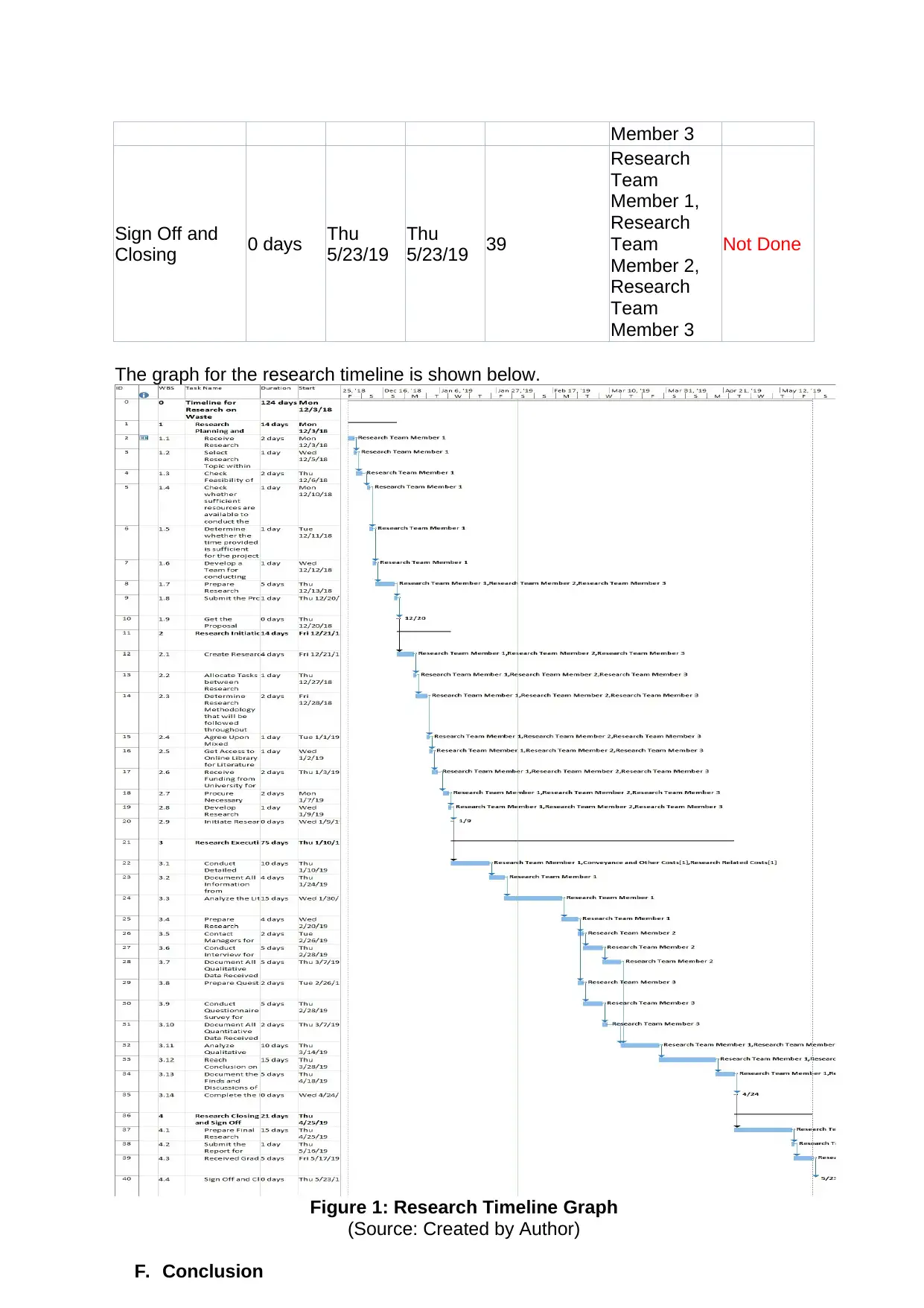
The graph for the research timeline is shown below.
Figure 1: Research Timeline Graph
(Source: Created by Author)
F. Conclusion
Sign Off and
Closing 0 days Thu
5/23/19
Thu
5/23/19 39
Research
Team
Member 1,
Research
Team
Member 2,
Research
Team
Member 3
Not Done
The graph for the research timeline is shown below.
Figure 1: Research Timeline Graph
(Source: Created by Author)
F. Conclusion
Paraphrase This Document
Need a fresh take? Get an instant paraphrase of this document with our AI Paraphraser
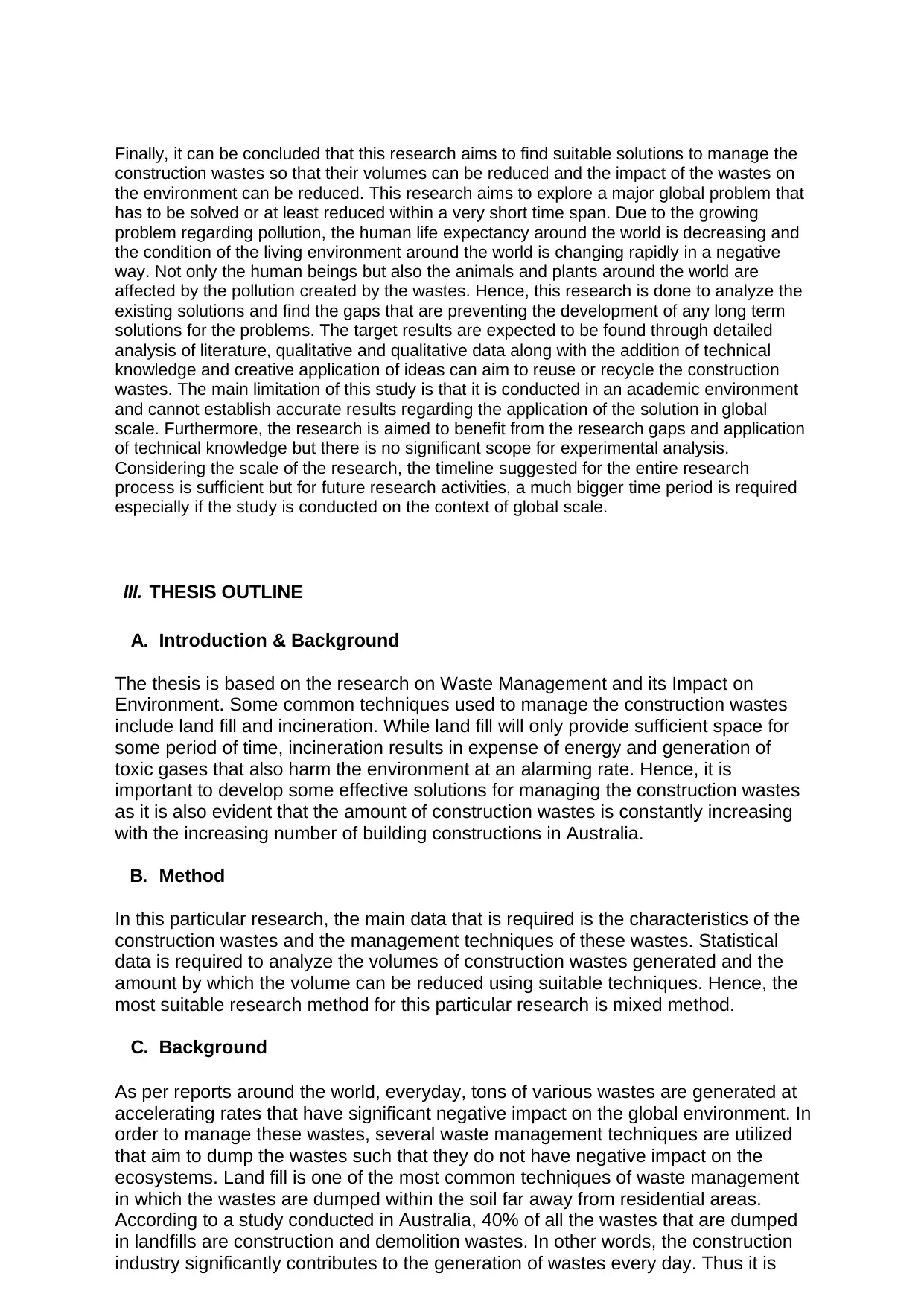
Finally, it can be concluded that this research aims to find suitable solutions to manage the
construction wastes so that their volumes can be reduced and the impact of the wastes on
the environment can be reduced. This research aims to explore a major global problem that
has to be solved or at least reduced within a very short time span. Due to the growing
problem regarding pollution, the human life expectancy around the world is decreasing and
the condition of the living environment around the world is changing rapidly in a negative
way. Not only the human beings but also the animals and plants around the world are
affected by the pollution created by the wastes. Hence, this research is done to analyze the
existing solutions and find the gaps that are preventing the development of any long term
solutions for the problems. The target results are expected to be found through detailed
analysis of literature, qualitative and qualitative data along with the addition of technical
knowledge and creative application of ideas can aim to reuse or recycle the construction
wastes. The main limitation of this study is that it is conducted in an academic environment
and cannot establish accurate results regarding the application of the solution in global
scale. Furthermore, the research is aimed to benefit from the research gaps and application
of technical knowledge but there is no significant scope for experimental analysis.
Considering the scale of the research, the timeline suggested for the entire research
process is sufficient but for future research activities, a much bigger time period is required
especially if the study is conducted on the context of global scale.
III. THESIS OUTLINE
A. Introduction & Background
The thesis is based on the research on Waste Management and its Impact on
Environment. Some common techniques used to manage the construction wastes
include land fill and incineration. While land fill will only provide sufficient space for
some period of time, incineration results in expense of energy and generation of
toxic gases that also harm the environment at an alarming rate. Hence, it is
important to develop some effective solutions for managing the construction wastes
as it is also evident that the amount of construction wastes is constantly increasing
with the increasing number of building constructions in Australia.
B. Method
In this particular research, the main data that is required is the characteristics of the
construction wastes and the management techniques of these wastes. Statistical
data is required to analyze the volumes of construction wastes generated and the
amount by which the volume can be reduced using suitable techniques. Hence, the
most suitable research method for this particular research is mixed method.
C. Background
As per reports around the world, everyday, tons of various wastes are generated at
accelerating rates that have significant negative impact on the global environment. In
order to manage these wastes, several waste management techniques are utilized
that aim to dump the wastes such that they do not have negative impact on the
ecosystems. Land fill is one of the most common techniques of waste management
in which the wastes are dumped within the soil far away from residential areas.
According to a study conducted in Australia, 40% of all the wastes that are dumped
in landfills are construction and demolition wastes. In other words, the construction
industry significantly contributes to the generation of wastes every day. Thus it is
construction wastes so that their volumes can be reduced and the impact of the wastes on
the environment can be reduced. This research aims to explore a major global problem that
has to be solved or at least reduced within a very short time span. Due to the growing
problem regarding pollution, the human life expectancy around the world is decreasing and
the condition of the living environment around the world is changing rapidly in a negative
way. Not only the human beings but also the animals and plants around the world are
affected by the pollution created by the wastes. Hence, this research is done to analyze the
existing solutions and find the gaps that are preventing the development of any long term
solutions for the problems. The target results are expected to be found through detailed
analysis of literature, qualitative and qualitative data along with the addition of technical
knowledge and creative application of ideas can aim to reuse or recycle the construction
wastes. The main limitation of this study is that it is conducted in an academic environment
and cannot establish accurate results regarding the application of the solution in global
scale. Furthermore, the research is aimed to benefit from the research gaps and application
of technical knowledge but there is no significant scope for experimental analysis.
Considering the scale of the research, the timeline suggested for the entire research
process is sufficient but for future research activities, a much bigger time period is required
especially if the study is conducted on the context of global scale.
III. THESIS OUTLINE
A. Introduction & Background
The thesis is based on the research on Waste Management and its Impact on
Environment. Some common techniques used to manage the construction wastes
include land fill and incineration. While land fill will only provide sufficient space for
some period of time, incineration results in expense of energy and generation of
toxic gases that also harm the environment at an alarming rate. Hence, it is
important to develop some effective solutions for managing the construction wastes
as it is also evident that the amount of construction wastes is constantly increasing
with the increasing number of building constructions in Australia.
B. Method
In this particular research, the main data that is required is the characteristics of the
construction wastes and the management techniques of these wastes. Statistical
data is required to analyze the volumes of construction wastes generated and the
amount by which the volume can be reduced using suitable techniques. Hence, the
most suitable research method for this particular research is mixed method.
C. Background
As per reports around the world, everyday, tons of various wastes are generated at
accelerating rates that have significant negative impact on the global environment. In
order to manage these wastes, several waste management techniques are utilized
that aim to dump the wastes such that they do not have negative impact on the
ecosystems. Land fill is one of the most common techniques of waste management
in which the wastes are dumped within the soil far away from residential areas.
According to a study conducted in Australia, 40% of all the wastes that are dumped
in landfills are construction and demolition wastes. In other words, the construction
industry significantly contributes to the generation of wastes every day. Thus it is
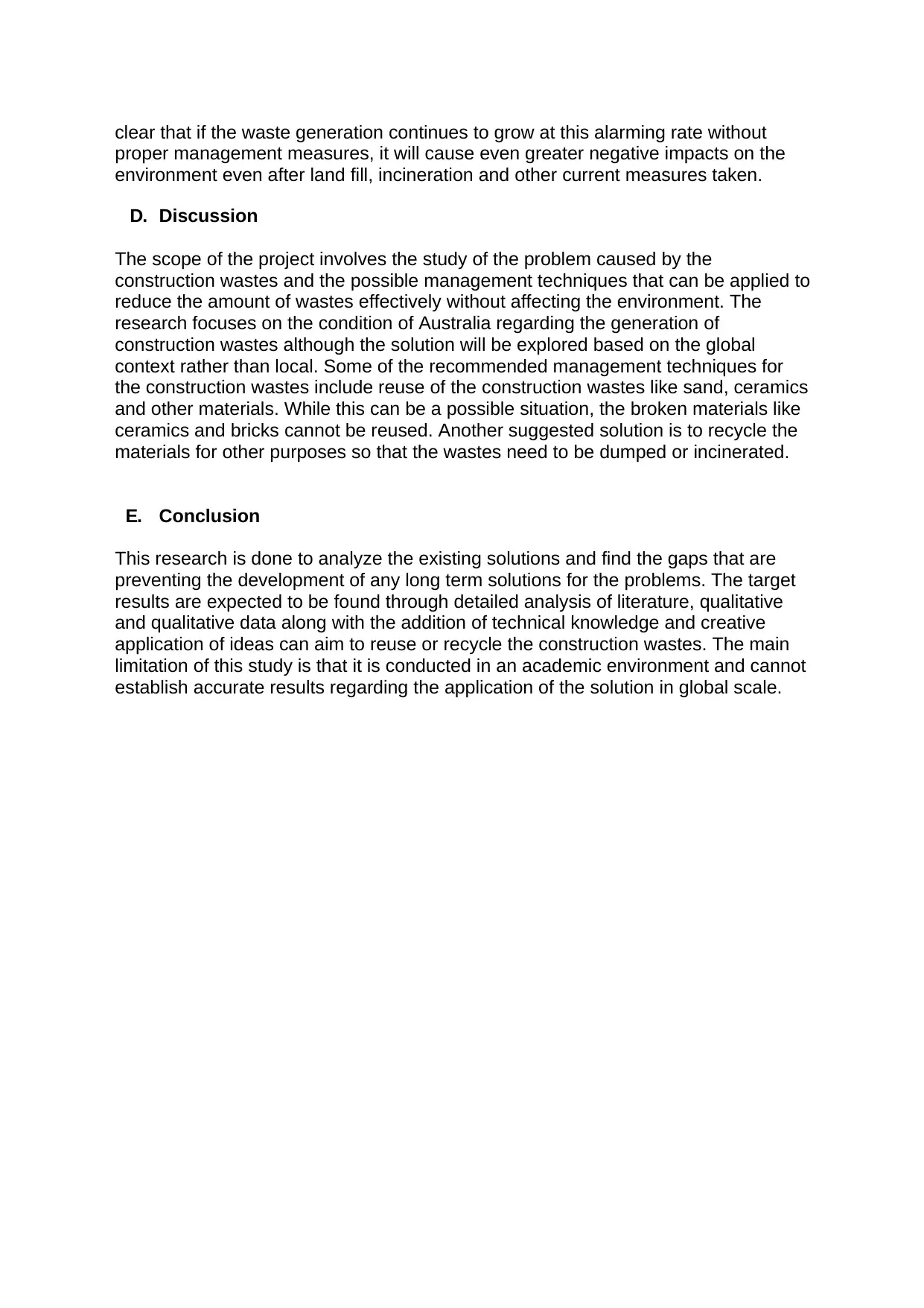
clear that if the waste generation continues to grow at this alarming rate without
proper management measures, it will cause even greater negative impacts on the
environment even after land fill, incineration and other current measures taken.
D. Discussion
The scope of the project involves the study of the problem caused by the
construction wastes and the possible management techniques that can be applied to
reduce the amount of wastes effectively without affecting the environment. The
research focuses on the condition of Australia regarding the generation of
construction wastes although the solution will be explored based on the global
context rather than local. Some of the recommended management techniques for
the construction wastes include reuse of the construction wastes like sand, ceramics
and other materials. While this can be a possible situation, the broken materials like
ceramics and bricks cannot be reused. Another suggested solution is to recycle the
materials for other purposes so that the wastes need to be dumped or incinerated.
E. Conclusion
This research is done to analyze the existing solutions and find the gaps that are
preventing the development of any long term solutions for the problems. The target
results are expected to be found through detailed analysis of literature, qualitative
and qualitative data along with the addition of technical knowledge and creative
application of ideas can aim to reuse or recycle the construction wastes. The main
limitation of this study is that it is conducted in an academic environment and cannot
establish accurate results regarding the application of the solution in global scale.
proper management measures, it will cause even greater negative impacts on the
environment even after land fill, incineration and other current measures taken.
D. Discussion
The scope of the project involves the study of the problem caused by the
construction wastes and the possible management techniques that can be applied to
reduce the amount of wastes effectively without affecting the environment. The
research focuses on the condition of Australia regarding the generation of
construction wastes although the solution will be explored based on the global
context rather than local. Some of the recommended management techniques for
the construction wastes include reuse of the construction wastes like sand, ceramics
and other materials. While this can be a possible situation, the broken materials like
ceramics and bricks cannot be reused. Another suggested solution is to recycle the
materials for other purposes so that the wastes need to be dumped or incinerated.
E. Conclusion
This research is done to analyze the existing solutions and find the gaps that are
preventing the development of any long term solutions for the problems. The target
results are expected to be found through detailed analysis of literature, qualitative
and qualitative data along with the addition of technical knowledge and creative
application of ideas can aim to reuse or recycle the construction wastes. The main
limitation of this study is that it is conducted in an academic environment and cannot
establish accurate results regarding the application of the solution in global scale.
⊘ This is a preview!⊘
Do you want full access?
Subscribe today to unlock all pages.
Trusted by 1+ million students worldwide

1 out of 14


Related Documents


Your All-in-One AI-Powered Toolkit for Academic Success.
+13062052269
info@desklib.com
Available 24*7 on WhatsApp / Email
![[object Object]](/_next/static/media/star-bottom.7253800d.svg)
Unlock your academic potential
Copyright © 2020–2026 A2Z Services. All Rights Reserved. Developed and managed by ZUCOL.