Strategic Planning and Implementation for Waste Management in Malaysia
VerifiedAdded on 2020/05/11
|9
|1883
|63
Report
AI Summary
This report provides a detailed analysis of waste management strategies, focusing on the Malaysian context. It emphasizes the importance of public awareness, recycling programs, and the utilization of digital platforms to promote waste reduction. The report outlines various strategies, including maximizing recycling services, utilizing modern waste treatment facilities, and implementing kerbside collections. It also highlights the role of education, government initiatives, and digital campaigning in creating awareness. The implementation section delves into the challenges of changing public attitudes and the use of broadcast and social media to educate and engage the public. Furthermore, the report stresses the significance of on-ground campaigns, government support, and the promotion of waste reuse. A research timetable is included to illustrate the stages of data collection, industry environment analysis, strategy development, and evaluation. The report concludes by emphasizing the social, economic, and environmental benefits of effective waste management.
Running head: WASTE MANAGEMENT
WASTE MANAGEMENT
Name of the Student:
Name of the University:
Author Note:
WASTE MANAGEMENT
Name of the Student:
Name of the University:
Author Note:
Paraphrase This Document
Need a fresh take? Get an instant paraphrase of this document with our AI Paraphraser

1WASTE MANAGEMENT
Strategic planning:
On round campaign:
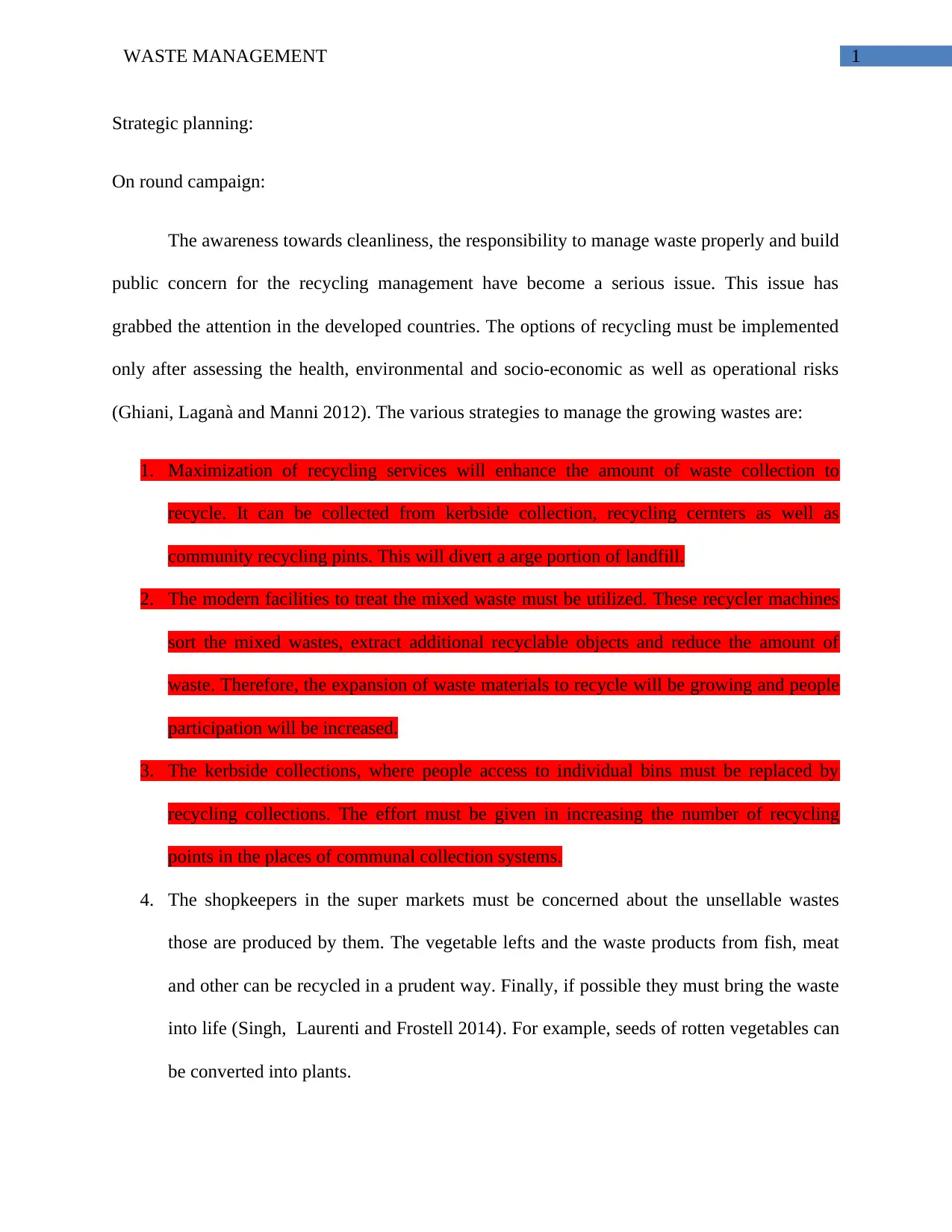
The awareness towards cleanliness, the responsibility to manage waste properly and build
public concern for the recycling management have become a serious issue. This issue has
grabbed the attention in the developed countries. The options of recycling must be implemented
only after assessing the health, environmental and socio-economic as well as operational risks
(Ghiani, Laganà and Manni 2012). The various strategies to manage the growing wastes are:
1. Maximization of recycling services will enhance the amount of waste collection to
recycle. It can be collected from kerbside collection, recycling cernters as well as
community recycling pints. This will divert a arge portion of landfill.
2. The modern facilities to treat the mixed waste must be utilized. These recycler machines
sort the mixed wastes, extract additional recyclable objects and reduce the amount of
waste. Therefore, the expansion of waste materials to recycle will be growing and people
participation will be increased.
3. The kerbside collections, where people access to individual bins must be replaced by
recycling collections. The effort must be given in increasing the number of recycling
points in the places of communal collection systems.
4. The shopkeepers in the super markets must be concerned about the unsellable wastes
those are produced by them. The vegetable lefts and the waste products from fish, meat
and other can be recycled in a prudent way. Finally, if possible they must bring the waste
into life (Singh, Laurenti and Frostell 2014). For example, seeds of rotten vegetables can
be converted into plants.
Strategic planning:
On round campaign:
The awareness towards cleanliness, the responsibility to manage waste properly and build
public concern for the recycling management have become a serious issue. This issue has
grabbed the attention in the developed countries. The options of recycling must be implemented
only after assessing the health, environmental and socio-economic as well as operational risks
(Ghiani, Laganà and Manni 2012). The various strategies to manage the growing wastes are:
1. Maximization of recycling services will enhance the amount of waste collection to
recycle. It can be collected from kerbside collection, recycling cernters as well as
community recycling pints. This will divert a arge portion of landfill.
2. The modern facilities to treat the mixed waste must be utilized. These recycler machines
sort the mixed wastes, extract additional recyclable objects and reduce the amount of
waste. Therefore, the expansion of waste materials to recycle will be growing and people
participation will be increased.
3. The kerbside collections, where people access to individual bins must be replaced by
recycling collections. The effort must be given in increasing the number of recycling
points in the places of communal collection systems.
4. The shopkeepers in the super markets must be concerned about the unsellable wastes
those are produced by them. The vegetable lefts and the waste products from fish, meat
and other can be recycled in a prudent way. Finally, if possible they must bring the waste
into life (Singh, Laurenti and Frostell 2014). For example, seeds of rotten vegetables can
be converted into plants.

2WASTE MANAGEMENT
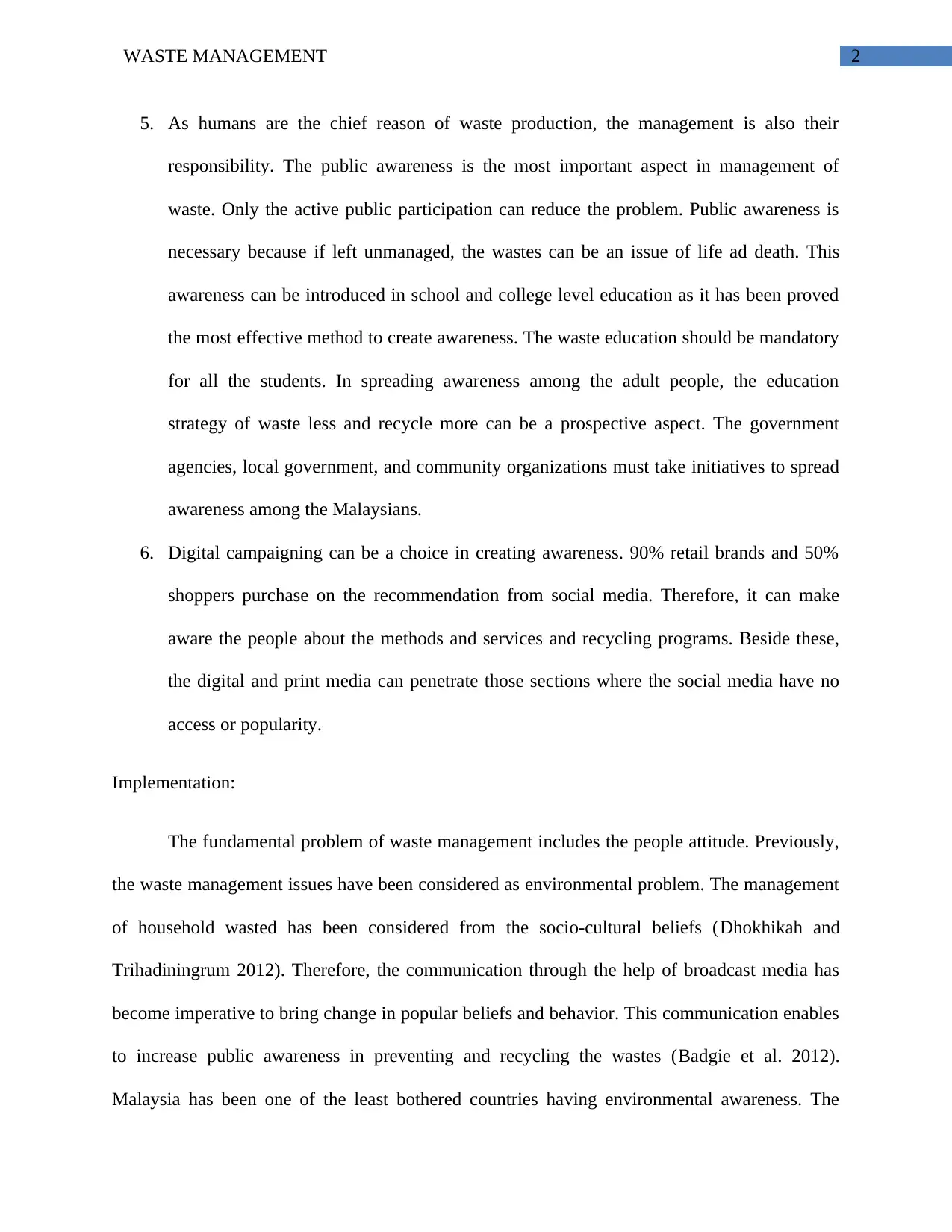
5. As humans are the chief reason of waste production, the management is also their
responsibility. The public awareness is the most important aspect in management of
waste. Only the active public participation can reduce the problem. Public awareness is
necessary because if left unmanaged, the wastes can be an issue of life ad death. This
awareness can be introduced in school and college level education as it has been proved
the most effective method to create awareness. The waste education should be mandatory
for all the students. In spreading awareness among the adult people, the education
strategy of waste less and recycle more can be a prospective aspect. The government
agencies, local government, and community organizations must take initiatives to spread
awareness among the Malaysians.
6. Digital campaigning can be a choice in creating awareness. 90% retail brands and 50%
shoppers purchase on the recommendation from social media. Therefore, it can make
aware the people about the methods and services and recycling programs. Beside these,
the digital and print media can penetrate those sections where the social media have no
access or popularity.
Implementation:
The fundamental problem of waste management includes the people attitude. Previously,
the waste management issues have been considered as environmental problem. The management
of household wasted has been considered from the socio-cultural beliefs (Dhokhikah and
Trihadiningrum 2012). Therefore, the communication through the help of broadcast media has
become imperative to bring change in popular beliefs and behavior. This communication enables
to increase public awareness in preventing and recycling the wastes (Badgie et al. 2012).
Malaysia has been one of the least bothered countries having environmental awareness. The
5. As humans are the chief reason of waste production, the management is also their
responsibility. The public awareness is the most important aspect in management of
waste. Only the active public participation can reduce the problem. Public awareness is
necessary because if left unmanaged, the wastes can be an issue of life ad death. This
awareness can be introduced in school and college level education as it has been proved
the most effective method to create awareness. The waste education should be mandatory
for all the students. In spreading awareness among the adult people, the education
strategy of waste less and recycle more can be a prospective aspect. The government
agencies, local government, and community organizations must take initiatives to spread
awareness among the Malaysians.
6. Digital campaigning can be a choice in creating awareness. 90% retail brands and 50%
shoppers purchase on the recommendation from social media. Therefore, it can make
aware the people about the methods and services and recycling programs. Beside these,
the digital and print media can penetrate those sections where the social media have no
access or popularity.
Implementation:
The fundamental problem of waste management includes the people attitude. Previously,
the waste management issues have been considered as environmental problem. The management
of household wasted has been considered from the socio-cultural beliefs (Dhokhikah and
Trihadiningrum 2012). Therefore, the communication through the help of broadcast media has
become imperative to bring change in popular beliefs and behavior. This communication enables
to increase public awareness in preventing and recycling the wastes (Badgie et al. 2012).
Malaysia has been one of the least bothered countries having environmental awareness. The
⊘ This is a preview!⊘
Do you want full access?
Subscribe today to unlock all pages.

Trusted by 1+ million students worldwide

3WASTE MANAGEMENT
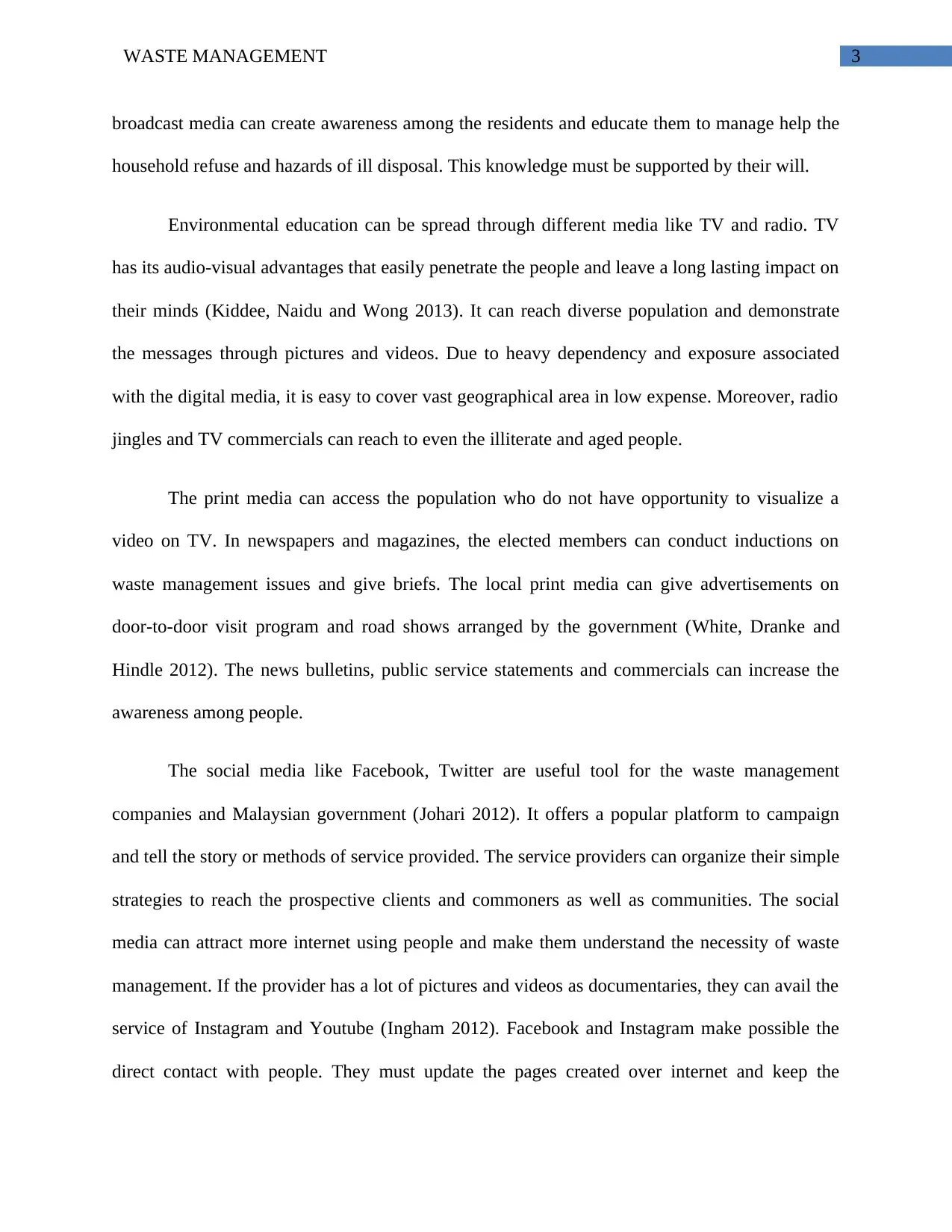
broadcast media can create awareness among the residents and educate them to manage help the
household refuse and hazards of ill disposal. This knowledge must be supported by their will.
Environmental education can be spread through different media like TV and radio. TV
has its audio-visual advantages that easily penetrate the people and leave a long lasting impact on
their minds (Kiddee, Naidu and Wong 2013). It can reach diverse population and demonstrate
the messages through pictures and videos. Due to heavy dependency and exposure associated
with the digital media, it is easy to cover vast geographical area in low expense. Moreover, radio
jingles and TV commercials can reach to even the illiterate and aged people.
The print media can access the population who do not have opportunity to visualize a
video on TV. In newspapers and magazines, the elected members can conduct inductions on
waste management issues and give briefs. The local print media can give advertisements on
door-to-door visit program and road shows arranged by the government (White, Dranke and
Hindle 2012). The news bulletins, public service statements and commercials can increase the
awareness among people.
The social media like Facebook, Twitter are useful tool for the waste management
companies and Malaysian government (Johari 2012). It offers a popular platform to campaign
and tell the story or methods of service provided. The service providers can organize their simple
strategies to reach the prospective clients and commoners as well as communities. The social
media can attract more internet using people and make them understand the necessity of waste
management. If the provider has a lot of pictures and videos as documentaries, they can avail the
service of Instagram and Youtube (Ingham 2012). Facebook and Instagram make possible the
direct contact with people. They must update the pages created over internet and keep the
broadcast media can create awareness among the residents and educate them to manage help the
household refuse and hazards of ill disposal. This knowledge must be supported by their will.
Environmental education can be spread through different media like TV and radio. TV
has its audio-visual advantages that easily penetrate the people and leave a long lasting impact on
their minds (Kiddee, Naidu and Wong 2013). It can reach diverse population and demonstrate
the messages through pictures and videos. Due to heavy dependency and exposure associated
with the digital media, it is easy to cover vast geographical area in low expense. Moreover, radio
jingles and TV commercials can reach to even the illiterate and aged people.
The print media can access the population who do not have opportunity to visualize a
video on TV. In newspapers and magazines, the elected members can conduct inductions on
waste management issues and give briefs. The local print media can give advertisements on
door-to-door visit program and road shows arranged by the government (White, Dranke and
Hindle 2012). The news bulletins, public service statements and commercials can increase the
awareness among people.
The social media like Facebook, Twitter are useful tool for the waste management
companies and Malaysian government (Johari 2012). It offers a popular platform to campaign
and tell the story or methods of service provided. The service providers can organize their simple
strategies to reach the prospective clients and commoners as well as communities. The social
media can attract more internet using people and make them understand the necessity of waste
management. If the provider has a lot of pictures and videos as documentaries, they can avail the
service of Instagram and Youtube (Ingham 2012). Facebook and Instagram make possible the
direct contact with people. They must update the pages created over internet and keep the
Paraphrase This Document
Need a fresh take? Get an instant paraphrase of this document with our AI Paraphraser

4WASTE MANAGEMENT
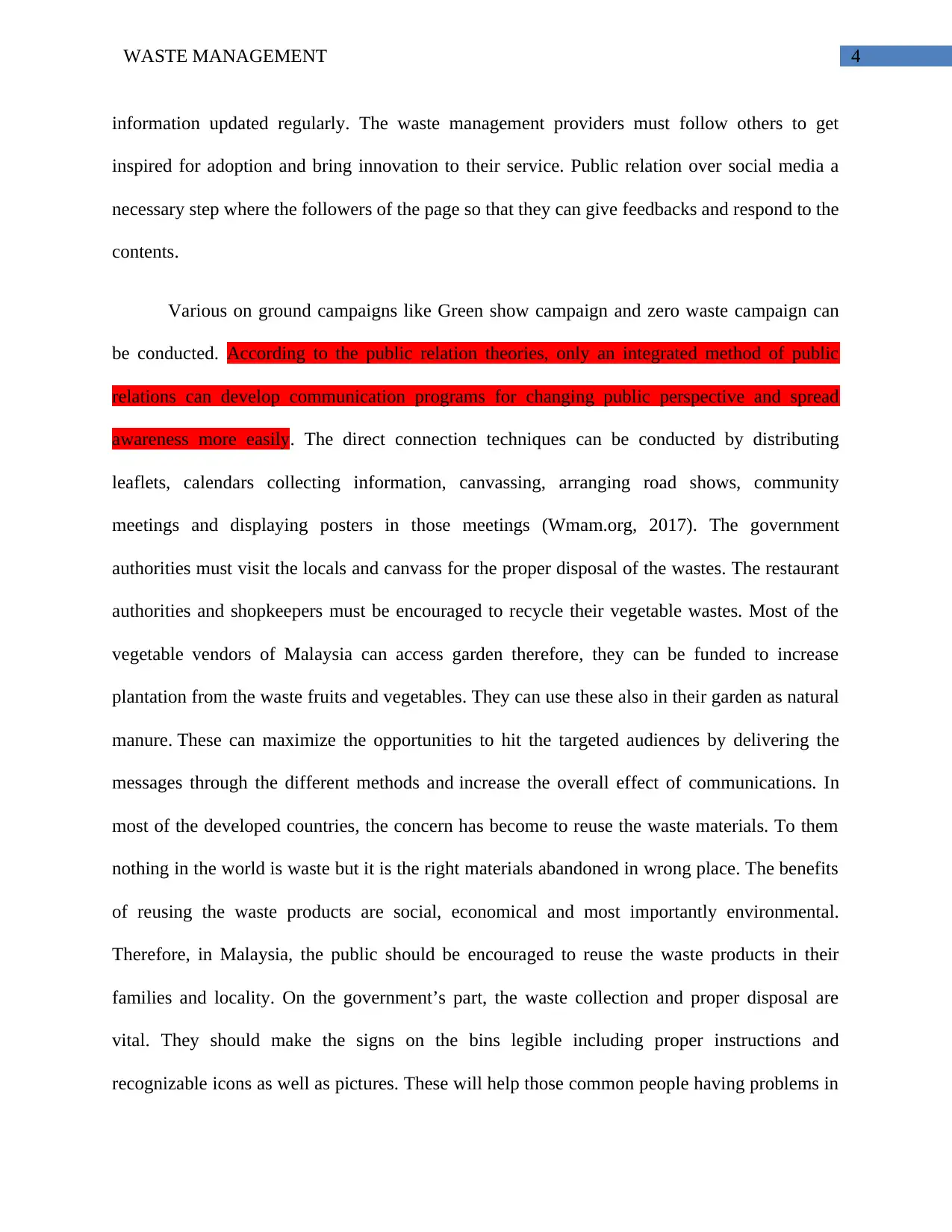
information updated regularly. The waste management providers must follow others to get
inspired for adoption and bring innovation to their service. Public relation over social media a
necessary step where the followers of the page so that they can give feedbacks and respond to the
contents.
Various on ground campaigns like Green show campaign and zero waste campaign can
be conducted. According to the public relation theories, only an integrated method of public
relations can develop communication programs for changing public perspective and spread
awareness more easily. The direct connection techniques can be conducted by distributing
leaflets, calendars collecting information, canvassing, arranging road shows, community
meetings and displaying posters in those meetings (Wmam.org, 2017). The government
authorities must visit the locals and canvass for the proper disposal of the wastes. The restaurant
authorities and shopkeepers must be encouraged to recycle their vegetable wastes. Most of the
vegetable vendors of Malaysia can access garden therefore, they can be funded to increase
plantation from the waste fruits and vegetables. They can use these also in their garden as natural
manure. These can maximize the opportunities to hit the targeted audiences by delivering the
messages through the different methods and increase the overall effect of communications. In
most of the developed countries, the concern has become to reuse the waste materials. To them
nothing in the world is waste but it is the right materials abandoned in wrong place. The benefits
of reusing the waste products are social, economical and most importantly environmental.
Therefore, in Malaysia, the public should be encouraged to reuse the waste products in their
families and locality. On the government’s part, the waste collection and proper disposal are
vital. They should make the signs on the bins legible including proper instructions and
recognizable icons as well as pictures. These will help those common people having problems in
information updated regularly. The waste management providers must follow others to get
inspired for adoption and bring innovation to their service. Public relation over social media a
necessary step where the followers of the page so that they can give feedbacks and respond to the
contents.
Various on ground campaigns like Green show campaign and zero waste campaign can
be conducted. According to the public relation theories, only an integrated method of public
relations can develop communication programs for changing public perspective and spread
awareness more easily. The direct connection techniques can be conducted by distributing
leaflets, calendars collecting information, canvassing, arranging road shows, community
meetings and displaying posters in those meetings (Wmam.org, 2017). The government
authorities must visit the locals and canvass for the proper disposal of the wastes. The restaurant
authorities and shopkeepers must be encouraged to recycle their vegetable wastes. Most of the
vegetable vendors of Malaysia can access garden therefore, they can be funded to increase
plantation from the waste fruits and vegetables. They can use these also in their garden as natural
manure. These can maximize the opportunities to hit the targeted audiences by delivering the
messages through the different methods and increase the overall effect of communications. In
most of the developed countries, the concern has become to reuse the waste materials. To them
nothing in the world is waste but it is the right materials abandoned in wrong place. The benefits
of reusing the waste products are social, economical and most importantly environmental.
Therefore, in Malaysia, the public should be encouraged to reuse the waste products in their
families and locality. On the government’s part, the waste collection and proper disposal are
vital. They should make the signs on the bins legible including proper instructions and
recognizable icons as well as pictures. These will help those common people having problems in

5WASTE MANAGEMENT
reading or cannot understand other languages except their mother tongue. The use of color can
also solve this issue. These people must know the method of proper disposal. the method of
sorting of organic or biodegradable wastes to a different bin and inorganic waste materials into
another. The opportunity of using recycle electrical must be made available all the times. The
providers can follow other campaigning mottos of different countries. For example, England
introduced a campaign to bring instead of bin the wastes.
reading or cannot understand other languages except their mother tongue. The use of color can
also solve this issue. These people must know the method of proper disposal. the method of
sorting of organic or biodegradable wastes to a different bin and inorganic waste materials into
another. The opportunity of using recycle electrical must be made available all the times. The
providers can follow other campaigning mottos of different countries. For example, England
introduced a campaign to bring instead of bin the wastes.
⊘ This is a preview!⊘
Do you want full access?
Subscribe today to unlock all pages.

Trusted by 1+ million students worldwide

6WASTE MANAGEMENT
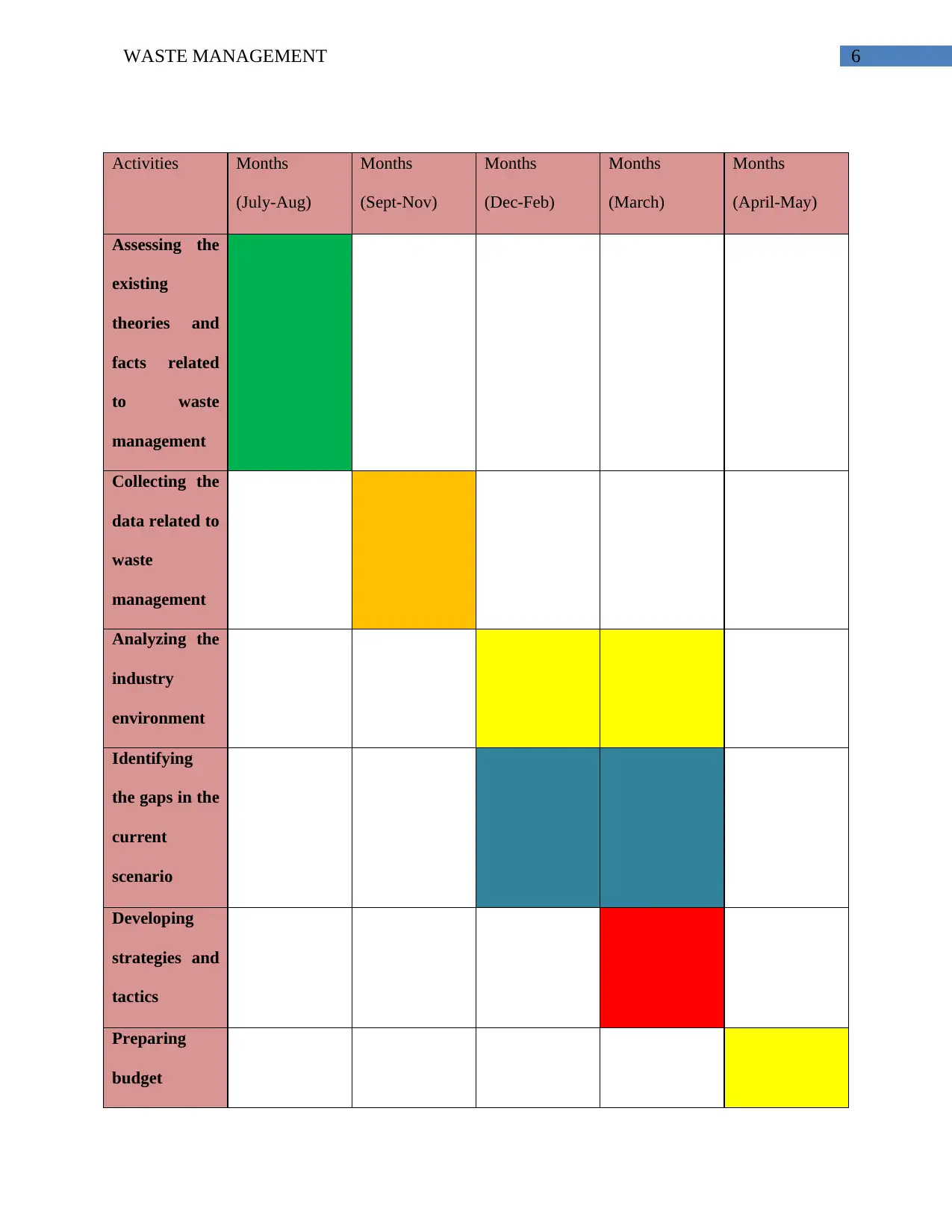
Activities Months
(July-Aug)
Months
(Sept-Nov)
Months
(Dec-Feb)
Months
(March)
Months
(April-May)
Assessing the
existing
theories and
facts related
to waste
management
Collecting the
data related to
waste
management
Analyzing the
industry
environment
Identifying
the gaps in the
current
scenario
Developing
strategies and
tactics
Preparing
budget
Activities Months
(July-Aug)
Months
(Sept-Nov)
Months
(Dec-Feb)
Months
(March)
Months
(April-May)
Assessing the
existing
theories and
facts related
to waste
management
Collecting the
data related to
waste
management
Analyzing the
industry
environment
Identifying
the gaps in the
current
scenario
Developing
strategies and
tactics
Preparing
budget
Paraphrase This Document
Need a fresh take? Get an instant paraphrase of this document with our AI Paraphraser

7WASTE MANAGEMENT
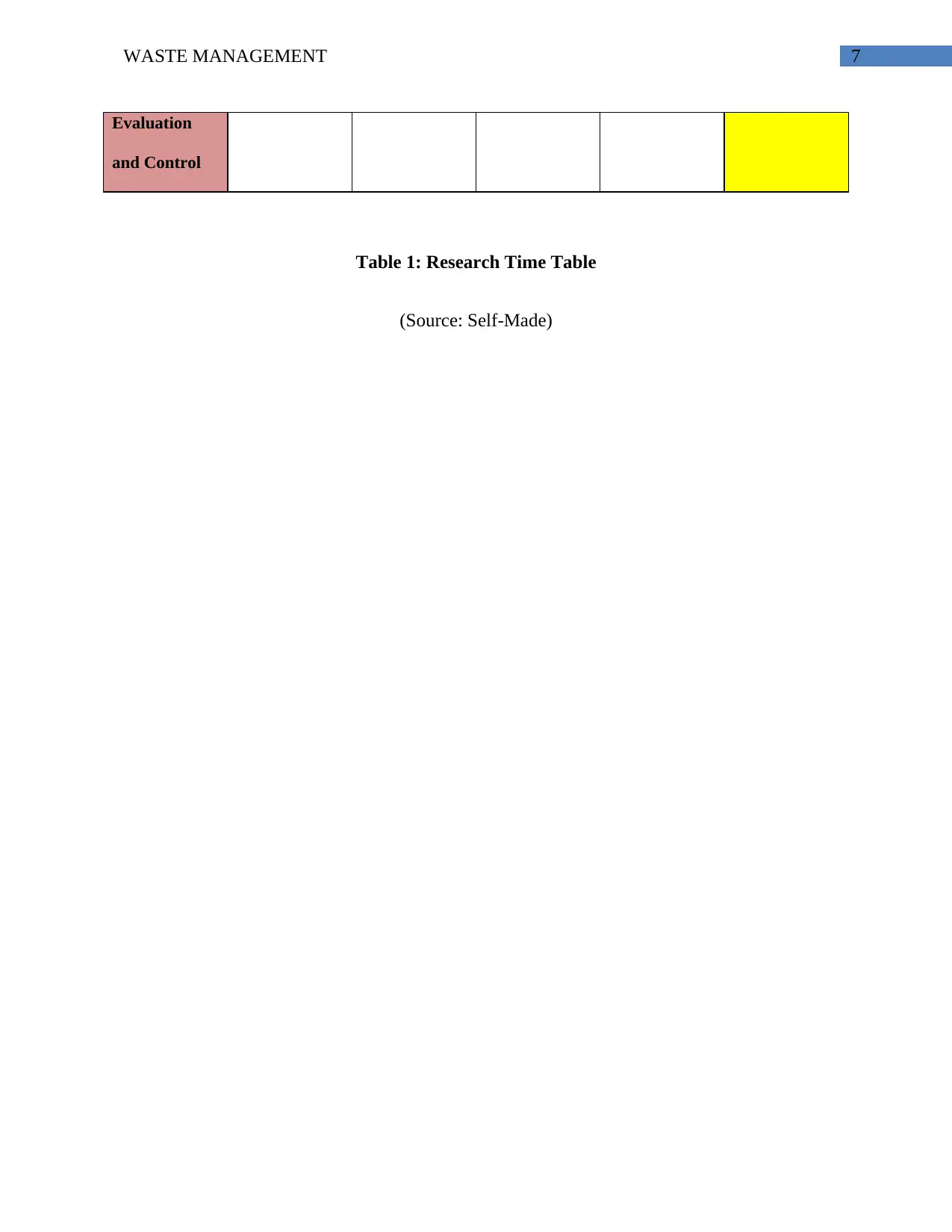
Evaluation
and Control
Table 1: Research Time Table
(Source: Self-Made)
Evaluation
and Control
Table 1: Research Time Table
(Source: Self-Made)

8WASTE MANAGEMENT
References:
Badgie, D., Samah, M.A.A., Manaf, L.A. and Muda, A.B., 2012. Assessment of Municipal Solid
Waste Composition in Malaysia: Management, Practice, and Challenges. Polish Journal of
Environmental Studies, 21(3).
Dhokhikah, Y. and Trihadiningrum, Y., 2012. Solid waste management in Asian developing
countries: challenges and opportunities.
Ghiani, G., Laganà, D., and Manni, E. 2012. Capacitated location of collection sites in an urban
waste management system. Waste management, 32(7), pp.1291-1296.
Ingham, D., Bejan, A., Mamut, E. and Pop, I. eds., 2012. Emerging technologies and techniques
in porous media (Vol. 134). Springer Science & Business Media.
Johari, A., Ahmed, S.I., Hashim, H., Alkali, H. and Ramli, M., 2012. Economic and
environmental benefits of landfill gas from municipal solid waste in Malaysia. Renewable and
Sustainable Energy Reviews, 16(5), pp.2907-2912.
Kiddee, P., Naidu, R. and Wong, M.H., 2013. Electronic waste management approaches: An
overview. Waste Management, 33(5), pp.1237-1250.
Singh, J., Laurenti, R., and Frostell, B., 2014. Progress and challenges to the global waste
management system. Waste Management & Research, 32(9), pp.800-812.
Thi, N.B.D., Kumar, G. and Lin, C.Y., 2015. An overview of food waste management in
developing countries: current status and future perspective. Journal of environmental
management, 157, pp.220-229.
References:
Badgie, D., Samah, M.A.A., Manaf, L.A. and Muda, A.B., 2012. Assessment of Municipal Solid
Waste Composition in Malaysia: Management, Practice, and Challenges. Polish Journal of
Environmental Studies, 21(3).
Dhokhikah, Y. and Trihadiningrum, Y., 2012. Solid waste management in Asian developing
countries: challenges and opportunities.
Ghiani, G., Laganà, D., and Manni, E. 2012. Capacitated location of collection sites in an urban
waste management system. Waste management, 32(7), pp.1291-1296.
Ingham, D., Bejan, A., Mamut, E. and Pop, I. eds., 2012. Emerging technologies and techniques
in porous media (Vol. 134). Springer Science & Business Media.
Johari, A., Ahmed, S.I., Hashim, H., Alkali, H. and Ramli, M., 2012. Economic and
environmental benefits of landfill gas from municipal solid waste in Malaysia. Renewable and
Sustainable Energy Reviews, 16(5), pp.2907-2912.
Kiddee, P., Naidu, R. and Wong, M.H., 2013. Electronic waste management approaches: An
overview. Waste Management, 33(5), pp.1237-1250.
Singh, J., Laurenti, R., and Frostell, B., 2014. Progress and challenges to the global waste
management system. Waste Management & Research, 32(9), pp.800-812.
Thi, N.B.D., Kumar, G. and Lin, C.Y., 2015. An overview of food waste management in
developing countries: current status and future perspective. Journal of environmental
management, 157, pp.220-229.
⊘ This is a preview!⊘
Do you want full access?
Subscribe today to unlock all pages.

Trusted by 1+ million students worldwide
1 out of 9
Related Documents
Your All-in-One AI-Powered Toolkit for Academic Success.
+13062052269
info@desklib.com
Available 24*7 on WhatsApp / Email
Unlock your academic potential
Copyright © 2020–2026 A2Z Services. All Rights Reserved. Developed and managed by ZUCOL.