ENGT5260: Resource Efficient Design and Waste Reduction Report
VerifiedAdded on 2022/08/31
|12
|3473
|18
Report
AI Summary
This report, prepared for ENGT5260, delves into resource-efficient design with a focus on waste reduction and improved resource utilization in product manufacturing. It begins by defining resource-efficient design and its importance in the context of environmental concerns and the depletion of non-renewable resources. The report explores the 'Rebound Effect,' examining the trade-offs between product efficiency and resource use, particularly in the automotive industry. It then analyzes the environmental impact of commercial vehicles, highlighting their contribution to air pollution and the need for sustainable alternatives. Electronic vehicles (EVs) are presented as a key solution, with Tesla serving as a case study to illustrate how EVs can contribute to resource efficiency through innovative design features like the Internet of Things (IoT) integration and accident prevention measures. The report concludes by emphasizing the environmental benefits of EVs, including reduced emissions and efficient resource utilization in their life cycle, and the role of the circular economy in waste management.
Running head: ENGT5260: Assignment B
ENGT5260
Assignment B: Recommendations for waste reduction and improved resource use
Name of the Student
Name of the University
Author note
ENGT5260
Assignment B: Recommendations for waste reduction and improved resource use
Name of the Student
Name of the University
Author note

Paraphrase This Document
Need a fresh take? Get an instant paraphrase of this document with our AI Paraphraser
1ENGT5260: Assignment B
Introduction.
Resource efficient designing refers to minimising the utilisation of resources required
to develop a particular product. In the contemporary context, Recourse Efficient Design has
become one of the most vital aspects of product manufacturing. The reason behind that is the
array of environmental concerns that has arisen recently. A series of research has shown that
product manufacturing has been influential in largely contributing to generation of pollution
and subsequently degrading the environmental wellbeing. Furthermore, resource use because
of large scale commercial manufacturing of products have also been on the rise, which has
severely impacted the non – renewable resource reservoir of the world.
Arrobo and Padovan (2018) have looked at resource use in product manufacturing
from a user’s point of view and stated that there is a generally direct relationship between the
resources used during product manufacturing and the efficiency of the product that the
customer demands. As the demand for more effective, functional and user friendly products
go up, the resource use also rises, indirectly putting pressure on the environment. There is an
urgent need to look at alternative resource efficient designs of various products which are
instrumental in not only managing the resource utility but are also light on the environmental
impact scale. However, there are certain caveats associated with the aspect. Firstly, as
previously pointed out, there is a direct correlation between the user friendliness of a product,
its efficiency and the amount of work that goes behind meeting those criteria (Arrobo &
Padovan 2018). The amount of work associated with the process of manufacturing a new
product is directly in correlation with the amount of resources that need to be utilised as well.
This is why, a domino effect can be felt when analysing products from a resource use
perspective. The Rebound Effect looks at that phenomenon specifically from a resource use
perspective and attempts to understand whether technological advances are significantly
contributing to energy consumption. There is ample amount of research in existence that
Introduction.
Resource efficient designing refers to minimising the utilisation of resources required
to develop a particular product. In the contemporary context, Recourse Efficient Design has
become one of the most vital aspects of product manufacturing. The reason behind that is the
array of environmental concerns that has arisen recently. A series of research has shown that
product manufacturing has been influential in largely contributing to generation of pollution
and subsequently degrading the environmental wellbeing. Furthermore, resource use because
of large scale commercial manufacturing of products have also been on the rise, which has
severely impacted the non – renewable resource reservoir of the world.
Arrobo and Padovan (2018) have looked at resource use in product manufacturing
from a user’s point of view and stated that there is a generally direct relationship between the
resources used during product manufacturing and the efficiency of the product that the
customer demands. As the demand for more effective, functional and user friendly products
go up, the resource use also rises, indirectly putting pressure on the environment. There is an
urgent need to look at alternative resource efficient designs of various products which are
instrumental in not only managing the resource utility but are also light on the environmental
impact scale. However, there are certain caveats associated with the aspect. Firstly, as
previously pointed out, there is a direct correlation between the user friendliness of a product,
its efficiency and the amount of work that goes behind meeting those criteria (Arrobo &
Padovan 2018). The amount of work associated with the process of manufacturing a new
product is directly in correlation with the amount of resources that need to be utilised as well.
This is why, a domino effect can be felt when analysing products from a resource use
perspective. The Rebound Effect looks at that phenomenon specifically from a resource use
perspective and attempts to understand whether technological advances are significantly
contributing to energy consumption. There is ample amount of research in existence that
2ENGT5260: Assignment B
states that non - renewable resources like fossil fuels are capable of generating more energy
than renewable resources like solar power or tidal power. This is the reason why resource use
in product manufacturing is primarily dependent upon utilising the earth’s resources to speed
up the process of manufacturing as well as building more efficient products.
The current report focuses on understanding resource efficient design from a specific
product or process perspective. The key aspect of resource efficient design that is being
looked at here is that of waste management and waste reduction. The manufacturing process
being heavily reliant on resource utilisation, is capable of and responsible for generating large
amounts of waste. However, the waste generation does not stop once the manufacturing is
done. In many product cases, the generation of waste as a by - product continues even in the
product life cycle as well as in the post utilisation period. The Waste Reduction Report
(Volume 1) identifies several national legislations alongside a series of products and objects
that contribute to waste generation (House of Lords Science and Technology Committee
2008). Vehicles for example are identified as one of the chief sources of environmental
pollution as well as resource utilisation on a global scale. With each car belonging to a
particular manufacturer, contributing to the overall carbon footprint of the organisation, it has
become important to look at how vehicles can be made more resource efficient and modified
to generate low waste. This current report looks at the process, life cycle and overall
contribution to environmental pollution by electronic vehicles in general, while looking at the
company ‘Tesla’ as a key source of information (Milosheska 2013), and establishes how and
why, electronic cars can be a valuable addition to the domain of resource efficient designing
of products and processes.
Resource Efficient Design and The Rebound Effect.
As stated earlier, the Rebound Effect or the ‘take-back effect’ refers to the aspect of
compromise that technology has to make with product efficiency, if the manufacturers have
states that non - renewable resources like fossil fuels are capable of generating more energy
than renewable resources like solar power or tidal power. This is the reason why resource use
in product manufacturing is primarily dependent upon utilising the earth’s resources to speed
up the process of manufacturing as well as building more efficient products.
The current report focuses on understanding resource efficient design from a specific
product or process perspective. The key aspect of resource efficient design that is being
looked at here is that of waste management and waste reduction. The manufacturing process
being heavily reliant on resource utilisation, is capable of and responsible for generating large
amounts of waste. However, the waste generation does not stop once the manufacturing is
done. In many product cases, the generation of waste as a by - product continues even in the
product life cycle as well as in the post utilisation period. The Waste Reduction Report
(Volume 1) identifies several national legislations alongside a series of products and objects
that contribute to waste generation (House of Lords Science and Technology Committee
2008). Vehicles for example are identified as one of the chief sources of environmental
pollution as well as resource utilisation on a global scale. With each car belonging to a
particular manufacturer, contributing to the overall carbon footprint of the organisation, it has
become important to look at how vehicles can be made more resource efficient and modified
to generate low waste. This current report looks at the process, life cycle and overall
contribution to environmental pollution by electronic vehicles in general, while looking at the
company ‘Tesla’ as a key source of information (Milosheska 2013), and establishes how and
why, electronic cars can be a valuable addition to the domain of resource efficient designing
of products and processes.
Resource Efficient Design and The Rebound Effect.
As stated earlier, the Rebound Effect or the ‘take-back effect’ refers to the aspect of
compromise that technology has to make with product efficiency, if the manufacturers have
⊘ This is a preview!⊘
Do you want full access?
Subscribe today to unlock all pages.

Trusted by 1+ million students worldwide
3ENGT5260: Assignment B
to comply with resource efficiency (Chakravarty et al. 2013). There are several
interconnected elements within this domain that profoundly influences the Rebound Effect.
Firstly, the efficiency of a product is the primary reason why a product is deemed usable and
consumer friendly. Consumers bend more towards products that are user friendly, are visually
appealing and show remarkable performance. A lot of these performative aspects of a product
are dependent upon how the product is utilising resources. Therefore, the Rebound Effect
looks at what compromises need to be made in terms of performance in order to match the
required resource use criteria.
The current report looks at resource efficient designing in automobile industry. It is
thus prudent to look at how the Rebound Effect measures resource use and performance in
vehicles. The Rebound Effect is mathematically expressed as a ratio of lost benefit to the
expected environmental benefit, if the consumption of the product is kept constant
(Gillingham, Rapson & Wagner 2016). Vehicles consume a large amount of fossil fuel in its
lifetime in the form of petrol, diesel, etc. Given that these are non - renewable resources,
overuse is leading them towards certain complete depletion. According to Wang, Han and Lu
(2016), the Rebound Effect can help understand a vehicle’s energy consumption in terms of
fuel efficiency through using the aforementioned ratio. They state that, for a 5 %
improvement in the fuel efficiency of the vehicle, there is only a 2 % drop in fuel use because
of the remaining 3 % being utilised by driving styles (frequent braking), speed and distance.
Therefore, the rebound effect associated with the process is at 60 %, since (5-2)/5 = 60
(Wang, Han & Lu 2016). When the actual outcome of the Rebound Effect is at 100 %, it is
termed as Full Rebound, where the Rebound Effect (RE) score is equal to 1, indicating that
resource use and resource savings are equal (Gillingham, Rapson & Wagner 2016). The
lower the number goes, the better the outcome, meaning that ideal Rebound effect score
should either be equal to or less than 0. Anything between 0 % and 100 % is identified as
to comply with resource efficiency (Chakravarty et al. 2013). There are several
interconnected elements within this domain that profoundly influences the Rebound Effect.
Firstly, the efficiency of a product is the primary reason why a product is deemed usable and
consumer friendly. Consumers bend more towards products that are user friendly, are visually
appealing and show remarkable performance. A lot of these performative aspects of a product
are dependent upon how the product is utilising resources. Therefore, the Rebound Effect
looks at what compromises need to be made in terms of performance in order to match the
required resource use criteria.
The current report looks at resource efficient designing in automobile industry. It is
thus prudent to look at how the Rebound Effect measures resource use and performance in
vehicles. The Rebound Effect is mathematically expressed as a ratio of lost benefit to the
expected environmental benefit, if the consumption of the product is kept constant
(Gillingham, Rapson & Wagner 2016). Vehicles consume a large amount of fossil fuel in its
lifetime in the form of petrol, diesel, etc. Given that these are non - renewable resources,
overuse is leading them towards certain complete depletion. According to Wang, Han and Lu
(2016), the Rebound Effect can help understand a vehicle’s energy consumption in terms of
fuel efficiency through using the aforementioned ratio. They state that, for a 5 %
improvement in the fuel efficiency of the vehicle, there is only a 2 % drop in fuel use because
of the remaining 3 % being utilised by driving styles (frequent braking), speed and distance.
Therefore, the rebound effect associated with the process is at 60 %, since (5-2)/5 = 60
(Wang, Han & Lu 2016). When the actual outcome of the Rebound Effect is at 100 %, it is
termed as Full Rebound, where the Rebound Effect (RE) score is equal to 1, indicating that
resource use and resource savings are equal (Gillingham, Rapson & Wagner 2016). The
lower the number goes, the better the outcome, meaning that ideal Rebound effect score
should either be equal to or less than 0. Anything between 0 % and 100 % is identified as
Paraphrase This Document
Need a fresh take? Get an instant paraphrase of this document with our AI Paraphraser
4ENGT5260: Assignment B
partial rebound and is the most common outcome of any process (Gillingham, Rapson &
Wagner 2016).
Commercial vehicles and resource use: an overview.
Most commercial vehicles are associated with a variety of factors that make them a
weaker entry into the resource efficient design paradigm. First of all, the most common
commercial vehicles run on petrol and diesel, the two primary fossil fuels required to run
most engines. Their combustion produces a lot of carbon dioxide and carbon monoxide
alongside other harmful gases. A car’s primary contribution to waste generation is in the
domain of air pollution. Apart from the harmful carbon based gases, the vehicular emission
also consists of nitrogen oxides and other nitro – carbon based emissions which significantly
affect the ozone layer of the planet. Apart from that, a variety of particulate matters are also
emitted from the vehicles which contribute to hazy atmospheres, weather conditions like
smog and significantly affect people’s health. Furthermore, the emissions also increase the
level of carbon dioxide in the air, contributing to the increasing greenhouse effect,
responsible for trapping the sun’s heat in the atmosphere and contributing to global warming.
The Environmental Protection Agency states that, on an average in a global scale, vehicular
emissions are responsible for one third of the total air pollution in the world, with almost half
that number coming from the United States itself, followed closely by China (Richa et al.
2014). The need for a sustainable and alternative source of transportation is therefore quite
dire (Diabat, Khodaveri & Olfat 2013). That is where electronic vehicles or green
automobiles come into play and gain considerable support. Not only are electronic vehicles
resource efficient by using electrical power for running, they are also light on the
environment by contributing to almost no environmental pollution. Furthermore, the current
generations of electronic vehicles are nearly as efficient in terms of performance as their fuel
driven counterparts. Not only do they utilise less resources compared to commercial vehicles,
partial rebound and is the most common outcome of any process (Gillingham, Rapson &
Wagner 2016).
Commercial vehicles and resource use: an overview.
Most commercial vehicles are associated with a variety of factors that make them a
weaker entry into the resource efficient design paradigm. First of all, the most common
commercial vehicles run on petrol and diesel, the two primary fossil fuels required to run
most engines. Their combustion produces a lot of carbon dioxide and carbon monoxide
alongside other harmful gases. A car’s primary contribution to waste generation is in the
domain of air pollution. Apart from the harmful carbon based gases, the vehicular emission
also consists of nitrogen oxides and other nitro – carbon based emissions which significantly
affect the ozone layer of the planet. Apart from that, a variety of particulate matters are also
emitted from the vehicles which contribute to hazy atmospheres, weather conditions like
smog and significantly affect people’s health. Furthermore, the emissions also increase the
level of carbon dioxide in the air, contributing to the increasing greenhouse effect,
responsible for trapping the sun’s heat in the atmosphere and contributing to global warming.
The Environmental Protection Agency states that, on an average in a global scale, vehicular
emissions are responsible for one third of the total air pollution in the world, with almost half
that number coming from the United States itself, followed closely by China (Richa et al.
2014). The need for a sustainable and alternative source of transportation is therefore quite
dire (Diabat, Khodaveri & Olfat 2013). That is where electronic vehicles or green
automobiles come into play and gain considerable support. Not only are electronic vehicles
resource efficient by using electrical power for running, they are also light on the
environment by contributing to almost no environmental pollution. Furthermore, the current
generations of electronic vehicles are nearly as efficient in terms of performance as their fuel
driven counterparts. Not only do they utilise less resources compared to commercial vehicles,
5ENGT5260: Assignment B
one of their key features is the longevity of the parts, something that is heavily demanded
when looking at sustainable development of products.
Electronic vehicles: A Resource Efficient Design perspective.
Green vehicles or electronic vehicles are specific, electronically driven cars that are
environmentally friendly, produce less impact on the environment and, by utilising alternate
resources for power, it contributes to efficient resource utilisation (Diabat, Khodaveri & Olfat
2013). There are several major automobile companies around the world that have picked up
development of environmentally friendly vehicles as their front end business facet. Tesla is
one such company renown for developing cars that run on electric power, are less impactful
on the environment and are highly user friendly. One of the most vital features that makes
several models of Tesla cars stand out from the commercial counterparts is the integration of
the Internet of Things (IoT) in the designing process. The IoT is a current branch in B 2 C
technological domain which aims to bring the benefits of the World Wide Web to the
consumer end on a commercial basis (Manzetti & Mariasiu 2015). Tesla cars use an array of
integrated software – hardware compatibility to provide the users with several functions that
can be considered to be not only user friendly but also as those features that increase product
efficiency (Milosheska 2013). For instance, one such feature is the auto – drive, which
matches the driving components of the vehicle with the data from GPS to trace a route and
relieve the driver of holding the steering wheel (Dikmen & Burns 2016). The auto - drive
feature ensures that the car is moving in a steady pace throughout the road wherever it is free.
This is a feature, if implemented in the commercial vehicles, it can significantly bring down
fuel use by the vehicle by maintaining an optimal speed throughout the road. Tesla models
are also capable of sensing motion and proximity so that they can prevent accidents and
crashes. Although not particularly in line with resource management, a large number of cars
one of their key features is the longevity of the parts, something that is heavily demanded
when looking at sustainable development of products.
Electronic vehicles: A Resource Efficient Design perspective.
Green vehicles or electronic vehicles are specific, electronically driven cars that are
environmentally friendly, produce less impact on the environment and, by utilising alternate
resources for power, it contributes to efficient resource utilisation (Diabat, Khodaveri & Olfat
2013). There are several major automobile companies around the world that have picked up
development of environmentally friendly vehicles as their front end business facet. Tesla is
one such company renown for developing cars that run on electric power, are less impactful
on the environment and are highly user friendly. One of the most vital features that makes
several models of Tesla cars stand out from the commercial counterparts is the integration of
the Internet of Things (IoT) in the designing process. The IoT is a current branch in B 2 C
technological domain which aims to bring the benefits of the World Wide Web to the
consumer end on a commercial basis (Manzetti & Mariasiu 2015). Tesla cars use an array of
integrated software – hardware compatibility to provide the users with several functions that
can be considered to be not only user friendly but also as those features that increase product
efficiency (Milosheska 2013). For instance, one such feature is the auto – drive, which
matches the driving components of the vehicle with the data from GPS to trace a route and
relieve the driver of holding the steering wheel (Dikmen & Burns 2016). The auto - drive
feature ensures that the car is moving in a steady pace throughout the road wherever it is free.
This is a feature, if implemented in the commercial vehicles, it can significantly bring down
fuel use by the vehicle by maintaining an optimal speed throughout the road. Tesla models
are also capable of sensing motion and proximity so that they can prevent accidents and
crashes. Although not particularly in line with resource management, a large number of cars
⊘ This is a preview!⊘
Do you want full access?
Subscribe today to unlock all pages.
Trusted by 1+ million students worldwide
6ENGT5260: Assignment B
that suffer major accidents, are disposed of in junkyards as waste. If the salvageable parts are
not recovered, this contributes to a rather detrimental number in the rebound effect score.
This is where the circular economy also becomes a relevant concept to look at, where reuse
and recycling (Peeters et al. 2018) are identified as the continuation process that certain
products go through after their life span (Ellen MacArthur Foundation 2013; Blomsma &
Brennan 2017). By treating waste as a valuable resource, a lot of strain from the environment
can be withdrawn (Report of the Government Chief Scientific Adviser 2016). Tesla’s
electronic vehicles look at prevention of accidents as a primary requisite for their electronic
vehicles, which indirectly contributes to lessening the amount of waste generated due to
accidents and crashes.
Coming to electronic vehicles in general, there are several beneficial contributors to
bringing down the environmental pollution. One such is the resources it utilises in its life
cycle. First of all, the most defining feature of an electronic vehicle is the reliance on
electrical power for mobility. As such, it does not possess any tailpipe emission (Milosheska
2013). Another significant factor that comes into play when considering the efficiency in the
designing of electronic vehicles is the ‘Well to Wheel’ emissions. The Well to Wheel
emission refers to the emissions that are caused in the entire process of powering a vehicle
(Ramachandran & Stimming 2015). Recent reports suggest that electronic vehicles emit
approximately half the amount of carbon Dioxide and even less than a quarter of the amount
of Carbon Monoxide compared to the fuel driven cars. This is definitely a significant number,
however, research further suggests that using zero emission electricity to power the vehicles
and its batteries can bring down the number even more.
Resource Efficient Design Suggestions.
Despite the several benefits of electric vehicles that make it a strong product for
considering under resource efficient design, there are certain limitations associated as well.
that suffer major accidents, are disposed of in junkyards as waste. If the salvageable parts are
not recovered, this contributes to a rather detrimental number in the rebound effect score.
This is where the circular economy also becomes a relevant concept to look at, where reuse
and recycling (Peeters et al. 2018) are identified as the continuation process that certain
products go through after their life span (Ellen MacArthur Foundation 2013; Blomsma &
Brennan 2017). By treating waste as a valuable resource, a lot of strain from the environment
can be withdrawn (Report of the Government Chief Scientific Adviser 2016). Tesla’s
electronic vehicles look at prevention of accidents as a primary requisite for their electronic
vehicles, which indirectly contributes to lessening the amount of waste generated due to
accidents and crashes.
Coming to electronic vehicles in general, there are several beneficial contributors to
bringing down the environmental pollution. One such is the resources it utilises in its life
cycle. First of all, the most defining feature of an electronic vehicle is the reliance on
electrical power for mobility. As such, it does not possess any tailpipe emission (Milosheska
2013). Another significant factor that comes into play when considering the efficiency in the
designing of electronic vehicles is the ‘Well to Wheel’ emissions. The Well to Wheel
emission refers to the emissions that are caused in the entire process of powering a vehicle
(Ramachandran & Stimming 2015). Recent reports suggest that electronic vehicles emit
approximately half the amount of carbon Dioxide and even less than a quarter of the amount
of Carbon Monoxide compared to the fuel driven cars. This is definitely a significant number,
however, research further suggests that using zero emission electricity to power the vehicles
and its batteries can bring down the number even more.
Resource Efficient Design Suggestions.
Despite the several benefits of electric vehicles that make it a strong product for
considering under resource efficient design, there are certain limitations associated as well.
Paraphrase This Document
Need a fresh take? Get an instant paraphrase of this document with our AI Paraphraser
7ENGT5260: Assignment B
The primary limitation being the cost. Electronic vehicles are quite expensive to make as well
as maintain, thereby making it difficult for average consumers to actively invest in one and
bring down their personal carbon footprint (Bartiaux & Salmon 2012; Boucher 2016). There
are certain design recommendations that can significantly help the debate, by incorporating
certain elements of the electronic vehicles within the commercial fuel driven vehicles.
The first addition that can be made is a switching mechanism that can switch the car’s
motion from a fuel driven one to a battery driven one, on specific roads. This, combined with
the auto – drive technology that tesla features, can help lower the emission from these
vehicles by maintaining a steady speed and replacing the fuel requirement with electrical
power generation (Tian & Chen 2014). Furthermore, the motion of the car can also be used to
generate motion based electricity, like smaller rotating turbines, which in turn can be used to
charge the batteries.
Secondly, if incorporating electrical measures turn out to be difficult, alternate fuels
like Compressed Natural Gas (CNG) can be looked at as an alternative which has also been
proven to produce less emission as waste (Salim et al. 2014).
Conclusion.
Vehicles are significantly responsible for generating waste in the form of air
pollutants. This has contributed to and continues to contribute to a series of degrading
environmental effects. An efficient design can be a vital resource in preventing the generation
of waste and enforcing more feasible management practices. This report has looked at electric
vehicles in terms of its user friendliness and performance effectiveness in order to identify
whether or not it can be a valuable addition in the resource efficient design domain. In doing
so, the report has also looked at the rebound effect to identify how electric vehicles can fare
pin comparison with their commercial counterparts.
The primary limitation being the cost. Electronic vehicles are quite expensive to make as well
as maintain, thereby making it difficult for average consumers to actively invest in one and
bring down their personal carbon footprint (Bartiaux & Salmon 2012; Boucher 2016). There
are certain design recommendations that can significantly help the debate, by incorporating
certain elements of the electronic vehicles within the commercial fuel driven vehicles.
The first addition that can be made is a switching mechanism that can switch the car’s
motion from a fuel driven one to a battery driven one, on specific roads. This, combined with
the auto – drive technology that tesla features, can help lower the emission from these
vehicles by maintaining a steady speed and replacing the fuel requirement with electrical
power generation (Tian & Chen 2014). Furthermore, the motion of the car can also be used to
generate motion based electricity, like smaller rotating turbines, which in turn can be used to
charge the batteries.
Secondly, if incorporating electrical measures turn out to be difficult, alternate fuels
like Compressed Natural Gas (CNG) can be looked at as an alternative which has also been
proven to produce less emission as waste (Salim et al. 2014).
Conclusion.
Vehicles are significantly responsible for generating waste in the form of air
pollutants. This has contributed to and continues to contribute to a series of degrading
environmental effects. An efficient design can be a vital resource in preventing the generation
of waste and enforcing more feasible management practices. This report has looked at electric
vehicles in terms of its user friendliness and performance effectiveness in order to identify
whether or not it can be a valuable addition in the resource efficient design domain. In doing
so, the report has also looked at the rebound effect to identify how electric vehicles can fare
pin comparison with their commercial counterparts.
8ENGT5260: Assignment B
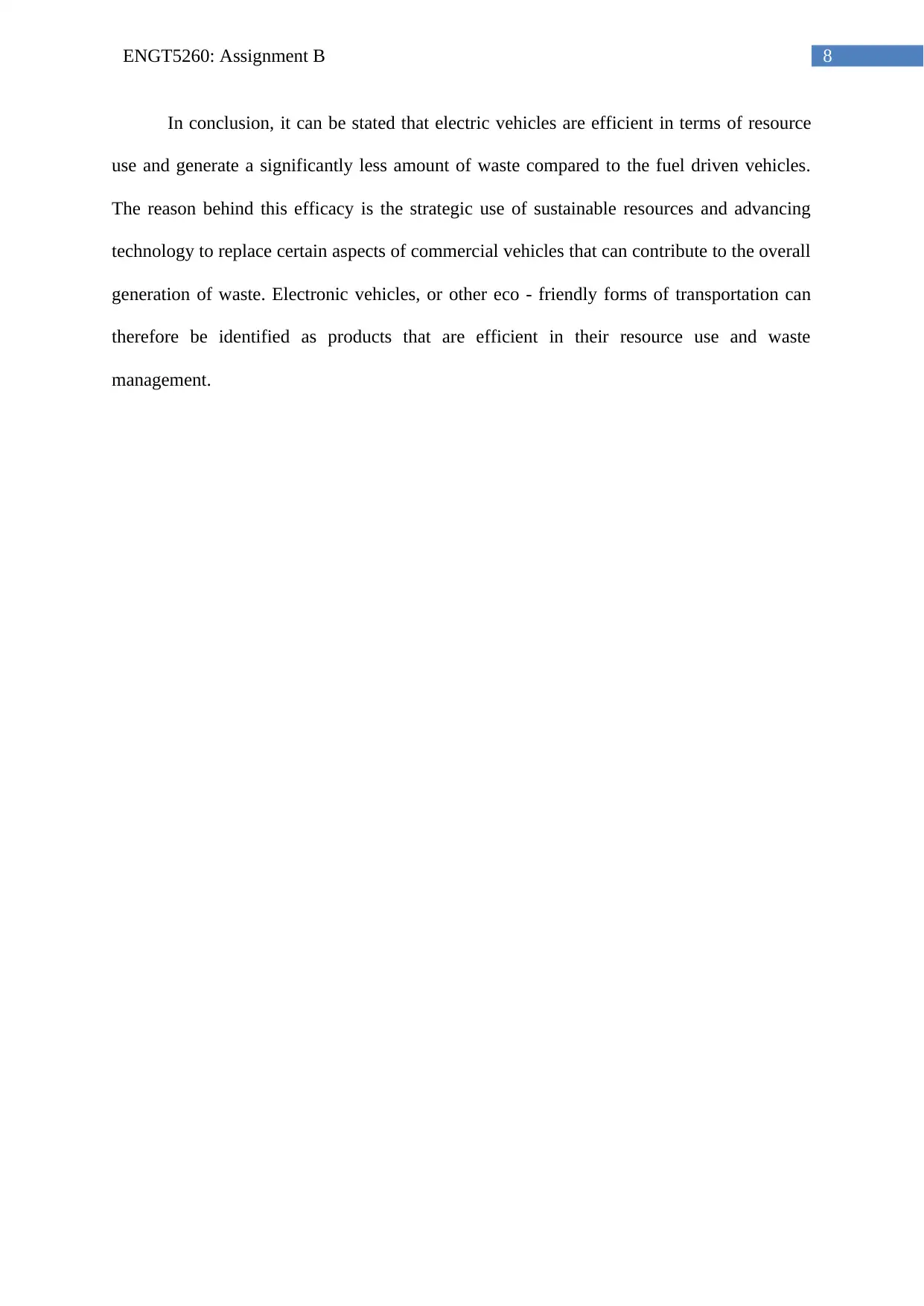
In conclusion, it can be stated that electric vehicles are efficient in terms of resource
use and generate a significantly less amount of waste compared to the fuel driven vehicles.
The reason behind this efficacy is the strategic use of sustainable resources and advancing
technology to replace certain aspects of commercial vehicles that can contribute to the overall
generation of waste. Electronic vehicles, or other eco - friendly forms of transportation can
therefore be identified as products that are efficient in their resource use and waste
management.
In conclusion, it can be stated that electric vehicles are efficient in terms of resource
use and generate a significantly less amount of waste compared to the fuel driven vehicles.
The reason behind this efficacy is the strategic use of sustainable resources and advancing
technology to replace certain aspects of commercial vehicles that can contribute to the overall
generation of waste. Electronic vehicles, or other eco - friendly forms of transportation can
therefore be identified as products that are efficient in their resource use and waste
management.
⊘ This is a preview!⊘
Do you want full access?
Subscribe today to unlock all pages.
Trusted by 1+ million students worldwide
9ENGT5260: Assignment B
References.
Bartiaux, F. and Salmón, L.R., 2012. Are there domino effects between consumers' ordinary
and ‘green’practices? An analysis of quantitative data from a sensitisation campaign on
personal carbon footprint. International Review of Sociology, 22(3), pp.471-491.
Blomsma, F. and Brennan, G., 2017. The emergence of circular economy: A new framing
around prolonging resource productivity. Journal of Industrial Ecology, 21(3), pp.603-614.
Boucher, J.L., 2016. Culture, carbon, and climate change: A class analysis of climate change
belief, lifestyle lock-in, and personal carbon footprint. Social Ecology: Journal for
Environmental Thought and Sociological Research, 25, pp.53-80.
Brookes, L.G. and Grubb, M., 2012. Energy efficiency and economic fallacies: a reply; and
reply. Utilities Policy, 20(5), pp.390-393.
Chakravarty, D., Dasgupta, S. and Roy, J., 2013. Rebound effect: how much to
worry?. Current opinion in environmental sustainability, 5(2), pp.216-228.
Diabat, A., Khodaverdi, R. and Olfat, L., 2013. An exploration of green supply chain
practices and performances in an automotive industry. The International Journal of
Advanced Manufacturing Technology, 68(1-4), pp.949-961.
Dikmen, M. and Burns, C.M., 2016, October. Autonomous driving in the real world:
Experiences with tesla autopilot and summon. In Proceedings of the 8th international
conference on automotive user interfaces and interactive vehicular applications (pp. 225-
228). ACM.
Ellen MacArthur Foundation. 2013. Towards the Circular Economy, Economic and business
rationale for an accelerated transition, Available at:
https://www.ellenmacarthurfoundation.org/assets/downloads/publications/Ellen-MacArthur-
Foundation-Towards-the-Circular-Economy-vol.1.pdf
References.
Bartiaux, F. and Salmón, L.R., 2012. Are there domino effects between consumers' ordinary
and ‘green’practices? An analysis of quantitative data from a sensitisation campaign on
personal carbon footprint. International Review of Sociology, 22(3), pp.471-491.
Blomsma, F. and Brennan, G., 2017. The emergence of circular economy: A new framing
around prolonging resource productivity. Journal of Industrial Ecology, 21(3), pp.603-614.
Boucher, J.L., 2016. Culture, carbon, and climate change: A class analysis of climate change
belief, lifestyle lock-in, and personal carbon footprint. Social Ecology: Journal for
Environmental Thought and Sociological Research, 25, pp.53-80.
Brookes, L.G. and Grubb, M., 2012. Energy efficiency and economic fallacies: a reply; and
reply. Utilities Policy, 20(5), pp.390-393.
Chakravarty, D., Dasgupta, S. and Roy, J., 2013. Rebound effect: how much to
worry?. Current opinion in environmental sustainability, 5(2), pp.216-228.
Diabat, A., Khodaverdi, R. and Olfat, L., 2013. An exploration of green supply chain
practices and performances in an automotive industry. The International Journal of
Advanced Manufacturing Technology, 68(1-4), pp.949-961.
Dikmen, M. and Burns, C.M., 2016, October. Autonomous driving in the real world:
Experiences with tesla autopilot and summon. In Proceedings of the 8th international
conference on automotive user interfaces and interactive vehicular applications (pp. 225-
228). ACM.
Ellen MacArthur Foundation. 2013. Towards the Circular Economy, Economic and business
rationale for an accelerated transition, Available at:
https://www.ellenmacarthurfoundation.org/assets/downloads/publications/Ellen-MacArthur-
Foundation-Towards-the-Circular-Economy-vol.1.pdf
Paraphrase This Document
Need a fresh take? Get an instant paraphrase of this document with our AI Paraphraser
10ENGT5260: Assignment B
Gillingham, K., Rapson, D. and Wagner, G., 2016. The rebound effect and energy efficiency
policy. Review of Environmental Economics and Policy, 10(1), pp.68-88.
House of Lords Science and Technology Committee. 2008. Waste Reduction (vol 1) Report,
House of Lords, London. Available at:
http://www.publications.parliament.uk/pa/ld200708/ldselect/ldsctech/163/163.pdf
Manzetti, S. and Mariasiu, F., 2015. Electric vehicle battery technologies: From present state
to future systems. Renewable and Sustainable Energy Reviews, 51, pp.1004-1012.
Milosheska, D., 2013. Tesla Motors, The reinvention of the luxury sports car industry.
In Global Luxury Trends (pp. 209-223). Palgrave Macmillan, London.
Peeters, J.R., Bracqguene, E., Nelen, D., Ueberschaar, M., Van Acker, K. and Duflou, J.R.,
2018. Forecasting the recycling potential based on waste analysis: A case study for recycling
Nd-Fe-B magnets from hard disk drives. Journal of cleaner production, 175, pp.96-108.
Ramachandran, S. and Stimming, U., 2015. Well to wheel analysis of low carbon alternatives
for road traffic. Energy & Environmental Science, 8(11), pp.3313-3324.
Report of the Government Chief Scientific Adviser. 2016. From Waste to Resource Productivity, The
Government Office for Science, London. (Final report and case studies)
Richa, K., Babbitt, C.W., Gaustad, G. and Wang, X., 2014. A future perspective on lithium-
ion battery waste flows from electric vehicles. Resources, Conservation and Recycling, 83,
pp.63-76.
Salim, R.A., Hassan, K. and Shafiei, S., 2014. Renewable and non-renewable energy
consumption and economic activities: Further evidence from OECD countries. Energy
wEconomics, 44, pp.350-360.
Gillingham, K., Rapson, D. and Wagner, G., 2016. The rebound effect and energy efficiency
policy. Review of Environmental Economics and Policy, 10(1), pp.68-88.
House of Lords Science and Technology Committee. 2008. Waste Reduction (vol 1) Report,
House of Lords, London. Available at:
http://www.publications.parliament.uk/pa/ld200708/ldselect/ldsctech/163/163.pdf
Manzetti, S. and Mariasiu, F., 2015. Electric vehicle battery technologies: From present state
to future systems. Renewable and Sustainable Energy Reviews, 51, pp.1004-1012.
Milosheska, D., 2013. Tesla Motors, The reinvention of the luxury sports car industry.
In Global Luxury Trends (pp. 209-223). Palgrave Macmillan, London.
Peeters, J.R., Bracqguene, E., Nelen, D., Ueberschaar, M., Van Acker, K. and Duflou, J.R.,
2018. Forecasting the recycling potential based on waste analysis: A case study for recycling
Nd-Fe-B magnets from hard disk drives. Journal of cleaner production, 175, pp.96-108.
Ramachandran, S. and Stimming, U., 2015. Well to wheel analysis of low carbon alternatives
for road traffic. Energy & Environmental Science, 8(11), pp.3313-3324.
Report of the Government Chief Scientific Adviser. 2016. From Waste to Resource Productivity, The
Government Office for Science, London. (Final report and case studies)
Richa, K., Babbitt, C.W., Gaustad, G. and Wang, X., 2014. A future perspective on lithium-
ion battery waste flows from electric vehicles. Resources, Conservation and Recycling, 83,
pp.63-76.
Salim, R.A., Hassan, K. and Shafiei, S., 2014. Renewable and non-renewable energy
consumption and economic activities: Further evidence from OECD countries. Energy
wEconomics, 44, pp.350-360.
11ENGT5260: Assignment B
Tian, J. and Chen, M., 2014. Sustainable design for automotive products: Dismantling and
recycling of end-of-life vehicles. Waste management, 34(2), pp.458-467.
Wang, Z., Han, B. and Lu, M., 2016. Measurement of energy rebound effect in households:
evidence from residential electricity consumption in Beijing, China. Renewable and
Sustainable Energy Reviews, 58, pp.852-861.
Tian, J. and Chen, M., 2014. Sustainable design for automotive products: Dismantling and
recycling of end-of-life vehicles. Waste management, 34(2), pp.458-467.
Wang, Z., Han, B. and Lu, M., 2016. Measurement of energy rebound effect in households:
evidence from residential electricity consumption in Beijing, China. Renewable and
Sustainable Energy Reviews, 58, pp.852-861.
⊘ This is a preview!⊘
Do you want full access?
Subscribe today to unlock all pages.
Trusted by 1+ million students worldwide

1 out of 12


Related Documents


Your All-in-One AI-Powered Toolkit for Academic Success.
+13062052269
info@desklib.com
Available 24*7 on WhatsApp / Email
![[object Object]](/_next/static/media/star-bottom.7253800d.svg)
Unlock your academic potential
Copyright © 2020–2026 A2Z Services. All Rights Reserved. Developed and managed by ZUCOL.